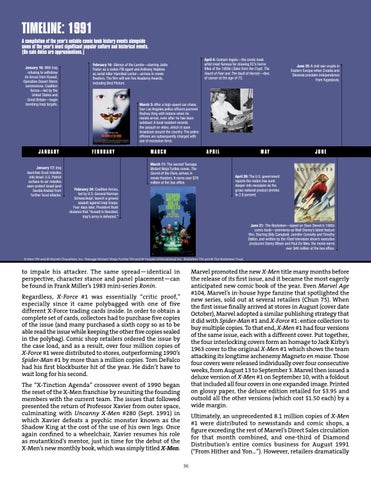
TIMELINE: 1991 A compilation of the year’s notable comic book history events alongside some of the year’s most significant popular culture and historical events. (On sale dates are approximations.) January 16: With Iraq refusing to withdraw its forces from Kuwait, Operation Desert Storm commences. Coalition forces—led by the United States and Great Britain—begin bombing Iraqi targets.
JANUARY January 17: Iraq launches Scud missiles into Israel. U.S. Patriot surface-to-air missiles soon protect Israel (and Saudia Arabia) from further Scud attacks.
April 4: Graham Ingels—the comic book artist most famous for drawing EC’s horror titles of the 1950s (Tales from the Crypt, The Haunt of Fear and The Vault of Horror)—dies of cancer at the age of 75.
February 14: Silence of the Lambs—starring Jodie Foster as a rookie FBI agent and Anthony Hopkins as serial killer Hannibal Lecter—arrives in movie theaters. The film will win five Academy Awards, including Best Picture.
June 25: A civil war erupts in Eastern Europe when Croatia and Slovenia proclaim independence from Yugoslavia.
March 3: After a high-speed car chase, four Los Angeles police officers pummel Rodney King with batons when he resists arrest, even after he has been subdued. A local resident records the assault on video, which is soon broadcast around the country. The police officers are subsequently charged with use of excessive force.
FEBRUARY
MARCH
APRIL
March 11: The second Teenage Mutant Ninja Turtles movie, The Secret of the Ooze, arrives in movie theaters. It earns over $78 million at the box office. February 24: Coalition forces, led by U.S. General Norman Schwarzkopf, launch a ground assault against Iraqi troops. Four days later, President Bush declares that “Kuwait is liberated, Iraq’s army is defeated.”
M AY
JUNE
April 26: The U.S. government reports the nation has sunk deeper into recession as the gross national product shrinks to 2.8 percent.
June 21: The Rocketeer—based on Dave Steven’s 1980s comic book—premieres as Walt Disney’s latest feature film. Starring Billy Campbell, Jennifer Connelly and Timothy Dalton, and written by the Flash television show’s executive producers Danny Bilson and Paul De Meo, the movie earns over $46 million at the box office. X-Men TM and © Marvel Characters, Inc. Teenage Mutant Ninja Turtles TM and © Viacom International Inc. Rocketeer TM and © The Rocketeer Trust.
to impale his attacker. The same spread—identical in perspective, character stance and panel placement—can be found in Frank Miller’s 1983 mini-series Ronin.
Marvel promoted the new X-Men title many months before the release of its first issue, and it became the most eagerly anticipated new comic book of the year. Even Marvel Age #104, Marvel’s in-house hype fanzine that spotlighted the new series, sold out at several retailers (Chun 75). When the first issue finally arrived at stores in August (cover date October), Marvel adopted a similar publishing strategy that it did with Spider-Man #1 and X-Force #1: entice collectors to buy multiple copies. To that end, X-Men #1 had four versions of the same issue, each with a different cover. Put together, the four interlocking covers form an homage to Jack Kirby’s 1963 cover to the original X-Men #1 which shows the team attacking its longtime archenemy Magneto en masse. Those four covers were released individually over four consecutive weeks, from August 13 to September 3. Marvel then issued a deluxe version of X-Men #1 on September 10, with a foldout that included all four covers in one expanded image. Printed on glossy paper, the deluxe edition retailed for $3.95 and outsold all the other versions (which cost $1.50 each) by a wide margin.
Regardless, X-Force #1 was essentially “critic proof,” especially since it came polybagged with one of five different X-Force trading cards inside. In order to obtain a complete set of cards, collectors had to purchase five copies of the issue (and many purchased a sixth copy so as to be able read the issue while keeping the other five copies sealed in the polybag). Comic shop retailers ordered the issue by the case load, and as a result, over four million copies of X-Force #1 were distributed to stores, outperforming 1990’s Spider-Man #1 by more than a million copies. Tom DeFalco had his first blockbuster hit of the year. He didn’t have to wait long for his second. The “X-Tinction Agenda” crossover event of 1990 began the reset of the X-Men franchise by reuniting the founding members with the current team. The issues that followed presented the return of Professor Xavier from outer space, culminating with Uncanny X-Men #280 (Sept. 1991) in which Xavier defeats a psychic monster known as the Shadow King at the cost of the use of his own legs. Once again confined to a wheelchair, Xavier resumes his role as mutantkind’s mentor, just in time for the debut of the X-Men’s new monthly book, which was simply titled X-Men.
Ultimately, an unprecedented 8.1 million copies of X-Men #1 were distributed to newsstands and comic shops, a figure exceeding the rest of Marvel’s Direct Sales circulation for that month combined, and one-third of Diamond Distribution’s entire comics business for August 1991 (“From Hither and Yon…”). However, retailers dramatically 36