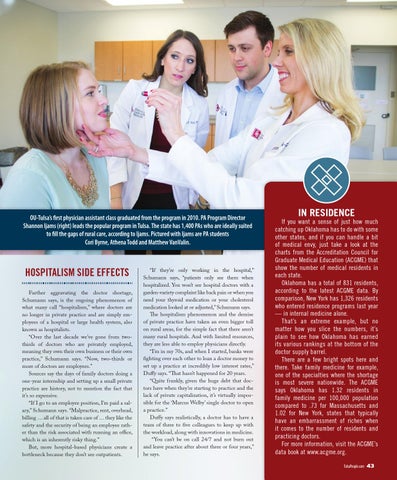
OU-Tulsa’s first physician assistant class graduated from the program in 2010. PA Program Director Shannon Ijams (right) leads the popular program in Tulsa. The state has 1,400 PAs who are ideally suited to fill the gaps of rural care, according to Ijams. Pictured with Ijams are PA students Cori Byrne, Athena Todd and Matthew VanValin.
HOSPITALISM SIDE EFFECTS Further aggravating the doctor shortage, Schumann says, is the ongoing phenomenon of what many call “hospitalism,” where doctors are no longer in private practice and are simply employees of a hospital or large health system, also known as hospitalists. “Over the last decade we’ve gone from twothirds of doctors who are privately employed, meaning they own their own business or their own practice,” Schumann says. “Now, two-thirds or more of doctors are employees.” Sources say the days of family doctors doing a one-year internship and setting up a small private practice are history, not to mention the fact that it’s so expensive. “If I go to an employee position, I’m paid a salary,” Schumann says. “Malpractice, rent, overhead, billing … all of that is taken care of … they like the safety and the security of being an employee rather than the risk associated with running an office, which is an inherently risky thing.” But, more hospital-based physicians create a bottleneck because they don’t see outpatients.
“If they’re only working in the hospital,” Schumann says, “patients only see them when hospitalized. You won’t see hospital doctors with a garden-variety complaint like back pain or when you need your thyroid medication or your cholesterol medication looked at or adjusted,” Schumann says. The hospitalism phenomenon and the demise of private practice have taken an even bigger toll on rural areas, for the simple fact that there aren’t many rural hospitals. And with limited resources, they are less able to employ physicians directly. “I’m in my 70s, and when I started, banks were fighting over each other to loan a doctor money to set up a practice at incredibly low interest rates,” Duffy says. “That hasn’t happened for 20 years. “Quite frankly, given the huge debt that doctors have when they’re starting to practice and the lack of private capitalization, it’s virtually impossible for the ‘Marcus Welby’ single doctor to open a practice.” Duffy says realistically, a doctor has to have a team of three to five colleagues to keep up with the workload, along with innovations in medicine. “You can’t be on call 24/7 and not burn out and leave practice after about three or four years,” he says.
IN RESIDENCE
If you want a sense of just how much catching up Oklahoma has to do with some other states, and if you can handle a bit of medical envy, just take a look at the charts from the Accreditation Council for Graduate Medical Education (ACGME) that show the number of medical residents in each state. Oklahoma has a total of 831 residents, according to the latest ACGME data. By comparison, New York has 1,326 residents who entered residence programs last year — in internal medicine alone. That’s an extreme example, but no matter how you slice the numbers, it’s plain to see how Oklahoma has earned its various rankings at the bottom of the doctor supply barrel. There are a few bright spots here and there. Take family medicine for example, one of the specialties where the shortage is most severe nationwide. The ACGME says Oklahoma has 1.32 residents in family medicine per 100,000 population compared to .73 for Massachusetts and 1.02 for New York, states that typically have an embarrassment of riches when it comes to the number of residents and practicing doctors. For more information, visit the ACGME’s data book at www.acgme.org. TulsaPeople.com
43