TUlane THE MAGAZINE OF TULANE UNIVERSITY
LOSS OF A LEADER Remembering President Emeritus Eamon Kelly
SLIPPING INTO THE SEA A community preserves its culture
LAB TO LIFE PhD bioinnovators change the world through invention
IN THE HUNT FOR A LASSA FEVER CURE Researchers solve a medical puzzle
SEPTEMBER 2017
The Plight of Isle de Jean Charles
cover-SEP2017-FINAL.indd 2
8/18/17 1:46 PM
PAULA BURCH-CELENTANO
0-1_IFC_FINAL.indd 1
8/18/17 1:43 PM
CONVERSATION PIECE A NOLA sign, created by students as part of a social innovation and design thinking course, is temporarily installed on the uptown campus this spring. The sign in front of Donna and Paul Flower Hall for Research and Innovation was designed to generate feedback and was a prototype for a larger, permanent NOLA sign that has since been erected near the Merryl and Sam Israel Jr. Environmental Sciences Building. The installation of the signs gave students the opportunity to apply their knowledge and skills to the planning, development and execution of a community-based project.
The Way Home Front cover: A walkway on Isle de Jean Charles in August. (Photo by Paul Morse) Back cover: SpiderMan, aka Omar Zaki, extends his limbs on the Newcomb Quad. A performer in a traveling Marvel Universe Live show, Zaki stopped by campus in June. (Photo by Paula Burch-Celentano)
T U L A N E MAGA Z I N E S E P T E M B E R 2 0 1 7
0-1_IFC_FINAL.indd 1
1
8/18/17 1:47 PM
P R E S I D E N T ’ S
L E T T E R
Remembering Eamon
COURTESY TULANE UNIVERSITY ARCHIVES
by Mike Fitts
In June, I wrote to you in a “View from Gibson” email with the news that former Tulane President Eamon Michael Kelly passed away. This summer, Tulane has remembered and mourned our energetic and inspiring leader. I personally knew Eamon to be an excellent scholar with a facile and dynamic mind, with a brilliance that enabled him to advance this university by leaps and bounds during his 17-year tenure as president (1981–98). Eamon was also a wonderful person with a giant heart who inspired deep fondness and affection in everyone fortunate enough to meet him. His importance to the continued success of Tulane cannot be overstated. Eamon’s vision, and his deep abiding passion for education and research, helped transform Tulane. He believed, over anything else, that no one could impact and change the world like a university. Eamon turned Tulane from a regional university into a national powerhouse of research and scholarship. He put the university on a sound and secure financial path forward. And Eamon passionately pursued diversity in
2
AN ENERGETIC LEADER President Emeritus Eamon Kelly believed in the power of universities to change the world and lived that belief at Tulane.
our faculty and student body, opening our ranks to all of the best and brightest. I know that Eamon would be most proud of how Tulane continues to flourish, particularly the fact that our incoming first-year class is the most competitive, diverse and academically qualified we’ve ever admitted. After “retiring” as president, Eamon went back to his work transforming the world. This issue of Tulane magazine focuses on the kind of profound research that follows in Eamon’s footsteps. From deciphering the origins of human culture to curing diseases that threaten us, our faculty and students prove every day why Tulane matters. Read Bill Bertrand’s remembrance of Eamon Kelly and his tireless work at Tulane on page 14.
S E P T E M B E R 2017 TULANE MAGA ZINE
2-3_Prez & TOC_FINAL.indd 2
8/18/17 1:57 PM
TUlane C O N T E N T S Resilience On Isle de Jean Charles, a sign on a building by the water indicates the wariness of residents toward intruders. (See, “Slipping Into the Sea,” on page 16.)
PAUL MORSE
2 PRESIDENT’S LETTER Eulogy for President Eamon Kelly
14 L oss of a Leader
President Emeritus Eamon Kelly, who died in June, leaves a legacy of thought and action matched by few in higher education. By Bill Bertrand
16 S lipping Into the Sea
Isle de Jean Charles along the coast of Louisiana has lost 98 percent of its land since the 1950s. Its residents—members of the Biloxi-Chitimacha-Choctaw tribe of Native Americans—find a way to survive as they forge a model for other coastal communities facing similar existential threats. By Danny Heitman
22 L ab to Life
From improved breast reconstruction for cancer survivors to “bladeless” biopsies and faster virus detection in cattle, Tulane doctoral students are taking their inventions from the laboratory to the marketplace. By Leslie Cardé
26 I n the Hunt for a
Tulane researchers Robert Garry and James Robinson won’t give up until they unravel the mystery of the Lassa virus, saving lives from a severe and often fatal hemorrhagic fever that By Katy Reckdahl
13 SPORTS Green Wave cornerback Parry Nickerson • New women’s tennis coach 30 TULANIANS Kinika Young • Cuba travel • Dan Grandal • Joelle Mertzel • David Dockery 31 WHERE Y'AT! Class notes 37 FAREWELL Tribute: Andrew Lackner
Lassa Fever Cure
infects more than 300,000 people annually and is wrecking West African communities.
6 NEWS Diversity of new class • Head of ByWater Institute • Blood pressure studies • Karen Oser Edmunds • Sex of cells • Prostate cancer study • Katrina recovery book • Tricentennial • Newcomb pottery • Computational science art show • Provost Robin Forman
38 WAVEMAKERS Energy Law • Zemurray Foundation gift • TRIP 40 NEW ORLEANS Triumph in 1970
T UL A N E MAGA Z I N E S E P T E M B E R 2 0 17
2-3_Prez & TOC_FINAL.indd 3
3
8/22/17 2:46 PM
APPRECIATION Bill Dearman (A&S ’49) of Peekskill, New York, writes, “I thought this last issue [June 2017] was the best college magazine I had ever seen. The writing, topics, pictures were all excellent.”
Y O U
SOCIAL WORK GRAD Thank you for the inspiring article “Heart of Gold” (June 2017) about Dr. Peter Gold’s founding of Strong City and its partnership with Youth Empowerment Project, an exciting and innovative community-based program with an excellent track record for empowering underserved New Orleans youth. Omitted from the list of Tulane alums listed in the article, but pictured as a YEP staff member, is Darrin McCall, LCSW, Director of Programs at YEP. Mr. McCall began his work at YEP as a graduate student intern and graduated from Tulane School of Social Work in 2011. Among many other responsibilities, he now mentors social work interns aspiring to practice social work with youth in the community. We at TSSW are very proud of him! Judith S. Lewis, PhD, LCSW Emeritus faculty, Tulane School of Social Work CELEBRATION Once I read the June 2017 Tulane magazine, I realized it was loaded with important stuff, from beginning to end. So I kept going back and rereading each separate presentation. There was not a wasted inch of printing in the entire magazine. “This is not a magazine,” I said to myself. “This is a celebration of everything that is now happening in the university, the City of New Orleans and for students. … Tulane University … has become the pacesetter for others to emulate. … Oh, the poetry! “Deep, deep, deep into the Oxford afternoon.” Followed by, “Hang ’em, bang ’em. Hang ’em, bang ’em.” [“Call Home,” page 13.]
4
W R I T E
PAULA BURCH-CELENTANO
Y E A H,
(Left to right) Darrin McCall is a 2011 School of Social Work graduate and a Youth Empowerment staff member. He’s pictured with Nick Curran (B ’12, ’13), a Strong City board member, and YEP staff members Alberta Wright and Tevin Clark at the YEP offices in New Orleans.
(Poetry needs no explanation. We do offer insight on “Hang ’em, bang ’em.” Pitchers do not intend to let one of their pitches “hang” for even a split second as it crosses home plate. An experienced hitter, during that moment of unintended “hang” time, instinctively launches his bat to “bang” that ball as hard as he can “deep, deep, into the Oxford afternoon.” Understanding this, one can practice delivering the repeated words and phrases, with as much emphasis and pauses as they deserve.) “We’re counting on you. We’re counting on you to be our Generation Empathy, our Generation Cares, our Generation Gamechangers.” [“Helen Mirren Wows,” page 15.] … Richard M. Janopaul, L ’60 Oklahoma City
DALLAS FAMILY Awesome, lead story, truly. [“Re: Defining NOLA,” Tulane, June 2017] I read that story in the print edition but seeing it on my computer was, well, more vivid. We have a colony of ex– New Orleans residents here in Dallas. … The men meet every Thursday for a spirited lunch, and the women every other. We call our men’s group NOMADS (New Orleans Men At Dallas). … I intend to discuss this article at our next lunch meeting. Tulane should be very proud. I will forward to all in our group to call attention and for our discussion. Many are Tulane Family. Roll, Wave, Roll. I think a spark has been lit, finally. Joe Bernstein, L ’57 Dallas
DIFFERENCES I was fascinated, yet disappointed, to read the tribute to Christina Vella on page 35 of the June issue of Tulane magazine. The author, Lawrence N. Powell, first describes her physical size (diminutive, sparrow-like, frail), then her voice (soft, honeyed). Not until the third paragraph does he begin to describe her qualities as a writer. Contrast that with the profile of Dean Altiero on page 38 that makes no mention whatsoever of his appearance. Both articles are accompanied by photos. Emphasizing Ms. Vella’s physical attributes perpetuates the notion that women’s appearance is equal to, or more important than, their skills and talents. The tribute would have been excellent without these unnecessary observations. Joanne P. Watson, MD, E ’90 Memphis, Tennessee
CORRECTION 11 graduates in May 2017 earned a Bachelor of Science in Management with a concentration in entrepreneurship. (The number was incorrectly stated in the June Tulane on page 7 in In That Number, “Dedicated to Entrepreneurship,” about the Albert Lepage Center for Entrepreneurship and Innovation.) DROP US A LINE Email us at: tulanemag@tulane.edu or U.S. mail: Tulane University Office of Editorial & Creative Services 200 Broadway, Suite 226 New Orleans, LA 70118
S E P T E M B E R 2017 T ULANE MAGA ZINE
4-5_Letters_Sep2017-FINAL.indd 4
8/21/17 11:59 AM
Letter From the Editor
TUlane M
A
G
A
Z
I
N
E
EDITOR Mary Ann Travis
CREATIVE DIRECTOR Melinda Whatley Viles
LORENZO SERAFINI AND RICHARD CAMPANELLA, MARCH 2017
EDITORIAL DIRECTOR Faith Dawson
The Tulane uptown campus and the surrounding neighborhood glow at night from an aerial perspective. The vista stretches from St. Charles Avenue to Claiborne Avenue, from Gibson Hall to Turchin Stadium.
STRIVING FOR A BETTER WORLD THROUGH RESEARCH In this issue of Tulane, President A diverse and high-performing group Mike Fitts and professor Bill Bertrand of doctoral students in the bioinnovasalute one of Tulane’s great leaders— tion and biomedical engineering prothe late President Emeritus Eamon grams at Tulane is doing top-notch basic Kelly. Kelly led Tulane from 1981–98. science—and they are finding ways to As Fitts writes, Kelly “turned Tulane bring their discoveries from the laborafrom a regional university into a tory into the marketplace. See “Lab to national powerhouse of research Life” on page 22 to find out about some and scholarship.” of their awesome inventions. The research efforts of Tulane Like any other good detectives, continue to expand and grow, making researchers Robert Garry and James amazing impacts locally and globally. Robinson relish the hunt for clues Research is more than unraveling and savor their “Eureka!” moments. intriguing puzzles of science and hisRead about their dogged pursuit of tory, sociology and math—and all the understanding the Lassa virus and its other disciplines that are explored at antibodies in “In the Hunt for a Lassa the university. The way that research Fever Cure” on page 26. The pair is conducted at Tulane, lives are made helped to develop crucial anti-viral better in real ways. drugs and early diagnosis HIV tests in Research, approached ethically the late 1980s, and they will be saving and sensitively, can benefit local the lives of people affected by Lassa residents of Isle de Jean Charles, fever in the near future. Louisiana, where the land is literally We hope you enjoy reading these disappearing underneath their feet stories. They showcase a sampling and homes, contends professor Amy of the exciting research happening Lesen of the Tulane ByWater Institute at Tulane, all done in the quest for a in “Slipping Into the Sea” on page 16. better world.—MARY ANN TRAVIS
CONTRIBUTORS Marianna Barry Keith Brannon Barri Bronston Mary Cross, SLA ’10 Alicia Jasmin Angus Lind, A&S ’66 Ryan Rivet, UC ’02 Mary Sparacello Mike Strecker, G ’03 SENIOR UNIVERSITY PHOTOGRAPHER Paula Burch-Celentano, SW ’17 SENIOR PRODUCTION COORDINATOR Sharon Freeman GRAPHIC DESIGNERS Marian Herbert-Bruno Kimberly D. Rainey IPAD AND ANDROID VERSIONS OF TULANE ARE AVAILABLE.
PRESIDENT OF THE UNIVERSITY Michael A. Fitts SENIOR VICE PRESIDENT FOR STRATEGIC INITIATIVES AND INSTITUTIONAL EFFECTIVENESS Richard Matasar VICE PRESIDENT FOR UNIVERSITY COMMUNICATIONS Deborah L. Grant, PHTM ’86 Tulane (ISSN 21619255) is a quarterly magazine published by the Tulane Office of Editorial and Creative Services, 31 McAlister Drive, Drawer 1, New Orleans, LA 70118-5624. Periodical postage at New Orleans, LA 70113 and additional mailing offices. Send editorial correspondence to the above address or email tulanemag@tulane.edu. Opinions expressed in Tulane are not necessarily those of Tulane representatives and do not necessarily reflect university policies. Material may be reprinted only with permission. Tulane University is an affirmative action/equal opportunity institution. POSTMASTER: Send address changes to: Tulane, Tulane Office of Editorial and Creative Services, 31 McAlister Drive, Drawer 1, New Orleans, LA 70118-5624. SEPTEMBER 2017/VOL. 89, NO. 1
T UL A N E MAGA Z I N E S E P T E M B E R 20 1 7
4-5_Letters_Sep2017-FINAL.indd 5
5
8/18/17 4:58 PM
LOVELY CAMPUS TIME in May 2017 identified Tulane as the most beautiful campus in Louisiana. Tulane is “a spot worth visiting even for the nonmatriculated. Majestic Gibson Hall faces Audubon Park just across St. Charles Avenue, and behind it lies acres of lovely campus.”
N E W S
SALLY ASHER
ByWater Leader
Best & Brightest
6
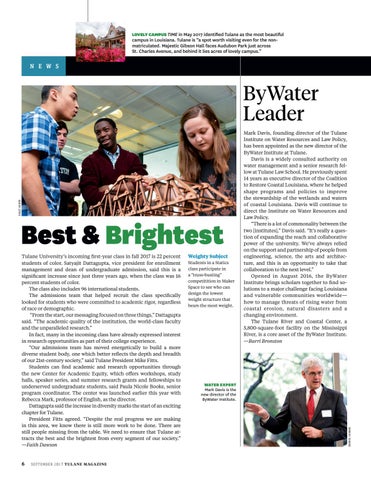
Weighty Subject Students in a Statics class participate in a "truss-busting" competitition in Maker Space to see who can design the lowest weight structure that bears the most weight.
WATER EXPERT Mark Davis is the new director of the ByWater Institute.
CHERYL GERBER
Tulane University’s incoming first-year class in fall 2017 is 22 percent students of color. Satyajit Dattagupta, vice president for enrollment management and dean of undergraduate admission, said this is a significant increase since just three years ago, when the class was 16 percent students of color. The class also includes 96 international students. The admissions team that helped recruit the class specifically looked for students who were committed to academic rigor, regardless of race or demographic. “From the start, our messaging focused on three things,” Dattagupta said. “The academic quality of the institution, the world-class faculty and the unparalleled research.” In fact, many in the incoming class have already expressed interest in research opportunities as part of their college experience. “Our admissions team has moved energetically to build a more diverse student body, one which better reflects the depth and breadth of our 21st-century society,” said Tulane President Mike Fitts. Students can find academic and research opportunities through the new Center for Academic Equity, which offers workshops, study halls, speaker series, and summer research grants and fellowships to underserved undergraduate students, said Paula Nicole Booke, senior program coordinator. The center was launched earlier this year with Rebecca Mark, professor of English, as the director. Dattagupta said the increase in diversity marks the start of an exciting chapter for Tulane. President Fitts agreed. “Despite the real progress we are making in this area, we know there is still more work to be done. There are still people missing from the table. We need to ensure that Tulane attracts the best and the brightest from every segment of our society.” —Faith Dawson
Mark Davis, founding director of the Tulane Institute on Water Resources and Law Policy, has been appointed as the new director of the ByWater Institute at Tulane. Davis is a widely consulted authority on water management and a senior research fellow at Tulane Law School. He previously spent 14 years as executive director of the Coalition to Restore Coastal Louisiana, where he helped shape programs and policies to improve the stewardship of the wetlands and waters of coastal Louisiana. Davis will continue to direct the Institute on Water Resources and Law Policy. “There is a lot of commonality between the two [institutes],” Davis said. “It’s really a question of expanding the reach and collaborative power of the university. We’ve always relied on the support and partnership of people from engineering, science, the arts and architecture, and this is an opportunity to take that collaboration to the next level.” Opened in August 2016, the ByWater Institute brings scholars together to find solutions to a major challenge facing Louisiana and vulnerable communities worldwide— how to manage threats of rising water from coastal erosion, natural disasters and a changing environment. The Tulane River and Coastal Center, a 5,800-square-foot facility on the Mississippi River, is a core asset of the ByWater Institute. —Barri Bronston
S E P T E M B E R 2 0 1 7 T ULANE MAGA ZINE
6-13_NEWS_SEP-2017_FINAL.indd 6
8/22/17 2:50 PM
In That Number Lower Blood Pressure Target
PAULA BURCH-CELENTANO
Dr. Jiang He is the Joseph S. Copes Chair and Professor in the Department of Epidemiology at the Tulane University School of Public Health and Tropical Medicine. He is an expert in the study of hypertension, diabetes, stroke, cardiovascular disease and chronic kidney disease and has conducted research in seven countries and published more than 400 research papers related to hypertension and cardiovascular diseases. Below are some numbers related to Dr. He’s latest findings on the effects of blood pressure on cardiovascular disease.
1
92.1
MILLION
There are 92.1 million adults affected by heart disease in America.
Heart disease is the no. 1 cause of death in America.
<140
Previously, <140 mm Hg was thought to be the target number for systolic blood pressure (SBP) in adults with hypertension.
120-124
85.7
There are 85.7 million U.S. adults with hypertension (high blood pressure).
MILLION
42
Researchers from Tulane University schools of Public Health and Tropical Medicine and Medicine analyzed 42 clinical trials to come to the conclusion on lower SBP.
144,220
THINKSTOCK IMAGES
INFOGRAPHIC BY CHELSEA CHRISTOPHER AND ALICIA JASMIN
A new study by Tulane University researchers led by Dr. He finds that 120–124 mm Hg could be a better SBP treatment target for preventing cardiovascular disease and mortality.
The combined trials for the study involved 144,220 patients.
T U L A N E MAGA Z I N E S E P T E M B E R 2 0 17
6-13_NEWS_SEP-2017_FINAL.indd 7
7
8/18/17 4:37 PM
COURTESY NEWCOMB COLLEGE ARCHIVES
Who Dat? Karen Oser Edmunds and Healing Art
While in Paris during their Junior Year Abroad in 1966, Karen Oser Edmunds (NC ’67) (left) and the late Gray Dugas (A&S ’67) recite lines from a Georges Feydeau play, Occupe-toi d’Amelie, during a speech class to learn proper pronunciation of French.
MOTIVATION KAREN OSER EDMUNDS (NC ’67) encourages people to make art— even if it’s bad art. Art is a way to get over sadness, depression and angst. The reason to do art of any kind—singing, painting, sculpting, playing music or writing—is that it’s healthy to have an outlet to deal with upheaval, she said. “Understanding that art can overcome obstacles began for me while JYA,” said Edmunds. She spent her Junior Year Abroad in Paris in 1966–67. A psychology major, she studied European and American child developmental psychologists and became interested in art therapy as a way to help children. A New Orleanian, Edmunds earned a Master of Fine Arts from the University of Vermont in 2005. She’s had studio space at Studio Inferno, now located in Arabi, Louisiana, since the early 1990s. The
8
gallery and glass art studio are owned by Mitchell Gaudet (G ’90). She and her husband, Dr. J. Ollie Edmunds Jr., an emeritus professor of orthopaedics at Tulane School of Medicine, have four children. Throughout her life, Edmunds said that she’s been lucky, but she and her family have experienced illness and some heartbreak as anyone does. Art Responds to a Diagnosis: A Body of Work in Progress is conceptual artwork that Edmunds designed around her diagnosis of breast cancer in 2012. Breast cancer is a disease that affects one in every eight women—and wherever Edmunds has presented the large art installation, or parts of it, viewers have responded on an emotional, gratifying level, she said. As a sculptural piece, Art Responds to a Diagnosis was exhibited in Prospect.3, the
international art show in New Orleans in 2014, as well as at the Contemporary Arts Center. It includes cast glass made from plaster casts of Edmunds’ own breasts, medical X-rays and an X-ray light box. Edmunds also wrote and illustrated a book that includes revealing photographs and a diary chronicling her progression from surrender to acceptance and finally healing. Creating the piece was “a way for me to have something positive to think about,” said Edmunds. “All of a sudden, I had a project that became positive and took the edge off the other stuff.” What has been good for her is good for other people, too. Edmunds’ inspiration is taking trauma and working it out. “That, in a nutshell, is where I’m going with my art,” she said. —MARY ANN TRAVIS
S E P T E M B E R 2 0 1 7 T ULANE MAGA ZINE
6-13_NEWS_SEP-2017_FINAL.indd 8
8/21/17 10:42 AM
LOCAL CULTURE Tulane has partnered with NolaVie Magazine to create ViaNolaVie, a new
archival website with content provided by journalists, Tulane students and community partners. The new project emerged from a redesign of MediaNOLA, a website that Tulane professor of communication Vicki Mayer founded in 2009 to record local cultural heritage.
N E W S
SHUTTERSTOCK
Encouraging Results
Sex Cells Sex Matters in Research Y and X chromosomes indicate the sex of cells.
BLACK MEN AND PROSTATE CANCER TREATMENT Dr. Oliver Sartor led a new study that shows good results for immunotherapy for African-American men with prostate cancer.
PAULA BURCH-CELENTANO
Over the last decade, many drugs that have been pulled from the market due to toxicity were withdrawn because they affected women more than men. It turns out the studies that brought the drugs to market were designed using only male cells and animal models, a common flaw a Tulane endocrinologist is working to help correct. “We need to study both sexes,” said Dr. Franck Mauvais-Jarvis, a leading voice in the debate to bring sex parity to preclinical research. “The focus on a single sex threatens to limit the impact of research findings as results may be relevant to only half of the population.” Mauvais-Jarvis, a professor of endocrinology at Tulane University School of Medicine, is the lead author of an article in the journal Cell Metabolism to help scientists who study obesity, diabetes or other metabolic diseases better account for inherent sex differences in research. While the National Institutes of Health recently mandated researchers consider sex as a biological variable by including both sexes in preclinical research, there is little guidance in designing studies to fully consider sex differences in underlying biological mechanisms. The article outlines the causes of sex differences in research models and the methods for investigators to account for these factors. Mauvais-Jarvis’ goal is to help investigators better understand that sex differences are not simply a superficial aspect of research that only account for different sets of hormones. He maintains that male and female are two different biological systems. “Sex differences are at the core of the mechanism for biological traits and disease,” Mauvais-Jarvis said. “We believe that the incorporation of appropriately designed studies on sex differences in metabolism and other fields will accelerate discovery and enhance our ability to treat disease. This is the fundamental basis of precision medicine.” —Keith Brannon
New study results released by Tulane oncologist Dr. Oliver Sartor hold promising news for African-American men fighting advanced prostate cancer. Sartor is the C.E. and Bernadine Laborde Professor for Cancer Research at the School of Medicine. African-American men treated with the drug sipuleucel-T had a median nine-month overall survival advantage compared to Caucasian men with the disease, according to an analysis of 1,900 patients who received the treatment between 2011 and 2013. “This is the first time that I have seen a prostate cancer treatment seemingly work better in African-Americans,” said Sartor. “These findings are encouraging given that African-American men with prostate cancer have a mortality rate more than twice as high as Caucasian men.” Sipuleucel-T is a cancer treatment that boosts the immune system to help it attack prostate cancer cells. It is used for advanced prostate cancer that no longer responds to hormone therapy. African-American patients in the study had a median overall survival of 37.3 months compared to 28 months for Caucasian patients. Among the group of patients with the lowest median prostate specific antigen levels at the time of treatment, AfricanAmerican patients demonstrated over 16 months improved survival compared with Caucasian patients (54.3 months vs. 37.4 months, respectively).—Keith Brannon
T U L A N E MAGA Z I N E S E P T E M B E R 2 0 17
6-13_NEWS_SEP-2017_FINAL.indd 9
9
8/18/17 4:38 PM
POTTERY & JAZZ The story of Newcomb Pottery is linked to the evolution of jazz in a traveling exhibit, “The Most Natural Expression of Locality: Jazz, Newcomb Pottery and the Creative Impulse in Turn-of-the-Century New Orleans.”
N E W S
PAULA BURCH-CELENTANO
300 Years & Counting
Post-K Vietnamese
10
How Did You Do in the Storm? Weathering Katrina by Tulane public health professor Mark VanLandingham explores how the Vietnamese community in New Orleans recovered after Hurricane Katrina.
TRICENTENNIAL SCENE A boat on the Mississippi River completes the New Orleans skyline. PAULA BURCH-CELENTANO
In his new book Weathering Katrina: Culture and Recovery Among Vietnamese Americans, Mark VanLandingham chronicles the VietnameseAmerican community’s post-storm comeback. VanLandingham is the Thomas C. Keller Professor in Global Community Health and Behavioral Sciences at the Tulane School of Public Health and Tropical Medicine. He became interested in studying New Orleans’ Vietnamese population, which began settling in the city after the collapse of the South Vietnamese government in 1975, after reading Growing Up American, a book co-authored by Tulane sociology professor Carl L. Bankston III. Soon after arriving at Tulane two decades ago, VanLandingham and a team of Vietnamese graduate students and colleagues began a crossnational study comparing local Vietnamese residents with their counterparts living in Vietnam in terms of economic growth, mental and physical health, and social connections. “Just as I was finishing the data collection for the eastern New Orleans community sample, Hurricane Katrina hit,” he said. Post-storm interviews that VanLandingham conducted throughout 2006, 2007 and 2010 laid the groundwork for the book. Covering factors like health, housing and economic stability, VanLandingham’s interviews and longitudinal survey data formed the basis of his conclusion that the group fared much better than other devastated local communities during their rebuilding process. In the second part of the book, he tackles the more difficult question: why? VanLandingham found that the Vietnamese had a wide range of attributes that became advantageous during their recovery process. Sharing a history of starting over in New Orleans after fleeing South Vietnam, the group developed a culture that emphasized insularity, collective perseverance and progress. “They’re a remarkable people and are an outstanding example of how immigrants provide vitality and inspiration to the rest of us in America,” said VanLandingham.—Mary Cross
As New Orleans prepares to commemorate its 300th anniversary in 2018, Tulane University is celebrating its relationship with the city and gearing up for the next 300 years of partnership to come. Established as a medical college in 1834, Tulane has remained a part of the fabric of New Orleans for more than half the city’s existence. Richard Matasar, senior vice president for strategic initiatives and institutional effectiveness, said, “There is no Tulane without New Orleans, and there’s a very different New Orleans without Tulane.” Matasar noted that Tulane doctors were at the forefront of battles against tropical illnesses that once plagued the city. Today, the university remains on the front line against recent outbreaks such as the Zika and Ebola viruses. Also exciting, Matasar said, is anticipating how new contributions by Tulane researchers and scholars help ensure the city’s prosperity and success in the future. “Our scholarship puts us in a position to improve the human condition,” said Matasar. “Through exploration of environmental sustainability, diversity and inclusion, gulf regional industries like oil and gas, and better understanding of the arts, music and food of our region, we can continue to make a real impact for the next 300 years.”—Alicia Jasmin
S E P T E M B E R 2 0 1 7 T ULANE MAGA ZINE
6-13_NEWS_SEP-2017_FINAL.indd 10
8/18/17 4:39 PM
Gallery Science Meets Art
COMPUTATIONAL IMAGERY In fall 2008, the Center for Computational Science at Tulane University began a tradition that brought together minds well versed in numbers and those with an eye for art. The tradition lives on in an annual showing of computational art during which researchers use algorithms and computers to visually present their findings. “The Center for Computational Science had an administrative assistant who was not a scientist but used to say that some of the figures we generated were nice to look at even without understanding the science behind them,” said Ricardo Cortez, director
of the Center for Computational Science. The assistant’s idea led to the framing of computations and their eventual display in an art show and open house. Cortez said the process is an oppor tunity for the researchers to step out of their comfort zones. Participants in the show, held the week after Thanksgiving, include undergraduate and graduate students as well as researchers and faculty who have an active role in the center’s research projects. “Some students and postdoctoral re searchers are reluctant to contribute to the event because they are not sure that their
HIDEKI FUJIOKA
This image depicts a dam-break wave at a vertical wall as computed using the moving particle semi-implicit method. It was on display at the Center for Computational Science art show in fall 2016.
images are ‘artistic’ enough,” said Cortez. “After all, most of us are not trained in art. But everyone eventually gets excited about participating.” In order to foster creativity, research ers—or artists in this case—are allowed to relax the accuracy of their scientific computations and focus on the images as art rather than meticulous research. “Our goal is to promote the existence of the Center for Computational Science and its collaborative scientific projects,” said Cortez. “The art show is a way for scientists and nonscientists to enjoy a common event.” —ALICIA JASMIN
T U L A N E MAGA Z I N E S E P T E M B E R 2 0 17
6-13_NEWS_SEP-2017_FINAL.indd 11
11
8/18/17 4:39 PM
PAULA BURCH-CELENTANO
In Your Own Words Crossing Boundaries
IN YOUR OWN WORDS Robin Forman is senior vice president for academic affairs and provost at Tulane. As I near the first anniversary of my arrival at Tulane, I look back on a joyful year in which I had the opportunity to immerse myself in one of the world’s great research universities. I have learned that much of the remarkable work taking place on this campus reflects Tulane’s distinctive ability to support an environment in which students and faculty can easily cross boundaries. More so than any other university of our sort, we cross the boundary between the campus and the community. We are the only research university that requires multiple service-learning experiences for each undergraduate, and the Tulane Law School was the first in the country to require its students to participate in pro bono work. The city of New Orleans is well known for its extraordinary cultural vibrancy, but it also faces issues common to all major urban
12
areas, related to education, crime and health care, and it is on the front lines of growing ecological challenges. Our faculty and students are exploring these issues locally and learning lessons that are of global significance. With the support of the Andrew W. Mellon Foundation, we have introduced a program in which graduate students in the humanities will have the opportunity to carry out community-engaged research. Our work also crosses disciplinary boundaries. For example, our programs in Latin American studies, environmental studies and neuroscience involve faculty from multiple departments and schools. With the creation of our ByWater Institute on the banks of the Mississippi River, we bring together faculty who study river and gulf ecology, coastal preservation and restoration, the role of water in human health, and the laws and policies governing water, creating one of the nation’s most powerful university programs focused on water and coastal issues.
Our undergraduates regularly design their own boundary crossings. With all our undergraduate students registered in Newcomb-Tulane College, they study in disciplines across the university, easily creating their own double majors such as engineering and architecture, business and theater, public health and neuroscience. Finally, we cross the boundaries between basic research, applied research and implementation. From the university’s origins as the Medical College of Louisiana to today, Tulane faculty have demonstrated the ability to ask big questions, discover big answers and then transform those answers into actions that improve the lives of those around us. Tulane is an extraordinary intellectual community, one in which our faculty and students are carrying out work that is changing the way we understand the world and what is possible. And we are doing work that others cannot, because we are crossing boundaries.—ROBIN FORMAN
S E P T E M B E R 2 0 1 7 T ULANE MAGA ZINE
6-13_NEWS_SEP-2017_FINAL.indd 12
8/18/17 4:40 PM
SAIL ON Tulane is taking club sailing to greater depths. Beginning with the 2018–19 academic year, sailing will move to varsity status, thanks to generous support from Elizabeth “Libby” Connolly Alexander (NC ’84) and Robert Alexander along with Community Sailing New Orleans.
S P O R T S
RICK OLIVIER
Between assistant coaching stints at Auburn University–Montgomery and Clemson University, Maria “Maru” Brito spent three years with the Tennis Academy at Franco’s Athletic Club in Mandeville, Louisiana. She often would head to New Orleans to watch Caroline Magnusson—who had transferred from Clemson to Tulane—compete in matches. “I loved it at Tulane,” said Brito, a native of Mexico City who also played for Clemson. “I always thought this would be an amazing place to work. So when the opportunity came up, I went for it.” With four years of coaching experience at Clemson—where she helped lead the Tigers to 64 wins including a 22-7 campaign in her first year in 2014 and a regular season ACC Championship—she applied for the vacant position of head women’s tennis coach at Tulane. Tulane Athletic Director Troy Dannen knew he had found the ideal candidate. “Her experience as both a player and coach at the highest level, and her demonstrated commitment to all aspects of an outstanding student-athlete, are tremendous assets for our program,” Dannen said. Brito joins a program that in the 2016-17 season recorded one of the best turnarounds in all of NCAA Division I, jumping from 8-14 the previous year to a 22-7 record. She described the team as “hungry” to take women’s tennis at Tulane to the next level. —Barri Bronston
Senior Play In the Best Position Parry Nickerson, cornerback for the Green Wave, expects a stellar defensive season for Tulane football this year as he prepares for a career in the NFL.
NEW TENNIS COACH Maria “Maru” Brito, the Green Wave women’s tennis coach, says that her philosophy of coaching is: “If you take care of the little things, big things will come.”
Almost every year, Tulane sends a handful of players to the NFL, most recently Tanzel Smart to the Los Angeles Rams, Lorenzo Doss to the Denver Broncos and Ryan Grant to the Washington Redskins. When the 2018 draft rolls around, cornerback Parry Nickerson hopes to hear his name. But such talk, says Nickerson, is premature, and the only thing on his mind is helping the Green Wave have a winning season. “I want to see us grow,” Nickerson said. “Offensively, I think we’re headed in the right direction. Defensively, we want to be No. 1 in our conference.” With Nickerson, a fifth-year senior, on the team, there is no reason to think that a winning season is a fantasy. His career statistics include 133 total tackles, three forced fumbles, four fumble recoveries (including one for a touchdown), one blocked field goal, 22 pass breakups and 10 interceptions (including one returned for a touchdown). Earlier this year, he garnered first-team honors from Athlon Sports on its preseason All-American Athletic Conference teams, and he was a second-team selection by the conference’s coaches and the Louisiana Sportswriters Association. Nickerson considered forgoing his senior year and trying his luck in the 2017 NFL Draft but thought he could improve his stock—and experience a winning season—by playing in college one more year. “It’s basically putting yourself in the best position possible,” he said. “It’s about getting better physically, mentally and spiritually.” —Barri Bronston
T U L A N E MAGA Z I N E S E P T E M B E R 2 0 17
6-13_NEWS_SEP-2017_FINAL.indd 13
PARKER WATERS
To the Next Level
13
8/18/17 4:40 PM
COURTESY OF TULANE UNIVERSITY ARCHIVES
President Emeritus Eamon Kelly
Loss of a Leader P R E S I D E N T E M E R I T U S E A M O N K E L LY, W H O D I E D I N J U N E , L E AV E S A L E G AC Y O F T H O U G H T A N D ACT ION M ATCH ED BY F EW I N H IGH ER EDUC AT ION. By Bill Bertrand On June 28, 2017, my good friend, mentor and companion in many of life’s adventures, Eamon Kelly, passed away from complications related to major surgery. He was, of course, the president emeritus of Tulane and the Margaret W. and Eamon M. Kelly Distinguished Chair in International Development—and so much more. Eamon’s loyalty and dedication to Tulane and the broader New Orleans community were absolute, exceeded only by his enviable relationship to his wife and family, so eloquently detailed by his son Paul at the funeral Mass. Eamon first came to Tulane in 1981 as vice president and took over at a time when the university was in poor condition. He was the university’s first Catholic president, and this informed his absolute dedication to humanitarian and democratic principles that put the university on a new course of courageous engagement with contemporary problems. During his tenure, he brought
14
S E P T E M B E R 2017 TULANE MAGA ZINE
Tulane Leader (Clockwise) President Kelly DJ's for WTUL in 1988. He presents a check to a robot for a robotics lab in 1985. He congratulates his wife, Margaret, when she graduates from Newcomb College in 1985. Kelly never stopped teaching at Tulane.
the university from near financial ruin to a healthy endowment, a solid financial base and its highest national ranking ever. He expanded the Board from a primarily New Orleans–based group to one with broader national and international ties. Every component of the Tulane community prospered during his tenure as president. Starting in 1983, Eamon traveled widely with me to Africa, Asia and Latin America in pursuit of a highly successful effort to make Tulane an international institution and an active partner in improving conditions around the globe. Currently active programs in China, Vietnam, Cuba, Central and South America, and multiple countries in Africa all began during his presidential period. His belief that participating in the global community was vital to the future of the United States, and acquiring international sophistication was an important objective for Tulane’s academic community. Today Tulane students have numerous international opportunities due in large part to Eamon’s vision and his actions to achieve it. Eamon’s immediate family were first-generation Irish-Americans, a matter of great pride to him. He understood intuitively at all levels the value of open doors and an equally open heart to the suffering of others. Although raised a New Yorker, he and his family integrated into the Big Easy while at the same time remaining faithful to their New York and Irish roots. He had a host of what he presented as Irish sayings that he would call out in times of doubt. “It’s a good life if you don’t weaken” was one repeated many times. His support of all aspects of the human condition led to a conflict that he shared with me one evening. He had been awarded honors by both the Tulane gay community and the NAACP State Conference. Unfortunately, both fetes were on the same night. He managed to attend both. Eamon’s loyalty to his family and friends was matched only by his loyalty to Tulane. He did not enjoy asking for money but understood, as an economist, that finances enabled action and change. As a result he became one of the most successful fundraisers in university history. Often when I asked him for an analysis of a particular problem, he would reply, “Follow the cash, and it will become clear.” He recently noted that current national politics could be largely explained with this simple dictum. In the early days his close circle of friends became accustomed to the fact that Eamon rarely disagreed with their suggestions. Yvette Jones, Ron Mason, Tony Lorino, Bryant George and Jim Kilroy—among many of those who stayed close to him over the years—learned, however, that
when Eamon said, “Let me pray over that,” it was time to raise a large question mark. As part of his push to make Tulane into a truly international institution, he was fearless in his travels. He visited our international projects in war-torn Colombia, Guatemala and Zaire while president. Under his guidance we started our first academic programs in Cuba. He also recognized the need to understand and be involved with what was happening in China, resulting in a strong Tulane presence there today. Eamon’s wise and level counsel was recognized by many national and international organizations of note. He was chairman of the boards of the American Association of Universities and the National Science Foundation (where he was the first social scientist to serve in that position), as well as a member of numerous other boards. He was sitting chair of the Digital Promise Foundation, which has offered its own tribute to his vision and leadership. As a mentor and a teacher, he supported those whom he felt had potential. He sponsored many university senior administrators as they moved on from Tulane to become presidents of other universities. He leaves a legacy of thought and action matched by few in higher education. Eamon was fond of closing meetings such as the University Senate meetings by saying: “It’s time the Lord spoke to Moses.” I feel certain that he is now serving as a wise adviser to both of them. I spoke with him the day before he entered that fateful surgery, and he expressed to me a premonition that this was not going to end well. As usual, Eamon was right. Tulane and all the people and communities that Eamon touched have lost a great leader. The vision and principles that drove his personal and professional life are still relevant to the Tulane community and merit our continued support for a better world. Bill Bertrand is a professor in the Tulane School of Public Health and Tropical Medicine. He has worked at Tulane in multiple areas of public health and development since 1967, pioneering the use of information technology in public health research and education. His recent projects include certifying and measuring child labor in West Africa and supporting institutional development and learning systems at the American University of Nigeria. He currently serves as a consultant to the Centers for Disease Control and Prevention in Latin America on Zika and the U.S. Navy on intervention strategies for resistant malaria in Vietnam.
T UL A N E MAGA Z I N E S E P T E M B E R 2 0 17
15
ISLE DE JEAN CHARLES ALONG THE COAST OF LOUISIANA HAS LOST 98 PERCENT OF ITS LAND SINCE THE 1950S. ITS RESIDENTS—MEMBERS OF T H E B I L O X I - C H I T I M A C H A- C H O C TAW T R I B E O F N AT I V E A M E R I C A N S — F I N D A WA Y T O S U R V I V E A S T H E Y F O R G E A M O D E L F O R O T H E R C O A S T A L COMMUNITIE S FACING SIMIL AR EXISTENTIAL THREAT S.
Slipping Int By Danny Heitman
16
S E P T E M B E R 2017 TULANE MAGA ZINE
16-21_Ile de Jean Charles-FINAL.indd 16
8/21/17 10:50 AM
PAUL MORSE
nto the Sea T UL A N E MAGA Z I N E S E P T E M B E R 2 0 17
16-21_Ile de Jean Charles-FINAL.indd 17
17
8/21/17 11:37 AM
PAUL MORSE
Vanishing Land (Previous pages) Water encroaches on houses on Isle de Jean Charles, a narrow ridge located in Terrebonne Parish, Louisiana. (This page, left) Albert Naquin, chief of the Isle de Jean Charles tribe, surveys his island’s embattled ecology. (Right) The island’s homes are built on stilts to protect them from rising water.
18
Perched along the lip of Louisiana, an island off the coast of Terrebonne Parish has been home to members of the Biloxi-Chitimacha-Choctaw tribe of Native Americans for generations. But now, Isle de Jean Charles is slipping into the sea, meaning a perilous future for those who call it home. Albert Naquin, chief of the Isle de Jean Charles tribe, is a Vietnam veteran and retired oil field inspector for the federal government. He is well aware that his island’s embattled ecology is part of a larger pattern of peril that extends far beyond Louisiana. He visited the United Nations on behalf of his tribe in 2010, and he’s also traveled to Alaska to gain insights from coastal residents who dealt with the 1989 Exxon Valdez oil spill. “We don’t have time,” Naquin told National Geographic last year. “The longer we wait, the more hurricane season we have to go through. We hate to let the island go, but we have to. It is like losing a family member. We know we are going to lose it. We just don’t know when.” GHOST TREES BUT HOME Chantel Comardelle, secretary of the Biloxi-Chitimacha-Choctaw tribe, began her life on Isle de Jean Charles but left in 1985 when she was 4 years old. “Our trailer was flooded twice—after Hurricane Danny, then
S E P T E M B E R 2017 TULANE MAGA ZINE
16-21_Ile de Jean Charles-FINAL.indd 18
8/21/17 11:00 AM
PAUL MORSE
Hurricane Juan after that,” Comardelle recalled. Subsequent mold problems in her family home made her chronically ill, prompting the family to relocate. She now lives in Houma, where she works as a purchasing agent for the Terrebonne Parish government. Comardelle’s roots on Isle de Jean Charles run deep. Her grand parents still live on the island, which is named after one of her 19thcentury ancestors. In the decades since Comardelle moved away, much of the landscape of her childhood has vanished. “The land is not there anymore,” she said. “The trees and vegetation have drastically changed. Where there were trees and wooded areas, now there’s marsh.” Islanders call stumps from the ruined woodland “ghost trees,” which points to the way that the natural history of the island con tinues to resonate with residents even when touchstones of the local geography have disappeared. The memories of that home ground, along with what still remains of Isle de Jean Charles, exert a powerful pull on the people with ties to the island. “It’s where my heart is,” said Comardelle. “I would live there now if I could. The trees seem to come alive as you drive into the island. You
can sit on the porch there and be at peace with the rest of the world. I call it home.” As many residents like Comardelle have gradually moved to safer ground, maintaining tribal traditions has become more diffi cult. “We are documenting our oral history,” she said. “We are docu menting our way of making bas9/kets, our ways of making other things. We have different medicines that we’ve always made from the plants here. We’d like to be able to propagate those plants in a different location.” ASTONISHING LOSS OF LAND Since the early 1950s, Isle de Jean Charles has lost 98 percent of its land, a coastal calamity caused by culprits Louisiana knows all too well. Girdled by levees, the Mississippi River can no longer sweep the land as it once did, carrying its cargo of rich sediments to the coast and replenishing the marshes. Without that lifeblood, coastland has disappeared. Damage done by oil and gas exploration also weakened the coast, and rising sea levels from climate change, along with land subsidence, are wreaking havoc, too. In the 1950s, Isle de Jean Charles spanned 33,000 acres. Now, only 320 acres remain.
T UL A N E MAGA Z I N E S E P T E M B E R 2 0 17
16-21_Ile de Jean Charles-FINAL.indd 19
19
8/21/17 11:00 AM
PAUL MORSE
RYAN RIVET
“Around the globe, governments are confronting the reality that as human-caused climate change warms the planet, rising sea levels, stronger storms, increased flooding, harsher droughts and dwindling freshwater supplies could drive the world’s most vulnerable people from their homes,” New York Times writers Coral Davenport and Campbell Robertson noted. “Between 50 million and 200 million people— mainly subsistence farmers and fishermen—could be displaced by 2050 because of climate change.” Isle de Jean Charles is at ground zero of the crisis. The tribe and its partners have developed a resettlement plan to move families to less environmentally vulnerable land. Last year, the U.S. Department of Housing and Urban Development awarded $48 million to the state of Louisiana to support the resettlement. The funding, part of $1 billion HUD distributed to assist communities in answering climate change, sparked national headlines. The biggest challenge is advancing a resettlement plan to move residents to safer ground. A related goal is preserving the island’s legacy. TULANE AND TRIBAL LEADERS A Tulane faculty member, Amy Lesen, is collaborating with tribal leaders as they develop solutions to the profound challenges facing the community. Lesen is a research associate professor with the Tulane ByWater Institute, which engages scholars in studying coastal and urban environmental issues in the New Orleans area and the Lower Mississippi Delta Region. “I wanted to see what I could do to be helpful,” she said. “In this project, we’ll develop a model for bringing together a sustainable crossboundary collaboration of scientists, community members, practitioners and other professionals to combine community knowledge with scientific knowledge to address the challenges facing the Isle de Jean Charles community. This collaborative team will help the tribe envision
20
a science center, a seed bank, a plant-cutting library and other elements that could be incorporated into their resettlement.” The work is being supported by a $200,000 grant from the National Academies of Science, Engineering and Medicine’s Gulf Research Program. The project lead is the Lowlander Center, a Terrebonne Parish nonprofit that’s working with coastal residents to adapt to land loss and the changing coastline. Lesen is working with Isle de Jean Charles tribal leaders to develop a more sustained and integrated model for scholars, scientists and community members to work together. Their insights could eventually help other communities facing similar struggles. “It’s a beautiful place with a deep history,” she said. “The environment and the place are part of the community. The conundrum of being in a place where your community lives and that may no longer be viable and safe is very poignant. It’s a place that embodies a lot of the challenges many coastal communities are facing. “I love talking to Chief Albert about the island and all the plants and animals he’s encountered,” Lesen added. “It’s moving to me to talk to the people of the community about what the island means to them.” For Lesen, as for many others, Hurricane Katrina dramatized the vulnerability of coastal areas to the forces of nature. A graduate of the University of Massachusetts–Amherst with a Bachelor of Science in marine fisheries biology, the New York City native earned a PhD from the University of California–Berkeley in integrative biology. For her first seven years in New Orleans, Lesen was on the faculty at Dillard University, where she developed Scientists, Experts and Civic Engagement, a 2015 book in which contributors explore the ways that scientists and other academic specialists could connect in a more equitable way with communities that might benefit from their expertise. The book grew out of a 2010 New Orleans symposium on the subject that Lesen organized with the collaboration of Richard Campanella, a geographer with the Tulane School of Architecture, and Julie Hernandez,
S E P T E M B E R 2017 TULANE MAGA ZINE
16-21_Ile de Jean Charles-FINAL.indd 20
8/18/17 4:20 PM
Way of Life (Facing page, left) Research professor Amy Lesen regularly communicates with Isle de Jean Charles community leaders about the challenges of the changing coastline. (Middle) Chris Brunet uses an elevator to access his home’s living quarters. (This page) Wenceslaus Billiot Sr., who grew up on the island, lives in the home that he raised
PAUL MORSE
after repeated flooding.
a research assistant professor at Tulane University Law School’s Payson Graduate Program in Global Development. In the wake of Katrina, “New Orleans and the southeastern coast of Louisiana were now extremely popular places for scholars, researchers and students from all over the world to study,” Lesen recalled in the preface to her book. “But the scores of academics flocking to New Orleans—all doing important work—also made me think about the dilemmas this situation poses. What are the ethical implications when scholars come into a location—particularly one where people are in distress—study the situation, and then leave to go home and write an article or book for an academic audience? Isn’t there a way this can be done where the research plan and the benefits of the work can be formulated with the intention of also benefitting the local residents?” Lesen’s team of scholars and practitioners who are working with Isle de Jean Charles’ tribal leaders includes not only natural and social scientists like her, but planners and landscape designers. “We’ve brought together a number of different types of expertise, including the expertise of the Isle de Jean Charles community,” she said, “and we do have partners from elsewhere in the United States. Hopefully, we’re building a model that can be useful for other coastal communities—not only in the United States, but the rest of the world. It’s generally not part of the training of people in the sciences to do this kind of cross-boundary work. But it’s becoming clearer that these kinds of partnerships are necessary in coastal cities and in coastal communities facing environmental change.” GLOBAL COASTAL CRISIS “We as a tribe know that we’re not the only community dealing with this,” Comardelle said. That fact was underscored in 2015, when President Barack Obama visited the Inupiat Eskimo community of Kivalina in coastal Alaska. Residents there have no more than a decade left before coastal erosion
will force many of them from their homes, Millie Hawley, president of Kivalina’s tribal council, told the Associated Press. Around the world, coastal villagers are confronting similar problems. But Louisiana residents don’t have to look very far to find parallels with the plight of Isle de Jean Charles. “We’re the first wave of challenges,” Comardelle said of the island. “The next will be the inland areas.” As if to prove Comardelle’s point, New Orleans Mayor Mitch Landrieu recently designated climate change as an “existential threat” to Tulane’s home city. Comardelle said the island could conceivably exist in some form for decades, though life on Isle de Jean Charles is becoming increasingly tenuous. “The general feel of the island has changed,” she noted, echoing Naquin’s warning that future storms could radically accelerate the island’s demise. As the community draws on collaboration and expertise from many sources in deciding its future, voices from the distant past might offer insights on adaptability, too. In the 19th century, the island became home to tribal members displaced by federal policies, part of a series of forced relocations of Native Americans that came to be known as “The Trail of Tears.” “Our ancestors once lived east of the Mississippi,” Comardelle said. As they were forced to move, some members turned south to coastal Louisiana, she added. “It’s a matter of resilience,” Comardelle said. “We’re family, and we’re going to stick together and survive.” Danny Heitman, a columnist for The Advocate newspaper, is the author of A Summer of Birds: John James Audubon at Oakley House. He frequently writes for The Wall Street Journal, The Christian Science Monitor, Humanities magazine, and other national publications. He wrote “Louisiana Bird Calls” in the December 2016 Tulane.
T UL A N E MAGA Z I N E S E P T E M B E R 2 0 17
16-21_Ile de Jean Charles-FINAL.indd 21
21
8/18/17 4:52 PM
KIM RAINEY
22
S E P T E M B E R 2017 TULANE MAGA ZINE
F ROM I M PROV E D BR E A S T R EC ONS T RUC T ION F O R C A N C E R S U RV I VO R S T O “ B L A D E L E S S ” B I O P S I E S A N D FA S T E R V I R U S D E T E C T I O N I N C AT T L E , T U L A N E D O C T OR A L S T U DE N T S A R E TA K I NG T H E I R I N V E N T IONS F ROM T H E L A B OR AT ORY T O T H E M A R K E T P L AC E . By Leslie Cardé
The world of bioinnovation is the science that propels mere mortals known as scientists into visionaries who solve the most complicated medical conundrums today. In the relatively new field that constantly strives to solve the perplexing puzzles at the nexus of mechanics and biology, Tulane University is producing dynamic solutions to some very complex problems. If curing lung disease and cystic fibrosis, for instance, seems like it could be decades away, there is one researcher who has a decidedly different notion of that timetable. “Think organogenesis,” said Bruce Bunnell, director of Tulane’s Center for Stem Cell Research and Regenerative Medicine and professor in the Department of Pharmacology in the School of Medicine. “The days of having to sign up organ donors, probably in the next decade, will come to an end, in theory. We’ll be able to grow the organs in laboratories.” This medical breakthrough is particularly important when it comes to replacing human lungs. A matching donor can give up a kidney and still survive, and liver cells regenerate, so whatever tissue is donated grows back, but living people cannot donate a whole lung. That’s why Bunnell is working so diligently to produce lungs in the lab. One of Bunnell’s PhD students, who has been working with him on the stem cell research to generate new lungs, recently came to him with an idea straight out of the box. SCAFFOLDING OF SKIN “It was 2014, and I had one of my sleepless nights,” said Nick Pashos, a doctoral student in bioinnovation. “I was watching a documentary on Netflix called ‘Becoming Chaz,’ about Sonny and Cher Bono’s daughter Chastity transitioning to male Chaz Bono. Chaz was sitting with his girlfriend in the pre-op area, talking to the breast surgeon who was telling him that post-operatively he might not have nipples any longer. I remember thinking, wow … is this an issue? I hadn’t realized that having a mastectomy meant removing the nipple and areola [the darker surrounding tissue]. Or, that if you keep it, you stand the chance of it becoming necrotic [cell death due to a lack of blood supply], which would mandate that it has to be removed. I stayed up the rest of the night researching this.”
T UL A N E MAGA Z I N E S E P T E M B E R 2 0 17
23
Pashos walked into Bunnell’s office the next day and presented him with his newfound thoughts on breast reconstruction. “I said I had an idea,” said Pashos. “I told him it was basically the same concept as the lungs, but I wanted to transfer those procedures over to the nipple and areolar area. His initial response was, ‘Come again?’” But Bunnell was aware of one important factor, which encouraged him about the musings of Pashos. “One of the problems we were running into with lungs was that they’re very complex organs with different cell types. They have to function in different ways, and getting the appropriate cell ratios in there at the right time and in the right position to function properly can be difficult. But skin is a much simpler organ. … It’s just a couple of layers. I thought Nick’s ideas made sense.” Bunnell required that Pashos do some fieldwork, to check the viability of his idea with those who would actually be intimately involved with his innovation— surgeons and patients. “We met with two plastic surgeons. First, we discussed the intricacies of the procedure with Dr. Abigail Chaffin [assistant professor of surgery at Tulane]. Next, we took it to Dr. Scott Sullivan [physician and co-founder of the Center for Restorative Breast Surgery in New Orleans. Sullivan earned a Bachelor of Science in biomedical engineering from Tulane in 1987]. Both surgeons thought it was an idea whose time had come,” said Pashos. THE RACE IS ON With the eventual knowledge that both doctors and patients were interested in this new biotechnology, Pashos began to put the pieces into place. Since one in eight women will develop invasive breast cancer, and many require mastectomies or opt for preventive ones either to prevent the cancer’s spread or to avoid the possibility of cancer altogether, the race for Pashos was on to make reconstruction more complete. “I spent time with Dr. Sullivan at his Breast Restorative Center in New Orleans,” said Pashos, “and learned the intricacies of breast reconstruction. After observing multiple surgeries, I knew I needed to tweak my original idea. With a National Science Foundation grant, and winnings from a number of competitions, I set out to build a graft that would not only be cosmetically pleasing but functional as well.” Current procedures to reconstruct the nipple/areolar complex involve everything from tattooing nipples and areolas on to the patient’s chest to fashioning a raised nipple out of the patient’s own underarm or thigh tissue. But tattoos fade, and raised nipples eventually lose the structure that supports the protrusion, making the procedure impermanent. “This is why we construct a scaffold,” said Pashos. “It’s a personalized transplant model, if you will, made from human tissue or from prophylactic mastectomy tissue. Then we remove all of the cells and the donor’s DNA from it, and what you’re left with is a collagen structure, which I call scaffolding. Think of it as the two-by-fours, which hold something together, but instead of filling it in with brick and mortar, in this case it’s cells.” Pashos now leads his own company, BioAesthetics. A biotech accelerator program—IndieBio in San Francisco—has now picked up his project. Representatives from that group came to New Orleans earlier this year, met with Pashos for one hour, and explained that they would give him $250,000 if he would agree to come to the Bay Area for four months, where they would give him the tools he would need to get his product to the marketplace. Once through FDA registration and ready
24
S E P T E M B E R 2017 TULANE MAGA ZINE
for clinical use, Pashos and his mentor Bunnell (now an adviser to the company) hope that the project Pashos has been working on for years will be more than his PhD dissertation, but will bring a positive change to those undergoing breast reconstruction. “If everything works perfectly the first time,” said Bunnell, “we could see this being done on humans in the next two to three years. We may not need clinical trials, just human application, since there are already a lot of de-cellularized human skin products that have been transplanted in humans.” Ultimately, the FDA regulators will make that call. In the meantime, it’s been a whirlwind from the very inception of this idea. “Compared to academia, the world of technology runs at lightning speed, “said Bunnell. “When Nick met with IndieBio, and they expressed an interest, they told him the class started in nine days, and they wanted him in San Francisco. He had nine days to change his entire life … and he’s done it.” BIOPSY AT THE SPEED OF LIGHT In another arena, Tulane doctoral candidate in biomedical engineering and bioinnovator Mei Wang is solving a different problem related to cancer, with her colleagues from Instapath. The Instapath team’s work with improving biopsy evaluations won this year’s grand prize in the International Business Model Competition in Mountain View, California, in April. (They also earlier this spring won the Tulane Novel Tech Challenge sponsored by the Office of Technology Transfer and Intellectual Property Development. Pashos also won the Novel Tech Challenge, sponsored by the Burton D. Morgan Foundation, in a previous year.) Apart from Wang, members of the Instapath team are Tulane students Sam Luethy, Peter Lawson and David Tulman and faculty adviser Quincy Brown, an assistant professor of biomedical engineering. Their work with structured illumination microscopy to examine fresh tissue is being heralded as the wave of the future in rapid biopsy evaluation. “Right now, 20 percent of biopsy analyses are inadequate,” said Wang. “This is because you’re only looking at some of the cells falling off the biopsy, and that’s not enough for a complete evaluation. To have biopsy procedures redone is painful, and there’s a waiting period of six weeks for a repeat procedure. So, if the surgeon determines there are red flags everywhere, the patient is put on some form of treatment, but predicting the exact targeted treatment required has to wait.” Clinical studies for Instapath using real tissues are running over 90 percent accurate, and new evaluation methods will give physicians the tools to make a better, quicker diagnosis, where time is of the essence in many aggressive cancers. “In our current procedure, the whole biopsy is stained with fluorescent stain,” said Wang, “and using a special light, we take a picture from the structured illumination. So, there’s no need for actual cutting in this technique. … It’s cutting with light. When all is said and done, a box will be next to the patient’s bedside or in the O.R. [operating room], the biopsy will go into a computer system, and a pathologist from anywhere in the world can read this remotely, and respond over the internet or with a phone call.” Patents have been filed, FDA approval will be needed, and industrial-consulting firms will take the Instapath invention from prototype to the final design. Ultimately, quick and accurate diagnosis of biopsy tissue, in order to expedite treatment, can be the difference between life and death for the patient dealing with cancer.
RICK OLIVIER
Boosted By The National Science Foundation Nick Pashos, Mei Wang and Jason Ryans are recipients of National Science Foundation Innovation-Corps grants. They, along with other Tulane doctoral students and faculty mentors, were awarded $50,000 grants during the past few years to look into the marketability and viability of their “bench science” as they develop new products to improve lives.
CHANGING LIVES Bioinnovation is not only applicable for the human species, but often crosses over into the animal kingdom. For Jason Ryans, who will receive his doctorate from Tulane this fall, a serendipitous class on microdevices changed the trajectory of his lifetime focus. In the biomedical engineering program, he has worked extensively in lung and fluid mechanics. But in a bioinnovation class, Ryans was required to come up with a new technology, and apply to the Bill and Melinda Gates Foundation, which contributes to making lives better in developing countries. “In this case it was working with mosquito borne viruses,” said Ryans. “We came up with a device that would change color when a drop of blood was put on it, if the patient was positive for malaria. My partner Ashwin Sivakumar [also a biomedical engineering graduate student] and I came up with a prototype. We ended up winning the New Day Challenge, the Spark Award and a business competition at Johns Hopkins.” (They also received supported from the Tulane Novel Tech Challenge.) But venture capitalists saw no opportunity to get their investment back for malaria testing in developing countries, although they lauded the Tulane partners for their work. It was at this point that the two doctoral students looked to solve a problem in the lucrative cattle industry. “We discovered there was a bovine diarrheal virus, which has a large impact on cattle production,” said Ryans. “Profit margins in the cattle world are based on the weight of the animal and how well it
reproduces, but this virus was interfering with that. Worse yet, the virus was being passed from mother to calf, and the viral shedding at feedlots was spreading the disease like wildfire. This can affect roughly 15 to 20 percent of cattle.” Conventional testing for the virus has been cumbersome, and not user-friendly for farmers, who have been required to get blood samples from their livestock. This new innovation in viral detection of BDV can glean results from saliva or nasal swabbing, and the sample needs no refrigeration. “This virus is not transmitted to humans, and therefore does not need the go-ahead from the FDA (Food and Drug Administration), but rather needs regulatory approval from the USDA (U.S. Department of Agriculture), which is a much faster process,” said Ryans. And what started out as a side project for Ryans has taken on a life of its own. “You know, initially I wanted to be in academia and research, and now I’m interested in the entrepreneurial side, combining business and science. I might want to do consulting, or go to work for the FDA to get some experience in the regulatory industry, and maybe eventually a private company.” So for Nick Pashos who began college wanting to become a dentist, or Mei Wang who dreamed of being a physician, and Jason Ryans who saw himself spending his life in a lab, the prospect of changing the world through bioinnovation has changed their lives, and ultimately all of our lives, for the better.
T UL A N E MAGA Z I N E S E P T E M B E R 2 0 17
25
Guinea
Nigeria
Sierra Leone
PHOTO ILLUSTRATION BY MARIAN BRUNO, MAP COURTESY THINKSTOCK, RIGHT IMAGE COURTESY CHRISTINA CORBACI, TSRI
Liberia
Mapped Out Lassa fever is endemic in West Africa and has been reported from Sierra Leone, Guinea, Liberia and Nigeria. The inset image ( facing page) shows an antibody anchoring to the base of the Lassa virus surface protein, locking it in position to prevent the virus from infecting new cells.
26
S E P T E M B E R 2017 TULANE MAGA ZINE
26-29_Lassa–SEP2017_FINAL.indd 26
8/18/17 3:53 PM
In the Hunt for a Lassa Fever
CURE T ULANE RESEARCHERS ROBERT GARRY AND JAMES ROBINSON WON’T GIVE UP U N T I L T H E Y U N R AV E L T H E M Y S T E R Y O F T H E L A S S A V I R U S , S AV I N G L I V E S F R O M A S EV E R E A N D O F T E N FATA L H E M O R R H AG I C F E V E R T H A T I N F E C T S M O R E T H A N 3 0 0,0 0 0 P E O P L E A N N UA L LY A N D I S W R E C K I N G WEST AFRICAN COMMUNITIES. By Katy Reckdahl Twelve years ago, Robert Garry first suggested that his team at Tulane University School of Medicine could unlock the secrets of the mysterious Lassa virus. Some researchers were skeptical. “They thought it was too difficult,” Garry said. For starters, the trip from the closest airport to Tulane’s partners at the Kenema Government Hospital in Sierra Leone took 13 hours, driving over treacherously bumpy dirt roads. Tulane would have to draw blood samples from Lassa survivors at a lab in southern Nigeria and the hospital in Kenema, freeze the samples, then keep them frozen for another long bumpy ride and a trans-Atlantic flight to New Orleans. Once those practical concerns were overcome, Tulane researchers were faced with a virus that science knew very little about in 2005. “This virus was an enigma,” said Garry’s longtime colleague, Dr. James Robinson, a professor of pediatrics. “We knew it occurred and that people either died or got better.” “Before we started, no one knew what the proteins of Lassa virus looked like,” said Garry, a professor of microbiology and immunology. “We knew little about how the immune system responded to the virus. And we didn’t know if our tests would work.” A few years ago, the Tulane team grieved and suffered setbacks after Kenema’s hospital became ground zero for an explosive outbreak of Ebola virus, a highly contagious hemorrhagic fever whose initial symptoms look similar to Lassa in patients. Despite protective gear, 11 of the
T UL A N E MAGA Z I N E S E P T E M B E R 2 0 17
26-29_Lassa–SEP2017_FINAL.indd 27
27
8/18/17 3:53 PM
PAULA BRUCH-CELENTANO
“If we get a positive, we shout, ‘Eureka!’” — J ames Robinson, professor of pediatrics in the School of Medicine
“We’re at the exciting part.”
—R obert Garry, professor of microbiology and immunology in the School of Medicine
Viral Detectives James Robinson (left) and Robert Garry have tracked the Lassa virus for more than a decade.
28
hospital’s staff were infected; several died, including the chief nurse and the doctor in charge of the Lassa fever program. During the project’s hardest times, even Garry, the project leader for the proposal, wondered if it was possible to get past all the practical hurdles in order to develop anti-viral drugs and vaccines for Lassa. “Could we pull this off?” he thought. But Garry knew that he had the institutional support of Tulane, because of its long-standing commitment to combating tropical illness. Garry himself had also spent much of his career unpuzzling viruses that others found difficult, most notably HIV. He and Robinson had worked with the virus since 1987, tracking it from strains taken from AIDS victims as far back as 1969 and helping to develop crucial anti-viral drugs and early-diagnosis HIV tests. So, in many ways, Garry felt that he and his team were ready to tackle the Lassa virus. Plus, a pot of money had emerged to finance such work. In 2001, after the attacks of 9/11 and the deadly anthrax mailings that followed shortly after, national authorities began creating a list of diseases that terrorists could easily “weaponize” and use in biological warfare. Lassa virus was on that list. In subsequent years, the National Institutes of Health announced grants for researchers focused on certain diseases, including Lassa. So, in late 2004, to address the U.S. government’s concerns about biological weapons and to further Tulane’s longtime commitment to public health, Garry started to write grant proposals for a dream team of partners. In addition to those who work with the Viral Hemorrhagic Fever Consortium out of Sierra Leone and Nigeria, Garry’s team now includes researchers from Tulane working alongside scientists from Scripps Research Institute, Harvard University, Albert Einstein College of Medicine, Zalgen Labs, the Sanford Burnham Prebys Medical Discovery Institute, and the University of Texas Medical Branch at Galveston, which conducts animal studies for the project. Through Tulane colleagues with experience in West Africa, Garry was well aware of the social toll taken by Lassa virus, which causes a
S E P T E M B E R 2017 TULANE MAGA ZINE
26-29_Lassa–SEP2017_FINAL.indd 28
8/18/17 3:55 PM
deadly hemorrhagic fever. Spread by human contact through the droppings, urine or blood of a large forest mouse, Lassa is a constant threat in countries like Sierra Leone, Liberia, Nigeria and Guinea, and infects roughly 300,000 people each year. For many, the virus is fatal, a reality made clear early on to Garry, who wrote the NIH proposal with Dr. Aniru Conteh, a Kenema doctor who contracted Lassa and died in 2004. Even now, doctors in the Kenema hospital’s Lassa-fever ward see an 80 percent mortality rate in Lassa patients, most of whom are severely ill by the time they arrive from rural villages, Garry said. Pregnant women are particularly vulnerable; about 90 percent die, and miscarriage is all but certain. Lassa virus is also disruptive within West African communities, Garry said, describing how villages often push out infected families and burn down their houses to prevent further infection. “If enough people die, an entire village will be shut down,” he said. But now, after 12 years of research, Garry’s team has developed lowtech diagnostic tests—similar to disposable pregnancy tests—that can, with a finger-prick of blood, provide early identification of Lassa fever. With widespread use of the tests and strategic implementation of the vaccines and drugs that his project is also working on, Garry believes that Lassa can be eliminated entirely. “We’re going to stamp this thing out,” he said. LASSA THE CIPHER As Garry pondered work with Lassa, his first move was to the office next door. In order for the Lassa project to succeed, Garry needed the expertise of the man in that office, James Robinson, a specialist in pediatric infections and a whiz in the lab with Memory B cells. For his work, Robinson used packages that arrived by air freight: big metal containers, frozen in dry ice, that look like giant thermoses that had been packed carefully with vials of white blood cells from healthy Lassa survivors. Each of the survivors who donated blood was able to fight off Lassa fever because they’d developed antibodies to it. Those antibodies are archived in certain kinds of white blood cells called Memory B cells, which have proteins that act like keyrings, holding specific keys— antibodies—that fit perfectly onto each past invader. Each person’s Memory B cells have hundreds of thousands of antibodies, for every thing from a common cold to influenza to antibodies for measles made from immunizations. To find the Lassa antibodies, Robinson added white blood cells to trays containing 96 culture wells, with a few cells in each well. Then he went through a detailed process to screen the wells and discover which wells of B-cell cultures made Lassa antibodies. When the antibody was present, the well changed color, to blue. Wells where the color was more intense had a higher concentration of antibodies; he measured the color precisely by putting the tray into a spectrophotometer, which gave each well a digital score. The most intensely colored wells received higher scores and were deemed to contain a higher concentration of Lassa antibodies. “If we get a positive, we shout, ‘Eureka!’” Robinson said, noting that there were spans of time where no one shouted in glee. Some weeks, Robinson’s lab might have processed 20 or 40 plates that yielded only one blue well. Or none at all. “It is a type of fishing, though you have to know how to fish,” said Robinson, an inveterate angler who often journeys to the Arkansas River basin with his brothers in search of bass. He sees clear parallels in his work. “You have to be able to accept failure—it doesn’t keep you down as long as you make progress,” he said. After doing further analysis on a group of roughly 120 identified Lassa antibodies, Robinson deemed 16 of them “pretty amazing” because they were able to prevent an infection of cells by a Lassa pseudovirus, a mimic of Lassa virus that his team could use safely in the lab.
Those 16 are the antibodies that he put forward for further experiments, to see whether they could control the virus and be used in immunotherapeutic drugs that can treat infected patients. The top antibodies are now being tested to see how they combat the four different strains of Lassa that the team found in West Africa. A genetic study that traced the evolution of the virus found that, while strains of it have existed in Sierra Leone for roughly 150 years, it has existed in Nigeria for about 1,000 years. MOVING TOWARD A VACCINE Before the Tulane team could use the Lassa antibodies to develop a vaccine, they needed to understand how the antibodies interacted with the virus. All antibodies are proteins made by B cells that play a molecular Twister game each time they meet an invader. They must make contact in exactly the right way so that the invader can no longer connect to the body’s host cells and infect them. “They come together like praying hands,” said Robinson, showing how the finger pads of each hand came together, similar to the way that an antibody needs to bond to an available surface to neutralize the Lassa virus, he said. To understand how the antibodies could neutralize Lassa, they needed to know how the virus made those connections. With Lassa, the Tulane team zeroed in on a molecule on the surface of the virus called the Lassa glycoprotein precursor complex, which binds with a neutralizing antibody. Three pairs of proteins called a trimer form a tripod-like structure. Antibodies target that tripod, locking the pieces of it together, neutralizing it. At that point, the body becomes immune. Based upon that work, Garry’s group received a grant from National Institutes of Health to develop a Lassa vaccine. And in July, the NIH announced new grants worth more than $12 million to Garry. They include two five-year grants for preclinical research—a $5.72 million grant to evaluate a potent Lassa fever antibody drug cocktail and a $6.32 million grant to design a vaccine based on a recently discovered key antibody target on the surface of the virus. Already, the University of Texas facility is having great success in its tests of the immunotherapeutic drugs designed for use with infected patients. First, the scientists there tested some of Robinson’s top antibodies in guinea pigs that had been infected with Lassa. “We found that some antibodies were worthless, some pretty good, and some great,” he said. That narrowed the number to three antibodies that are now being tested in therapeutic cocktails that are given to infected monkeys. Typically, creatures begin to die after the ninth or 10th day, Garry said. So first, the scientists gave the antibodies to the infected monkeys three days after they showed symptoms of Lassa fever. Every single monkey recovered. In the next round of tests, the scientists waited six days before giving a dose of the antibodies. Again, all recovered. Most recently, they waited eight days. “By that time, they were very sick animals, sitting in the corner of their cages,” Garry said. Again, the antibodies worked in all the animals. In January, Garry was heartened by an announcement from the Coalition for Epidemic Preparedness Innovation, a well-funded group supported by the Bill & Melinda Gates Foundation and the Wellcome Trust. The coalition announced that it is focusing on the development of vaccines for Lassa and two other diseases that could pose epidemic threats. “We’re at the exciting part,” Garry said, predicting that, in less than five years, he and his partners will have developed good candidates for both a vaccine and a therapeutic treatment. Success seems so close—and yet so far, said Garry, who feels a renewed sense of urgency every time he visits the Kenema hospital’s Lassa-fever ward. “Each time I visit, I see how we are losing patients that we will be able to save in a few years,” he said.
T UL A N E MAGA Z I N E S E P T E M B E R 2 0 17
26-29_Lassa–SEP2017_FINAL.indd 29
29
8/18/17 3:55 PM
ON BOARD Mandy Simpson (UC ’01, SW ’09) founded NOLA BOARDS, a company that creates locally inspired handmade cutting boards, countertops and custom furniture, in 2014. Simpson opened the company’s second retail store in July, at 519 Wilkinson St. in the French Quarter.
T U L A N I A N S
Children First
Kinika Young (L ’06) knows that communities benefit when children have access to quality health care. Steering her career in a new direction, the alumna now campaigns to protect healthcare programs that provide for the success of future generations. Dedicating her time to public service while she was a law student, Young, from Montgomery, Alabama, worked as a student attorney in the Domestic Violence Clinic and as a volunteer with Common Ground, an organization that assisted locals in navigating legal issues stemming from Hurricane Katrina. The storm hit New Orleans during Young’s second year of law school, and she relocated for a semester to Vanderbilt University in Nashville, Tennessee. After graduating, she joined the corporate law firm Bass, Berry & Sims, in Nashville, where she worked on managed care for five years and was promoted to partner in 2015. After the 2016 presidential election, the country’s political climate ignited a spark in Young, leading her to reevaluate her career goals. “Attorneys can effect change in ways other than through traditional legal practice,” she said. “I was looking for a way to devote more time to working on issues that I felt strongly about, and I always had an interest in healthcare policy.” Young had previously worked on pro bono cases for the Tennessee Justice Center, a public interest law firm that ensures access to state health care, and she expressed interest in joining the nonprofit’s team. In April 2017, she was named as its director of children’s health, a new position funded through a grant from the David and Lucile Packard Foundation. Young is currently spearheading the center’s efforts to protect and improve the health insurance programs that are vital for youth. “I’m responsible for educating different stakeholders in the healthcare field on how the Medicaid program and other programs that benefit children are at risk,” she said.—Mary Cross
30
Serving Youth Kinika Young uses her legal expertise as an advocate for children’s health care.
OLD HAVANA Tulane Alumni Travel offers trips to Cuba, with Havana as a highlight.
Cuba quickly became a top destination for Americans when the United States eased travel restrictions to the island last year. As excitement bubbled nationwide, the Tulane Alumni Travel Program immediately organized a trip to the island in February 2017. “Our first trip was a resounding success,” said James E. Stofan, vice president of Tulane Alumni Relations, who served as the Tulane liaison and hosted 11 Tulanians on the trip. “Our group enjoyed seeing a Cuba that you used to only be able to see through pictures.” In response to high demand, the association has planned two more trips to Cuba. The first, Cuban Discovery, is a seven-night land trip that explores Havana and Trinidad from Oct. 12–19, 2017. For the seaworthy, Cuba by Land and by Sea offers travelers the chance to explore the island via a small sailing ship, as well as three nights on land in Havana. The latter trip sets sail Feb. 3–12, 2018, with a 10-day itinerary that overlaps with Mardi Gras break. Nicknamed the “Paris of the Caribbean,” Havana is a highlight of both trips, providing plenty of opportunities to visit museums, engage in people-to-people exchanges with residents and explore the city’s famous colorful neighborhoods. “We’re particularly excited to be able to offer two different ways to explore Cuba,” said Ashley Perkins, director of Tulane Alumni Travel. “The island is such a unique destination, with so many interesting sights, tastes and sounds—there’s a little bit of something for everybody.” More information on the travel packages can be found at http://alumni.tulane.edu/ travel.—Marianna Barry
SHUTTERSTOCK.COM
ALEX KENT
Cuba Calling
S E P T E M B E R 2017 T ULANE MAGA ZINE
30-37_Tulanians_SEPT_2017_v09.indd 30
8/18/17 4:07 PM
Dispatch Dan Grandal W H E R E
Y ’ A T !
1940s ROBERT LONGMIRE (E ’49) celebrated his 90th birthday on June 28, 2017, by playing golf with his three sons in Fort Collins, Colorado. Longmire retired in 1987 from Exxon after a 37-year career. His last position was in Tokyo, where he was president of Esso Sekiyu KK. He and his wife, GAYLE LONGMIRE (NC ’49), have lived in Houston since retirement. 1960s “The Man Who Wasn’t Missed,” a short mystery story by BRENDA SEABROOKE (NC ’63), was published in an anthology called Busted! Arresting Stories From the Beat by Level Best Books. A Roller Coaster Ride Is Short, a book by CARLA STERNE LINN (NC ’65), is available on Amazon. KAY GROSSMAN ROSEN (NC ’65) was awarded a John Simon Guggenheim fellowship in fine art for 2017–18.
Breazeale, Sachse & Wilson LLP announce that ALAN H. GOODMAN (A&S ’67) and PAUL M. HEBERT JR. (A&S ’67) were named as Super Lawyers in the 2017 edition of Louisiana Super Lawyers. NORMAN SILBER (A&S ’67, L ’69) was elected to the New Hampshire House of Representatives from Belknap County District 2, representing the towns of Gilford and Meredith. He was also elected as the chair of the Gilford Budget Committee and serves as a voting member of the Gilford Planning Board.
1970s TED P. TINDELL (A&S ’70) received a master of arts degree from the Department of History at the University of New Orleans on May 13, 2017. His thesis was “The Cultural and Collective Memory of the Hungarian Revolution of 1956.” STEPHEN ABSHIRE (M ’72) is actively practicing gastroenterology in Lafayette, Louisiana. When not working with patients, he enjoys family, hunting, fishing and a cattle ranch in southwest Louisiana. F.J. WITT III (A&S ’72) is vice president for human resources at Kent State University in Kent, Ohio. STEVEN CAVALIER (A&S ’73, M ’77) practiced neurology with a specialty in multiple sclerosis for 23 years in Baton Rouge, Louisiana. He currently leads the MS Global Scientific Communications team for Sanofi Genzyme. His wife, Debbie, is
PAULA BURCH-CELENTANO
JOSEPH A. WALLACE (L ’65) has been appointed to the West Virginia Board of Education by Gov. Jim Justice for a seven-year term. Wallace was previously awarded The Distinguished West Virginian, the state’s highest award, as well as Volunteer of the Year by the West Virginia Economic Development Council, and Volunteer of the Year by the Southern Industrial Development Council. He continues to practice law with his son, John J. Wallace IV, Esq.
Dan Grandal, a 1993 Tulane engineering graduate, surveys the work at the 17th Street Canal Pumping Station at the edge of Lake Pontchartrain. Grandal is the lead designer for the Permanent Canal Closures and Pumps project for the 17th Street and Orleans and London Avenue canals pumping stations.
SUPER PUMPS A. Baldwin Wood, an 1899 Tulane graduate, is a legend for his invention of the Wood Screw Pump, which has been used for more than a hundred years to drain rainwater from the canals that crisscross New Orleans. Now Dan Grandal (E ’93), is about to make his own engineering mark for work on the $690 million Permanent Canal Closures and Pumps (PCCP) project. The PCCP project includes pump stations at the edge of Lake Pontchartrain in three locations—17th Street, Orleans Avenue and London Avenue. (The 17th Street and London Avenue canals were sites of catastrophic levee failures during Hurricane Katrina.) “The PCCP project helps reduce flooding risk to our New Orleans community” from tropical storm surge, Grandal said. “This project is key to resiliency and part of the larger effort to save Louisiana’s coast.” The three pumping stations combined are “one of the largest storm water pumping systems in the world,” Grandal said. He is design director for Stantec Consulting Services, a private firm contracted to design the project, which includes pumps, bypass floodgates, floodwalls, electric generators, a fuel facility and a hurricane-safe house for operators. “We are doing the same thing that Wood started, keeping floodwater out of the city with giant pumps,” said Grandal. The pumps are indeed gigantic—five stories tall. When working at their peak capacity, the pumps can drain enough water to fill an Olympic-size swimming pool in 4 seconds and the Mercedes-Benz Superdome in 89 minutes. PCCP is the last phase of the $14.6 billion U.S. Army Corps of Engineers Hurricane Storm Damage and Risk Reduction System. It’s being built under the auspices of the Louisiana Coastal Protection and Restoration Authority. Once fully functional (it’s almost complete and currently in the testing phase), the project will be turned over to its owner/operator, the New Orleans Sewerage and Water Board. —MARY ANN TRAVIS
T UL A N E MAGA Z I N E S E P T E M B E R 20 1 7
30-37_Tulanians_SEPT_2017_v09.indd 31
31
8/18/17 4:07 PM
Dispatch Joelle Mertzel a pathologist practicing full-time at Woman’s Hospital in Baton Rouge. BARNES CARR (UC ’74) published the nonfiction book Operation Whisper: The Capture of Soviet Spies Morris and Lona Cohen through the University Press of New England (UPNE). Much of the research for the book was done in the HowardTilton Memorial Library. His next work, The Lenin Plot: America’s War Against Russia, will be published next year by UPNE in conjunction with the 100th anniversary of Armistice Day. The Government Lawyer Section of the Florida Bar presented RICHARD WEISS (A&S ’74, L ’77) with the 2017 Claude Pepper Outstanding Government Lawyer Award. Weiss has spent 39 years representing, counseling and advocating for numerous governmental entities. His practice, Weiss Serota Helfman Cole & Bierman, focuses on governmental and municipal law and provides guidance to numerous governmental agencies.
GEOFFREY RAGATZ
ROB KARP (A&S ’76) authored an opera about Napoleon and his family.
HOLD THE COLD Sit down and hold onto your toast: Joelle Feinstock Mertzel (NC ’95) of Los Angeles wants you to know that butter does not need to be refrigerated. Mertzel, inventor of the Butterie countertop butter dish, was once like many Americans: resigned to using cold, rocky, bread-tearing butter straight out of the refrigerator (First World problem, right?), until she realized, quite by accident, that it’s OK to store it at room temperature, at least for a while. “To learn that you can actually keep butter on the counter and always have it be soft and spreadable—it’s life-changing,” Mertzel said with a wink. In fact, it was life-changing in more ways than one. Eager to “spread” the word, Mertzel ended up inventing, designing and marketing her own dish: the Butterie, a nifty gadget that neatly stores room-temperature butter. Butterie has a one-piece, flip-top design, so you can’t drop and break the lid, and it has a wall to scrape the excess butter off the knife. She couldn’t believe such a product didn’t already exist. “It seemed so obvious to me. You have the idea and it comes to you so naturally, but then when it doesn’t exist, you’re like, ‘Hmph! OK, now what?’ ” Putting her Newcomb College communication degree to work, she set out to educate the public that when stored properly, butter does not require refrigeration. She hired a food safety lab to test salted butter stored at room temperature; the results showed no spoilage for three weeks. Mertzel had never invented anything before, never tended a product from hatchling idea to successful launch. She had owned a public relations firm before, though, and still felt the call of an entrepreneur’s life. But she said she enjoyed the process of developing a product and meeting each what-to-do-next challenge. Without any manufacturing contacts, she cold-called suppliers herself, undaunted. “I had to learn so many different elements”—like the patent process, food safety testing and market research—“it’s been an exciting journey.” Butterie launched last year and is now available online and at Bed, Bath and Beyond. Mertzel’s company, Kitchen Concepts Unlimited LLC, has plans to make other products. In the meantime, the soft-butter keeper improves Mertzel’s family life by a dab. “Now I make awesome grilled-cheese sandwiches,” she said.—FAITH DAWSON
32
S E P T E M B E R 2017 T ULANE MAGA ZINE
ELLEN SEIDEMAN (NC ’77) writes the best-selling Cajun Country Mystery series under the name Ellen Byron. Body on the Bayou, the second book in the series, won the Lefty Award for Best Humorous Mystery and was nominated for a Best Contemporary Novel Agatha Award. A Cajun Christmas Killing, the third Cajun Country Mystery, launches on Oct. 10, 2017. The series was inspired by the years she grew to know and love south Louisiana as a Tulane student. PETER TRAPOLIN (A ’77) and REB HAIZLIP (A ’79) were elected to the American Institute of Architects College of Fellows. New Orleans attorney STANLEY COHN (A&S ’78, L ’81) is president of the Sugar Bowl Committee for a yearlong term.
1980s ERIN O’SULLIVAN FLEMING (M ’82) is retired from anesthesiology and lives in a suburb of New Orleans across from two classmates: CECILE (M ’82) and RICHARD DEICHMANN (A&S ’80, M ’82). She has two sons. One is a recent Louisiana State University graduate, and the other is a sophomore at Louisiana Tech in Ruston, Louisiana. Her husband is a mechanical engineer from the New Orleans area. JEFFREY W. MANKOFF (A&S ’83) was selected to serve on the Zeta Beta Tau Foundation Board of Directors. WAYNE TROYER (A ’83) was elected to the American Institute of Architects College of Fellows. AMANDA W. BARNETT (NC ’85) is general counsel and corporate secretary for Red River Bank and Red River Bancshares, with corporate offices in Alexandria, Louisiana. Prior to joining the bank, Barnett was with Gold, Weems, Sues, Bruser &
Dispatch David Dockery Y ’ A T !
Rundell, where her practice focused on general corporate law and commercial litigation. ALEA MORELOCK COT (NC ’85, G ’87) has served as the assistant provost for international education at the University of New Orleans since 2008. In her 28-year career, she has served in local, statewide and national leadership positions in the field of international education. She credits much of her success to her year in Spain on the Tulane Junior Year Abroad (JYA) program, where she attained fluency in Spanish and met fellow Tulane JYA student JOSE COT (A&S ’85, L ’88). They were married in 1990 and have one daughter, Isabella, who is currently a sophomore at Ben Franklin High School. GREGORY GROSS (A&S ’86) was named chief creative officer at Greater Than One, a pharmaceutical advertising agency in New York City. Gross joined Greater Than One in 2013 as executive creative director. A lecturer in Latin American and Caribbean Studies, LAURA HOBSON HERLIHY (UC ’86) teaches the language of the indigenous Miskitu people of Nicaragua. She wrote a Miskitu operetta, “Green Man, Blue Woman,” which drew 5,000 people to a performance. The story is based on Herlihy’s real-life working relationship with Brooklyn Rivera, the political leader of the Nicaraguan Miskitu, and involves themes of politics, romance and voodoo. Two novels by KAREN SCONIERS WHITE (B ’86) published this year by Penguin Random House landed at No. 10 and No. 15, respectively, on the New York Times hardcover best-seller list. White’s next novel, Dreams of Falling, will be published in April 2018. CECILIA ANSPACH (M ’87) married WILLIAM ANSPACH III (M ’86) on April 11, 1987. They settled in Stuart, Florida, after completing their residencies in North Carolina and raised their twins, Mark and ALLISON ANSPACH (SLA ’14), who are now 24 years old. Cecilia retired from obstetrics and gynecology in 2005 and now owns a small home furnishings store. Her husband recently retired from private practice in orthopedic surgery. Breazeale, Sachse & Wilson LLP announced that THOMAS M. BENJAMIN (L ’87) was named as a Super Lawyer in the 2017 edition of Louisiana Super Lawyers. HELENE SHEENA (NC ’87, M ’91) was appointed to the board of Girl Scouts of San Jacinto Council in Texas. Sheena is a pediatrician at KelseySeybold’s Tanglewood Clinic and a fellow of the American Academy of Pediatrics. She teaches community pediatrics to medical students at Baylor College of Medicine and Texas A&M Medical School. She is also the recipient of Girl Scouts’ highest honor, the Gold Award. Commercial litigator THOMAS FLANAGAN (L ’89), an attorney at Flanagan Partners LLP in New
ON THE ROCKS Photographs taken of David T. Dockery III (G ’91) at 5 years old picking up stray rocks and collecting them in a bucket could have predicted his career as an acclaimed geologist. Dockery filled his childhood days exploring his Jackson, Mississippi, neighborhood with kids from his community. “We started looking at fossils and trying to identify our stuff. It was like traveling into deep time, when there used to be a beach with shells on it at Jackson,” he said. It was during those formative years that Dockery made the bargain of a lifetime. While out collecting specimens, he bought a uniquelooking shell for 50 cents from a friend who had found it while digging in a state park. Decades later, Dockery would identify that fossilized seashell as a new species, naming it Transovula producta in his 1977 book Mollusca of the Moodys Branch Formation, Mississippi. He wrote the book while working as a summer intern for the Mississippi Geological Survey. Dockery, who earned his PhD from Tulane in paleontology, served as Mississippi Department of Environmental Quality’s director of the Surface Geology Division until June 2017, when he was selected to head the Office of Geology. He is now the state geologist. Michael Bograd, who previously held the position, encouraged Dockery to compose an encyclopedic work on Mississippi’s local geology during their time working together. “Well, he didn’t count on it being that big,” said Dockery, noting that the 8-pound book was the largest work ever published by University Press of Mississippi. Written over 12 years as time permitted, The Geology of Mississippi was co-authored with David E. Thompson and released in April 2016. Featuring over a thousand images and site-specific surface geologic maps, the mammoth text displays how the state’s geologic formations act as earthen fingerprints, providing clues that help scientists understand global events, like the extinction of dinosaurs.—MARY CROSS Orleans, was profiled in Chambers USA 2017, an annual guide to lawyers practicing in the United States. Flanagan handles matters such as unfair trade practice cases and contract disputes in state and federal courts.
1990s PayPal Gives awarded a grant to the Children’s Cancer Therapy Development Institute, a
nonprofit research institute based in Beaverton, Oregon. Founded in 2014 by pediatrician CHARLES KELLER (E ’90), the institute focuses on rare and often fatal childhood cancers, such as the muscle cancer ARMS and the brain cancer diffuse intrinsic pontine glioma. DONA KAY RENEGAR (L ’92), a member of the Lafayette, Louisiana, law firm of Veazey, Felder
T UL A N E MAGA Z I N E S E P T E M B E R 20 1 7
30-37_Tulanians_SEPT_2017_v09.indd 33
RON BLAYLOCK
W H E R E
33
8/18/17 4:08 PM
WORK OF ART Ed Hall (A&S ’83) co-edited the summer 2017 issue of ART PAPERS, an Atlanta-based international arts journal. The issue includes a special section on visionary author Philip K. Dick, whose works include Do Androids Dream of Electric Sheep? and The Man in the High Castle.
W H E R E
Y ’ A T !
& Renegar LLC, was welcomed on June 8, 2017, as the 77th president of the Louisiana State Bar Association during its annual meeting in Destin, Florida. PETER M. SPIRO (A&S ’92) married Deanna Howes at the Cathedral of St. Matthew the Apostle in Washington, D.C., on July 29, 2017. Spiro works on Capitol Hill as the chief of staff to California Rep. Ro Khanna. PATTY HEYDA (A ’95) published the book Rebuilding the American City with co-author David Gamble. The book presents a behind-the-scenes view of how cities redevelop amidst ongoing challenges. Heyda is an associate professor of architecture and urban design at the Sam Fox School of Design & Visual Arts at Washington University in St. Louis. Both Heyda and Gamble were featured speakers at the American Institute of Architects national convention in Orlando, Florida, in April 2017. RYAN E. DAVIS (TC ’96), an attorney at the law firm of Winderweedle, Haines, Ward & Woodman, was recently selected as a 2017 Florida Super Lawyer. Super Lawyers recognizes attorneys who have distinguished themselves in their legal practice. JOHN MCCHESNEY (B ’96) has been named division president at Dorf Ketal Chemicals LLC, where he oversees the catalyst, chain extender and lubricant additives businesses. He began his career at Dorf Ketal in 2009 after working for the Albemarle Corp. for 27 years. KRISTIN VAN HOOK MOORE (NC ’96) will serve as nominating committee chair on the 2017–18 Junior League of New Orleans board of directors. She is a graduate of the LSU School of Medicine. She currently serves as a staff pediatric pulmonologist at Ochsner Medical Center in New Orleans. She and her husband, Brian, are the parents of 6-year-old twins, Finnegan and Liam. GEOFF NAGLE (SW ’96, PHTM ’97, G ’02) is the CEO of Erikson Institute, the nation’s premier independent institution in the early childhood training field. Breazeale, Sachse & Wilson LLP announced that SCOTT N. HENSGENS (L ’97) was named as a Super Lawyer in the 2017 edition of Louisiana Super Lawyers. HUGO V. ALVAREZ (L ’98) joined Becker & Poliakoff as a shareholder in the firm’s expanding business litigation practice. Alvarez is the founder and managing partner of the Miami firm Alvarez Barbara LLP, a practice that concentrates on business disputes, real estate and insurancerelated claims. CHRISTOPHER K. RALSTON (L ’99) is a litigation partner and litigation group coordinator at Phelps Dunbar LLP. His practice is focused on business disputes, including litigation of
34
S E P T E M B E R 2017 T ULANE MAGA ZINE
real estate, intellectual property, tax and licensing disputes.
2000s ALEXIS MATHIS-TUNELL (NC ’00) was recently announced as the operations executive for Orchid Advisors in Round Rock, Texas. VALERIE BRIGGS BARGAS (L ’01) was installed as the 2017–18 president of the Louisiana Bar Foundation. Bargas is a founding member of Kinchen, Walker, Bienvenu, Bargas, Reed & Helm LLC. Her practice is focused on insurance defense and general casualty defense. TALIA GOLDSTEIN (NC ’02) is the CEO and founder of Three Day Rule, a tech-enabled personal matchmaking startup backed by Match.com. Three Day Rule has expanded and has matchmakers available in nine cities. In her book The Paradox of Paternalism: Women and the Politics of Authoritarianism in the Dominican Republic, ELIZABETH S. MANLEY (G ’02, SLA ’08) examines women’s participation in Dominican politics over decades. PATRICK REILLY (B ’02) was named partner at the accounting firm Lane Gorman Trubitt LLC (LGT). LGT is a mid-market Dallas accounting firm that specializes in dealership services, construction and real estate. Reilly lives in Dallas with his wife and two children. After earning a doctorate degree in English from the City University of New York Graduate Center in 2013, JAMES ARNETT (TC ’03) became an assistant professor of English at the University of Tennessee–Chattanooga in 2014. For the academic year 2017–18, he was named a Fulbright Core Teaching/Research Scholar to Zimbabwe. He will be conducting research on literary culture and institutions in Bulawayo, Zimbabwe, and teaching writing at the National University of Science and Technology. TRAVIS COUNTS (L ’03) is senior vice president, general counsel and corporate secretary of Concho Resources. Travis and SOPHIE COUNTS (L ’03) reside in Midland, Texas, with their daughter, Evelyn. LEAH SPIVEY (NC ’04) has joined the firm of Gasparian Immigration LLC in New Orleans. Spivey has practiced immigration law since 2009, furthering interests inspired by her studies at the Stone Center for Latin American Studies. JONATHAN RUDOLPH KOMINEK STROUD (E ’04) was admitted to the U.S. Supreme Court Bar on May 9, 2017. He resides in Washington, D.C., where he is chief patent officer for United Patents. IRIS TRAVIS WELCH (NC ’04) and her husband, Michael Welch, announce the birth of Kieran Travis on Feb. 20, 2017. Kieran joins his big sister, Adeline Rose, 4. The family lives in Madison,
Wisconsin, where Iris Welch, who earned a MSW from Loyola University Chicago in 2008, is a social worker for the VA Hospital. TRACEY HENRY (G ’05), assistant professor of medicine and assistant health director at Emory University School of Medicine, was selected as a Presidential Leadership Scholar. SARAH EDGAR KEEPERS (B ’05, ’05) and her husband, Robert Keepers, welcomed their second child, Campbell Ivo, on Nov. 8, 2016. The family lives in Dallas. Breazeale, Sachse & Wilson LLP announced that JOSEPH R. HUGG (L ’07) was named as a Rising Star in the 2017 edition of Louisiana Super Lawyers.
2010s ZACHARY ENGEL (B ’10), chef de cuisine at Shaya restaurant in New Orleans, won the James Beard Award for Rising Star Chef of the Year. The award honors American chefs under 30. Breazeale, Sachse & Wilson LLP announced that RACHAEL JEANFREAU (L ’11) was named as a Rising Star in the 2017 edition of Louisiana Super Lawyers. LAUREN PYLE (SLA ’11) graduated in 2016 from The George Washington Law School in Washington, D.C. She began her legal career working as an attorney for CDW Corp. in Chicago. The Louisiana Forestry Association selected HANNA GAMBLE (B ’12) as the Outstanding Tree Farmer of the Year in Louisiana for 2017. The Washington Redskins signed NICO MARLEY (B ’17) as an undrafted free agent. Marley is the grandson of reggae musician Bob Marley.
KEY TO SCHOOLS SLA (School of Liberal Arts) SSE (School of Science and Engineering) A (School of Architecture) B (A. B. Freeman School of Business) L (Law School) M (School of Medicine) SW (School of Social Work) PHTM (School of Public Health and Tropical Medicine) SCS (School of Continuing Studies) A&S (College of Arts and Sciences, the men’s liberal arts and sciences college that existed until 1994) TC ( Tulane College, the men’s liberal arts and sciences college that existed from 1994 until 2006) NC (Newcomb College, the women’s liberal arts and sciences college that existed until 2006) E (School of Engineering) G (Graduate School) UC (University College, the school for part-time adult learners. The college’s name was changed to the School of Continuing Studies in 2006.)
Tribute Andrew Lackner F A R E W E L L Emile F. Fuhrmann Jr. (A ’34) of Metairie, Louisiana, on May 20, 2017. Dorothy Barker (NC ’37, G ’42) of Colleyville, Texas, on May 31, 2017. Marian Mayer Berkett (L ’37) of New Orleans on June 4, 2017. Dorothy Pugh Deloteus (NC ’38, L ’40) of Louisville, Kentucky, on April 27, 2017. COURTESY OF TULANE NATIONAL PRIMATE RESEARCH CENTER
Darrah Chauvin Bagley (NC ’40) of Sarasota, Florida, on Dec. 30, 2016. Elaine Solomon Goldman (NC ’40) of Atlanta on April 8, 2017. Leonard R. Bertolino Sr. (A&S ’41) of Gretna, Louisiana, on June 22, 2017. Arthur W. Goodwin (E ’42) of Chesterton, Indiana, on May 22, 2017. Gloria Hill Hopkins (NC ’43) of Covington, Louisiana, on April 27, 2017. Phyllis Eckert Huhner (NC ’43) of Metairie, Louisiana, on March 15, 2017. LaVerne Morris Welch (NC ’43) of New Orleans on June 7, 2017. Benjamin S. Brupbacher Jr. (E ’44) of New Orleans on March 26, 2017. C.J. Grayson Jr. (B ’44) of Houston on May 4, 2017. Norris Murphy Sartin (NC ’44) of Metairie, Louisiana, on April 9, 2017. Eugene C. St. Martin (M ’44) of Shreveport, Louisiana, on April 13, 2017. August H. Eberle Sr. (B ’45) of Fredericksburg, Texas, on May 18, 2017. Elsie Landry Lapham (NC ’45) of Baton Rouge, Louisiana, on April 23, 2017. Henry P. Luckett (E ’46) of Tyler, Texas, on May 18, 2017. William J. White (A&S ’46) of Los Angeles on Oct. 2, 2016. Howard B. Ginsberg (A&S ’47, G ’50) of Flushing, New York, on May 8, 2017. Daniel D. Guice Sr. (L ’47) of Biloxi, Mississippi, on April 13, 2017. Stanhope F. Hopkins (A&S ’47) of Pass Christian, Mississippi, on April 17, 2017. James B. Moss Jr. (A&S ’47, M ’51) of Clovis, New Mexico, on Nov. 2, 2016. Lydia Caffery O’Reily (NC ’47) of Houston on April 8, 2017.
Andrew A. Lackner, director and chief academic officer of the Tulane National Primate Research Center, died on April 2, 2017. Andrew earned his Doctor of Veterinary Medicine from Colorado State University and his PhD in pathology from the University of California–Davis. Before moving to Tulane in 2001, he served in leadership positions at the New Mexico Primate Center Laboratory and later at Harvard Medical School and New England Regional Primate Research Center. At Tulane, Andrew developed and implemented an ambitious strategic plan that resulted in recruitment and retention of an extraordinarily talented group of scientists. Under Andrew’s leadership, they successfully competed for a broad array of peerreviewed grants from the National Institutes of Health, including about $100 million for new construction and renovation projects at the center. The centerpiece was a $40 million, state-of-the-art BSL3 biosafety laboratory, one of only a handful in the nation. During Andrew’s directorship, grant support grew from approximately $10 million per year to a peak of about $40 million per year, supporting research projects for more than 400 investigators and appropriately leading to a renaming of the center as the Tulane National Primate Research Center. Andrew was an outstanding scientist who had the capacity to address and solve research questions that positively impacted the lives of millions, especially those with HIV. He took great delight in formulating and answering difficult research questions. Even when faced with a major scientific challenge, he maintained his composure and was able to take advantage of the situation to create important new knowledge. Andrew was not only a marvelous scientist and gifted administrator, but also an outstanding mentor and friend to many. He cared about others and worked hard to help them achieve their goals. He was proud of the accomplishments of the center’s faculty and staff. He greeted people by name and treated them with respect. It was easy to see why everyone admired him, respected him and loved him. After Hurricane Katrina, the center was the only major Tulane unit that continued to function without interruption. With ingenious solutions to daunting problems, Andrew and his colleagues maintained a business-as-usual ambiance at the center and concurrently accommodated the needs of displaced faculty and staff from the rest of the university. More than that, Andrew and his wife, Cathy, opened their home to many of us. I will always treasure my time with Andrew. I enjoyed visiting the center and having the opportunity, after we finished our business, to sit in his office and talk. We had good times together, and I can envision him now, leaning back in his chair with that special smile and great sense of humor. He was a lovely person who died far too young. His death is a great loss to Tulane, to primate research and to the nation, and an even greater loss for those of us fortunate enough to have him as our friend. —PAUL WHELTON is the Show Chwan Professor of Global Public Health at the Tulane University School of Public Health and Tropical Medicine.
T UL A N E MAGA Z I N E S E P T E M B E R 20 1 7
30-37_Tulanians_SEPT_2017_v09.indd 35
35
8/18/17 4:08 PM
F A R E W E L L James T. Badeaux Jr. (A&S ’48) of New Orleans on June 10, 2017.
Patrick W. Browne Jr. (A&S ’54, L ’56) of New Orleans on April 20, 2017.
Audrey Virgets LaPlante (UC ’57, G ’59) of Asheville, North Carolina, on March 13, 2017.
Jack H. Folk Sr. (L ’48) of Tallulah, Louisiana, on April 6, 2017.
Paula Beaver Chipman (NC ’54) of Bloomfield, Connecticut, on May 28, 2017.
Robert E. Rood (E ’57) of Freehold, New Jersey, on April 3, 2017.
John B. Arlt Jr. (B ’49) of Fort Mill, South Carolina, on May 19, 2017.
Edward T. Cullom Jr. (A&S ’54) of St. Louis on June 15, 2017.
Barbara Gray Bartholomew (G ’58, ’62) of Houston on March 26, 2017.
E.T. Morris Jr. (A&S ’49) of Peterborough, New Hampshire, on March 24, 2017.
Patty Scarborough Duarte (M ’54) of Decatur, Georgia, on April 10, 2017.
Harold P. Cervini Jr. (A&S ’58) of Gretna, Louisiana, on June 20, 2017.
Lucile Bernard Trueblood (NC ’49) of Highlands Ranch, Colorado, on June 1, 2017.
William P. Hayman Jr. (PHTM ’54) of Winter Park, Florida, on May 27, 2017.
Victor P. Chisesi Jr. (A&S ’58, M ’62) of New Orleans on May 21, 2017.
Marie Ellen Marcotte Waldmann (SW ’49) of New Orleans on May 22, 2017.
Emilie Gaudet Hinton (NC ’54, G ’70) of Slidell, Louisiana, on April 8, 2017.
William C. Burks (A ’59) of Baton Rouge, Louisiana, on May 8, 2017.
Jesse R. Young (B ’49) of Scottsdale, Arizona, on June 1, 2017.
James L. Kelly (E ’54) of Keswick, Virginia, on June 9, 2017.
Robert E. Cole (B ’59) of Houma, Louisiana, on April 29, 2017.
Sylvia Solomon Enelow (NC ’50) of Washington, D.C., on May 28, 2017.
Sam B. Laine (E ’54) of Collierville, Tennessee, on Feb. 17, 2017.
Gary P. Cooper (G ’59, ’63) of Lewisburg, West Virginia, on March 10, 2017.
Warren H. Hunt III (A&S ’50, M ’53) of Longview, Texas, on May 10, 2017.
Oswin I. O’Brien (A&S ’54) of Metairie, Louisiana, on May 19, 2017.
Henry W. Hooker (L ’59) of Nashville, Tennessee, on April 24, 2017.
Douglas R. Ingram (A&S ’50) of Southaven, Mississippi, on April 26, 2017.
Douglas S. Watters Jr. (A&S ’54) of Somerville, Tennessee, on Aug. 20, 2016.
Donald E. Miller (B ’59) of San Antonio on May 2, 2017.
Wallace E. Mathes Jr. (A&S ’50) of Amelia Island, Florida, on May 26, 2017.
Clay L. Bartlett (B ’55) of Jackson, Mississippi, on March 26, 2017.
James W. Parker (B ’59) of Lafayette, Louisiana, on May 20, 2017.
Edgar N. Quillin (A&S ’50, L ’53) of Chalmette, Louisiana, on April 29, 2017.
William K. Catching Jr. (B ’55) of Metairie, Louisiana, on March 14, 2017.
Norvell O. Scott Jr. (A&S ’59) of Virginia Beach, Virginia, on May 29, 2017.
Stanley Sard (A&S ’50) of Aventura, Florida, on May 14, 2017.
James A. Montgomery (A&S ’55, M ’58) of Jacksonville, Florida, on March 4, 2017.
Cornelia Carrier (NC ’60) of Charleston, South Carolina, on April 8, 2017.
James N. Pezant Sr. (A&S ’51) of Slidell, Louisiana, on May 2, 2017.
Francis I. Tanaka (M ’55) of Bonita, California, on April 29, 2017.
Joe Fette (A&S ’60) of Orange Park, Florida, on Feb. 8, 2017.
Tatsuo Asari (L ’52) of Kapaa, Hawaii, on April 26, 2017.
Martha Sparks Tisdale (NC ’55) of Tulsa, Oklahoma, on May 19, 2017.
Walter E. Lundin III (B ’60, L ’63) of New Orleans on May 18, 2017.
Bert P. Bannister (A&S ’52) of Metairie, Louisiana, on May 29, 2017.
Dean A. Tyner (A&S ’55) of Port Orange, Florida, on May 21, 2017.
Julian C. Henderson (M ’61) of Jackson, Mississippi, on June 9, 2017.
Francis R. Cox (A ’52) of New York on May 5, 2016.
H.B. Burch (M ’56) of Lafayette, Louisiana, on March 16, 2017.
Nelson J. Becker (B ’62, L ’64) of Logansport, Indiana, on April 7, 2017.
Peter G. Drake (A&S ’52, M ’58) of Osterville, Massachusetts, on March 13, 2017.
Adrian B. Cairns Jr. (A&S ’56, M ’59) of Covington, Louisiana, on June 5, 2017.
Maxwell H. Bloomfield III (G ’62) of Galveston, Texas, on April 21, 2017.
Helen Byrn Wauson (SW ’52) of Houston on May 14, 2017.
Mary Kendall Garraway (NC ’56) of Jackson, Mississippi, on April 9, 2017.
Richard T. Corrado (G ’62) of Orlando, Florida, on Sept. 25, 2016.
John B. Holland (M ’53) of New Orleans on May 5, 2017.
St. Clair L. Hultsman (A&S ’56) of New Orleans on Jan. 22, 2017.
Beverly Cross (SW ’62) of Little Rock, Arkansas, on Oct. 8, 2016.
Harold A. Mouzon Jr. (L ’53) of Arlington, Virginia, on Dec. 15, 2015.
Waite S. Kirkconnell (A&S ’56, M ’59) of Cayman Islands, B.W.I., on April 2, 2017.
Frank D. Flores Jr. (A&S ’62) of Kenner, Louisiana, on April 4, 2017.
Jared B. Palmer Sr. (B ’53) of New Orleans on June 13, 2017.
Harold L. Lutenbacher Sr. (B ’56, ’58) of Goodlettsville, Tennessee, on April 13, 2017.
Otis L. Hubbard (A&S ’62, L ’65) of Los Angeles on April 9, 2017.
Anthony G. Pitalo Jr. (A&S ’53) of Bay St. Louis, Mississippi, on March 22, 2017.
David A. Moynan Jr. (E ’56) of Metairie, Louisiana, on May 22, 2017.
Barbara Williams Woodward (NC ’62) of Lakeville, Connecticut, on June 12, 2017.
Frederick R. Skrainka (B ’53) of Chesterfield, Missouri, on May 27, 2017.
Louis P. Di Giovanni Sr. (UC ’57) of Houston on April 14, 2017.
James F. Cole (SW ’63) of Baton Rouge, Louisiana, on June 24, 2017.
36
S E P T E M B E R 2017 T ULANE MAGA ZINE
30-37_Tulanians_SEPT_2017_v09.indd 36
8/18/17 4:08 PM
CALL OF DUTY Erwin R. Johnson (E ’52) died at home in Wynantskill, New York, on Aug. 17, 2016, on the 71st anniversary of his release from a Japanese prisoner-of-war camp in Manchuria. Johnson wrote a book called By the Grace of God about his experience.
Richard A. Mottram (G ’63, ’75) of Houston on Aug. 5, 2016.
Robert R. Hildebrandt (SW ’69, SW ’78) of Metairie, Louisiana, on May 22, 2017.
Cleveland J. Guillot Jr. (B ’79) of New Orleans on April 4, 2017.
Thomas S. Pardue (A ’63) of Atlanta on April 30, 2017.
James L. Wheeler (A&S ’69, L ’71) of Metairie, Louisiana, on April 10, 2017.
Douglas K. Wise (E ’80) of Spartanburg, South Carolina, on March 28, 2017.
Jane Cheney Redmon (NC ’63) of Metairie, Louisiana, on June 3, 2017.
Frederick J. King Jr. (L ’70) of New Orleans on May 4, 2017.
Nancy Bernstein (NC ’82) of Los Angeles on Sept. 18, 2015.
Anthony J. Cerasaro (A&S ’64) of Endicott, New York, on April 24, 2017.
DeAnne Hines Rogers (NC ’70) of Chicago on June 13, 2017.
Andrew H. Feinman (B ’84) of Menands, New York, on May 11, 2017.
Benjamin F. Hatchett Jr. (M ’64) of Florence, Alabama, on May 27, 2017.
Arthur E. D’Angelo (A&S ’71) of Grand Prairie, Texas, on March 26, 2017.
James M. Mayonado Jr. (E ’84) of Leonardtown, Maryland, on April 24, 2017.
Janice Mickelson (SW ’64) of Petaluma, California, on May 24, 2017.
Erasmus E. Feltus Sr. (A&S ’71, G ’78) of Southfield, Michigan, on May 11, 2017.
Bruce E. Baumgardner (A&S ’85) of Hilton Head Island, South Carolina, on May 31, 2017.
Rebecca Officer (SW ’64) of Livingston, Tennessee, on Jan. 21, 2017.
Frank C. Whitesell (G ’71) of Hattiesburg, Mississippi, on March 22, 2017.
Michael S. Kendrick (A ’85) of Dallas, Georgia, on March 31, 2017.
Helen Chandler (SW ’65) of Montgomery, Alabama, on May 11, 2017.
Karen Heller Greenstone (NC ’72, G ’74) of New Orleans on June 15, 2017.
Lisa Dyer (M ’86, PHTM ’86) of Burlingame, California, on March 25, 2017.
C.A. Dietz (E ’65) of Heber Springs, Arkansas, on April 7, 2017.
William A. Kendrick (A ’73) of Orinda, California, on May 13, 2017.
Frances Gonzalez Labadie (SW ’86) of Gretna, Louisiana, on May 26, 2017.
Gibson M. Jones Sr. (A&S ’65) of Marrero, Louisiana, on March 19, 2017.
Steven M. Benzuly (A&S ’74) of Dallas on May 26, 2017.
Eric M. Roy (E ’86) of Lake Charles, Louisiana, on May 4, 2017.
Ann Yerger Simpson (NC ’65) of Ridgeland, Mississippi, on May 24, 2017.
Robert B. Keaty (L ’74) of Nashville, Tennessee, on March 1, 2017.
Ross A. Gallo (M ’87) of New Orleans on May 29, 2017.
Priscilla Robinette Clement (NC ’66) of Whitesboro, Texas, on Sept. 22, 2016.
Margaret Restucher (NC ’74, L ’77) of New Orleans on March 16, 2017.
Maxine Pijeaux (B ’89) of Birmingham, Alabama, on March 20, 2017.
David A. Depp (A&S ’66, M ’67) of Baton Rouge, Louisiana, on May 11, 2017.
Mary Turner (NC ’74) of New Orleans on April 20, 2017.
Ronald S. Blum II (E ’91, L ’06) of Hollywood, Florida, on Aug. 12, 2014.
Mary Henshaw Jernigan (NC ’66, G ’71) of Evergreen, Colorado, on May 27, 2017.
Connie Walker (NC ’74, G ’75) of New Orleans on April 29, 2017.
Glenn A. Miller (PHTM ’96) of Walker, Louisiana, on April 10, 2016.
Daniel B. Killeen Sr. (E ’66) of Pass Christian, Mississippi, on April 28, 2017.
Nancy Meyers Marsiglia (NC ’75) of New Orleans on May 30, 2017.
Andrea Scheele (G ’97, SW ’98) of New Orleans on May 21, 2017.
John D. Wilder (G ’66) of Richardson, Texas, on June 9, 2017.
Peter J. O’Malley III (A&S ’75) of New Orleans on June 11, 2017.
Charles V. Wright Jr. (PHTM ’98) of Amarillo, Texas, on April 17, 2017.
Carolyn Ellis Staton (NC ’67) of Oxford, Mississippi, on May 19, 2017.
Michael M. Harpold (G ’76) of Tucson, Arizona, on March 15, 2017.
Stephen L. Hendry II (M ’01) of New Orleans on April 17, 2017.
Caroline Dickey Young (NC ’67) of Pinehurst, North Carolina, on Feb. 24, 2017.
Julie Wepfer Robinson (A ’76) of New Orleans on April 19, 2017.
Scott C. Stevens (L ’03) of New Orleans on June 14, 2017.
William J. Fox (A ’68) of Columbus, Indiana, on April 18, 2017.
Margaret Bauer Lampton (NC ’77) of Houston on June 25, 2017.
Jason D. Smith (M ’04, PHTM ’06) of Bend, Oregon, on March 1, 2017.
John T. Kinst (L ’68) of Batavia, Illinois, on July 15, 2016.
Richard D. McDowell (G ’77) of Slidell, Louisiana, on March 8, 2017.
Gary M. DuGan (PHTM ’08) of Du Bois, Pennsylvania, on April 10, 2017.
Sergio A. Leiseca Jr. (A&S ’68, L ’71) of Luling, Texas, on Aug. 24, 2016.
Angela Rigney (SW ’77) of Gretna, Louisiana, on April 17, 2017.
Ramona Lyons (SCS ’09) of Ocean Springs, Mississippi, on March 2, 2017.
Louis Pichulik (A&S ’68) of Atlanta on April 16, 2017.
Jeanette Allday Thomas (NC ’77) of Richmond, Virginia, on June 15, 2017.
Dustin C. Draughon (M ’14) of Birmingham, Alabama, on May 13, 2017.
J.M. Bentley Jr. (G ’69) of Downingtown, Pennsylvania, on May 19, 2017.
Lydia Weber Blache (G ’78) of New Orleans on May 24, 2017.
Laura Goedeke (SSE ’15) of Forest Lake, Minnesota, on April 15, 2017.
William O. Geny (A&S ’69) of Portland, Oregon, on June 1, 2017.
Charlotte Bynum (L ’79) of Gretna, Louisiana, on June 20, 2017.
T UL A N E MAGA Z I N E S E P T E M B E R 20 1 7
37
A NEW HOME The Newcomb Art Museum will display Newcomb pottery in display cases in the Woldenberg Art Center. Benefactors have sponsored three “vitrines,” or museum-quality glass cases, in Woodward Way. “The vitrines are a superb opportunity to share this important artwork and expose a wider audience to its beauty,” said museum director Mónica Ramírez-Montagut.
W A V E M A K E R S
COURTESY MARCELLO CANUTO, DIRECTOR OF MARI
Remote Work
The Tulane Remote Internship Program allows students to intern remotely during the school year. TRIP wrapped up its fourth successful semester in spring 2017 with over 25 national companies and 40 undergraduate participants. The generosity of Nisa Geller and Jeffrey Tannenbaum (A&S ’84) makes the program possible. “We support the Tulane Remote Internship Program because it offers undergraduates a unique opportunity to further their career prospects by using a forward-thinking, tech-driven strategy that connects students on campus to employers across the country,” said Geller and Tannenbaum. “TRIP is a meaningful experience that makes Tulanians more competitive for full-time employment. We have used TRIP interns, and they are great.” Internships are available in a range of fields, such as science, engineering, finance and entertainment, with companies based in Chicago, Los Angeles, New York and other cities. TRIP features an all-expenses paid trip to the student’s selected company to meet with supervisers and get a feel for the company’s culture. “TRIP gives students exposure to industries of interest without requiring a full-time commitment, and at the same time makes them more competitive for future career opportunities by growing their resumes during the academic semesters,” said Byron Kantrow, director of Career Wave programming for Newcomb-Tulane College. For more information on TRIP, contact Byron Kantrow at bkantrow@tulane.edu. —Mary Sparacello
38
S E P T E M B E R 2017 T ULANE MAGA ZINE
Gift Strengthens Stone Center The Zemurray Foundation has given $2 million to establish two endowments at the Roger Thayer Stone Center for Latin American Studies, a continuation of its efforts to strengthen Latin American studies at Tulane University. “These gifts are part of a long and successful partnership between the Zemurray Foundation and the Stone Center,” said Thomas Reese, executive director of the Stone Center and holder of the Thomas F. and Carol Reese Distinguished Chair in Latin American Studies. “These endowments will continue to enhance Latin American studies as an area of excellence in interdisciplinary scholarship at Tulane.” One $1 million gift will complete the endowment of the Samuel Z. Stone CIPR Support Trust for the Center for Inter-American Policy and Research (CIPR), founded in 2007, which is the social sciences arm of the Stone Center. Its endowment supports CIPR’s academic research on critical policy issues facing the Americas and facilitates exchanges between scholars and policymakers in Latin America. The donation honors the late Samuel Zemurray Stone, a political scientist, author, historian and longtime Tulane supporter. The other $1 million gift endows the Doris Zemurray Stone Post-Doctoral Fellowship at the Stone Center. The fellowship will be awarded to scholars of archaeology, anthropology and linguistics, areas in which the late Doris Stone excelled. The fellowship will strengthen programs at the Stone Center and the Middle American Research Institute (MARI), where Doris Stone was a noted archaeologist and ethnographer, Reese said. The foundation’s generosity is coming full circle—in one of his first donations to Tulane, Samuel Zemurray, Doris Stone’s father, enabled the establishment of MARI in 1924. The long-standing and generous support of the Zemurray Foundation has been a fundamental asset in establishing a position of national prominence for Tulane’s Latin American studies programs.—Mary Sparacello
Classic Maya Discoveries from the Classic Period Maya continue at the Middle American Research Institute.
TRIP BENEFACTORS Nisa Geller and Jeffrey Tannenbaum (A&S ’84) support the Tulane Remote Internship Program (TRIP).
UNIVERSITY GIFTS Tulane had a record-breaking fundraising year, receiving $126.1 million during the fiscal year that ended June 30, 2017. The impact of these gifts reaches across the university, touching countless lives. It was a team effort by Tulane’s Advancement and University Relations teams, deans, academic leaders, board and councils, and all of our 20,492 inspiring and generous donors. Thank you!
W A V E M A K E R S
Energy Law Center and Chair Established
Weinmann Hall RYAN RIVET
Tulane Law School is located in the heart of America’s energy corridor.
Tulane Law School has named energy law scholar Kim Talus as inaugural holder of the James McCulloch Chair in Energy Law. Talus will also become founding director of the new Tulane Center for Energy Law when he joins the faculty in January 2018. The chair was launched with a $2 million endowment gift from Tulane graduate Jim McCulloch (A&S ’74, L ’77), executive vice president and general counsel for Houstonbased Forum Energy Technologies, and his wife, Susan. Through the center, the law school aims to leverage its strengths in the related fields of maritime, environmental and international law to build a world-leading program in energy law. Talus currently holds a dual appointment as professor of energy law at the University of Helsinki and the University of Eastern Finland (UEF), where he is a founding co-director of the Center for Climate Change, Energy and Environmental Law. He also has taught at University College London and the universities of Bonn, Houston, Malta and Sydney.
Talus has published seven books and more than 100 articles and chapters dealing with all sectors of the energy field. He also is editor-in-chief of the Oil, Gas and Energy Law journal. “Energy law and policy is inherently and increasingly international and has never been more important,” said David Meyer, dean of Tulane Law School. “Tulane Law is uniquely
fields of environmental, international and maritime law.” Sirja-Leena Penttinen, a lecturer at UEF and frequent Talus collaborator, will serve as assistant director of the Tulane Center for Energy Law. Penttinen has authored or coauthored four books and more than a dozen articles on energy and competition law in Europe and elsewhere. She also has played
“Tulane Law School is uniquely positioned to lead in this area.” —David Meyer, dean Kim Talus positioned to lead in this area, given its location in the heart of America’s energy corridor and its long leadership in the closely allied
an integral role at UEF’s Center for Climate Change, Energy and Environmental Law. —Barri Bronston
T UL A N E MAGA Z I N E S E P T E M B E R 2 0 17
38-39__wavemakers_v08.indd 39
39
8/18/17 2:06 PM
ANGUS LIND A 1966 graduate of Tulane, Angus Lind spent more than three decades as a columnist for The Times-Picayune.
N E W
O R L E A N S
Triumph in 1970
Hotel, known for its fountain with ducks in it and only a few blocks from Beale Street. “The fans were terrific, unbelievable,” said Bullard. “They were a great support to us all year but they took it to another level in Memphis. Nobody from Colorado had ever seen anything like that before.” The Greenies were definitely flying under the radar. But on the way to their eventual 8-4 record, they had beaten Georgia, Miami and North Carolina, and played LSU tough.
by Angus Lind A gallon of gas cost 36 cents. The Concorde made its first supersonic flight. The Beatles disbanded. John Wayne won the Academy Award for True Grit. A back-to-college typewriter cost under 30 bucks. The year was 1970. On the night of Nov. 28, some Tulane football players were already at Fat Harry’s on St. Charles Avenue, drowning their sorrows over what they felt was a missed opportunity to beat LSU at old Tulane Stadium on Willow Street. The year that Tulane sports information director Bill Curl had promoted on billboards citywide as “The Year of the Green” had turned blue—and not Tulane blue. In an apartment near the stadium, a crowd of disappointed Tulane fans who had been to the game was gathered around a radio listening to the postgame wrap-up of the Tigers’ 26-14 win over the Green Wave. Behind the mike was the deep voice of Tulane football, “Bronco” Bruce Miller—at his funereal best— moaning and groaning, lamenting what could have been. Then from out of the gloom and despair, the football gods intervened. “Hold the phone!” shouted Miller. “I’ve just been handed this: Tulane has been invited to play in the Liberty Bowl! Holy cow!” Not long after that, a smiling Tulane linebacker and tricaptain Rick Kingrea walked into Fat Harry’s and gave his teammates the news that would keep them out all night. For Tulane fans, in seconds despair had turned to delirium. Tulane would face Colorado and immediately was made a 16-point underdog. “What you have to understand is that there were only 11 bowl games back then,” said wide receiver Steve Barrios, the leading receiver on that team and the longtime color commentator for Tulane football. “Now there are 41. So this was a big deal.” Tulane, an independent, hadn’t been to a bowl game since 1939. “The year before, Colorado had defeated Alabama in the Liberty Bowl. Colorado was a force. They were averaging over 400 yards a game in total offense.” The Buffaloes’ wide receiver, Cliff Branch, would go on to be an All-Pro and win three Super Bowls in his 14 years in the NFL. But in the Liberty Bowl, “Bullet” Joe Bullard and fellow defensive backs Paul Ellis and David Hebert—aka “Bullard’s Bandits”—held Branch to zero catches. Coach Jim Pittman’s team had a 28 interceptions that year, a school record that still stands. The Buffaloes had never faced a defense like Tulane’s, who held them to 175 total yards in the Green Wave 17-3 victory. The Wave finished sixth in the nation in total defense. Barrios, for the season, averaged 25.3 yards a catch, another record that still stands. On the weekend of Oct. 6–7, 2017, the entire 1970 Tulane football team with its 8-4 record will be enshrined in the Tulane Athletics Hall of Fame, 47 years later, joining those already in the Hall: Kingrea, Barrios, Bullard, Ellis, David Abercrombie, Glenn Harder and the late Ray Hester. Tulane center Jim Thompson recalled the week in Memphis: “A group of us went to The Rendezvous, a barbecue and beer place. Some big SOBs from Colorado came in and sat near us. They were really cocky. One of them turned our way and said, ‘So when is your football team going to show up?’ That really got us stoked up.” Things escalated when an enormous crowd of fans arrived from New Orleans, many by train. The team headquarters was the famed Peabody
40
LIBERTY BOWL PARAPHERNALIA
Play money and a decal commemorate the Green Wave football team’s berth at the Liberty Bowl in Memphis in 1970. Tulane won the game, beating the Colorado Buffaloes, 17-3. The entire 1970 Green Wave football team will be immortalized in the Tulane Athletics Hall of Fame in October 2017.
A week before the game, coach Jim Pittman put in a pro-style offense, splitting the offensive linemen 2–3 yards apart because the Buffs had a huge defensive line. The blocks would have to be held much less time to get slashing runners like David Abercrombie and Bob Marshall through the holes. “I think they were in shock,” said Bullard. “It was a grindit-out-offense we had that day.” Abercrombie scored twice and was named the game’s MVP. Kingrea was voted outstanding player on defense after making nine tackles and intercepting a pass. “I can’t keep this ball,” said Kingrea after accepting the award. “It belongs to Tulane. Not to just one or two or even three players. It belongs to all 55 of us who dressed out.” Today he says, “We worked for the same goals, the epitome of teamwork. It’s amazing how many of us are still close friends.” A crowd of 44,640 saw the game, played in near freezing weather. But by the end, even neutral fans were cheering for the Wave. No doubt everybody loves underdogs, but the Memphis Commercial Appeal headline on Sunday nailed it: “Those Little Green Men Were Out of This World.”
S E P T E M B E R 2 0 1 7 T ULANE MAGA ZINE
40_New Orleans_FINALt.indd 40
8/18/17 4:47 PM
— TULANE UNIVERSITY —
WAVE ’17
HOMECOMING • REUNION • FAMILY WEEKEND
November 2 – 5 • 2017 The President’s Town Hall
friday, November 3 10:30 A.m. dixon hall
Celebrating Undergraduate Class Reunion Years 1972 • 1977 • 1982 • 1987 1992 • 1997 • 2002 • 2007 • 2012 & Young Alumni (’13-’17)
The Green Wave take on the Bearcats vs.
Saturday, November 4
tailgating on quad before game
“Back to the Classroom”
Enjoy an afternoon of academic programming with some of Tulane’s star professors! Rediscover your favorite curricula or take the opportunity to explore new disciplines.
• P atrick Bordnick, PhD
• Candace Jens
• Richard Campanella
• Maureen Lichtveld, MD, MPH
• S tacy Drury, MD, PhD
• Mark Powers
• Peter Ricchiuti
Dean, Tulane School of Social Work Geographer, Senior Professor of Practice
Associate Professor of Psychiatry and Behavioral Sciences
• g ene koss
Glass Professor
Assistant Professor of Finance Professor and Chair, Freeport McMoRan Chair of Environmental Policy Adjunct Professor, Former CFO of JetBlue Clinical Professor of Business Administration
Visit homecoming.tulane.edu for more info and travel options
TUlane M A G A Z I N E
Office of Editorial and Creative Services 31 McAlister Drive, Drawer 1 New Orleans, LA 70118-5624
PAULA BURCH-CELENTANO
Wish you were here. ‘With great power comes great responsibility.’
cover-SEP2017-FINAL.indd 1
8/18/17 5:09 PM