Arts & Living
5
tuftsdaily.com
Album Review
barasch on books | James barasch
Dr. Dog’s ‘Be the Void’ successfully fuses psychedelic-pop with folk soul by
Kate Griffiths
Daily Editorial Board
Dr. Dog released its seventh album, entitled “Be the Void,” this week to a chorus of generally favorable appraisal
Be the Void
Dr. Dog Anti-Records from fans and critics alike. The newest album is yet another successful fusion of folk and psychedelic-pop soul that harks back to the British pop movement of the 1990s, while at the same time incorporating even older elements of playful ’60s guitar. Hailing from Pennsylvania, this six piece band self-released its first album in 2001. While Dr. Dog has changed its lineup it has finally found its signature sound after eleven years of polishing its music and working to find the right band members. While “Be the Void” might be a solid record overall, its opener “Lonesome” is a fairly weak start to a record that fluctuates in strength throughout its duration. “Lonesome,” a somewhat folksy ballad, has vocalist Toby Leaman repeating the line “What does it take to be lonesome?/Nothing at all” in tones that lack the excitement necessary to make the song great. The twang of
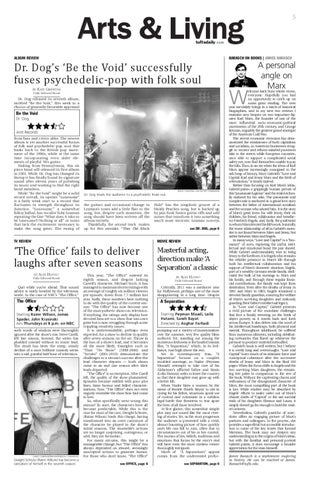
Rock Coustau via Flickr Commons
Dr. Dog treats the audience to a psychedelic freak out. the guitars and occasional change in Leaman’s tones add a little flair to the song, but, despite such moments, the song should have been written off the album entirely. Thankfully, the second track makes up for this mistake. “That Old Black
Hole” has the simplistic groove of a Moldy Peaches song, but is backed up by jazz-funk fusion guitar riffs and odd noises that transform it into something much more intricate. Leaman conveys see DR. DOG, page 6
TV Review
Movie Review
‘The Office’ fails to deliver laughs after seven seasons
Masterful acting, direction make ‘A Separation’ a classic
by
Alex Hanno
Daily Editorial Board
Quit while you’re ahead. That sound advice is rarely heeded by the television world. In the case of NBC’s “The Office,”
The Office Starring Rainn Wilson, James Spader, John Krasinski Airs Thursdays at 8 p.m. on NBC such words of wisdom were thoroughly ignored after the show’s star, Steve Carell, left last season. Instead, the series has plodded onward without its iconic lead. The result has been the steep, steady decline of a once brilliant comedy series into a sad, painful half hour of television.
David Shankbone/Wikimedia Commons
Dwight Schrute (Rainn Wilson) has become a caricature of himself in the seventh season.
This year, “The Office” entered its eighth season, and despite lacking Carrell’s character, Michael Scott, it has managed to maintain decent ratings with an average of roughly six million viewers per episode, down from 7.7 million last year. Sadly, these numbers have nothing to do with the quality of the current season: “The Office” has now become one of the most pathetic shows on television. If anything, the ratings only display how devoted fans are to a show that was once great but is now struggling through some crippling creativity issues. It is understandable, perhaps even expected, for a show to decline in quality after seven seasons on the air. Throw in the loss of a show’s lead, and it becomes all the more likely. Examples such as “That ’70s Show” (1998-2006) and “Scrubs” (2001-2010) demonstrate the challenges to a sitcom’s success after the lead character departs — both shows came to an end one season after their leads departed. “The Office” is no exception. After Carell left, the quality of the show plummeted. Episodes became riddled with poor plot lines, lame humor and failed characterizations. Now, “The Office” does not even vaguely resemble the show fans had come to love. So, what specifically went wrong this season? To start, the characters have all become predictable. While this is the case for most of the cast, Dwight Schrute, (Rainn Wilson) leads this charge, having transformed into an overt caricature of the character he played in the show’s initial seasons. The ensemble’s actions are no longer surprising, outrageous, or odd; they are formulaic. For many sitcoms, this might be a manageable change, but “The Office” has always depended on absurd, seemingly unscripted actions to generate humor. For those who don’t know, “The Office” see OFFICE, page 6
by
Alex Hanno
Daily Editorial Board
Critically, 2011 was a mediocre year for Hollywood, perhaps one of the most disappointing in a long time. Despite
A Separation Starring Peyman Maadi, Leila Hatami, Sareh Bayat Directed by Asghar Farhadi pumping out a variety of moneymakers over the summer, very few quality films surfaced. Yet, standing out among the numerous letdowns is the lauded Iranian film, “A Separation,” which, in its brilliance, rose high above the rest. Set in contemporary Iran, “A Separation” focuses on a couple’s troubled marriage, as Nader (Peyman Moaadi) attempts to take care of his Alzheimer’s afflicted father and Simin (Leila Hatami) seeks to leave the country so that their daughter may grow up with a better life. When Nader hires a woman by the name of Razieh (Sareh Bayat) to aid in caring for his father, situations spiral out of control and culminate in a ruthless legal battle that threatens to tear apart the lives of all those involved. At first glance, this somewhat simple plot may not sound like the most riveting of stories. Yet, as the story progresses the audience is presented with a vivid, almost haunting picture of how quickly one’s life can fall to ruin, often due to circumstances out of his or her control. The morass of lies, beliefs, traditions and emotions that forms by the story’s end will have even the most careless viewer thoroughly intrigued. Much of “A Separation’s” appeal comes from the understated perforsee SEPARATION, page 6
A personal angle on Marx elcome back from winter recess,
W
everyone. Hopefully you had an opportunity to catch up on some great reading. The new year inevitably brings in a batch of historical biographies, and in my next two reviews I examine new biopics on two important figures: Karl Marx, the founder of one of the most influential socio-economic-political movements of the 20th century, and George Kennan, arguably the greatest grand strategist of the American Cold War. The recent economic recession has demonstrated the weaknesses of both capitalism and socialism, as American businesses struggle to recover and reform-minded protesters take to the streets while European countries, once able to support a complicated social safety net, now find themselves unable to pay the bills. Thus, in an era when the ideas of Karl Marx appear increasingly consigned to the ash heap of history, Mary Gabriel’s “Love and Capital: Karl and Jenny Marx and the Birth of a Revolution,” is timely indeed. Rather than focusing on Karl Marx’s ideas, Gabriel paints a grippingly human picture of this “passionate logician” and the trials his family endured for his sake. The passionate and complex tale is anchored in a grand love story between the father of international socialism and the woman who adored him. It is the story of Marx’s great loves: his wife Jenny, their six children, his friend, collaborator and benefactor Friedrich Engels, and, lastly, the proletariat to whom Marx devoted his life’s work. Ironically, the truest relationship of all in Gabriel’s narrative is not found between Marx and Jenny, but rather between Marx and Engels. In many ways, “Love and Capital” is a “bromance” of sorts, exploring the joyful, intellectual and emotional bond the pair shared. While Gabriel understandably tries to bring Jenny to the forefront, it is Engels who remains the reliable presence in Marx’s life through both his intellectual collaboration and his support of Marx’s domestic situation. Engels, part of a wealthy German textile family, dedicated the bulk of his earnings to Marx and his family, and through these regular financial contributions, the family was kept from destitution. Even after the deaths of Jenny in 1881 and Marx in 1883, Engels remained a devoted family guardian, ensuring the welfare of Marx’s surviving daughters and zealously guarding their father’s intellectual legacy. In “Love and Capital,” Gabriel presents a vivid picture of the mundane challenges that face a family teetering on the brink of abject poverty as it travels back and forth across Europe. It also delves into the word of his intellectual handicaps, both physical and mental. Throughout adulthood, he suffered from numerous ailments, including debilitating carbuncles that flared up whenever the pressure to produce material intensified. Gabriel’s book is well written, but I believe it is overly long and overwrought. “Love and Capital” loses much of its dramatic force and conceptual coherence after the successive deaths of Jenny and Marx in the final 100 pages. When the focus shifts to Engels and the two surviving Marx daughters, the remaining text pales in comparison to the rest of the book. Without the captivating charm and enthusiasm of the disorganized character of Marx, the most compelling part of the book is lost. While readers may be absorbed by Engels’ efforts to make order out of Marx’s chaotic drafts of “Capital” or the sad suicidal ends of his daughters Eleanor and Laura, it simply doesn’t go far enough to hold the reader’s interest. Nevertheless, Gabriel’s pastiche of anecdotes offers an engaging picture of Marx’s partners and colleagues. In the process, she provides a superficial but accessible introduction to some of the key tenets that formed Marxism. The book may not deepen any understanding as to the origins of Marx’s ideas, but with the familiar and personal portrait Gabriel paints, it does encourage a broader appreciation for the man himself.
James Barasch is a sophomore majoring in history. He can be reached at James. Barasch@tufts.edu.