NEWS THE STUDENT LIFE
PAGE 2
APRIL 26, 2019
DENVER: One expert says group seems ‘harmless at this stage’ Continued from Page 1 quitted of those charges. “My opinion of Jnanda is that he fits the classic profile of a cult leader,” Ross said. “It appears based on the money that they have given him that he is basically living off of them.” Jnanda couldn’t be reached for comment, but previously denied claims that the Denver House is a cult. “If you look up the word ‘cult,’ there’s many definitions and it’s been morphed over the years because of misqualified cults,” Jnanda said. “Cults take on a bad name.” Ross said Jnanda appears to be the defining element and driving force who shapes the group based on the beliefs he’s assembled from various religions. He said the groups’ isolation and Jnanda’s lack of accountability concerned him as well. “It’s all about what he’s picked, what he’s chosen to include and what he teaches and his supposed spiritual wisdom and power and presence,” he said. Ross said “excessive” meditation is common in neo-Eastern groups — such as the Denver House — which induces a trance state, making people more susceptible to suggestion. Nori Muster, a researcher, author and former member of the Hare Krishna sect, which has been frequently labeled a cult, disagreed and said she doesn’t believe the Denver House is a cult, but saw several warning signs. “My take on [the Denver House] was that it’s probably pretty harmless at this stage,” she said. “It just seems like a little commune … [Jnanda] looks friendly enough, but you can’t tell by just looking at someone what’s going on inside.”
Muster said William Latta PO ’19’s statement to TSL that he would rather be shot than stop practicing his spiritual beliefs is “cultish” and “a really troubling thing.” “I admit that the statement was reactionary and understand the concern,” Latta wrote in response. “The essence of it is a relationship at my core with the Divine that transcends any group that I am with. I invite anyone to reach out for clarification.” Muster also said cult leaders convince their followers they can read minds and therefore can tell if they’re thinking about leaving the group. “[Jnanda] leads the people to believe that he has supernatural powers that other people don’t have and that he has some kind of special connection with God,” Muster said. “It’s a way to control people; that’s a red flag.” Muster said a primary characteristics of cults is isolating members through new words, languages, outfits and living situations. “[Cults] have their own language, they often have their own costumes,” she said. “There’s a lingo that you learn when you move in with them.” Phil Zuckerman, a professor of sociology and secular studies at Pitzer College, brought his “Sociology of Religion” class to the Denver House after spring break. Every week, the class visits a different religious group in the area, from Scientologists to Quakers. Isabel Kelly PO ’20, who now goes by Sundara Shakta Vinyasa Ananda, is in the class and a member of the Denver House. She suggested the visit to the house, according to Zuckerman. Zuckerman, an atheist, said he was excited to visit
the house to examine it from a sociological perspective. “To me, there’s no difference [from other religions],” he said. “[The members of the Denver House] think [Jnanda’s] divine, well, people think the Pope is divine. Every religion is based, to me, on unsupported claims, unsupported assertions.” Zuckerman recalled sitting in the backyard with his class while the Denver House’s teacher, Jnanda, sat cross-legged, dressed in a robe, with jewelry adorning his body. Having observed the group, Zuckerman said he doesn’t think it’s a cult. “These are adults who have chosen to follow this guy. To me, if you think people are being brainwashed, I would say the kid that’s being taken to Sunday school at four or five years old, that’s brainwashing, they truly don’t have a choice,” he said. “If 19- or 20- or
21-year-olds choose to follow this bald dude, why do we care? If it makes them feel enlightened, why do we care?” Zuckerman said his students’ two main concerns were Jnanda’s anti-LGBTQIA+ rhetoric and alleged cultural appropriation. “[My students] illuminated [the cultural appropriation] a bit for me,” he said. “They really helped me see that it’s not an equal exchange. There is a history of oppression, colonialism [and] imperialism.” Jnanda told TSL last week that he sees it as “silly” to say that his teachings and students are culturally appropriative. “So people who think [our spirituality] is cultural appropriation, I forgive their ignorance because they just don’t understand what’s going on,” he said. Zuckerman said stu-
dents questioned why Kelly didn’t change her name to the English meaning of her Sanskrit name and criticized how she can choose to switch between names. “She can always just flip back to Isabel Kelly when she needs to,” he said. “A person from India doesn’t have that option; they can’t just switch.” Kelly addressed Zuckerman’s students’ comments about her privilege. “With full transparency, I admit that transitioning to publicly going by my spiritual name has been a very sensitive process for many reasons. The relationship I have with this name is profoundly personal one, and I do not consider it to be a mere ‘decoration’ or shallow aspect of my being,” Kelly said via message. “At this point, I respect the need to be culturally aware of how my use of this name might be offensive to some peo-
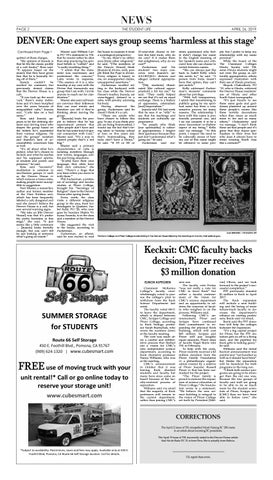
ple, but I prefer to keep my relationship with my name personal.” While the board of the The Claremont Colleges Hindu Society told TSL some Hindu students might not view the group as culturally appropriative, others expressed frustration with their use of Hindu practices. Shayok Chakraborty PO ’19, who is Hindu, criticized the Denver House residents’ use of Hindu and other South Asian iconography. “It’s just bizarre to see these same gods and goddesses plastered up around these people’s rooms like these novelty decorations when they mean so much more to me and so many others,” Chakraborty said via message. “I don’t think these are bad people and it’s great that they found spiritualism in their lives but why does it always have to mean wearing South Asia like a costume?”
TALIA BERNSTEIN • THE STUDENT LIFE
Pomona College and Pitzer College students living in the Denver House following the teachings of Jnanda, their spiritual guru.
Keckxit: CMC faculty backs decision, Pitzer receives $3 million donation ELINOR ASPEGREN Claremont McKenna College’s faculty overwhelmingly voted to pursue the college’s plan to withdraw from the Keck Science Department last week. The faculty voted 68-11 to leave the department, which is shared between CMC, Scripps College and Pitzer College, according to Keck biology professor Sarah Budischak, who wrote the numbers down at the faculty meeting. The vote was made after a careful and deliberative process that fleshed out a vision for CMC’s new independent science department, according to Keck chemistry professor Nancy Williams, who was at the meeting. CMC’s announcement in October that it was leaving Keck shocked students and faculty, but many have since come on board because of the faculty-centered process of separation. Williams said via email that the majority of Keck professors will remain in the current department, rather than joining CMC’s
new one. The faculty vote Friday “was not really a vote for CMC to leave Keck” but rather a faculty endorsement of the vision for CMC’s science department and an opportunity to address the concerns of faculty who weighed in on the process, Williams said. Following CMC’s announcement, Pitzer and Scripps have continued their commitment to expanding the physical Keck building, which will cost $65 million. Scripps and Pitzer will pay roughly equal amounts, Pitzer dean of faculty Nigel Boyle told TSL in February. To help with the costs, Pitzer recently received a $3 million donation from the Pitzer Family Foundation — a philanthropic organization created by a relative of Pitzer founder Russell Pitzer — that has been earmarked for the project. “The Pitzer family is proud to endorse the expansion of science education at Pitzer College,” the foundation wrote in a statement. “We believe the new science building is integral to the vision of Pitzer College set forth by President [Mel-
vin] Oliver, and we look forward to the project’s successful completion.” PFF previously donated $1 million to Keck in April 2017. The Keck expansion will include a new building and the hiring of more tenure-track faculty to decrease the department’s reliance on visiting professors, Boyle said via email. Boyle said the PFF donation will help the colleges kickstart the expansion. “It’s a big capital project for Pitzer, but the PFF donation gets us off to a flying start, and the pipeline for Keck gifts is looking good,” he said. Williams said the initial Keckxit announcement was painful and “not handled as well as it should have been” but thinks the separation will be beneficial for both programs in the long run. “I think both science programs are going to be stronger than the old one was, because the two groups of faculty and staff are going to be able to do so much more for the student scientists of Pitzer, Scripps and [CMC] than we have been able to before now,” she said.
CORRECTIONS The April 12 issue of TSL misspelled Niyati Narang SC ’20’s name in an article about incoming 5C presidents. The April 19 issue of TSL incorrectly stated in the Denver House article that Ale de Rada PZ ’21 is from Peru. She is actually from Bolivia.
TSL regrets these errors.