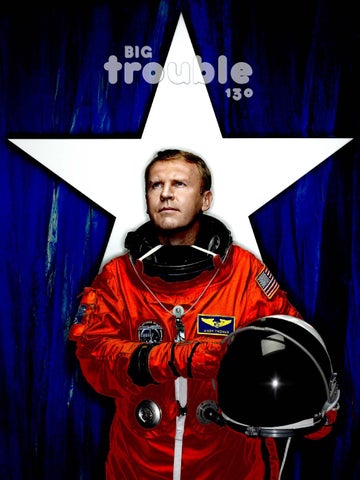
trouble 130 BIG
TRENT PARKE
the camera is god
ALL IMAGES: Trent PARKE, courtesy of the artist and Stills Gallery (Sydney) - Trent Parke: the camera is god, Monash Gallery of Art (MGA), 860 Ferntree Gully Road, Wheelers Hill (VIC), 26 November 2015 to 21 February 2016 - mga.org.au In order of appearance: Bathurst races, NSW 1999, from the series Minutes to midnight 1999-2004, gelatin silver print; 30.0 x 45.0 cm. Monash Gallery of Art, City of Monash Collection. Catfish and turtles, Roper River, Northern Territory 2011, from the series The black rose, pigment ink-jet print, 98.0 x 147.0 cm. Monash Gallery of Art, City of Monash Collection. No 447 Candid portrait of a child on a street corner, Adelaide 2013, from the series The camera is god (street portrait series), pigment print; 145.0 x 110.0 cm. No 731 Candid portrait of a woman on a street corner, Adelaide 2013, from the series The camera is god (street portrait series), pigment print; 80.0 x 60.0 cm.
CONTENTS TRENT PARKE: THE CAMERA IS GOD Monash Gallery of Art ................................................................................ 02 COMICS FACE
Ive Sorocuk ...............................................................................................
THE MADNESS OF ART: WATER UNDER THE BRIDGE & RED DOTS
Jim Kempner ............................................................................................
11
12
A POST ENCOUNTER: CASPER JEAN RIMBAUD Social Work .............................................................................................. 14 MEMENTO PARK: AN AUDIENCE WITH THE COMRADES Inga Walton .............................................................................................
DEC/JAN SALON
Decidedly Juicy .......................................................................................
WOOD & TRADITION: JOINED AT THE HIP
Gordon Dowell ........................................................................................
GREETINGS FROM BEYOND THE PALE: EXPULSION FROM THE GARDEN OF EDEN
Ben Laycock ...........................................................................................
20 40 52
60
COVER: MONTALBETTI+CAMPBELL, Andy Thomas 2002, type C photograph on polyester-based paper. Collection: National Portrait Gallery, Canberra. Commissioned with funds provided by the L Gordon Darling AC CMG 2002. Uncommon Australians: The Vision of Gordon and Marilyn Darling, a National Portrait Touring Exhibition, McClelland Gallery + Sculpture Park, 390 McClelland Drive, Langwarrin (VIC), 13 December 2015 to 21 February 2016 - mcclellandgallery.com Issue 130 DECEMBER 2015 / JANUARY 2016 trouble is an independent monthly mag for promotion of arts and culture Published by Trouble Magazine Pty Ltd. ISSN 1449-3926 CONTRIBUTORS Ive Sorocuk, Jim Kempner, Inga Walton, Ben Laycock, love. GET from AppStore FOLLOW on issuu & twitter SUBSCRIBE at troublemag.com READER ADVICE: Trouble magazine contains artistic content that may include nudity, adult concepts, coarse language, and the names, images or artworks of deceased Aboriginal or Torres Strait Islander people. Treat Trouble intelligently, as you expect to be treated by others. Collect or dispose of thoughtfully. DIS IS DE DISCLAIMER! The views and opinions expressed herein are not necessarily those of the publisher. To the best of our knowledge all details in this magazine were correct at the time of publication. The publisher does not accept responsibility for errors or omissions. All content in this publication is copyright and may not be reproduced in whole or in part in any form without prior permission of the publisher. Trouble is distributed online from the first of every month of publication but accepts no responsibility for any inconvenience or financial loss in the event of delays. Phew!
This comic first appeared in Trouble December 2013
art comedy series
WATER UNDER THE BRIDGE Cousin Billy gets another chance when Jim hires him to check names at an important gallery event.
Dec/Jan double dose
RED DOTS Jim attempts to convince Dru of the power of ‘hidden persuasion’.
visit: themadnessofart.com/
SOCIAL WORK
A Post Encounter with Casper Jean Rimbaud
Casper Jean Rimbaud is an author and multi-media artist from Melbourne. His first novel, Post Encounter (Fiction Terrifica, 2015), tells the terrifying story of an ordinary middle class Australian family held captive in their home by a silent yet deadly alien. Now in his 30’s, Casper has struggled with the mental illness Bipolar since his early teens. Fittingly, Casper agreed to a little Social Work to celebrate the release.
Which member of your family influenced you the most? CJR: My family were the stock photo Western suburbs family. My old man worked in factories and my step-mother did a lot of ironing. I had this childhood fantasy that Spielberg was my real dad. I’ve since reconciled the fact that Steven Spielberg isn’t my father, and the one I did get is pretty okay. How do your values differ from those of your family? CJR: I rejected the suburban dream – get a job, climb the company ladder, get married, have kids, quasi-worship a sports team, have lots of bbqs and then die. I had to be inventive with my choices. And by that I mean devastatingly foolish. Do you have a favourite family story? CJR: My step-mother’s family had jacks (police) in it and we’d have to see them every Christmas. One time this cop family member growled at me like a dog, trying to intimidate me. I was about 11 years old at the time and he was trying to impress his girlfriend, or something. I was so full of rage I went outside with a fork and stabbed a tree. What do you hope for? CJR: A resolution to the terror problem and another album from East 17. What do you think is your main purpose in life? CJR: Much like Kanye, I believe that if they wrote a modern day Bible, I’d be one of the people in it. A low-level dude though. Someone behind the scenes. Do you think its ok to lie? CJR: Could you imagine a world without lying? “Hey, your hair looks shit and you swing your arms like a bloke when you walk...”. I was at a funeral one time and I tried to convince the father of the deceased that Jason (the guy who died) owed me $25. He only owed me $20, but I lied and added the extra five on because I didn’t really like Jason. One time we had a photo taken with some mates and when it was developed, Jason was staring at me coldly whilst all the other guys were smiling. Things like that stick with you. Jason’s dad only had $30 and I ended up feeling bad because I had no change for him. So, you see, lying can lead you to dark places. What does freedom mean to you? CJR: It’s indescribable. As Corey Haim once so eloquently stated ‘it feels like seahorses swimming up my bloodstream’ [Haim’s quote from Me, Myself and I refers to kissing and dolphins – ed]. That good, I really appreciate it now because I used to work in a department store where red and black were the uniform colours. Going to work was like spending eight hours voluntarily marching in Red Square. Now I write things for a living and wear what I want. That’s freedom baby. Stacking paper to the ceiling. Caspar Jean Rimbaud / Social Work
ABOVE & NEXT SPREAD: Stills from Caspar’s upcoming film Dark Night of the Werewolf
What do you think are the most important social issues today? CJR: Outside of the terrorism, the rumblings of civil unrest in Europe and the continuing degradation of females in the media, I really worry that 50Cent has fallen off for good. That last record was beyond sub-par. What beliefs do you have that you think will never change? CJR: Art is most perfect when flawed, and that the government put a wire in my head to control my thoughts. Do you believe in the supernatural? CJR: I asked a Ouija board once if Elvis was alive and it said ‘yes’. Is any religious text important to you? CJR: This is a progressive arts magazine, yeah? In that case all of them. Have you ever come close to dying? CJR: I don’t know, did you bring a pack lunch? One night I did 400mg of oxycontin, a bottle of Robitussin and enough Bupe strips to kill a triceratops. Walking around gasping for breath looks bad when at home at three in the morning, but totally unprofessional at 11am when your supervisor is questioning you over fact you’re wearing the wrong shoes and slipping in and out of consciousness. What do you like the best about your body? CJR: The fact that it hasn’t totally shut down in the last 16 weeks.
4
What do you think would be the best thing about being the opposite gender? CJR: I used to have a recurring dream that I was married to Chaz Bono and we were on Oprah together discussing how we fell in love, but Chaz goes ape-shit and starts smashing up the set. Oprah’s crying, screaming through her fingers and I’m asking ‘why isn’t anybody stopping this?’ Make of that what you will. Who is the best teacher you have ever had? CJR: Western Suburbs dude. I lived in St Albans and Sunshine. The teachers there took self-defence lessons at lunchtime, and could often be seen scraping pens against the concrete to make a shiev, or shank, as it is more classically known. Have you ever been lost? CJR: I used to do door to door sales but would lose my map and wander around the suburbs like a dazed nomad. I’d literally get lost every day and wait for the company bus to find me. I was too timid for door to door sales. What was your favourite book as a child? CJR: Alice in Wonderland. If I asked a good friend of yours what you were good at, what would they say? CJR: They’d most likely say ‘Who?’ I don’t have many friends. I have acquaintances. I suppose my acquaintances would say I’m good at playing pretend, but then again that’s not always a good thing. What stays the same in your life, no matter how much other things change? CJR: The fact that reality is a program and wise elves who exist in another dimensional frequency have complete control of it. Our race and everything we see, think and hear is merely a projection. We’re simply data in a computer. Our reality is monitored and controlled. What is stopping you? CJR: The ankle bracelet. I have to get my mail with a fishing pole. Casper’s debut novel Post Encounter is now available on Amazon in paperback and for Kindle. Casper has just launched his own art website titled Melbournian Psycho, and has a feature length film, Dark Night of the Werewolf, which he made during a bipolar episode, ready for release early 2016.
An Audience With the ComradeS by Inga Walton
When your Socialist utopia crumbles under the weight of decades of anger and seething resentment on the part of the brutalised proletariat, what becomes of the visual representations of that oppression? Any despotic régime worthy of a body count needs suitable props to intimidate and subdue the sullen populace, inducing conformity with monuments celebrating Party apparatchiks and glorifying Communist ideals in the form of stoic patriots and obedient workers. ...
> The Three Terrors: Stalin, Lenin and Mao, souvenir poster (concept by Ákos Réthly), 70 x 100 cm, © Memento Park, Budapest. Available from the Red Star Store - mementopark.hu/shop
4
These imposing ideological relics are amongst the first symbols of authority to be vandalised when their subjugated and embittered audience gets the opportunity; most are hastily removed, if not destroyed. Nonetheless, some institutions and private individuals have seen the value in retaining such totalitarian plinth-warmers. Grūtas Park (known as ‘Stalin’s World’) in Druskininkai, Lithuania, Fallen Monument Park (Muzeon Park of Arts) in Moscow, and the Museum of Socialist Art in Sofia, Bulgaria, all display examples of the apparatus of terror employed by the former Soviet states. On a small bus careering along the narrow winding roads into the remote and semi-rural environs of South Buda we head to Memento Park (Szoborpark Múzeum), which offers a look at nearly fifty of these now-vilified, but curiously compelling sculptures from Hungary’s Communist period (1949-89). Architect Ákos Eleőd won the design competition announced by the Budapest General Assembly (Fővárosi Közgyűlés) in 1991 to design a site for these contentious works. Speaking of his difficulties with the overall concept for the Park, Eleőd explained, I had to recognise that I needed to summarise the individual thoughtprovoking elements of a historical series of paradoxes into one conceptual thought process. Paradox, because these statues are both the reminders of an anti-democratic society and at the same time pieces of our history; paradox, because they are symbols of authority and at the same time works of art; and finally, paradox, because despite the fact that they were without doubt originally set up for the purpose of propaganda, in assigning them a new location, I deemed it important to avoid the possibility that they would become anti-propaganda, which would have been no more than a continuation of dictatorship mentality.1 The neoclassical red brick main entrance hearkens back to the characteristic Socialist Realism style of imposing façades and looming columns. The ‘official’ style of Soviet culture expressed Communist ideology through architectural construct, “by their sheer enormity, their power over everything, they emphasise the worthlessness of everything beneath them and the desire to be served by those under them”.2 Two arches either side of the gate enclose the venerated ‘icons’ of the Communist movement, at the apex of Socialist Realism’s twisted cult of personality. Marx and Engels (Marx és Engels) (1971) by György Segesdi is thought to be the only cubist-style representation of the authors of the The Communist Manifesto (1848) ever produced. Segesdi had originally wanted to use sheets of welded steel for the work, but the Party hierarchy considered that idea too radical, insisting that such an important work must be made from a material more ‘worthy’ of the subjects. The cubist design was retained, but the medium changed to the more traditional Mauthausen granite. The work was installed outside the entrance of the Communist Party Headquarters in Jászai Mari Square. Sculptor Pál Pátzay (1896-1979), was one of twelve nationally known and respected figures to be appointed as deputies in the Hungarian National Assembly by the transitional government in 1945.3 His work Lenin (1965) originally stood in Parade
> György SEGESDI (Hungarian, b.1931), Marx and Engels (Marx és Engels) (1971), Mauthausen granite, 4.2 metres (height). Originally located at 5th District, entrance of the Communist Party Headquarters, Jászai Mari Square. Photo: Inga Walton
4
Square (Felvonulási tér) where the mass political and military rallies were conducted. Unusually, for such an important personage, the statue is relatively small, but this was a deliberate choice designed to emphasise Lenin’s ‘proximity’ to the people. The ubiquity of the great and infallible leader continues inside the gates with a threequarter length study in granite, Lenin (1970) by Agamémnon Makrisz (1913-93), and out into the grounds with a small plaque, Lenin Relief (Lenin-emléktábla) (1970) by Iván Szabó, and a bronze statue Lenin (1958) by an unknown Soviet sculptor. The first area of the Park lies east of the main entrance and encompasses the trapezium-shaped Witness Square (also called ‘Neverwas Square’) where a replica of ‘Stalin’s boots’ by Ákos Eleőd has been installed on a raised dais. The original eight-metre statue of Josef Vissarionovich Stalin (1878-1953) weighed 6.5 tonnes and stood omnipresent on a grandstand in Parade Square, an edifice twenty-five metres high in total and eighteen metres long, beneath which the Party leaders reviewed the obligatory saluting soldiers and marching crowds. Created by Sándor Mikus (1905-82), the monument was ostensibly a gift from the Hungarian People to mark Stalin’s seventieth birthday (officially 21 December, 1949), and was unveiled before a crowd eighty thousand strong on the morning of 16 December, 1951.4 The front of the tribune was decorated with a high relief frieze depicting idealised scenes of the Hungarian people (children, farmers, soldiers, workers, the elderly, mothers) welcoming their honoured guest; sections from the left side of the frieze lie on the ground inside the entrance to Memento Park like funerary markers. Inspired by the Polish October movement and its leader Władysław Gomułka (1905-82), thousands of Hungarians gathered in Parade Square, 23 October, 1956, to demand similar political reforms in Hungary. During the demonstrations that followed, steel ropes and blowtorches were used to pull the statue of Stalin down from its pedestal, whereupon sections of it were dismembered and dragged through the streets by the jubilant crowds. Only his boots remained in position, into which Hungarian flags were placed, a mockery of the ‘Great Leader’.5 On 1 November, 1956, the Chairman of the Council of Ministers of the Hungarian People’s Republic, Imre Nagy (1896-1958), announced Hungary’s withdrawal from the Warsaw Pact; by 4 November Soviet forces had invaded Budapest. Thousands of deaths and widespread casualties ensued. A new Moscow-approved government was in place by January, 1957, and Nagy was executed in June, 1958. An exhibition hall and a small movie theatre in the barracks, designed to resemble internment camp buildings, opened in 2007. Under the government of János Kádár (1912-89), General Secretary of the Hungarian Socialist Workers’ Party (Magyar Szocialista Munkáspárt), or MSZMP, from 1956 until his retirement in 1988, the Ministry of Interior Affairs had its own film studio. Several hundred short and feature-length films were produced by the Ministry between 1958 and 1988 for propaganda and ‘educational’ purposes. These productions included ‘training and instruction’ films for the secret police covering topics such as the methods employed to hide listening devices, how to conduct searches, recruit suitable candidates for the force, and effective networking. Documentary filmmaker Gábor
Memento Park: An Audience with the Comrades / Inga Walton
Zsigmond Papp edited several of these short films together to form a four-part montage, The Life of an Agent (Az ügynök élete) (2004), shown in a loop as part of the permanent exhibition. The rest of the statues and plaques are installed in three figure eight formations around a central circular flower-bed with a red star in an area officially named ‘A Sentence About Tyranny’ Park. This is in reference to the poem One Sentence on Tyranny (Egy mondat a zsarnokságról) written in 1950 by Hungarian writer and parliamentarian Gyula Illyés (1902-83), the verses of which are inscribed on two large metal panels at the Park’s entrance. Most sculpture parks are meticulously maintained, but as Memento Park is set within a large tract of land on the Tétényi moors with few surrounding structures, trees and other plants are allowed to encroach on the works. The passage of time is marked much as it would be in a graveyard. This seems appropriate, both for the ideology that produced these works, and more poignantly for those whose lives were forfeit to it. The monuments are grouped into three broad categories: the ‘Endless Parade of Liberation Monuments’, the ‘Unending Parade of Workers’ Movement Personalities’ and concluding with the ‘Unending Parade of Workers’ Movement Concepts and Events’. Memento Park was opened in June, 1993, a date chosen to mark the second anniversary of the final withdrawal of Soviet troops from Hungarian territory, 19 June, 1991. There is an irresistible kitsch factor associated with many of these determinedly serious and incredibly ponderous, but ultimately absurd sculptures. To westerners, the end of the Cold War has rendered the identifiable political figures benign and easily mocked: ‘selfie’ heaven within the retirement village for demagogues and their servile cronies. Various Hungarian Socialist Party personalities are literally ‘faceless’ – from prominent functionaries to those fêted as martyrs to the Communist cause – they are virtually unknown to foreign visitors, and now consigned to history. Nonetheless, it must be remembered that for many Hungarians, these works still carry sinister associations as objects of fear and repression. They are the surviving symbols of a once sophisticated and proud country brutally subjugated by the all-pervasive and poisonous Soviet influence, likened to “a spiritual and physical quarantine”.6 Eleőd acknowledges this potentially uncomfortable divergence in perception, “A foreign tourist, for whom dictatorship is merely something they have read about, has completely different thoughts when in the Park than the person with a tragic past, who lived here, survived and under the aegis of these statues takes the drama of his own ruined life into the Park with him. But the silence is shared”.7 To commemorate the Soviet ‘liberation’ of Hungary from German occupation, 4 April, 1945, Marshall Kliment Yefremovich Voroshilov (1881-1969) commissioned the Liberty or Freedom Statue (Szabadság Szobor) (1947) on Gellért Hill overlooking the Danube. Designed by Zsigmond Kisfaludi Strobl (1884-1975), a female figure (13.5 metres tall) holding a palm frond stands atop a stone pillar some twenty-two metres high. In front of that, on a plinth seven metres high,
4
stood the Liberating Soviet Soldier (Felszabadító szovjet katona) (1947/58), for which Private Vasili Ivanovich Golovcov of the Red Army was the model. With a PPSh-41 submachine gun draped across his chest, he holds up a large flag bearing the hammer-and-sickle symbol in his right hand while his left is clenched into a fist. This turned out to be quite prophetic, as the Soviets had no intention of relinquishing their grip on Hungary. The depraved Mátyás Rákosi (1892-1971), who described himself as “Stalin’s best Hungarian disciple”, did his master’s bidding with great zeal until he was forced to retire in June, 1956. Over the years there has been speculation as to whether Kisfaludi Strobl, who was declared the People’s Artist of the Hungarian People’s Republic and named an honorary member of the Soviet Academy of Arts in 1958, recycled a design he already had near completion and simply made a few politically expedient amendments. Kisfaludi Strobl had already received a commission to design a monument to István Horthy de Nagybánya (1904-42), the popular eldest son of the Hungarian Regent, Admiral Miklós Horthy de Nagybánya (1868-1957). First Lieutenant Horthy, then Deputy Regent, was killed in a flying accident in Russia while serving in the Royal Hungarian Airforce, but as the war continued, the memorial did not proceed. Liberating Soviet Soldier was another work to be pulled down from its plinth during the October, 1956 revolution. It was then replaced by an exact copy in 1958, was removed again in the early 1990s, and is now at Memento Park. Kisfaludi Strobl’s other work at the Park, Hungarian-Soviet Friendship Memorial (A magyar-szovjet barátság emlékműve) (1956), shows a grateful Hungarian worker shaking hands with a Soviet soldier. Designed to reinforce the advantages of a cordial relationship with the Soviet Union, the work was nonetheless considered rather telling: the Hungarian offers friendship with both hands, while the Russian coolly offers only one hand in response. The extent to which some of the works have been ‘scavenged’ is evident from the damage inflicted on several of them, including the statue of Ferenc Münnich (18861967) by István Kiss (1927-97). A former Chairman of the Council of Ministers of the Hungarian People’s Republic (1958-61), Münnich was the hard-line Minister of the Interior and of Defence who played a key role in crushing the 1956 uprising, but was ultimately passed over for the Party leadership in favour of the more compliant János Kádár. Originally the work was full-length, but on 21 March, 1990 it was cut at the knees and knocked down, reportedly with the encouragement of György Krassó (1932-91), the former dissident jailed by the Party for his role in the 1956 uprising, but who had recently returned to Hungary from exile in London.8 Also by Kiss, the Workers’ Movement Memorial (Munkásmozgalmi emlékmű) (1976), has significant damage to its reverse. The original sphere was made of plastic and decorated with a five-pointed star, but it was repeatedly defaced; in 1982 it was replaced with a less perishable plain granite one. The work was baffling to many when it was originally unveiled, and is typical of the convoluted subtext favoured by the Party. According to the official explanation the sphere represents the perfect ideology which has been fought for, realised and perfected by the Worker’s Movement. The two hands are defending and protecting this fragile treasure, while at the same time opening up so that it can be seen by, and made available to, everyone.9 Um ... sure. Memento Park: An Audience with the Comrades / Inga Walton
Zsigmond Kisfaludi STROBL (Hungarian, 1884-1975), Liberating Soviet Soldier (Felszabadító szovjet katona), part of the Liberty or Freedom Statue (Szabadság Szobor), (original, 1947/copy, 1958), cast in bronze, 6 metres (height). Originally located at 11th District, Gellért Hill. Photo: Inga Walton.
Zsigmond Kisfaludi STROBL, Hungarian-Soviet Friendship Memorial (A magyar-szovjet barátság emlékműve) (1956), cast in bronze, 2.5 metres (height). Originally located at 10th District, Pataki [now Szent László] Square. Photo: Inga Walton.
István KISS (Hungarian, 1927-97), Workers’ Movement Memorial (Munkásmozgalmi emlékmű) (1976), steel plates, granite, 3 metres (height). Originally located at 2nd District, Hűvösvölgy. Photo: Inga Walton.
Revolutionary leader Béla Kun (1886-1938/39) is commemorated in three works. As the founder of the Hungarian Communist Party in 1918, he led the short-lived Hungarian Soviet Republic of March-August, 1919, before going into exile, first in Austria where he was arrested, and thereafter in Russia. With Lenin’s approval, Kun was active in atrocities perpetrated against prisoners of war and civilians in the Crimea in 1920, and ethnic cleansing of the Crimean Turks. He was a prominent operative of the Comintern in Germany, Austria and Czechoslovakia for the rest of the decade, but was later accused of Trotskyism and arrested in 1937 during Stalin’s ‘Great Terror’. So sensitive was information regarding his fate that for years the official Soviet line was that Kun had died mysteriously in prison in 1939. In 1989 it was reported that, following a brief and secret judicial proceeding, Kun had been executed in the Gulag in 1938. Following the policy of deStalinisation instituted by Nikita Khrushchev (1894-1971) in the 1950s, Hungarian communists posthumously rehabilitated Kun as a national hero, despite the fact that he never returned to his homeland. Unfortunately for the Csepel Committee of the Hungarian Socialist Workers’ Party they did not take delivery of the Béla Kun Memorial Plaque (Kun Béla emléktábla) (1989) for their headquarters until rather late in the day, as it were. Surrounded by stony-faced comrades, this rather clunky effort by Viktor Kalló commemorates Kun’s engagement with the predominantly working-class 21st District, known for its Iron and Steel Works. The inscriptions reads, “In this square on March 18th, 1919, the Csepel workers, Béla Kun, and the other communist leaders arrested with him demanded to be set free. Here they pledged their loyalty to the programmes of the KMP (Communist Workers Party) and the power of the workers”. Kun appears as the middle figure in the Monument to the Heroes of the Workers’ Movement (Munkásmozgalmi harcosok emlékműve) (1967), a composite work by three artists. Kun’s likeness by Zoltán Olcsai-Kiss (1895-1981) is flanked by that of Tibor Szamuely (1890-1919) by Aladár Farkas (1909-81). Szamuely was the fanatical People’s Commissar for Military Affairs who led the ‘Red Terror’, and whose feared personal guards were nicknamed the ‘Lenin Boys’. The third in this Triumvirate of Terror is Jenő Landler (1875-1928) who became the People’s Commissar of Interior Affairs and a commander of the Hungarian Red Army; his is the only work at Memento Park by a female artist, Klára Herczeg (1906-97). Imre Varga, who studied under Pál Pátzay and Sándor Mikus, is often described as Hungary’s leading contemporary sculptor, and has a designated Collection within the Gallery of the Municipality of Budapest. Varga enjoyed a distinguished career during the Communist era, and has been entrusted with several other important public works since then, including the Wallenberg Memorial (1987), and the Memorial of the Hungarian Jewish Martyrs (1991), located behind the Dohány Street Synagogue. Varga’s earlier output includes one of Memento Park’s more bizarre works, the Béla Kun Memorial (Kun Béla emlékmű) (1986). Designed as a dynamic (if rather confusing) narrative, the work was commissioned by the Communist party to mark the 100th anniversary of Kun’s birth. As Ákos Réthly, the general manager of Memento Park, has commented, “The reason for the enormity of these celebrations Memento Park: An Audience with the Comrades / Inga Walton
is paradoxical. Neither Kun’s personality, nor his achievements are admired or understood by the official Communist historians, or by general consensus”.10 Varga strives to provide some sort of context for the renewed interest in Kun, whose political significance within Hungary had perhaps been diminished by his years in exile, and more active engagement with Soviet political affairs. The figure of Kun is elevated on a platform as he gestures to the agitated mob who all face right as if charging forward in the direction he commands. The rows of characters he presides over represent the chaotic political developments in Hungary throughout 1918-19. At the extreme left of the work we see a bourgeois couple: he is dressed in a trench coat and wearing a fedora, she is clad in a long dress with a patterned cloak and holding an umbrella.11 The couple symbolise the so-called ‘Aster Revolution’ led by the socialist Count Mihály Károlyi de Nagykároly (1875-1955). This established the First Hungarian Republic, or Hungarian People’s Republic, after the dissolution of the Austro-Hungarian Empire and the withdrawal of King Charles IV (18871922) from State affairs. Directly beneath Kun we see working-class demonstrators building the momentum for popular revolt, then the troops of the Hungarian Red Army rush forward with their bayonets raised ushering in Hungary’s Red Terror. The scale of the work is certainly impressive, as befitted its original placement at one end of Vérmező Park (which means ‘field of blood’), near Budapest’s Southern Railway station, but the cluster of levitating figures charging to nowhere lends it an inadvertently comical look. Réthly ticks off the problems with Varga’s ultimately flawed work, which struggles to reconcile Kun’s divisive legacy with the Party’s agenda. “Béla Kun is portrayed as a leader, but detached from reality and speaking to the crowd. He is showing the way, leading the assault, while he is waving goodbye with his hat. His ship is being tossed about in the storm, in the background the mast light, reminding us of a gallows, ominously alludes to the still confused circumstances of his later death. The crowd, coming from nowhere and heading nowhere, their feet not even touching the ground, symbolises those who were executed during the Red Terror, hovering like ghosts above the ground”. At the time this grandiose and faintly ridiculous monument was completed, the Party leadership could not have conceived how immanent their political irrelevancy, and that of the work, would be. “The statue is basically a ‘parody’... during the fall of communism, members of the opposition wrapped the statue up, painted it and put a clown’s hat, complete with bells, onto Kun’s head”, Réthly relates.12 One of the few other non-Hungarian personalities to be individually memorialised is Bulgaria’s first post-war Communist leader (1946-49), Georgi Dimitrov (Mikhaylov) (1882-1949). Dimitrov Square existed in Budapest (1949-91), now Fővám Square, and both of these sculptures were gifts from Communist Bulgaria to their Hungarian comrades for its edification. The first is a modest and uninspiring bust, Georgi Dimitrov Bust (Dimitrov mellszobor) (1954/1984), by Jordan Kracsmarov (1895-1984), the original of which was knocked down in the 1956 revolution, and later replaced. The second, full-length treatment, Dimitrov Statue (Dimitrov szobor) (1983), was produced by one of Bulgaria’s most senior
4
Imre VARGA (Hungarian, b. 1923), Béla Kun Memorial (Kun Béla emlékmű) (1986), bronze, chrome, red copper, 2.5 metres (height, main figures). Originally located at 1st District Vérmező-park. Photo: Inga Walton.
4
and respected artists, Valentin Sztarcsev whose varied practice ranges from numerous monumental works, to medals and works on paper.13 An exiled Greek artist, Agamémnon Makrisz (aka. Memos Makris), is responsible for one of the most striking works, Memorial to the Hungarian Fighters in the Spanish International Brigade (A spanyolországi nemzetközi brigádok magyar harcosainak emlékműve) (1968). Three giant and highly stylised bronze guards stand saluting next to a limestone tablet with an inscription honouring the Hungarians who fought in the Spanish International Brigade (1936-39). The piled stone slabs next to the guards list the locations of battles and dates of the Spanish Civil War on their sides. “Among the Hungarian volunteers were many Communists. Later political propaganda sought to magnify their role: by making heroic deeds out of their actions, they sought to find and strengthen the roots of the ‘international proletariat’ within these events”, says Réthly.14 During the German Occupation of his homeland (1941-44), Makrisz played an active role in the National Resistance. After the liberation of Greece, he accepted a scholarship from the French Institute and participated in several prestigious exhibitions in Paris. In the aftermath of the Greek Civil War (1946-49), Makrisz’s political allegiance to the Left brought him to the attention of Greek authorities who pressured their French counterparts to deport him back to Greece. In 1950, Makrisz and his wife Zizi were offered refugee status by Hungary, where they received help from Hungarian refugee agencies and the local Greek community. He was stripped of his Greek citizenship in 1964, and only regained it in 1975 after the junta known as the Regime of the Colonels ended, ushering in the first democratic elections in a decade. Makrisz established himself a leading sculptor in his adopted homeland, and produced several notable works such as the Liberation Monument (Nike) (Felszabadulási emlékmű (Niké) (1975) in Pécs. The robust and almost generic figures in Memorial to the Hungarian Fighters bear some similarity to those in Makrisz’s Mauthausen Memorial (Mauthauseni Mártír-emlékmű) (1964) in Austria commemorating the victims of the Mauthausen-Gusen concentration camps, where Nazi authorities implemented their Extermination Through Labour (Vernichtung durch Arbeit) programme. A slightly different version of the original Austrian work, Magyar Mártír Emlékmű (1986), was installed at 13th District Kerület, in Viza street on the banks of the Danube, to commemorate those Hungarians killed by the Nazis in the winter of 1944-45. The monument was a project initiated by the Budapest City Council and the Association of Hungarian Resistance Fighters and Anti-Fascists (Magyar Ellenállók és Antifasiszták Szövetsége, or MEASZ), and is the site of an annual wreath-laying ceremony (12 February). The colossal Republic of Councils Monument (Tanácsköztársasági emlékmű) (1969) by the prolific István Kiss, is a favourite amongst foreign visitors to Memento Park, an irony that would not be lost on the Hungarian public who had to endure it daily. This enormous work, “an example of socialist gigantism”,15 was
Memento Park: An Audience with the Comrades / Inga Walton
Agamemnon MAKRISZ (aka. Memos Makris) (Greek, 1913-93), Memorial to the Hungarian Fighters in the Spanish International Brigade (A spanyolországi nemzetközi brigádok magyar harcosainak emlékműve) (1968), bronze and stone, 9.5 metres (height). Originally located at 5th District, Néphadsereg [now Honvéd] Square). Photo: Inga Walton.
4
modelled after an avant-garde propaganda poster by Róbert Berény (1887-1953).16 Intended to encourage military recruitment, To Arms! To Arms! (Fegyverbe! Fegyverbe!) (1919), was designed and printed during 133 days of the Hungarian Soviet Republic. Kiss’ reinterpretation, honouring the first Hungarian ‘workers’ state’, aims to capture the extreme force of expression and dynamic power of the original graphic work, but remains oddly one-dimensional. The Monument soon became the object of derisive jokes in Pest. “The site of the statue was shocking – if you looked at it from the right angle – a huge giant was running out from among the trees of the City park [Városliget]”, Réthly asserts. “In City folklore, the statue became known as the ‘cloakroom attendant’, who was running after someone: ‘Sir, you forgot your scarf!’”17 As David Lowe and Tony Joel have observed, “Despite, or perhaps because of, such popular contempt, the statue serves as an important reminder of how Hungarian leaders during the Cold War era reached back to 1919 to reinforce the notion that Communism was not a ‘foreign’ politico-ideological system now being enforced upon Magyars by Moscow, but rather it had strong national roots”.18 Towards the rear of the Park are two works on raised plinths that commemorate events from the Battle of Budapest in December, 1944. Although they are by different artists, and were not erected in proximity originally, the decision to pair them is a fitting one. The encirclement of the city by Soviet and Romanian troops from 26 December, 1944 until the German and Hungarian forces surrendered on 13 February, 1945 was a strategic victory for the Allies, but decimated Budapest. An estimated 38,000 civilians died during the siege, either from military action, starvation, or disease; Soviet troops then initiated an orgy of violent reprisals against survivors. Two peace envoys were dispatched to treat with the besieged commanders, 29 December, 1944, both carried an ultimatum for the city’s surrender. Sándor Mikus depicts the Hungarian-born Red Army Captain Miklós Steinmetz (1913-44), who set out from the South-East, in Captain Steinmetz (Steinmetz kapitány) (1958). Steinmetz was killed on his return to base when he drove over a mine in Üllői Avenue (Üllői út), the longest avenue in Budapest. During the Socialist era the avenue’s name was Vörös Hadsereg útja (‘street of the Red Army’), and the statue was erected near the death site. Jenő Kerényi (1908-75) provides us with the second envoy, the Ukranian Captain Ilia Afanasjevics Ostapenko, who approached from the South-West, and was killed by screen fire from his own side. At the beginning of the 1990s, the debate about whether to leave or take down many of these monuments was spirited, and the removal of Ostapenko (Osztapenkó) (1951) was quite controversial. “The work changed in its significance over time ... motorists heading to Lake Balaton or Vienna on the motorways newly built at the end of the 1960s set out from Budapest right where the statue stood”, Réthly recalls. “Young hitch-hikers heading for Balaton were recommended to stand by Ostapenko, and as those returning home glimpsed the envoy’s statue they sighed, ‘Home at last!’. In this way Ostapenko became the symbol of leaving and coming home, a landmark and a good friend. Or to put it another way, forgetting all of the political implications, people grew to like him”.20 Memento Park: An Audience with the Comrades / Inga Walton
From its inception, Memento Park has had to tread a difficult path between being respectful of the deeply compromised history of these works, and otherwise appearing like a Communist theme park, complete with a Trabant (yes, you can sit in it) and a selection of nostalgic souvenirs. “Whereas there is no doubt that Memento Park evokes very different feelings among curious yet detached western tourists compared to Hungarians and other eastern Europeans who lived through Communism, it is equally true that for all visitors it offers a unique experience that represents a most remarkable departure from the usual arenas of articulation”.21 As the Communist era in Europe recedes further into memory, the mechanisms by which fear and compliance were maintained in daily life become harder for subsequent generations to comprehend. Memento Park is not a sombre place, rather it is a fascinating and quite sobering one: there is a certain pathos that clings to these monuments to megalomania. Although, as Beverly Ann James has observed, “the relocation of the Communist monuments radically destabilised whatever meanings they had come to embody to the various publics that encountered them in their original settings”.22 Marooned in the countryside amongst the vegetation and the elements, the sculptures look somewhat forlorn, and yet no visitor would wish for them to ever again fulfil their malign purpose in conferring legitimacy on tyrants. It is this inherent contradiction that preoccupied Ákos Eleőd, “Every violent form of society formalises the need and the right to re-analyse, touch up and appropriate their own past in order to shine favourable light on the ‘historical necessity’ of their régime. Democracy is the only régime which is capable of looking back to its past, with all its mistakes and wrong turns, with its head up. The wonderful thing about looking back is that you are free to do this. Democracy is the only régime that has dignity”.23 Memento Park, 22nd District (South Buda), Corner Balatoni Road & Szabadkai Street (Balatoni út- Szabadkai utca sarok), Budapest, 1223 Hungary - mementopark.hu FOOTNOTES: 1 Ákos Réthly (Ed.), In The Shadow of Stalin’s Boots: Visitors’ Guide To Memento Park (Sztálin csizmái árnyékában: Memento Park látogatói kalauz), Premier Press Publishing/Private Planet Books, Budapest, 2010 (Trans. Erika J. Füstös and Helen Kovács), p.6. 2 Ibid, p.16. 3 Mária Palasik, Chess Game for Democracy: Hungary Between East and West, 1944-1947, McGill-Queen’s University Press, London, 2011, p.26. 4 Beverly Ann James, Imagining Postcommunism: Visual Narratives of Hungary’s 1956 Revolution, Texas A&M University Press, College Station, 2005, p.46. 5 David Lowe and Tony Joel, Remembering the Cold War: Global Contest and National Stories, Routledge, Oxon, 2013, p.104. 6 Ákos Réthly (Ed.), op cit, p.58. 7 Ibid, p.7. 8 Ibid, p.39. 9 Ibid, p.45. 10 Ibid, p.36. 11 Women with umbrellas were a motif within Varga’s work of the period, inspired by prostitutes he saw in Paris waiting in the rain for their clients. They reappear in the work Waiting (Várakozók) (1986), which can be seen in Óbuda outside the building housing The Imre Varga Collection. 12 Ákos Réthly (Ed.), op cit, p.36-37. 13 Following his eightieth birthday in August, Sztarcsev held an exhibition of all white large-scale abstract sculptures inspired by Biblical narratives at Gallery Raiko Alexiev at the Union of Bulgarian Artists, Sofia (7-24 October, 2015). 14 Ákos Réthly (Ed.), op cit, p.45. 15 David Lowe and Tony Joel, op cit, p.109. 16 Berény was back in the news when one of his ‘lost’ works, Sleeping Woman with Black Vase (Woman Asleep) (1927-28), last seen in 1928, was ‘rediscovered’ in 2009 by art historian Gergely Barki while he was watching Stuart Little (Rob Minkoff, 1999) with his daughter. The work was used as a prop that an assistant set designer had bought cheaply from a Californian antique store; it was sold at Virág Judit Gallery & Auction House in Budapest for €229,500 (13 December, 2014). 17 Ákos Réthly (Ed.), op cit, p.47. 18 David Lowe and Tony Joel, op cit, p.110. The Wende Museum in Culver City, California, which is dedicated to collecting artefacts from the Cold War, purchased a small bronze model (1969) that Kiss fashioned in preparation for the large work. 20 Ákos Réthly (Ed.), op cit, p.50-51. 21 David Lowe and Tony Joel, op cit, p.111. 22 Beverly Ann James, op cit, p.25. 23 Ákos Réthly (Ed.), op cit, p.6. With thanks to Dr. Judit Mazányi at the Imre Varga Collection, Budapest Gallery & Dóra Szkuklik at Memento Park. Bulgarian curator and writer Vessela Nozharova of the Art Affairs & Documents Foundation in Sofia kindly provided background information about Jordan Kracsmarov and Valentin Sztarcsev.
István KISS (Hungarian, 1927-97), Republic of Councils Monument (Tanácsköztársasági emlékmű) (1969), cast in bronze, 9.5 metres (height). Originally located at 14th District, Dózsa György Street, Felvonulási Square. Photo: Inga Walton.
dec/jan salon
1 PREVIOUS SPREAD: Kate Gorringe-Smith, Wings over water. The Flyway Print Exchange, Community Gallery, Immigration Museum, 400 Flinders Street Melbourne (VIC), 1 December 2015 – 28 February 2016 - museumvictoria.com.au/ 1. Derek HENDERSON, Waitoa Slaughter House #1 2009, giclee digital print on Archival Hahnemuhle Fine Art Paper, 150 x 120 cm, edition of 6 + 2AP. Available at Michael Reid, Sydney and Berlin - michaelreid.com.au 2. Louis PRATT, DOLLAR 2015, coal, resin, gold leaf and perspex \ 57x36x5cm. Black Gold, Nanda Hobbs, Level 1, 66 King Street Sydney (NSW), 3 – 18 December 2015 - nandahobbs.com/
2
4
3. Tim SILVER, Untitled (monument) 3 2014, steel, 49.5 x 40.0 x 43.0 cm. Courtesy of the artist and Sullivan+Strumpf, Sydney. Tim Silver: Talking to the Shadows, McClelland Gallery + Sculpture Park, 390 McClelland Drive, Langwarrin (VIC),13 December 2015 to 21 February 2016 - mcclellandgallery.com 4. David George LEDGER, Glacier 2012, oil on linen, 60 x 60 cm, courtesy the artist. Plastic, curated by Anna Louise Richardson, GALERIE POMPOM, 2/39 Abercrombie Street, Chippendale (NSW), 9 - 24 December 2015 - galeriepompom.com
3
PREVIOUS SPREAD: Production still from Now Showing 2008, Director: Raya Martin, image courtesy: the artist and Arleen Cuevas, Manila. APT8 Cinema: Filipino Indie, presented as part of ‘The 8th Asia Pacific Triennial of Contemporary Art’, GOMA, Cinema A, Until 6 APR 2016 - qagoma.qld.gov.au THIS SPREAD: UuDam Tran NGUYEN (Vietnam B.1971), Draw 2 Connect with License 2 Draw 2015. UuDam Tran Nguyen has developed a multimedia activity for APT8 Kids where visitors create a large-scale digital drawing by controlling a car with a joystick. The work, based on the artist’s app project License 2 Draw, will see visitors manoeuvre a car across a screen to create a collaborative artwork. This activity will also be available on the Gallery’s website so that people from all over the world can participate. A tailored version of this project will be presented for APT8 Kids on Tour, until 10 April 2016 - qagoma.qld.gov.au NEXT SPREAD: Khvay SAMNANG (Cambodia b.1982), Rubber Man 2014, inkjet print on Hahnemühle Photo Rag paper 308gsm, ed. 2/3, 80 x 120cm. Purchased 2015 Queensland Art Gallery, Gallery of Modern Art Foundation. Collection: Queensland Art Gallery. Asia Pacific Triennial of Contemporary Art (APT8), QUAGOMA, until 10 April 2016 - qagoma.qld.gov.au
words: Gordon Dowell images: Geoff Park
Lachie Park - Joined at the Hip / Gordon Dowell
Sitting on a shaving horse (aka The Pleasure Pony) and armed with a razor-sharp drawknife, Lachie Park is using the centuries-old method of green woodworking known as ‘bodging’ to produce two hundred wooden pegs. He is adamant that his pegs should be made from the ‘traditional’ English Oak (Quercus robur). Lachie has managed to source his wood from a place close to home, using a tree garnered originally from Melbourne’s Royal Botanic Gardens, which he discovered lying in a Daylesford timber yard. The skill and knowledge to make the pegs, however, was learned many miles away while he was studying in The Scottish Borders in 2010. Lachie’s two hundred pegs are the essential component used to bind a traditional post and beam barn, a feature of which is the complete absence of modern metallic fasteners. Lachie is using the English building method of scribe rule construction for his barn, which now dominates the skyline in his home town of Newstead in central Victoria. The scribe rule tradition reached its zenith in the 16th and 17th centuries, through the provenance of log cabin construction. The pegs are tapped into the holes through both mortice and tenon, thus bringing the joint together. This process is known as ‘drawboring’. Lachie described the advantages of this method of building as: “… trees can be felled and framed up in one day, while the pegs allow the construction to be taken apart if required”. Though the mind does boggle – considering the weight and size of this thing – at the thought of Lachie’s deconstructed barn becoming a ‘pop up’ in another location, it is an intriguing idea. These are not piddling sticks of lumber. The green timber posts are recently harvested Murray Pine (Callitris glaucaphylla) from Injune in Queensland measuring 250mm square, and the beams not much smaller. At 12 x 5 metres in area, 5.7 metres high, and weighing 10 tonnes minus the cladding, this is indeed a very solid framework.
photo by Gordon Dowell
4
It was after sitting in a cold and lonely shed in Ontario, Canada, late last year while churning out three hundred breadboards, Lachie decided it was more than time to ‘live the dream’ of fulfilling his career as a fine furniture maker and return to Australia. The dream had its genesis at Highview College in Maryborough, where Lachie studied Design & Technology. A successful two-year Diploma of Arts in Furniture Design at RMIT followed. To consolidate his learning Lachie then moved to Nelson in New Zealand to study at the Centre for Fine Woodworking, a move facilitated by a grant from the Ian Potter Cultural Trust. The centre has become his spiritual woodworking home, to which he returns regularly, both to improve his skills and to teach. Back at home Lachie required his own dedicated studio/workshop, and the post and beam barn currently being built in the Park’s backyard is his solution. When completed and clad in timber weatherboards it will house the machinery, tools and wood supplies Lachie has gathered over recent years, and provide him with an ideal, bespoke workspace. Lachie Park - Joined at the Hip / Gordon Dowell
4
Despite his growing expertise, getting to this stage of construction required Lachie to learn yet more traditional skills. A recent four-week residency under the tutorage of Steve Stoodley from Timber Frames of Australia (timberframes.com.au) in the small town of Uraidla in the Adelaide Hills, this time ‘riding’ the saw horse(s) to craft the structural components of his new barn, gifted both the knowledge and materials for his build. Lachie philosophises into the future and likes to think, “… this barn will become a hub of wood construction activities in the Newstead community.” He recalls the late Dickie Blackman, a master craftsman in traditional furniture making who lived opposite the Parks when Lach was growing up. Dickie was also a bodger … and a teacher, and would be very pleased indeed with Lachie’s adoption of this particular method of building. Lachie has been overwhelmed by the community support and goodwill that has “... kept the spirit high” during the build. That support includes help from his neighbours, friends and family, as well as his New Zealand woodworking cobbers, Adam Webb and Ian ‘Dizzie’ Gillespie, who arrived in time to help with raising the barn framework. A fine furniture maker he may be, but the impressive dimensions of his barn have not daunted Lachie. The exactitude and precision required for his craft have been applied to the barn with the same aptitude. You only had to be there as it was erected – barely a ‘whisker’ needing to be pared from a tenon, here and there – to be convinced by such an art as this. Gordon Dowell lives in Newstead and, amongst other entries listed on his business card, works as an oral historian and cane and paper artist. He has written histories of the YMCA in Victoria and the Energy Breakthrough Programme held annually at Maryborough. Gordon is a regular contributor to the Newstead ECHO - newsteadecho.org/
Ben Laycock
GREETINGS FROM BEYOND THE PALE PART 13 – EXPULSION FROM THE GARDEN OF EDEN
In medieval Europe a white picket fence was all that separated the village from the heathen savages beyond ...
A long days journey into night finds me stranded once more. Far from home, far from civilisation, far from certain of my place amongst this motley crew of cowboys, tomboys (Carol), ferals and hippies. The camp is primitive to say the least, but they have managed to construct a dwelling of sorts, utilising the surrounding timbers and some corrugated iron. Although lacking walls it does boast a loft with a rather novel corrugated iron floor covered in cow hides where the gang bed down for the night. l am left to share the ground with a plethora of creatures of the night including scorpions the size of tarantulas (l kid you not), and tarantulas the size of dinner plates (only kidding). l sleep like a log, a log that is temporary lodgings for said uninvited guests. I wake to the sweet, sweet sounds of the wild. Maybe, just maybe, l have arrived at the destination of my destiny. My hosts, however, don’t seem to be grooving on the ambience. They are shifty and taciturn, tense and edgy, and guarded. The leader of this little gang struts about in Cuban heels muttering to himself, and he wears a pistol on his belt, a la The Lone Ranger, which l find a little unsettling. When I innocently enquire what in the fuck they are all doing out here squatting in the middle of nowhere, twelve hours from the nearest town, l am given some lame story about experiments with seeding pearls in fresh-water muscles and farming blubber-mouthed-sooty-grunters. This is not an entirely unheard of idea, though somehow these people don’t strike me as scientists; but l do not quibble. To tell you the truth, l don’t want to know the truth. The truth hurts. Every morning they head off to some unknown destination, leaving me and Carol behind. Carol being the only woman, though a very manly woman, she is naturally assigned the job of cook. They may be a bunch of ferals but certain aspects of civilisation must be maintained, lest we all descend into barbarism. There is no shortage of meat. From time to time The Lone Ranger dashes off on his trusty steed, six gun at the ready, and returns with a dead calf. l ignore the warnings of unspecified dangers lurking without and wander off to draw pictures and explore the unknown, as is my wont. I sit by a pond and draw the reflections and reflect on my drawings and draw on my conclusions.
< BoreTrack by Kdliss - Own work. Licensed under Creative Commons Attribution-Share Alike 3.0 via Wikimedia Commons Greetings From / Ben Laycock
4
I sit so still l am invisible. The blubber-mouthed-sooty-grunters kiss my toes with their blubbery mouths. A taipan stalks a frog sunbaking on a lotus leaf. A splash breaks the deathly silence and the snake slithers off with a mouth full of frog. Nature raw in tooth and claw. l discover aboriginal rock art under every rock. Strange images, the likes of which l have never seen. They speak to me of a rich social life, a deep culture, a powerful law. I strain my ears for the sound of corroborees echoing through the hills, but hear nothing. Those echoes faded out long ago. Nothing but a deathly silence echoes the silence of the dead. Upon my return the mutterings become more audible, the tension more palpable. I have breached the conditions of my conditional stay. l am told to leave. l collect my belongings and am escorted from the premises. Someone is heading back to town so I tag along. Carol apologises for bringing this upon me, and apologises to them for bringing me. I bid a fond farewell to the fauna and flora. Some time later, when the dust settles, the truth emerges, as truth will do. Namely, I was the scapegoat. As harvest time approaches the mounting tension mounts even more. The Lone Ranger shoots his own dog, which seems to help somehow. Eventually the harvest is packed neatly into a Holden ute and dispatched to Perth, 2,000 nerveracking kilometres away. Now, a ute-load is a shit-load of gunja by anyone’s standards. My friend and acquaintances are suddenly rich beyond their wildest dreams. Carol and a fellow gang member have become more intimate during the episode and choose to fulfil their wildest dreams together. Somehow they end up in a small aeroplane flying over a large property in North Queensland, being plied with French Champagne by a smarmy estate agent and swapping their ill-gotten gains for the seemingly magnificent property spread out below them in all its splendour. Land on which they have not yet set foot, such are the impulses of the nouveau riche. As luck would have it, the endless plains of green, green grass, munched on by fat contented cows is but an illusion. The year is 1983 (the statute of limitations has expired), just before the worst drought in recorded history. After ten long years of struggle and heartache, her lover has flown the coop, skedaddled, scampered, buggered off at the first sign of trouble like the flakey ne’er-do-well that he always was. The cows have long since starved to death. Carol walks away with nothing but the shirt on her back. She holes up in Tasmania to lick her wounds, beaten by the ups and downs and vicissitudes of outrageous fortune, a mere shadow of her former self. As some lag once said: “Such is life.”
Ben Laycock grew up in the country on the outskirts of Melbourne, surrounded by bush. He began drawing the natural world around him from a very early age. He has travelled extensively throughout Australia, seeking to capture the essence of this vast empty land. In between journeys he lives in a hand-made house in the bush at Barkers Creek in central Victoria - benlaycock.com.au Background image Aleks - Own work. Cultivation of industrial hemp for fibre and grain in France. Licensed under the terms of the GNU Free Documentation License via Wikimedia Commons