trouble 128
All images courtesy of the artist: William and Winifred Bowness Photography Prize 2015, Monash Gallery of Art (MGA), 860 Ferntree Gully Road Wheelers Hill (VIC), 1 October – 22 November 2015 - mga.org.au Established in 2006 to promote excellence in photography, the annual non-acquisitive William and Winifred Bowness Photography Prize is now in its 10th year, and has become Australia’s most coveted photography prize. It is also one of the country’s most open prizes for photography. All film-based and digital work from amateurs and professionals is accepted and there are no thematic restrictions. Guest Judges for 2015 were artist Bill Henson and Bendigo Art Gallery Director Karen Quinlan. IMAGES (in order of appearance): Anne ALGAR, Eruption 2015, from the series Night sky, pigment ink-jet print, 60.0 x 90.0 cm. Jon LEWIS, Untitled 2015, from the series Sydney town street portraits, pigment ink-jet print, 80.0 x 100.0 cm. Clare BEDFORD, Flower stalk 2014, from the series In a bottle, pigment ink-jet print, 84.1 x 118.9 cm. Rebekah STUART, Dreaming in reverse 2 2014, from the series Pictures of elision, pigment ink-jet print, 102.0 x 140.0 cm. Peta CLANCY, She carries it all like a map on her skin (detail) 2014–15, from the series Punctures, chromgenic prints, 55.0 x 80.0 cm (each). WINNER: Joseph McGLENNON, Florilegium #1 2014, from the series Florilegium pigment ink-jet print, 127.0 x 100.0 cm. Daniel SHIPP, Defunct industrial site 2014, from the series Botanical inquiry, pigment ink-jet print, 68.5 x 86.5 cm.
S I FF
CAFS SURVIVAL INTERNATIONAL FILM FESTIVAL BALLARAT 2015
L A V I V R N SU O I T A R I P S IN E C N A R U D N E
Another Country He Named Me Malala
Three days and four nights - sharing
stories of survival, inspiration and endurance in the context of social justice, community living, Aboriginal peoples and human strength.
The Lobster
Frank Yamma
The Nice House
SIFF HIGHLIGHTS • Afternoon and evening film sessions • KItty Green double feature
10-13 NOVEMBER 2015 REGENT CINEMAS BALLARAT
Ukraine is not a Brothel: The FEMEN Story Wild Life
Three Australian Premieres
CAFS
Survival International Film Festival
2015
www.siff.net.au • Q&A’s with Molly Reynolds, director of Another www.cafs.org.au Country, and Louise Turley, director of The www.regententertainment.com.au Nice House • Frank Yamma and David Bridie live! Tickets on sale now!
CONTENTS BOWNESS PHOTOGRAPHY PRIZE 2015 Monash Gallery of Art ........................................................................... 02 COMICS FACE
Ive Sorocuk .........................................................................................
THE MADNESS OF ART: THE PRINT FAIR
Jim Kempner ......................................................................................
FEATHERING THE NEST: RICHARD NYLON Holly Barbaro .....................................................................................
MATTHEW HARDING: TALKING HANDS Steve Proposch ..................................................................................
OCTOBER SALON
Opportunistic ......................................................................................
DAVID BOWIE: THE MAN WHO FELL ... Inga Walton .........................................................................................
GREENWASH: GLOBAL MATTERS ...
Ben Laycock .......................................................................................
17 20 22 32 38 50 72
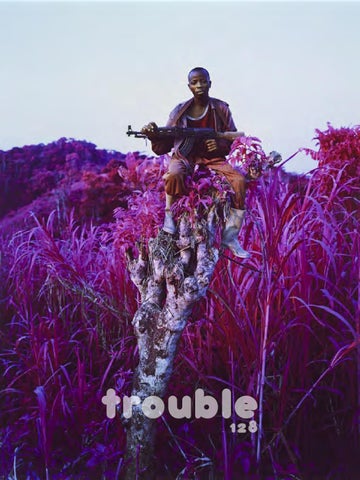
COVER: Richard MOSSE (Irish 1980–), Higher ground 2012, type C photograph, 227.0 x 185.0 cm (image and sheet). National Gallery of Victoria, Melbourne. Purchased NGV Foundation, 2014 © Richard Mosse. Courtesy of the artist and Jack Shainman Gallery, New York. Richard Mosse: The Enclave, NGV International, 180 St Kilda Rd, Melbourne (VIC), 10 October 2015 – February 2016 - ngv.vic.gov.au Issue 128 OCTOBER 2015 trouble is an independent monthly mag for promotion of arts and culture Published by Trouble Magazine Pty Ltd. ISSN 1449-3926 CONTRIBUTORS Ive Sorocuk, Jim Kempner, Holly Barbaro, Inga Walton, Ben Laycock, love. Find our app at the AppStore follow us on issuu , twitter Subscribe at troublemag.com READER ADVICE: Trouble magazine contains artistic content that may include nudity, adult concepts, coarse language, and the names, images or artworks of deceased Aboriginal or Torres Strait Islander people. Treat Trouble intelligently, as you expect to be treated by others. Collect or dispose of thoughtfully. DIS IS DE DISCLAIMER! The views and opinions expressed herein are not necessarily those of the publisher. To the best of our knowledge all details in this magazine were correct at the time of publication. The publisher does not accept responsibility for errors or omissions. All content in this publication is copyright and may not be reproduced in whole or in part in any form without prior permission of the publisher. Trouble is distributed online from the first of every month of publication but accepts no responsibility for any inconvenience or financial loss in the event of delays. Phew!
This comic first appeared in Trouble October 2011
art comedy series
THE PRINT FAIR (Saltz in the Wound) Jim and Dru’s misadventures in the Park Avenue Armory during the Print Fair.
visit: themadnessofart.com/
Holly Barbaro
Feathering the Nest RICHARD NYLON at The Johnston Collection
With the artist intervention moving into the mainstream of exhibition programming, and the rise and thrive of fashion exhibitions in the museum sector, it seems a natural evolution for the two to collide in Richard Nylon’s guest curation titled Feathering the Nest at The Johnston Collection. 4
Artist interventions, involving an artist from outside an institution critically and creatively engaging with a museum and its collection, was arguably (and controversially) first practiced in Australia by contemporary artist Domenico de Clario at the National Gallery of Victoria in 1975. In the last summer of 2014/15, three of Australia’s state galleries, being the National Gallery of Victoria, the Art Gallery of South Australia and the Queensland Art Gallery, ran fashion exhibitions as their major ‘blockbuster’ shows. The collaboration between milliner Richard Nylon and house-museum The Johnston Collection therefore seems an ambitious venture, shrewdly balancing the risk of the intervention with the mass appeal of fashion. Richard Nylon has been creating millinery pieces for over twenty years. His work has been collected by the National Gallery of Victoria, commissioned by The Australian Ballet, and he teaches millinery at RMIT University. Nylon is recognised for his audacious personal style often captured in the social pages. He has collaborated with bridal couturier Gwendolynne Burkin for almost his entire career, both operating from their adjoining studios in Kerr Street, Fitzroy. As for Nylon’s personal interests and story, Feathering the Nest discloses this in remarkable detail and intensity. The Johnston Collection is a house museum in leafy East Melbourne Victoria. Its founder William Johnston traded in antiques and left his collection and home in trust to be administered as a museum. Although Johnston is recorded to have rearranged his antiques to form a series of vignettes in his store, it has been in more recent times that a program of inviting external creatives to rearrange the collection has been officially implemented. The program evolved from inviting identities such as philanthropist Lady Potter (2004) and Lynne Landy (2002), magazine editor and wife of the former Victorian Governor John Landy, AC, OBE, who inserted domestic and personal touches to the arrangement such as flowers, framed photographs and even a cat basket. This has been followed by celebrated and gifted fashion designers of Akira Isogawa (2010) and Romance Was Born (2012). Other notable creatives have included architect and designer Pascale Gomes-McNabb (2012), contemporary artist Rosslynd Piggott (2013), Artistic Director of The Australian Ballet David McAllister (2014) and former curator of the Historic Houses Trust of NSW (now known as Sydney Living Museums) Dr James Broadbent (2014). In a competitive climate of attracting visitation, the programming allows the museum to refresh its offerings, encourage repeat visitation, and provide the public with a three dimensional experience of the guest curator’s creative output and imagination.
Feathering the Nest: Richard Nylon / Holly Barbaro
Nylon explained that he chose the exhibition title Feathering the Nest as feathers reference his millinery practice, and the expression arouses the idea of intimate domestic environments. Nylon advised that he had no all-encompassing theme for his guest curation. Several themes do, however, cross-pollinate throughout the house, such as time, and the interests and inner life of Nylon fused with that of the museum founder William Johnston and his collection. The exhibition also shows the strength of fashion designers in the area of exhibition design, a preoccupation with materials and surfaces, and an accentuated use of intuition in executing an artist intervention. The blue room, conveniently described for its deep indigo blue wall treatment, focuses on time and scientific-related objects. The room can be heard before it is entered, having several metronomes clicking unnervingly in the room. The noise replicates the ticking of the clock, a number of which are also found in the blue room. Several of the collection’s barometers are also placed in the room. Veering to an autobiographical narrative, Nylon explains that he vividly remembers his grandfathers, both farmers, regularly inspecting their barometers given the importance of weather to farming the land. Beyond the personal associations, Nylon advised that his use of the metronomes are part of his wider use of triangular and pyramid shapes in his arrangement as they act to draw the eye up, making full use of the high ceilings of the museum. The ticking not only adds the element of sound to the exhibition, but engages a primal startle response, creating a sophisticated and experiential exhibition design. The green-drawing room is given over to the grandeur of Louis XIV, particularly through the invocation of the ceremony lever, the king’s elaborate arising and dressing ceremony. The museum’s four-poster bed, despite its Indian origin and being made circa 1800, has been re-imagined as the site of the ceremony. The Baroque music of Louis XIV’s court composer Lully plays in the room, integrating music into the exhibition. If this sounds questionably grandiose, Nylon has offset the grandeur with humour with a cluster of Staffordshire greyhound figurines (circa 1870) across the surface of the bed providing a wink to royalty’s love of dogs, and a dog’s love of their master’s beds. Nylon has arranged the upstairs bedroom as a tribute to his long-time collaborator Gwendolynne Burkin. The room features several gowns selected by Burkin herself from the Gwendolynne archives. They can be seen laid out on the chaise lounge, intriguingly reminiscent of Sophie Calle’s intervention at the Freud Museum, London, where she lay her wedding gown over Freud’s patient examination lounge. Although academic commentators note the artist intervention genre owes much to avant-garde practice, Nylon puts the similarity down to coincidence and intuition. In particular, he cites that his display owed
4
much to the lounge’s yellow upholstery and the gold dress melding together well. Revealing Nylon’s and Burkin’s shared memories of collaboration, a group of miniature portraits are mounted on the wall, half concealed by an open wardrobe door, and another group of miniatures are displayed prominently in a central display case. Nylon explained that the two groups represent the many brides that he and Burkin have seen over the years, some confident knowing exactly what they want, and others who are more shy and unsure. Other objects in the room include ceramics with Chinoiserie motifs, crystal lamps and Persian rugs selected by Nylon on the criteria that they are ‘objects Gwendolynne would like’ as a tribute to his collaborator, muse and friend. Specially made hairpieces and accessories for the exhibition are displayed in the dressing room, playfully sitting on various marble sculptures from the Collection. Nylon stated that the pieces relate specifically to each sculpture. For example the sculpture of Mercury (circa 1840) wears a small helmet with feathers. The bust of Seneca, who Nylon thought looked miserable, was given ‘a very sparkly headpiece to cheer him up’. The creation of works in response to an intervention commission is a clearly positive outcome and legacy of this genre of exhibition. A fashion designer’s greater proximity to the commercial world is also perceptible in the gift shop, where visitors can purchase small items made by Nylon, providing a tactile experience and a souvenir of the exhibition. The remaining upstairs rooms feature various materials, giving an insight into the fashion designer’s tools of trade. The yellow room highlights feathers and glass. Nylon stated that feathers are his favourite millinery material and ‘see through’ is his favourite colour. The southern alcove of this room displays bird-related objects ranging from ceramic figurines to a Victorian glass bird dome. Nylon framed the display with a curtain of peacock feathers that ripple with movement, seemingly activated by the arrival of visitors into the room. The display is further enlivened with a recording of Australian and English birds overlaid with excerpts Feathering the Nest: Richard Nylon / Holly Barbaro
from Olivier Messiaen’s Catalogue des Oiseux. Messiaen’s music featured in the Balletlab production Aviary, of which Nylon designed the dancer’s headpieces in a collaboration with designer Toni Maticevski. These layers of meaning and materials, communicated in a visually arresting display, are a highlight of Nylon’s exhibition design. The study is filled with silver objects installed in a pyramid structure, drawing the viewer’s eye upward as desired by Nylon. The silver items are bound in black stocking which adds a gothic, theatrical feel to the arrangement. Apart from acting as a counter-point to the white cloud room downstairs, the everresourceful Nylon explains that black stocking is proficient in cleaning silver. The most personal and evocative of the rooms is the white room. Themed as the ‘cloud room’, Nylon has used several of his veils to cover objects in the room. Glass tears are thread from the chandelier to rain down below it. Nylon has placed his sister Deirdre’s bride doll, which can be wound to play Beethoven’s Für Elise, at the centre of the room amidst the glass tears. Deidre passed away at age four before Nylon was born. This private sadness, told in the softness and delicacy of the bride’s veil, caused the room to linger in my mind long after seeing the exhibition. Feathering the Nest is saturated with ideas from the mind of one of Melbourne’s most admired creatives in the field of fashion. Each room has a different focus yet stories and themes reappear throughout the house providing a dream-like experience, peppered with humour. Revealing the inner life and interests of Nylon, the exhibition’s major achievement is its execution of exhibition design. Visitors to the exhibition will be granted an insight into Nylon’s creativity and exposure to the evolving exhibition offerings at The Johnston Collection. Fairhall House-Museum Tour Feathering the Nest, The Johnston Collection, East Melbourne (VIC), until 20 October 2015 - johnstoncollection.org
4
MATTHEW HARDING
INTERVIEW Steve Proposch
I took an instant liking to Matthew Harding. Meeting for the first time at his workshop in Trentham, he struck me immediately as the kind of guy I’d enjoy chatting to over Friday frothies at the bonfire-side. We’d drink proper beer like Carlsberg or a good hard cider, and talk about cutting firewood, growing veggies, protoscience and Dostoyevsky. Harding shows me a pitch he has prepared for a new approach to Melbourne’s Tullamarine Airport and I am stunned at the scale and daring in his design – a rolling, writhing column of stainless steel tubing, twisted along the roadside, leaping high to arc across a proposed bike track, and lit for night time in blues and pinks and greens – which he tells me was originally done in mostly orange hues, until the client intervened. “I was thinking ‘why not’? We had the Yellow Peril, this could be the Orange Twisty!” he laughs. ”But they were very definite: no orange.” Harding has been working with public sculpture since the mid-80s and his works adorn public spaces far and wide, from the 70th floor lobby of the Four Seasons Tower in Guangzhou, China (Neo 2011) to the busy corner of Burke and Elizabeth Streets in Melbourne (Mercury Rising 2009), or a lonely outpost of the Pilbara (Chrysalis 2010). The front entrance of MONA is also one of Matthew’s (sculptural entry façade 2011) and his works are fairly dotted around Canberra, where he lived and worked for a decade. His list of awards is equally prodigious, including the McClelland National Sculpture Survey and Award twice (2007, 2010), the National Sculpture Prize (NGV 2003), the Helen Lempriere National Sculpture Award four times (2003, 2004, 2006, 2008), and Sculpture by the Sea six times (1999, 2002, 2006, 2008, 2010, 2011). Harding uses a range of materials and forms in his work but has a consistently organic approach to his conceptualisation that springs largely from a background in house and ship building that led to his interest in wood carving and the concept of ‘thinking hands’, which for him: “opened a path to understanding the world through problem solving, aesthetic decisions and finding ways to shape meaning from the materials at hand”. Your work borrows from nature, what is the most inspiring landscape for you? Matthew Harding: I think it is forest, where there is some sort of chiselled character to the landscape, through human intervention, or just nature’s processes. I’m most attracted to that idea of decay and regeneration. I like fire scarification … the idea of the phoenix rising from the ashes, whether as a metaphor for the human condition, or the regeneration of the environment. There’s always a balance between growth and decay. Well the Australian bush especially is sort of built to burn ... MH: Obviously, seedpods feature a lot in my work. I like the way they represent that latent quiescence, that encapsulation of life. And the Australian landscape often requires the condition of fire, that idea of release …
You work with a variety of materials … some traditional such as stone and steel, and some more unusual such as monofilament ...? MH: That’s a fancy word for fishing line (laughs). I come from a mariner background, and there are fishermen in my family as well. My father used to build boats, which I think has led to a lot of the curvilinear aspects in my work. It’s funny but I often think about my great, great grandfather who captained ships, and I think how we seem to have these genetic dispositions to certain things, like the ocean, and even the way we think of things, even forms, shapes. And in saying that I think theres a characteristic of fluidity and vortices, and those things you would associate with water, often comes through in my own work. It’s interesting how the influence of work, which we think of as primarily external, through successive generations can become internalised. MH: Even down to the way I run my workshop now. I’ve had to upscale a bit over the last couple of years and – where I used to do everything myself – I’ve now got a few people helping out, some skilled friends and labourers, but still all the work is made here, and I often think it feels like being the captain of my own very small boat (laughs). Mutiny all around (laughs). A small boat perhaps but making big things … MH: Yeah, we’re building Arks here, trying to save ourselves. … I love working across media. Since moving to Melbourne I’ve been pigeonholed a bit with this type of lineal, stainless steel structure, but I’ll take any opportunity to push other materials, which are more my background in a way. I’m really a carver at heart. That’s been my forte but it’s never really been taken to full flight. Is it about being pigeonholed do you think, or rather a recognisable style that’s developed, where people can tell from a mile off – that’s a Matthew Harding … is that a good thing?
4
MH: Yeah, I think that’s a good thing actually. I just never wanted to be one-dimensional. So it’s having that as a persona, but then having the undercurrent of what we actually are. We are all multi-dimensional, other than what we’re generally perceived as by the community, or often by even our loved ones on occasion (laughs). Tell us a bit about working on public sculpture projects, the difficulties and compromises … MH: Look there are compromises, but it’s mainly the challenge of problem solving. I actually enjoy the challenge of a brief. It’s almost exponentially more difficult making work that doesn’t have to respond to those things such as public liability concerns, heat, glare, magnets, longevity, and on and on and on. There’s a whole list of things. I find that really challenging and it sort of narrows the focus. It’s a bit like a form of concentration, and I think I need that because I have a kind of lateral brain that thinks too broadly, too abstractedly, taking me in too many directions. So I think a brief is something that reins me in and I almost need it. Perhaps that’s why … I mean I have a lot of ideas for exhibitions, but when somebody says ‘why don’t you have a solo exhibition’, it’s just like a cascade of … a cumulus of neurones just … my brain turns into a neural soup of ideas. Can you talk a bit about your collaborative processes? MH: I don’t get to collaborate as much as I’d like. I’m particularly into cross-cultural collaboration, particularly with the indigenous cultures from other countries, traditional skills, tradesmen or artisans. What appeals to me about that is the idea that skills are like bridges and are almost non-verbal. Trades can bridge cultural barriers and if you think of the way that skills are handed down culturally, by people within the culture - cooking, sewing, it’s about observation and sharing, and that’s a really important part of culture that is being undermined, or morphed away
“I actually enjoy the challenge of a brief. It’s almost exponentially more difficult making work that doesn’t have to respond to those things ...” from its traditional associations. And I think it’s still a really valid point of intergenerational connection. There’s something lost when we’re not handing down these non-verbal things so much. Travel - you produce much of your work from this studio in Trentham but you have worked in other places - how does that broaden your experience? MH: One great thing about the work I’ve been doing over the past decade is that it is quite nationally based, so I get to travel, both to fabricate and install, there at the coalface all the way through, to sign off on the installation. Yeah it’s a default way of keeping open to experience and stepping outside of your comfort zone. I think artists and creatives by nature are people who draw associations between all aspects of their environments – people, places, objects, things, events. We draw metaphors and associations or inspiration from all around us, so obviously travel is a great flux for creativity. You came here from ACT, where you had made quite an impression on the public sculpture landscape … MH: Yeah, before I got run out of the place (laughs). No, not quite. ACT is not a bland as people perceive. There’s a REALLY strong arts community. There’s two sides to the coin. All communities have an undercurrent of creatives. It was greet to be a part of all that, the educational side of art there was excellent and just the scale of the community, the fact that you can know people, and be networked. It’s sort of the optimum scale, isn’t it. Maybe something like that happened in ancient Greece, where there was not too many people to bump heads, but not too few either. Do you think that contact with … sort of … leadership if you want to call it that, has helped progress your career? MH: Well … no. I’m originally from Newcastle and sort of grew up in a very working class situation. I’m a carpenter by trade, and it was all about getting a trade in those days. I left school at fifteen to get a trade and I think that puts you in that school of hard knocks, where your driven … in my case not driven to succeed, but driven towards expression. I can’t turn it off. I can’t sleep, can’t stop. It’s your blessing and your curse, your vice and your virtue, your nemesis and your friend. It’s inescapable. Matthew Harding is opening his Trentham (VIC) studio to the public for the Daylesford & Macedon Ranges Open Studio (DMROS) weekends, along with 26 other artists, 31 October – 1 November, 7 – 8 November, & 14 – 15 November 2015 - dmropenstudios.com.au
october salon
1.
1. Darcey Bella ARNOLD, New but Nah (detail) 2014, oil on board, 20 x 60 cm. New but Nah, M16 Artspace, 21 Blaxland Crescent Griffith (ACT), 8 – 25 October 2015 - m16artspace.com 2. Nigel MILSOM, Judo House pt 6 (the white bird) 2015, oil on linen, 232 x 190 cm. © the artist, © AGNSW, Mim Sterling. WINNER The Archibald Prize 2015, Art Gallery of Ballarat, 40 Lydiard St North, Ballarat (VIC), 2 October – 15 November 2015 - artgalleryofballarat.com.au
2.
october salon
Yao JUI-CHUNG, Yao’s Journey to Australia 2015, biro, pen and gold leaf on paper, 200 x 546 x 6cm. Courtesy of the artist and Tina Keng Gallery. INK REMIX: Contemporary art from mainland China, Taiwan and Hong Kong, a touring exhibition organised by Canberra Museum and Gallery, Bendigo Art Gallery, 42 View Street Bendigo (VIC), 31 October 2015 – 7 February 2016 - bendigoartgallery.com.au
4.
PREVIOUS SPREAD: France is a dreadfully cold place - Private Michael Ryan, St Kilda. 5th Division men wearing their newly issued sheepskin vests December 1916 France. Photographer Herbert Baldwin. Reproduced courtesy of the Australian War Memorial. Australia Will Be There: Victorians in the First World War (1914-19), Ararat Regional Art Gallery, Town Hall, Vincent Street, Ararat (VIC), 4 September to 18 October 2015 - facebook.com/araratgallery 3. Molly HARRIS, Sandra and Hercules 2014, from the series Being Sandra, pigment ink-jet print, 84.0 x 59.0 cm. Courtesy of the artist. William and Winifred Bowness Photography Prize 2015, Monash Gallery of Art (MGA), 860 Ferntree Gully Road Wheelers Hill (VIC), 1 October – 22 November 2015 - mga.org.au 4. David ROSETZKY, Living together is easy #3 2002, lambda digital print on Fuji crystal archive paper, 64 x 93.5 cm each; edition AP2. Courtesy the artist and Sutton Gallery, Melbourne. True Self: David Rosetzky Selected Works, a Centre for Contemporary Photography and NETS Victoria touring exhibition, Swan Hill Regional Art Gallery, Horseshoe Bend Swan Hill (VIC), until 18 October 2015 - swanhillart.com
3.
october salon
5.
october salon
5. Rodney STEWART, New fun, old fun 2014, from the series Urban emotion, pigment ink-jet print, 130.0 x 89.0 cm. William and Winifred Bowness Photography Prize 2015, Monash Gallery of Art (MGA), 860 Ferntree Gully Road Wheelers Hill (VIC), 1 October – 22 November 2015 - mga.org.au 6. Katherine EDNEY, The apparition 2015, oil on wood, 30 × 39.5 cm. The InBetween - Katherine Edney, The Lost Ones, 14 Camp Street, Ballarat (VIC), until 30 October 2015 - thelostones.com.au NEXT SPREAD: Valerie SPARKS, Le Vol 2 (detail), 2014, pigment inkjet print on paper, 100 x 270 cm, 2 of 8. Fremantle Arts Centre Print Award supported by Little Creatures Brewing, Fremantle Arts Centre, 1 Finnerty Street, Fremantle (WA), 25 September – 15 November 2015 - fac.org.au
6.
THE MAN WHO FELL TO ... MELBOURNE Inga Walton
“We keep talking about Bowie, and actually we’re talking about ‘the myth of Bowie’. I’m not sure he even knows who he is anymore, rather like some actors ... because they’ve played the same parts so often, we confuse them with the person they are playing. Bowie has played lots of parts, but we always talk about him as if they exist. I don’t know what lies behind those parts. All I know about is the myth, because that is what we are presented with.” Professor Sir Christopher Frayling.1
Making its only stop in the Southern hemisphere, David Bowie is... (until 1 November, 2015), has been one of the most anticipated exhibitions to be held at the Australian Centre for the Moving Image (ACMI). Curators Geoffrey Marsh, Director of the Department of Theatre and Performance at London’s Victoria & Albert Museum, and his colleague Victoria Broackes were granted permission to trawl through Bowie’s beautifully maintained archive in New York. “I think the important thing to stress is that it’s about David Bowie, it’s not about David Jones. So the real person, the person born in London in 1947 is David Jones, the archive is about David Bowie who is a creation of David Jones, performer, artist ... So there’s nothing in the archive about David Jones”, says Marsh. “What he’s collected, or recorded, is the story, the history, of himself as a performer. What’s extraordinary about it is that he’s kept so much stuff, and from quite an early age, and because it’s not very rock ‘n roll! I mean most rock stars tend to just move on to the next thing, or give away their clothes for charity dos ... There are very, very few major stars who have archives like this, but David kept it all”.
< Brian DUFFY, David Bowie during the filming of the Ashes to Ashes video, 1980. Pierrot (Blue Clown) costume by Natasha Korniloff. © Duffy Archive & The David Bowie Archive.
4
Of his and Broackes’ six visits to Aladdin (Sane)’s Cave, the epicentre of Bowie fan nirvana (the location of which he will not reveal), Marsh was struck by the sheer detail and complexity of Bowie’s nascent concepts. “The thing that is most interesting, for me at least, in David’s archive is the sketches and things, the videos, the film ideas he had for set designs. I mean there are proto set designs in the exhibition that he did when he was fifteen or sixteen, I think he says in [one of] the film clips, ‘Most kids, boys are just happy at sixteen to get a gig’. Whereas David was designing the back-drop and the costumes and everything, so right from day one he was interested in all that sort of stuff. So that was, I think, the prime motivator in the approach we brought to [the exhibition]”. The ever-evolving performance art project that is David Bowie spans over fifty years: from the period where ‘Davie’ Jones first tested the musical waters with his band the Kon-rads in 1962, to the surprise announcement (on his sixty-sixth birthday) of The Next Day (2013), Bowie’s twenty-fourth studio album, and his first in a decade. How to mount a credible exhibition about a performer whose principal output is music-related was of paramount concern to the curators. “The extraordinary thing is when we started on the exhibition [2011], David had disappeared for nearly a decade. And [now] because he’s on such a high at the moment ... it’s a very different kind of environment”, Marsh observes. “Some people at museums said, ‘oh you know, no one’s interested in David Bowie any longer, he’s from years and years ago’, and all that sort of stuff!”. (And if you want to know what planet these arbiters of museum and gallery programming are on, good luck with that. Planet earth still seems to be blue, however). Marsh used to be the Director for the London office of AEA Consulting, a museum design company, and has considerable experience in the field. “Sound, whether it’s music or any other sound, has been pretty poorly treated in museum exhibitions generally. It’s a question of expectation I think, and secondly of technology and cost. But I think it also comes back to the hierarchy about how art is valued ... in many ways, museums don’t even collect sound”, he contends. “It’s an immersive exhibition. From the start, sound is as important as the objects, secondly, this is about a very high quality sound. We wanted a sound system whereby you didn’t have to press buttons – the ‘and this is exhibit 100’ approach – but one that just flowed with you”. Enter the Sennheiser Group, a German sound company whose participation as a sponsor for the exhibition allowed the curators to realise their vision. Viewers are issued with a location-sensitive guidePORT system that automatically provides the audio component of the show – whether it be music, interviews, filmic dialogue, or specially mixed soundtrack – when they approach the exhibits and screens. This technology seamlessly integrates all sound material, including numerous audio-visual displays, into the tour wherever in the space the viewer moves. Gregor Zielinsky, Sennheiser’s International Recording Applications Manager, created an upmix algorithm to enable both stereo and mono material to be played as a 3D reproduction. “We had some really old mono material, not exactly recorded under the best of circumstances! With the algorithm and some fine-tuning in the studio we ensured that this rare material can be enjoyed in an astonishingly new form”, Zielinsky explains. “Working with Sennheiser on audio delivery has been a fantastic opportunity” Marsh acknowledges.
David Bowie: The Man Who Fell to Melbourne / Inga Walton
“We wanted a sound system whereby you didn’t have to press buttons – the ‘and this is exhibit 100’ approach – but one that just flowed with you ...” “Sennheiser has pushed the boundaries as to how sound can evoke, provoke and inspire visitors, creating a genuinely multi-media museum experience, which has been a challenging objective but one we are delighted to have achieved with its support and expertise”. This sonically integrated ‘sound landscape’ approach adopted for the exhibition in many ways typifies the way Bowie has leveraged various media throughout his career, particularly television and the video medium. Integral to his success as a performing artist of tremendous range has been Bowie’s innate understanding of presentation and costuming. The exhibition includes many of Bowie’s most memorable ensembles, “Obviously they’re stage costumes, they’re not costumes that you’re meant to see up close like kind of high fashion”, Marsh notes. “So, that’s quite a challenge because we wanted to have them on open display. I think costumes always look terrible in glass cases, but performance costumes just look ridiculous ... you know, like kind of caged animals! So that required [extra] spacing so people could look at them”. There are, however, some ‘caged’ costumes that represent some of the more outrageous moments in Bowie’s performance history; the infamous Cobweb bodysuit and the Angel of Death red vinyl costume with feathers and paillettes (both 1973) that he wore for The 1980 Floor Show (1973) on NBC in America. Bowie has worked with bespoke costumers like Freddie Burretti (1951-2001), Natasha Korniloff (d. 2008), and Ola J. Hudson (1946-2009), whose son Saul would achieve global stardom as Guns ‘n’ Roses’ formidable guitarist Slash. As the demands of Bowie’s touring schedule and promotional requirements became more complex he turned to opera and theatre designer Peter John Hall (1926-2010) on the Serious Moonlight tour (1983), and Olivier Award-winning production, set and costume designer Alison Chitty, OBE for the short film Jazzin’ For Blue Jean (Julien Temple, 1984). Bowie has consistently engaged with the world of contemporary fashion by seeking out the leading designers of the day to realise the desired look for albums, and to set the visual tenor for tours. From the daring and futuristic designs supplied by Kansai Yamamoto for the Aladdin Sane tour (1973), to restrained monotone Giorgio Armani for the Sound + Vision tour (1990), Thierry Mugler (1991) during the Tin Machine period, (Lee) Alexander McQueen, CBE (1969-2010) for the I.Outside tour (1995) and Earthling (1997), and Hedi Slimane (then creative director for Dior Homme) on the Heathen tour (2002).
4
Bowie’s assiduous courting of publicity was evident from his earliest public forays, particularly his valuable contribution as the spokesman for the Society For the Protection of Long-Haired Men (1964). Bowie has adopted many personæ over the course of his career of a sexually ambiguous nature, reinforced by the various ‘provocative’ statements he has made in the press. Declarations that he was gay (1972), bisexual (1976), and later, “I think I was always a closet heterosexual. I didn’t ever feel that I was a real bisexual” (1993), demonstrated both his fearless (and occasionally reckless) attitude to the media, and his understanding of the dramatic impact such pronouncements would have.2 He has long since transcended both the incessant background chatter that has accompanied his every move, and the limitations of the published discourse concerning it – estimated at over 100 books and innumerable print interviews. Nonetheless, Bowie’s wider influence on identity politics and notions of sexuality cannot be over-stated. Educationalist and popular culture theorist Sir Christopher Frayling recently made the point that, “one of the things that Bowie did at that time was change the debate from class to gender”.3 The many controversies that have clung to Bowie served to only deepen his appeal and pervasive influence. “Generally speaking he’s avoided making political comments. I know that’s slightly different in Australia because of [the video for] Let’s Dance [David Mallet, 1983] ... but if you think over fifty years given how most pop stars get lent on for one thing or another he has not made a huge amount of political or social comment ... He’s never gone out to try to outrage by swearing [on television], or that sort of thing, or even taking obvious pokes at iconic figures”, Marsh maintains. “What he’s actually done is much deeper, which is pressing the buttons which really, really worry ‘authorities’, for want of a better way of looking at it. At the bottom of that is this issue about individuality because all states find that kind of troublesome. In a way it’s deeper than that, it is ‘You owe it to Yourself to be Yourself’, that is the definition of being a true human being, and within that is a sub-set which is be what you want to be sexually ... and that is obviously, incredibly subversive, particularly in the early ‘70s”. This is evident in the video clip for Boys Keep Swinging (David Mallet, 1979), which perpetuated the song’s theme of satirising homosocial privilege and self-interest: “Heaven loves ya/The clouds part for ya/Nothing stands in your way/When you’re a boy”. Bowie’s rendition of the song as a stereotypical 1960s rock ‘n’ roll singer clad in a dark suit is uproariously undermined by his appearance in drag as his own female backing vocalists. RCA, Bowie’s then record label, decided against releasing the single in the American market because of, “fears about the video’s unpalatable transvestism”.4 Interviewed by his wife Iman in 2000, Bowie commented, “The glory in that song was ironic. I do not feel that there is anything remotely glorious about being either male or female. I was merely playing on the idea of the colonisation of a gender”.5 Bowie has continued to use this medium to reinforce his philosophical views, “The idea that the individual should determine their future as long as it doesn’t hurt other people, which is obviously very different from other parts of the world. That’s why I think he’s so relevant to today because, if you look at his videos he’s just produced over the last couple of years, you couldn’t show them on a lot a lot of television stations in the world, because they challenge the idea that actually people
> Masayoshi Sukita (b. 1938), Tokyo Pop bodysuit for Aladdin Sane tour, 1973. Designed by Kansai Yamamoto, February 1973, RCA Studios, New York, © Masayoshi Sukita.
are just sort of slaves to the state”, Marsh stresses. “They’re about being yourself which is, you know, one of the great challenges of the 21st Century. Who’s in power, individuals or the state?” The parallels between Bowie’s career and that of Pop artist, filmmaker, and the cofounder (in 1969) of Interview magazine, Andy Warhol (1928-87), are alluded to within the exhibition. After he graduated with a Bachelor of Fine Arts (Pictorial Design) in 1949, Warhol moved from Pittsburgh determined to try his luck in New York. He quickly found work in advertising, magazine illustration, and later designed album covers for, you guessed it, RCA Records. Unlike many artists who make the transition from commercial work to ‘fine art’, Warhol never down-played his earlier career, saying, “I loved working when I worked at commercial art and they told you what to do, and how to do it, and all you had to do was correct it and they said yes or no”.6 Bowie wrote the song Andy Warhol, which appeared on Hunky Dory (1971), and contained the chorus, “Andy Warhol looks a scream/Hang him on my wall/Andy Warhol, Silver Screen/Can’t tell them apart at all”. Warhol was said to have taken offence at the lyrics, and the two cultural titans reportedly met only once.7 However, Warhol was also reported to be in the audience for Bowie’s Broadway début in The Elephant Man (Jack Hoffiss, 1980-81), and it is hard to believe he was not invited back-stage. Warhol’s career as an underground filmmaker and actor (196376) achieved both considerable notoriety and some renown for his daring, often innovative approach. Fourteen minutes of footage of Bowie performing mime, and looking distinctly uncomfortable at being filmed, is included in the Factory Diary for 14 September, 1971. After a failed career as entertainment impresario, and then running a short-lived piano bar, Bowie’s father, Haywood Stenton ‘John’ Jones was appointed head of public relations at Dr. Bernardo’s Children’s Homes in 1956. Jones then used his industry contacts to induce some of the leading British entertainers of the day to help promote the charity. With the example of his father’s PR skills, the young David began developing his precocious talent for marketing and promotion. He left Bromley Technical High School when he was sixteen, and where his third year form master and art teacher was Owen Frampton (father of singer and guitarist Peter). Bowie pursued a similar path to Warhol: he spent twelve months working in advertising, first as a Junior Visualiser (or paste-up artist), and later joined the London office of Nevin D. Hurst Advertising. “David’s first job was in advertising and he’s always [in interviews] very dismissive about it, which I suspect is because it had quite a big impact on him, but he doesn’t want to admit it”, Marsh remarks. “It was this critical moment in advertising, the sort of Mad Men era, everyone was getting into the ‘science’ of marketing, brain washing and all that stuff that came out. People in the late 1950s like Vance Packard [1914-96], and how to influence people. When you look at Bowie’s career, you think ‘where did he get it all from?’, and clearly he plugged into that. The fact that these two superstars of the late 20th century, Warhol and Bowie, are rooted in advertising, marketing, and PR I don’t think is any accident”. In what might be
< David BOWIE (b. 1947) & Freddie BURRETTI (1951-2001), designers, Bodysuit with graphic print (1972) replica, Ziggy Stardust tour and album cover, Courtesy of The David Bowie Archive. Installation image: Inga Walton.
4
viewed as a sly nod to his past, Bowie went on to portray the slick advertising guru Vendice Partners in Absolute Beginners (Julien Temple, 1986). Partners, who seems to speak in CAPITALS, tells Colin, the central protagonist, “we don’t sell things, we sell dreams”. He then serenades the hapless young photographer with a song unambiguously titled Selling Out, before his main number That’s Motivation (a Bowie composition), tap-dancing atop a giant typewriter. The art dealer Bruno Bischofberger had a long association with Warhol, and with American Pop artists more generally. He suggested that Warhol collaborate with the emerging artists Francesco Clemente and Jean-Michel Basquiat (1960-88) for a series of fifteen paintings in the Spring of 1984. Warhol and Basquiat struck up a friendship and worked on another series of paintings shown at the Tony Shafrazi Gallery in 1985. In an inspired move, when artist Julian Schnabel decided to make a film about Basquiat’s life (1996), he cast Bowie as Warhol. Basquiat also had a strong interest in music, as a member of the ‘noise rock’ band Test Pattern, which later became Gray; it was in this context that Bowie met Basquiat in 1982. Wearing one of Warhol’s own platinum wigs, his glasses, and various other personal items loaned for the film, Bowie’s subdued and nuanced performance deftly captures the interplay between the two artists as they worked in Warhol’s studio. As Bischofberger reflected, “Such collaborations are an intricate and beautiful duet involving two of the greatest artists of their time. Earnest but filled with humour and a kind of jibing affection, the paintings document the mutual admiration and respect that the artists had for each other’s work, ideas, and distinct personalities. Just a few years later, of course, both Warhol and Basquiat would be dead, leaving these collaborations as a rare monument to a dialogue that spanned generations, cultures, and even races”.8 The British writer and broadcaster Philip Hoare (Patrick Moore) has stated, “Bowie was Warhol’s Frankenstein’s creature. Without Warhol, Bowie couldn’t have existed. He was the product of that new attitude to commodification and to art, where Bowie, a musician, could be an artist; a fine artist. That’s where the notion of him being in films, films that aren’t completely under his control, which aren’t an extension of his unreal personality, almost don’t work for me”.9 Bowie’s trajectory as an actor, both on stage and in film, is eclectic to say the least. The exhibition includes memorabilia and excerpts from several of Bowie’s best known acting roles, as well as his first appearance in the black and white short film The Image (Michael Armstrong, 1967). “One of the things we wanted to focus on was how he learned to be an actor in the late ‘60s, which hardly gets a mention in any book [on Bowie], but actually is fundamental because what you realise is that, although he’s a very famous writer, famous performer, he’s actually an actor”, Marsh believes. Bowie’s feature film début in The Man Who Fell to Earth (Nicolas Roeg, 1976) was well received, as was his stand-out performance in the otherwise rather muddled Merry Christmas, Mr. Lawrence (Nagisa Oshima, 1983). In an interview with Rolling Stone conducted while in Australia, Bowie said of his role as the troubled New Zealand POW Major Jack Celliers, “I think it’s the most credible performance I’ve done in a film”.10 Bowie has proved he has the ability to be a serious actor, but his choice of filmic roles over the years has been somewhat baffling. “I have to say I find his film
David Bowie: The Man Who Fell to Melbourne / Inga Walton
“... I find his film career, not a mystery, but it’s something I find quite difficult to come up with any simple explaination for ...” career, not a mystery, but it’s something I find quite difficult to come up with any simple explanation for ... given that he is a great actor, and he’s only ever appeared on stage once [The Elephant Man], where he was clearly successful ... You sort of get the feeling with that as soon as he’d done it, he kind of thought, ‘oh well, you know, I’ve done that, no need to do it again’”, Marsh muses. Bowie’s next leading film role was in the much-panned Just A Gigolo (David Hemmings, 1978) as the Prussian officer Lt. Paul Ambrosius von Przygodski. He returns from World War I a hero, only to find his social position and prospects drastically altered: as a consequence, he drifts into work as a male escort. The film suffered as much from the meandering and inconsistent script as it did from being considerably cut after its initial release. The exhibition preserves a letter, dated 2 March, 1978, that Bowie received from his (not quite) co-star, the celebrated film actress and cabaret star Marlene Dietrich (1901-92). In her final screen role, Dietrich played von Przygodski’s madam, Baroness von Semering, but her scenes were filmed in Paris where she lived, intercut with his filmed in Berlin. “I am sorry not to be able to visit you today as we discussed. Lots of problems with fittings etc. for your film. Hope to see you in America. Starting a tour in May. Please let me know where to reach one of your agents so we can keep in touch”. It is doubtful whether the two actually ever met. Bowie’s disappointment with Just A Gigolo was palpable in his blunt assessment to the New Musical Express that, “the film was a cack, a real cack ... I think the great failure on my part for becoming involved in that particular venture was my acceptance of the director as a person rather than actually bothering to consider what the script consisted of – or rather didn’t consist of, since it contained absolutely nothing – and also what experience the guy had had as a director ... my thirty-two Elvis Presley movies rolled into one”.11 Elvis, with whom Bowie shares a birthday, is a ghostly presence throughout the exhibition. There is even a 1976 telefax from ‘the King’ to Bowie that reads, “Wishing you the best on your current [Station To Station] concert tour. Sincerely, Elvis and the Colonel”. After the failure of ‘Gigolo’, Bowie largely confined himself to supporting parts, with varying levels of success. A cello-playing vampire in the achingly stylish The Hunger (Tony Scott, 1983); an aging gangster in the Mancunian crime drama Everybody Loves Sunshine (aka. B.U.S.T.E.D, Andrew Goth, 1999); the Serbian engineer, inventor and futurist Nikola Tesla (1856-1943) in The Prestige (Christopher Nolan, 2006). In
4
the immensely controversial and overblown The Last Temptation of Christ (Martin Scorsese, 1988), Bowie plays Pontius Pilate as a sort of world-weary headmaster scolding a student sent for detention, telling Jesus (Willem Dafoe): You know it’s one thing to want to change the way that people live, but you want to change how they think and how they feel. Either way, it’s dangerous. It’s against Rome, it’s against the way the world is and, killing or loving, it’s all the same. It simply doesn’t matter how you want to change things – we don’t want them changed. In just under four minutes of screen time he brings a certain gravity to the part, something demonstrably lacking in the rest of the film. Bowie then co-starred in surely one of the most excruciatingly un-funny and dreary comedies around, The Linguini Incident (Richard Shepard, 1991), as the disreputable barman, Monte. Other wink-wink-look-it’s-me cameos in films like Into the Night (John Landis, 1985) where he played the Band Aid-sporting henchman Colin Morris; in Zoolander (Ben Stiller, 2001) where he judges the ‘walk-off’ between the titular male model Derek Zoolander and his rival Hansel McDonald; and his brief role as corporate raider Cyrus Ogilvie in the immensely tedious Josh Hartnett vehicle August (Austin Chick, 2008) did little to allay Bowie’s reputation as a filmic dabbler. Bowie’s fleeting part as the incoherent FBI agent Phillip Jeffries, who has been trapped in the Red Room for almost two years, has only recently been reappraised, owing to the fact that Twin Peaks: Fire Walk With Me (David Lynch, 1992) was editorially mangled before its cinematic release. Bowie’s appearance at the conclusion of Bandslam (Todd Graff, 2009) was telegraphed virtually from the beginning, given that the lead character Will Burton (Gaelan Connell) writes a series of diary-like missives to Bowie that punctuate the film. In an exchange that might resonate with many a despondent young fan, Burton’s mother Karen (Lisa Kudrow) asks, “Are you writing another letter to David Bowie? Doesn’t it bother you that he never writes back?”, to which Will replies, “He knows that would only intimidate me”. Her son’s determination to conceal his disappointment leads her to ponder, “See, why can’t I process rejection like that?” Interviewed in 1999 during the production of Exhuming Mr. Rice, a cheery title later altered in favour of the less morbid Mr. Rice’s Secret (Nicholas Kendall, 2000), Bowie discussed his motivation in selecting film projects. “I really don’t have the commitment to be an actor. I mean I think it’s wonderful to see Billy [Bill Switzer] for instance, who’s starring in this film, is so committed to the idea of being an actor. I really envy him his commitment, although I shouldn’t say that because I have it in another area, as a musician and as a painter. So I think I’m not really looking for anything, they [film roles] kind of find me”. Bowie’s rather obtuse choice of projects is perhaps explained by his emotive selection criteria, “Every now and again a film will come along that actually really quite touches me for some reason or another, or there will be somebody attached to it that I’ve always wanted to get to know better, or to see how they work. So I tend to find myself in films because of those conditions, not really because I’m looking for anything at all”. > David George JAMES SMPSP (b. 1940), photo-collage of manipulated film stills from The Man Who Fell to Earth, 1975-76. Film stills © STUDIOCANAL Films Ltd. Image © Victoria and Albert Museum.
4
4
Marsh points to Bowie’s greater success in portraying historical figures, however thinly drawn. “These are all very strong, incredibly strong characters ... if you say [Nikola] Tesla and Andy Warhol I mean, they’re about as extreme as you can get within their character-types, and I think that’s what appeals to him about them. I mean, he’s not made many films like The Man Who Fell to Earth, where’s he’s got a proper ‘leading man’ role. Clearly, at that level, filmmaking doesn’t interest him, and also, as you know, filmmaking is incredibly time-consuming, so I think he obviously prefers these kind of highly focused things. But, even so, given that he’s inundated with offers, I do find it quite strange actually ... I get a sense that filmmaking per se is not something that he finds terribly interesting as a process, compared to music-making”. For an artist with such a refined sense of aesthetics, and one accustomed to fulfilling his own very specific creative vision, perhaps film represents both an enticing and potentially problematic platform for Bowie. An actor’s lot is usually concerned with realising the director’s vision. Acting is, in any number of ways, the antithesis of self, whereby the performer is expected to project, or inhabit, a character. “Exactly, and that’s what I think he likes about those particular [biographical] roles because, in a sense, the director of a film about Andy Warhol ... you can’t bend Andy Warhol out of shape, I mean Andy Warhol’s Andy Warhol. Therefore, I think it prevents [Bowie] just becoming a tool of somebody else, if I can put it that way”, Marsh concurs. And then there is Labyrinth (Jim Henson, 1986). Of all Bowie’s films it is undoubtedly the most widely seen, and the one that unabashedly worships at the altar of his incredible allure. A letter from Jim Henson courting Bowie for the part reads, “This is the present shape of the script [by Terry Jones], it is still rough and needs quite a bit of polishing, but you can see where we’re going. I’m looking forward to hearing your reaction. You would be wonderful in this film”. As Jareth, the imperious and petulant Goblin King, Bowie glowers, preens, and faux menaces a self-absorbed teenage girl, Sarah (future Academy Award winner Jennifer Connolly). Holding dominion over several wind machines, inexhaustible stores of glitter, and a shifting array of puppet vassals, Jareth stalks moodily around his castle in a spiky blonde wig and eye makeup no New Romantics act could ever have pulled off. Clad in an array of extravagant costumes so incredibly camp that they flutter, twinkle and billow at every opportunity, it might be supposed that Bowie’s otherwise too-tight jodhpurs were a visual ploy to reaffirm the character’s masculinity. The producers needn’t have worried. Before the term ‘sexed up’ was even coined, Bowie imbued Jareth with an unsettling, magnetic, disproportionately torrid quality that was decidedly not G-rated. Against his expectations, Sarah finally reaches Jareth’s castle beyond the labyrinth to reclaim her half-brother Toby. Jareth once more offers her a crystal ball, with the new caveat, “Just let me rule you, and you can have everything that you want. Just fear me, love me, do as I say, and I will be your slave”. Alrighty then. Although Absolute Beginners the same year yielded one of Bowie’s most resplendent singles, it was Labyrinth that most closely merged his abilities as a song-writer and performer within a filmic role. He contributed five original songs to the film’s soundtrack, and performed all but one. (It remains something of a travesty that Bowie has received
< Terry O’NEILL (b.1938), promotional photograph of David Bowie for Diamond Dogs, 1974. Image © Victoria & Albert Museum, London.
4
so little industry acknowledgement for his soundtrack work). Storyboards from the film join Jareth’s ornamental staff, and one of the famous crystal balls he toys with throughout the film (actually manipulated by performer Michael Moschen, crouched behind Bowie). A commercial failure upon its release, and a bitter disappointment to its creator Jim Henson, Labyrinth was another film to achieve a cult following, initially via VHS, and subsequent DVD re-issue. “Although the character [Bowie] plays is a sort of created character, it’s such a strong character. He plays the Goblin King ... he’s not playing someone lifted from The Lord of the Rings or The Hobbit, he owns it totally. And I think that’s why he did it”, Marsh suggests. “I mean when you look at it, to all the Bowie fans who grew up in the ‘70s, it seems utterly bizarre, but I don’t think it is, and it’s why it still works as a film. I think it shows actually what a really good actor he is ...” For an entire generation, Labyrinth was their most indelible experience of Bowie: a star who had already been a figure of fantasy, illusion, ambiguity, permissiveness, mischief, and wish-fulfillment for so many decades. Australian Bowie enthusiast Bruce Butler has loaned items from his extensive personal collection of memorabilia, which will only be seen during this leg of the show. “As a Bowie fan of forty years I was very excited when I heard the V&A had been given exclusive access to Bowie’s vast personal archive. When the ACMI first acquired the exhibition for Melbourne in September, 2014 they contacted the local fan group Bowie Down Under; group head Adam Dean and myself went in to talk with the ACMI team about how we could contribute. From the beginning we were involved in promotion and marketing events and in developing special exclusive fan events”, he relates. Butler held positions as a Promotions Manager for CBS Records, at Virgin Records Australia, and worked on the ABC television program The Factory (1987-89). He was at the forefront of the music industry in Australia for many years, and has met Bowie several times, both in his professional capacity, and at various concerts. “Apart from a few Australian release album covers that ACMI requested, I concentrated on Bowie’s first Australian tour in 1978. I loaned a few photos, including one I took at the first Australian show in Adelaide on 11 November, and signed by Bowie a week later, a number of photos from the famous MCG concert, and my copy of the Australian tour program”, says Butler. “The first time I saw this material of mine mounted in the exhibition case with the description cards, my own words and with my name on the items, I was quite emotional, as it was a great honour to be a part of an exhibition that is so personal to Bowie featuring 300 of his items. It felt like a validation for my forty years of devotion to David Bowie as an artist”. The exhibition has given Butler the opportunity to reflect on his own career in the music industry, and how Bowie’s work has impacted on him over the years. “Through numerous interviews, articles I’ve written, public and private talks I have come to realise how many of my attitudes to and tastes in literature, art, film, theatre, philosophy and of course music have been influenced by my admiration of David Bowie as an artist. He is without doubt the single most influential musician of the 20th century and is still having an enormous effect to this day”, Butler declares emphatically.
David Bowie: The Man Who Fell to Melbourne / Inga Walton
“The first time I saw this material of mine mounted in the exhibition case ... I was quite emotional ...” Having absorbed the variety, diversity, and scope of Bowie’s influences throughout the exhibition, the viewer can peruse these various strands delineated and organised into a work by British artist Paul Robertson. Commissioned by the V&A Museum, The Periodic Table of Bowie (2013), continues Robertson’s interest in creating false (but nonetheless pertinent) taxonomic systems for individual subjects or genres. A trained psychologist, Robertson works as an artist, curator, critic, writer and collector of avant garde material. “All these aspects of my life ... then all relate to my belief that all of science, culture and history are intertwined and cannot be understood in isolation ... Most of my artworks related to science and pseudo-science and the periodic tables are one aspect of that”, he explains. “When I create a periodic table it is not just a random jumble of names. The ten families (based on similar properties) in the original chemical periodic table are used by me to organise wider themes (here with poetic titles in the colour key) and I structured the overall work in that way. For instance, the four corners of the table have four very significant names for Bowie in [Oscar] Wilde, Warhol, Basquiat, Iman (not all of whom were obvious), and the main central block of names are all direct musical influences on Bowie. If you imagine him on a spot right in the middle of the table, then the Spiders From Mars are all around him, but nearby are Little Richard (a key musical influence in style and sexuality), Elvis and others. The names are not randomly placed either: there are other subtle relationships between names. If you look hard at the work then these become obvious after a while”. Robertson credits Bowie with expanding his horizons during his formative years, “... there was a definite identification with his more intellectual side and his fay persona and look was enticing. Importantly, he was not just another of the cynically produced groups that were played on the radio and had been put together by cunning Svengalimanagers”, he recalls. “Aladdin Sane [1973] was eagerly devoured when it was released (I bought it the same day), and it delivered. I must have played it twenty times in a single week in my bedroom while I stared at the gatefold cover. I remember the thick silver paint on the photograph in particular. The jazz piano and arrangements of Mike Garson on that album was perhaps my first introduction to a more avant garde music, and while I was also listening to progressive rock at that time, Bowie was definitely a hero. [He] was a significant reason I started to read more philosophical books, and tried to see less mainstream films, A Clockwork Orange [Stanley Kubrick, 1971] being one film recommended by Bowie I was able to sneak in to see at age thirteen!”
4 4
The seismic event that was Bowie’s third appearance on the British television show Top of the Pops, performing Starman (6 July, 1972), is a central feature of the exhibition. Freddie Burretti’s Quilted two-piece suit (1972), designed for the Ziggy Stardust tour, is displayed in front of a loop of the performance. BBC radio DJ and rock critic Marc Riley has described it thus, “... I was transfixed by a bloke in a quilted jumpsuit and red leather wrestler’s boots! There’s no doubt that Bowie’s appearance ... was a pivotal moment in British musical history ... his performance lit the touchpaper for thousands of kids who up ‘til then had struggled to find a catalyst for their lives. ... Bowie encouraged you to have a broader interest in pop culture, not that it was called that back then”.12 Robertson also remembers the broadcast distinctly, “The phenomenon that was Top of The Pops cannot be understated. It was the only pop programme one could watch on television and when Bowie performed Starman there was a country-wide cultural change in the offing. I was one of many, many thousands who recognised that this was somehow different from other acts on the show. The performance itself felt fresh, the costumes somehow seemed more interesting than the usual glam rock tat and the interaction between Bowie and [guitarist Mick] Ronson, when the latter suddenly found Ziggy’s arm draped over his shoulder, looked so languid, relaxed and friendly. It seemed authentic”. Or, as Marsh puts it, “You didn’t just watch prime time television in the UK and there’d be two men kind of with their arms around each other, it just didn’t happen. So something now, which doesn’t look that strange, was just completely outrageous”. Bowie’s evolution as an artist continued to influence Robertson, “Lyrically, songs like Drive-In Saturday [1973] were educational, a song in which for the first time I had heard mention of [Carl] Jung ... Interviews would throw up names like Warhol, Brecht, Dalí, Crowley or Burroughs and, as a result, I would also seek out books or artworks by them. I doubt if I would have been quite as interested in modern and contemporary art if I had not had Bowie’s early enthusiasm for the subject”, he concedes. “Bowie’s own artwork exhibited in the V&A show is very interesting. When one looks at the detail in his stage designs and drawings for record covers then one gets a sense of how all-encompassing his vision is/was. Not many pop stars have the depth he displays. The mooted opera based on Orwell’s Nineteen Eighty-Four [1949] would have been interesting to see had it actually been completed. It is wrong to say Bowie is a chameleon, as often lazily described by some journalists ... such a description ignores the fact that Bowie was usually the first to initiate popular change. A better way of describing his influence is that he was the first true avant garde pop star”. So the question lingers, who is ... David Bowie? His own magnificently diverse and evolving creation; a brilliant self-mythologiser who has drawn us into a web being constantly and enticingly re-spun; a canvas upon which countless viewers and listeners have projected their own aspirations and desires; a brilliant cultural medium who both anticipates and interprets the times. “Somebody asked me, who do you see as being comparable to Bowie? I mean the fact is, he’s a one off. It’s not like there’s another one! If you look at his career, there’s no one who’s tracked anything like it, and, at the moment, I can’t really see anyone coming along and occupying that
< Freddie BURRETTI (Frederick Burrett, 1951-2001), designer, Quilted two-piece suit (1972), designed for the Ziggy Stardust tour. Courtesy of The David Bowie Archive. Installation image: Inga Walton.
4
THE PERIODIC TABLE OF BO WORDS ARE REAL THINGS - LYRICAL BEGINNINGS IMAGES MATTER: THE SURFACE IS ALWAYS SHINY THIRTY-TWO FRAMES A SECOND AND FOR 90 MINUTES WE ALL VANISH ISLANDS FULL OF SOUNDS - ALL AROUND THE CLOCK AND THEN SOME
Wi
THE EMPEROR WOKE UP FOUND THE MAKE UP ON HIS FACE SIX DECADES OF GRACE - A LOT HAS HAPPENED IN THIS WORLD
Oscar Wilde
DON’T GET ME WRONG I’M ONLY DANCING. THE BEST CAMOUFLAGE IS TO BE EVERYONE ELSE
Tz
La
Da
Gb
Tristan Tzara
FLY MY PRETTIES FLY. “THANK YOU, WE’LL TAKE IT FROM HERE” HISTORY IS A CHOICE THE FUTURE DECIDES UPON
Fritz Lang
Salvador Dalí
Greta Garbo
Pi
Bu
Be
Dy Bob Dylan
Pablo Picasso
Luis Buñuel
Syd Barrett
Dp
De
To
Po
Nu
Pr
Pa
Mu
Marcel Duchamp
Pk
Nam June Paik
Bq
Jean-Michel Basquiat
Marlene Dietrich
Ku
Stanley Kubrick
Ro
Nicholas Roeg
Pete Townshend
Gary Numan
Jimmy Page
Ga Lady Gaga
Ha
Václav Havel
Iggy Pop
Prince
Freddie Mercury
Le
John Lennon
Ta
Vince Taylor
El Elvis
Tommy Steele
Bo
Wk
Lr
Rn
Rs
Jc
Marc Bolan
Diana Ross
Ja
Mick Jagger
By
Md
Mk
Ws
Boy George
Harvey Milk
Madonna
Vivienne Westwood
Scott Walker
Michael Jackson
Little Richard
Vi
Tony Visconti
Ma
Hn
Al
Mz
Ms
Ho
Curtis Mayfield
Marc Almond
Kate Moss
Jimi Hendrix
Morrissey
Pam Hogg
St
Mick Ronson
Bd
Trevor Bolder
Wo
Stevie Wonder
Sy
David Sylvian
Mq Alexander McQueen
OWIE Wa Andy Warhol
Tw
Nw
En
Or
Kansai Yamamoto
Bertolt Brecht
George Orwell
Lindsay Kemp
Am
Du
Wd Brian Ward
Cr
Aleister Crowley
Fa
Hermione Farthingale
Ju
Hh
Mi
Rt
Ag
Mn Bg
Sc
Hu
Mr
Wy
My
Ly
Ri
Lou Reed
Terry Riley
Ck
Gn
Jarvis Cocker
Te
Dita Von Teese
David Gahan
Bw
Leigh Bowery
Si
Paul Simon
Co
Billy Corgan
Wn Tony WIlson
Brian Duffy
Bobby Moore
Howard Hughes
Yukio Mishima
Herb Ritts
Angie Bowie
Sr
Mo
Jo
Bn
Mc
So
Gf
Di
Go Mikhail Gorbachev
Bill Clinton
Om
Df
Trent Reznor
Mp
Peter Murphy
Pc
Bc
Dm
Gg
Ko
Ou
In
Ob
Ralf Hütter
Joe Strummer
Art Garfunkel
Rz
Gilbert & George
Ba
Aneurin Bevan
Ca
Re
Pe
Bt
Gr
John Lydon
Ke
Ya
Neil Armstrong
La Monte Young
J.G. Ballard
Bv
Kurt Weill
Mick Woodmansey
Ken Pitt
Jack Kerouac
Edgar Froese
Florian Schneider
Kp
William Blake
Eno
John Cage
Kc
Jacques Brel
We
Mike Garson
Bl
Twiggy
Fr
Anthony Newley
Br
Mao
Dalai Lama
Jeff Koons
Steve Jobs
Peaches
Tony Oursler
Tim Berners-Lee
Cl
Beyoncé
Invader
Marcel Marceau
Barack Obama
Ken Scott
Tony Defries
John Peel
Carl Jung
Marshall McLuhan
William Burroughs
I
Iman
Deadmaus
Shepard Fairey
Paul Robertson 22
space, just because the nature of performance has utterly changed”, Marsh believes. “There was a quote about William Blake [1757-1827], by someone [writer and critic William Michael Rossetti,1829-1919] that said he was, “... a man not forestalled by predecessors, nor to be classed with contemporaries, nor to be replaced by known or readily surmisable successors”,13 and I thought that was a bit like Bowie, he sort of springs ... almost from nowhere”. Bowie’s creative antennae is so acutely attuned that he has been one of the truly influential figures of his time. “One of the key things is that, although he’s incredibly original, I don’t think he’s very interested in being original. I know that’s a complete contradiction; he’s fascinated by the world, what’s going on, he’s always been interested by new technology, and using computers when they turned up, and all that sort of stuff ... I don’t think he’s interested in making single statements. I think he’s genuinely interested in trying to intrigue other people in what’s going on”, Marsh attests. What appeared to be merely a desire for change or artistic restlessness always had a focus, however initially obscure to Bowie’s audience, as though he was a perpetual chrysalis whose ideas always emerged far in advance. David Bowie is ... confounding, perplexing and utterly enthralling. He is someone who desperately yearns, who is compelled to explore and to create, and understands the need in all of us for the same. The man who would seem to have so assiduously crafted his own image, and all its many permutations has, in the last decade, withdrawn from the rigors of public life. His A Reality Tour (2003-04) was cut short after Bowie suffered a blocked coronary artery, and he has not performed live since 2006. He may not crave our attention as he used to, but our compulsion to look remains undimmed. David Bowie Is ... Australian Centre for the Moving Image (ACMI), Federation Square, Melbourne (VIC), until 1 November 2015 - acmi.net.au The exhibition continues to the Groninger Museum (11 December, 2015-13 March, 2016), The Netherlands - groningermuseum.nl Official site - davidbowie.com With thanks to Bruce Butler and Paul Robertson for their kind cooperation.The Periodic Table of Bowie (2013) is available from the ACMI store, and in various sizes from the artist’s website - paulrobertsonart.com ENDNOTES: 1 Victoria Broackes & Geoffrey Marsh (Eds), David Bowie is, V&A Publishing, London, 2013, p.293. 2 Michael Watts, “Oh You Pretty Thing”, Melody Maker, 22 January, 1972, reprinted in Sean Egan (Ed.), Bowie On Bowie: Interviews and Encounters, Souvenir Press, London, 2015, p.9. Cameron Crowe, “Candid Conversation”, Playboy, September, 1976. David Sinclair, “Station To Station”, Rolling Stone (US), Issue 658, 10 June, 1993, reprinted in Sean Egan (Ed.), op cit, p.246. 3 Victoria Broackes & Geoffrey Marsh (Eds), op cit, p.283. 4 Ibid, p.80. 5 Iman [Abdulmajid], “Watch That Man”, Bust, Fall, 2000. 6 Steven Bluttal (Ed.), Andy Warhol “Giant” Size, Phaidon, London, 2006, p.14, 59. 7 Victoria Broackes & Geoffrey Marsh (Eds), op cit, p.86. 8 Bruno Bischofberger, “Last Call”, in Steven Bluttal (Ed.), Andy Warhol “Giant” Size, Phaidon, London, 2006, p.550. 9 Victoria Broackes & Geoffrey Marsh (Eds), op cit, p.293. 10 Kurt Loder, “David Bowie: Straight Time”, Rolling Stone (US), Issue 395, 12 May, 1983. 11 Angus MacKinnon, “The Future Isn’t What It Used to Be”, NME (New Musical Express), 13 September, 1980, reprinted in Sean Egan (Ed.), op cit, p. 114, 131. 12 Dylan Jones, When Ziggy Played Guitar: David Bowie and Four Minutes That Shook the World, Random House, London, 2012, p.90. 13 William Michael Rossetti (Ed.), The Poetical Works of William Blake: Lyrical and Miscellaneous, George Bell & Sons, 1890, p. xiii.
PREVIOUS SPREAD: Paul ROBERTSON, The Periodic Table of Bowie (2013), full colour Giclee print, 59.4 x 84.1 cm. Collection, Victoria & Albert Museum, London. Private Collections internationally. © Paul Robertson 22. < David BOWIE, original lyrics for Ziggy Stardust, 1972. Courtesy of The David Bowie Archive. Image © Victoria & Albert Museum, London.
BEN LAYCOCK
greenwash Big Jamboree in Sleepy Hollow Thinking people all around the world are coming to the inescapable conclusion that the whole God-damn place is run by a cabal of Corporate Psychopaths. If you count yourself amongst the cognoscenti who share this unshakable belief, you may be interested in a gathering soon to take place in a small town in the centre of Victoria. Speakers are coming from all corners of the globe and all around the nation, joined by a plethora of local luminaries, all sharing a common desire to find answers to the burning questions of our time, and to celebrate the enormous strides already taken on our journey into the unknown. So why, you may well ask, is this momentous event taking place in the little town/large village of Castlemaine, nestled amongst the rolling hills and bucolic scenery of rural Victoria? A little history may help. As you are all no doubt aware, if you passed Grade Four Australian History, the goldrush put Castlemaine on the map (wiping the local Jarra people off the map simultaneously). All the gold soon ended up in the coffers of The Queen of England, to be frittered away on golden trinkets and gilded carriages. Every sword had a gilt hilt. It was the Age of Gilt, but not of Guilt. So the freewheeling, fun-loving diggers had to find a more conventional method of filling their pockets and their bellies, a method that involved gainful employment. Thus was born the mighty Thompson’s Foundry, an industrial giant that has dominated the town and fed and clothed the lumpen proletariat almost to this very day. Not to mention supplying the entire country with top-of-the-range steam driven locomotives, the chosen vehicle of British Colonialism, built for the express purpose of subjugating half the nations of the world, including our own. The first steam trains were painstakingly crafted by hand out of natural timbers, but proved to be unsatisfactory in the extreme Australian conditions. The first Iron Horse rolled off the assembly line way ahead of its time, a gleaming symbiosis of British Engineering and Aussie sweat. But it soon came to a stand-still. The railway line to Castlemaine had not yet been built, indeed, was not even on the drawing board. Undaunted, the good burgers of this wealthy and important town soon convinced the bean counters of Spring Street to divert the proposed
Bendigo line on a circuitous route, through said rolling hills and bucolic scenery, right past the door of the notorious Midland Hotel, to this day the social hub of this bustling town. It was a grand vision that says much about our pioneering forefathers (and very little about our pioneering foremothers). Castlemaine was steaming ahead but, alas and alak, history tells us that the ups, downs and vicissitudes of destiny would intervene in our seemingly inexorable progress. The fickle traveller would soon be bedazzled by the next shiny new mode of conveyance: the motorized vehicle, or ‘car’ as it is referred to in the vernacular (pronounced k-R). Those tooting vanguards of civilization that served us so well were left to languish, rust and decay. As luck would have it, just when we were on the bones of our collective arses, just as the once mighty Foundry, mother to us all, began to groan with the heavy burden of neglect, an enterprising young fellow whose name escapes me, recently retrenched from life-long employ, came up with the brilliant concept of an Austrasized version of the immensely popular Chinese Spring Roll. He made a roll tough enough to hold in one hand at the footy and munch on between guzzles of V.B. without the eye ever needing to stray from ‘the action’; a roll that could be chucked a long way without disintegrating; a roll bland enough that anyone could stomach it. The Chiko Roll was born! An invention way ahead of its time, fifty years before the word fast-food entered the lexicon, when McDonald’s was just an old farm. And where better to produce en masse the vast quantities of product for which the discerning consumer clamored, than The Foundry. Castlemaine was back on the map, claiming its rightful place at the vanguard of innovation. But, alas and alak, the twists and turns of outrageous fortune would take us down a totally unforeseen pathway, on a bicycle. The ‘70s arrived without warning. Hippies and ferals descended on the place without footwear, artists moved in without invitation, all agog at this Shangri La sadly overlooked by the modern world. The newcomers did not like Chico Rolls, not even a little bit. The once mighty Foundry fell into neglect once more. But not for long, this town breeds entrepreneurship like Daylesford breeds mosquitos.
Greenwash / Ben Laycock
4
Petrus Spronk
Greenwash / Ben Laycock
4
The Foundry was resurrected as The Falafel Factory. The falafels were good ... very good. They were very good falafels. The town grew and prospered once more on the blood, sweat and tears of the toiling masses. The schools filled with children, the shops began selling vegetables, sourdough bakeries popped up on every corner. Life was good. But man cannot live by bread alone, and women know what side their bread is buttered on. There were mutterings and rumblings outside the sourdough bakeries. Speech began to be peppered with words like ‘permaculture’ and ‘resilience’ and ‘relocalisation’ and ‘antidisestablishmentarianism’. These were unfamiliar words that were hard to get your tongue around. Heretics began to question the very need for a falafel factory, endlessly churning out product for the export market. Surely there was more to life than the mindless drudgery of factory life? Our proud history whispered in our collective ear’oles, “you were born to lead. Sieze-the-day! It is your destiny.” As one, we threw off our shackles with gay abandon and woke up in the very same moment to the inescapable truth; our shackles were in our minds. It was time to throw off the yoke of servitude, the straitjacket of mediocracy, the chains of slavery, and all the other clichés we could think of, and build a better world from the ground up, mudbrick by mudbrick. This was a world where Corporate Psychopaths are treated just like everybody else; a world where the ‘economy’ is just another word in the dictionary of life, not a State Religion; a world were everyone calls each other bro’, … even girls. Thus was born, like the seed that becomes a mighty oak, like the drop of water that becomes a mighty ocean, like the spark that starts a mighty inferno, like the bee that pollinates a thousand metaphors, The Local Lives Global Matters 3 Day Conference. Enjoy! Local Lives Global Matters is inspired by worldwide Economics of Happiness conferences. Presentations, workshops, panel discussions, plenaries, story-telling, art, music, film and site visits will showcase local in initiatives and kick-start new ones. Listen and learn from people doing similar things around the world. Organised by active community people living in Central Victoria, namely Mt Alexander Shire, Hepburn and the Greater Bendigo region, partnering with Local Futures / International Society for Ecology and Culture, OASES Graduate School, Borderlands Co-Operative, New Community Journal, and a growing number of regional community groups. Castlemaine (VIC) 16 – 18 October 2015 - locallivesglobalmatters.org
Ben Laycock grew up in the country on the outskirts of Melbourne, surrounded by bush. He began drawing the natural world around him from a very early age. He has travelled extensively throughout Australia, seeking to capture the essence of this vast empty land. In between journeys he lives in a hand-made house in the bush at Barkers Creek in central Victoria - benlaycock.com.au