LISTINGS NSW / ACT
(70)
TASMANIA
(71)
MELBOURNE
(71]
CENTRAL VICTORIA
(79)
MURRAY RIVER
(85)
NORTHERN VICTORIA
(87)
WESTERN VICTORIA
(88)
Issue 103: JULY 2013 trouble is an independent monthly mag for promotion of arts and culture Published by Trouble magazine Pty Ltd, ISSN 1449-3926 STAFF: administration Vanessa Boyack - admin@ troublemag.com | editorial Steve Proposch - art@ troublemag.com | listings - listings@troublemag.com CONTRIBUTORS: Mandy Ord, Ive Sorocuk, Inga Walton, Dmetri Kakmi, Courtney Symes, Cassandra Scalzi, Stuart Beekmeyer, Robin Pen, Neil Boyack, Ben Laycock, Dave O’Donohue, Matt Bissett-Johnson, Greenwish designs by Horse. Find us on Facebook: www.facebook.com/Troublemag Subscribe to our website: www.troublemag.com READER ADVICE: Trouble magazine contains artistic content that may include nudity, adult concepts, coarse language, and the names, images or artworks of deceased Aboriginal or Torres Strait Islander people. Treat Trouble intelligently, as you expect to be treated by others. Collect or dispose of thoughtfully.
trouble
FEATURES (04) COMICS FACE
Ive Sorocuk
(10) DRESSING THE MOVIES PART TWO
Inga Walton
(18)
DEAR DREAMBOAT
Dmetri Kakmi
(20) ACTEASE
Courtney Symes
(24) MELBURNIN’
Inga Walton
(30) ADELOUD
july 2013
(50) SWINDLING THE SWINDLERS
Stuart Beekmeyer
(52) SKULL MOVIES: SCENE IV
Robin Pen
(58) GREENWISH #16
designs by Horse
(64) STRALIAN STORIES Neil Boyack (68) GREETINGS FROM LONDON TOWN
Ben Laycock
Cassandra Scalzi
(34) CIRCUS OZ: CRANKING
Stuart Beekmeyer
(40) JULY SALON Generous
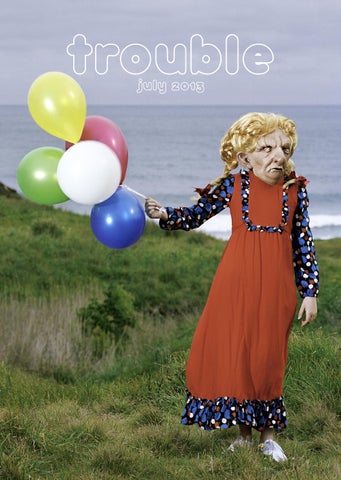
COVER: Polixeni Papapetrou, The Wind Watcher (detail) 2011, pigment ink print (ed. 1/8), 102 x 102 cm. Courtesy the Artist and Nellie Castan Gallery, South Yarra, Victoria. Creep Show, Strange Neighbour, 395-97 Gore Street, Fitzroy (VIC), until 13 July - www.strangeneighbour.com DIS IS DE DISCLAIMER! The views and opinions expressed herein are not necessarily those of the publisher. To the best of our knowledge all details in this magazine were correct at the time of publication. The publisher does not accept responsibility for errors or omissions. All content in this publication is copyright and may not be reproduced in whole or in part in any form without prior permission of the publisher. Trouble is distributed online from the first of every month of publication but accepts no responsibility for any inconvenience or financial loss in the event of delays. Phew!
Artists are invited to submit work for inclusion in the sixth
UWS Sculpture Award Exhibition to be held on the University of Western Sydney’s Campbelltown Campus from 2 May until 1 June 2014
Prizes UWS Acquisitive Sculpture Award, valued up to $30,000
For application forms or information contact: Monica McMahon (02) 4620 3450 or monica.mcmahon@uws.edu.au UrbanGrowth NSW Acquisitive Sculpture Award, valued up to $30,000 Rosemary Hopkins (02) 4620 3460 UrbanGrowth NSW People’s Choice Award, or r.hopkins@uws.edu.au $5,000 (non-acquisitive) Or visit the UWS website http://virtualtours.uws.edu.au/home Janice Reid Emerging Artist Award, $5,000 (non-acquisitive) Entries close Friday 6 September 2013
Campbelltown
Image reproduced courtesy of artist Winner of 2012 UWS Sculpture Award, Louisa Dawson, New Arrivals, 2012, Photograph by Sally Tsoutas
Complimentary accommodation in a Studio Apartment will be provided to interstate and regional finalists, coinciding with the dates of installation (27-29 April, 2014) and de-installation (1-3 June, 2014) of the exhibition courtesy of Quest Campbelltown.
Robert Clinch: Fanfare for the common man A mid-career retrospective 13 July to 8 September An Art Gallery of Ballarat exhibition | Open daily 10am - 5pm. Admission free Robert Clinch Fanfare for the Common Man (detail) 2003 egg-tempera on panel. Private collection.
TAKE A LOOK AND SEE WHAT’S IN STORE AND ON STAGE... SEASON BROCHURE AVAILABLE FROM MAJESTIX ON 5333 5888 OR VISIT HERMAJ.COM
DRESSING
THE MOVIES (Part Two)
< Marlene Dietrich, Herbert Marshall & Melvyn Douglas in Angel (1937). Costume design by Travis Banton (1894-1958). (Paramount/The Kobal Collection).
by Inga Walton
As part of the Melbourne Winter Masterpieces program, Hollywood Costume, an initiative of the Victoria & Albert Museum (V&A), London, is at the Australian Centre for the Moving Image (ACMI) until 18 August, 2013. Part One of this extended feature on the sprawling exhibition was in our June 2013 issue of Trouble. By the time he retired in 1966, Walter Plunkett (1902-82) was one of the film industry’s most revered talents, with ten Oscar nominations (1950-63) and one win. He worked on over 170 films, first as head designer at RKO until 1935, and afterwards for Selznick International Pictures, MGM, and Walt Disney Productions. Plunkett’s credits include King Kong (1933), Little Women (1933 & 1949), Duel In the Sun (1946), Show Boat (1951) and Singin’ In the Rain (1952). Despite admitting that, “I don’t think it was my best work, or even the biggest thing I ever did ...”, his greatest triumph remains Gone With the Wind (1939). Plunkett created some five thousand five hundred separate items of clothing for fifty-nine major characters: including two hundred and six changes for the principal women, and eighty-three changes for the principal men. Hundreds of rented costumes for the extras also had to be fitted to his specifications. Even if he did bow slightly to the fashions of the day, Plunkett established the definitive filmic archetype of the Civil War-era Southern belle with his costuming for Scarlett O’Hara (Vivien Leigh), a cinematic period he would revisit with Edward Dmytryk’s Raintree County (1957) starring Dame Elizabeth Taylor.
Despite having already designed thirtyfive hats for the film, Plunkett was left quietly seething over a commercial arrangement producer David O. Selznick struck with New York milliner Mr. John (John Pico Harberger, 190293) to provide Scarlett’s hats; probably the least ‘authentic’ items of clothing in the film. On display is ‘Scarlett’s change #16’, the dress Plunkett would later suggest was, “probably the most famous costume in the history of motion pictures”. Unable to pay the new land taxes on Tara implemented by the Reconstructionalists, Scarlett decides to visit Rhett Butler (Clark Gable) in gaol, hoping to charm him into advancing her the money. With no suitable clothes to wear, she pulls down the moss-green velvet portières still hanging in the front room, telling Mammy (Hattie McDaniel), “I’m going to Atlanta for that $300, and I’ve got to go looking like a queen”. Plunkett followed author Margaret Mitchell’s preference for Scarlett in green – which she wears almost exclusively in the book – and had the fabric slightly faded, ostensibly to show the effects of constant sunlight on the curtains. His extensive research, obsession with period authenticity, and perfectionism on the film led to the observation, “Plunkett’s attention >>
Dressing the Movies / Inga Walton
“The scale of the skirt at the hem actually defines her space; you physically cannot get close to the queen ...�
< Cate Blanchett in Elizabeth: The Golden Age (2007). Alexandra Byrne, Academy Award winner for Costume Design, 2008. (Universal/Studio Canal/Working Title/The Kobal Collection/Greg Williams)
> to detail, control and accuracy was Selznick’s system in microcosm. He placed costuming on a level with scripting and directing: no effort was spared, no obstruction tolerated”. Inevitably, it is historical genre and period films that tend to offer the greatest challenge and exhilarating possibilities for a designer, where they can be at their most indulgent. Calculated to deliver a ‘wow factor’ to audiences, these overtly lavish and spectacular confections often garner the most widespread attention off-screen as well. The exhibition’s central tableaux groups together seven magnificent gowns created for royal and noble characters on screen over the last eighty years. The earliest is the elongated velvet court dress trimmed with bands of silver worn by Greta Garbo in Queen Christina (1933). Designer Adrian (Adrian Adolph Greenberg, 1903-59) worked with Garbo on eighteen successive films beginning in 1928, and his creations were central to burnishing her mystique as the remote, melancholic, and impossibly glamorous ‘Swedish Sphinx’. Although the costume is not authentic to the period in the mid-seventeenth century when Christina abdicated the Swedish throne, Adrian explained, “Literal reproductions would not have achieved the dramatic quality we sought ... As far as is known, the queen never possessed such a costume but as a picture it struck both designer and director [Rouben Mamoulian] as conveying a dramatic credibility within the particular scene”. Milena Canonero is a seasoned Academy regular, nominated for the Oscar eight times, and winning thrice. Her first nomination (with Ulla-Britt Söderlund) for Stanley Kubrick’s Barry Lyndon (1975) yielded the award, as did her most recent
citation for Sophia Coppola’s pastel-hued pop interpretation of the shallow Marie Antoinette (2006), examples from which are positioned in relation to one another. Excerpts from various ‘biopic’ films based on the life of Elizabeth I are screened behind two magnificent Oscar-winning costumes, which emphasise the imposing look and sculptural possibilities inherent to sixteenth century attire. A black and gold jewel-encrusted velvet gown and trailing cloak by Sandy Powell was worn by Dame Judi Dench as the aging monarch in John Madden’s romance Shakespeare In Love (1998). The vivid orange damask silk and velvet flocked dress by Alexandra Byrne was made for Shekhar Kapur’s sequel to his 1999 film, Elizabeth: The Golden Age (2007). Cate Blanchett reprised her role as the indomitable queen, facing down the might of the Spanish Armada in 1588, “This film is about [Elizabeth’s] journey towards immortality. The scale of the skirt at the hem actually defines her space; you physically cannot get close to the queen. I used colour to make her radiant within her Court”, says Byrne. In the midst of such opulent examples from demonstrably ‘costume films’, science fiction and action fans have not been neglected. However, it is unfortunate that the sale of Lucasfilm to the Walt Disney Company for $4.05 billion last year seems to have scuttled the loan agreements for two costumes from Star Wars-Episode IV: A New Hope (1977), and senior curator Deborah Nadoolman Landis’ own design for Indiana Jones, which were in the London show. An early example of the fantasy genre comes in the form of the silk and velvet robe for Ming the Merciless (Charles Middleton) from Flash Gordon (1936). >>
Dressing the Movies / Inga Walton
> Also on display is the neon yellow tracksuit for the vengeful Bride (Uma Thurman) in Kill Bill, Vol. 1 (2003) by Kumiko Ogawa and Catherine Marie Thomas; Penny Rose’s rock-chic pirate duds for Jack Sparrow (Johnny Depp) in Pirates of the Caribbean: On Stranger Tides (2011); April Ferry’s version of the scavenged clothing look established in the previous films for Arnold Schwarzenegger’s T-101 cyborg in Terminator III: Rise of the Machines (2003); John Bloomfield’s interpretation of the famous lycra suit for Superman IV: The Quest for Peace (1987) flies overhead; James Acheson’s ‘exoskeletal’ spandex suit for Spider-Man (2002) clings to the wall; Bob Ringwood and Mary Vogt’s skin-tight PVC outfit for Catwoman (Michelle Pfeiffer) in Batman Returns (1992) lolls on a shelf. Lindy Hemming won her Oscar for the costume design of Mike Leigh’s film about Gilbert & Sullivan, Topsy-Turvy (1999). She has since produced costumes for the three films in Christopher Nolan’s ‘reboot’ of the Batman franchise, the final incarnation of which looms over the room from its elevated plinth. “For Batman Begins (2005), [we] wanted to change the Batsuit radically – to make it more modern and believable as an item that someone would wear for protection and agility. By The Dark Knight Rises (2012), we’d worked it out and completely redesigned it, with only the modifications for action Batman has in the script”. Hemming has also worked on the longest running franchise in film history, James Bond, beginning with GoldenEye (1995). She collaborated with Italian luxury tailors Brioni on a fresh look for a ‘greener’ Bond in Daniel Craig’s first outing as the sixth actor in the Eon series, Casino Royale (2006). “At the beginning of the film, Bond is undercover and blends in
with his background ... he doesn’t look like the traditional Bond at all. By the time he appears at the casino in the Bahamas, he’s wearing his tuxedo, the ‘established’ Bond look”, Hemming notes. “As he becomes more comfortable with his 007 status, he dresses more stylishly”. Costumes for action/adventure films often don’t have the visual impact that period films do, as many of the characters tend to wear more anonymous ‘street clothes’ which blend in. The Bourne Ultimatum (2007) designer Shay Cunliffe had precisely this aim when dressing Matt Damon, “I distilled Bourne’s ‘look’ down to one of pure, utilitarian simplicity. My goal was to create a totally functional and forgettable garment so that Bourne could move efficiently and invisibly through the world. Twenty-five copies of these jackets were needed to handle all the abuse they would take during the action sequences”. The popularity of the Die Hard series of films starring Bruce Willis now spans twenty-five years, and is a testament to the winning formula of the reluctant ‘everyman’ thrust into exceptional circumstances. For Marilyn Vance who worked on the original movie, Die Hard (1988), the nondescript clothes helped the audience relate to the character, and serve to emphasise his matter-of-fact stoicism. “[Officer] John McClane is an ordinary man plunged into an extraordinary situation, becoming an ‘accidental hero’. Arriving at a corporate Christmas party after a long journey, he ducks into a bathroom to clean up when the building is taken over by terrorists”, she recounts. “Barefoot and wearing only his white (ever more distressed) undershirt, McClane wages a one-man war and survives near impossible odds”. >>
> Spider-Man (2002) worn by Tobey Maguire. Costume by James Acheson. (Courtesy, Sony Pictures Entertainment Archives, Los Angeles). Photo: Mark Ashkanasy.
“Cinematic icons are born when the audience falls deeply in love with the people in the story ...” > Other designers have resorted to heightened or exaggerated versions of extant styles to suggest a futuristic world, but one not too far removed from our own. Jacob McMurray, senior curator at the EMP Museum, Seattle has posited that ‘asynchronous costuming’ allows viewers to imagine themselves as part of the narrative, “paradoxically, given the futuristic settings explored, sci-fi films often feel like products of their time”. Australia’s Kym Barrett rose rapidly through the industry after her attentiongetting début film as a costume designer, Baz Luhrmann’s Romeo + Juliet (1996). She went on to complete The Matrix Trilogy (1999-2003) for directors Andy and Lana Wachowski, and is represented by one of her ‘cyber-fetish’ outfits for ‘The One’, Neo (Keanu Reeves), from the first film. Michael Kaplan and Charles Knode won the costume BAFTA for Sir Ridley Scott’s landmark dystopian epic Blade Runner (1982). Kaplan describes the form-fitting ‘corporate suits’ for Dr. Eldon Tyrell’s assistant, the replicant Rachael (Sean Young), as “a whacked-out take on the 1940s that pushed the clothes into the future. We exaggerated the shoulders so that the shoulder pads had nothing to do with the way they did things in the 1940s, but it still had that film noir feeling that we were looking for”.
Dressing the Movies / Inga Walton
Changing cultural norms, audience expectations, and technological advances have also significantly influenced how costumes are designed and how they look on-screen. “Costume design is a living art, it’s happening on film sets today. Costumes are one channel by which characters are transformed from the written page into multi-dimensional people”, Nadoolman Landis believes. Computer generated imagery (CGI), digital animation, and the increasing use of motion capture (‘mocap’) technology presents designers with further challenges as that process of transformation becomes ever more sophisticated. Actor Andy Serkis is renowned for his work in motion capture, creating the character of Gollum in The Lord of the Rings (2001-03) and The Hobbit (2012-14) trilogies, and as the titular King Kong (2005), under the direction of Sir Peter Jackson. “Motion capture offers limitless possibilities. [It] is such a liberating tool ... a magic suit that allows you to play anything regardless of your sex, your size, your colour, whatever you are, as long as you have the acting chops and the desire to get inside a character”, Serkis maintains. The ‘mocap’ suit he wore as the chimpanzee Caesar in Rise of the Planet of the Apes (2011) looks surprisingly drab and deflated without the transformative abilities of the actor. Certain scenes and clothes can resonate far beyond the context of the original film, and will be immediately recognisable to viewers. The infamous leg-cross of Catherine Tramell (Sharon Stone) during a police interview in Basic Instinct (1992) wearing a short wool crêpe suit by Ellen Mirojnick. Holly Golightly (Audrey Hepburn) pausing before a window display during Breakfast At Tiffany’s (1961) in a black satin dress by couturier Hubert
de Givenchy. The first time we see Rose DeWitt Bukater (Kate Winslet) peering out from under a picture hat by Oscar-winner Deborah L. Scott, so large and overwhelming it seems to preface the perils she will soon face in Titanic (1997). Arguably the most famous school uniform in the world, the well-worn Gryffindor robe of Harry Potter (Daniel Radcliffe) from Harry Potter and the Half-Blood Prince (2009) by Jany Temime, who costumed all but the first two films in the franchise. For Nadoolman Landis, the explanation is as simple as it is gratifying, “When a character and a film capture the public’s imagination the costumes can ignite worldwide fashion trends, influence global culture, and may become embedded in our collective unconscious. Cinematic icons are born when the audience falls deeply in love with the people in the story. And that’s what movies, and costume design, is all about”. Nadoolman Landis was in a particularly buoyant humour at the Melbourne launch of Hollywood Costume. She had just been informed that the exhibition’s weighty monograph, which she edited, had received the “Best Moving Image Book Award” from the Kraszna-Krausz Foundation (UK), a charitable organisation established in 1985 by publisher Andor Kraszna-Krausz. Australian Centre for the Moving Image (ACMI), Federation Square, Melbourne (VIC) - www.acmi.net.au
Image: Kate Winslet in Titanic (1997). Deborah L. Scott, Academy Award winner for Costume Design, 1998. (Twentieth Century Fox/Paramount/The Kobal Collection)
with Dmetri Kakmi
Dear Dreamboat A man appeared in my kitchen. We started talking. He was striking, with a well-defined mouth and unruly black hair. We were lured outside by noises of a crowd. Fascinated, I wandered away from the house. On the way back to the house I noticed an impressive structure – a mansion with an open window above one of the balconies. I thought I saw bricks falling from the top of the structure, but this was an illusion. I noticed advertising posters pasted along the section of wall above ground level, and I made a comment about them to my friend. When I turned, he wasn’t there. I remembered I’d left the back door of the house open. With trepidation I returned the house. A guy with a beard rushed out of the house and ran down the side. I went inside and discovered that my laptop was gone, cables and all. So was my friend. Numbly, I stared at the empty power point, then walked outside. I looked at the shadows and said out loud, ‘I hate myself for letting this happen.’ — Rebecca
Dear Rebecca
Dear Tony
The house is associated with the human body, thought and life. To dream of a house is to dream about the self.
For many ancient peoples god resided under water. The sea was the rock bed, the mother of creation; therefore to fish is to wait patiently at the shores of consciousness or at the point of origin. From a psychological point of view a fish is the embodiment of its medium, water. A fish represents the unconscious psyche, the invisible, that which is hidden; and, with patience, can be drawn to conscious.
This is a violation dream. You feel your deepest self has been taken advantage of. It’s possible that you feel betrayed. You also blame yourself for allowing this to happen. The dream recreates the stages of life, with its ups and downs. It may be that you feel you have been led down the path of falsehood and distraction and arrive at a stage in life where you have nothing to show for yourself. You blame yourself but remember that such is life. There is the good and the bad. All are lessons on the path to self discovery. You did what you had to do at a certain point. Now you can replenish yourself. The essential self is never lost, only waylaid. Notice the open window on the top floor of the ornate house. Light and fresh air stream in. The man who appears in your kitchen, the focal point of alchemical change, is no normal man. He is universal man, the juncture of cosmic forces, alignment and balance. His beautiful mouth can tear you to pieces or it can kiss pain away. He offers a blessing and a curse. It depends on you which you receive. The lustrous hair denotes virility, strength, potency. Transformed he appears wearing a beard, which can denote wisdom and dignity. In either case he is leading you down through various stages of psyche to the open. Although you feel you have been betrayed you are also being presented with the opportunity to grow. It’s up to you which path to take. Dear Dreamboat I’m at sea in a rowing boat. I’m fishing and I think I’ve caught a large fish that’s straining at the end of the line. When I manage to haul my catch in I’m surprised by what I’ve caught. It’s a small woman. She’s tiny, pale and not fully formed. I’m not exactly disappointed I caught her but she wasn’t what I was expecting. What does this mean? – Tony
The fish you caught turned out to be a small, deformed woman. You weren’t disappointed but you were surprised. This suggests that you had high hopes that were not met. Woman symbolises the anima, which is the feminine psychological tendency in a man: vague feelings, moods, prophetic hunches, receptiveness to the irrational and so on. When you combine woman with dwarf you end up with yet another interesting symbol. Traditionally dwarfs are of the fairy realm and represent that which lies beneath the soil. They are of the earth and of the underground. They are of this world and they are not. They can speak harsh truths and draw forth buried treasure, symbolising intuition as well as monstrous shapes. It’s a complicated dream. It can be auspicious as well as inauspicious. At the moment you are standing at a threshold. You can only wait and see what transpires. Despite this, I say that the key words are ‘wait patiently’. You are already at the shores of consciousness. If that which you desire has not yet surfaced, it will in time.
Dmetri Kakmi learned to tell fortunes and interpret dreams by observing his grandmother when he was growing up in Turkey. Nowadays he combines that fledgling knowledge with Jungian, ancient and traditional symbolism. If you have a dream you would like interpreted email: dreamboat@troublemag.com
ACTease
DATELINE: JULY 2013 by Courtney Symes
What do your possessions say about you? Imagine that a collection of your favourite items, including paintings and drawings you created, clothing, furniture and other precious mementos were locked away in a room for fifty years before being uncovered to an audience you’d never met. How do you think your character and life experiences would be viewed in the eyes of these strangers and what’s more, would you care? The National Portrait Gallery’s latest exhibition, Paris to Monaro: Pleasures from the studio of Hilda Rix Nicholas explores the objects of artist Hilda Rix Nicholas, as discovered in her studio on the family property, Knockalong, near Delegate, Southern Monaro. These possessions offer a glimpse into Hilda’s life, which was shaped by adventure, tragedy, and romance. Born Emily Hilda Rix in Ballarat in 1894, she travelled to Europe in 1907 with her sister and widowed mother. Hilda studied at the New Art School in London, before attending art classes at the Académie Delecluse and the Grande Chaumière in Paris. Hilda’s study was complemented with exotic journeys to Tangier, Morocco with her sister Elsie. Tragically, Hilda’s mother and sister succumbed to typhoid fever during the First World War. Hilda then married Australia soldier, George Nicholas, but sadly within weeks of their wedding, George was killed in France. Hilda retained George’s name, and continued to sign her artwork with the Nicholas name. After returning to Australia, Hilda remarried Edgar Wright in 1928 and lived on the Wright family property, Knockalong.
Hilda designed a custom-built French-style studio on Knockalong to accommodate her artwork, costumes and souvenirs collected from her travels. Amazingly, this building still remains on the Wright property and has been largely untouched since the artist passed away in 1961. Paris to Monaro is an exhibition that showcases the “treasure trove” of objects found within Hilda’s studio. This fascinating collection is like a time capsule and includes paintings, costumes, handmade toys, furniture and more. Each of these cherished pieces represents key moments in history, as well as in the artist’s rich and accomplished life. Paris to Monaro is on at the National Portrait Gallery until 11 August - www.portrait.gov.au ANCA’s latest exhibition, Gestalt-ed is a slightly nostalgic exhibition that includes the work of six artists who all attended the Canberra School of Art during the 1980s: Elisa Crossing, Colin Grant, Felicity Green, Philippa Hofgartner, Gerald Jones and Andrew Kaminski. Whilst this exhibition focuses on the artists’ new work, it is interesting to see how the artists have progressed in their respective practices over the last three decades. “We have really enjoyed reflecting on the work that we’d created thirty years ago during our time together at the Canberra School of Art, and seeing the echoes in our current work today,” say the group on this latest project. The exhibition title, Gestalt-ed, is based on the German word, ‘Gestalt’, meaning ‘shape’. The Gestalt concept was used as a psychology theory in the early twentieth century and suggests that “the whole is greater than the sum of its parts”. Gestalt applies to this exhibition in that the artists believe the culmination of their individual experiences makes for a strong, dynamic and varied exhibition. Runs until 14 July. - www.anca.net.au Two Views – An Interpretation of Australian Native Landscape, Flora and Fauna is the resulting exhibition when a visual artist and photographer team up and present their perspective on the same subject matter. Both Cindy Wilkins (Australian Photographer) and Kylie Fogarty (Visual Artist) share a love for the Australian landscape, flora and fauna, which is evident through this captivating exhibition. >>
> Leanne ZILKA, Glow 2012, knitted phosphorescent glow embedded fibre and nylon tubes, dimensions variable. Photograph: Shannon McGrath. Embracing Innovation Volume 3, Craft ACT, 1st Floor, North Building, 180 London Circuit Canberra (ACT), 18 July – 24 August - www.craftact.org.au/
> Wilkins has focused on the habitats of the bush that are often over-looked as they become the heroes in her work, whilst Fogarty has honed in on the “organic tone and line” of the Australian landscape. Fogarty works with a combination of pen and ink and mixed media monotypes to capture her abstract compositions, whilst Wilkins is constantly seeking the unexpected in the scenes she captures. Wilkins is based in Brisbane, but she never sits still for long – always striving to “capture the perfect image” at home and abroad. Recently Wilkin’s award winning work was featured in the Cranleigh Capital Chemist Art Show, Radford Art Show and The Bentley Art Show, NSW. Fogarty is a local Canberra multi-disciplinary artist who enjoys working with graphite, pen and ink, etching and painting. You may have seen Fogarty’s work at the The Belconnen Arts Centre, The Platypus Gallery, Casino NSW, and previously in the Strathnairn Arts Gallery Solo Exhibition in 2011. Two Views runs from 19 July until 4 August. Don’t miss the exhibition opening on 20 July at 3.30pm. Strathnairn Homestead Gallery is one of Canberra’s best-kept secrets. The converted 1920s homestead is located on the north-western outskirts of Canberra and boasts a gallery, café and a small shop. Visitors can enjoy regular exhibitions across a variety of disciplines, including ceramics, glass, mixed media, photography, sculpture, textiles and woodwork. - www.strathnairn.com.au Another pair of artists; Jock Puautijimi (Tiwi Islander) and Luna Ryan (local artist) have teamed up for collaborative exhibition, Parlingarri Mamanta or ‘Long Time Friendship’ at Canberra Glassworks this month. Both artists have added another dimension to their established practices by casting Puautijimi’s ceramics into glass forms. Through the process of sandblasting and engraving, Lyndy Delian has created an intricate body of work consisting of carved glass wall panels in her latest exhibition, Sand Carved. “Delian explores the subtle depth of pattern within her works … evoking rhythm and patterns of the land”. Join Canberra Glassworks for the opening of both these exhibitions on 3 July at 6pm. Both exhibitions run until 4 August. - www.canberraglassworks.com
Digital technologies extend the boundaries of thought and possibility for craft practitioners. Embracing Innovation Volume 3 is Craft ACT’s tribute to the important role that digital technology plays for the creative arts. This exhibition is the culmination of work from artists who are exploring the frontiers of digital technology in their practice. The Side Project demonstrates how our obsession with food and molecular gastronomy can be extended to art and craft disciplines. This exhibition is the collaboration of Cesar Cueva (internationally recognised Australian designer) and Karl Firla (Sydney-based chef) and explores “the culinary movementof molecular gastronomy and presents new work exploring the relationship between this movement and object design”. Visitors can look forward to an exhibition of new work from Cueva, offering an “entirely visual and tactile experience from furniture, lighting and objects for the table, complemented with serving and eating implements”, to complement chef Karl Firla’s interactive dinner. “Researching the molecular gastronomy culinary movement, I became aware there has been very little investigation into object design that responds to this departure from conventional cookery,” says Cueva. This exhibition will certainly indulge and thrill the senses. “Discarded objects that invoke a forgotten story or untold narrative” are the inspiration for Mariana del Castillo’s captivating jewellery pieces. Craft ACT’s showcase of del Castillo’s latest work features intriguing (yet wearable) objects that hint towards her Ecuadorian heritage. These pieces will capture your heart and your imagination. All Craft ACT exhibitions run from 18 July until 24 August. - www.craftact.org.au
ACTease / Courtney Symes
Eleanor GATES-STUART, Bugs 2013, Titanium, dimensions variable. Photo Eleanor Gates-Stuart.
DATELINE: JULY 2013 by Inga Walton
< Tim MOORE, Robocock 2011, embroidery on vintage linen, 28 x 28 cm.
LOL: Laugh Out Loud at Latrobe Regional Gallery (until 15 September, 2013), curated by Fiona West and Maria-Luisa Marino, brings together nineteen works by eleven artists to explore a central feature of the collective Australian identity. The works were selected to express various aspects of the national sense of humour; the ribald, ironic, anti-authoritarian, dry, laconic, self-mocking, and the comic. New Zealand-born ceramist Jim Cooper’s sprawling installation from his Family Portraits series (2011) comprises approximately 100 riotously glazed works ranging from figurative studies, to animals, flowers, fruit, and everyday items. His work acted as the catalyst for developing the exhibition when Arts Director Julie Adams received the invitation to Cooper’s Sydney show, and began to ponder the place of humour in contemporary arts practice. Despite being posed in a manner that evokes the worst parts of a class photo, viewers will probably recognise someone they know amongst these disparate characters with their quirks, preoccupations and vulnerabilities. Tim Moore’s subversive embroideries meticulously document the more absurd aspects of life, particularly the hobbies and outdoor pursuits of others; the more eccentric and extreme the better. He is particularly fond of naturists (who, in a delightful paradox, apparently refer to clothed people as textiles), and their fearless exposure of any number of wobbly bits to wider scrutiny. Granny Going Down (2008) depicts an abseiling lady of a certain age-bracket whose pendulous breasts are at risk of tangling in her harness as she prepares to rappel from a cliff. Other targets of Moore’s treacherous needle include sporting events and arena demonstrations with a perilous edge such as la voltige (an equestrian vaulting discipline which combines gymnastics and dance on horseback), figure skating, and pairs ice dancing, seen here in Disney Swingers on Ice (2011). Targets also include any number of cartoon characters and popular children’s figures that Moore finds grating.
In Hee-Hee Man (2011) the eponymous hero of the 1980s animated show, Prince Adam of Eternia, strikes his usual manly pose with a less-thanmanly aspect poking out of his red briefs. (At the time of writing, Skeletor remains unscathed). The fictional Detroit cyborg police officer RoboCop fairs better, but is struggling to wrangle his unwieldy member in Robocock (2011). The most recent recipient of the Tom Malone Prize at the Art Gallery of Western Australia, Tom Moore (no relation to Tim), uses traditional blown and hot-worked glass techniques, combined with mixed-media, to create immersive panoramas and thematic installations. These bustling environments are populated by hybrid and biomorphic creatures who go about their nonsensical or incongruous activities unencumbered by human interference. Moore speculates what the world might have, or may still, look like if evolution gives a defeatist shrug and takes a different direction. These Boots (2009) shows the truncated underside of two water birds diving into a lake, displaying shiny footwear instead of webbed feet. In contrast to our fast-paced exhaustively ‘connected’ world, Moore’s protagonists seem to display abundant bonhomie, and a sense of mutual obligation as they scoot hither and thither within these curious narratives. Other artists included are Joanna Braithwaite, Rodney Forbes, Linda Marrinon, Kate Mitchell, collaborative duo (Tim) Gregory & (Oliver) Watts, Colin Suggett, and Julian Wolkenstein. • Latrobe Regional Gallery, 138 Commercial Road, Morwell, Victoria, 3840. - www.latroberegionalgallery.com >>
Melburnin’ / Inga Walton
> Pip RYAN, Happy Orang (2011), density foam, resin, fake fur, metal, wood, electrical motor, paint, motion sensor and drum, 180 x 55.5 x 80 cm. Photograph: Matthew Stanton.
> There’s a disconcerting din emanating from one of the anonymous industrial buildings just down the street from Colour Factory in Fitzroy. Strange Neighbour is Melbourne’s newest contemporary art gallery, also housing a separate photo studio with roller door access for natural light options, and a darkroom for artists to work onsite. But back to the thumping noise, the culprit is from the début exhibition, Creep Show (until 13 July, 2013), which draws on further aspects of strange; the disconcerting, the weird, the unsettling, and the uncomfortably familiar. Not terribly pleased to see you, Happy Orang (2011) is a motion-sensor activated gorilla scaled up to adult-size. Glowering in the corner, its repetitive drumming is set off by proximity, like some sort of abused circus captive trained to amuse. The cheery red checked trousers and matching bow-tie it wears are belied by the creature’s disconcertingly hairy bulk, expressionless shiny face, and rather sullen, looming presence. Pip Ryan’s work casts us back to childhood fantasies of the secret lives of toys in their private time, except this one has also grown up and wants to reclaim your bedroom! Polixeni Papapetrou’s series The Dreamkeepers (2012), focuses on the outdoor ramblings of a group of somewhat grotesque individuals whose confronting appearance might explain their otherwise isolated position within the landscape, and by implication, society as a whole. The Holiday Makers (2011) shows a family group in the process of negotiating a photograph of the mother and daughter on a beach-top bluff; all very ordinary, but for their distorted faces. The Wind Watcher (2011) and The Photographer (2012) both follow the somewhat introspective activities of young girls amusing themselves. The viewer is invited to wonder whether they have been ostracised by potential friendship groups because they don’t conform to accepted
and stereotypical ideas of ‘pretty’. These freakish, wizened individuals serve to confront us with our aesthetic prejudices. Papapetrou questions whether much-vaunted ideas of tolerance, difference and inclusiveness are literally skin-deep. Three monochrome works on paper by Heather B. Swann have a sinister, spectral quality, hinting at other-worldly transformation. Tony Woods filmed himself through a fish bowl for the new media work My Goldfish and I (2013), which gives the distorted ‘goldfish eye-view’ of the world seemingly trapped in a bubble. The reversed scale means the fish dwarfs the artist, lending a strange surrealist edge to the footage. • Strange Neighbour, 395-97 Gore Street, Fitzroy, Victoria, 3065. - www.strangeneighbour.com Painter Andrew Browne supervises (the venue’s preferred term) an intriguing cross-generational group of works from eight artists for Within (until 20 July, 2013) at Greenwood Street Project. Speaking of this capsule selection, which reflects Browne’s interest in the psychological dimensions of enclosure, the body, space and landscape, he remarks, “Each of these artists, in their own exemplary manner, deal with interior space, whether that of the psyche, the architectural, or the imaginative and metaphorical”. With just eleven works on view, Browne acknowledges that his approach is counter to grouping according to obvious similarities or themes. “There are few ‘stylistic’ links here – rather a shared attitude of serious immersion in the nature of perception and subtleties of individualised image-making, with an at times wilful surrealism – not the textbook ‘surrealism’ of the early twentieth century, but that of individuals grappling with personal touchstones and symbolism, processing feelings and imaging the intuitive”. >>
Melburnin’ / Inga Walton
> Graeme BASE, Before the Pharaoh once more (2011), 59 x 105 cm & Frieze (2011) 43 x 82 cm. Digital Cintiq 21UX with Adobe Photoshop Elements printed on Tecco 310 FineArt Rag 310g/m2.
> Two works by Paul Boston, Body (2002) and Head With Distant City (2009), seem to exemplify these notions of interiority. “Boston’s works invite you on a contemplative journey, his forms alluding to the body within and of the landscape – yet just as you are moving deep via an illusionistic portal you are brought back to the surface and back to the abstraction of much of his language”, Browne contends. “Much in the world takes us outside of ourselves, entertaining us as we bounce from one surface to another to only glancing effectthese artists and their works, like the figure in Tim McMonagle’s immersive painting That’s the style, Mary (2011), dig deeper to excavate something meaningful from within”. Other artists included are Benjamin Armstrong, Peter Booth, Louise Bourgeois (1911-2010), David Noonan, Sally Ross, and Hanna Tai. * Greenwood Street Project, 9 Greenwood Street, Abbotsford, Victoria, 3067. - www.greenwoodstreetprojects.blogspot.com.au Just in time for the school holidays, younger fans of beloved children’s book author Graeme Base will be excited to see an exhibition of over thirty illustrations and tracings from his popular title The Jewel Fish of Karnak (2011) at St. Kilda Town Hall Gallery (3 – 31 July, 2013). Ancient Egypt is the setting for this cautionary tale that follows the misadventures of the bumbling thieves, Jackal and Ibis, who are brought before the Cat Pharaoh to be punished. To earn pardon, they must travel up the River Nile to the Palace of the Crocodile Prince at Karnak to retrieve the golden Jewel Fish he has stolen from her. Ignoring Pharaoh’s warning not to pinch anything else, or get the magical Jewel Fish wet, inevitably leads to further strife for the hapless duo.
After an ignominious departure from the advertising industry, and dabbling in music, Base’s design portfolio led to work as a freelance illustrator working for publishing firms. “I always wanted to be an artist, or a musician. Writing came later when I figured out that if I wrote the stories myself I could draw what I wanted instead of what someone else wanted”, he admits. Base’s first book, My Grandma Lived in Gooligulch (1983), came out to great acclaim when he was twenty-five. “I got lucky ... I met the right guy (Bob Sessions of Penguin Books Australia) at the right time (the publishing business was in great shape) with the right idea (he suggested I do something Australian)”.
The international success of the follow-up, Animalia (1986), “turned a hobby into a career”, one which now extends to fourteen books, an animated TV series, stage and orchestral adaptations, and sales in the region of five million copies. “Ideas come first, usually visually driven. Next comes scribbles – I am first and foremost an artist – but very soon I stop scribbling and concentrate on story. Without a good story the scribbles are just that, scribbles”, Base says. “When the story is fixed in my mind I design the layout of the book ... then finally I design and execute the final artwork. Each book usually takes two years, though I’m getting faster ... I am seeing
if I can do a book in one year. It’s the artwork that takes all the time ... each piece takes anything from two-to-six weeks, depending on complexity”. • The Gallery, St. Kilda Town Hall, 99A Carlisle Street, St. Kilda, 3182 - www.portphillip.vic.gov.au/the_gallery.htm Artist site: www.graemebase.com
DATELINE: JULY 2013 by Cassandra Scalzi
This month, Adelaide lovers of tutus and elegant swans will see the world’s most famous and beloved ballet, Swan Lake, return to its roots with a new, yet traditional, production by The Australian Ballet of Stephen Baynes’ recent interpretation to be showcased at our proud Adelaide Festival Centre, from 5 – 11 July. Created especially for Aus. Ballet’s 50th anniversary, Baynes’ version is said to have everything a good Swan Lake should – a troubled prince, an enchanted swan, a malevolent magician and doomed love. Nevertheless, Adelaide is doomed to miss out a little as usual ... The Australian Ballet’s 2013 season features some fiery fun in Don Quixote (Melbourne and Sydney), key works from Balanchine, Kylian and McGregor in Vanguard (Melbourne and Sydney), seminal Romantic ballet, La Sylphide (Melbourne and Sydney), and the world premiere of a newly imagined fairytale, Cinderella (Melbourne and Sydney). Furthermore, Sydney audiences can exclusively attend the experimental Bodytorque series, while Graeme Murphy’s internationally praised modern update of Swan Lake will return for a Melbourne only season. Melbourne will also be treated to a free outdoor performance with Telstra’s Ballet in the Bowl, which stirs up some ill feelings and resentment I have for Melbournians putting our beloved Grand Prix in their bag, or rather stealing it from us! In its 34th annual tour, the Dancers Company will, however, be presenting Paquita, a new world premiere work by Simon Dow, and Swan Lake (Act III), to regional audiences including South Australia, along with the other states, so that’s something to be grateful for, I guess. >>
>
Artists of The Australian Ballet in Swan Lake photo Jeff Busby
Photo: Jan Yeltes
ADEloud / Cassandra Scalzi
> There is also Elmo’s World Tour being presented by Sesame Street, which was a staple for many of us growing up, including myself. At least Elmo has the decency to stop by Adelaide. What with the Cabaret Festival catering for more acquired adult tastes, it is only fair our young ones can get excited about seeing favourite characters like, Abby Cadabby, Big Bird, Bert and Ernie, Cookie Monster, The Count, and of course Elmo live on the stage. I must confess, I have a thing for the shaggy red creature, and always have. I’m sure I’m not the only one ... like all those others who have a silent crush on our redhead PM, who also performs on a stage with a bunch of puppets, albeit with a more polished look. Now onto tree planting. Yes, it is that time of year which South Australians take very seriously. National Tree Day. It is Australia’s biggest community treeplanting event, to be held on the 28th of July, or the 26th of July for schools, and it aims to inspire, educate and recruit Australians to actively care for our unique land, while creating future generations of committed environmental custodians. That’s all well and good, but what about innocent, helpless significant trees living in custody? Never mind the concerning ‘’Tree for a Weed’’ campaign for residents of Eurobodalla Shire Council, or Tasmania’s fattest tree, the Blue Tier Giant, with its massive 19.4 metre girth; drugs and obesity are of course, serious issues in our community. But right now I want readers to stop and remember our oldest trees, often forgotten and ill- treated. Take Adelaide’s ailing, 100 year old River Red Gum tree, which lives in ‘’Tree Mall’’. No, not a park near some shopping mall, but an enclosed glass atrium at Burnside Village, a ritzy shopping mall which underwent major development, full of high end fashion boutiques and of course, a fashionable, grand old River Red standing sadly above a popular, trendy coffee outlet since 2011. Yes, we are the City of Churches and a Significant Tree in a Shopping Centre. Clearly, the developers could not get permission to remove this ‘’significant tree’’ from the local authorities, so they decided to build around it and make it a feature. Forward thinking or sheer stupidity? Take your pick. I myself have a bone to pick with the local council, their “expert” arborists, and especially the thoughtless owners of the glamorous shopping precinct. Soon after the centre reopened, the big, old gum tree was
clearly dying, all in the name of redevelopment. I’m surprised these forward thinking folk didn’t throw in a cute and cuddly koala to add to the naturalistic ambiance for its high end shoppers. Adelaide sure does have its fair share of movers and shakers! If you can’t move a tree, just build around it, put it in a giant glass house and give it a shake up! “The leaves look so lovely falling like that,” said a lady with a plum in her mouth and what looked like a beehive on her head. “The tree is dying, honey,” I told her as I walked past. Another lady, with what could have been a lovely bird’s nest in her hair, was kind enough to answer my question. I was intrigued by this species of shopper. “It’s a unique piece of public installation art. They have done a marvellous job,” she said to my horror. Another point to Adelaide! But it’s a close call to the claim of pop up urinals constituting viable art while tackling a wee problem we have in our city. The simple problem with the poor River Red is that it has gone from living in the open air to living like a structure (art to some) in a glass house. Go figure. Now, the experts are saying the old gum tree is expected to die before this year is out if extreme action is not taken. So of course it is diligently being taken. Forward thinking once again ... foliage stimulants and a supplement injection in a last-ditch survival bid. Just brilliant. Drugs are indeed everywhere aren’t they? And a misting system was installed in March in an attempt to revive this wonderful relic. But Burnside Village has ruled out removing or replacing the roof to rectify the dangerous lack of UV light, in spite of the artificial lighting already in place. Too expensive, and too much disruption to tenants, apparently. Clearly, the tree is not significant enough. I can’t help but think back to learning about photosynthesis back in school. Maybe these guys wagged class during that bit? They were probably in a park somewhere playing with their toy tip trucks and excavators, and dreaming of being big developers one day. As for art, my arse it is! If only Abby Cadabby could save the old gum tree ... but like the clever Cohen group, the owners of the Village, say, it requires a “multi-disciplinary” approach. Something we can relate to in the world of art and sanitation it seems. NEXT MONTH: 10 inch heels hit the pole at the Land of Promise, and the South Australian Living Artists Festival kicks off.
by Stuart Beekmeyer
cran Circus Oz
If you told me two months ago that I would be a little bit gaga about Circus Oz I wouldn’t have believed you. Firstly there’s no way in hell you would catch me at a Circus, especially a circus that represents Oz. This is not a cultural cringe thing. There are so many things that we are good at, but Circus? Isn’t that for waif eastern blockers and pretentious French guys with moustaches and silly suits? Ethically I don’t go to anything where people end a trick with spirit fingers, so why in the hell would I like Circus Oz! When people think of Circus they think of Cirque du Soleil. Without a doubt this cashed up juggernaut of stadium circus rock has gathered the best tricksters in the world. To be in Cirque du Soleil you must be at the top of your game, but I, for one, would not go to a Cirque du Soliel show because of everything outside the tricks. I can’t relate to it. I hate the music, I don’t get the storylines, or the weird MC character who appears here and there talking in some made up language with that ridiculous grin on his face. Quite simply, everything outside the tricks gives me the shits. So what if the tricks are amazing? I’m just not going to sit through the rest of it. Nevertheless I thought myself lucky when sent by Trouble to the media call out for Circus Oz, to check out the site for their new home in Collingwood. I think it was then that I started to get it. What I saw was a bunch of familiar faces with the swagger and unity of a pirate crew ready to pillage the seven seas. They were familiar because they seemed like people I had met
before at some crazy, eclectic party off Brunswick Street years ago, before the yuppies and Kiwis moved in. I saw a reflection of what I love about alternative Australian culture presented as a circus troupe the likes of which I did not believe existed. Not only did they have swagger but they had power. Ted Ballieu gave fifteen million bucks to these guys so that circus could have a state-of-the-art facility. It was obvious this was bigger than a group of people doing tricks. There was a cultural value here that even a rather conservative politician saw fit to reward. There was something else going on here. Two months later I arrived at the bigtop at Birrarung Marr with pensive anticipation of what was in store. Sure these guys seemed cool, but seriously ... Circus? Oz? Apparently there were free drinks. What’s the worst that can happen? As my friend and I took our seats the first thing I noticed was that the performers were already out, chatting to friends, knitting, warming up, tastefully regurgitating stuff and generally clowning about. From this moment on I was caught in the blur between the personality of the individual and the personality of the performer. They were the same person and remained this way through the entire show. At this moment I knew there was something very different to something like Circus de Soliel. When you watch ‘the Cirque’ you see lots of anonymous tricksters relying on the personality of the lead characters to bind the tricks together. With Circus Oz you see an array of multi skilled performers with individual, strong personalities on stage, ready to entertain far beyond the expectations you have as you take your seat. >>
nking
Photos by Rob Blackburn
> As the show starts you start to notice a dynamic between the performers which you do not get in stadium rock circus shows. These guys perform for each other as much as the crowd. When they land a trick you can see the enthusiasm in the eyes of the entire crew as much as the audience. You know when you see a band – I’m talking a proper band who react to each other and vibe off each other’s energy as opposed to a choreographed show where a lead performer is surrounded by a bunch of dancers who are paid to look like they are having fun – well the real band is how Circus Oz comes across . At the media call I asked creative director, Mike Finch, that if Cirque du Soleil is Iron Maiden, who would Circus Oz be. He replied that Soliel would be more like Celine Dion than Maiden (thanks Mike, it was a loaded question and you passed), and Oz would be more like Midnight Oil but back around the time of Diesel and Dust when they were Ozzie, gritty and had something real to say.
Cranked up is all about construction, and the use of construction materials and equipment to create the sets blends seamlessly with the tricks, the comedy, and the acts. The music is awesome. It is apparent that the band listens to lots of good music and know how to incorporate it into the realm of circus. Everything from classical piano to trippy Pink Floyd-ish jams, to jazzy swing tunes, can be found in the show. Not only is the band switched on but the tricksters are often part of the band, and not in a token way. They can actually play before heading off into another flip trick.
I guess I could describe the show for you in detail. Or I could drop names, qualifications and credentials of the performers. Maybe I could write about all of the classy venues they have played in New York, where they have delighted full crowds. Instead I choose to give you an overall description of the feeling that this troupe delivers, in the hope you just go and see it for yourself. I’d rather talk about my scepticism of Apart from the power of the personalities which this artform, because it may be the same as inhabit the stage is the depth of performance yours, and because then I could go on to say that each character possesses. Circus Oz is not that you should get over all of that NOW and go just about tricks, but about tricks combined with see this show. The tickets are reasonably priced comedy, music, physical theatre and a genuine (even the cheap seats are good), and it is more warmth that is suited to the intimate environment than a good day out for you, your special friend, of the big top and the medium of Circus. In and/or your family. More than anything, this is a many ways it is everything about Australian living, breathing, progressive circus and part of culture that is good. It doesn’t take itself too the Australian arts community, both legitimate seriously on the outside, but is underhandedly and underground. Circus Oz holds its own at an professional and proficient at the same time. It international level, without ever denying its roots is about being rather good without being snobby and foundations. It has been going for thirty-five or a dick about it. Just when you think they are years and it seems that, with their bright new only clowning around, the most amazing trick home on the horizon, Circus Oz is about to be is performed on a continually changing stage, reborn into a bright new era of significance to which creates a fluid dynamic to the show. Australian culture, and earn international acclaim.
Circus Oz: Cranking / Stuart Beekmeyer
Circus Oz 2013: Cranked Up Season: Birrarung Marr, between Federation Square and Batman Avenue, Melbourne (VIC), 19 June – 14 July - circusoz.com Tickets $24 – $92 Bookings 136 100 and ticketmaster.com.au
JULY SALON
1. Lin TIANMIAO, All the Same (detail) 2011, coloured silk threads, synthetic skeletons and metal constructions, edition 1/3, length: 1200-1500 cm © Lin Tianmiao. TarraWarra International 2013: Animate/Inanimate. TarraWarra Museum of Art, 311 Healesville-Yarra Glen Road, Healesville (VIC), 29 June – 6 October - www.twma.com.au 2. Tina LEE, The Karens, 2010, 120 x 120 x 11cm, Finalist M2011 Manningham Victorian Ceramic Art Award Exhibition, Manningham Art Collection. Photo: Chris Sanders. M2013 Manningham Victorian Ceramic Art Award Exhibition, MC² (Manningham City Square), 687 Doncaster Road, Doncaster (VIC), 10 July – 17 August - www.manningham.vic.gov.au/gallery
1
2
2
2. Carol JERREMS, Butterfly behind glass [Red Symons from Skyhooks] (detail) 1975, gelatin silver photograph. National Gallery of Australia, Canberra. Gift of Mrs Joy Jerrems 1981 © Ken Jerrems and the Estate of Lance Jerrems. Carol Jerrems: photographic artist. A National Gallery of Australia travelling exhibition. Monash Gallery of Art, 860 Ferntree Gully Road, Wheelers Hill (VIC), 6 July – 28 September - www.mga.org.au 3. Gerald JONES, Boy Masked 1 2013, oil on canvas, 60cm x 90cm. Gestalt-ed, Australian National Capital Artists (ANCA) 1 Rosevear Place, Dickson (ACT), until 14 July - http://anca.net.au/ NEXT SPREAD: HOLY SHIP! The Stage Show, The GH Hotel, 1 Brighton Road, St Kilda (VIC), 12 – 14 July - www.facebook.com/ HOLYSHIPTheStageshow or http://ghhotel.com.au/
JULY SALON
3
4
5
4. Giulio MENOSSI, Fuoco 2012, found objects, glass. Illuminate: contemporary and traditional mosaics, Bundoora Homestead Art Centre, 7-27 Snake Gully Drive, Bundoora. (VIC), 19 July – 22 September - http://bundoorahomestead.com 5. Philip HAMMIAL, Mama Mbata 2013, 2300 x 1200 x 900 mm. Photo: Colin Rhodes. Courtesy the Self-Taught and Outsider Art Research Collection. Works from the Self-Taught and Outsider Art Research Collection (Part 1), Callan Park Gallery, Sydney College of the Arts, The University of Sydney (NSW), 17 June – 25 July - http://sydney.edu.au/sca/
6
6. Paul RYAN, Second Coming of Cook 2013, oil on linen, 153cm x122cm. Wild Colonial Boys, Olsen Irwin Gallery, 63 Jersey Road Woollahra (NSW), 17 July – 4 August - www.timolsengallery.com/ 7. FINUCANE & SMITH, The Glory Box 2013, burlesque theatre. Fortyfivedownstairs, 45 Flinders Street Melbourne (VIC), 10 July – 11 August - www.moirafinucane.com/ or www.fortyfivedownstairs.com/
7
NICHOLAS J JOHNSTON Swindling the Swindlers Nicholas Johnson is a comedian, a magician, and a con artist who loves to prank the pranksters. At the Melbourne Comedy Festival last April, his show, Today Tonight, Tomorrow the World, told “a personal story about my own experiences working with some truly dodgy people on a pretty ridiculous show.” As the story goes, Channel Seven’s Today Tonight asked Johnson to appear as an expert on con artists and scams, and he jumped at the chance. A little while later they asked again, and he jumped again, and again, and again. Six months later, he had made five stories, taken thousands of dollars in payments from the show, and had the basis for his own hilarious new act. It’s easy to hate Today Tonight. I suspect many a Trouble reader has inadvertently turned on the TV to see an advertisement or a story only to be filled with some sort of rage or disgust at the blatant hype and sensationalism displayed on the screen. These sorts of programs are synonymous with taking pretty much any story they like and twisting it to their own ends. Shakey cam and spooky music signifies the bad guy. Soft screen effects and nicer music indicates the good. The ever-present irony, of course, is that a production with such a poor moral compass can claim to be exposing the dirty secrets of street grifters and con men for the benefit of the unsuspecting public. In person, Nicholas comes across as the terminal class clown and somwhat of a natural doofus, and I wonder if it is exactly these dual qualities he used to his advantage when negotiating his role with Today Tonight. It’s easy to imagine the Channel Seven producers sitting at some South Yarra whiskey bar talking about this Nicholas guy, and how he could be “used” to their advantage. One could also easily imagine Nicholas and his mates sitting at the Wesley Anne in Northcote laughing about how the Producers thought they were playing him, while all the time he was playing them like hillbilly banjos. It is this continual cycle of playing and being played that made Today Tonight, Tomorrow the World so fascinating and funny.
by Stuart Beekmeyer
I asked Johnson what was in it for him on a personal level. I loved the honesty of his response. “I just wanted to see if I could be in control and have a couple of digs,” he said. But there is more to this prank than left-leaning politics. Nicholas’ show offered real insight to the characters and situations involved in making a show like Today Tonight. His production contact, who worked with a Troy McClure-type zeal, would spirit Nicholas on short notice to different parts of the country to demonstrate his skills in ridiculous and often less than ethical ways. His interactions with the hosts of the current affairs show and the culture of celebrity surrounding them, the weird distortions of truth and reality, and how those distortions impacted on him, soon made Johnson realise how easily his prank could fall apart. “There I was working for the clown,” he told me, “then I realized, I was the clown.” What I took away from that Comedy Festival show is a sense of satisfaction at my own disgust for Today Tonight. It’s great to be told that your instinct was right, and that these people are bunch of brainwashing, sensationalist pricks who are happy to dumb down their viewers through tricks and misdirection. It’s great to hear it through a tale of someone who played their game and took it to their level. But then it started to occur ... was Johnson just playing me as well? After all, fans of TT were hardly likely to buy tix to see such a gig and have their worst fears realised, so naturally those who were drawn through the door were those who were already converted. And wasn’t that recent TT story about medical marijuana and muscular dystrophy really quite fair, positive and informative? ... No, it doesn’t pay to overthink these things. This month Johnson has a new show called Beat The Cheat, which “combines card cheating, swindling, psychological manipulation and good old fashioned board games into a comedy magic show that pits the audience against each other and Nicholas”. Beat The Cheat runs from 9 – 13 July at Northcote Town Hall as a part of the Melbourne Magic Festival. For more information on Nicholas visit www.conman.com.au
SKULL MOVIES by Robin Pen
Scene IV : Set Your Brain on Automatic The light is harsh and glaring in the void of space, and the music is hollow, full of portent, and a tragically obvious Holst rip-off. The semioexploratory craft Spare Me The Crap moves slowly through the exergeze, plying the un-space between alternate filmic realities. To every side are ‘film-boxes’, each a self-contained alternate reality, floating at their fixed meta-statis points within the Filmverse: that 4-space, ethereal soup of potentiality fluctuations that lies beyond and within everything, sustaining the time/space continuum as we knows it (or would know it if that whispering stopped and they shut down the orbital mind-control lasers for just a moment). An incongruous ‘ping’ echoes through the minimalist bridge, and an iridescent blip appears on the Kaleidoscope, immediately drawing the attention of the chief semiotologist, Dr Roland Barthes. >>
Until the End of the World Dir. Wim Wenders
“It was shit-boring, even with all those neat little bits to keep the mind-bogglingly simple plot from appearing as mind-bogglingly simple as it was.”
As the Spare Me The Crap heaves to and moves away, our camera-eye view does not follow, but instead pans slowly round to a distant, rectangular Film-Box, and proceeds to zoom in, revealing a group of three figures seated at a table in what appears to be a grotty old cafe where the seats require re-upholstering and the heavily scratched window badly needs replacing. Two of the figures seem to be bickering, and the third one seems to be me.
> “What is it Dr Barthes?” Asks LORD FIGHTING COMMANDER GUS GRISSOM, a pathetic figure whose heroic name belies his touchingly prominent place amongst the severely vertically challenged.
“What you won’t credit is that Until The End Of The World succeeded in maintaining a high level of interest by continually presenting fresh ideas and intriguing concepts.”
“It appears to be a new box sir,” says Dr Barthes. “Co-ordinates X-062 of the inverse exergeze quadrant.” “Can you identify it?” asks the COMMANDER, desperately hopping on his tippy-toes in a futile attempt to see above the edge of the instrumentation console. “According to my credits and titles analyser, it is designated Until The End Of The World. And COMMANDER: it’s a big one.” “Another one of those contemporary epics Dr Barthes?” asks GRISSOM, generously ignoring the ill-considered reference to dimensionality measures. “Indeed COMMANDER, but there doesn’t seem to be much happening in it.” “That sounds dangerously like a review, Roland. Need I remind you that regulations specifically prohibit subjective assessment in BetweenSpace? After all, we don’t want a bias-induced worm-hole ripping through the Filmverse, now do we?” “No COMMANDER. Sorry COMMANDER. I assure you it won’t happen again.” “Very good; leave that to the Philistines on the other side. Now, set a course for the film-noir quadrant; I want to see how Bogie’s doing.”
There I was, a flat white steaming at my elbow – thin layer of undulating froth over subtly magnificent Brasilio-Italian coffee – and two fellow critics engaging each other, tooth and nail, sign and signifier, across the table in front of me.
“Bull! It was shit-boring, even with all those neat little bits to keep the mind-bogglingly simple plot from appearing as mind-bogglingly simple as it was.” “The science portrayed and the social concepts expounded were carefully constructed to support and justify an underlying mistrust of technological society.” “Get real! The gadgets were old hack and the “social commentary”, was as naive as a your average volunteer for a free personality test.” “But you’re failing to appreciate the film’s subtle extrapolation of our contemporary fears, and its clever juxtaposition of those fears with the ‘reality’ of its carefully imagined future.” “Listen: as science fiction, it was dated before they wrote it. Until The End Of The World makes Space 1999 look modern and sophisticated.” “Unbelievable rubbish!” “Go see a real movie.” “You couldn’t spot a real movie if they nailed it to your face.” “Better than you could Four-eyes.” “Yeah, Squid-mouth?” “Yeah.”
Skull Movies scene 4 / Robin Pen If not for the coffee, I’d have slept through all this; I was bored with the argument before it began. I went to the film too, and have decided I will make a judgment only when I actually see it. Which may never happen. Still, it’s pointless trying to analyse a film shown in a form which almost deliberately seems to avoid helping it to make sense. At least, I hope the form was at fault; I’d hate to discover that Until The End Of The World was as meaningless and as pointless in the Longer-Than-Known-Time version as it seems to be in the Slightly-Shorter-ThanKnown-Time-But-Quite-Long-Enough version that has been screening around the place. Then again, who cares anyway? Arguing about – or even discussing – the science fiction in Until The End Of The World is really a waste of a time. That may be harsh, but the simple truth is that you’re wasting your time watching science fiction movies to discover new, or even wellpresented old concepts in science fiction. This becomes even more apparent when an SF-idea rich setting like that of Until The End Of The World is made listless and rather impotent by an apparent misunderstanding of the very issues that are being so loftily portrayed. So, in this sense at least, this monumental film by Wim Wenders, with its screenplay by Wenders and Peter Carey (who should have known better) is a disappointment. For all its apparent dealings with science and sociology, the film is little more than the meandering adventures of a misunderstood son and his relationship with his “mad scientist” father, albeit amongst lots of lovely scenery, and boasting a pretentious ending entrenched in the most ludicrous of pop psychology. And it’s all the more disappointing because much of the movie was rather pleasant to sit through, even while managing to adroitly elude the trappings of cohesiveness.
“SF cinema is not about ideas (though they are generally welcome there): it’s about execution.” Apply neuro-vascular tension. Suppress cortical area X ... Y ... Z, and set the automatic controls.” This extraordinarily wonderful piece of pseudoscientific clap-trap came, word-for-word, from Mario Bava’s bizarre but rewarding 1965 sci-fi horror flick Planet Of The Vampires. It may sound ridiculous, but it has as much relevance to the ideals of science fiction as do the central concepts presented in Until The End Of The World. And yet, Planet Of The Vampires seems to be able to get away with it far more easily (though with a chuckle or two from a contemporary audience). Why? Because it does it with style; and style is what science fiction film is all about. SF cinema is not about ideas (though they’re generally welcome there): it’s about execution. Now, I’m not claiming such thoughts represent the ideals of SF cinema; good god by no means! Good science fiction in film is often a wonderment to behold, but is so rare that if you’re looking for innovative science-fictional concepts, you’d almost do better reading the back of a packet of instant noodles or a copy of New Idea. In fact, the good ideas in SF movies are generally on par with the ideas in bad SF novels.
But I’m not treading any new ground here, so why bring it up? Well, though I often whinge and moan about the current state of SF in Tight zoom and cut (mercifully briefly) back to commercial cinematic art, I keep writing about the bridge of that redoubtable bark Spare Me this shit. And the reason must be obvious to all The Crap, where comms have just intercepted a of you who persist in reading these indulgent strange and faintly surreal transmission. rants: I love it! I love this shit. I love every “Attention ... attention ... all crew members prepare putrid moment and wallow in the dire filth that for landing. In sixty fractions of a megon we’ll makes up the bulk of sf cinema. Give me more! start the landing manoeuvre. The intensity of the Give me more! Why? Because, no matter how gravitational field will be maintained at the wave vile and loathsome it may be, sf film generally moment of force G-7. Synchronize the meteor contains at least a tiny, pathetic dribble of style. rejector on the electro-magnetic control device. Yep: I’m a style junkie. >>
Skull Movies scene 4 / Robin Pen
above and right: Planet of the Vampires Dir. Mario Bava > Science fiction is generally referred to as a genre. I prefer to think that SF in cinema operates in a different way: parasitic on other genres, distorting them to adopt its forms, like forcing them to wear some fantastic, freaky costume. And the cut and quality of that suit is determined partially by budgetary constraints, but more importantly by directorial stylistics. In film, good SF can consist of good ideas, but more often, in fact almost inevitably, it’s simply good style.
basis of style. This “Favourites List” of mine was, to a large extent, the basis of the selection guide I formulated for Perth’s Lumiere Cinema’s “Sci-fi Blockbuster” movie marathon (June 5th and 6th, 1993). Thus the list is not intended to comprise the “best” of SF cinema (which would include many foreign language and animated films), but simply to represent a compilation of fantastic cinema that, while perhaps varying widely in form and quality, is nevertheless entertaining because of its stylishness.
Alien is one of the best SF movies ever made, and it doesn’t have a half-decent SF concept in it; style makes all the difference. Them, It Came From Outer Space, Planet of the Apes, Star Wars, The Empire Strikes Back, War of the Worlds, Blade Runner, Metropolis, Andromeda Strain, The Incredible Shrinking Man, Altered States, Back to the Future 2, Planet of the Vampires, 2001: A Space Odyssey, Mad Max 2, Solaris, Videodrome, Brazil, Aliens, Forbidden Planet, Westworld, Terminator, Robocop, The Fly, Android, The Time Machine, Alien3 , Hardware, and many, many others are similarly examples of the triumph of style over content.
But enough of this; time for some audience feedback. What What would your list have included? How would you have chosen to celebrate the cinema’s portrayal of science-fiction? Would you run festivals of James Cameron, John Carpenter or Ridley Scott; play the Star Wars and Alien trilogies until your brain implodes; get drunk and watch Hell Comes to Frogtown, Starcrash or Angelica Jagger’s unbelievable performance in Robot Holocaust? Write and let me know. I might even run the results in this column, although I can’t promise anything.
Obviously, the judgment of a film’s stylistic worth is at least partially a matter of personal taste, and the list I’ve just reeled off doesn’t contain everything I consider good SF cinema on the
And when the party’s over, once you’ve sat through the best SF cinema of the moment - once the disbelief-suspension drives in your own semioexploratory vehicle have red-lined just that once too often, dock, disembark, trot off to your local video library, and check out how Bogie’s doing.
http://news.latech.edu/2010/04/25/shoe-power-generator-earns-louisiana-tech-professor-national-attention/
Mexico’s Smog Eating Hospital
y Cit alth ’s orld xico he t e ws, Me of a , tha h t of itie eed fore c one st c te n ere bli As oggiesperaing th in pu ith aem. e sm in d is fitty’s ma up wprobl is ck. It e cit ome the ke c b-li ing che of th has tion to combuild y onepitalsl solu e hon er y xico hostentia ite, surg e y po whnew l in Mticall new k l ’ ra e chaon a ene esth ses a70e Theade ital G ply ature u lve3 nd o a c m s fa Hosp ot si struc ‘pro ring sed of y is n , this lled on Dlin-ba rub’ Cit asinggy ca Allis f Ber to ‘sc plehnoloed by ag o ents, tec elop chwallishm as devniel SEmbe ite nal ebs sio Dagant lean. r wdimene i e Ele air c n th ree- an b ir the d o , th at c ce a nts,” riberativetile th redu nme loys c s De decotural kly to nviro emp n “a hitec quic ban elogy ersio ient arctalled in urechnolytic vngred insllutionde’s tocata (an i ste) po faca phot xideothpat and the ano, m diond toV ligh tion. a ntitaniu ck a to U l reacide of unbloonds micaen ox then nate in st respa chenitrogich is arbo thagers turn , wh ium colatile trig tilesc acidy calcng. V e The nitri ed b coati nd finbroken intotraliz ade nds a also neu e fac mpours are e. h o in t nic c matte e370
a orgticulateprosolv par n by w do
http://www.smartplanet.com/blog/global-observer/mexicos-smog-eating-hospital-gets-to-work/12039
The Renault Kidma is a ‘mobility system’ conceived by Thomas Felix for the city of Tel Aviv, Israel, that uses solar energy to charge itself up while parked, and utilizes moving walls to help create airflow and cool the car down on the inside.
Intended for public access through city terminals, phones and internet bookings, passengers will be able to customize seat positions, the sound system, the opacity of the walls, and even the colour of the vehicle.
You’ve got to be
KIDMA
www.automotto.com/entry/renault-kidma-concept-offers-clean-green-mobility/
stralian stories with Neil Boyack
Wild White Men:
living between cultures
T
hroughout the invasion/colonisation of this country there have been numerous instances where Aboriginal people have assisted, supported, guided, and rescued white explorers, convicts, bushrangers and children. Often this assistance has come through a sense of graciousness that is aided by an incomparable knowledge of the land, combined, as the evidence would suggest, with a strong sense of human decency that has often not been afforded Aboriginal people in return. At other times rescue and support has come through a duty to belief. “The European was not fitted to survive long under such severe conditions and, once lost in the bush, a slow death from exposure, starvation or thirst frequently followed.” Those who decided to leave, escape, or wander from the relative safety of small communities or towns in the beginning of white-time, ran the risk of death at the hands of Aboriginal people. There were other possibilities, however. Befriending Aboriginal people was one. Those who did find themselves in the situation of a ‘white aboriginal’ endured a precarious and harsh existence and that only the toughest could endure.
was extinguished (regularly) he endured terrible cold and wet. Over time he found himself living in caves, caverns, under bushes and in tree hollows. In his most needy hour, starving, his body failing, his mental health destroyed, he saw a broken spear sticking out of an earth mound (a burial site) and used it as a walking stick. Then, while he was laying at the base of a tree, two aboriginal women discovered him and saw him to be a reincarnation of the previous owner of the spear, who was a relative of the group. It was believed that the spear owner was back from the dead. From then on Buckley’s name was Morrunghurk. From there he was integrated into the clan-group, belonging to An escaped convict himself, William Buckley the larger Wathawurrung culture. Buckley is the best known example of such a person. became a part of group movement and Absconding with three other miscreants at mythology, assisting with tasks and duties Sullivan Bay, Sorrento, in 1803 after a failed integral to the survival of the group both attempt at settlement led by David Collins physically and culturally. This included access (after whom Collins Street is named), to ceremonies. Buckley survived for a year or so by himself, evading Aboriginal people through fear, and In John Morgan’s The Life and Adventures living a patchy existence through fossicking of William Buckley, the author describes shellfish, picking berries and relying on the Buckley eating kangaroo, emu, eel, dog, swan land for shelter and protection. He carried eggs, as well as shellfish, possums, and many a fire stick some of the time, yet when this sorts of berries and foliage. Soon, Buckley
Samuel CALVERT, Buckley discovering himself to the early settlers April 24 1869, print.
swapped his worn out jacket for a possum skin rug. He also described seeing many battles and blood-fueds, usually over the theft, or absconding, of women from the clan. He travelled great distances within the estate of the Wathawurrung territory, from the coastal regions to huge inland lakes and plains. Buckley himself stated that “I became as expert as any of them in spearing the kangaroo and taking fish – and with regard to the latter was generally more successful” and “when I had attained this knowledge of their tongue, I was fast losing my own”. Incredibly Buckley lived with Aboriginal people on the Bellarine Peninsula for thirty-two years. Another not so well known wild white man was George ‘the Flying Barber’ Clarke, also an escaped convict. George Clarke is a powerful example of a white man who thrived while living amongst the Kamilaroi people for extended periods of time, having
demonstrably strong relationships with partners…“Clarke’s native women refused to leave him at first, and one accompanied him on the long ride south to Bathurst ... Naked except for his dirty possum-skin cloak, blackened, and scarred wearing his long hair native fashion.” When Clarke was locked up, his native partner was “dragged away kicking and wailing. Clarke spoke to her in her native tongue and she left quietly.” It is also assumed, that Clarke’s Aboriginal ties came with various kinship responsibilities, duties and tasks, although this is unclear. Clarke was someone who remained true to his adopted clansmen for much of the time, and was forced back to white ways through lawful arrest. Clarke relied upon the support of the Kamilaroi group to aid evasion from police and others. The Kamilaroi in-turn showed a loyalty to Clarke, who escaped jail, and was captured, on a few separate >>
> occasions. One time “it becoming known among the tribe that their great friend and benefactor had fallen into the power of his enemies, the blacks mustered in great force to rescue him [Clarke], and threatened to destroy all the police if Clarke was not given up. Sergeant Sandy, however was equal to the occasion, and putting a pistol to his prisoner’s head, he told them that the first spear which was thrown should be the signal for his death”. After another capture, Clarke and fellow convict, locked in irons, trudged along the Parramatta road into Sydney, being too “footsore and weary to pay much attention to the excitement they aroused among bystanders. Clarke had steadfastly refused to part with his Aboriginal costume ... his breasts, arms, and shoulders, have been tattooed by the blacks, among whom he says he lived in great familiarity; round his neck he wears a string of beads, made of grass ... his hair is long and parted in the middle, and he has not washed the stains from his skin; such is his tout ensemble that few could have distinguished him from an aborigine”.
that Clarke’s descriptions were filled “with great apparent accuracy, the courses of the known streams of the northern interior”.
Surely despite an environment of extreme racism, genocidal-assumption and violence towards Aboriginal people, these men were torn at some level. On an excursion through the Western District of Victoria Joseph Tice Gellibrand wrote in his journal of February 5th, 1836 that Buckley’s people gathered round him and “clinging to him with tears of joy and delight running down their cheeks ... Buckley told me this was his old friend and with whom he had lived and associated thirty years”. Aside from the lifesaving elements of their experiences with Aboriginal people, the elements of friendship, respect, love, intimacy, culture, and battle connected these white men intimately to their Aboriginal families. Only these men could have explained their feelings. Finding themselves used as tools of white expansion based on greed and violence towards Aboriginal people, and in a philosophical age of ‘the noble savage’, aty best, it may have been hard for these men to articulate or advocate for their fellow Aboriginal countrymen, and as escaped, or former convicts, On 6 July 1835 William Buckley appeared at their voices were likely dismissed. We will never the campsite of John Batman’s Port Phillip really know. In the end Buckley “was confused Association with a party of Aboriginal people in his loyalties, and felt that neither Aboriginals who had told him about the sighting of a ship nor the whites trusted him entirely”, this being a at Indented Head. Wearing kangaroo skins and common theme in the Aboriginal experience of carrying Aboriginal weapons, he walked into the trying to bridge cultures. camp, communicating that he was motivated by informing on an Aboriginal plot to kill white These stories are fascinating, deeply sad, yet invaders. It must have been a mythical, strange invigorating and motivating for many reasons. For and explosive sight (a huge white man, six foot me it is the traditional cultural detail in particular. five inches, sporting an aged beard, emerging Yet there is a caveat emptor. The main source from the bush in a possum skin cloak, not being for this article, John Morgan’s, Life and Adventures able to speak a word of English) yet, over time, of William Buckley (1852), has been criticised as Buckley picked up his native tongue again and “sensationalist” in the past. I would recommend became a go-between and translator. George that the reader follow this up for themselves. The Clarke’s adventures captured the imagination of book is available free through the State Library Major Thomas Mitchell, explorer and celebrity of Victoria, and is easy, yet compelling reading. of the time, to mount an expedition aimed Even if it is more fiction than fact, the romance at finding the large inland river systems that and rarity that has been injected into the story is Clarke had written about. Mitchell reported a pleasure to appreciate.
Stralian Stories / Neil Boyack
Tommy MCRAE, Buckley ran away from ship, c.1880s.
In our world of western white privilege it is rare to find stories of a white person having to battle, and straddle cultures in such a desperate way, especially when white privilege itself underscores the cold dominant paradigm and meta-narrative of our world. We shudder when Australian soldiers are killed in Afghanistan, we are tempted to reach for our cotton wool when the difficult debates arise, we are called bullies or problems when we try and highlight the unresolved truth, simultaneously highlighting the comfort and
peace we exist in. The modern day asylum seeker possibly comes close to connecting a thread to Buckley and Clarke. This reality however is lamentable when considering the historical record of agency and support Aboriginals offered those vulnerable invaderscum-settlers-cum-convicts-cum-explorers. I urge you to subvert the dominant paradigm and teach this as truth to your children. Neil Boyack is a writer and social worker. He is creator and director of the Newstead Short Story Tattoo. His new book Self Help and Other Works is out now, Check www.neilboyack.com and www.newsteadtattoo.org
References: Dean Boyce: Clarke of the Kindur: Convict, bushranger, explorer, Melbourne University Press, 1970 John Morgan: The Life and Adventures of William Buckley, 1852 http://www.slv.vic.gov.au/vicpamphlets/inter/280127.shtml National biography – website http://adb.anu.edu.au/biography/buckley-william-1844 Buckley, W 1837, Reminiscenses of James Buckley, Manuscripts collection, State Library of Victoria, MS13483. Further reading: Charles Barrett: White Blackfellows- The Strange Adventures of Europeans who Lived Among Savages
LONDON TOWN
GOODBYE DARKEST PERU
words & pics: Ben Laycock
We land in London in the depths of winter, amazed to see throngs of cyclists, covered from head to foot, merrily riding in the rain. It turns out Red Ken Livingston has slapped a 5 pound congestion tax on the CBD, so the only cars you see have chauffeurs. By this stage of the journey we are absolutely skint of course so we find the cheapest room in all of London, a bargain at $1200 per week, but with four beds it is standing room only. Our chief form of entertainment is riding the buses from one side of that vast city to the other, sitting up top in the front row with a cut lunch, watching the world go by. One particular bus is heading for Crystal Palace, a place I have heard so much about: built at the height of the British conquest of the globe, standing like a gothic cathedral made completely of steel and glass. After hours winding through drab English suburbs we are regurgitated on a windy hill overlooking the satanic mills of industry, but no sign of any beautiful palaces, in fact no sign of beauty at all, so I accost the nearest passer-by and enquired as to the where-abouts of said Palace. After suppressing a chuckle at my antipodean accent and quaint Colonial understanding of the world he stated plainly, “My dear fellow, the Crystal Palace burnt down in 1876 and was never rebuilt.” We soon found the suburb was inhabited by black people with broad cockney accents, something I found strange until I learned that many of them could trace their English ancestry back to way before Australia was known to exist by anyone except those who existed there. London is a city of museums; some say it is a museum, a monument to past glories. On every second block we come across some marble edifice stuffed with loot, and The British Museum would have to be the largest cache’ of stolen goods in all the
world. Fortunately this makes it really easy to get a thorough grounding in the history of civilization simply by strolling through the place on a Sunday afternoon. Here goes ... The Egyptians, having just emerged from the woods, were still worshiping wild beasts, but they soon adopted the thoroughly modern obsession with immortality. Just down the corridor we find the Greeks, who soon lose their connection to the natural world and become fascinated with their own bodies and what can be done with them – mainly chasing other bodies and raping them or smiting them, sometimes both. Apparently there were also quite a few bohemian types who eschewed such vulgar pursuits and whiled away their time chatting about what we now refer to as Philosophy. By the time we get to the Romans, all the fun has gone out of raping and pillaging and it becomes a bureaucratic exercise administered with clinical efficiency, until of course the Barbarians rear their ugly heads again and plunge the Christian world back into darkness, leaving the ‘Moslems’ to carry the torch of civilization. Alas they waste far too much effort building beautiful mosques and endlessly copying the Qur’an. It takes Christendom seven hundred long and gruelling years for the merchant class to throw off the yoke of the Church and wrest the torch of civilization from the Moslems and begin that magnificent orgy of creativity we so lovingly call the Renaissance. But that is another story. www.benlaycock.com.au
canberra
NSW / ACT
• ANCA Gallery Gestalt-ed, an exhibition of new work by six artists who were at the remarkable Canberra School of Art in the infamous 80s. Artists: ELISA CROSSING, COLIN GRANT, FELICITY GREEN, PHILIPPA HOFGARTNER, GERALD JONES and ANDREW KAMINSKI. Until 14 July. Natural Perceptions sees emerging artists CHRISTINE ATKINS and ZOE WOODS examine abstract organic forms and patterns through the optical qualities of glass. 17 July – 4 August. Image: Zoe Woods, Microcosm Pair 2012, blown glass, wheel cut, 12 x 27 x 15 cm. ANCA Gallery, 1 Rosevear Place Dickson ACT, Wednesday-Sunday 12pm-5pm. 02 6247 8736. www.anca.net.au
sydney • Art Gallery of New South Wales LLOYD REES paintings, drawings and prints, until 7 July. DADANG CHRISTANTO, They give evidence, until 21 July. The space between us, Anne Landa Award for video and new media arts 2013, until 28 July. BILL HENSON, cloud landscapes, until 22 September. Art Gallery Rd, The Domain, Sydney NSW 2000. T: (02) 9225 1744, www.artgallery.nsw.gov.au
MANNINGHAM
VICTORIAN
CERAMIC ART
AWARD2013 Finalists Exhibition 10 July - 17 August
Manningham Art Gallery MC2 (Manningham City Square) 687 Doncaster Road, Doncaster 3108 Mel Ref. 47 F1
• Sydney College of the Arts Works from the Self-Taught and Outsider Art Research Collection (Part 1) will be on display at the Callan Park Gallery from 17 June to 25 July. This is a fantastic, mixed selection of artworks acquired for the collection since its beginnings in 2008. 12 Australian and International artists are represented in Part 1, ranging from drawings by LEON SORENSEN (Denmark), paintings by IAN GOLD (Melbourne), and collage by ANNEMARIE GRGICH (USA), to a huge metal figure sculpture by PHILIP HAMMIAL (New South Wales). Led by Professor Colin Rhodes, STOARC was established at The University of Sydney, Sydney College of the Arts as a unique international centre for the academic study of, dissemination of knowledge about, and promotion to the public of Self-Taught and Outsider Art. Image: THE COLOUR GANG, Gippsland Fishing Fleet Lakes Entrance (detail), nd. Gift of Stuart Purves. Photo: Vlad da Cunha. Callan Park Gallery, Sydney College of the Arts The University of Sydney, Balmain Road Rozelle (enter opposite Cecily Street). Gallery hours: By appointment. Further Information: T (02) 9351 1002 E: callanpark.gallery@sydney.edu.au http://sydney.edu.au/sca
windsor • Hawkesbury Regional Gallery 24 May – 28 July: It is what it is (transcending the art vs craft debate). Image: David Capra, Gemstones, plasticine and metal, dimensions variable 2011-12. Hawkesbury Regional Gallery, Deerubbin Centre -1st Floor, 300 George Street Windsor 2756. T: (02) 4560 4441 F: (02) 4560 4442 Hours: MonFri 10am-4pm Sat & Sun 10am-3pm (Closed Tues and public holidays) Free admission. www. hawkesbury.nsw.gov.au
WE LIKE TO WATCH ... http://www.youtube.com/user/troublestudios/
hobart
TASMANIA
• MONA, Museum of Old and New Art, Hobart Ancient, modern and contemporary art. Monanism the permanent collection – evolving over time. Our next exhibition opening 19 June, 2013 is The Red Queen curated by DAVID WALSH, OLIVIER VARENNE and NICOLE DURLING asks why homo sapiens have always made art – is it integral to human evolution? Fees: $20/adult; under 18s are free. Autumn/ Winter opening hours: 10am to 5pm, closed Tuesdays. Food, bars, winery, microbrewery, accommodation, bookshop and library. 655 Main Road Berriedale, Tasmania, 7011. T: (03) 6277 9900, www.mona.net.au
box hill
MELBOURNE
• Box Hill Community Arts Centre 2–13 July Alcove Art Shop - Winter Delights, Sneak Preview 1 July, 6pm. 16 – 20 July Box Hill Art Group - Mid Year Exhibition. 23 July – 4 August, Nell Street Painters. Meet the Artists Sunday 4 August 2pm. Image: Nell Street Painters. 470 Station Street Box Hill T: (03) 9895 8888 www.bhcac.com.au
MANNINGHAM
VICTORIAN
CERAMIC ART
AWARD2013 Finalists Exhibition 10 July - 17 August
Manningham Art Gallery MC2 (Manningham City Square) 687 Doncaster Road, Doncaster 3108 Mel Ref. 47 F1
brunswick • Counihan Gallery in Brunswick 28 June to 21 July Gallery one: Reflecting Surfaces | ELWYN MURRAY. Gallery Two: My River | LUKE BEESLEY | CRAIG BURGESS | KATE HILL | EUGENE LUKE HOWARD | SARAH MOORE| ANNA TOPALIDOU| NICHOLAS UMEK. Curated by ANNA TOPALIDOU. Please see the website for further details and public programs: www.moreland. vic.gov.au/gallery Image: Elwyn Murray, Friday (detail) 2012, etched mirror and light guide plate, 16 x 20 inches. Image courtesy the artist. 233 Sydney Road, Brunswick 3056 T: (03) 9389 8622; www.moreland.vic.gov.au/gallery. E: counihangallery@moreland.vic.gov.au
bundoora • Bundoora Homestead Art Centre Tooth & Nail: Cross Cultural Influences in Contemporary Ceramics until 14 July, 2013. A dynamic exploration of contemporary artistic practice and cultural influences between Asian and Australian ceramicists. In place: artwork by ELISABETH BODEY starts 15 July. Illuminate: contemporary and traditional mosaics starts 19 July. Image: GIULIO MENOSSI, Fuoco 2012, found objects, glass 7-27 Snake Gully Drive, Bundoora. (Melways 19 G2) T: (03) 9496 1060; http:// bundoorahomestead.com
deer park • Hunt Club Community Arts Centre Galleries 28 June to 27 July Quiet Noise (Main and Foyer Galleries), a mixed-media exhibition exploring the artistic talent of Brimbank City Council employees. Centre open Mon-Thurs 9am - 7.30pm, Fri 9am - 4.30pm, Sat 9am -12.30pm. Closed Public Holidays. 775 Ballarat Road, Deer Park (Melway 25, F8) T: (03) 9249 4600 E: huntclubarts@ brimbank.vic.gov.au www.brimbank.vic.gov.au/arts
doncaster • Manningham Art Gallery M2013 Manningham Victorian Ceramic Art Award Exhibition, 10 July – 17 August. Biennial award developed by Manningham Council to highlight the talents of Victorian ceramic artists. Exhibition showcases the 2013 award finalists with award winners announced on opening night. Image: TINA LEE, The Karens, 2010, 120 x 120 x 11cm, Finalist 2011 Award. Manningham Art Collection. Photo: Chris Sanders MC² (Manningham City Square), 687 Doncaster Road, Doncaster 3108. Mel Ref. 47 F1. Open Tuesday to Saturday 11am to 5pm. T: (03) 98409367. E: gallery@manningham.vic.gov.au; www. manningham.vic.gov.au/gallery Free entry.
east melbourne • The Johnston Collection House Museum & Gallery Fairhall: Murmur (mur mer) 1 July – 23 October. An installation by guest curator, Melbournebased artist ROSSLYND PIGGOTT as part of the annual ‘house of ideas’ series. Through her rearrangement of William Johnston’s collection and installation, Piggot will recapture the spirit of Fairhall as Johnston might have lived in it. This is a guided tour. Gallery: Secrets & Scents 1 July – 23 October. Explores the ideas behind new scents and aromas through the objects created to capture or conjure them from the 18th century onwards. Bookings essential www.johnstoncollection.org
geelong • Geelong Gallery Impressions of Geelong—a portrait of the city and its region, until 25 August. Painted porcelain — decorated British ceramics 1750–1850, until 8 September. 17th VIGEX international photography salon 2013, until 7 July. Geelong region artists program: Seascapes — JON FRANK, until 14 July. Image: MAX DUPAIN, Eastern Beach, Geelong 1946 (printed 1999), black and white photograph. Collection: Geelong Gallery. Sybil Craig Bequest Fund, 1999. Reproduced courtesy of the Max Dupain Exhibition Negative Archive. Geelong Gallery, Little Malop Street, Geelong 3220. T: (03) 5229 3645, www.geelonggallery. org.au Free entry. Open daily 10am to 5pm. Closed Christmas Day, Boxing Day, New Year’s Day and Good Friday.
healesville • TarraWarra Museum of Art 29 June – 6 October 2013. TarraWarra International 2013: Animate/Inanimate. Six contemporary artists explore connections between the animate and inanimate worlds. ALLORA & CALZADILLA (USA), AMAR KANWAR (India), JANET LAURENCE (Australia), LIN TIANMIAO (China) and LOUISE WEAVER (Australia). Curated by VICTORIA LYNN. TarraWarra Museum of Art celebrates its tenth anniversary year in 2013 with the launch of the inaugural TarraWarra International, presenting the exhibition Animate/Inanimate. Artists from around the world are creating haunting and beautiful works that consider the profound interconnections between diverse life forms (natural, animal and human) and visitors will have the opportunity for a unique experience in an exhibition which include installations, sound works, sculptural elements and video works. These artists explore the impact of global economic and climatic change on our natural environments and ask, can we find a ‘spirit’ in the inanimate? Image: Lin Tianmiao All the Same (detail) 2011, coloured silk threads, synthetic skeletons and metal constructions, edition 1/3, length: 1200-1500 cm © Lin Tianmiao
langwarrin • McClelland Gallery + Sculpture Park Two new exhibitions: Air Born and Nest: The art of birds, 23 June to 6 October 2013. McClelland Sculpture Survey & Award 2012, closing 14 July 2013. Image: Winner of the Frankston City People’s Choice Award announced 15 June 2013, Terrance Plowright, Tubular resonance (detail) 2012, stainless steel, sound 430.0 x 252.0 x 231.0 cm. Photographer: Terrance Plowright. 390 McClelland Drive, Langwarrin (Mel. Ref. 103 E3 only 45 min from St Kilda!) T: (03) 9789 1671. Gallery Hours: Tues-Sun 10am-5pm (Entry by donation). McClelland Gallery Café, Tues-Sun 10am-4.30pm. Guided Tours: Wed and Thurs 11am and 2pm, and Sat and Sun by appointment only. Prior bookings highly recommended. E: info@mcclellandgallery. com, www.mcclellandgallery.com
Visit website for public programs and events. Admission: $5 (children, students and pensioners free). TarraWarra Museum of Art, 311 Healesville-Yarra Glen Road, Healesville. For information and bookings visit twma.com.au
melbourne • BLINDSIDE 8 – 13 July 2013 With Open Arms: Screen Series curated by RAYMONDA RAJKOWSKI and FELICITY STRONG. Opening : 11 July, 6-8pm. Featuring: ANTOINETTE J CITIZEN (Melbourne), TARA COOK (Melbourne), DANIEL MCKEWEN (Brisbane), JONATHON NOKES (Melbourne) and JOSEPHINE SKINNER (Sydney). Wednesday 17 July – Saturday 3 August, opening Wednesday 24 July 6-10pm - NITE ART Melbourne Gallery 1: LLAWELLA LEWIS: Quiltwood. Gallery 2: ELIZA JANE GILCHRIST: Skins and Bones. Image credit: Daniel McKewen, Untitled (after Steven and John), single channel video installation. BLINDSIDE, Nicholas Building, 714/37 Swanston St (enter via Cathedral Arcade lifts, cnr Flinders Lane), Melbourne. Hours: Tue to Sat 12-6pm. T: (03) 9650 0093
• fortyfivedownstairs 2 – 13 July White Parachute by LISA SEWARDS, paintings, works on paper and installation; Living China by NARELLE CRIDLAND, photography; 3 – 7 July Between the Cracks by YANA ALANA, cabaret; SWEET DREAMS: Songs by Annie Lennox by MICHAEL GRIFFITHS, cabaret; 16 – 27 July Places by GREG ADES, painting; The Sum of All Things by STEPHEN WILLIAMS, painting; 10 July – 11 August Glorybox: Paradise!, FINUCANE & SMITH, burlesque/cabaret; 30 July – 10 August Compositions in Paint: This is the End by PAUL NEWCOMBE, painting; Crossings by YSABELLE DAUGUET, painting. Image: Mangroves (detail) by Greg Ades, 2012, oil on linen, 1070 x 910mm. 45 Flinders Lane, Melbourne, 3000. T: (03) 9662 9966 www.fortyfivedownstairs.com
moonee ponds • Incinerator Gallery Artecycle. The Environmental Art Award and Exhibition. Until 14 July. Featuring art around the themes of environmentalism and sustainability from TIM BARRASS, CATHERINE BELL, HANNAH BERTAM, JEREMY BLINCOE, JOANNA BUCKLEY, JOEL GAILER, LISA GILES, CHRISTINE HEALY, GEORGINA HUMPHRIES, ASHLEE LAING, PIPPA MAKGILL, LAILA MARIE COSTA, ANNEE MIRON, MICHAEL PHILLIPS, CANDY STEVENS, JAMES TAPSCOTT, JASMINE TARGETT, HARTMUT VEIT, FRANK VELDZE, LIZ WALKER and DAVID WATERHOUSE. Indigenous Voices, Contemporary Strategies, 26 July – 15 September. Featuring LIZ LIDDLE, BINDI COLE, GORDON HOOKEY, PAOLA BALLA, PETER WAPLES-CROWE, DARREN SIWES, MEGAN CADD, THE TREATERS (KAREN ADAMS, ANNA LIEBZEIT, PETER WAPLES-CROWE with STEVEN RHALL). Choose Your Own Adventure, EMMA ANNA. 26 July – 15 September. A Little Bit of Resolve, Andrew Gutteridge. 26 July – 15 September. Image: Jeremy Blincoe, untitled 2013, c-type print, 1500 x 1150mm. Artecycle. Opening hours: Tues to Sun, 10am-4pm. Free Entry. Incinerator Gallery, 180 Holmes Road, Moonee Ponds VIC 3039 T: (03) 8325 1750, E: incinerator@mvcc.vic.gov.au, www. incineratorgallery.com.au
mornington peninsula • Mornington Peninsula Regional Gallery Until 7 July: 2013 Archibald Prize, An Art Gallery of New South Wales exhibition toured by Museums and Galleries, NSW. From 19 July DAVID LARWILL: Ten years on and LISA ROET: Monkey Grip. Image: Michael Zavros, Bad dad (detail). Image courtesy of Art Gallery of NSW. Mornington Peninsula Regional Gallery, Civic Reserve, Dunns Road, Mornington VIC 3931. T:: (03) 5975 4395; W: mprg.mornpen.vic.gov. au. Open Tuesday – Sunday 10am-5pm.
southbank • ACCA - Australian Centre for Contemporary Art Until 28 July Daria Martin: One of the Things That Makes Me Doubt Enter the sensorium of DARIA MARTIN’s magical, mystical, mythical film worlds in this first ever survey of works presented in Australia. American, British based artist Daria Martin creates hypnotic works in 16mm film that beguile and fascinate. Working between theatre, design and art and activating the spaces of dream and unconscious, Martin’s works are unique and unmissable. MIKALA DWYER: Goldene Bend’er Three works, including a major sculpture series and performance project, comprise this new exhibition from one of Australia’s most important contemporary artists. Australian Centre for Contemporary Art, 111 Sturt Street, Southbank. Gallery hours: TuesdayFriday 10am–5pm. Weekends 11am-6pm. Mondays by appointment. T: (03) 9697 9999 Admission: Free. www.accaonline.org.au
st andrews • The Baldessin Press and Studio Artists / writers retreats, workshops, studio access etc in tranquil bushland 50 kms from Melbourne. T (03) 97101350, www. baldessinpress.com
trouble is on twitter too
sunshine • Sunshine Art Spaces Studio & Gallery Artist studios, gallery and shop front. Four resident artist share the space and host a regular open studio on the second Saturday of each month. Opposite the studio is a Gallery space. Opening hours vary, call to confirm. 2 City Place & 11 Sun Crescent, Sunshine (Melway 40, H1) T: (03) 9249 4600 E: artspaces@brimbank.vic. gov.au; www.sunshineartspaces.com.au
upwey • Burrinja Gallery Kati Thanda - Green Desert, 18 May – 11 August. This multimedia exhibition is a journey through time into the ancient world of Australia’s desert interior, featuring low level aerial images by award winning photographer PETER ELFES. Jarmbi Gallery, ELISABETH WILLIAMS: Narratives, Juet Sculpture: Treasure Hunting and ANNE KING: All That Jazz, 21 June – 21 July. Quorum Group: Unconscious Creativity 21 June – 11 August. Image: Peter Elfes, Tangerine Sea (detail). Cnr Glenfern Rd and Matson Dr. Tue to Sun 10.30am-4pm. T: 9754 8723. W: burrinja.org.au
wheelers hill • Monash Gallery of Art (MGA) 6 July – 28 September 2013 Carol Jerrems: photographic artist. A National Gallery of Australia travelling exhibition. Drawn from the National Gallery of Australia’s massive holdings of the artist’s work, Carol Jerrems: photographic artist features more than 100 works, most of which have not been seen in Melbourne since Jerrems lived here during the late ‘60s and ‘70s. Image: CAROL JERREMS, Butterfly behind glass [Red Symons from Skyhooks] (detail) 1975, gelatin silver photograph. National Gallery of Australia, Canberra. Gift of Mrs Joy Jerrems 1981 © Ken Jerrems and the Estate of Lance Jerrems. 860 Ferntree Gully Road, Wheelers Hill 3150. Tues - Fri 10am to 5pm, Sat - Sun 12 to 5pm, Closed Mon. T: (03) 8544 0500, E: mga@ monash.vic.gov.au, www.mga.org.au
CENTRAL VIC
ballarat • Art Gallery of Ballarat Goldfields Printmakers: Borders and Crossings, until 7 July. ROBERT CLINCH: Fanfare for the Common Man, a mid-career retrospective, 13 July – 8 September. Image: Robert Clinch, Fanfare for the Common Man (detail) 2003, eggtempera on panel. Private Collection. T: (03) 5320 5858 Free entry. Open daily except Christmas and Boxing Day. E: artgal@ballarat. vic.gov.au; www.artgalleryofballarat.com.au
• Ballarat Arts Foundation Grants Rounds for emerging artists: 1 – 31 March and 1 – 30 September. Visit Downloads on www.ballaratartsfoundation.org.au or T: (03) 5332 4824 or M: 0409 352 268
Robert Clinch: Fanfare for the common man A mid-career retrospective 13 July to 8 September An Art Gallery of Ballarat exhibition | Open daily 10am - 5pm. Admission free Robert Clinch Fanfare for the Common Man (detail) 2003 egg-tempera on panel. Private collection.
• Her Majesty’s Her Majesty’s Theatre, 17 Lydiard Street South, Ballarat. Box Office/Ticket Sales: MajesTix T: (03) 5333 5888 Box Office hours - Monday to Friday, 9.15am - 5pm and one hour prior to performance starting times. Details of current shows http:// www.hermaj.com/
• Post Office Gallery Wed 3 – Sat 20 July NAIdOC 2013: Inside Indigenous Perspectives: Indigenous artists from Hopkins Correctional Facility and Langi Kal Kal present an eclectic mix of recent works including poetry, writing, painting and drawing in an exhibition exploring broad themes and ideas celebrating NAIDOC 2013. Wed 24 July – Sat 3 August 2013 BENCHMARK Arts Academy 2nd, 3rd & Honours level Degree and Diploma Vis Arts students. Image: MAIRIN NI SHIOCHAIN, Untitled 2012, paper, paperclay & acrylic. Honours (Intermedia), courtesy the artist. Post Office Gallery, University of Ballarat. Cnr Sturt and Lydiard St Ballarat. VIC. 3350. Mon/Tue by appt. Wed to Sat 1-4pm. T: (03) 5327 8615, E: s.hinton@ballarat.edu.au; www.ballarat.edu.au • Radmac Radmac Office Choice has moved to a great new location 110 Armstrong St. South, now offering you more choice than ever before in our bright new showroom. Radmac is the local one stop shop for all your office and school supplies, computer consumables, copy and specialty papers art and craft needs, you can also order online: sales@ radmacofficechoice.com.au or via. T: (03) 5333 4617 or F: (03) 5334673 Hours 8.30am 5.30pm Mon-Fri, 9am to 12pm Sat.
bendigo • Artsonview Framing and Gallery Expert custom framing by GEOFF SAYER. Conservation and exhibition framing also available. Ceramics and etchings by RAY PEARCE, limited edition prints by GEOFF HOCKING now in stock. 75 View Street. E: sayer@iinet.net.au; T: (03) 5443 0624 Opening 14 June at Dudley House Two Points of View (looking from Sandhurst) joint exhibition by Geoff Sayer and Ray Pearce. Hours Sat, Sun, & following Thurs, Fri, Sat, Sun 11-5pm. Runs until 24 June.
• Bendigo Art Gallery Shadowlife, an Asialink/ Bendigo Art Gallery exhibition, 13 April - 28 July 2013. Contemporary Australian Silver & Metalwork Award, Post Office Gallery, 29 June – 28 July, 2013. Image: FIONA FOLEY, The Oyster Fisherman I (detail) 2011, digital print on Hahnemühle paper. Courtesy of the artist, Andrew Baker Art Dealer, Brisbane, and Niagara Galleries, Melbourne. 42 View Street, Bendigo. T: (03) 5434 6088. www.bendigoartgallery.com.au
• The Capital - Bendigo’s Performing Arts Centre See website for session details. Tickets: www.thecapital.com.au
• Community & Cultural Development (CCD) www.bendigo.vic.gov.au - for arts, festivals and events info at your fingertips. Select Council Services, then Arts Festivals and Events for Events Calendar and Arts Register. The CCD Unit is an initiative of the City of Greater Bendigo. E: eventscalendar@bendigo.vic.gov. au T: (03) 5434 6464
• La Trobe University Visual Arts Centre VAC Gallery: To 28 July ASH KEATING West Park Proposition. 31 July to 8 September ANDREW SOUTHALL Country. Access Gallery: To 14 July DENNIS CARTER and PETER WILLIAMS Inhabiting Bendigo. 17 July to 11 August DONNA FEARNE Frieze. 14 August to 8 September PETRUS SPRONK An Exhibition of Stillness. Image: Ash Keating, West Park Proposition, 2012, production still photograph by Greta Costello. © Ash Keating. 121 View St, Bendigo. T: (03) 5441 8724 W: www.latrobe.edu.au/vac
castlemaine • Arts & Culture: Mount Alexander Shire Phee Broadway Theatre – Book tickets, view upcoming shows and subscribe to our e- news www.pheebroadwaytheatre.com.au Arts & Culture Officer, Tegan Lang, Community Activity and Culture Unit, Mount Alexander Shire Council. T: (03) 5471 1793; M: 0428 394 577; E: arts@mountalexander.vic.gov.au
• Castlemaine Art Gallery and Historical Museum 1 June – 28 July Rick Amor: From sketch to finished oil. RICK AMOR is one of Australia’s finest contemporary artists and the Gallery is pleased to present an exhibition showcasing how he composes his finished oils by producing sketches, prints and watercolours that are used for his final oil paintings. A must for anybody interested in how professional artists undertake painting compositions. Image: Rick Amor, The end of Lyall Street, Newport (detail) 2002, watercolour. CAGHM, 14 Lyttleton Street Castlemaine, Vic. For full list of events and exhibitions log onto: www.castlemainegallery.com
• Greengraphics: web and print We design anything, in web or print. Call (03) 5472 5300 or visit www.greengraphics.com.au
kyneton • Daffodil Prize for Art at Kyneton Kyneton Daffodil and Arts Festival will again award $500 to the winner of its prize for an art work containing daffodils. People 17 and older are invited to enter. Winner announced at Festival Opening 5 September and on exhibition during Festival 5 – 15 September. Entries close 16 August. Entry Guidelines www.kynetondaffodilarts.org.au or from Festival 03 5422 2282.
• New Photography Art Prize at Kyneton Daffodil & Arts Festival Capture any season – nature’s, sporting or any other. Photographers are invited to Capture the Season for the Festival’s new Art Photography Prize an Exhibition. Prize is $250 and works will be displayed during the Festival in Kyneton 5 – 15 September. Entrants to be 17 and older and all invited to Opening when prize announced on 5 September. Entries close 16 August. Entry Guidelines www.kynetondaffodilarts.org.au or from Festival 03 5422 2282.
• Stockroom Kyneton 11 July – 4 August 2013 PIA JOHNSON, Finding Yourself at Home Alone. Pia Johnson’s latest series of photographs Finding Yourself at Home Alone takes us straight into the intimate arena of self-portraiture. We understand home to be a safe and familiar place, surrounded by our belongings and cultural codes; home confirms who we are. Turning these notions on their head, Johnson delves into a world where isolation and loneliness overwhelm, and the sense of identity becomes fragmentary. To view images and read more visit www.piajohnson.com Stockroom, 98 Piper Street Kyneton - www. stockroomkyneton.com
newstead • Dig Café Until 7 August Cyclists and Chooks by ALLEX HALL. An exhibition of paintings drawings and prints. Including handpainted cards for sale Closed Monday and Tuesday. Open Wednesday and Thursday 9am-4pm, Friday and Saturday 9am - late, Sunday 9am-4pm. Cnr Lyons and Panmure Streets Newstead. T: (03) 5476 2744; www.digcafe.com.au
• Pocket Gallery Until 31 July 2013 ZOE AMOR Life on Earth: Cross Pollination. The bee is a testimony to the ingenuity, grace and inherently beautiful structures present in the natural world, structures we have been observing and interacting with for thousands of years. Natural forms, such as the tree or the honey-bee, become an analogy for life itself. Imbued with mythic qualities, they generate narratives about life and death and the interplay between humanity and the natural world. Image: Bees Bronze, Ed. of 6, 24 x 12 x 12cm $1100 each. Pocket Gallery is a community-run art space located at Newstead Rural Transaction Centre (RTC) 45 Lyons Street Newstead VIC 3462. Artists are invited to exhibit at Pocket for free. E: pocket@troublemag.com for info or find us on Facebook.
mildura • The Art Vault To 15 July JENNY MANNING; SPORANGIA The Secret life of fungi; CLAIRE PRIMROSE & MAXINE PRICE Time Travellers; 17 July – 5 August DAMON KOWARSKY & KYOKO IMAZU Along the River. This project is supported by the Victorian Government through Arts Victoria. Artists in residence: Damon Kowarsky and Kyoko Imazu; Mark Hannick. 17 July – 5 August LORRAINE CONNELLY-NORTHEY. Image: Jenny Manning, Cokermyces recurvatus (detail), pen & ink with oil on board, 121 x 72cm. 43 Deakin Avenue, Mildura 3500. T: (03) 5022 0013 E: juliechambers@theartvault.com.au www.theartvault.com.au Gallery Director: Julie Chambers. Wed - Sat 10am to 5pm and Sun Mon 10am to 2pm. • Mildura Arts Centre Until 21 July 2013, 2010-2011 Acquisitions: Mildura Arts Centre Collection. Until 21 July 2013, Lazy days and landscapes: Mildura Arts Centre Collection. Until 21 July 2013, Lazy days and landscapes: Mildura Arts Centre Collection. 25 July – 1 September 2013, dancing with fish: CHRIS FRASER. Image: SIR RUSSELL DRYSDALE, (1912-1981), Country north from Balranald (detail) 1944, pen, ink and coloured wash on paper, Mildura Arts Centre Collection, 2010 Acquisition. Mildura Arts Centre, 199 Cureton Avenue, Mildura VIC 3500. T: (03) 5018 8330; F: (03) 5021 1462; www.milduraartscentre.com.au
MURRAY RIVER
swan hill • Swan Hill Regional Art Gallery Until 28 July ACO VIRTUAL. Built using stateof-the-art video technology, ACO VIRTUAL in its Victorian premiere features projected performance footage of the 13 acclaimed Australian Chamber Orchestra musicians. The sound of each coming from the direction of their projection. Audiences are surrounded on all sides, and a touch-screen music stand and spotlight allows them to spotlight the sound and visuals of the ensemble. Audiences can highlight one particular musician, a section of instruments or their own desired selection of players, providing a unique understanding of how music is constructed. Tickets: Adults $10, Members, seniors and students $7.50, 5 -16 years $5, family tickets $20. Until 28 July Singular Impressions – WAYNE VINEY. Best known for his hauntingly evocative twilight studies, Wayne Viney masterfully draws upon the painterly potential of monotypes in his exploration of the pastoral tradition. Image: Wayne Viney, New Morning 1999, monotype, 9.5 x 9 cm. Image reproduced courtesy of the artist and James Makin Gallery Opening hours 10am-5pm Tuesday to Friday, 11am-5pm Saturday and Sunday. Horseshoe Bend, Swan Hill, 3585. T:(03) 5036 2430 E:artgal@ swanhill.vic.gov.au; www.swanhillart.com
NORTHERN VIC
benalla • Benalla Art Gallery ASHER BILU: Cosmotifs from 6 July to September 2013
8
Opening hours 10am - 5pm. Benalla Art Gallery, Bridge Street, Benalla, Victoria, 3672. T: (03) 5760 2619; E: gallery@benalla.vic.gov.au; www. benallaartgallery.com
shepparton • Shepparton Art Museum 70 Welsford Street, Shepparton VIC 3630; T: (03) 5832 9861; E: art.museum@shepparton. vic.gov.au; www.sheppartonartmuseum.com.au Director: Kirsten Paisley. Open 7 days, 10am to 4pm (public holidays 1pm to 4pm).
LAUNCH PARTY Saturday 18 February 2012
wangaratta • Wangaratta Art Gallery IAN WESTACOTT – Inside/Outside, 20 July – 18 Aug, a survey exhibition of prints from this master printmaker. Workshop Space: Stitched up Textile Festival, Stitchy Central, 6 – 14 July. Wangaratta Artists Society: Impressions, 19 July to 11 August. In the WPAC: JO BRISCOMBE, The Changing Landscape, 17 July – 24 August. Image: Ian Westacott, Dool Tree, Leith Hall (detail) 2010, chine colle etching. 56 Ovens Street Wangaratta. Director: Dianne Mangan, Hours: Mon-Tues 12-5pm; Wed-Fri 10am-5pm, Sat-Sun 1-4pm. T: (03) 5722 0865, F: (03) 5722 2969, E: d.mangan@wangaratta. vic.gov.au or gallery@wangaratta.vic.gov.au; www.wangaratta.vic.gov.au then follow the links to the gallery. Follow us on Facebook.
• Free arts activities, live music & tours of SAM: 10.00am to 5.00pm • Sir John Longstaff: Portrait of a Lady Exhibition • 2011 Indigenous Ceramic Art Award Exhibition • 6 New Permanent Collection Galleries For more information visit sheppartonartmuseum.com.au 70 Welsford St, Shepparton, 3630 VIC p 03 5832 9861 f 03 58318480 e art.museum@shepparton.vic.gov.au
WESTERN VIC ararat • Ararat Regional Art Gallery Making Time: The Art of JOHN CORBETT 1974-2013, to 11 August. Sensorial Loop: 1st Tamworth Textile Triennial, 15 August to 29 September. ‘What must I do now?’ – DIANA WOOD CONROY, to 25 August. Image: John Corbett, Fighting for our Love II (detail) 1987-2013. Town Hall, Vincent Street, Ararat. Mon to Fri 10am-4.30pm, w/ends 12-4pm. Free entry. T: (03) 5352 2836; E: gallery@ararat.vic.gov.au; www.facebook.com/araratgallery
horsham • Horsham Regional Art Gallery Until 18 Aug: Time Machine – SUE FORD. An exhibition of photography developed by Monash Gallery of Art curated by Dr SHAUNE LAKIN. Sue Ford (1943–2009) was one of Australia’s most important photographers and filmmakers. Ford studied photography at RMIT and in 1974 was the first Australian photographer to be given a solo exhibition at the National Gallery of Victoria. Ford’s Time series (1960s–70s) is one of the key moments in late modernist Australian photography. 21 Roberts Ave, Horsham. Tues-Fri 10am-5pm, Sat-Sun 1-4.30pm. T: (03) 5362 2888; E: hrag@ hrcc.vic.gov.au; www.horshamartgallery.com.au
• Print Council of Australia Inc. Printmakers and print collectors stay in touch with print exhibitions, events and technical issues through IMPRINT magazine. Members receive frequent email updates and information about opportunities (courses, forums, group exhibitions and competitions). Subscriptions $65/year or $45 concessions see website: www.printcouncil.org.au or phone T: (03) 9328 8991 for membership details