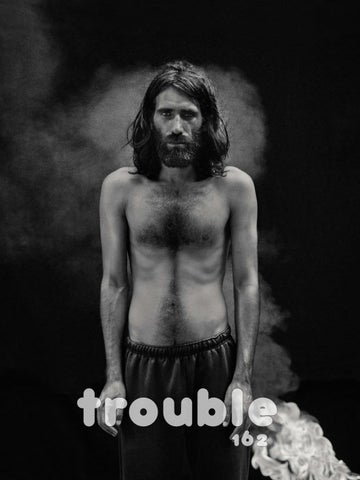
trouble 162
Bowness Photography Prize 2018 Monash Gallery of Art Until 18 November 2018 IN ORDER OF APPEARANCE COVER: Hoda AFSHAR, Portrait of Behrouz Boochani, Manus Island 2018, from the series Remain, pigment ink-jet print, 100.0 x 86.0 cm, courtesy of the artist | Michael COOK, Telephone 2018, from the series Invasion, pigment ink-jet print, 135.0 x 200.0 cm, courtesy of the artist, THIS IS NO FANTASY (Melbourne) and Andrew Baker Art Dealer (Brisbane) | Tamara DEAN, Sacred Lotus (Nelumbo nucifera) in summer (detail) 2018, from the series In our nature, pigment ink-jet print, 120.0 x 160.0 cm, courtesy of the artist and Martin Browne Contemporary (Sydney) | Amos GEBHARDT, Water #3 2018, from the series Evanescence, chromogenic print, 100.0 x 155.0 cm, courtesy of the artist and Tolarno Galleries (Melbourne) | Anne ZAHALKA, Krazy Kashmiris in Stagland (detail) 2018, pigment ink-jet print on canvas, 100.0 x 136.0 cm, courtesy of the artist and Dominik Mersch Gallery (Sydney) | Nathan STOLZ, Bathurst (detail) 2017, from the series Aporia, chromogenic print, 60.0 x 80.0 cm, courtesy of the artist | Joseph McGLENNON, Eclectus Australis – Brown Goshawk (detail) 2018, from the series Eclectus Australis, pigment ink-jet print, 155.0 x 100.0 cm, courtesy of the artist and Michael Reid (Sydney + Berlin). MONASH GALLERY OF ART 860 Ferntree Gully Rd Wheelers Hill (VIC) - mga.org.au
CONTENTS
BOWNESS PHOTOGRAPHY PRIZE 2018
Monash Gallery of Art .............................................................................
THE HON. KELVIN THOMSON IMMIGRATION, POPULATION & GAMBLING
Deep Trouble ..........................................................................................
MANISHA ANJALI SONG OF THE CROCODILE
Deep Trouble ..........................................................................................
MORE HEAT THAN LIGHT: BRETT WHITELEY
Alexandra Sassé .....................................................................................
NOVEMBER SALON
Nice ..........................................................................................................
FINDING THE ART IN PHUKET: THE ART OF TOLERANCE
Anthony S. Cameron ...............................................................................
02
16
17 18 28
40
COVER: Hoda AFSHAR, Portrait of Behrouz Boochani, Manus Island 2018, from the series Remain, pigment ink-jet print, 100.0 x 86.0 cm, courtesy of the artist. Winner Bowness Photography Prize 2018, Monash Gallery of Art, 860 Ferntree Gully Rd Wheelers Hill (VIC), until 18 November 2018 - mga.org.au Issue 162 NOVEMBER 2018 trouble is an independent monthly mag for promotion of arts and culture Published by Trouble Magazine Pty Ltd. ISSN 1449-3926 EDITOR Steve Proposch CONTRIBUTORS Dr Mark Halloran, Alexandra Sassé, Anthony S. Cameron, love. FOLLOW on issuu, facebook & twitter SUBSCRIBE at troublemag.com READER ADVICE: Trouble magazine contains artistic content that may include nudity, adult concepts, coarse language, and the names, images or artworks of deceased Aboriginal or Torres Strait Islander people. Treat Trouble intelligently, as you expect to be treated by others. Collect or dispose of thoughtfully. DIS IS DE DISCLAIMER! The views and opinions expressed herein are not necessarily those of the publisher. To the best of our knowledge all details in this magazine were correct at the time of publication. The publisher does not accept responsibility for errors or omissions. All content in this publication is copyright and may not be reproduced in whole or in part in any form without prior permission of the publisher. Trouble is distributed online from the first of every month of publication but accepts no responsibility for any inconvenience or financial loss in the event of delays. Phew!
a deep trouble
6
episode # with Dr Mark Halloran
The Hon. Kelvin Thompson
Immigration, Population & Gambling Kelvin’s views on immigration address the common misconception that the Howard government was anti-immigration, when in fact the immigration intake increased significantly after the Tampa incident in 2004. On population, Kelvin contends that world population growth in the last century – which has increased from 2 billion to 7 billion, with no signs of levelling out – will eventually lead to a rapid decline in quality of life. Kelvin contends the need to stabilise the Australian population by limiting skilled migration whilst increasing humanitarian refugee intake. On the Rudd-Gilliard-Rudd years, Kelvin talks through his overall disappointment in the process of governing after such a long time in Opposition. We discussed the internal leaking and undermining which affected the Gilliard government and which resulted in a hung parliament and crippled the government politically. This leads into a discussion about Kelvin’s work with the Alliance for Gambling Reform. Like what you hear? Listen to all of the Deep Trouble interviews we’ve run to date. Or listen on iTunes, Spotify, Stitcher or Mixcloud
double
7
episode # with Dr Mark Halloran
Manisha Anjali
Song of the Crocodile Indian-Fijian poet Manisha Anjali was born in Suva, the capital of Fiji, and we begin by discussing the importance of familial and national history in the development of works such as Sugar Kane Woman. We discuss the British colonisation and indenture that began in 1879 and ran until 1919 in which Indians were tricked into coming to Fiji with visions of paradise, when the reality was slave-like conditions where they were forced to work in the colonial sugar cane plantations and refineries. Manisha talks about the plight of Indian women in Fiji at this time, and recites her poem Song of the Crocodile which is about three historical Indian women. We also discuss the mysticism of her grandmothers and her own secular obsession with religion, Hinduism, mass worship, Jungian archetypes and the collective unconscious. We finish by talking about death, grief, the acceptance of the heartbreak of loss and her casting off of the traditional role of the Indian women, and her ‘liberation from love’. Like what you hear? Listen to all of the Deep Trouble interviews we’ve run to date. Or listen on iTunes, Spotify, Stitcher or Mixcloud
More Heat Than Light BRETT WHITELEY
Baldessin/Whiteley: Parallel Visions National Gallery of Victoria until 28 January 2019
by Alexandra Sassé
Prolific, intense and successful, Brett Whiteley’s art and life have been difficult to separate. Twenty-six years after his untimely death, his work lives on as part of our present whilst his colourful life story fades into the fabric of history. Currently on display at the National Gallery of Victoria, Baldessin/Whiteley: Parallel Visions is a chance to reassess. Brett Whiteley and George Baldessin – a printmaker of figurative expressionist etchings – were born in the same year, but there is little else to tie them together and I will leave Baldessin to another time. The Whiteley works span his entire oeuvre, from his 1956 travelling scholarship win and early abstracts to his late Sydney Harbour pictures, stopping by his London Christie works and his New York period on the way.
< Brett WHITELEY Remembering Lao Tse (Shaving off a second) 1967 pencil, pen and ink 66.4 x 56.2 cm. Art Gallery of Ballarat Gift of Jerry Van Beek, 1968 (1968.30) © Wendy Whiteley
4
Brett WHITELEY Sofala 1958 oil on canvas on composition board 65.5 x 85.8 cm Art Gallery of New South Wales, Sydney Purchased by the New South Wales State Government 1994, transferred to the Gallery 1998 © Wendy Whiteley
The earliest paintings – tentative, evocative, nuanced – are heavily influenced by Lloyd Rees and Russell Drysdale; the latter was the judge of Whiteley’s scholarship win. In Sofala (1958) earth-rich reds, warm greys and creams are woven into a flattened and simplified image of a country town. The horizon line sits up close to the top edge of the painting – we are immersed in a sparse domestic world clinging to life on a harsh but harmonious crimson land. Shades of Nolan, Drysdale and Tucker infuse Whiteley’s sensibility at this stage. His later rococo line is absent, pre-dated by the pared and scraped back forms more consistent with the drought and angst-stricken images of Australia that had begun to make such an impact on London, chiming, as they did with the mood of post war existentialism. Whiteley launched himself onto the British art world at a moment when the interest in Australian art and culture was at full flood. Arthur Boyd, Lawrence Daws, Charles Blackman, Francis Lymburner, Sidney Nolan and Roy de Maistre were in residence. Kenneth Clark was a friend of Nolan and the director of the Tate, Sir John Rothenstein, was the author of a biography on Australian painter Charles Conder. There was a burgeoning sense that Australian conditions – the isolation in particular – were capable of precipitating something vital and original. Two major exhibitions of Australian art were being organised even as Whiteley arrived – one at the Tate, and the other at Whitechapel. Bryan Robertson, director of the latter, had just returned from a scouting trip to Australia when he was introduced to Whiteley in London. ‘Sidney Nolan had taken decades to break through but Dibbs, [Whiteley] while the dust from the rubble was still rising, made his entrance through the same hole with a Qantas bag over his shoulder’ - Clive James, Falling towards England: Unreliable Memoirs II (Picador, 2008) Whiteley’s early abstracts gained immediate attention; their painterly ebullient style exuding confidence and talent. He was included in Robertson’s 1961 Whitechapel show Recent Australian Painting and became the youngest painter to ever be collected by the Tate with Untitled Red Painting (1960). From the same period, Summer at Sigean (1962) is a masterful composition of thick, thin, translucent, opaque, scraped and scored pigment. The bulging, folded and flattened forms occasionally hint at three dimensionality, alluding to both rock forms and flesh but are never representative. Delicate blues, pale ochres, warm pinks and greys sliding along the scale from olive towards orange are woven across the three panelled work. The best of Whiteley is brilliant. His innate means of approaching the world – apprehending it not as a set of ideas or objects, but as the raw material of the senses with NEXT SPREAD: (TOP) Brett WHITELEY, Summer at Sigean 1962–63, synthetic polymer paint, oil, tempera, charcoal, pencil on hessian and cotton gauze on composition board (a-c) 198.0 x 456.0 cm (overall). National Gallery of Australia, Canberra. Purchased 1975 © Wendy Whiteley. (BOTTOM) The American Dream 1968−69, oil, tempera, collage and found objects on plywood, (a-r) 244 x 2196.0 cm (overall). State Art Collection, Art Gallery of Western Australia, Perth.
which to play, is apparent from the very beginning. Historians like to make a lot about stories of young artists constantly drawing, and feeding on all the images they can find and Whiteley did just that. But it’s a little like remarking on the fact that monkeys like peanuts. It indicates an appetite, not a commitment. A commitment requires belief which we so often strangle in our young. For eight years following a negative review of his first show, Francis Bacon, a painter of far superior power and innovation, produced nothing that survives today. Let us not pretend that the art world is a simple meritocracy. But early success threw rocket fuel on Whiteley’s belief, and that flame never faltered. The quality of the work inevitably did; his art had to mature in full public view. The search for an authentic voice and for what art could do detours through the Christie paintings. Heavily derivative of Bacon, they hover between voyeurism and sensationalism without Bacon’s terror. In his return to representation Whiteley seems to forget the battles he won with abstraction – the successful balance of evocative forms, layering of pigment and subtle transitions of colour. Things get worse in New York, whence Whiteley departed to conquer in 1967. What to make of American Dream? Hung at the end of this exhibition, the painting makes even less sense than usual. An undigested mix of adolescent kitsch, art-school experimentation and pseudo-prophetic imagery painted with the sensibility of signwriter, it curves around a dreadful twenty-two metres. I believe small children in Perth are taken to see it. Then he comes home to Sydney. It’s not happy ever after – far from it if you have read the life story. He never beat his demons; he navigated them. Rimbaud has a lot to answer for. The old idea that one has to be high to be creative dogged him and ultimately brought him down. But in Lavender Bay he did find again a voice of his own. It was patchy, but there were good patches. There was more of Matisse in him than Bacon now, his love of colour and line became fluent in sight of Sydney Harbour. The spray at Bondi (1981) might be glib, shallow and glitzy (rather like Bondi itself) but he also made Interior with time past (1976) an ode to the studio and the city imbued with a sense of peace in the unlikely colours of orange and green. Mother and Child (1977) and Backview (1976) are line etchings of singular beauty and simplicity. Whiteley is best appreciated if you don’t look for consistency in either his art or his life. He has left us with some iconic timeless images. We would have liked more. Baldessin/Whiteley: Parallel Visions, NGV Australia, Federation Square, Melbourne (VIC), until 28 January 2019 - ngv.vic.gov.au
Alexandra Sasse is a painter who writes, based in Melbourne. She lost her sense of humour whilst in art school but doesn’t consider that an impediment to a successful career. Unfortunately, no-one else agrees - alexandrasasse.com
Brett WHITELEY My armchair 1976 oil on canvas 206.5 x 283.5 cm Private collection, Melbourne © Wendy Whiteley
november salon
PREVIOUS SPREAD: Megan COPE, The Blaktism 2014, single-channel HD video, edition 2 of 5, 8:04 minutes. State Art Collection, Art Gallery of Western Australia. Purchased through the TomorrowFund, Art Gallery of Western Australia Foundation, 2015 © the artist, courtesy THIS IS NO FANTASY. Art Gallery of Western Australia, Screen Space, Perth Cultural Centre (WA) until 25 February 2019 | FREE - artgallery.wa.gov.au LEFT: Takehito KOGANEZAWA, Untitled 2018, courtesy of the artist and Loock Galerie, Berlin. The Garden of Forking Paths, Buxton Contemporary, Cnr Dodds St & Southbank Blvd, Southbank (VIC), 7 November 2018 – 17 February 2019 - buxtoncontemporary.com ABOVE: Benjamin AITKEN, Jack 2018, Subject: Jack Shaw, synthetic polymer paint on canvas, 126 x 150 cm. Black Swan Prize for Portraiture, Tony Fini Foundation Artist Prize Winner, Art Gallery of WA, Perth Cultural Centre (WA), until 26 November 2018 - artgallery.wa.gov.au - blackswanprize.com.au NEXT SPREAD: Hassan SHARIF (Iran/United Arab Emirates c.1951-2016), Cutting and tying no.2 (detail) 2014, cotton rope and wool, 275 x 650 x 50 cm © Estate of Hassan Sharif. Image courtesy: Gallery Isabelle van den Eynde. The 9th Asia Pacific Triennial of Contemporary Art (APT9), QAGOMA, Stanley Place, South Bank, Brisbane (QLD), 24 November 2018 – 28 April 2019 - qagoma.qld.gov.au
november salon
PREVIOUS SPREAD: Zico ALBAIQUNI (Indonesia b.1987), When it Shook The Earth stood Still (After Pirous) 2018, oil on canvas, 200 x 120cm Courtesy the artist and Yavuz Gallery. The 9th Asia Pacific Triennial of Contemporary Art (APT9), QAGOMA, Stanley Place, South Bank, Brisbane (QLD), 24 November 2018 – 28 April 2019 - qagoma.qld.gov.au BELOW: Amir TEHRANI, Thread 1 2018, Etching on paper, 30 x 42cm. HOME, Walker Street Gallery & Arts Centre, corner of Walker and Robinson streets, Dandenong (VIC), 18 October – 24 November - greaterdandenong.com RIGHT: Brett WHITELEY, The spray at Bondi 1981, oil on canvas, 179.0 x 154.0 cm. Private collection, Melbourne © Wendy Whiteley. Baldessin/Whiteley: Parallel Visions, NGV Australia, Federation Square, Melbourne (VIC), until 28 January 2019 - ngv.vic.gov.au NEXT SPREAD: Sally SMART, Artist Portrait. Photo by Gregory Lorenzutti. The Violet Ballet, presented as part of the Adelaide Festival, ACE Open, Lion Arts Centre, North Terrace (West End), Kaurna Yarta, Adelaide (SA), 2 March – 27 April 2019 - aceopen.art
FINDING THE ART IN
Phuket The Art of Tolerance by Anthony S. Cameron
4
They say that you can feel the pulse of a place through its traffic, that you can sense its spirit as it dances on the tar. If this is the case, then the roads here are a daily abstract painting bursting forth in all directions. Any part of the road, median strip or pavement is fine in this daily free-for-all, and the common remark of ‘up to you’ takes on a whole new meaning when a truck is barrelling towards you on the wrong side of the road covered in wacky stickers and the last thing you see is the whites of the trucker’s eyes streaked with broken blood vessels and you swear to yourself later you could hear the chink of the spent Red Bull bottles rolling around his feet as he squeezed past in a rush of hot, diesel rich air. If you have come from a place that puts you in a state of financial fear for breaking a road law, then your first solo drive here will be quite an experience. Think of the road as a moving feast, a place where radical moves are done slowly enough for everyone around to adjust, where the expectation is for anything to occur and that even the most selfish and cocky manoeuvre will be tolerated with a smile through the tinted glass. One of the few rules of thumb is to try and keep most of your wheels on the ground if possible. If you want to drive at three times the speed limit, go ahead, just try and do it using only two of the three available lanes. If you are late for a meeting, feel free to ghost ride on the shoulder instead of sitting in the traffic. Just put your hazard lights on and everything will be cool. If you want to make a left turn from the far right lane, go nuts. Just do it slowly and politely and please ensure that you block as much through traffic as you can, at least until the lights change. If you’re a minivan, then the road is your high speed canvas. None of the above polite niceties apply. Wherever you are going is a hell of a lot more important than any of our destinations, obviously, since you seem completely unaware of our existence; except when you are tailgating one of us who is stupidly doing the speed limit and holding you up. These dudes carry guns so you want to try and dish out your road rage behind the safety of your tinted glass cocoon or put it in a story like this, because a bullet is more precious than the life it takes, and there is plenty of jungle to go hide in until it all blows over.
Finding the Art in Phuket / Tony Cameron
4
Sure, the roads are crazy here, but there is an air of tolerance that hangs over it all that keeps us all alive and ready to dance another day. It is that tolerance and easygoing approach that keeps tourists flocking here, and it’s not just in the traffic. It is in the awkward smile as another farang wearing a g-string bikini walks into your restaurant next to the mosque and doesn’t think anything of it. It is in the feigned indifference as the plump, middle aged lecherous hand grabs at the young nubile Thai body and gives it a satisfying squeeze. It is in the tight lipped grimace as you watch all your land being sold to foreign business interests. It is in watching another beautiful Thai woman hopping out of a rich white man’s car. It is in the money you send back to your family in Isaan, the loose change that spilled from a first world pocket. It is in watching the culturecide occurring around you as you reach for another belt of lao khao to help it all make sense. It is in the weary laugh of the tuk tuk driver as the big Russian belly gets pushed out at him, bereft of context, just a mindless gesture in a place where only money talks. But most of all it is in the heartbeat of this island as she strains under the weight of a tourism industry that knows no limits, and in the little things. The small differences bleached by the hot sun and the large chasm breached in the interests of the greater good. It is in the massage parlour happily co-existing with the mosque and its population of worshippers. It is in the myriad of cultures that grind up against each other as the infectious beat tears a hole in the night. Phuket is a grand old lady, and she can take this constant transformation. She can take the pilings being driven into her bedrock constantly, she can bear the curious brown sludge that runs out of the rivers into the ocean surrounding her, she can absorb the tonnes of rubbish that get buried under landfill in the dead of night. Sure, she might groan a bit, but what old lady doesn’t, right? Meanwhile the jungle creeps silently around the edges, waiting to swallow it all up.
ANTHONY S. CAMERON is an Australian ex-pat living in Phuket, Thailand, and the author of two novels, Driftwood (2014) and Butterfly on Bangla (2015). His books are available on Amazon here. You can find his sculptural furniture on Facebook here.