TAKE A LOOK AND SEE WHAT’S IN STORE AND ON STAGE... SEASON BROCHURE AVAILABLE FROM MAJESTIX ON 5333 5888 OR VISIT HERMAJ.COM
contents
trouble august 2013
FEATURES (07) COMICS FACE Ive Sorocuk (08) NATASCHA STELLMACH: I DON’T HAVE A GUN
Carmen Ansaldo
(14) PETER ELLIS: A THREE PIPE PROBLEM
Dr. Peter Hill
(18) EMMA HACK: SOCIAL WORK
Like it is
(20) ACTEASE Courtney Symes (23) THE STREAM: INTERVIEW WITH DAN KOOP
Trouble
(24) ADELOUD Cassandra Scalzi (28) MELBURNIN’ Inga Walton (32) DEAR DREAMBOAT Dmetri Kakmi (34) ACTUAL RUSSIAN BRIDES: WIFE BEATS Trouble (36) AUGUST SALON Augustitious (46) STRALIAN STORIES: KENNETH SLESSOR Neil Boyack (48) GREETINGS FROM HIROSHIMA
Ben Laycock
(50) SKULL MOVIES: SCENE V
Robin Pen
(58) PERCEIVED TIME Darby Hudson
Issue 104: AUGUST 2013 trouble is an independent monthly mag for promotion of arts and culture Published by Trouble magazine Pty Ltd ISSN 1449-3926 STAFF: Vanessa Boyack, administration, admin@troublemag.com | Steve Proposch, editorial, art@troublemag.com | Listings, listings@troublemag.com CONTRIBUTORS: Mandy Ord, Ive Sorocuk, Inga Walton, Dmetri Kakmi, Courtney Symes, Cassandra Scalzi, Dr Peter Hill, Carmen Ansaldo, Robin Pen, Neil Boyack, Ben Laycock, Darby Hudson. Find us on Facebook: www.facebook.com/Troublemag Subscribe to our website: www.troublemag.com
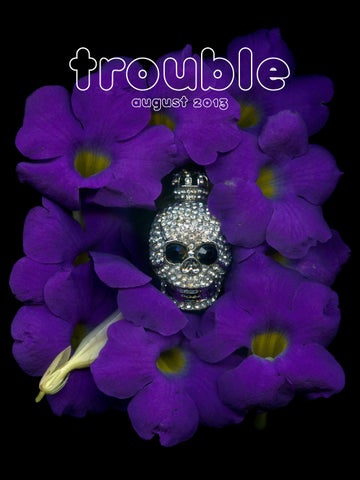
COVER: Angki Purbandono, King of Purple (detail) 2012, print on Dbond, Scanography, 100 X 100 X 8 cm. Crossing Contemporary Cultures – 11 of Indonesia’s top contemporary artists, MiFA Asian Pacific Contemporary, Level 1, 278 Collins Street Melbourne (VIC), 23 August – 27 September - www. mifa.com.au
READER ADVICE: Trouble magazine contains artistic content that may include nudity, adult concepts, coarse language, and the names, images or artworks of deceased Aboriginal or Torres Strait Islander people. Treat Trouble intelligently, as you expect to be treated by others. Collect or dispose of thoughtfully. DIS IS DE DISCLAIMER! The views and opinions expressed herein are not necessarily those of the publisher. To the best of our knowledge all details in this magazine were correct at the time of publication. The publisher does not accept responsibility for errors or omissions. All content in this publication is copyright and may not be reproduced in whole or in part in any form without prior permission of the publisher. Trouble is distributed online from the first of every month of publication but accepts no responsibility for any inconvenience or financial loss in the event of delays. Phew!
Natascha Stellmach:
I Don’t Have A Gun by Carmen Ansaldo
Natascha Stellmach’s Berlin solo exhibition I Don’t Have a Gun at Wagner + Partner Gallery pushes the German-Australian artist’s concerns to new frontiers. Stellmach presents an ambitious yet eloquent collection of photo-collages, text based passages and performative happenings which work together to address the phenomena of ‘burn-out’.
>
Contemplating the question ‘What do you want to let go of?’ viewers can participate in the exhibition by booking a one-on-one consultation with Stellmach where they decide on a word signifying a sentiment they wish to personally relinquish. The artist then tattoos this word onto the participant with a professional needle, minus the tattoo ink. The inscription on the skin and the healing that subsequently follows stands in for a more abstract process of courage, surrender and renewal that Stellmach herself undertook to overcome her own experience of burnout. I Don’t Have a Gun combines these inkless tattoo happenings with a series of the artist’s hung pieces. Stellmach has worked into a series of Super-8 film stills with images of her own imaginary heroines, framed by winding lines of poetry teeming with Australian euphemisms. 4 Smoking gun No. 5 (detail from installation) 2013, ink on paper on walls, dimensions variable. Courtesy Wagner+Partner, Berlin.
>
Smoking gun No. 1 (detail from installation) 2013, ink on paper on walls, dimensions variable. Courtesy Wagner+Partner, Berlin.
> These addtions spill out of the confines of their hung collages to cover the gallery walls themselves. Entries from the artist’s journal are combined with a motley crew of sketched figures Stellmach affectionately refers to as her ‘bitches’ – a rough and ready troupe of larger-than-life women – each ‘armed’ with her own tool of creative expression. I caught up with Stellmach before one of her inkless tattoo happenings to explore the themes of I Don’t Have a Gun, and to find out how inkless tattooing became such an eloquent expression of confession and redemption for her. The preamble to I Don’t Have a Gun invites participants to undertake an inkless tattoo in order to answer the question ‘What do I want to let go of?’ How do you think inkless tattooing facilitates an answer to this question? Natascha Stellmach: Inkless tattooing is something that I’ve been developing and it’s exciting because it is new for me and new for all of the people who have engaged with it. Primarily I’m interested in rituals that allow for transformation, and I like exploring different rituals – the ritual of smoking a deceased loved one or a deceased rock star were some of my past investigations. I Don’t Have a Gun looks at a different kind of transformation. A few years ago I started working on skin, writing statements in pen and textas. I realised that what emerged was a beautiful confessional atmosphere and intimacy despite it being public. The process was highly creative. Even though I wasn’t penning words that were personal to the participants, they were statements that resonated with them, so the participants became these billboards for questions around art. I wanted to develop that further, bring it under the skin so to speak, so then I learnt how to tattoo. I was keen to address these ideas of purging, catharsis, and the whole notion of transformation in a new way. It seemed to be fitting that the participant would have to engage with a bit of bloodletting to affect some kind of change, an internal process. It wasn’t about anything being aesthetic, permanent, or beautiful. While tattoos are all about permanence, this process is also a way for people to engage in that experience but 6 without the permanence. You tattoo a word on your participants which is decided upon during a
Natascha Stellmach: I Don’t Have a Gun / Carmen Ansaldo
> without the permanence. You tattoo a word on your participants which is decided upon during a 1:1 consultation between the participant and yourself. How is that word decided upon? NS: It is quite simple and quite magic what happens in the sessions. Some people come in very defined and we’ll still often discuss it and see if the word they chose is still fitting. Sometimes it changes. Often I’m starting at the very beginning and people will say ‘Well actually I’m fine – I’ve got nothing to let go of’ and then, through the discussion, people start to trust and open up to me and I become a bearer of people’s memories and sadnesses. I have a background as a therapist so I’m inadvertently using cognitive behavioural strategies to facilitate a deep awareness of underlying fears. Sometimes I use simple word associations and tools such as a Thesaurus, or we look at if the concept is more representative in another language, perhaps closer to that person, or in an ancient language like Greek or Latin to represent their concept more strongly. So this is what the purging is about. It’s not about the superficial or about lip service: ‘Oh well I moved on, I’m going to put it behind me’. There is a process as well as a magic and tension that is involved with choosing a tattoo and having that on your skin. There’s a similar cathartic process here because it’s something that people need to actively engage in, and this may mean they need to hurt, to engage with fear. The word which represents their concept is then something that they also have to connect with every day throughout the healing process. For me, that’s what I’m interested in. You have to nurture and heal that word away and this can take weeks, months. The person becomes the art. This active participation is why they are happenings rather than performances and it’s actually not about me, it’s about them. I become a mirror, a facilitator. I draw it out. This exhibition addresses your personal experience with burn-out. How did you use your art practice to combat this dilemma? Are you addressing artistic burn-out specifically in this exhibition or burn-out more generally? NS: I address artistic burn-out but as you can imagine art often encompasses the artist’s life so really, it affected every aspect of my life. I used my own practice to pull myself back up because it was the only option left to me. What I also did was I sought help from various disciplines, everything from shamanic practitioners through to Catholic nuns, through to the medical professions. I looked at the whole gamut and how they address or looked at burn-out. What linked all of them was this idea of compassion. When modalities worked for me was when there was a sense of understanding, of empathy and compassion with that practitioner. And what I realised was that I needed to look at my own practice through that lens. I discovered that burnout is classic for people who are hyper-self-critical and perfectionists, all these ridiculous modern notions that the creative professions are full of. This idea of looking compassionately, it was like a thread I used to realise ‘Well actually I just need to work again in a gentle way, in a compassionate way’. That was what brought me out, I started working from there. What do you want to say to your audience about burn out? What ideas do you want them to walk away with from this exhibition? NS: I guess this idea of compassion really. It can’t even be more simple than that. But it is also hard, it is the most difficult thing to do, not only to be compassionate with others but being compassionate with oneself – that’s where it all begins ... It’s not just the Buddhists who say that, it’s such a beautiful lesson in life and I guess what I rediscovered was an inherent sort of playfulness and pleasure and that’s why I experimented with different media, things that are bizarre such as tattooing words that represent fears or sadnesses, without ink. As well, I’ve always drawn a little bit but I’m not an illustrator, so this also tapped into this idea of breaking my own rules, experimenting and becoming more playful. I guess that’s something that I would love people to take away, and obviously I would love them to experience an inkless tattoo! ¢ Natascha Stellmach’s solo exhibition I Don’t Have a Gun finished on the 31st of July 2013 at Wagner + Partner Gallery – Strausberger Platz 8, Berlin (www.galerie-wagner-partner.com). The artist will be showing later this year at La Trobe Visual Arts Centre in Bendigo. Carmen Ansaldo is a freelance art writer from Brisbane, Australia who is now based in Berlin, Germany (Carmenansaldo.wordpress.com) > IMAGE CREDITS: TOP I have a ghettoblaster & a pen (2013), archival ink and photo paper, 68 x 86 cm, unique piece. BOTTOM: I have a blender (2013), archival ink and photo paper, 68 x 86 cm, unique piece. All images by NATASCHA STELLMACH, Courtesy Wagner+Partner, Berlin. Natascha Stellmach: I Don’t Have a Gun / Carmen Ansaldo
Day 5, Natascha lets go of her X (2013) inkless tattoo. Copyright the artist.
Natascha Stellmach tattoos a visitor without ink as part of I Don’t Have A Gun. Photo: Oliver Parzer.
Day 2, Reinhard lets go of Longing (2013), inkless tattoo. Copyright the artist. Natascha Stellmach: I Don’t Have a Gun / Carmen Ansaldo
Peter Ellis: a Three-pipe Problem
Catalogue Essay Extract by Dr. Peter Hill
A Head In A Hive Of Bees, the major exhibition at RMIT Gallery of selected drawings by Peter Ellis, Associate Professor of Fine Art within the School of Art, owes a debt to the imagery of surrealism in film, literature and the visual arts. This is an edited extract from the exhibition catalogue essay by Dr Peter Hill, Associate Professor of Fine Art at RMIT University. Writing about the work of Peter Ellis is what Sherlock Holmes would have called a three-pipe problem. The first fill of the pipe deals with childhood and early influences. We talk about this in his office at RMIT as we look through sketchbooks and folders of work. “In my childhood and early teens, I had the desire to become a zoologist,” he tells me. “My obsession with animals led me towards categorising information, collating and identifying subject matter that would later appear in my art. I recall a high school biology teacher commenting that the drawing I had done of a dissected frog contained too much pathos.” The second fill of the pipe brings us to content. And what a glorious, brimming-over- the-edge-of-theglass content it is. “The use of microscopic minutiae of the animal kingdom is very important to me. I have a long history of the use of animal imagery in my work.” And as we talk, and turn the pages of the sketchbooks and loose sheets of paper, in no particular order penguins, scallops, moose, oysters, accident-prone bears, microbes, and fleas flit beneath our gaze. Ah, fleas! There are plenty of coffee
table books on “The Art of the Horse”, or “Cats in Art” – maybe it is now time for the flea. Look at one under a microscope and it appears more deadly than a stealth bomber, more complex than a computeraided architectural drawing. The bowl of the pipe grows hot as one considers the many other influences pumping through his lifelong project; influences that range from ancient Chinese, Japanese, and Korean calligraphy, to the use of chance, paradox, and humour in those experiments of the Surrealists and Dadaists. Outsider art rubs shoulders with the work of Leonora Carrington, Miro, and Meret Oppenheim. Swapping pipes, fill the third is concerned with methodology, collage, exhibition, display, and chance. I am intrigued with the gridding system he uses and the emergence of “satellite” panels. These, he explains, can signify the possibility for an expansion of the image. “The works are constructed from traditional Japanese Shikishi panels, arranged as multiples to create a large overall surface area. Much of this exhibition is inspired by first hand observation of great Asian art and artists. Fusen, Motsugai, Sengai, Hakuin. I have a highly fertile imagination and can invent images anywhere - while travelling for example. There is no need for a studio if you have sheets of paper, sketchbooks pencils and ink.” Like many artists, Peter incorporates collage into his drawings. And this element, this “collage principle” that influences so much of his work and that of many contemporary image-makers, is found in “the estrangement of the original material itself and the neutralization of our habitual responses to it”. And this finally brings us to “chance” and all the big and small “what if?” questions? What if I drop a piece of string on the floor three times, as Marcel Duchamp did in his Three Standard Stoppages? What if I paint flat on the floor of my barn, as Jackson Pollock did, dripping skeins of paint with such controlled randomness? Or what, as the young and always curious Peter Ellis did, if I used snails to create a drawing? “Chance is not a neutral but a distinctly positive force,” he continues, as we approach the end of a pile of drawings as big as three stacked phone books. It’s been a delight to have such a guided tour of his imagination – like watching a wonderful film, frame by frame, and having the director beside you to point out all the bit players, as well as the stars – the whales and the elks, the crazy bears, the oysters, and of course the fleas. ¢
Bizarre animal forms, hybrid creatures inhabiting seemingly irrational psychological spaces. These are the images that have permeated artist Peter Ellis’ drawings for over 38 years.
A Head in a Hive of Bees: Selected Drawings by Peter Ellis, RMIT Gallery, 344 Swanston Street Melbourne (VIC) until 17 August 2013 - www.rmit.edu.au/rmitgallery Peter Ellis: A Three-Pipe Problem / Dr. Peter Hill
Robert Clinch: Fanfare for the common man A mid-career retrospective 13 July to 8 September An Art Gallery of Ballarat exhibition | Open daily 10am - 5pm. Admission free Robert Clinch Fanfare for the Common Man (detail) 2003 egg-tempera on panel. Private collection.
Emma Hack
Neil Boyack’s
SOCIAL WORK with
Prior to her iconic collaboration with Grammy award winning musician Gotye on his film clip for Somebody That I Used to Know (2011), Adelaide-based artist Emma Hack was known best for her Wallpaper series (2005 - 2010), in which she painstakingly camouflaged the human form by hand painting her models into the remarkable wallpaper designs of the late Florence Broadhurst. More recently, Emma has achieved sell out status at the 2013 Affordable Art Fair in Hong Kong, as well as successful showings at art fairs in Brussels and Milan. Emma’s signature medium of body paint installation and photography seems to have blossomed in the larger art world too, with the Melbourne Body Art Xpo now in its 5th year and promising to attract more punters than ever before. Although unable to attend the event herself, Emma agreed to the drill of Trouble’s Social Work interview to celebrate this unique artform’s burgeoning popularity. Which member of your family influenced you the most? EH: My mum, she was always there and supportive of whatever I wanted to do. She also nurtured my ‘craft’ spirit and always had me learning. Who is the best teacher you have ever had? EH: Mr Pridgent, from primary school as he was the first to discover my artistic ways and make me feel special by nurturing them. Do you think its ok to lie? EH: Not to me! But I have been known to twist the truth to get my way, my husband would vouch for that. What does freedom mean to you? EH: Being able to make choices for where you are in life and enjoying every one of them. How do you make important decisions? EH: I follow my gut. Being a freelancer has taught me to listen to my intuition – as I am getting older its more finetuned but you must be willing to take risks. 4
Emma Hack / Social Work 1. Emma at work on Hydrangea Cradled Owl, 2013 2. Hydrangea Cradled Owl, 2013 3. Plaza de Espana - Seville, 2013 4. The Redhead, 2013
> Do you think things happen for a reason? EH: Absolutely – it’s the only way to reason with anything that goes wrong - or right! What beliefs do you have that you think will never change? EH: The belief that anything can be achieved if you believe and visualise it. Do you believe in the supernatural? EH: I don’t not believe…. Have you ever come close to dying? EH: Not that I know of, but I have been in some hairy situations that could have lead to being hurt if I hadn’t ‘listened’ to my inner voice. Do you have a favourite family story? EH: Not a story as such but my most favourite family moment was Christmas time when we all at my Nanna and Poppa’s, loads of cousins and fun! What do you like the best about your body? EH: That I am finally fit after not making any effort for so many years, that I am stronger now than I have ever been. What do you think would be the best thing about being the opposite gender? EH: Not having to wear a bra? I don’t know, I am pretty much loving being a woman. What do you hope for? EH: Can I say World Peace? I kind of want to – mainly for us to live in a more stable way. We need to be nurturing our environment and the wonderful creatures within it. Have you ever been lost? EH: Yes, 2am, pouring rain, Antwerp, Belgium, not a taxi in sight for two hours and being followed by a random car ... Not ultimate! What do you like most about where you live? EH: Everything is 20mins away, sea, vines, hills, friends, great nature and produce. What is stopping you? EH: Not a lot! ¢ Artist Site: www.emmahackartist.com The Melbourne Body Art Xpo is on 31st August at Revolt, 12 Elizabeth Street Kensington (VIC). The theme this year is ‘H2O’. For more info visit www.mbac.net.au
ACTease DATELINE: AUGUST 2013 by Courtney Symes
A few weeks ago, I was fortunate enough to attend a Seekers concert. Having bought the tickets as a Christmas present for my mum, I have to confess my knowledge of The Seekers’ repertoire was limited to Georgy Girl and Morningtown Ride, but having being exposed to their cassettes on long car trips, I had a rough idea of what I was in for. What I didn’t expect was the quality of their live performance. This was particularly impressive when I remembered this was their 50th Anniversary tour! The other thing I discovered was that The Seekers’ lead singer Judith Durham has such a distinctive voice that you can close your eyes and recognize it without needing to see her. This got me thinking: what other musicians have such a unique voice that you could recognize it without seeing them perform? I asked some friends and a few names came to mind: Louis Armstrong, Tracy Chapman, Barry Gibb, Freddie Mercury, Michael Jackson, Rod Stewart, Tina Turner, Missy Higgins, Sarah Blasko, and Amy Winehouse. Another favourite musician I thought of was Paul Kelly. In addition to a distinctive voice, Kelly also has a distinctive look, which the National Portrait Gallery has recognized in their latest exhibition, Paul Kelly and the Portraits. There’s something mesmerizing about Paul Kelly. Maybe it’s his dark eyes that catch your gaze and draw you into his world. Or perhaps it’s the way he completely connects with his music in a pure, uninhibited way. This collection of portraits includes work from photographers such as: Greg Noakes, Tony Mott, Wendy McDougall, Jon Lewis, Liz Reed, Bleddyn Butcher, Peter Brew-Bevan, Stu Spence, Peter Hudson, Jon Campbell, Martin Philbey and Warwick Thornton. Images span several decades and are a mustsee for Paul Kelly fans and portrait enthusiasts. Runs until 1 September - www.portrait.gov.au 4 Peter HUDSON, Words and Music, Portrait of Paul Kelly (detail) 2007, oil on canvas over board. Collection: Maureen Ritchie.
Majura Women’s Group, 1960s (2013), photograph.
> “At the beginning of 2012 our group decided to do a year-long project to celebrate Canberra’s Centenary in 2013,” says Victoria Sutherland on Majura Women’s Group’s latest exhibition, Women: Celebrating a Century of Canberra’s Women. This exhibition features a series of photographs created by group members that focus on life for women in Canberra over the last century. These images cover eras such as Canberra’s settlement in the early 1900s, 1940s wartime and the Swinging 60s, whilst showcasing the vibrant costumes, makeup, hairstyles and photographic techniques from these periods. Quilted and textile works, as well as basketry pieces will also accompany these images. Running for nearly 30 years, the Majura Women’s Group provides a creative, stimulating space for people at home with young children to meet and produce artwork in a relaxed environment. Also at Belconnen Arts Centre, a community exhibition, Intersection, showcases the work of sixtyfive artists from the Canberra region. Artists of all ages and backgrounds present works in a variety of mediums. Take a few moments and appreciate the world from someone else’s perspective – you
might be inspired and learn something new. Women: Celebrating a Century of Canberra’s Women and Intersection both run until 4 August. - www.belconnenartscentre.com.au Head on over to ANCA for some gorgeous glass work as emerging artists Christine Atkins and Zoe Woods team up in their latest exhibition, Natural Perceptions. As the exhibition name suggests, the featured “works create a richer and more complex vision of nature, triggering a feeling of familiarity with the natural world, while also evoking a sense of mystery and wonder” by examining “abstract organic forms and patterns through the optical qualities of glass”. Canberra-based artist Atkins explores the creation of natural phenomena through the combination of light and glass, demonstrated through her floating installation of hanging glass panels. Adelaide artist Woods is inspired by the intricacies in nature and showcases self-contained forms influenced by complex patterning. Both artists’ works complement each other, and visitors are presented with a rich, diverse collection. Christine Atkins will give an artist talk at 2pm, Saturday 3 August. Exhibition runs until 4 August. - www.anca.net.au 4 ACTease / Courtney Symes
> Focusing on the concept of ‘light’, Liz McNiven has curated the works of nine contemporary Indigenous artists including: Brenda Croft, Kerry Reed Gilbert, Lyndy Delian, Gary Lee, Jenni Kemarre Martiniello, Jonathan Jones, Tjanara Jali Talbot, Rachel Perkins and James Tylor in Canberra Contemporary Art Space’s latest exhibition, First Light. The exhibition features a variety of works, such as large light boxes from Jonathon Jones, intimate photographs from Tjanara Jali Talbot, woven glass traps from Jenni Kemarre Martiniello and Rachel Perkins’ One Night the Moon. Whilst many of these artists are recognized nationally and even internationally, most also have a close connection to Canberra. Curator Liz McNiven (former curator at the National Film and Sound Archives) is also a Barnba woman from the Budjiti nation of Paroo river country in north-west NSW and south-west Queensland. Runs until 10 August. - www.ccas.com.au Skulls adorned with flowers; guns entwined with soft foliage; and intricately-detailed insects. eX de Medici’s subject choices clash and contrast as she combines familiar items of beauty (nature) with shocking items that instil terror (weapons) in her latest exhibition, eX de Medici: Cold Blooded at ANU’s Drill Hall Gallery. Cold Blooded is a comprehensive collection of eX de Medici’s major works – sourced from public and private collections for the first time – and curated by Dr Jenny McFarlane. eX de Medici’s recent watercolours (inspired by her visits to Iran) are an exhibition highlight. Runs until 11 August. - http://dhg.anu.edu.au
Our perception and understanding of our native flora and fauna has changed drastically since Australia’s early days, observes Nicola Dickson in her latest exhibition, Frames of Reference at M16 Artspace. “This group of paintings was inspired by the many illustrations made by members of the First Fleet soon after arriving in Australia. My paintings attempt to convey the wonder and fascination that was felt by these early European settlers in response to the novel bird life they encountered,” says Dickson. A childhood fascination with birds and animals has attracted Dickson to this subject matter, and she explains, “I feel a paradoxical mix of affinity and alienation towards these living, sentient creatures that influences my own sense of personal and national identity. The way my feelings and thoughts have been informed by different historical and cultural factors interests me. In order to explore this in my paintings I imaginatively engage with historical imagery to refer to the cultural origins and evolutions of my perceptions of Australian birds and animals.” Works from Dickson’s series, Birds from a New World touch on “the inherent violence within the process of British colonisation of Australia and some of its consequences such as species loss”. Dickson’s other series, Patterns of Empire, focuses on notions of “imperialism, ornamentation and the rise of the natural sciences”. This is a gorgeous body of work that is well worth a look. Runs until 18 August. - www.m16artspace.com.au ¢
Nicola DICKSON, Patterns of Empire - Monarchy I (detail) 2013, acrylic and oil on linen, 76 x 56cm. ACTease / Courtney Symes
The Stream / The Boat / The Shore / The Bridge by Dan Koop places the audience at the centre of the action, bringing participants together to make their own journey around the Esk River, Launceston during this year’s Junction Arts Festival (4 – 8 September). Inspired by “what if?” scenarios and lateral thinking puzzles, the event is guided by activities and events at each site, where participants contribute their thoughts, choices and actions to decide how best to cross the river and reach the city. Along the way the audience will see the site through new eyes from unexpected vantage points, to create an imaginative overlay upon a city space most often frequented by tourists.
www.junctionartsfestival.com.au 4 - 8 SEPTEMBER 2013
the stream: DAN KOOP
Can you preview some of the stories you will be covering in regards to the history around the Esk River? Dan Koop: To say that we take stories and represent them is a bit of a red herring, as the work is much more about what each participant wants to tell us. But we do find interesting factoids about the site that we think chime with personal stories and use these as a framework to open up conversation. For instance, the city we come from, Melbourne, was “founded” from Launceston when Batman and Fawkner headed north to explore. Even in this outline of a story there’s some kind of resonance we can use that alludes to the many moments of departure and arrival any individual experiences over a lifetime. Another reference might be drawn from purely geographical queues, like where an invisible border is marked by the King’s Bridge where the South Esk meets the Tamar. It’s not only about a technical line of demarcation between where one river ends and and an estuary begins, but a line that might make us think about the thin and overlapping lines of what is ‘our space’ like a city or town, and an ‘other space’ like the bush or a wilderness. But maybe that’s a long winded way of admitting that we are still looking for the right cues from the site and Launceston history! We have made two visits to Launceston already and we are doing plenty of library style research now that we’ve got some hints. Then the week we spend in Launceston before we open the Junction Arts Festival season is crucial to see if we can skilfully place each of these ideas onto the site in a way that makes the experience flow in a natural way. I bet there’ll be great ideas that we’ll have to throw away and even better ideas that we’ll discover once we start working in situ and talking more to the people of Launceston.
our team) so I have plenty of stories to tell about specific places around the city. I grew up near one of the “green wedges” that slice through Melbourne and surrounds the Yarra, so I know what the river is like upstream and downstream - It’s always the same river, but really different at every kilometre along the way. So when we mix geography and personal history it’s a very particular story I could tell. Those of the team who have moved to Melbourne for work, study or love tell a completely different story again. While the geography of Melbourne shapes our communities (north vs south) it also makes a common connection that connects us (from west to east), but in the end I believe a city is ultimately made up of it’s people. The project creates a space where participants are given time time to linger in a place that they don’t often get the chance to, while contemplating the society they live in. In regards to creating an ‘imaginative overlay’ do you think that is a natural habit of tourists as they travel around an unfamiliar city? DK: Sure, I think people do the best they can to “make sense” of a new place. But a city isn’t necessarily trying to “explain itself”, it’s just getting on with it. So people do fill in the gaps, sometimes correctly, sometimes not. I often feel a relationship to a city or place is just like a person, it’s always evolving so hard to pin down at any exact moment. Is the challenge more about giving residents of the city a new perspective on where they live?
>
DK: Yes. One of the principles of the work is to give a new What stories have you used previously, from the Yarra? perspective, allow time to be spent and give permission for some behaviour or activity that one does not usually feel DK: I was born in Melbourne (true of about half of they are given. ¢ The Stream / The Boat / The Shore / The Bridge by Dan Koop and Co. Image by Max Milne. The Stream: Dan Koop / Steve Proposch
DATELINE: AUGUST 2013 by Cassandra Scalzi
August is art month in South Australia. Recognised as the largest and most innovative community based, visual arts festival in Australia, The South Australian Living Arts Festival, known as SALA (yes, we celebrate the living; we are not that dead beat a town after all), will present 502 exhibitions and art events from the 2nd to the 25th of August, with a record number of participating, diverse and talented artists with something to say. Innovative Adelaide, I am proud to say this month. Innovative, because, quite simply, SALA brings art to the community by utilizing unconventional venues, including shops, pubs, cafes, offices and public spaces, in addition to the more traditional studios and art galleries. Every imaginable space is transformed into a gallery, so to speak. And it’s free! In fact, SALA would have to be the most successful festival in terms of widespread community contact and impact, because it makes it easy for everyone to embrace the wonderful experience of art. There’s no excuse not to during August. Art is everywhere! The festival is inclusive of every medium from painting, sculpture, photography, mixed media, moving image and installations. If you are into art, and I assume you all are, then it’s a good time to visit Adelaide, and our beautiful churches! But don’t forget about Adelaide’s best pubs … you will be pleasantly surprised with what can come out of these places. Trust me! Take, talented, local artist, Jacky Murtaugh, the winner of this year’s Austral Hotel Emerging Artist Award, and last year a finalist. I will certainly be going to check out, Let Them See at, quite fittingly, ‘Let Them Eat’, a favourite vegetarian haunt in the western suburbs. Reflecting modern lifestyle and the environment, this emerging artist’s work, with its sparkling renditions of water and blinding representations of sunlight, is reminiscent of the work of an old-world impressionist painter, but with more of an eclectic style and modern twists, which tantalizingly weave into stunning landscapes. By night would have to be my favourite work from this promising Adelaide artist.
Peter WALLFRIED, Brigitte 2013, painting.
New ways of thinking about place, country and identity will be offered at the Art Gallery of South Australia, with Heartland: Contemporary Art from South Australia by presenting the evolving and often unexpected visions of Aboriginal and non-Aboriginal artists. This exciting exhibition, is also accompanied by an energetic events program of tours, talks and hands-on arts activities to get people right into the experience of art. He, She, S and B is not some artistically delivered variation of S&M, but rather another exhibition which promises to be enlightening with paintings of rich contrasts by the talented and regarded couple from Utopia in the Northern Territory, Kamara Johnson and Pitjara Petyarre. Gallery space, Ingigenu, is the place to see their exciting work. ‘A Wild Fibre’ is showcasing excitement of a different kind of with, A Bit of What You Fancy. One source of inspiration, eight interpretations. If you are more into girls on scooters and boys on bikes, then Peter Wallfried’s latest exhibition, Scooter Girls and Biker Boys is an exhibition to catch. Fun and sexy, featuring the likes of Lollobrigida, Hepburn and Funicello as they have never been seen before, together with other celebrities from the 60s and 70s. Orange Wrappers by Paul Hoban and Scott Pyle at Greenaway Gallery, is a unique project that explores how intuition and spontaneity are fruitful common ground between outsider art and avant-garde practice. 4
Adeloud / Cassandra Scalzi
Jacky MURTAUGH, Retrospect (detail) 2013, oil on linen, 101x101 cm.
> Random Association, a process whereby artist Michael Bryant recycles found images, drawing equally from nature and pop culture, together with portraiture, is used to explore the depth and subtleties of the human experience. Points of Contact can be experienced at the South Coast Regional Arts Centre in Goolwa, following an extensive tour of regional galleries across South Australia. It is certainly on my list for SALA this year. As is Cockatoo Valley, the Shearers Gallery to be precise, where Stephen Oatway, will be showcasing a mix of old farming equipment sculpted into amazing artworks, along with pop art paintings, to present, Farm-Junk-Sculpture for that something different to be enjoyed by art enthusiasts who like to get out of town to see some interesting art. Back to the city for my last big pick at one of Adelaide’s favourite pubs, I’ll be heading to the Colonist Tavern for a pint and a peek of Annette Summers’, ‘Burlesque Ladies’, featuring the brilliant transgender ladies of Sydney’s Kings Cross in the 1970s. These beautiful women in captivating colours and fine detail are frozen in time, whilst frequenting and performing in burlesque clubs and cabarets. This not to be missed exhibition, boasting timeless images, is a means to remember them, like one of the ladies herself, artist Annette is proud of her vibrant and colourful past and keen to share it at this year’s SALA festival.
There is something else quite extraordinary that can emerge out of Adelaide’s established pubs, which I discovered when I stumbled into a suburban pub one Friday afternoon, and met the loveliest, bubbliest artist of a different kind. I had just finished teaching my beloved collage class and had worked up quite an appetite (I try to take cutting and pasting to a whole new level). I felt like a nice, fulfilling pub meal on this particular Friday; a good chicken schnitzel with chips on the side. Any pub on Port road will do, I thought. The discreet black entrance with the letter R should have been a dead giveaway, so too, the disco lights bouncing on the floor which greeted me. As for the double Ds belonging to, I thought, regular waitresses with something to say, well, I just thought there was some sort of themed party going on. Then I noticed the poles with strippers who took it all off for the local council workers and tradies who had just knocked off for the week. I suddenly realized I was the only woman in the room apart from the naked gymnasts on stage and the two lasses behind the bar, who boasted coats of thick mascara and painted-on brows that were as generous as the meals being dished out. Oh, holy coconuts, how on earth did I ever find myself in such a place? Everyone was looking at me ... I clearly looked out of place with my green and white geometrical vintage blouse with a big bow, teamed up with a pretty, crisp white, dainty jacket streaming with a bouquet of >>
> of flowers, including fragrant varieties like violets and azaleas (among my grandmother’s favourites). In fact I had on a pair of super soft white shoes with a rounded toe and a comfortable square heel most ladies over 70 get around in. What can I say? I don’t want to wait until then and I can’t get enough of vintage right now. I was feeling a little awkward and self -conscious for a change, until Jimmy called me over to his table. Jimmy was a man in his late seventies, maybe even early eighties, smartly dressed with a tweed blazer and matching hat. Like me, he was the odd one out ... the only guy with a walking stick and a set of new teeth, except he was a regular; a widow of three years, happy to lead a hedonistic lifestyle for a change. It’s never too late, he told me as he offered to get me a beer. Perfect for my schnitzel with pepper sauce, I thought to myself. I congratulated him and wondered what my six dollar meal would be like with free entertainment. The friendly guy with the bright orange vest assured me it was the best value in town, but I should have gone the mushroom sauce. ‘’Dianne is not bad either here,’’ he said with a large grin. ‘’Maybe next time,’’ I politely replied. ‘’I like your bun,’’ he offered out of the blue. Amazing! A man who appreciates a good bun, with so many bare buttocks on display! A hairstyle I don’t usually wear as I feel rather naked like that, but there you go, an unexpected, clean compliment from the opposite sex in unsuspected circumstances. It got crazier. A big cat in a lacy black corset, who goes by the name of Kitty, is called to the stage, accompanied by a loud applause by the men, who quickly take their seats in the front row. She starts her show with the same warm enthusiasm I show to my art students. Wasn’t she cold like that I thought, wishing I had put on something warmer than a spring blouse. It seemed Kitty had a stride in her step with her outrageous 10 inches of stilettos, which she would kindly allow me to try on later. But even more impressive was how comfortable she was in her own skin, and all that glitter! Very generous with her audience also, I thought, demonstrating her skill and passion for her art, which most people sadly attach preconceived ideas to. I saw nothing but an enthusiastic, bubbly, 22 year old performer who loved her job; an exhibitionist who was not embarrassed to be one. And the bigger the better, one bloke at the bar told me. ‘’Girls get too skinny these days, I like to see real women up there.’’ Interesting. A pub on Port Road which promises to showcase real women doing really interesting things on a pole and a makeshift shower with sponge in hand. That’s what the ‘Land of Promises’ promises to deliver to its patrons. Together with a six-dollar schnitzel, which comes with shredded iceberg lettuce and a triangle of buttered, white sandwich bread (the kind I put in my son’s lunchbox). But I can’t fault anything else in this refreshing place without any annoying pretence that I surprisingly stumbled upon. And I didn’t fall over in a
black pair of 10 inch, 6 black patent heels with flames on the side. I felt like I was on fire for a brief moment. That may have had something to do with the hot plastic encasing my toes which Kitty had kindly heated up with the hair dryer for me, so they would mould into my feet and not let me slip. One of many tricks of the trade I was privileged to learn. Hairspray to set glitter all over one’s body ... At four dollars a can, one cannot complain as it goes a long way, I was assured. Even with an added 10 inches I still only reached up to Kitty’s chest when we posed for a photo together! The big, bubbly cat thought it was absolutely hilarious how short I was. She even had a dig at my granny-style shoes! Kitty was genuinely concerned for my apparent disability, gorgeously suggesting I should pop into the sex shop on West Terrace to grab a pair of 10 inchers for a bargain price of $20, and wear them under my jeans. “No one will even be able to tell how short you are’’. All I know is I did not expect to be telling a new story of ‘Kitty and the Beanstalk’ to my son after school. When I picked him up he asked me why I had glitter all over my face. I told him it was from my collage class. It is ever so nice to meet wonderful souls who are genuine and honest, not hiding behind anything but a warm smile and copious amounts of glitter. Kitty was the biggest and coolest cat out there, more confident than her slimmer counterparts by far. Maybe more women should visit these places to shake off those body image issues they have and stop reading those bullshit fashion magazines that don’t show the diversity of women who come in many different shapes and sizes. As for Grandad Jimmy, it’s nice to know you have made someone’s day, just by daring to take a seat and have a beer with a senior citizen who likes to admire art of a different kind. ¢
NEXT MONTH: The Big Duck Boat Tour in Victor Habour, Illuminart at Port Adelaide and more. Adeloud / Cassandra Scalzi
HIDDEN invites you to explore the historical Rookwood Cemetery, whilst admiring highly contemplative sculptures inspired by love, death and memory. Come and witness artistic responses to this iconic site in a meaningful, yet avant-garde context. HIDDEN – A Rookwood Sculpture Walk runs from 21st September to 31st October 2013. Open from sunrise to sunset, entry is free.
FOR MORE INFORMATION VISIT: www.hidden.rookwoodcemetery.com.au
DATELINE: AUGUST 2013 by Inga Walton
Since May, the floating installation clinamen (2013) by French artist and composer Céleste Boursier-Mougenot has been casting quite a spell on viewers to the National Gallery of Victoria (until 8 September, 2013). Many have settled themselves on the perimeter bench within the temporary exhibition space erected in the Federation Court atrium to partake of the somewhat hypnotic quality of this ingenious work.The title refers to the curve of celestial configurations; to the arc of the sun, and the unpredictable motion of atoms moving through, and colliding, in space. Buoyant in a vivid turquoise pool, white porcelain bowls are gently propelled across the surface by a water pump whereupon they inevitably collide, causing a percussive clinking, like a sonic ‘pondscape’. The number of bowls varies depending on maintenance, but at any one time there can be between 140 and 155 vessels of various sizes drifting around, contributing to this lively and unpredictable acoustic experience.
“Art is a possibility to open and to escape from the functionality of objects. For me, functionality is the worst thing in the world, because its message is to functionalise people in the same way”, Boursier-Mougenot asserts. The present work can be viewed as the next stage in a process of gradual refinement, as it draws on some of his earlier creative initiatives; untitled (Series I, II, III...) (199799) using inflatable rubber pools, and Variation (2009), exhibited at the Pinacoteca do Estado de São Paulo, Brazil, employing three recessed pools. Boursier-Mougenot trained at the Conservatory for Music in Nice, and initially worked as a composer for avant-garde music projects and the Pascal Rambert theatre company (1985-94). He then began to develop long-duration mixed-media installations in which sound and movement merge to maximise the “musical potential” of various situations and objects. These projects have included such disparate components as vacuum cleaners, fans, balloons, video monitors, cameras, and projectors, live finches (the original Twitter?), glassware, and furniture, combined with a range of musical instruments and technical equipment like pianos, keyboards, Les Paul guitars, harmonicas, integrated loudspeakers, microphones, and amplifiers. In bringing the visible and the audible together into a “listening experience”, which embraces the potential for random musicality, Boursier-Mougenot temporarily incorporates “the one who contemplates” (the viewer) into the work of art as both a witness and a participant.4
Céleste BOURSIER-MOUGENOT, clinamen (2013), 7m (diameter) x 22 cm (depth), MDF floor, PVC liner, water pump, heating device, porcelain bowls, installation view. Supported by the Loti and Victor Smorgon Fund. Installation pics by Inga Walton and Trouble.
> By integrating music, clinamen is expressive of the artist’s belief that the audience becomes more engaged and invested in the work as a result, “People fall in[to] a kind of meditation or contemplation. Not to the piece, but to themselves, like a mirror”, he observes. “The problem with visual art is that a lot of times you have to have an art background to understand it. Music is the opposite; it poses very emotional questions. People like some kinds of music, not others; and nobody will tell us that we are stupid because we don’t like one over another. Experiencing my work allows people the possibility to have an opinion, or an emotion they accept when they say it is music. For me, that is fifty percent of what I am trying to do”. The movement and spontaneity of Boursier-Mougenot’s work beautifully prefaces the glimmering and tranquil world of Claude Monet’s famous Waterlilies (Nymphéas) in the principal exhibition space. “It took a long time, many years to make a piece like this, not many years of labour, but many years of pleasure and experimentation to finally catch the moment when the pieces [are] in the state to be stabilised ... but then I did play first, this was very important, as you play music, as you improvise, and then little by little year after year, the things become more and more pure”. • National Gallery of Victoria (International), 180 St Kilda Road, Melbourne, 3004: www.ngv.vic.gov.au The twenty-one artists who make up the professional group Goldfields Printmakers recently held their first exhibition Borders & Crossings at the Art Gallery of Ballarat (25 May – 7 July, 2013). Now those works will travel to the IMPACT8 International Printmaking Conference in Dundee (28 August – 1 September, 2013), a central element to the Inaugural Print Festival Scotland. Jimmy Pasakos, who lectures in Contemporary Imaging at the University of Ballarat, had the idea to establish Goldfields Printmakers during the IMPACT7 conference held in Melbourne (2011). “Appropriately enough, I had a ‘Eureka’ moment!”, he quips. “My concept was to bring together printmakers from the historic and significant Goldfields region and to provide a portal through which dialogue and diversity can evolve in a supportive and enriching environment”. The group held its first meeting in November last year, “There was a sense of anticipation around the possibilities for the group to concertedly explore printmaking in this creatively diverse region, to tell our story through print, molding our own identity and leaving a legacy for
new printmakers who come through the region. Our journey has only just begun”. Pasakos will present a paper in Dundee discussing their achievements to date and potential future directions. “I will be reflecting upon the cultural significance of this project in regards to community engagement and the role that distance plays in the formation of this group. With Goldfields Printmakers we can engage, stimulate and provide a valuable contribution to not only the artists themselves but to the wider regional audience”, he believes. “Currently we are investigating various ways in which we can achieve this; in the form of print exchanges, group exhibitions and workshops. Ideally, we want to expand the number of established artists associated with our group, and perhaps mentor upcoming talent to participate in this rewarding area of practise”. • www.goldfieldsprintmakers.com • IMPACT8: www.conf.dundee.ac.uk/impact8/home Destination – Through a Glass, Darkly at Sophie Gannon Gallery (until 24 August, 2013) is the fourth in a series of sculptural installations by Judith Wright following A Wake (2011) at Queensland’s GOMA, A Journey (2012) at the 18th Biennale of Sydney, and Destination at Jensen Gallery, Sydney in March this year. Works on paper are interspersed with found objects, props, costumes, antique masks and vintage mannequins to form an eerie and static neo-Gothic pantomime, populated by a cast of ambiguous and hybrid characters. Two inscrutable black-clad and masked sentries, one holding a closed box, the other a copy of The Angel in the House (1854), the narrative poem about an ‘ideal’ happy marriage by Coventry Patmore (1823-96), wait at the entrance. Imbued with shadow and a somewhat funereal aspect, this unfolding narrative imagines the potential life a lost child never experienced, a subject of great poignancy for Wright whose infant daughter died shortly after birth. Like Demeter trying to liberate her daughter Persephone from captivity in the underworld, so the absence of her beloved child, and Wright’s deepseated sense of loss and abandonment, permeates many of the works. Wright came to her career in visual art from a background in dance, having performed with the Australian Ballet (1966-70), she has also worked extensively in the video-based medium. This is evident in the strong element of theatricality present in these sometimes disconcerting vignettes, and Wright’s inherent understanding of the nuances of staging and lighting in her placement of each element. 4
Melburnin / Inga Walton
4
Melburnin / Inga Walton Judith WRIGHT, Destination: Through a glass, darkly [4] (2013), mixed media. Installation image: Inga Walton.
work of Australia’s leading textile practitioners. John Corbett is the most represented artist in the gallery’s permanent collection, and the exhibition traces his development from off-loom weaving in the 1970s, to his engagement with international fibre art traditions, and the text-based assemblages and sculptures he produced from the 1980s onwards. Curator Anthony Camm grappled with the scarcity of examples from Corbett’s early career, “John has always treated the art objects he makes with irreverence, privileging the process and exhibition outcome over permanence or saleability, and this sometimes led to the creation of materially fragile work or even the repurposing of materials from completed artworks to make new work”.
Leonie AUHL, Over the sea to ….? (2013), Monotype, Edition: 2/3, 15 x 15 cm. Goldfields Printmakers.
> Wright’s protagonists exhibit various degrees of deficiency and disempowerment; mute, limbless, truncated, heedless, forbidding, as if expressing her own agony of powerlessness to help her child. An armless and seated jackal-headed figure in a dark pink and gold-net ‘romantic’ tutu contemplates a birthday cake, on a pedestal just beyond its reach, as a gold putto looks on. This is perhaps a reference to Anubis, the half-human, half-jackal Egyptian god associated with mummification and the protection of the dead for their journey into the afterlife. A tailor’s dummy with the taxidermy head of a dingo bears its teeth behind an empty wire crib; the torso of a sombre plaster angel, with one of its eyes plucked out, cannot play the hunting horn before it. Two macabre religious figures, a paunchy red-faced priest and frightful nun holding a red tribal mask seem to mock proceedings, a pair of battered children’s shoes before them. The figures in these haunting set-pieces seem immersed in interminable melancholy, or perhaps intractable rage, but are all silent as the grave. • Sophie Gannon Gallery, 2 Albert Street, Richmond, Victoria, 3121 - www.sophiegannongallery.com.au • Artist site: www.judith-wright.com Ararat Regional Art Gallery celebrates its forty-fifth anniversary this year with a number of exhibitions highlighting its specialisation in the area of fibre art, a mandate established under the auspices of the inaugural Gallery Director (1973-77), Pamela Gullifer, AM. Making Time: The Art of John Corbett, 1974-2013 (until 11 August, 2013) continues this fine history of providing a platform for the often under-represented
Corbett was one of the first Australian artists to address the emerging AIDS crisis, and the wider issue of gay rights, in a stark and uncompromising manner. Works from this period emphasise his mounting sense of personal grief and mourning for a generation of friends and lovers lost. For this survey, Corbett re-made a pivotal work, Fighting for our Love (1987), which the Art Gallery of Western Australia declined to loan. Comprised of fabric-wrapped and tar coated wooden posts designed to lean against the wall in a jumble, the letters spell out a rallying cry for the gay community against entrenched prejudice and governmental inaction. Corbett represented Australia at the 9th International Triennale of Tapestry in Lodz, Poland (1998) with The Loss (1997) one of his ‘scroll’ works, in which the dead are memorialised within the cloth like a burial shroud, one which can be unfurled as a remembrance, or archived for future generations. A study tour of America and Mexico in 1987 transformed Corbett’s practice, drawing in ethnic and folk textile imagery, especially those with a ritualistic purpose, such as milagros, votive offerings left in Catholic churches. He also explored the textile art of the indigenous Kuna people of the San Blas Islands off the coast of Panama. Corbett was inspired by their symbolically rich molas, highly coloured and boldly graphic iconography produced with a reverse appliqué technique, which he incorporated into his increasingly politicised and homoerotic works addressing gay male identity. Making Time serves to acknowledge the contribution of a rebellious and unconventional artist who has shown scant interest in the ‘mainstream’ over the course of his career. Corbett’s decision to align himself with materials, techniques and influences on the margins of the art world, and to embrace social advocacy at a time of personal risk, confers upon his work a raw and powerful authenticity. • Ararat Regional Art Gallery, Town Hall, cnr. Vincent Street and Western Highway, Ararat, Victoria, 3377 www.araratregionalartgallery.blogspot.com.au ¢
with Dmetri Kakmi
Dear Dreamboat
Dear Dreamboat
I was outside an antique shop. There was something ornate in a box. It was beaded in lines of reds and golds. The object was hanging from some wires. As I turned it around I realised it was a lamp. I reattached the shade to its stand. It was beautiful. I took it to the counter and said I would take it. First I looked for anything else I might like. When I returned to the counter, the shop owner offered me a different lamp. It was taller, plainer, not the lamp I had found. I told him it was not the lamp I wanted.
I’ve had two recurring elements in my dreams ever since I was a child.
Bliss
Dear Patrick
Dear Bliss
Flying and bats are ambiguous, contradictory symbols. They sit between polarities.
You feel as if you have lost something vital, brilliant and true. Or you fear you have been shortchanged, cheated, perhaps. The lamp symbolises intelligence and spirit, the dawning of clarity. It is a quantum of cosmic light, captured and preserved to sustain the flame of life, hope, liberty. We hold it before us as we progress through life. In ancient times different types of lamps represented different occasions. The ornate box refers to the unconscious and the maternal body. Streamed with gold and red, it is sexual passion, divine intelligence and superior function. Caskets or boxes often recur in fables. They correspond to the three stages of life. Two are fortunate; the last unfortunate. To open a box is to take a risk.
The first is flying, but not very good flying; I only ever manage to glide a foot or so off the ground. Sometimes this is a remarkable feat, sometimes everyone can do it, but it’s in a lot of my dreams and it’s never very impressive. The second is that I’m Batman. What does this mean? Patrick
These dreams could be about a life-long attempt to strike a balance between two poles: realism and fantasy. You could be striving to sublimate one for the good of the other. In that lies your dilemma and uncertainty. Flight is a symbol of thought and imagination. It indicates a desire to rise above a situation, in moral and physical terms. The other side of the coin is that flight in dreams symbolises the inability to fly. The more you want to, the less you are able. The dream of flying always ends in the dream of falling. In this regard flight is an unreal substitute for action that ought to be taken in real life. It’s saying, face reality rather than try to escape it.
You are not able to fully fly. No matter how much you try, you always hover or glide above the earth. Put together it sounds as if you have let slip through No matter how limitless your imagination, you have your fingers something authentic, precious and one foot on the ground. This could be a good thing. delicate. There is an element of regret too. Did you Despite your inclination, you are a realist. Your hesitate to make a decision or choice and thereby situation keeps you sober and sensible because you miss out on what you wanted? Have you opted for an know you have the capacity to lose yourself. inferior version of what you hoped? The bat is another ambiguous symbol. A bird without feathers, a mammal that flies, it is neither one thing nor another. In some cultures it trails death, in others it augers longevity and blessings. It Dmetri Kakmi learned to tell is caught in an intermediate stage. fortunes and interpret dreams by observing his grandmother when he The question is: are you bogged down? Are you was growing up in Turkey. Nowadays he combines caught between two planes and wish to rise higher? that fledgling knowledge with Jungian, ancient and Or maybe you need to strike a balance and make traditional symbolism. your peace with that? ¢
If you have a dream you would like interpreted email dreamboat@troublemag.com
ACTUAL RUSSIAN BRIDES WIFE BEATS
How did the band name come about? Lindsay Webb (a.k.a. Baby Swindle): Actual Russian Brides? Drunk. Elle was trying to explain to a group of friends that a colleague had a new girlfriend who was … tall … glamorous … Russian… always asking for money and jewellery … and apparently already married or committed to a scary and threatening Russian man. Elle was slurring ‘she’s an actual Russian bride!’ and the group said ‘that’s a ridiculous phrase’ and later the night got out of hand and the phrase was remembered, and we were DJ-ing and we decided to make the band. We looked online and the amount of Russian brides available was outstanding. (In fact we culled a whole bunch of Russian dating site profile images to make a video for our song The Shackup ( http://vimeo.com/arb/shackup ). The economy of this world is both absurd and sinister but it presents a shiny surface that is so Eurovision. Do you have a production tool that you couldn’t live without? LW: A lot of our songs come from noodling about on the Elektron Monomachine; we might then replace some of the sounds but use its initial groove or melody. We also use it live and some entire songs are programmed with it. Otherwise in the studio we have a lot of stuff. Favourites like the Roland Jx3P, Macbeth M3X and Lexicon PCM80 get lots of use. With computers we have a hybrid approach. We tend to mix in Logic, occasionally Ableton; Elle is more used to Protools so she is using that. When playing shows we don’t use a computer, this gives a live and organic feel to the event and also tests our skills to the limit. We’ll primarily use an MPC as the centre with drums programming, random samples etc; but the MPC is sick at the moment and it might be terminal. Like a pet, we are not sure if we’ll replace it, and are experimenting with the Elektron Octotrack as another ‘brain’ option. 6 Are you planning to tour the album with any live shows? LW: We are planning some shows in Sydney and Melbourne in September. We’d love to go further afield if people want to have us. You experiment with helium on the track Balloons ... Are you planning any other substance experiments for the next album? LW: For Balloons (http://vimeo.com/arb/balloons) we have a digital setting that makes Elle’s voice into helium-speak when we don’t have a balloon onstage. The main challenge with inhaling helium is to get the lyrics out without laughing — the first time always gives you a fright! The next album already has a title and quite a few tracks. It aims to be quite earnest, quite post-ironic, so maybe as a substance we will try Bovril. Storytelling with songs – can you relate one of the stories that inspired a track on this album? LW: The most story-like one is probably Anywhere. It is recounting leaving a relationship for another potentially better relationship (maybe like the actual Russian bride!) and leaving the first one in such a mess that skipping town is required for a while. You leave with your new love and your hormones are irresponsible and you can’t focus on what the consequences might be and you just feel invigorated and free. That — possibly clichéd — state where anything is possible and it doesn’t matter to you where you go. The song is a road trip song about this particular type of running away and is incidentally fun to listen to while driving. Also do you have a fave narrative song (and why)? LW: Not a favourite, but in this genre Elle thinks of Björk’s Hyperballad and I like Loch im Tag by Quarks (in German), a melancholic, beautifully crafted pop song about having a pointless day but observing everything that happens in that day in its absolute minutiae. ¢ Actual Russian Brides present Wife Beats, EP released by Clan Analogue: www.clananalogue.org Artist sites: http://actualrussianbrides.com
https://soundcloud.com/actual-russian-brides
Actual Russian Brides: Wife Beats / Trouble
1.
2.
august salon 1. Mina MOKHTARANI, One Night In Tehran (2013), photograph. One night in Tehran, Little Woods Gallery, 1 Langridge Street Collingwood (VIC), 24 August – 14 September - www.onenightehran.com 2. Ronak MOUSSAVI, 11, The Melbourne You Miss (2013), photograph. 11, The Melbourne You Miss, Obscura Gallery, 1st Floor, 285 Carlisle Street East St Kilda (VIC), 1 August – 5 September. 3. Lauren TICKLE, $36.00 US Dollars, Currency Converted Brooch 2013, US Currency, silver, latex, monofilament, and surgical steel, brooch,1.3x7.2x7.5 inches. Seams, curated by Marian Hosking and Robyn Quigley, presented by MADA (Monash Art Design & Architecture) & Rhode Island School of Design, MADA, Monash University, 900 Dandenong Road Caulfied East (VIC), until 20 August.
3.
4.
august salon
4. Heri DONO, Flying in Cocoons 2001, fibreglass, acrylic, paper mache, cast iron, gauze, chicken wire, bulb, metal string, mechanic and electronic devices, automatic timer, transformer, foot switch, cable, 210 X 110 X 110 cm. Crossing Contemporary Cultures – 11 of Indonesia’s top contemporary artists, MiFA Asian Pacific Contemporary, Level 1, 278 Collins Street Melbourne (VIC), 23 August – 27 September - www.mifa.com.au
5.
7.
5. Nicola DICKSON, Hunter, Raper, and Watling’s Channel-billed Cuckoo 2012, acrylic and oil on linen, 55.5 x 75cm. Frames of Reference, M16 Artspace, 21 Blaxland Crescent Griffith (ACT), until 18 August. www.m16artspace.com.au 6. Caroline HUF, Timelines 2013, site specific stop motion animation (digital still). Intersections, Belconnen Arts Centre 118 Emu Bank Belconnen (ACT), until 4 August. 7. Simon MACEWAN, All that is solid melts into air (detail) 2013, watercolour. John Fries Memorial Prize 2013 (finalist), Gaffa Galleries, 281 Clarence Street, Sydney (NSW), 24 August to 14 September - www.gaffa.com.au
6.
august salon
8.
10.
8. Elizabeth ZEILON, Genevieve 2013, photograph. Passion Palace, The Mining Exchange, Ballarat. & 9. Francisco DIAZ, Two Crows 2013, photograph. The Lost Road, St. Patrick’s Community Hall. & 10. Mark RUFF, Abraham 2013, photograph. Zed, Ballarat Trades Hall. All part of the Ballarat International Foto Biennale, Ballarat (VIC), 17 August – 15 September - www.ballaratfoto.org NEXT SPREAD: Christina SIMONS, Wild Winner 2010, digital print, 30 x 45 cm, no edition. CCP Documentary Photography Award, Swan Hill Regional Art Gallery, Horseshoe Bend Swan Hill (VIC). 15 August – 29 September - www.swanhillart.com
9.
august salon
stralian stories with Neil Boyack
Kenneth Slessor: a reluctant master
K
enneth Slessor wrote some culture defining Australian poetry and is still considered as one of Australia’s great poets. Aside from poetry however, he was a decorated journalist and “writing industry” leader having a hand in managing peak industry bodies, editing, writing criticism, and seeing action as a war correspondent in WWII. What makes him very unique however is that he quit writing poetry as the top of his game as an artist. This act reveals more about the man, and his attitude to the worth of artistry, than his work ever could. Kenneth Adolf Slessor (1901-1971), poet and journalist, was born on 27 March 1901 at Orange, New South Wales. German-Jewish in origin, the family name was Schloesser, yet Ken’s father changed the family surname to ‘Slessor’ on 14 November 1914, just after the outbreak of World War I. An early influence on Slessor’s writing was Norman Lindsay and his exuberant posse. Slessor’s themes in earlier works were flavoured by gods, myths, and pagans, identifying strongly with Lindsay’s artistic style and content, yet Slessor “had none of Lindsay’s giant egocentricity, and was as devoted to experiment as Lindsay was opposed to it” (Haskell, 2002). Lindsay’s woodcuts appeared in Slessor’s first book of poetry, Thief of the Moon, published in 1924, “printed on a hand-press by J. T. Kirtley in his Kirribilli bathroom” (Haskell, 2002). Then followed Earth-Visitors in 1926, also illustrated by Norman Lindsay. Lindsay and Slessor edited a shortlived literary journal entitled Vision (4 issues)which aimed to “cut adrift from parochialism” in the Australian arts climate at the time, which celebrated the outback, Australian flora and fauna, stockmen and pioneers, Slessor being dismissive of all the bush balladeers including Lawson and Patterson (Semmler, pvii, 1944). From: Five Visions of Captain Cook ….Those captains drove their ships By their own blood, no laws of schoolbook steam, Til yards were sprung, and masts went overboard Daemons in periwigs, doling magic out, Who read fair alphabets in stars Where humbler men found a mess of sparks. Who steered their crews by mysteries Slessor’s literary route was esteemed to say the least, if at times contradictory. His first poems were published in the Bulletin in 1919, and in the same year he joined the Sydney Sun as a graduate journalist. He wrote and contributed to other publications over his time such as Punch (where he met artist Joe Lynch – whose drowning
inspired 5 Bells) Smith’s Weekly (at a time when Rosaleen Norton was contributing horror stories), and the Melbourne Herald amongst others. From: 5 Bells In Melbourne, your appetite had gone, Your angers too; they had been leached away By the soft archery of summer rains And the sponge paws of wetness, the slow damp That stuck the leaves of living, snailed the mind, Having influential friends, colleagues and engaging dinner party partners, Slessor took Australian poetry somewhere new. This is a credit to his skill and desire to think and invent. His subject matter was very much Australian a lot of the time, some dedicated to regional settings, yet always with a twist here and a slash there he managed to bring further value to his already personal and poignant pen. Importantly in most of Slessor’s major works he is not intimidated by either a European cultural cringe (which must have been pervasive at the time), or the referred domestic pressure of unpacking of local pioneer myths and legends. Instead he manages to straddle this ground with originality and simplicity. “He raised all the problems about the relationship of the Australian poet to European culture” (TLS, 1976). Slessor expressed a “uniquely Australian language which so many Australian poets sought, and still seek” (TJS, 1976). From: Beach Burial “Unknown seaman” – the ghostly pencil Wavers and fades, the purple drips, The breath of the wet season has washed their inscriptions As blue as drowned men’s lips ‘Australian-ness’ is elusive for many a writers and poets still. Some writers are still ashamed of it, others are overawed by trying too hard, punctuating work with nationalistic or nostalgic sentiment. Others still milk the clichés of 4
> popular myths with prawns on the barbeque, shearing sheep and endless roads, incorrectly assuming a loyal religiosity to such subjects from discerning readers, which couldn’t be further from the truth. Yet others are inspired by the endless supply of material in the Australian wilderness and landscape, sometimes folding Indigenous cultures in, again, assuming that introspective, lovely, self-indulgent descriptions of the functions of nature and the habits of birds will seal the deal and win Australian poetry prizes. Lamentably, in many cases and for aesthetic reasons I am yet to understand (I am not sure if I want to), this is correct. ‘Australian-ness’ and it’s worth, it’s palatability, it’s importance, is all a matter of taste, of course, leading us to an intractable debate around values and beliefs. A poetical, towering, figure that springs to mind is Les Murray, whose word combinations are sublime yet taste of the local earth. Deeper still, and managing to circumvent the usual traps that all writers and poets have fallen for in an attempt to capture that essence, is the lesser known Philip Hodgins (1959-1995). A local, Central Victorian, who lived in Bet Bet, near Maryborough, up until his death in 1995. Hodgins is well known for his poems on illness and hospitalisation. His poems about personal experience with a life on the land could have so easily been lame clichés, but he had the skill and grit to dig deeper with his observations, giving new life to subject matter that many have made plain. His legacy is mostly solid, insightful poetry and pieces weaving myths, symbols, and nature together in a classless, at times tough, and beautiful way. From Country Football (by Phillips Hodgins) But one without a number, as resolutely white as the cue ball, omnipotent in classical pose, holds aloft the red ellipse A marked feature of Kenneth Slessor’s life was that he stopped writing poetry. He must have been sick to death of people asking him why. Imagine the time it must have taken for the message to disseminate through his circle of friends and associates, and beyond (…but why Ken? Why? Why? echo echo). Perhaps today there is a greater pressure to continue, greater pressure from product and turnover. Slessor certainly had nothing to prove by this time. There must have also been a sense of disappointment in the fan base, eliciting romance-rescue fantasies from fans and admirers (Imagine the headlines in the minds of those fans … ‘Love Gets Ken Back on Track’ or ‘Rhyme and Reason returns to Ken’s Pen’). Clementine Semmler, who wrote the forward to Slessor’s Selected Poems, claims he ceased writing poetry as an act of “selfcriticism” because he felt he had “nothing more to say poetically” (Semmler, ix, 1944). Some argue Slessor lived his station as a respected poet as “a problem” and that he Refs:
was “restricted by it” (TLS, 1976). I have read much of Slessor’s poetry and personally, I don’t care for a lot of it, especially the earlier works. Their themes aren’t attractive to me, and there are deliberate explosions (the sign of a writer experimenting and searching for a ‘voice’). I am, however, in awe at Slessor’s outstanding poems. Especially his signature works like 5 Bells, Beach Burial and Five Visions of Captain Cook. These are poems that can never be read often enough. Whatever the real reason Slessor stopped thinking and seeing things in this world as poetical challenges, he loved to write, suggesting that the category of poetry was too limiting for him. His war correspondence, it was suggested, “far outstrips Hemingway’s in the evocation of battle” (TLS, 1976). There is also, I suspect, the love of a working life in the mix, possibly being weighed against the worth of a “poet” in the world, especially after his experiences of WWII. Some artists, like boxers, probably go on too long, yet this is their prerogative (cue images of Lester Ellis). “When a poet’s prose manifests qualities that his verse is starved of, we are entitled to suspect that he has not taken his final risks as an artist” (TLS, 1976). Slessor showed honesty, integrity, and a sense of balanced professionalism when he decided that he had nothing left to say as a poet, maybe the fire wasn’t burning hot enough to begin with. ¢ Neil Boyack is a poet, writer, welfare professional and commentator. He is also the founder and director of the Newstead Short Story Tattoo www.newsteadtattoo.org . Check www.neilboyack.com for more.
TLS, 9 April, 1976 - http://www.clivejames.com/pieces/hercules/slessor Dennis Haskell - http://adb.anu.edu.au/biography/slessor-kenneth-adolf-11712 Slessor, K. Collected Works, (1944), Foreward by Clementine Semmler, Angus and Roberston, Melbourne.
GREETINGS FROM ...
Hiroshima PART ONE: Japanese Avant-Garde Ikebana Artists Visit Australia words & pics by Ben Laycock
This story begins right here in the land of Oz. My friend Akio (God bless his soul) has some mates from the old country shacked up at his joint. They are Ikebana artists and they want to ‘do their thing’ right here in our great land. Being a Native Australian Country Bumpkin with limited experience of the outside world, I put up my hand to be their guide. It is just after the Ash Wednesday bushfires and the Ikebana artists are keen to witness the aftermath first hand. The fires had received extensive coverage back in their native land. The Japanese, being the ‘sensitive types’ they are, were very upset to see so much death, destruction and suffering.
being ‘sensitive types’, I refrain from chucking mine back into the sea and chew on till the bitter end.
The first place I take them is Maldon, a quintessentially Australian town that has changed little since the Gold Rush. There are two artists, followed close behind by a journalist and a photographer, who document their every creative act, if not their every breath, as is the Japanese way.
They had been nagging me for some time to visit ‘the outback’. I try to explain that the sheer size of this continent precludes the possibility of it being experienced within the confines of a typical Japanese itinerary. As a sop I take them to Hattah Lakes National Park, near Mildura, which is about as outback as you can get on an overnight trip from Melbourne.
The artists soon find a whole pile of burnt apples, which they place artistically about the streets of Maldon much to the consternation of the locals. It was something they would manage to achieve almost everywhere they went – consternate the locals, that is. Next leg: The Great Ocean Road, a must for every visitor to our shores. The Artists proceed to cut squares of lovely green grass and place them in the middle of burnt out landscapes. Readers may be aware that Ikebana is the traditional art of flower arrangement, but these artists have pushed the genre right to the very edge of contemporary art. We camp at Moonlight Head where, to the sheer amazement of the Artists we go plucking abalone off the rocks without even getting wet. They very proudly demonstrate the traditional Japanese method of cooking abalone. It is a method that renders them almost inedible. If you have ever tried eating thongs you will get the idea. The Japanese
My girlfriend, Lorreta, has brought her dog Kafka. The Japanese delight in feeding it prime steak and filming the act. The cost of prime steak in Australia is the equivalent price of dog food in Japan. Funny.
The artists emerge from the mini van, each clutching the cutest little boxes from which they extract dinky little fold-out saws and the like, and begin to cut down live saplings. As an environmentally responsible Native Australian Country Bumpkin I feel it is my duty to put a stop to this wanton (wonton?) vandalism. The Japanese being ‘sensitive types’ by nature (except for that little bit in the early ‘40s that I am assured was quite out of character) are soon convinced to weave their magic on inanimate objects instead. They gather the fallen bark of the ancient red gums and lay it about the dried-up bed of Lake Mournepool. The cracked black mud of the lake provides a striking contrast to the contorted twists of white bark so elegantly arranged by these masters of their craft. To me, a fledgling art student, it is obvious these fellows are at the top of their game. There are other observers however, who are
> Mirei SHIGEMORI (1896–1975), Moss garden at Tofuku-ji (1939).
not so convinced. A gaggle of local hoons, tiring of catching carp, have taken a keen interest in proceedings and feel compelled to join in. They proceed to roll out toilet paper in a rough copy of the Japanese design, and are to be heard loudly professing the superior quality of their work. In order to avoid an ‘international misunderstanding’ I explain to the artists that the local lads are ‘Bogans’ – a simple people who mean no offence. Alas, the gulf in understanding between the two races, Japanese Avant-Garde Ikebana Artists and Extremely Inebriated Illiterate Country Bumpkins is further exacerbated on the trip back to the Riverside Caravan Park in Mildura. You see, the lads had caught an inordinate number of carp and, as you are all no doubt aware, it is illegal to throw live carp back into the waters from which they were extracted ... carp being a noxious feral species in these parts, not unlike Europeans. So, every few kays on the ride home we are forced to veer suddenly to avoid a great big dead fish dumped unceremoniously in the middle of the road. This piece of performance art is also very well documented and puzzled over by our erstwhile guests, and no doubt placed at the very pinnacle of contemporary Ikebana practice these days. 6 After spending the entire journey driving directly into the setting sun whilst avoiding absurdist statements at regular intervals, we all feel the need to unwind by imbibing copious quantities of whiskey. As you can imagine I soon find the need to micturate. Upon my emergence from the said caravan I am gob-smacked to see the most exquisite full moon rising over the majestic Murray River, something I have never experienced before and something I am sure will be of great interest to our avant-garde experimental Ikebana artists. But no, they collectively display a complete disinterest in full moons rising over majestic rivers and such like, and keep drinking intoxicating liquor into the wee hours without so much as a glance at the night sky. At this point, I must admit my respect for Japanese avant-garde experimental Ikebana artists is dented somewhat, but this does little to shake the unbreakable bond of ‘mateship’ we have established. I have revealed the very heart and soul of our culture and they promise to reciprocate if ever I venture to their far shores. Something I set my sights on doing as soon as I am able. ¢ NEXT MONTH: Part Two: Australian Country Bumpkin Arrives in Tokyo www.benlaycock.com.au
SKULL MOVIES
by Robin Pen
Scene V : Hula-Hoops Along the Razor’s Edge You walk the razor’s edge: on one side lies madness and on the other lies death. Buddhist teaching The Hudsucker Proxy: let me tell you about it. It’s a lavish smörgasbord of tall cityscapes, wide office interiors and wood-panelled, hallowed halls of commerce and greed, while still retaining a little office desk for the goodhearted working man. Every inch of every shot is a salute to architects and interior designers who have constructed and adorned sky-scrapers throughout the ‘30s, ‘40s and ‘50s; a showman’s pastiche of line, colour and shade that identifies the overwhelming grandeur of the great cities of North America, before they got dirty with smog. And into this grandeur walks Daffy Duck as a rather young Jimmy Stewart. And he enters as Porky Pig exits at speed to the pavement. Then Daffy meets John Barrymore, played masterfully by Elmer Fudd. And, as Daffy’s suspiciously given Porky’s old job, a computer-morph hybrid of Myrna Loy, Constance Bennett, Joan Crawford, Barbara Stanwyck and Katherine Hepburn enters and makes a serious attempt to steal the show. But that’s not likely as anybody who has ever performed or been animated in a Warner Bros. production prior to 1962 makes an appearance in one manifestation or another and does their little bit for the glory of nostalgia. 4
The Hudsucker Proxy Dir. Joel Cohen Skull Movies: Scene V / Robin Pen
4
“ ...though it may sound fanciful and simplistic, so is the formula for the Mandelbrot Set.” > Now, have I told you what The Hudsucker Proxy is about yet? No? Each decade since the beginning of film has created a celluloid myth of how it wanted to see itself. Hudsucker takes these romantic, rosecoloured mirror images and composites them into the late ‘50s; that time when innocence was about to be lost and naivety about to give way to a realisation that corruption had infested the American dream. But don’t worry, you’re here to enjoy yourself. The Hudsucker Proxy is a light-hearted fantasy that brings new dimensions to the experience of urban, suburban and city-life conventionality, that encourages miracles in a world where there aren’t any miracles to be found. It revitalises the vain but desperate belief in the impossible dream, so you can sleep soundly at night. This film is a reminder that the secret to happiness is not to understand one’s place in the scheme of things. And it’s not trying to kid anyone that it’s anything other than fantasy - fantasy about a time gone in every way but memory. And it’s not even an accurate memory at that. Can you imagine what it would have been like to have seen The Maltese Falcon for the first time back in 1941? No you can’t, unless you were there, so don’t try. You can’t recapture the magic of cinema past - especially of the Golden Age - unless you resort to the fantasy employed in The Hudsucker Proxy; the re-interpretation of images and icons of a by-gone era, and the attempt to make them as fresh as the experience was back when it was fresh. Hudsucker is a fiction of a time-back-when, seducing one into worldthat-never-was. This is the wonder of film illusion: inviting the audience to imagine a place that never was and making them believe, even for a brief moment, that such a place exists or existed - it’s fantasy in action. And though it may sound fanciful and simplistic, so is the formula for the Mandelbrot Set. Like many a fractal, Hudsucker is an intricately constructed chaos from which a spontaneous
simplicity must emerge and, like the Mandelbrot, Hudsucker consists of levels of a familiar strangeness from no matter how close or far one looks. Maybe a good story should come across as turbulent. After all, we are there to watch the swirling eddies and currents in the wake of destiny. And in Hudsucker’s case, Death and Father Time are doing a bit of water-skiing atop the foam. But hey, have I told you what it’s about? It’s about the Coen brothers (and Sam Raimi) capturing and collecting the cinematic moments they loved and representing them in a tightly-bound package in order for you and I to share in their pleasure and excitement. This film salutes sixty years of romantic comedy with the dazzling virtuosity of Orson Welles and Bugs Bunny. It’s a comedy of errors and inevitabilities displayed with cinematic artistry; a superb whimsy deftly spun from rich dialogue, lyrical and glib, with a modicum of supreme wit. But I haven’t got around to telling you what it’s about yet. I guess if I am forced into a high-brow interpretation of this live-action version of ‘Mail Room Daffy’, then I’d have to say that it’s making the simple but true statement that we’re all mad. The hero is mad, the support players are mad, and we the audience are more than a little nuts too. Man, we’re loony tunes; out of centre field; walking around as if we’ve just been slapped in the face, asking everyone “Hey, what gives?” We lost it when we became Big City Folk; over the decades the big cities snuck up and shouted “Boo! You’re all a bunch a morons to let things get so out of hand.” Forgive me for making a few gigantic leaps at this point, but we should get on with it. Firstly, big cities are like madness: they are what you make of them and what they make of you. Secondly, madness, including madness spawned of the big city, manifests itself in the complex cracks that dismember our large and apparently civilised societies. Thirdly, it can manifest itself in the form of updated mythologies and, as we know, mythology is full of heroes, especially largerthan-life heroes. In The Hudsucker Proxy the hero is a naive-but-nice simpleton who the gods favour in his pursuit of success as defined in the Big City manifesto. It is not long before he is battling greed and fear for his very soul. As with all good stories, the fight wavers back and forth – as part of the eternal cycle of things – while the gods await the outcome. 4
The Hudsucker Proxy Dir. Joel Cohen
Skull Movies: Scene V / Robin Pen
4
“He is one of the few fictional characters of this century to ... become a mythic icon.” > The mythological battle of The Hudsucker Proxy is played against a background of straight-lined Art Deco. Hudsucker is brimming with Art Deco, but turn the lights off and the city changes form; the atmosphere grows thick and foreboding, and in response the lines of the city change and shift to a straight-lined Gothic. It becomes a place where creatures of a different nature lurk; creatures that thrive in the darkness. The darkness is manifested out of the shape of the buildings, streets and alleys; it becomes the city of Gotham, the home of the Dark Knight. And his Big City is introduced marvellously in the opening moments of Batman: Mask of the Phantasm. But hold it! It’s a cartoon! I didn’t come here to see a Batman movie only to find out it’s some Saturday morning kids’ cartoon. The nerve of these filmmaking guys. They dish up two monstrous, live-action-hero adventure movies with big stars and big sets and special effects and things, and then they have the impudence to fob us off a with cartoon. I might’ve been pissed if it hadn’t been the best theatrical presentation of Batman to date. But it was. Indeed, the opening titles with Shirley Walker’s fantastic score let you know immediately that something remarkable is going on here, something missing from its non-animated counterparts. And what’s that? Mythology, my dear friend. What Batman: The Movie and Batman Returns sadly lack is what gives heart and soul to Batman: Mask of the Phantasm. Batman is one of the great heroes created in the twentieth century, possibly the greatest. He is one of the few fictional characters of this century to transcend his original story-telling confines and become a mythic icon. The animated Batman - both the series and the movie - shows an understanding and respect for the Batman mythos. Its creators have understood that what comprises the Batman of mythology is more than just the man; it’s the world in which he resides, and that world is the city of Gotham and it’s people. Gotham is the Big City. Like the city of Hudsucker, it’s an architectural
synthesis of mid-century North America, but as Hudsucker’s is a retrospective city, Batman’s Gotham is a retro-future city: a futuristic megalopolis evolved from the romantic visions of past decades. This aspect of the Batman world is a key to the whole ‘Bat’ thing. The Gotham World’s Fair in Batman: Mask of the Phantasm is an important location, and the two ways in which we see it reflect Batman’s psyche. First we see the past operating in all its pageantry, pointing the way to a bright future and a belief that Batman is not required. Then we’re shown the present; a state of decay and abandon, home to the Joker (as beautifully voiced by Mark Hamill). Time has revealed the corruption and given reason to Batman’s need to save Gotham from itself. The transparent illusions of innocence and ignorance, and the false dreams of futures bright, are shown up by the reality of Batman’s foreboding presence. And Batman is close to being nuts. The Big City’s desperate hope for a saviour creates a virtual madman; only a madman can handle the manifestations of Big City corruption. This is made all the more poignant by a superior, intelligent telling of the transformation of young Master Bruce to the Dark Knight that no live-action film has dared match. It even portrays Bruce Wayne’s sanity as a disturbing split-personality complex in a manner that makes the live stuff look a bit childish. Indeed, the ‘birth’ of Batman - played almost entirely on the face of Alfred - is likely to be one of the most striking moments in Batman’s dramatised history. It may be that the mythology of Batman, which is what gives him and his stories any credibility, is simply much more effective in ‘Phantasm’ because it is in animated form. Animation allows certain short-cuts and simplifications in story-telling, and Phantasm does not avoid exploiting these. If it is the case that animation brings out the mythology in a manner that live action cannot, then Batman is simply better-off animated. On a practical level, that simply is the state of things. But I don’t believe that’s the case. The argument is flawed in the fact that the mythology of this animated Batman is derived almost entirely from dialogue and characterisation and, in contrast to the non-animated epics, every aspect of this production is concerned with the story at hand. It never loses sight of the fact that what we are watching is indeed a tragic tale. What we see is respect for the characters, respect for the story and, above all, respect for the mythology. 4
Skull Movies: Scene V / Robin Pen
4
“... The Crow displays refreshing vistas of the slow-rot that creeps into contemporary dreams.” > It is a general rule that you can’t just make myth happen. Too often it is tried and usually without question, and often without mercy, it fails (Mad Max 2 is one of the rare exceptions). Superman has come close a few times, but the Christ analogies that often encourage it have also tripped it up. Superman The Movie almost got there at various moments, but as soon as they saw a potential, they lost it. The same occurred with the brave but unfortunate The Crow. The Crow is a film that has a lot going for it - more than many movies with similar concepts and intent. It’s a credible manifestation of modern trauma and psychosis, in fact more successful at achieving the symbolism and representation than Tim Burton’s Batman world attempts to lay before the ignorant audiences of Big City cinemas. Lavish with dirt and rising damp, The Crow displays refreshing vistas of the slow-rot that creeps into contemporary dreams. Through its attempts - not necessarily successful - at fluid motion and ceaseless dynamics The Crow becomes an atmospheric seduction into dark but tantalising realms of modern fantasy; a good looking nightmare-cumdreamscape of a mutated Big City simulcra. Even more credit is due to the striking and highly effective use of sound and music. The Crow is based on James O’Barr’s comic of the same name, and is seemingly inspired by Neil Gaiman’s Sandman. Both comics have been taken to heart by a stream of popular culture with an expressed interest in ‘alternative’ directions in popular music. The Crow’s use of well-chosen pieces from this musical sub-culture, intertwined with Graeme Revell’s soundtrack, creates an energetic, driving soundscape and unique cinematic experience. It helps capture the attraction (sometimes approaching the sexual) of being close to something dangerous. At times it’s almost darkly omnipotent, like aspects of the gloomy pseudo-religions which comprise the fun naivete and pretence of the Gothic movement.
But while a dark heart lies at the centre of the audio/ visual experience of The Crow, the film as a tale – and therefore as a whole – is virtually devoid of heart. The Crow hits the target almost everywhere but where it counts. But to be fair The Crow is ambitious; it’s trying to create or at least capture modern, urban sub-culture -pop-culture and Big City myth. But then that is why it largely fails. It’s a deliberate act of myth creation in the mode of Batman, but what they forget is that Batman is a fluke which the recent films have exploited. No one tried to mythologize Batman, at least not until it had become deserving of the honour. Good and effective mythological story-telling does not come out of mythological constructs; mythology is not iconography. By trying, and trying too hard, The Crow shoots the runway. But then, the film’s creators may well have overshot it because of the death of Brandon Lee and, for the same reason, probably cannot come round and try again. In fact Lee’s death may have more to do with it than that. His death – and the violent manner of it – took on almost mythical proportions, largely due to his father’s mysterious death (recently brought to the fore with the very entertaining and worthwhile Dragon: The Legend of Bruce Lee). It seems likely that The Crow was then deliberately promoted as more of a mythical event than had been originally intended; we’ll never know. But, despite its obvious failure, I like to think positively about The Crow. Although it’s a journey that fails to reach its destination, this doesn’t detract from the path it chose to take. So, to bring this instalment to an end: there are two secrets to successful mythological creation. The first is not to try; just do, and maybe, unpredictably, it might become something (probably much later on). Indeed, it’s still not too late for The Crow. It would be wrong to totally write it off, as it would have been wrong to write off the first appearance of Batman in Detective Comics. The second secret is that if you do go ahead and try, then don’t make it overt. Good Guys running around in their snazzy black get-up beating the shit out of Bad Guys in their own interesting wardrobes does not automatically cut it. Mythology isn’t obvious, it’s under-lying. It lays itself under the carpet, and when you walk across it your feet feel the comfort of universal truths. ¢
Robin Pen is a lapsed blogger. See The View From Mt Pootmootoo - http://members.iinet. net.au/~robinpen/blogger.html and Planet Blog -www.planetvideo.com.au/blog. This series originally appeared as The Secret Life of Rubber-Suit Monsters, in Eidolon: The Journal of Australian Science Fiction & Fantasy Issue 14, April 1994 © 1994 Robin Pen.
The Crow Dir. Alex Proyas
Skull Movies: Scene V / Robin Pen