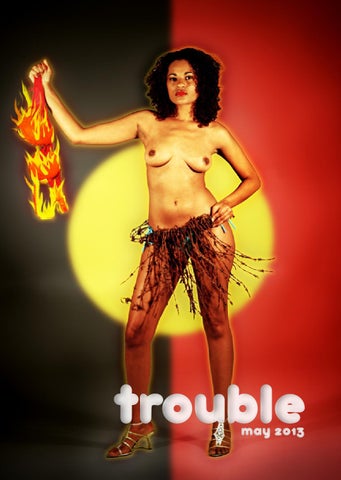
trouble may 2013
LISTINGS NSW / ACT
(66)
TASMANIA
(66)
MELBOURNE
(67]
CENTRAL VICTORIA
(75)
EASTERN VIC
(82)
MURRAY RIVER
(83)
NORTHERN VICTORIA
(85)
WESTERN VICTORIA
(86)
Issue 101: MAY 2013 trouble is an independent monthly mag for promotion of arts and culture Published by Newstead Press Pty Ltd, ISSN 14493926 STAFF: administration Vanessa Boyack - admin@ troublemag.com | editorial Steve Proposch - art@ troublemag.com | listings - listings@troublemag.com CONTRIBUTORS: Mandy Ord, Ive Sorocuk, Naima Morelli, Stuart Beekmeyer, Emmi Scherlies, Robyn Gibson, Inga Walton, Courtney Symes, Cassandra Scalzi, Neil Boyack, Ben Laycock, Dave O’Donohue, Jase Harper, Matt Emery. Greenwish designs by Horse. Find us on Facebook: www.facebook.com/Troublemag Subscribe to our website: www.troublemag.com READER ADVICE: Trouble magazine contains artistic content that may include nudity, adult concepts, coarse language, and the names, images or artworks of deceased Aboriginal or Torres Strait Islander people. Treat Trouble intelligently, as you expect to be treated by others. Collect or dispose of thoughtfully.
trouble
FEATURES
may 2013
(04) COMICS FACE
(42) MAY SALON
(09) BINDI COLE
(54) GREENWISH #14
(16)
(60) STRALIAN STORIES Neil Boyack
Ive Sorocuk
Naima Morelli
SOCIAL WORK
Inez de Vega
(18) CIRCUS OZ TWO
Stuart Beekmeyer
(24) FRANKENSTEIN: THE FACE OF A FIEND
‘Mazing
Robyn Gibson + Horse
(64) GREETINGS FROM HUANCHACHO
Ben Laycock
Emmi Scherlies
(28) ACTEASE
Courtney Symes
(32) MELBURNIN’
Inga Walton
(38) ADELOUD
Cassandra Scalzi
(41) DARBY HUDSON
a poem by ...
COVER: Bindi COLE, Miss Australia 2009, pigment print on cotton rag. See our exclusive interview with Bindi this issue, starting on page 9. DIS IS DE DISCLAIMER! The views and opinions expressed herein are not necessarily those of the publisher. To the best of our knowledge all details in this magazine were correct at the time of publication. The publisher does not accept responsibility for errors or omissions. All content in this publication is copyright and may not be reproduced in whole or in part in any form without prior permission of the publisher. Trouble is distributed online from the first of every month of publication but accepts no responsibility for any inconvenience or financial loss in the event of delays. Phew!
Profiling Indigenous art practice focussed on South-eastern Australia. A range of category prizes with a prize pool of over $40,000 Presented at Art Gallery of Ballarat Sat 2 Nov - Sun 8 Dec
Call for entries Applications close Wednesday 31 July 2013 No entry fee
For information and entry forms visit the website:
indigenousartawards.com.au or for further enquires phone the Gallery on 03 5320 5858
newsteadtattoo.org
3/4/5 May, 2013 NEWSTEAD, VICTORIA Rohan Anderson, Andrew McKenna, Jospehine Rowe, Courtney Collins, Cate Kennedy, Black Cab, Carmel Bird, Amy Espeseth, Archer Shepherd, Andrew Till, Patrick Pittman, Jackie Kerrin, Jordie Albiston, Dr Fred Cahir, Frank Golding, Gordon Dowell, Eric Dando, David Thrussell, Neil Boyack, Abraham Mamer, Adib Khan, Emmi Scherlies, Tru Dowling, Megan Anderson, Geoff Brown, Lucy Sussex, and more.
TAKE A LOOK AND SEE WHAT’S IN STORE AND ON STAGE... SEASON BROCHURE AVAILABLE FROM MAJESTIX ON 5333 5888 OR VISIT HERMAJ.COM
Natalie Weir’s
R&J Produced by Expressions Dance Company and Queensland Performing Arts Centre
Image by Justin Nicholas
Love plays a major role in all our lives, but as Shakespeare knew too well, does not always guarantee a fairy-tale ending.
Tuesday 7 May 8pm Set across three different eras, and telling three different versions of events, Expressions Dance Company turns the classic story of Romeo and Juliet on its head, cutting to the essence of what is real, human and inevitable. Winner of Outstanding Achievement in Choreography at the 2012 Australian Dance Awards, R&J reinforces the notion that love – no matter what age you are, or what era you live in – is eternal, and its power, everlasting. With music composed by John Babbage and recorded by prolific music ensemble Topology, R&J celebrates contemporary performance at its most bold and powerful.
Tel: 03 5434 6100 thecapital.com.au The Capital is proudly owned and operated by The City of Greater Bendigo
EDC has received financial assistance from the Queensland Government through Arts Queensland and has been assisted by the Australian Government through the Australia Council, its arts funding and advisory body. The Australian Government is proud to be associated with this tour through the national performing arts touring program, Playing Australia, which gives Australian across the country the opportunity to see some of our best performing arts. Tour managed and coordinated by arTour, an initiative supported by the Queensland Government through Arts Queensland.
Bindi Cole
Faith In God & Prison
by Naima Morelli
Bindi Cole’s voice sounds like that of a young girl telling a secret to her best friend in the schoolyard, but the quiet café near the railway where we were sitting didn’t look like a school canteen at all. Likewise Bindi’s walk through life has been far from that of a naïve girl strolling from classroom to cafeteria. Bindi has passed through a troubled family history, through drugs and prison, she has gone through it all, but in the end she found hope and redemption in photography, challenging stereotypes, and consecration from the art world. You can’t see her turbulent past on her face just as you can’t see she’s an aboriginal woman of Wathaurung descent. Her face is smooth, her skin is fair. Her peaceful expression changed to cheerful when they brought her the banana pancake with chocolate and warm coffee she’d been waiting for. But what you cannot see in Bindi’s face you can see in her art. >>
image this spread and previous page: EH5452 2012, digital video (still).
Bindi Cole: Faith in God & Prison / Naima Morelli
> Cole started making art as a photographer, mostly talking about her aboriginal legacy. In one of her latest artworks, EH5452, you can see a picture of her from the period in which she was in prison. Her smile in that photograph has nothing of a woman deprived of her liberty. It’s a hopeful and quiet smile that corresponds to what she proclaims as her attitude toward life: “I’m the eternal optimist. I can’t help it,” she says.
makeup, the hair, the lights, the positioning was all entirely staged. So it’s not documentary as such even though it is capturing something real. It’s a combination of taking something that exists and giving it a voice. But those works were constructed. NM: What about the artworks that the Sistagirls have in the photographs? They always pose with a painting or a statue.
BC: I was inspired by ethnographic photography. In Australia we have a lot of ethnographic Naima Morelli: You studied photography at photography of aboriginal people from the TAFE. Why have you decided to become an artist early eighteen hundreds right through. And if that used photography as medium, instead of, you look at some of that particularly of artists let’s say, a photoreporter? from the photographer J.W. Lindt, you will see Bindi Cole: At first when I studied similarities with what I’ve done. So I was really photography I didn’t know that I was going inspired by capturing-the-exotic, which in a to use it as an expression of my voice in similar way was not real, because he staged an artistic way. After I finished studying I it. Lindt said: “Here are the aboriginals from actually thought about it. Do I want to be a Australia” but his presentation was fake. I did commercial photographer, do I want to be a the same thing. But at the same time I was journalist, do I want to do social documentary? celebrating it. I also gave them ownership over After thinking about it for years I realized certain elements of their photographs and that I wanted to do art. I was in Europe in things like that, and people know who they that period and I wrote it in my journal and are. They are not nameless people, they are diaries. I remember reading it not long ago: celebrated through these photographs. “I’ve decided that what I’m going to do with NM: In your work you often challenge current my photography is to make art. I want to have views of aboriginal issues and perspectives. Do a voice, I want to say something, I will use it you seek to actually change people’s minds or in that way.” simply open them a little? NM: Do you think that your work Sistagirls BC: I don’t know that I have the power to (about the aboriginal transgender community of change the way someone thinks, but I know the Northern Territory’s Tiwi Islands) has a sort of what I do has the power to create discourse photojournalistic approach or were you interested and discussion. Some of the things I looked to express other things? at in my earlier works were kind of taboo BC: I think that people sometimes look at subjects. No one wanted to speak about those Sistagirls and think it’s documentary, but it’s not things at first. Now, a couple of years later, because it’s staged. I mean, apart from them everybody is able to speak about it openly. It’s being transgender they would never dress up nice to think that my work has contributed to like that. The whole setting, the costuming, the that discussion. >>
“I’m quite fearless when it comes to having a voice but I’m nervous when it comes to being accepted or rejected.” > NM: The installation I forgive you can be related to your personal experience but also with the wider issue of aboriginal people and colonial history, the Stolen Generation too. You said: “As I forgave I was able to take my power back.” Could you expand on this concept? BC: I learned that when I’ve been through a traumatic experience that wasn’t my fault. I develop resentment and anger about that. If I hold on to that for a long period of time, it creates dysfunction in me. When that experience happens it is like I’m disempowered, and for as long as I hold onto the resentment and anger towards that experience I stay disempowered. I’m still a victim to it. Even if it’s ten years later I’m so angry and hurt by it that I’m still the victim. Forgiveness is about saying: ”I will no longer be a victim of that situation, I’m going to take my power back, I release it. It’s not going to live in my head anymore.”
below: I Forgive You 2012, MDF and feathers.
NM: In Post-us you collected original propaganda posters from the eighteen hundreds to the fifties and you painted on them, replacing the white models with Koorie models. How did people react to this artwork? BC: The aboriginal community loved it. Because they get that immediately. We have not really seen that kind of advertising before, because Australian television is very white, homogenous, you know. It’s always hard for me to answer how people react to things, because I don’t really know. NM: But you are there at your openings, so I guess you get a certain kind of feedback… BC: I hate openings. I really don’t like them. I go, but I’m uncomfortable. In fact at the opening of Post-us I almost hid at the back of the gallery. I’m okay with people but when it comes to an opening and it’s my work, and everybody is there … it’s too intense for me! If I look at all my work instead of just one series there’s not much in the middle. Most people love it or hate it, because it challenges people to think about uncomfortable things. NM: At the same time you do that in a very positive way. It’s not about complaining, it’s not a focus on negative things, it is more how to overcome difficulties.
Bindi Cole: Faith in God & Prison / Naima Morelli
BC: That’s good, I like that. I think it’s true. When I started making art I made that decision. I didn’t want to be negative, I wanted to challenge things but I want always to be positive about it. I can’t help that. I’m the eternal optimist. NM: You are often questioned about your aboriginal heritage, so you made the series Not Really Aboriginal portraying yourself and your family. Why did you decide to expose yourself in first person when at the same time you hide yourself at gallery openings? BC: If I put myself in a photograph it’s not me face to face to somebody, it’s different. I think I’m quite fearless when it comes to having a voice but I’m nervous when it comes to being accepted or rejected. In a weird way I’m sensitive, I’m strong and sensitive together. But even with that, those photos for me are serious but funny. They are meant to be quite humorous, so I probably underestimated the effect that they would have. A lot of people got quite mad about them. There are a lot of people who think that that aboriginal people who are fair skinned are only trying to get money and other things through our aboriginality. The politics are complicated in Australia, so those photos drew a lot of this complexity into the open and within that complexity there’s also a lot of anger.
NM: So you decided to use yourself and not a model because it was too personal a concept to express? BC: Yes, it’s very personal. Well, that’s the thing: I don’t want to speak for other people, I just want to speak for me. Particularly when I’m making such a loaded comment, I didn’t feel like it would be right for me to use anybody else. My experience is the only thing I can talk about. People can argue about everything, but you can’t much argue about personal experience. NM: In 2007, you created the Heart Strong series out of a response to the very one sided and negative view of Aboriginal communities by media that doesn’t matched with what you’ve experienced. What has your involvement in your community in St Kilda brought to your art? BC: All my early work was about stereotypes. I was annoyed by the negative view of aboriginal people and at the same time I was trying to find my place. Having experienced that aboriginal community through my family and friends was a privilege. It gives me insight into the community that most people don’t have. I was trying to challenge that negative view in some way. I think it is probably changed now, but definitely at the start I think I was trying to reconcile myself with the world. As much as my work was about the aboriginal community, it is always about me, going where and how I feel. >>
> The Original 2009, pigment print on cotton rag.
“Nobody outside of my friends and family knew I’d been in prison at all.” > NM: It was your grandmother that instilled in you this pride for your heritage, isn’t it? BC: That’s right. She did. My dad too. But mostly her when I was a child and my dad in my later years. It’s not something I can even get away from, it’s just part of who I am. At my wedding my dad tried to make it an aboriginal thing. I mean, it’s my wedding, can it be just … a wedding? My dad was suggesting aboriginal dances and didgeridoo players and I was like no, no, no, I don’t want any of this stuff! I just wanted my simple wedding. Moreover my husband is from Greece, so his family wanted to do an orthodox wedding. We end up not doing anything of these things. But even then my dad continuously referred to our roots during his speech, he had this aboriginal smoking and gave my husband a special name and he made a speaking in our language. He still got it in and he couldn’t help himself.
quiet. I was also interested in the fact that I had hidden it, and the shame that was around that. It was a cathartic process. I thought:”I don’t want to be this person here and a different person here”. I just wanted to be the same person everywhere. I wanted to take this thing that I’ve hidden and take it to the light and get rid of any shame. And to speak of who I am, really, everywhere. NM: It’s a very strong work. You show diaries, photographs… BC: That work is probably the most personal that I’ve done. And it had the best effect on me personally, cause all of a sudden it was like there was this artist who made works about aboriginal issues and there was also that artist who had been in prison and was making works about God. There was no resistance or transition. I thought people would say:“What does it mean she has been in prison? She was making works about aboriginal issues and now she’s making works about Christianity and God and being in prison”. I was expecting that but it didn’t happen. NM: I’ve noticed you’re working more and more with installations. Is photography still your main focus?
BC: I don’t know. If I look at all the work that I’ve done and the things that are more successful I think I’m probably best in photography. But I enjoy installations. I like using my hands, I enjoy making things, building ... and this year I’m doing a new photographic BC: Because over the last few years I developed series and I’m doing installations too. So it’s a deep faith in God and just in the last couple probably come down to video, photography of years that became really important to me. and installation. I’d say I’m the most elegant with I first started looking at God when I was in photography. My video can be a little funky. prison. I looked back to that, because that was Naima Morelli is an art critic and journalist with a a turning point for me and it changed my life particular interest in Italian and Indonesian contemporary and led me to this point. It’s not that I thought: art. She has written for Art Monthly, NY Arts, Artkey and “Oh I can make a work about being in prison”. now Trouble, and is a regular contributor to Art a Part of Nobody outside of my friends and family knew Cult(ure) and Artribune. She is also an indipendent curator I’d been in prison at all. I kept it completely with a special interest in New Media. NM: In your recent work EH5452 you refer to the time you were in prison. Why do you decided to think about that experience in this particular moment of your life?
Bindi Cole: Faith in God & Prison / Naima Morelli
Neil Boyack’s
SOCIAL WORK: Inez
De Vega
Which member of your family influenced you the most? I would have to say my mother. She must have suffered terribly in her youth and she, in turn, abused me dreadfully, but were it not for her I would never have experienced the existential and psychological struggles that I am now trying to express in my art. The other thing for which I am grateful is that the ill-will and anger I held for her and the rest of my family were poisoning me, so my family’s ongoing presence in my mind was the catalyst for me becoming a buddhist and trying to generate forgiveness and loving-kindness. I am not good at it but I at least now it seems like a possibility. What do you hope for? Just for me and everybody else to be happy. What does freedom mean to you? I have freedom in my life today. I didn’t when I was a child living in my own sort of Auschwitz, nor when I was an adult struggling with the psychological illnesses that develop as a result of child abuse. Today, having largely overcome both of these, I know how beautiful freedom is and I often wake up with a smile on my face because I am safe in my own bed and no one has any expectations of me. How do you feel about someone taking their own life? I wish people didn’t have to suffer to the extent that suicide feels like their only option. But I do understand why people take their own life. Do you think things happen for a reason? I think I believe in karma but I don’t really understand how it works. What beliefs do you have that you think will never change? Everything changes and thank fuck for that! Have you ever come close to dying? I spent 6 days on the floor of my flat in a coma and was very angry at the universe when I woke. Do you have a favourite family story? My mother used to leave a giant pot of mush on the stove all winter and add noodles and leftovers and rotting vegetables to it nightly. The bottom portion had been sitting there so long it was burnt and fermented and contained pieces of the aluminium pot where it had come away and surrendered to the general congealment of food. We used to say we were having “pot” for dinner. What do you think would be the best thing about being the opposite gender? I’m sure I’ve been a man in a past life but I can’t have been very good at it cos I’ve forgotten who I was. Who is the best teacher you have ever had? My teachers at art school changed my life, as have some of my buddhist teachers. My friend Bev has taught me many things my mother wasn’t able to. Have you ever been lost? For about 38 years.
Inez De VEGA, Kar Krash Karaoke 2013, Single Channel Video, 3:25 minutes. At the Substation until 12 May - www.thesubstation.org.au Photograph by Catherine Evans. Artist site - www.inezdevega.blogspot.com.au
words and pics: Stuart Beekmeyer
2
Circus Oz
There are many avenues of creativity and skill personified by people living on the Northside of Melbourne. You have the usual range of actors, designers, musos, poets and artists, of course, all of whom would have noticed by now that over the last ten years or so there has been a massive surge in the number of circus performers living in the area. We are talking acrobats, dancers, burlesque performers, fire-breathers, and so forth, who see this Vaudevillestyle interface as a legitimate form of expression. Fortunately for them, it also happens to have a dedicated and growing audience. And why not? Circus takes all these creative disciplines and lends them a stage, to mix the art of performance up in new and exciting ways. >>
These guys have the swagger of a pirate crew ready to set sail and pillage the seas. > One of the oldest practitioners of this style of art is Melbourne’s own Circus Oz. These guys have been unleashing their brand of new circus for thirty-five years. You have to remember that thirty-five years ago circus was caged animals, guys in top hats, women with moustaches (with way less irony than now) and other festivities performed by travelling groups of families in tents. It was not that the idea of circus being something more was being shunned, it was that thirtyfive years ago only a few crews knew what that something more could possibly be. Circus Oz is actually part of a tradition which is now the mainstream but was initially quite specialized. Specifically you had Circus Oz, San Fransisco’s The Pickle Family, New York’s Big Apple Circus and a couple of crews in France performing what we accept as circus today. Guy Labiberte, a co-founder of the stadium circus spectacular Cirque de Soileil visited all these crews including Circus Oz whilst developing his own ideas. In this way Circus Oz has a tradition that relies on the evolution of circus as much as its new beginnings. They are an extremely important part of the Australian creative culture and very soon they are about to have a new home, right next to the Tote in Collingwood.
I recently attended a media call out at the new Circus Oz headquarters. Right now it’s a tidy demolition site. Part of the call out was to promote the new Circus Oz show entitled Cranked Up, which is suitably based around the theme of construction. However I think there was something more cathartic in this event. If you have spent much time on construction sites you would notice a sense of anticipation that is often killed by the reality of the inhabited space. In this case the anticipation and the reality were coming together maybe for the first time as the media took a million generic happy snaps of the cast of the show. As we watched snippets of the tricks that become a curated story through the development of the show, there was a strong sense of past, present and future connected to the empty site. One could imagine the guy on the ten metre swaying pole belayed by the future building, and working on new tricks. You could imagine the band in their new room discussing licks as the admin chick quietly listens on a smoke break. I had the privilege of chatting to Creative Director for the last decade, Mike Finch. Finch was unassumingly psyched about the move. According to Finch it has been a ten year project to see this happen. Arts Vic will own the building, which has been designed in close conjunction with Ken Chen of Lovell-Chen architects. The building will contain the entire cast, crew and administration of Circus Oz with a dynamic public interface absolutely tailored to the cultural ecotone, which is the Northside of Melbourne and Collingwood in particular.
Circus Oz 2 / Stuart Beekmeyer
For the first time in its history Circus Oz will get to rehearse in performance type conditions. The rehearsal room will fit two-hundred punters with the appropriate rigging, lighting and stage design needed to fully justify the show. In fact even in the quiet times all the staff involved in the show, from the creative director to the payroll officer, will be no more than a couple of metres away from a window that allows visual access to the rehearsal room. The main event of this building is performance, with or without a formal audience.
of the people. I swear I had a beer with that guy around the fire at Jackson Street. Is that the chick who has her coffee at Hungry Birds? And so on. It truly is Circus Oz beyond the name. In fact one constant comment overseas is that the show is an amazing reflection of the positive nature of Australia. The humour, the openness, and most importantly the ability to be extremely proficient and talented without being a total dick about it. That is what this crew is about.
Finch says a big difference between Oz and something like Soileil is that each and Beyond the dramatic upgrade in facilities every person in the ensemble has a distinct for those involved in the show, is the personality and skill set which is showcased interface with the cultural context of the area throughout a performance. There is no which, to anyone into Northside culture, is chorus line of invisible talent, so to speak. To extremely enticing. These guys have their get into the cast performers must have several own Speigletent, for example, that will not skills. They are all comedians and actors, but only be used for performance but will open it’s the surprises in the skill set that start to onto the beer garden of the Tote Hotel. amaze. The trumpeter who puts down her Whilst touring, other crews will have the instrument then starts foot juggling is one chance to use the facilities to develop their surprise that stood out during the media call, own craft. There is talk of public gardens but the entire show is choreographed on this onsite and a host of moments that allow level for every performer. At the end there Circus Oz to connect with the culture that are twelve performers, each with their own feeds it, and in turn it feeds. swagger and skills that will leave you amazed and excited for more. This culture is very much personified by the performers and their personalities, The awesome thing about this project is which are constant on or off stage. The that a new and extremely strong part of first thing you notice is that they have the evolution of creative culture is being swagger. These guys are like a pirate crew created. We have the new Recital Centre, ready to set sail and pillage the seas. There the NGV and the G, and now even the is an awesome confidence in them, which Freaks have a proper home too. So whether is backed up by skill. This is Circus Oz you’re a foot juggler, an acrobat, burlesque remember.They play Broadway! dancer, trombone player, or whatever, The performers are only twelve in number, it’s time to be excited because something and one guesses that you must be pretty amazingly cool is coming to Collingwood good to earn a place amongst them. The and in one way or another at some point second thing you notice is the familiarity you will be invited. >>
Circus Oz 2 / Stuart Beekmeyer
FRANKENSTEIN THE FACE OF A
fiend by Emmi Scherlies
“It was already one in the morning; the rain pattered dismally against the panes, and my candle was nearly burnt out, when, by the glimmer of the half-extinguished light, I saw the dull yellow eye of the creature open; it breathed hard, and a convulsive motion agitated its limbs …” >>
> + previous: Lee Jones as The Creature in Ensemble Theatre’s production of Frankenstein. Photo by Heidrun Lohr.
> When I opened the covers of Mary Shelley’s Frankentein (1818), I was introduced to an agile creature that was eight feet tall with watery eyes, straight black lips, and yellow skin which “scarcely covered the work of muscles and arteries beneath”. Where was the lumbering hulk-like figure? The severe brow ridge and the tell-tale set of bolts studding the neck? I hadn’t watched any of the Frankenstein movies before I read the novel, yet I vaguely knew the story of the scientist who handcrafted a monster from corpses and brought it to life, only to be terrorised by his own creation. How did I know? I wasn’t sure. That is how deep the myth has been entrenched into our psyche. James Whale’s 1931 film Frankenstein introduced a Hollywood image of the nameless monster that has been imprinted into our minds, yet I believe Shelley’s original version of the creature was far more horrifying. Teamed with a healthy imagination, words could paint a monster more real and grotesque than makeup could ever achieve. In the gothic novel, the creature’s ghastly appearance doomed him to a life of loneliness from infancy onwards. Eventually it was mankind’s injustice that drove him to seek revenge. Even after his deadly reasoning had emerged, I found the monster’s suffering more appalling than the monster himself. Unlike the 1931 film, Shelley’s creature was not a voiceless and mindless brute. Her ‘monster’ had a sensitive heart and even became highly literate. Before enacting his revenge on Frankenstein, the monster implored his creator to have sympathy:
The depth of the monster’s character was largely abandoned in the classic film. And in true Hollywood fashion, it was even dramatically added that the problem originated from the monster receiving an “abnormal” brain from a criminal “whose life was one of brutality, violence and murder”. British playwright Nick Dear was eager to loosen the Hollywood bolts when he wrote his adaptation of Frankenstein. Director Mark Kilmurry is bringing Dear’s critically acclaimed play to Australian theatres so we can meet Shelley’s monster in the flesh. “It is a wonderful script and the best version of the novel I have ever read or seen,” he says. Lee Jones – who stars as the monster – says “the 1931 film robbed us of the creature’s voice, therefore audiences may not expect to gain such insight into his plight and emotional turmoil.”
“Remember, that I am thy creature; I ought to be thy Adam; but I am rather the fallen angel, whom thou drivest from joy for no misdeed. Everywhere I see bliss, from which I alone am irrevocably excluded. I was benevolent and good; misery made me a fiend. Make me happy, and I shall again be virtuous.”
The Faces of Frankestein / Emmi Scherlies
The play begins with his ‘birth’ where you see him as he is, completely vulnerable and innocent. The horrifying thing about the play is that the creature is a product of his environment and the way he has been treated. He then walks the line between revenge and remorse ... He is driven by a search for acceptance and love, and when denied, his actions are both horrifying and heartbreaking.
about Frankenstein is that it holds a mirror up to our – at times – ‘monstrous’ society; how we alienate the different and what affect this abandonment and lack of care can have on a person. Perhaps what we see in that reflection is the real monster.” Ensemble Theatre’s production will allow us to see Frankenstein as Shelley intended, cautioning us well beyond the consequences of playing God. Frankenstein’s monster reminds of the most basic need beyond survival and education: to be loved and nurtured.
Eventually I asked myself, ‘who is the true monster in Frankenstein’? “The audience will be faced with this same dilemma,” says Jones. “Do they side with Victor Frankenstein who created and neglected his own creature, or the Frankenstein, starring Andrew Henry as Frankenstein murderous monster? Perhaps neither character and Lee Jones as the creature, will be at the Capital in is the real monster. The most poignant thing Bendigo on 24 and 25 May - www.thecapital.com.au
Elizabeth KELLY, The Posting 2013, recycled steel, recycled timber, silicone and 3M mask, 250 x 70 x 70cm.
“Ten thousand hours of practice is required to achieve the level of mastery associated in being a world-class expert in anything … In study after study of composers, basketball players, fiction writers, ice skaters, concert pianists, chess players, master criminals, and what have you, this number comes up again and again. Ten thousand hours is equivalent to roughly three hours a day, or twenty hours a week, of practice over ten years,” says Daniel Levitin in his book, This Is Your Brain on Music: The Science of a Human Obsession. I felt encouraged by this little gem that wine writer Matt Kramer included in his book, Matt Kramer on Wine. Whilst there are some annoyingly naturally talented people out there who appear to pick things up in nanoseconds, Levitin confirmed what I wanted to hear – that to be good at anything you need to work jolly hard at it, for a decent period of time. Raw talent will get you so far, but it’s hard work and dedication that seal the deal. So with this in mind, what will you spend your 80 hours doing this month? If you’ve got a couple of hours to spare, read on – we’ve got a great line-up for you in Canberra this month. Richard Blackwell, Kate Dulhunty, Merryn Gates, Elizabeth Kelly, Marcia Lochhead, Ruth Maddison, eX de Medici, Byrd, Raquel Ormella, Martin Rowney, Duncan Smith, and Jo Wu have come together in ANCA’s latest group exhibition, FLIPSIDE. Like many cities, Canberra has a dark side – an “underbelly” life that many people don’t openly acknowledge. “FLIPSIDE provides a platform for artists who not only ‘have their little whinge on the side’ but, perhaps because of their attitude to social critique and individual positioning, may not have their voices heard.” Curator Merryn Gates explains that “It is seductive to over-
ACTease DATELINE: MAY 2013 by Courtney Symes
emphasise the positive aspects of Canberra and overlook the darker side of life, as it exists in any urban environment”. The purpose of this exhibition is to scratch the surface and discover what’s lurking in the shadows. Catch FLIPSIDE before it finishes up on 5 May. - www.anca.net.au Belconnen Arts Centre is gearing up for an exciting month with a variety of events this May. The trip from Canberra to the coast is a pilgrimage that many Canberrans make at least once a year. The Road to the Coast is an exhibition that explores the details of the road on this journey through the “sweeping plains, steep bends, middens, wild-life, bridges, rainforest gullies, pie and petrol stops and, finally, the first glimpse of the ocean”. Eight Far South Coast artists including Anna Buck, Jan Collingridge, Louella McPaul, Jane Murphy, Georgia Partridge, Anneke Paijmans, Donna Ransom and Jan Ridgway explore this journey and the links between Canberra and the coast. Through an exploration of cultural, historical and political contexts, Random 9 (a group of emerging artists from the Canberra area) offer their interpretation of what it means to live in Canberra in 2013 - Canberra’s centenary year - in their latest exhibition, 100. The Road to the Coast and 100 run until 5 May. Later this month at Belconnen Ar ts Centre, three new exhibitions: Off the Square – Craft ACT Members Exhibition; Objects Undefined – Jemima Parker ; and 100 Years of Light in the Bush Capital – Rocktavio will run from 10 – 26 May. >>
> Off the Square features works from Canberra’s talented craft practitioners and design makers and has been curated by consultant curator, writer and art historian Peter Haynes. Off the Square is part of the Designing a Capital: Crafting a Nation program presented by Craft ACT. Objects Undefined features a striking body of work from Jemima Parker that “blurs the boundaries between body adornment, garment and object”. Viewers can expect a collection of three-dimensional fabric forms that “can be placed on the body as an adornment, or installed within a gallery setting as objects in their own right”. 100 Years of Light in the Bush Capital – Rocktavio consists of a collection of images created by black & white large format film, pinhole image formation, wet process and printing. Rocktavio explores the co-existence of Canberra’s magnificent landmark buildings and natural landscape through work that has “a unique dream-like effect”. - www.belconnenartscentre.com.au Canberra Theatre has an exciting line-up this month. Check out: The Melbourne International Comedy Festival Roadshow, A Clockwork Orange and The Australian Ballet Symmetries. If you couldn’t make it to Melbourne this year for the International Comedy Festival, fear not – the Festival is coming to you! The Melbourne International Comedy Festival Roadshow has rounded up some of the world’s funniest comedians and hit the road for an unmissable couple of nights of fun here in Canberra on 17 and 18 May. It’s the 50th anniversary of Anthony Burgess’ renowned novel, A Clockwork Orange. Following sell-out performances in the UK, A Clockwork Orange will tour Australia this April, stopping off at the Canberra Theatre
from 22-25 May. Martin McCreadie (as Alex) leads the award-winning cast of this confronting violent, sexual text that makes for an electrifying performance. The storyline follows the hedonistic exploits of teenage gang leader Alex and his “Droogs” (gang). The performance is set to a powerful soundtrack of Gossip, David Bowie, The Scissor Sisters, Placebo and Beethoven. The Australian Ballet Symmetries is a collection of performances including: Monument, Pas De Deux from After the Rain and The Four Temperaments. Monument is Garry Stewart’s (artistic director of Australia Dance Theatre) tribute to Canberra’s Parliament House for Canberra’s centenary. Christopher Wheeldon’s pas de deux from After the Rain is an iconic 21stcentury stroke of genius described as an “unspoken love affair consummated on stage”. The Four Temperaments is George Balanchine’s masterpiece which draws inspiration from the use of the Ancient Greek concept of “temperaments” (the four main human body fluids: blood, yellow bile, black bile, and phlegm) that govern our body and moods. Runs from 23-25 May - www. canberratheatrecentre.com.au When was the last time you read or even listened to poetry? If you can’t remember, check out Poetry Night this month at The Phoenix pub (East Row, Civic). The Phoenix’s Poetry Night takes place on the third Wednesday of each month (15 May this month) and is a great opportunity to share your original work in an informal, relaxed environment. www.lovethephoenix.com
ACTease / Courtney Symes
Triumph Hall in Queanbeyan was the earliest dedicated cinema in the Canberra region in 1913. It played the latest films from Great Britain and America, attracting Canberra’s early residents via horse, foot or bus. The National Film and Sound Archive’s latest exhibition, CineCity Canberra: 1913-2013 pays tribute to Canberra’s centenary by exploring the city’s film history. This free exhibition includes films, stills, photographs and posters that highlight Canberra’s relationship with film over the last 100 years. The birth of Canberra was actually commemorated with a film (commissioned by
the Commonwealth Government), Naming the Federal Capital of Australia, March 12th 1913. Other themes explored throughout the exhibition include: Australian Films, Canberra at the Movies and filming Round about Canberra. This exhibition celebrates the important role that film has played in capturing Canberra’s milestones over the last century. Runs until 27 November. - www.nfsa.gov.au image: Staff outside Canberra’s Capitol Theatre, around 1930. Image courtesy National Film and Sound Archive.
DATELINE: MAY 2013 by Inga Walton
< Kohei NAWA, PixCell-Red Deer 2012, taxidermied Red deer, glass, acrylic, crystal beads, 209 x 163 x 194.5 cm. National Gallery of Victoria, Melbourne. Felton Bequest, 2013 © Kohei Nawa, courtesy Sandwich, Kyoto
Founded in 1861, the National Gallery of Victoria (NGV) is Australia’s oldest public art gallery. Many of its significant and diverse holdings are due, in part, to the greatest benefactor in Australia’s visual arts history, Alfred Felton (1831-1904). The residue of his estate, £378,033 (a massive sum in today’s terms), was put into a trust that has allowed the Felton Bequest to purchase more than 15,000 artworks (1904-2013) for the NGV with a current value of approximately $2 billion. The latest work acquired through the generosity and civic-mindedness of Alfred Felton went on display mid-last month, and will remain for a short duration throughout May. Situated in the foyer, PixCell-Red Deer (2012) by Kohei Nawa, is already attracting enthusiastic admirers. Its luminous surface has a compelling movement and energy as it twinkles and dances in the light, interacting with the motion of the famous waterwall. Nawa, one of Japan’s most significant young artists, is an Associate Professor at Kyoto University of Arts and Design. The Deer is one of his ‘Beads’ works (commenced in 2000), one of two groups in the ‘PixCell’ series (2002-), the other being ‘Prism’. Nawa uses technology to facilitate his artistic choices, “I use the internet to collect objects for both groups. I enter keywords into some auction sites on the internet, and receive many pictures by e-mail every morning that are automatically selected using the keyword Alert function. I set up this system of using keywords to receive pictures some years ago, I chose the objects for both the ... works in the PixCell series from the pictures”. Nawa also uses the internet to source many of the
taxidermied animals and other items which form the basis of his visual follies. Nawa initially focussed on pale abstract shapes covered with transparent glass beads before expanding the concept to stuffed animals, faux fruit, toys, musical instruments and other common items, varying the size and variety of the beads as the works progressed. He uses easily identifiable shapes and images, iconic objects that are already in people’s consciousness, “My condition for the selection of objects, or motifs, is to choose something that is widely pervasive as information, or as a visual image, so that people can see what it is immediately”, Nawa says. “The most significant thing for me is rather how our brain will respond to the sense, texture, and impression we receive from the use of beads as a medium and the prism as a visual and optical effect”. The outer layer formed by the glass beads suggests a molecular structure, and also references the pixel of the computer screen, or digital image. This barrier causes the surface of the object to be replaced with what Nawa refers to as a “husk of light”, a distancing of reality. >>
Melburnin’ / Inga Walton
> The myriad beads magnify the object in some areas and distort it in others, shifting our perception and questioning how we come to understand and process what we see. “By covering the objects with beads, we are not able to see them directly, and only see them through lenses, like a camera, and we only see the surface of things through the lens. At the same time, we are not able to touch them, this means that there is always a distance because there are beads between our hands and the [object]”, Nawa explains. “I think it is easier for people to engage with my work when it has an object inside it. They can question whether the things people regard as images, or the things people use as products, are really images or materials. By raising such questions, I want to consider how human senses operate, as well as the nature of being human”. • National Gallery of Victoria (International), 180 St Kilda Road, Melbourne, 3004 - www.ngv.vic.gov.au
religious expression, the somewhat nebulous areas of spirituality and mysticism, and works which deal more broadly with social justice and political issues. Some of these diversions are reflected in newer, subsidiary awards: the John Coburn Emerging Artist Award (introduced in 2007), the Poetry Prize (introduced in 2008) and the MUA Prize for Human Justice (introduced in 2009). In addition to the joint winners for 2012, four works were Highly Commended by the judging panel of three, including two new media works. Depart Without Return (2011) by Shoufay Derz (who won in 2003) uses the life cycle of silk moths to reflect on the transience of life and celebrate its mystery. Janet Laurence’s Grace (2012) projects close-up footage of elephants, viewed through gauze, to ponder the interconnection of all living things, and to call for respect and care for all life.
Also Highly Commended was Hope (2012), a joint work by Sue Saxon and Jane Becker. It uses a simple string of fairy lights housed within eggshells to spell the word out across A selection of thirty-three works from amongst the wall, which then tapers down to a tangle on the fifty-three finalists in the 61st Blake Prize: the floor. This approach emphasises both the Exploring the Religious and Spiritual in Art fragility of the concept, but also its capacity to 2012 is at the Jewish Museum of Australia illuminate darkness. Of the sculptural works, (until 28 July, 2013). The Blake Prize was certainly the most unusual is Sherna Teperson’s instigated in 1951 by Jesuit priest, Reverend At once both heaven and earth (2012) made Michael Scott, and Jewish immigrant, lawyer from carved ciabatta bread. Atop a pillar, what and artist, Richard Morley. Together, they appears to be the Lamb of God is prevented hoped the establishment of the prize would from making its ascent to heaven by a tethering encourage artists of disparate styles and rope, keeping it earth-bound; the medium religious allegiances to create significant a literal reference to the Last Supper and works of art with religious content. Previous the Communion wafer. For Attendant (After winners include the likes of Donald Friend Schongauer) (2012) Caroline Rothwell takes (1955), John Coburn (1960, 1977), Leonard as her inspiration a Gothic-style engraving French (1963, 1980), Asher Bilu (1965), Ken by Martin Schongauer (c. 1448-91) depicting Whisson (1974), John Davis (1993), and Euan the suffering of the ‘Father of Monasticism’ Macleod (2006). St. Anthony (c. 251–356) in the wilderness of the Libyan desert. This fierce bronze work As a response to our increasingly secular depicts one of the nine demons who tormented and disillusioned culture, in the last decade the saint, and is by far the most visceral and the prize has shifted its focus in an attempt uncompromising of the finalists. Rothwell to appear more relevant to contemporary engages not only with the traditions of Christian audiences, and receptive towards the issues art, but with the hagiography of St. Anthony artists are interested in. It has become written by St. Athanasius I of Alexandria. more inclusive towards non-denominational • Artist site - www.kohei-nawa.net
> Sherna TEPERSON, At once both heaven and earth 2012, ciabatta bread, PVA glue, plastic, 46 x 15.5 x 11 cm,
Danie Mellor’s Bulluru Storywater (2012) draws upon a Mamu/Ngagen creation story from the rainforest area of Northern Queensland. The ancestor Budaadji, in his role as a shell trader, is attacked by mythical birdmen on his journey from the ocean to the Atherton Tablelands, and his body is scattered in the bush. The central monochromatic work shows the skull of Budaadji dominating the forest with tiny flashes of colour for the birds and a snake in the trees. Mounted on the wall surrounding it, intricate arrangements of shells form words relating to the story. Positioned on the gallery floor, Fasces (2011) by Heather B. Swann shows twelve doves bearing olive branches, symbolic of the Apostles, with the intimidating presence of an axe resting against the wall. A fasces was a bound ceremonial bundle of rods with a projecting axe-blade, symbolising the power and jurisdiction of a consul or magistrate. In the Roman Republic the fasces lictoriae was borne by a lictor, a special class of office-bearer who accompanied those who held imperium, judicial powers that included capital punishment. Perhaps Swann is alluding to the fifth Prefect of Judæa, Pontius Pilatus, and his ambiguous role in the trial of Jesus: the axe stands apart from the doves, “I find in him no fault at all” (John; 18:38). The exhibition continues to Cessnock Regional Gallery, NSW, 18 August – 29 September, 2013. • Jewish Museum of Australia- Gandal Centre of Judaica, 26 Alma Road, St. Kilda, Victoria, 3182 - www.jewishmuseum.com.au • Official site - www.blakeprize.com >>
Melburnin’ / Inga Walton
> It’s the last chance to see over twenty new works, presented as a series of glass tableaux, in the touring exhibition Nick Mount- The Fabric of Work (until 12 May, 2013) at Geelong Gallery. Mount is one of Australia’s most accomplished and celebrated studio glass artists who has been at the forefront of innovation since the early 1970s. In 2012, he was named the seventh recipient of the Object Living Treasure Award. Since its inception in 2005, the Award celebrates the achievements of Australia’s most iconic and influential crafts practitioners and promotes the work of Australian artists whose exemplary artistic skills have been recognised by their peers. Mount’s work references his fascination with the flamboyant and intricate Venetian style of glass making, which captivated Europe with its refinement and opulence from the mid-fifteenth century onwards. Master artisans, principally on the island of Murano, pioneered a type of de-colorised glass called cristallo, and another, calcedonio, which imitated the variegated semi-precious stone chalcedony (often used for intaglios or cameo portraits). Combined with their expert use of gilding and enamel work applied to the vessel, dip molds, the use of zanfirico, ballotini and laticcino canework (coloured glass rods used to create stripe patterns), diamond-point engraving and the technique of assembling vessels from separate components with thin wafers of molten glass,Venetian work was unsurpassed for its artistry and complexity for hundreds of years. Venetian artisans use special tools including borselle (tongs to handform the red-hot glass); canna da soffio (a blowing pipe); pontello (an iron rod that helps with adding the finishing touches); tagianti (glasscutting clippers), and scagno (a work bench). Mount employs variations on these implements in his own studio; his esteem for traditional practices and manual skills honed by experience is an important part of his artistic philosophy, a point underlined by the exhibition’s subtitle. “I identify as a maker and believe ‘work’ is fundamental in the development of identity. This principle extends well beyond those of us [who] call ourselves ‘craftspeople’ and, for me, the fabric of our community is, to a large extent, determined by the work we do with our hands”, he stresses. Unusually for an exhibition of this nature, the works have been installed on plinths, or wall-mounted, completely unimpeded by distracting housings or reflective display cases. This allows the viewer the opportunity to fully engage with these fluted, filigreed and curvilinear vessels with their linked wood or metal components, and to appreciate the subtle nuances of surface polish, decoration and sculptural gesture Mount has achieved. In collaboration with the Gallery’s Director, Geoffrey Edwards, and Curator, Lisa Sullivan, Mount selected nine stilllife paintings and prints from the permanent collection to complement the installation, including works by Jeffrey Smart, Agnes Goodsir (18641939), Harley C. Griffiths (1908-81) and A.D Colquhoun (1894-1983). • Geelong Gallery, Little Mallop Street, Geelong, Victoria, 3220 - www.geelonggallery.org.au • Artist site - www.nickmountglass.com.au
Nick MOUNT, Scent Bottle #030808 2011, blown glass, carved, polished, assembled, 110 x 125 x 20 cm. Photography: Grant Hancock.
by Cassandra Scalzi DATELINE: MAY 2013
The madness of March may be well behind us, but let me say, things still seem quite crazy around here in the City of Churches, or maybe it’s just me? No, definitely not. Puppets don’t lie, nor do proprietors of city premises who are battling a wee problem and have reached boiling point. And it appears artists may be part of a practical, innovative solution for the unpleasant problem of puddles of urine left behind by men who cannot help but relieve themselves in public. Well, that’s according to Mr Rob de Kok, who runs the Co-West creative writing hub on Currie Street in the city, near Light Square. Open air urinals should be introduced in city night strips to help combat the problem of men relieving themselves in public, is what our Lord Mayor, Stephen Yarwood is suggesting. (If his nickname is Woody I would be really worried!) Mr De Kok, on the other hand, is calling for a more creative solution, such as a design competition for a permanent urinal that would be: ‘’art and useful at the same time.’’ I know times are tough for artists, but designing urinals? Is this guy serious or just taking the piss out of the city’s best self-employed creatives? Pop-up art galleries are good. Memorials are important. But pop-up urinals, please! I mean, no! Creative de Kok said something had to be done because: ‘’a bloke just wants somewhere to relieve himself.’ ’ Just like artists need somewhere to express themselves and a competition to enter? I think Mr de Kok should acquaint himself with the location of the city’s public toilets and those available in the night spot premises, where ladies also go to relieve themselves. If they are not sufficient for the blokes of Adelaide, then perhaps, similarly, like responsible dog owners, they should carry a ‘’Pee-Wee portable, unisex urine bag. They are commonly used in sport, apparently, and can even be purchased off ebay, brand new! If local councils can hand out doggy do bags for free, then perhaps the City Council could dig deep and provide pee wee bags to blokes who get on the piss and behave like dogs roaming around the streets in laneways. I might just add, after seeing a picture of an open air urinal for the first time, I would have honestly mistaken it for a water fountain!
Now to getting down and dirty, as promised, The Kona Dirty Weekend run by Bike SA in Cudlee Creek Forest in the Adelaide Hills is a 24hr race … Yes, we don’t do things by halves in this fast paced state. While I am planning to turn up as a wild card on the 4th of May, I have also decided to bring my pillow pet, since it looks like competitors will get to have a sleep over in Cudlee Creek. I think I might also sneak in my special night time vision goggles, after reading reports of past riders who rode part of the course in the dark. I’m a little confused right now as to how it all works, but I can’t be bothered with the maths. I am competitive, even if I am quite uncoordinated. It is claimed that the unique trail makes this event a must-do for every mountain biker in the land of Oz, being described as: ‘’a mix of Majura Pines on steroids and some of Mt Stromlo’s best bits put into a fun flowing 12km of smiles.’ ’ Why am I getting a nasty vision of bike riders lined up on the track with their lycra riding rather low from the back, right now? I guess it can’t be as bad as original, signed, abstract pop up urinals, accessible all over the city streets … just like the ATM machines, only arty. Perhaps while a guy is relieving himself, he could also activate a pop up screen which displays information about the artist and her/his works? It could become so popular that every artist would want to feature on a urinal … Who would want to paint a mural anymore? Speaking of urinals, I wonder if the Dirty Weekend will be drug tested? Going by past reports, it does surprisingly sound pretty clean, although, organizers may like to monitor the consumption of energy drinks with their young riders. Past competitor, Phoebe, 16, admitted to having, “administered slightly on the Red Bull,’ ’ but goes on to say it was ‘’great while [she] was riding.’ ’ She also suggests the event would be even better if it attracted younger riders. I am still not convinced there shouldn’t be a R rating, or MA at least for the Dirty Weekend event, what with a race report warning of ‘’roots’’ all over the forest! Exposed roots in the pine forest, apparently, but like I say, I’m not convinced, especially when the happy rider relays his account of himself and Amber, another rider, going out for a ‘’lap late in the afternoon and ending up ‘sliding around’ and getting a massage later. ‘’Getting down and dirty is what it’s all about!’’ as the event organizers say! >>
ADEloud / Cassandra Scalzi
Thank God later in May there is the Penola Coonawarra Arts Festival, commencing on the 23rd for three days of guaranteed, good clean art! In fact, it is one of regional Australia’s leading arts festivals, celebrating the literacy and arts heritage of Penola and of course the fine wines of Coonawarra. Features include local and national artists’ exhibitions, music, dance, literacy and history tours, and photographic exhibitions. Thank God also for Mary Mackilop. A not to be missed highlight of the festival, put on by the private school students, will be The Mini Da Vinci Exhibition. It sounds very intriguing, and fitting for the City of Churches.
where the men wear top hats and tails, while the women dance in their finest frocks. I wonder whether there is really some other frolicking fun and mayhem on May Day in the old mining town? The Moonta Mardi Gras ... I bet that’s what’s really being staged by the Moonta Progress Association in conjunction with the Moonta National Trust – a street party and a parade of floats! Why am I getting a vision of a Cornish pin up girl jumping out of a giant cornish pastie?
of winter and the beginning of spring. Furry Day’is on the 8th of May, the Feast of St. Michael as celebrated in Helston, Cornwall. Similarly, the festivities are enjoyed and replicated on the Copper Coast in South Australia,
NEXT MONTH, the Adelaide Cabaret Festival takes charge with an abundance of choice of world class acts and performers on show. Also some curious coffee culture in the City of Churches.
Still on the Copper Coast and a penny for your thoughts for this one …The Dressing of the Graves. While some frock up for a good festival, others in South Australia on a serious note, decide to dress special graves in some of the state’s oldest cemeteries. Another not to be missed, regional festival, especially Yes it’s all about choice here, and quite admirably some for lovers of Cornish pasties (I still prefer Portuguese chocolate tarts), is The Copper Coast Cornish Festival, festival goers choose not to forget the many lives lost by honouring the early settlers on the 22nd of May at from the 21st to the 26th of May. The Cornish the Moonta, Kadina and Wallaroo cemeteries. Following Festival is held in the historic copper mining towns of a colourful formal procession, flowers and citations are Kadina, Moonta and Wallaroo on the York Peninsula. placed on ten pre-selected graves within the cemetery. Established in 1973, the brainchild of the late Don (I am very curious about the selection process and Dunstan, then Premier of South Australia and famous for his pink shorts among other things ... the Kernewek wonder why I am thinking inappropriately about the blind auditions from The Voice.) Graves honoured Lowender has become the world’s largest Cornish festival. With over seven days of festivities, the highlight during the event feature midwives, fishermen, miners, sea captains, explorers, farmers, horsemen, nurses, is said to be, ‘The Big Weekend’ with large fairs, ambulance drivers and soldiers. the village green fair, Fer Kernewek and the Classic Cavalcade of Cars. Not sure if there is a mosh pit, but Getting back into the heart of the city, at the end of the festival promises to be packed with a variety of May, Adelaide’s most iconic and distinctive building, Cornish activities, including Furry dancing, art, craft, the Adelaide Festival Centre, will shine and radiate, as food, wine and live entertainment. its roof is uniquely used as a canvas for a constantly changing palate of illuminating, artistic projections Furry dancing and the Maypole Dance ... there goes that will be visible nightly until the end of June. The my imagination again! Apparently, the Furry Dance artists from the internationally acclaimed Electric (pronounced to rhyme with ‘hurry’) also known as Canvas, will certainly help to reflect the creative The Flora (why does the action film The Fast and The spirit and essence of the Adelaide Festival Centre’s Furious suddenly come to mind?) is a celebratory dance, carried out in Cornwall, and is one of the oldest fantastic forty years and its bright future. Finally there is some light shining in Adelaide! British customs still practiced today to mark the end
MAY SALON
1. Kate JUST, Paradise 2006, wool, clay, fibreglass, plastic, metal, glue, 156 x 330 x 266cm. Ararat Regional Art Gallery Collection. Courtesy of the artist and Daine Singer. Photo: Kate Just. Big Time: Large scale fibre art, Ararat Regional Art Gallery, Town Hall, Vincent Street, Ararat (VIC), 2 May to 16 June. NEXT SPREAD: Marcia LOCHHEAD, Jude 2005, digital photographic image. FLIPSIDE, ANCA, 1 Rosevear Place Dickson (ACT), until 5 May - www. anca.net.au
1
2
PREVIOUS SPREAD: Ash KEATING, West Park Proposition (detail) 2012, video still, three channel synchronised HD digital video, 16:9, PAL colour, stereo sound, 2 minutes 14 seconds. Collection: University of Ballarat. Winner: Guirguis New Art Prize (GNAP) 2013. Post Office Gallery, University of Ballarat, and Art Gallery of Ballarat, Lydiard Street Ballarat (VIC), until 19 May - www.ballarat.edu.au/gnap 2. Jemima WYMAN, Combat 02 2008, image courtesy of the artist and Milani Gallery, Brisbane. Direct Democracy, Monash Museum of Art (MUMA), Ground Floor Building F, Monash University Caulfield Campus, 900 Dandenong Road Caulfield East (VIC), 26 April – 6 July - www.monash.edu.au/muma 3. Peter DAILEY, artist is pictured with Meek (2013). Apparition: The Syndicate II, Fremantle Arts Centre, 1 Finnerty St Fremantle (WA), 13 April – 2 June - fac. org.au Photo Eva Fernandez. NEXT SPREAD: Yunuen Pérez MARTÍNEZ and Sissy M. REYES, De Las Manos, photograph. Mex-tli, fortyfivedownstairs, 45 Flinders Lane, Melbourne (VIC), until 12 May - www.fortyfivedownstairs.com FOLLOWING SPREAD: 4. Marilyn MONROE in Some Like It Hot (1959). OrryKelly (1897-1964), Academy Award winner for Costume Design (Black-andWhite), 1960. (United Artists/The Kobal Collection). See the dress in Hollywood Costume at Australian Centre for the Moving Image (ACMI), Federation Square Melbourne (VIC), 24 April – 18 August - www.acmi.net.au. Also see our article on Hollywood Costumes by Inga Walton, coming up in the next issue of Trouble (1 June 2013). 5. GÄDDA, SCOUT AND LUXEMBURG, Melon 2013, fujiflex c-type print on archival paper (ed of 5). We are animals, Kick Gallery, 4 Peel Street Collingwood (VIC), 30 April – 18 May - www.kickgallery.com
3
MAY SALON
4
5
Roli’s ‘Seabord’ is a new patent-pending rubberised keyboard lets you bend and twist the keys as you play to affect the way it sounds! It’s like bending a guitar string as opposed to using a wah-wah pedal. The instrument’s creator Roland Lamb says the keyboard adds a level of tangibility that’s so often ignored in modern digital instruments.
www.weareroli.com/
Dr. Lippold Haken wasn’t ignoring tangibility when he designed the Continuum Fingerboard, with a greater pitch range than traditional 88 note Midi keyboards. “… the Continuum offers realtime continuous control in three dimensions for every finger that is placed on the playing surface.” www.cerlsoundgroup.org/Continuum/
There is no way to sell these things better than the site itself: “If you want to cook food without any emissions, without any cost, in a totally healthy way, the Sun Oven Solar Cooker is the only choice. Let’s face it, the sun was designed for our benefit so we should utilize its amazing output ... Welcome the Sun Oven – designed and made in the U.S.A. with the common problems in mind – it is truly amazing. It does what it is meant to, cooks in the sun quickly at high temperatures, but is safe, compact and easy to use. This amazing high quality Sun Oven will give you years of cooking bliss and has the style to turn heads too!” www.bonzabuy.com.au
Rep
lace pa onto per wit h the s ame plastic a up to le 1,00 t’s call it sheet o nd print 0 tim f ‘p es a laper’, … $3 Eac h tim .25 AUD t the co st e the p the pap per shee of abou t er is t! rinte r in , it is can eras serted in be u ed to sed again and .
www.lumoenergy.com.au
Two-year-old Emma was born with the congenital disorder arthrogryposis multiplex congenita. AMC disease causes a person’s joints to become locked in a single position. In Emma’s case, it was her arms, and conventional prosthetics made of metal were too heavy for a 25-pound girl. Doctors at a Delaware hospital instead turned to 3D printing technology to create custom moulded parts and a lightweight vest for Emma. She has already outgrown her first vest and had a new one made. Replacement parts can be manufactured and delivered in a matter of hours – another fantastic quality of 3D printing! www.youtube.com/watch?v=WoZ2BgPVtA0
Liam is a five-year-old boy from South Africa who was born without fingers. But thanks to a couple of hobbyist designers and a 3D printer, Liam’s hand is now “better, stronger, faster” than it was before – or at least fully digital. Designers Rich Van As, in South Africa, and Ivan Owens in Bellingham, Washington, made ‘Robohand’ as their first intercontinental collaboration, and have decided to keep their work open source. They have posted it to the MakerBot Thingiverse, which is a repository for 3D printer designs that are free to download and replicate. www.thingiverse.com/thing:44150 www.facebook.com/pages/Robohand -www.youtube.com/watch?feature=player_embedded&v=kB53-D_N8Uc
stralian stories with Neil Boyack
I
speak as a novice on the world of mining, yet I know that mining is a heated, daily discussion in numerous political, professional, community and social media circles. Mining affects communities and individuals in many basic ways. It affects the ground they walk on – or plant in – the water they drink, the air they breathe, their economic standing, and in some instances community survival. There are also new horizons in terms of coal seam gas exploration, which adopts mining technology and labour as a “way forward”, and is touted as a new power source for all of us. Thus mining interests claim an importance that is flavoured with a “public good” issue-legitimacy on one hand, and the private sector, that run the on business plans and investor rewards, on the other. In between left and right machinations the Marxist elephant-in-theroom sits bleeding and unattended. The ownership of the means of production (trucks, infrastructure, dynamite, cranes) versus ownership of the resource itself (the place we call Australia), married in with the labour that drives the means of production is all still being sewn together by government, the industry and citizens, the latter not having much of a say. We saw this manifest itself partly in Kevin Rudd’s demise, we are seeing it the Labor party’s current death-by-a-million-leaks-demise, and we are seeing it in Coalition eyes-wide-open, tasting their new reign. Only a couple of years back an expensive, mining-company-driven advertising campaign fooled some into thinking that the mining industry itself was a “hard
working Aussie” that delivered benefits to everyone. Through evocative language and nostalgic notes, this campaign succeeded for a while in making itself a vote worthy issue; at its height creating a never-to-berepeated “protest” of the super-rich claiming a “fair go”. Certainly, the mining industry’s legitimacy dressed in a “common good” costume is not necessarily justified, especially if the damage to environment is permanent, and the benefits of profits don’t travel back to the community in wealth, services and/ or wellbeing. Fred Cahir’s book Black Gold: Aboriginal People on the Victorian Goldfields 1850-1870 looks at a time when these same issues were at play, only a hundred and fifty years back. When the mining industry was in its genesis in Australia it brought about a “fever”. It was possible to pick up gold nuggets from the ground and put them in your pocket, and in the process start a “new rush”. It was possible to become a winner in life and join the upper crust with a moment of fortune. Families and individuals dropped everything and sailed, walked, rode, hitched, hopped and rolled to goldfields everywhere and in the process spent any money they had on picks, shovels, tents, and then started digging.
country, native Black title and ecology Gold
Invasion after invasion, history on history, layer upon layer
Fred Cahir, Black Gold: Aboriginal People on the Victorian Goldfields 1850-1870, ANU, rrp $24.95
Fred Cahir tells the story about the magnitude of Aboriginal involvement on the Victorian goldfields in the middle of the nineteenth century. The first history of Aboriginal – white interaction on the Victorian goldfields, Black Gold offers new insights on one of the great epochs in Australian and world history—the gold story. In vivid detail it describes how Aboriginal people often figured significantly in the search for gold and documents the devastating social impact of gold mining on Victorian Aboriginal communities. It reveals the complexity of their involvement from passive presence, to active discovery, to shunning the goldfields.
Black Gold
Aboriginal People on the Goldfields of Victoria, 1850-1870
Fred Cahir
This created its own cultural episode in Australian history that has had a lasting impact on oftowns like Bendigo and Ballarat Running through this book are themes Aboriginal empowerment, identity, integration, resistance, social disruption and communication. as well as many others, whose street scapes ‘I have read Black Gold with both interestgold and admiration. It shows evidence and of extensive research. still reflect rush days the wealth Much of the material is quite new to me – it is fascinating – and important for our understanding of Aboriginal historiography. There is a great richness in the stories he tells about the complex relations that was created. between Aboriginal people and non-Indigenous Gold Rush society.’ This detailed examination of Aboriginal people on the goldfields of Victoria provides striking evidence which demonstrates that Aboriginal people participated in gold mining and interacted with nonAboriginal people in a range of hitherto neglected ways.
Fred Cahir Edited by Jessica K Weir
Awarded the 2008 Alan Martin Award by The Australian National University and the Australian Historical Association for ‘evidence of innovative thinking, sound scholarship, and the potential of the work for contributing to the knowledge and understanding of Australian History’.
ABORIGINAL HISTORY HISTORY ABORIGINAL MONOGRAPH 24 MONOGRAPH 25
Aboriginal people had already weathered the first damaging invasion of sheep and squatters, which had left them with diminished traditional resources, cutting into culture deeply. Gold brought a fresh, more diverse, and numerous, wave of humanity H Hthat was possibly more tawdry and “desperate” than the previous. Aboriginal ANU E Press http://epress.anu.edu.au people quickly found that they themselves played a critical role in the sustainability and in some cases survival, of those who came looking for gold. In towns where businesses were established, and on farms, employees deserted their employers for gold, leaving a labour-vacuum for Aboriginal people to fill, if they so chose. Prospectors closer to roads less travelled needed guides, yet there were limits to this from an Aboriginal perspective, especially when faced with the prospect of entering another clan’s territory, or traversing a sacred site, demonstrating to all that cultural ties maintained strength and sway even when under extreme pressure.
PROFESSOR HENRY REYNOLDS Australian Research Council Senior Fellow at the University of Tasmania in Launceston.
AboriginAl istory inc AboriginAl istory inc
Cahir suggests that the Wathawurrung people “avoided the dark forests west of Mt Blackwood” because of this very reason. Aboriginal skills and knowledge were demonstrated in many ways. Bush tucker procuring, hunting, tracking techniques, physical strength and know-how created an environment where Aboriginal people could
ABORIGINAL HISTORY MONOGRAPH 25 24 ABORIGINAL HISTORY MONOGRAPH
quote for services, and negotiate conditions of employment. Other elements, such as keenness of eyesight allowed Aboriginal people to find much gold in the tailings of mines. This is eluded to many times throughout the evidence in Cahir’s book. Of course many other unfortunate human trappings and traits followed the dirty business of procuring gold from the ground. Booze, disease, water quality, theft, prostitution were but a few in a context of wanton racism for Aboriginal people. Separating people from their money was one another mode, still a common occurrence in the modern world. Scams were everywhere and an unfounded superiority complex led many Europeans to believe that Aboriginal people would give up their secret gold sources. One story in particular describes an Aboriginal man >>
> being wined and dined and finally, at the last pub (in Newstead), being asked where he procured his gold from. The Aboriginal man promptly declared that he was not an idiot. Cahir does point out that Aboriginal guides, and people, were at times instrumental in actually founding diggings here and there, yet weren’t mentioned in the records of this. Some prospectors were in partnership with Aboriginal miners recognising their skills, knowledge, and reciprocity early on. With descriptions of Aboriginal people possessing agency and controlling the way they lived, reacted, and at times, avoided the vagaries of the goldfields, this book flies in the face of some traditional academic, anthropological assumptions still alive and well in mainstream Australia, painting Aboriginal people as eternal victims; as a people not capable of adapting and morphing. Cahir talks about the history of history in his introduction, possibly referring to the point just made, but particularly with reference to the agency that Aboriginal people clearly provided the early Australian mining industry. Cahir sites Australian historian Geoffrey Blainey and one of his earlier overarching texts where Blainey “neglected to synthesise
any broad acknowledgement of their part in the saga of Australian mining”. Australian history in many ways is written in a tense that promotes Aboriginal people as victims, who are simply incongruent with a middle class aesthetic. This myth is still a powerful driver for the barriers of contemporary class and culture in the mainstream, and as Noel Pearson may suggest, for some Aboriginal people themselves. Gary Foley may suggest that this myth is rolled out to “reassert the same colonialist mythology when the natives get restless”. Cahir’s book shows a time in history where Aboriginal people were transitioning from untrammelled autonomy to survival and sustainability. Connected to this, Cahir suggests that the dominant narrative contained within Victorian history is that “the Aboriginal presence is still predominantly held within frontier violence” and goes further to state that Aboriginal people have been removed or “excised” from Australian gold history. Cahir suggests that whilst “aboriginal people suffered racial vilification and sustained oppression on the goldfields, this did not prevent their active resistance nor their active engagement with the industry”.
Stralian Stories / Neil Boyack
This book is not a paternalistic, dry academic text, but more a record of evidence that shows aboriginal agency, activity and resourcefulness, in a time where ultraracism, death and destruction were daily considerations for Aboriginal people. The blood, lust, betrayal, death, sex, rape, and fortune contained within this book has all the makings of a master narrative … wait … maybe that is the mining industry. Cahir states that Aboriginal people across Victorian goldfields continued to declare their title and insist upon formal acknowledgement of what was rightfully theirs. Burial sites were found, as were bodies in hollow logs, reminding miners of whose land they were really mining. This recognition inhabits my life today when I see a canoe tree, a carved tree, or one of the many totems of the Aboriginal country I live upon (Jaara): black cockatoo, crow, eagle, bat. If you live in traditional goldfields areas you may well be able to find a sense of yourself, your home, and your community in this book, such are the familiar geographical references. Fred Cahir’s research and text I would suggest actually gives these places a new, positive energy, and a deeper significance as cultural markers for Aboriginal culture. Whilst
Aboriginal academic, Doctor, activist and ar tist, Gary Foley would argue that “there can be no one preferred way of knowing the past” the descriptions of Aboriginal agency, autonomy, activity and life from goldrush days tantalise the imagination, giving strong, meaningful pictures that act as powerful material for personal reflection on where we live, and on whose earth we are standing. Cahir’s book also acts as a learning oppor tunity for everyone who is interested in finding the knackers to stop BBQs when the story that’s being told needs to be corrected. Neil Boyack is a writer and social worker. He is creator and director of the Newstead Short Story Tattoo. His new book Self Help and Other Works is out now, Check www. neilboyack.com and www.newsteadtattoo.org
3/4/5 May, 2013 NEWSTEAD, VICTORIA
words & pics: Ben Laycock
HUANCHACO
DARKEST PERU PART XIII Ok, so we left Lima on a high note, but our arduous journey was not quite over. We had set off some months ago, you may recall, from the Atlantic coast of Brazil, and our quest would not be complete until we had dipped our toes in the greatest ocean of them, the one that laps at the shores of our native land: The Pacific, to be specific. We must endure just one more overnight bus trip. Luckily for us, Peru is equipped with the very latest in luxury bus travel, The Sleeping Bus: A soft pillow and comfy bed and we all wake up the next morning as fresh as a daisy in Trujillo, just a stones throw from the seaside resort of Huanchaco, where we throw ourselves into the broiling surf with gay abandon, amid much ululating and haleluleyas and weeping tears of joy, etc, etc. We write messages to our loved ones on the other side of that mighty ocean, stuff them in a bottle and throw them out to sea, knowing that one day it will surely reach the shores of our native land on the other side of the world. You see, as fate would have it, Peru and Australia are inextricably linked via that most notorious and mysterious weather pattern known colloquially as ‘El Niño’ (pronounced Ninyo) –The Boy Child. This is how it goes: Most of the time the current in the southern Pacific travels in an anti-clockwise direction. This is called La Niña, the girl child. As the current touches the equator it warms up, so by the time it comes down the east coast of Australia it is good and warm, bringing lots of lovely rain and the odd flood or two, maybe the occasional cyclone. As it continues on its merry way, by and by, it touches upon the Southern Ocean and
becomes rather cold, so as it makes its way up the west coast of South America it has the exact opposite effect as it does in Oz. It brings seals to the Galapagos Islands and it brings drought to the land, endless drought, creating the Atacama Desert, the driest place on earth. Many huts around Trujillo have no roofs to speak of, just bamboo slats for shade. We met 7-year-old children who had never seen rain. We visited elaborate palaces made entirely of mud, that had stood for a thousand years, still decorated with intricate patterns. But every now and then, for some inexplicable reason that no one can explain, the pattern reverses. The current begins to travel in a clockwise direction, bringing warm equatorial water and devastating floods to Peru, and cold water to the east coast of Australia, and with that cold water comes the droughts we have come to know and dread. Through the study of ice core samples in The Peruvian Andes and sedimentary deposits in Australia it has been established that this erratic oscillation has been going on for eons. When we get drought, they get floods. When we get floods, they get drought, and so it goes on ad infinitum. Next Chapter: Greetings from Hackensack New Jersey - www.benlaycock.com.au
NSW / ACT
sydney • Art Gallery of New South Wales The fashion of HELMUT NEWTON and BETTINA RHEIMS, until 19 May. Archibald, Wynne and Sulman Prizes 2013 until 2 June. LLOYD REES paintings, drawings and prints, until 7 July. DADANG CHRISTANTO, They give evidence, until 21 July. The space between us, Anne Landa Award for video and new media arts 2013, 16 May – 28 July. BILL HENSON, cloud landscapes, 30 May – 22 September. Art Gallery Rd, The Domain, Sydney NSW 2000. T: (02) 9225 1744, www.artgallery.nsw.gov.au
TASMANIA
hobart • MONA, Museum of Old and New Art, Hobart Ancient, modern and contemporary art. Monanism the permanent collection – evolving over time. Our next exhibition opening 19 June, 2013 is The Red Queen curated by DAVID WALSH, OLIVIER VARENNE and NICOLE DURLING asks why homo sapiens have always made art – is it integral to human evolution? Fees: $20/adult; under 18s are free. Autumn/ Winter opening hours: 10am to 5pm, closed Tuesdays. Food, bars, winery, microbrewery, accommodation, bookshop and library. 655 Main Road Berriedale, Tasmania, 7011. T: (03) 6277 9900, www.mona.net.au
A Unique Cafe & Dining Experience... • BREAKFAST • LUNCH • DINNER
Sun to Thur - 7am - 5pm Fri to Sat - 7am - late
Open 7 Days! Fully Licensed
BALLARAT
127 STURT ST, BALLARAT PH: 5338 7312 Trouble strip ad col
1
16/4/13, 4:45 PM
box hill • Box Hill Community Arts Centre 7-19 May, Kawaii! To celebrate council’s sister city relationship with Matsudo BHCAC presents an exhibition of Japanese pop culture collectables alongside work by contemporary visual artists. 21 – 26 May, Tea from around the World An exhibition of teapots and artwork on loan from students and user groups of BHCAC will be on display to coincide with the Cancer Council’s Australia’s Biggest Morning Tea fundraiser. 28 May – 9 June Recognition. To coincide with National Reconciliation Week, BHCAC will present an exhibition of artworks on canvas created by children and families who attended workshops under the guidance of Healesville based indigenous artist UNCLE REX MURRAY. 470 Station Street Box Hill T: (03) 9895 8888 www.bhcac.com.au • Whitehorse Artspace Botanica - (26 April - 22 June 2013). Paintings, works on paper and floral art. Works from the Whitehorse Art Collection, including artwork by Fiona McKinnon. These are displayed together with works by artists from the Box Hill and Whitehorse art groups and local floral artists. Guest exhibitor is Liu Xian Feng. Image: Fiona McKinnon, Western Bushfire Chrysanthemum 2010. © The Artist. Hours: Tues and Fri 10am-3pm, Wed and Thurs 9am-5pm, Saturday noon-4pm. T: (03) 9262 6250, 1022 Whitehorse Road, Box Hill VIC 3128, www.boxhilltownhall.com.au
MELBOURNE
brunswick • Counihan Gallery in Brunswick Until 5 May, Gallery one: MICHELLE HAMER, I send mixed messages. Gallery Two: PHUONG NGO, My Dad the People Smuggler. 17 May to 16 June, opening 16 May, 6-8pm, Ghost Citizens: Witnessing the Intervention, VERNON AH KEE, ALISON ALDER, BINDI COLE, FIONA FOLEY, DAN JONES, KYLIE KEMARRE, CHIPS MACKINOLTY, FIONA MACDONALD, SALLY M MULDA, AMY NAPURULLA, BRENDAN PENZER, THERESE RITCHIE, DEBORAH VAUGHAN and JASON WING. Curated by DJON MUNDINE OAM and JO HOLDER. Saturday 18 May, 2.30 pm - Panel discussion, speakers include Chips Mackinolty, Jo Holder and Djon Mundine OAM. Image: Chips Mackinolty, National Emergency Next 1,347,525km 2007, digital print, 49.5 x 49.5cm. 233 Sydney Road, Brunswick 3056 T: (03) 9389 8622; www.moreland.vic.gov.au/gallery. E: counihangallery@moreland.vic.gov.au
bundoora
• Bundoora Homestead Art Centre Presence: 24 April, 2013 – 19 May, 2013. MARK DOBER’s paintings reflect his unique perspective and understanding of the landscape. Tooth & Nail: Cross Cultural Influences in Contemporary Ceramics 10 May, 2013 – 14 July, 2013. A dynamic exploration of contemporary artistic practice and cultural influences between Asian and Australian ceramicists. Image: Mark Dober, Under An Ancient Gum (detail) 2013, oil on canvas. 7-27 Snake Gully Drive, Bundoora. (Melways 19 G2) T: (03) 9496 1060; http:// bundoorahomestead.com
NATIONAL EMERGENCY Next 1,347,525km2
deer park
• Hunt Club Community Arts Centre Galleries 18 May – 22 June Friends of Iramoo, Illustrations of Our Environment (Main and Foyer Galleries), drawings and installation exploring the ecological values of grasslands within the local area and the wider Victorian Volcanic Plains. To 11 May AUDREY CARDONA BUTTIGIEG, Eyedeas (Main Gallery) and, BRAD AXIAK, NIGEL GILLIES the Sunshine Line (Foyer Gallery). Centre open Mon-Thurs 9am - 7.30pm, Fri 9am - 4.30pm, Sat 9am -12.30pm. Closed Public Holidays. 775 Ballarat Road, Deer Park (Melway 25, F8) T: (03) 9249 4600 E: huntclubarts@ brimbank.vic.gov.au www.brimbank.vic.gov.au/arts
doncaster
• Manningham Art Gallery JOE BONACCORSO: The Mirror Stage – Gallery One, until 11 May. Solo exhibition. Introduces the reflected image as a platform for a series of exquisite paintings. BARRY CLARIS: Birdscene – Gallery Two, until 11 May. Solo exhibition. Presents a series of fantastical and hyper-realistic studies of birds produced in a variety of techniques and mediums. Bengek nyarrwa Bengoot. Errantherre Yenge eweme (I see you, I hear you), 22 May – 29 June. In celebration of National Reconciliation Week 2013, presents recent works by contemporary Indigenous artists ELIZABETH LIDDLE and DEANNE GILSON. Image: Deanne Gilson, Black and White (Self Vessel) 2013, oil on canvas, 120 x 90cm. Courtesy the artist. MC² (Manningham City Square), 687 Doncaster Road, Doncaster 3108. Mel Ref. 47 F1. Open Tuesday to Saturday 11am to 5pm. T: (03) 98409367. E: gallery@manningham.vic.gov.au; www. manningham.vic.gov.au/gallery Free entry.
east melbourne • The Johnston Collection House Museum & Gallery Fairhall: Barb Brownlow & Alexandra Brownlow Rearrange Mr Johnston’s Collection 12 March – 19 June. Melbourne interior designers Barb Brownlow and Alexandra Brownlow rearrange William Johnston’s collection. Against the backdrop of Johnston’s extraordinary collection, this guided tour explores the idea of 21st century living designed around historic objects. Gallery: Women Making History: Writers, Thinkers, Makers, Icons 1700–1900 12 March – 19 June. Inspired by the bicentenary of the publication of Jane Austen’s Pride and Prejudice, explores the role of women as writers, thinkers, makers, archetypes and artistic subjects from the 18th century to the close of the 19th century. Image: attributed to Derby porcelain factory (est. circa 1748-1848), figure (Minerva), circa 1780-1785. Bookings essential www.johnstoncollection.org
geelong • Geelong Gallery NICK MOUNT – the fabric of work, until 12 May. Corporeal – a print exchange folio, until 12 May. The lie of the land – contemporary landscapes from the collection, until 26 May. Painted porcelain — decorated British ceramics 1750–1850, until 8 September. Geelong region artists program: Seascapes – JON FRANK, 18 May to 14 July. Image: SCOTT MILES, Hoodhead no. 8 (detail) 2008, oil on board. Collection: Geelong Gallery. Purchased with funds generously provided by the Geelong Art Gallery Foundation, 2008. Geelong Gallery, Little Malop Street, Geelong 3220. T: (03) 5229 3645, www.geelonggallery. org.au Free entry. Open daily 10am to 5pm. Closed Christmas Day, Boxing Day, New Year’s Day and Good Friday.
healesville • TarraWarra Museum of Art 20 April – 16 June 2013 Vibrant Matter. Drawing predominantly from the TWMA collection with selected loans, Vibrant Matter highlights the richness and diversity of Australian abstraction since the 1950s. The selected paintings and sculptures incorporate formal invention, experiments in process and use of new materials, highlighting the myriad ways in which abstraction can powerfully convey complex ideas and feelings including: spiritual and metaphysical concepts and experiences; hidden correspondences and rhythms lying beneath outward appearances; elemental structures and forms; numinous experiences; and psychological transformation. Image: Nadine Christensen, Hourglass arrangement (detail) 2012, acrylic on board, 150 x 120 cm. Courtesy the artist and Hugo Michell Gallery, Adelaide. Visit website for public programs and events. Admission: $5 (children, students and pensioners free). TarraWarra Museum of Art, 311 Healesville-Yarra Glen Road, Healesville. For information and bookings visit twma.com.au
ivanhoe • Hatch Contemporary Arts Space Home - Reframing Craft and Domesticity. Until 11 May, Tues-Sat 10am-5pm. Curated by CLAIRE WATSON. Explores the intimate and intriguing world of the home within an exhibition space depicting different rooms, such as the living room, bedroom and kitchen. Image: PAUL YORE, Ideological Landscape (detail) 2012, plasticine on wood. Hatch Contemporary Arts Space, 14 Ivanhoe Pde, Ivanhoe, 3079; (03) 9457 9851
langwarrin • McClelland Gallery + Sculpture Park Until 14 July 2013: McClelland Sculpture Survey and Award 2012. Until 9 June – Made in China, Australia. Australia’s leading Sculpture Park and Gallery. Until 9 June – Momentum. 390 McClelland Drive, Langwarrin (Mel. Ref. 103 E3 only 45 min from St Kilda!) T: (03) 9789 1671. Gallery Hours: Tues-Sun 10am-5pm (Entry by donation). McClelland Gallery Café, Tues-Sun 10am-4.30pm. Guided Tours: Wed and Thurs 11am and 2pm, and Sat and Sun by appointment only. Prior bookings highly recommended. E: info@mcclellandgallery. com, www.mcclellandgallery.com
melbourne • BLINDSIDE Wednesday 8 May – Saturday May 25, Opening Thursday 9 May, 6-8pm. G1: LAURA SKERLJ – White Gold Mountain. G2: MELISSA OSBORNE – New Surfaces. Image: Laura Skerlj, Fool’s Gold (Amethyst Crinkle) 2013, oil on board, 35 x 40cm. Image courtesy the artist.. BLINDSIDE, Nicholas Building, 714/37 Swanston St (enter via Cathedral Arcade lifts, cnr Flinders Lane), Melbourne. Hours: Tue to Sat 12-6pm. T: (03) 9650 0093
• fortyfivedownstairs 25 April – 12 May Cruising Paradise – Tales by Sam Shepard, THE GRADUATES, theatre; 7-18 May Mex-tli, Mexican Goddesses by YUNUEN PÉREZ MARTÍNEZ and SISSY M. REYES, photography; Contemporary Painting presented by Gallery 9, various media; 15 May – 2 June True Love Travels on a Gravel Road by JANE MILLER, theatre; 21 May – 15 June UpROAR by ROAR artists, ceramics, drawings and paintings. Image: De Las Manos (detail) by Yunuen Pérez Martínez and Sissy M. Reyes 45 Flinders Lane, Melbourne, 3000. T: (03) 9662 9966 www.fortyfivedownstairs.com
moonee ponds • Incinerator Gallery Nightwatch: Urban Nocturnes and the Power of Narrative, until 12 May. Photography exhibition with MARK KIMBER (SA), REBECCA SHANAHAN (NSW), SARAH NGUYEN (NSW), RICHARD LIPP (VIC), TAMARA WATT (VIC), PAULA BINNIE (VIC) and EMMA LESLIE (QLD). Picnic at Phoenix Falls, DOMINIC KAVANAGH until 12 May. New installation as part of the Atrium Project, STUDIO OSK. Presenting Ori, a new installation as part of the Garden Project. Opening hours: Tues to Sun, 10am-4pm. Free Entry. Incinerator Gallery, 180 Holmes Road, Moonee Ponds VIC 3039 T: (03) 8325 1750, E: incinerator@mvcc.vic.gov.au, www. incineratorgallery.com.au
southbank • ACCA - Australian Centre for Contemporary Art NEW13, supported by the Balnaves Foundation. ACCA’s annual commissions exhibition for rising Australian artists. Curated by CHARLOTTE DAY, with new works by BENJAMIN FORSTER (WA), JESS MACNEIL (NSW), ALEX MARTINIS ROE (VIC), SANNE MESTROM (VIC), SCOTT MITCHELL (VIC), JOSHUA PETHERICK (VIC) and LINDA TEGG (VIC). 25 May – 28 July Daria Martin: One of the Things That Makes Me Doubt Enter the sensorium of DARIA MARTIN’s magical, mystical, mythical film worlds in this first ever survey of works presented in Australia. American, British based artist Daria Martin creates hypnotic works in 16mm film that beguile and fascinate. Working between theatre, design and art and activating the spaces of dream and unconscious, Martin’s works are unique and unmissable. MIKALA DWYER: Goldene Bend’er Three works, including a major sculpture series and performance project, comprise this new exhibition from one of Australia’s most important contemporary artists. Australian Centre for Contemporary Art, 111 Sturt Street, Southbank. Gallery hours: TuesdayFriday 10am–5pm. Weekends 11am-6pm. Mondays by appointment. T: (03) 9697 9999 Admission: Free. www.accaonline.org.au
st andrews • The Baldessin Press and Studio Artists / writers retreats, workshops, studio access etc in tranquil bushland 50 kms from Melbourne. T (03) 97101350, www. baldessinpress.com
sunshine • Sunshine Art Spaces Studio & Gallery Artist studios, gallery and shop front. Four resident artist share the space and host a regular open studio on the second Saturday of each month. Opposite the studio is a Gallery space, which currently hosts the exhibition Suffuse: Industrial Landscapes by ALLISON ORTON, 8 May – 2 June. Opening hours vary, call to confirm. 2 City Place & 11 Sun Crescent, Sunshine (Melway 40, H1) T: (03) 9249 4600 E: artspaces@brimbank.vic. gov.au; www.sunshineartspaces.com.au
upwey • Burrinja Gallery Kati Thanda - Green Desert, 18 May – 11 August. This multimedia exhibition is a journey through time into the ancient world of Australia’s desert interior, featuring low level aerial images by award winning photographer PETER ELFES. Paul Smits: Myths and Fashion: 10 May – 16 June. PAUL SMITS presents three bronze sculptures inspired by themes, old world cultures and mythology from Oceania, Asia and Mesoamerica. Image: Peter Elfes, Tangerine Sea (detail). Cnr Glenfern Rd and Matson Dr. Tue to Sun 10.30am-4pm. T: 9754 8723. W: burrinja.org.au
wheelers hill • Monash Gallery of Art (MGA) 3 May – 30 June 2013 Make up: painted faces in contemporary photography. Photographs by ERIC BRIDGEMAN, BINDI COLE, RAY COOK, SANDY EDWARDS, SIRI HAYES, OWEN LEONG, DARREN SYLVESTER, NAT THOMAS & CONCETTINA INSERRA, CHRISTIAN THOMPSON and JUSTENE WILLIAMS. 3 May – 30 June 2013 Bruce Postle: image maker. BRUCE POSTLE, one of Australia’s most celebrated photojournalists, has taken thousands of images in over half a century of photojournalism, capturing some of the most iconic images of our times. Image: Bruce Postle, Ali and Newton 1979, gelatin silver print. Monash Gallery of Art, City of Monash Collection. Courtesy of the artist. 860 Ferntree Gully Road, Wheelers Hill 3150. Tues - Fri 10am to 5pm, Sat - Sun 12 to 5pm, Closed Mon. T: (03) 8544 0500, E: mga@ monash.vic.gov.au, www.mga.org.au
CENTRAL VIC
ballarat • Art Gallery of Ballarat Exhibitions: Guirguis New Art Prize 2013 featuring work by leading contemporary artists, until 19 May (including Project Window). BARRY GILLARD: Help I Feel a Strong Weakness, drawings in the spirit of Dante Alighieri and others, until 26 May. Living Traditions: The art of belief, NGV touring exhibition, until 30 June. Goldfields Printmakers: Borders and Crossings, 25 May to 7 July. Events: SERAPHIM TRIO: The Illusionist, 2 May, 7.30pm. SANDI THOM, 5 May, 6.30pm. Last Sunday in May Concert, Arts Academy, 26 May, 2.30pm. Art Insight lunchtime talks: FERGUS BINNS, 1 May; DARREN SYLVESTER, 8 May; DAVID ROSETZKY, 15 May; TONI COVINO-BEERE, 22 May; JENNIFER MCKNIGHT, 29 May. Let’s Talk Poetry, 14 May, 12.30pm. Special program of events for Ballarat Heritage Weekend, 11 & 12 May, see website for details. T: (03) 5320 5858 Free entry. Open daily except Christmas and Boxing Day. E: artgal@ballarat. vic.gov.au; www.artgalleryofballarat.com.au
2 MAR TO 14 APR 2013 artgalleryofballarat.com.au
WE LIKE TO WATCH ... http://www.youtube.com/user/troublestudios/
• Ballarat Arts Foundation Grants Rounds for emerging artists: 1 – 31 March and 1 – 30 September. Visit Downloads on www.ballaratartsfoundation.org.au or T: (03) 5332 4824 or M: 0409 352 268
• Her Majesty’s Her Majesty’s Theatre, 17 Lydiard Street South, Ballarat. Box Office/Ticket Sales: MajesTix T: (03) 5333 5888 Box Office hours - Monday to Friday, 9.15am - 5pm and one hour prior to performance starting times. http://www.hermaj.com/
• Post Office Gallery Sat 13 Apr – Sun 19 May Guirguis New Art Prize (GNAP) 2013. University of Ballarat’s inaugural $20,000 national acquisitive art prize featuring REBECCA BAUMANN, FERGUS BINNS, PETRINA HICKS, ASH KEATING, BONNIE LANE, RICHARD LEWER, ANGELICA MESITI, DAVID ROSETZKY, DARREN SYLVESTER, BRENDAN VAN HEK & PAUL YORE. Art Gallery of Ballarat (AGB) 40 Lydiard St Nth. Ballarat VIC 3350 and Post Office Gallery. Open Mon to Sun 10am – 5pm (during GNAP). www.ballarat.edu.au/gnap. Wed 29 May – Sat 29 Jun JEN MCKNIGHT: Lend up your Ears. Image: Ash Keating, West Park Proposition 2012, video still, three channel synchronised HD digital video, 16:9, PAL colour, stereo sound, 2 minutes 14 seconds. Collection: University of Ballarat. Winner: Guirguis New Art Prize (GNAP) 2013. Post Office Gallery, University of Ballarat. Cnr Sturt and Lydiard St Ballarat. VIC. 3350. Mon/Tue by appt. Wed to Sat 1-4pm. T: (03) 5327 8615, E: s.hinton@ballarat.edu.au; www. ballarat.edu.au • Radmac Radmac Office Choice has moved to a great new location 110 Armstrong St. South, now offering you more choice than ever before in our bright new showroom. Radmac is the one stop shop for all your office and school supplies, computer consumables, copy and specialty papers art and craft needs, you can also order online: frank@ radmacofficechoice.com.au or via. T: (03) 5333 4617 or F: (03) 5334673 Hours 8.30am 5.30pm Mon-Fri, 9am to 12pm Sat.
trouble is on twitter too
bendigo • Artsonview Framing and Gallery Expert custom framing by GEOFF SAYER. Conservation and exhibition framing also available. Ceramics and etchings by RAY PEARCE, limited edition prints by GEOFF HOCKING now in stock. 75 View Street. E: sayer@iinet.net.au; T: (03) 5443 0624 Opening 14 June at Dudley House Two Points of View (looking from Sandhurst) joint exhibition by Geoff Sayer and Ray Pearce. Hours Sat, Sun, & following Thurs, Fri, Sat, Sun 11-5pm. Runs until 24 June.
• Bendigo Art Gallery Shadowlife, an Asialink/ Bendigo Art Gallery exhibition, 13 April - 28 July 2013. Image: FIONA FOLEY, The Oyster Fisherman I (detail) 2011, digital print on Hahnemühle paper. Courtesy of the artist, Andrew Baker Art Dealer, Brisbane, and Niagara Galleries, Melbourne. 42 View Street, Bendigo. T: (03) 5434 6088. www.bendigoartgallery.com.au
• The Capital - Bendigo’s Performing Arts Centre The Kransky Sisters: Piece of Cake 8pm Sat 11 May 2013. The Ring.Wagner.Animated condenses Richard Wagner’s epic opera cycle The Ring - in a format which everyone can enjoy and bridges the gap between opera and the general public. 8pm Fri 17 May 2013. Alex Williamson, YouTube Superstar, more than 200,000 subscribers and 27,000,000 views… he’s sold out across Australia more than 40 shows in the last year, 7:30PM Sat 18 May 2013 Tickets: www.thecapital.com.au
• Community & Cultural Development (CCD) www.bendigo.vic.gov.au - for arts, festivals and events info at your fingertips. Select Council Services, then Arts Festivals and Events for Events Calendar and Arts Register. The CCD Unit is an initiative of the City of Greater Bendigo. E: eventscalendar@bendigo.vic.gov. au T: (03) 5434 6464
• La Trobe University Visual Arts Centre VAC Gallery: To 5 May WENDY KELLY, LOUISE BLYTON, MAGDA CEBOKLI and GORDON MONRO Non-Objective Conversations by 4. 8 May – 16 June MARTIN KING, JUDY HOLDING and HEATHER SHIMMEN The Wisdom of Birds. Access Gallery: To 19 May MICHAEL HARKIN hominis dignitate. 22 May – 16 June MILTON LONG The Wearer as Curator. Image: Heather Shimmen, Hoot (detail), 2010, linocut on felt, edition 10, 53 x 42cm. 121 View St, Bendigo. T: (03) 5441 8724 W: www.latrobe.edu.au/vac
castlemaine • Arts & Culture: Mount Alexander Shire Phee Broadway Theatre Foyer Exhibition: SIMON MCKEOWN A Short Lifetime on Rooftops. Arts Fields 2013 Information Session Save the Date Saturday 4 May. Subscribe to the Mount Alexander Shire arts newsletter to find out more details by emailing arts@mountalexander.vic.gov.au Arts & Culture Officer, Tegan Lang, Community Activity and Culture Unit, Mount Alexander Shire Council. T: (03) 5471 1793; M: 0428 394 577; E: arts@mountalexander.vic.gov.au
• Castlemaine Art Gallery and Historical Museum Until 26 May BARRY SINGLETON: A Survey from Public and Private Collections and an Exhibition of Current Work, Higgins Gallery. Image: R W Sturgess Among the Marigolds (detail) 1923, watercolour. CAGHM, 14 Lyttleton Street Castlemaine, Vic. For full list of events and exhibitions log onto: www.castlemainegallery.com
• Greengraphics: web and print We design anything, in web or print. Call (03) 5472 5300 or visit www.greengraphics.com.au
• Moolana Yakama A celebration of spirit and culture through the mediums of art. Indigenous and non-indigenous artists, incl. paintings, sculpture, prints, jewellery, live music, short film screening, storytelling, marionette puppets and more. AUNTY ROCHELLE PATTEN, DIXON PATTEN, UNCLE ALLAN PARSONS, BEN LAYCOCK, RON MURRARY and SARAH JAMES-KINJA, JULIANN FRASER, ANN BERG, CURT MOUNTAIN, KIM SIMON, JINARI MOUNTAIN, LIAM KELLY, ALLIS MAUN, SIMEON ROBERTS, The Hunky Dory Puppet Show, STEVE ROBERTSON, People PIctures and Warlpiri media, 1-6pm Sat 1 June, Lot 19 Gallery, 19 McShannags Lane, Castlemaine. $10pp; free for children and over 60s. Meals and refreshments avail. Follow us on facebook. M: 0434 441 421
Mool
clunes • Union Bank Arts Centre 1-9 June From Coast to Clunes. An exhibition of photography, sculpture and mixed media by 5 artists from the Fleurieu Peninsula, S. Aust. KATHY FERGUSON, JANE HERON KIRKMOE, SUZANNE LASLETT, DAVID SUMMERHAYES and GREG TANSELL. The work has been inspired by a residency in Clunes in 2012 as well as by the Fleurieu environment. LAUNCH Saturday 1 June at 2pm by MICKEY LISIEUX (musician/singer/writer) with music by RICKETTY BRIDGE. Gallery open 11am to 4pm, 2 – 9 June. 22 Fraser Street, Clunes.
newstead • Dig Café Closed Monday and Tuesday. Open Wednesday and Thursday 9am-4pm, Friday and Saturday 9am - late, Sunday 9am-4pm. Cnr Lyons and Panmure Streets Newstead. T: (03) 5476 2744; www.digcafe.com.au
• Pocket Gallery Until 31 May 2013 HUGH WALLER. Image: Apparition (detail) 2012, pigmented inkjet print on paper, 95 x 70 cm. www.hughwallerart.com Pocket Gallery is a community-run art space located at Newstead Rural Transaction Centre (RTC) 45 Lyons Street Newstead VIC 3462. Artists are invited to exhibit at Pocket for free. E: pocket@troublemag.com for info or find us on Facebook.
• Karen Pierce Painter, Illustrator, Art Teacher, Community Artist. Quality prints and cards. Old Post Office Studio, 22 Panmure Street Newstead. T: (03) 5476 2459, www.karenpierceart.com
EASTERN VIC cowwarr • Future Now An annual exhibition of VCA honours graduates visiting regional Victoria in 2012/13 presented by The Substation and the VCA. Featuring artists ZOE CROGGON, GEORGINA CUE, CATHERINE EVANS, INEZ DE VEGA, NORIKO NAKAMURA, DARREN MUNCE and RENUKA RAJIV, 19 April – 25 May 2013. Image: Zoe Croggon, Arms Outstretched (detail) 2012, paper collage. Cowwarr Art Space, 2370 Traralgon Maffra Rd Cowwarr, Gippsland, Vic 3857; www.cowwarr.com
COWWARR ART SPACE
SERVING ART FOR 20 YEARS
RESIDENCIES, EXHIBITIONS - FOR OUR FULL STORY
WWW.COWWARR.COM
mildura • The Art Vault To 13 May RUTH LE CHEMINANT Connections; HEATHER BURNESS Bound by the River. 15 May – 3 June CARMEL WALLACE; ILONA LASMANIS Square Dance. ARTISTS IN RESIDENCE Ruth le Cheminant; Heather Burness; SIMONE PFISTER; Carmel Wallace. Image: Ruth le Cheminant, Mallee Landscape (detail) 2012 acrylic on canvas 120cm x 90cm. 43 Deakin Avenue, Mildura 3500. T: (03) 5022 0013 E: juliechambers@theartvault.com.au www.theartvault.com.au Gallery Director: Julie Chambers. Wed - Sat 10am to 5pm and Sun Mon 10am to 2pm. • Mildura Arts Centre Until 4 August 2013, Recent Acquisitions from the Mildura Arts Centre Collection. Until 30 May 2013, VicRoads Centenary: Keeping Victorians Connected for 100 years 1913 - 2013. Until 31 July 2013, Lazy days and landscapes from the Mildura Arts Centre Collection. Image: JENNY WATSON (b.1951), Horse Series No. 1: Palomino with Championship Ribbon, 1973, oil and acrylic on canvas © Mildura Arts Centre Collection. Mildura Arts Centre, 199 Cureton Avenue, Mildura VIC 3500. T: (03) 5018 8330; F: (03) 5021 1462; www.milduraartscentre.com.au
• Print Council of Australia Inc. Printmakers and print collectors stay in touch with print exhibitions, events and technical issues through IMPRINT magazine. Members receive frequent email updates and information about opportunities (courses, forums, group exhibitions and competitions). Subscriptions $65/year or $45 concessions see website: www.printcouncil.org.au or phone T: (03) 9328 8991 for membership details
MURRAY RIVER
swan hill • Swan Hill Regional Art Gallery Cut with the kitchen knife, 3 May – 9 June. A NETS Victoria touring exhibition curated by EMILY JONES. An exploration of contemporary collage, featuring works by leading Australian and international artists including: CHRISTIAN CAPURRO, SIMON EVANS, ELIZABETH GOWER, MANDY GUNN, DEBORAH KELLY, NICK MANGAN, STUART RINGHOLT, JOAN ROSS and HEATHER SHIMMEN. Limestone & Grease, 3 May – 9 June. Lithographs from the permanent collection. The Cumulous Approach, 7 May – 2 June. An experimental sound installation by local sound artist JOHN STEPHEN BRITTEN. Image: Deborah Kelly, Incomplete notes from timespace tourism (1 – 6) (detail) 2011, collage on pigment ink digital reproductions from Magazin, 12 August 1971, Jugoslavia, 45 x 60 cm. Courtesy the artist and Gallery Barry Keldoulis, Sydney. Opening hours 10am-5pm Tuesday to Friday, 11am-5pm Saturday and Sunday. Horseshoe Bend, Swan Hill, 3585. T:(03) 5036 2430 E:artgal@ swanhill.vic.gov.au; www.swanhillart.com
2014 s a m s t a g applications close 30 June 2013 www.unisa.edu.au/samstag 08 8302 0865
NORTHERN VIC
benalla • Benalla Art Gallery Opening hours 10am - 5pm. Benalla Art Gallery, Bridge Street, Benalla, Victoria, 3672. T: (03) 5760 2619; E: gallery@benalla.vic.gov.au; www. benallaartgallery.com
shepparton • Shepparton Art Museum Until 2 June: The Golden Age of Colour Prints: Ukiyo-e from the Museum of Fine Arts, Boston. Until 30 June: Occasional Miracles: Contemporary Artists Respond to the SAM Ceramics Collection. Until 19 January 2014: Crawling Through Mud: Australian Ceramics and the Japanese Tradition. 70 Welsford Street, Shepparton VIC 3630; T: (03) 5832 9861; E: art.museum@shepparton. vic.gov.au; www.sheppartonartmuseum.com.au Director: Kirsten Paisley. Open 7 days, 10am to 4pm (public holidays 1pm to 4pm).
LAUNCH PARTY Saturday 18 February 2012
wangaratta • Wangaratta Art Gallery 56 Ovens Street Wangaratta. Director: Dianne Mangan, Hours: Mon-Tues 12-5pm; Wed-Fri 10am-5pm, Sat-Sun 1-4pm. T: (03) 5722 0865, F: (03) 5722 2969, E: d.mangan@wangaratta. vic.gov.au or gallery@wangaratta.vic.gov.au; www.wangaratta.vic.gov.au then follow the links to the gallery. Follow us on Facebook.
• Free arts activities, live music & tours of SAM: 10.00am to 5.00pm • Sir John Longstaff: Portrait of a Lady Exhibition • 2011 Indigenous Ceramic Art Award Exhibition • 6 New Permanent Collection Galleries For more information visit sheppartonartmuseum.com.au 70 Welsford St, Shepparton, 3630 VIC p 03 5832 9861 f 03 58318480 e art.museum@shepparton.vic.gov.au
WESTERN VIC ararat • Ararat Regional Art Gallery Bold Beginnings: Foundational Acquisitions 1975-1979, to 16 June. Big Time: Large scale fibre art, 2 May to 16 June. Image: KATE JUST, Paradise (detail) 2006. Town Hall, Vincent Street, Ararat. Mon to Fri 10am-4.30pm, w/ends 12-4pm. Free entry. T: (03) 5352 2836; E: gallery@ararat.vic.gov.au; www.facebook.com/araratgallery
halls gap • Grampians Brushes 13 7 – 12 September. A workshop program for visual artist at Halls Gap on the edge of the Grampians National park. 15 fantastic tutors in the program each offering a 2 day (Sat&Sun) and 4 day workshop (Mon-Thur). Tutors: DAVID FRAZER, VAL MCCANN, LORRAINE LEWITZKA, ANTHONY PELCHEN, CATHERINE HAMILTON, BARRY & LUCY MCCANN, HERMAN PEKEL, JOHN WILSON, HELEN COTTLE, MALI MOIR, GALI WEISS, JENNIFER BARNETT, KATE FRENCH, ROBERT KNIGHT and ROSS PATERSON. M: 0428 825 971; www. grampiansbrushes.com.au
horsham • Horsham Regional Art Gallery 21 Roberts Ave, Horsham. Tues-Fri 10am-5pm, Sat-Sun 1-4.30pm. T: (03) 5362 2888; E: hrag@ hrcc.vic.gov.au; www.horshamartgallery.com.au
want more trouble?
there’s an app for that
>>> under construction
troublemag.com