Tuesday 18th November 2014
TRINITY NEWS
Features
10
Graduates ponder future on Front Square New graduates reflect on their time in Trinity and what lies in store for them. Lia Flattery Senior Reporter Alanna Clarke, a former student of French and Spanish, is one of hundreds of graduates to have been conferred with degrees across a range of disciplines over the last month. Thinking back over her college career, she says “it is hard not to look back on the experience through rose-tinted glasses.” Though only out of college a few months, she already feels “nostalgic” thinking about “the summer season, playing cricket till dusk out in College Park before indulging in cakes and sandwiches on the steps of the Pav.” Handing in her dissertation was another particularly rewarding experience. “That newly bound book represented countless hours of reading, examination, interpretation, toil, tears, revelation and writing,” she recalls. It “was my one ring and I had just dropped it into the flaming pits of Mount Doom.” She is uncertain but optimistic about the future. “I hope to find a career path that I love and if that means having to search around for a while first, then that is very well what I may be doing in a few years: searching. Come back to me then and I’ll tell you what I have found.” One of the things that meant most to Matt Ritchie, a history and political science graduate, were the other students. “My year were really great people and we were all very close, which made just about every part of my four years better,” he says. “Whether it was group studying or grabbing a bite to eat between classes, there was always somebody around looking for company.” He speaks fondly about his role in society life, and in particular his involvement with the College Historical Society (Hist), which offered him many opportunities, from debates and listening to famous guests to trips and competitions around Ireland. “The free beer and wine at the weekly receptions certainly didn’t hurt either,” he adds. Now back home in Canada, Matt is living in Ottawa and doing a master’s degree in public and international affairs. As for his plans for the future, he says, “After the next two years, the dream is to land a job with the Canadian civil service, hopefully something abroad. I’d love to get a chance to make my way back to Europe, maybe even back to Ireland, at some stage.”
Opportunities
For law and business graduate, Hannah McCarthy, Trinity was “exciting, terrifying and exhausting” and created “an environment where you can take risks and play with ideas.” Asked about some of the defining moments of her early days in Trinity, she says her first Hist speech in the “photogenic, but not particularly hospitable” Exam Hall comes to mind. The motion was ‘That this House believes the modern Irish woman has no need for a women’s movement’ and former president of Ireland, Mary Rob-
inson, was chairing the debate. Contacted by the committee the night before the event, she said she was “a last ditch attempt to get a woman speaking for the motion.” She “can still remember the nerves; the mixture of excitement and terror, as I realised what I’d agreed to.” Hannah is currently working in Washington DC for a US senator. Her years in Trinity, she tells me, were largely responsible for getting her to where she is now. “I’m not sure I would have been bold or imaginative enough to have attempted to get work like that without Trinity and all the friends I made there as my springboard.”
Challenges
Ailbhe Nic Cába, who studied modern Irish and history, recalls entering Front Arch on her first day of college in September 2010 “excited” about her achievement and “the prospect of what lay ahead for the next four years.” However, Trinity proved “a very lonely place” at times despite having had many friends, though the “highly competitive atmosphere” went on to act “as a catalyst to spur me on further.” Having just gone through the graduation process, she expresses several reservations about the way Trinity conducts its commencement ceremonies. “Trinity certainly conveys how proud they are of student academic achievement through formality, rather than words, which, when compared to the ceremonies of other universities, comes across as rather emotionless,” she says. She also criticises the seating of students according to grade during the ceremony as “completely unnecessary,” leaving some students “with a strong feeling of inferiority on what should be a day they feel most proud of their degree from such a prestigious university, regardless of their final result.” Ailbhe plans now to continue her studies with a master’s degree in communications in Acadamh na hOllscolaíochta Gaeilge at NUIG.
Memories
Morgan Macintyre, a former history and political science student, says the graduation day has been a nostalgic occasion. “I will always remember fondly my days working in the JCR with all of my friends,” she says. “The cafe became a safe haven for me in college, a place where I could seek refuge.” Among the other highpoints of her time at Trinity, she recalled her last year when her younger sister joined her in the college, as well as the 2013 and 2014 Trinity Ball, at which she had the pleasure of performing. She hopes now to focus on playing music and writing songs. “After four years in college I feel that I owe it to myself to explore music as a possible career,” she said, adding that if it doesn't work out she will always have her degree to fall back on. “I'm not in any rush to settle down into a 'proper job'. At 22, we've all got years ahead of us to try out any number of careers or passions.”
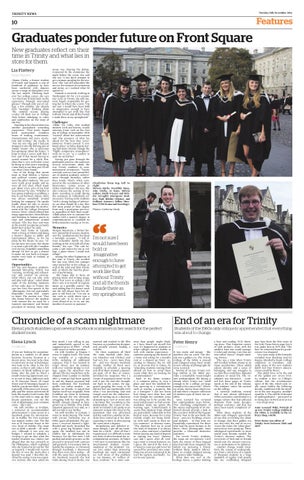
Clockwise from top, left to right:
Doreen Burke, Dearbhla Hone, Aine Clarke, Jo Kane, Mátyás Lukács, Emily O'Leary and Deirdre Geraghty (European Studies); Matt Ritchie (History and Political Science); Dillon Sheehan (TSM Drama and Sociology). Photos: Catherine Healy
“
I’m not sure I would have been bold or imaginative enough to have attempted to get work like that without Trinity and all the friends I made there as my springboard.
Chronicle of a scam nightmare Elena Lynch stumbles upon several Facebook scammers in her search for the perfect student room. Elena Lynch Contributor If you are looking for accommodation as a student, it’s all about location, location, location at a decent price. You want to be close to university to stay in bed longer. You want to be close to the city centre, so that it only takes a few minutes of drunk walking to get home after the pub. So when a mouth-watering opportunity arises to rent at fancy addresses such as 51 Harcourt Street, 95 Capel Street and 35 Mountjoy Square in Dublin, you do not think, you act especially if the prices are reasonable and the rooms advertised all look like swanky hotel rooms. But in the mad rush to snap up that dream apartment, you run the risk of abandoning your common sense – like I did. On 13th October at 10:45pm, I answered an accommodation advertisement I came across in a Facebook group for internationals in Dublin. My first scammer was named Andres Ann. The flat was at 51 Harcourt Street in the very heart of Dublin. The room was at ¤600 a month – all inclusive. Although it was over my budget, I wanted to schedule a viewing to get an idea what the market situation was. Andres Ann alleged that she was currently in the Philippines, which explained why she wanted to let out her flat so urgently. I would only receive the key to view the room after a deposit was paid. I therefore declined by saying it was too expensive anyway. She then asked me
how much I was willing to pay and immediately agreed to my suggested price of ¤500 – which came across as rather peculiar. On 22th October at 5:14pm, I wrote to Sophie Kroll. The room was available at a ridiculous ¤350, including all additional expenses. Plus it was located in Capel Street, just 10 minutes walk over Grattan Bridge to College. Again, the advertiser was abroad. The key would have to be shipped from London to Dublin after a contract had been agreed to and my deposit payment had been confirmed. Her Facebook profile was rather modest – no photos, no friends. It stated that Sophie Kroll was originally from Frankfurt am Main in Germany. Even though she was obviously struggling with her English, she funnily enough claimed to have grown up in Dublin. This whole situation appeared very odd, so I did not take it any further. On 24th October at 12:41pm, I wrote to Indra Besing. The room with private bathroom was at ¤500, again all included. The pictures I received showed a lightflooded and nicely furnished flat with a great big fireplace. Once again, the landlord was not in Dublin but in Edinburgh for business. For the first time, I felt pushed and under pressure, as she pressed to proceed with contract and payment. I was unsure how to handle the situation. As I browsed through Facebook, I discovered that there were three Indras – all with the same face. According to my Facebook research, the real Indra Besing lived in Berlin, was
married and worked in the film business as a production designer and actually existed, leading a real life. My three scammers all liked the same football clubs (Bayern München and Chelsea) and had very few – never more than 30 – and very bizarre Facebook friends. Neither of them were available to schedule a meeting and all of them wanted a deposit, pre-paid. All of this, of course, provoked my suspicion. Was I a victim of organised crime? In the end it was my dad who brought me back to my senses. He suggested googling the issue, as he did not feel too comfortable with what I was describing. Dad and Google saved me the embarrassment of turning up at a doorstep demanding to view or move into a fictitious flat. According to the Independent, the Union of Students in Ireland (USI) spoke to an innocent woman who lived in the apartment that was advertised and she said that a number of students have turned up at her door expecting to move in after paying the scam artist a deposit. Intimidation and disbelief remain though. I put off my roomhunt for a while – after all that I experienced, it is difficult to trust any kind of advertisement for accommodation anymore. In future I will turn to institutions like the International Student Accommodation or the Students’ Union (SU) rather than answering Facebook ads. Such institutions are well aware of this problem as Ian Mooney, SU welfare officer, confirms: “It is more com-
mon than people might think, as I have found out myself this year. It's happened to students in other colleges around Dublin as well, with similar experiences – someone posting up the details of a home and asking for a month’s rent or a deposit up front.” According to Mooney, the SU will try to prevent this in future, by “educating students coming from abroad on how to avoid these scams while they are looking for accommodation.” Back in my home country, it is common policy to view a place and meet the landlord before agreeing to a commitment such as renting a property. But as a foreigner I did not know how things were done here and even though my common sense was telling me to be careful, the need and pressure to find accommodation made me ignore the warning signs. “Unfortunately it seems that students from abroad are particularly vulnerable to this kind of scam. Reasons for it may include simply not being familiar with such scams in their native countries,” as Mooney states. “The absolute best tip to avoid this kind of situation is to always view a place and meet a landlord before paying any kind of deposit or signing any lease,” Mooney says and I agree, after all, renting a room is serious business. So, I guess, the moral of the story is to listen to your gut and never let yourself be pressured into something you are not convinced of. Be wary. Be vigilant. And finally – listen to your parents.
End of an era for Trinity
Students of the 1960s only obliquely apprehended that everything was about to change. Peter Henry Contributor It was exotic and unique – like nowhere else on earth. The decade was a golden era. The Trinity College of the 1960s is praised and eulogised using these words in new volume of photographs by Anne Leonard. Portrait of an Era: Trinity College Dublin in the 1960s provides a remarkable visual insight into undergraduate life during a decade when Trinity was “small enough to be a college yet large enough to be a university”. Where an erratic Junior Dean ruled over all and where a bizarre collection of student types all knew one another. Anne Leonard has revisited her undergraduate years before. Two charming compilations of the stories and legends of Dr McDowell already provide a look at the eccentric world of this bygone Trinity. Now in the new book, the faces – and cars, buildings, streets and fashions – of that time are beautifully reproduced. For those who had the great fortune to be there, these photographs must provoke a thousand memories and more. For recent Trinity students, the snaps are eye-openers. Until now, the stories of those languid days had only been imagined, the mind’s eye picturing a Trinity without those modern fabrications so crudely dumped among the austere older buildings. What does one see? At the College Races, a punter holding
a beer and reading TCD. Morning dress. That forgotten variety of club neckties, worn with the smallest knot one could manage. Cricket and rowing. Cars that are now called “classic”. People smoking. Porters. This was a time when Trinity still revelled without shame in its many peculiarities. These added colour, identity and a sense of belonging, and one struggles to see how they could have impeded academic or social life. The vocabulary was distinctive – Leonard lists three pages of Trinity words at the end of the volume. The students’ entire life centred on the college. A sartorial tradition existed that is now almost obliterated. Other curiosities contributed to a unique culture that had collected elements from many decades, perhaps centuries, and that has since been nearly completely effaced. What these students of the 1960s only obliquely apprehended was that everything was about to change, that their golden era was also truly the end of an era. Across the water, the “plate glass” universities were going up. These ideological experiments in stone would soon become models for Trinity’s decision makers. The University of York and its friends would oust the ancient universities as institutions to be admired. Another change would transform the corpus of undergraduates from a weird mix of a couple of thousand students to a huge monolith of regular Irish people like me. Archbishop McQuaid
may have been the bête noire of the Irish Times letters page, but it was under him in 1970 that “The Ban” he inherited from his predecessors was dropped. Very soon many of the formerly excluded were thanking God for Regina Elizabetha hujus Collegii conditrice at Commons. And, sadly, many of the new students didn’t feel that Trinity’s idiosyncrasies could be theirs. This didn’t have to be the end of the “golden era”. Every Trinity student is heir to College’s culture. But the revolutionary spirit of the 60s, which only really swept Dublin the following decade, combined with the mindset of the new majority, wouldn’t stand for it. The old life of decades of undergraduates – portrayed in its dying days in Portrait of an Era – was swept away. Anne Leonard MBE, Portrait of an Era: Trinity College Dublin in the 1960s, is available in the Library Shop, ¤49.50. Peter Henry was editor of Trinity News between 2006 and 2007.