16
OPINION
TRINITY NEWS March 23, 2010
The enraged anti-Catholic mob The angry mob that has sprung up in response to Church paedophila needs to calm down, according to Eamonn Hynes Eamonn Hynes Contributing Writer THERE’S NOTHING like a good paedophile story to drum up the outraged, liberal-media-reading masses; most of whom have never experienced the horrors of child abuse, nor are they charged with cleaning up the mess left behind by a bunch of sick perverts. Cribbing and moaning from the sidelines and making snipes at the Catholic Church are the tactics of a coward and symptoms of their ignorance. It is in an air of calm that I write this piece in support of the Irish Catholic Church and in support of the Irish clergy in their mission to cleanse the institution and continue on the path of repentance, healing and renewal. First off, we should calm down. Is one really that interested in the kind of slippery implication that one reads about in the holier-than-thou Irish media who bandy about terms such as “misprision of felony” and the 1937 Offences Against the State Act like bullies in a school yard. The fact is that in order for a person to be guilty of a crime (such as this Section 17 of the Offences Against the State Act that we hear about so often), proof of fault, culpability or blameworthiness in both behaviour and mind is required. Some of the stuff I’ve read in recent weeks would lead you to believe that Pope Benedict is the anti-Christ and Cardinal Brady one of his evil minions. But getting back to the issue that caused shock-waves of outrage across the nation, I say this: The then-Fr. Sean Brady never at any stage consciously acted to further harm an abuse victim with an accompanying level of mens rea. Yes, Fr. Brady was a man in a position of responsibility, but I do not believe for one moment that he purposely acted to expose more children to the care of a sex pervert. Brendan Smyth went on to abuse children after
Fr. Sean Brady interviewed him, wrote his report and sent it on to his Bishop, but to say that this is because of an act or an act of omission on the part of Cardinal Sean Brady 35 years later is a farce. We’d better start building prisons, because if we’re going to hold leaders of all institutions to those kinds of standards, we need to round ‘em all up, drag ‘em all before the judiciary (themselves of course squeaky clean in matters pertaining to child abuse and child pornography) and imprison them in a dungeon. There are plenty of company directors in the construction sector who have seen people killed under their watch: a tragedy that cannot be undone. Any right-minded Christian will acknowledge that the death or serious injury of a worker is a tragedy and that seeking vengeance against those higher up the hierarchy is futile and counterproductive in the process of grieving and recovering from life’s setbacks. There’s a big difference between the justice demanded by the angry mob and the type that civilised society dispenses. We must also remember that there are different standards of accountability in society, in that those who work 40 hours per week can engage in their little perversions outside office hours, unlike priests who are on duty 24 hours a day and cannot be “sacked” no matter how grave their crimes. The Church is an earthly institution run by humans with human failings and human temptations. It has been this way since the time of the Apostles. There have been terrible Popes in its 2,000-year history, not to mention lots of scandal. But that is not the real story of the Church: the Church is the largest charitable organisation in the world, has been responsible for the conversion of hundreds of millions in Africa, is the bedrock of the great European cultures, motivates and inspires over a billion people all over the globe to follow in
“Cribbing and moaning from the sidelines and making snipes at the Catholic Church are the tactics of a coward and symptoms of the liberalmedia-reading masses’ ignorance.”
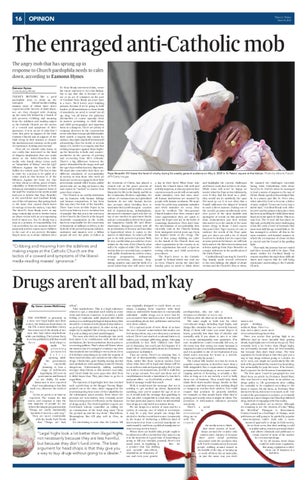
Pope Benedict XVI kisses the head of a baby during his weekly general audience on May 6, 2009 in St Peters’ square at the Vatican. Photo by Alberto Pizzoli/ AFP/Getty Images the footsteps of Christ, has played a central role in the peace process of Northern Ireland and provides a moral blueprint for life in the family and life in the community. Modern capitalism, the culture of consumerism and globalised business do not take human factors into account when deciding how to maximise their profit margins – a nation full of dumbed-down, individualistic, intoxicated consumer types who live on top of one another in apartment blocks and are continually in debt is their goal: not happiness, family life and divine sustenance. Bourgeois society with all its pretensions of decency and morality is hypocritical when it comes to the matter of child abuse. So what’s all this got to do with perverted priests? Well, be very careful what you wish for: if one wishes for the ruin of the Church, what will it be replaced with? The model for society that we currently have, complete with public drunkenness, violent crime, teenage pregnancies, widespread sexual perversion, abortion, drugtaking, murder, rape and the birth of a social underclass who will never work
a day in their lives? What those who knock the Church know full well and artfully suppress, is that any system that operates on such a scale will occasionally make mistakes, even bad ones, since all human institutions are manned by people with human weakness. We must strive for perfection, minimise mistakes and when mistakes do occur, they must be rectified. The bien-pensant Church-bashers fear their censure and crave approbation: they are quick to point the finger and not in the habit of examining themselves. They don’t have the mechanisms of accountability that currently exist in the Church, having been instigated several years ago from the highest levels of the clergy. The fact is that young childing are safer in the hands of the Church than any other organisation in the country as no other organisation has such a rigorous vetting scheme and child protection procedures. The Pope’s letter to the Catholic people in Ireland which was read out in every Church across the land last Sunday gives us much to think about
and highlights the current challenges and future work that needs to be done. While some will never be happy no matter what the Pope writes (ultimately, even if they had his head on a plate, they would not be satisfied), the opus Dei must go on. It is not often that a Pontiff addresses the island of Ireland in such a direct manner. Having one of the world’s greatest intellectuals write over 4,000 of the most humble and apologetic of words on this particular issue demonstrates just how serious this matter is in the minds of the most senior clergy in Rome. I don’t expect this post-Celtic Tiger society of ours to embrace the words of the Pope quite just yet: there are still a lot of closed hearts to be healed, but I do expect that at some point in the future, we will look back and see the direct intervention and solemn apology from Pope Benedict as a major milestone in the purification of the Irish Church. Cardinal Brady’s moving St. Patrick’s Day homily made several references to his own failings, the plight of abuse victims and the Church’s duty to them.
He equated the challenges currently facing Irish Catholicism with those faced by St. Patrick when he managed to lead a nation of pagans to the way of Christ. Brady openly acknowledged that he is a sinner, just like St. Peter who, when asked by God to become a fisher of men, replied: “Leave me Lord, I am a sinful man.” Cardinal Brady took office in 2007 and his primary duty since then has been in tackling the child abuse issue head-on in the spirit of Christ. This is no easy feat. The 71-year-old has taken on this task, probably the most challenging of his life, with a level of fortitude that most men half his age would balk at. He has managed to achieve all this in the most sensitive, soft-handed manner in which the recompense of abuse victims is central and the Gospel is his guiding light. That said, his journey has not ended and there is much still to be done. This sinner wishes for Cardinal Brady to remain steadfast through these difficult times and expects that he will bring repentance and healing to the Catholic Church.
Drugs aren’t all bad, m’kay By Conor James McKinney
THE COUNTRY is presently in a tizzy over legal highs and their source, the infamous head shops. In the UK, a more immediate outcry has arisen out of the deaths of two men who had taken mephedrone while out clubbing. The Labour Party here has published a bill that would force head shops to apply for planning permission b e f o r e opening, while the government is reportedly planning to ban a range of well-known legal highs. (If I were in government and listened to Joe Duffy, I’d make damn sure it were reported that I was planning to ban this stuff, too, whatever the truth of it.) So far, so good, or at least so expected. The reason for this outcry and response is that the vast majority of people do not believe the simple proposition that “Drugs are rarely intrinsically harmful if used in a safe way”. They are more comfortable with the South Park Thesis that “Drugs are bad,
m’kay”. Take mephedrone. This is a legal substance related to qat, a stimulant used widely in some Arab and African countries. It produces a mild feeling of euphoria, mild physical side-effects and a not-so-mild psychological dependency (this should be contrasted with physical dependence, as you’d get with nicotine). In other words, you might try it, mightn’t like to keep on using it, but if you do nothing very bad would happen. The men who died on Scunthorpe last week had taken it in combination with alcohol and methadone, the heroin substitute that is given to recovering addicts. That’s about all I know about the matter, but it’s enough to reinforce my view that mephedrone is nothing to worry about. Even if it did have something to do with the tragedy of these men’s deaths, over and above the other two drugs, I think that, quite frankly, mixing alcohol and methadone with anything would be bloody dangerous. Unfortunately, adding anything stronger than Cidona to that mixture was risky, and I don’t think the poor guys who died from it didn’t know that. They just chose to go for it regardless. The hysteria of legal highs here has reached such a pitch that, as the blogger Twenty Major pointed out at the time, those engaged in the scaremongering bear some of the culpability for the subsequent arson attacks. Even where the protests are non-violent, they certainly aren’t based on long years of reflection on the minutiae of drugs policy. The Irish Examiner reports one Cork-based Labour councillor as calling for an examination of the head shop issue “from the ground up and the top down”. Marvellous. Meaningless. But it’ll play well in Clon, no doubt. It’s interesting to note that the Labour bill
“Legal highs look a lot better than illegal highs, not necessarily because they are less harmful, but because they don’t fund crime. The best argument for head shops is that they give you a way to buy drugs without going to a dealer.”
was originally designed to crack down on sex shops. Lumping these together with head shops as undesirable businesses is conceptually unhelpful – unlike drugs, sex is never bad for you, no matter how much you do it – but does tell us something about how politicians and society view these outlets. It’s a natural point of view. Most of us have the sort of innate conservatism that makes one feel uneasy about, say, a sex shop near a primary school. There’s not much of a rational basis to it, unless you envisage gibbering gimps emerging periodically to lure little children into their pit of depravity, but you’d just feel happier if it wasn’t there, and was safely down in a basement somewhere in Dublin 8. They are seedy. There’s no denying that. A faint air of disreputability constantly clings to them, rather like those 24-hour casinos. Even when what they sell is legal and always will be so, as with sex aids and pornography, they’re just not kosher, not mainstream, not OK to walk into for a scope around. You can’t put these sort of establishments beside a hairdresser’s, butcher’s and post office – or, God forbid, a school – what kind of message would that send? Well, it would send the message that sex is nothing to get worked up about, figuratively speaking, once you’ve passed the age of 20 or so. It would send the message that gambling at four am after a nightclub is a bad idea, but only for that particular punter. And it would establish that drugs are only bad if you misuse them. We use drugs in a variety of ways and for a variety of reasons, one of which is recreation. It may be a pity that people use drugs like alcohol to further social intercourse (commonly in the hopes of furthering a different kind of intercourse) but from a societal standpoint we understand it, and from a political standpoint we don’t see any need to ban it. Where there are health risks, people ought to be allowed to reflect on whether they want to run it in the interests of a good time. If something is going to kill you outright, granted, there’s not much sense in legalising it. But for a product that has shifting and variable side-effects, dependent on frequency of use and even your genetic
predisposition, why not take a decision on whether or not to use it? This is, after all, what we do with alcohol. The same ought to hold true for other recreational drugs, including legal highs, and things like cannabis that are currently banned. Many of them will cause you some degree of harm, generally less than that of alcohol, and normally only if you abuse it, mix it or take it in some unimaginably vast quantities. (I’m sure mephedrone could eventually kill you, in the same way that eating too many bananas is supposed to give you lethal potassium poisoning, and it is possible to die of over-hydration if you drink water non-stop for hours at a stretch. That’s not really the point.) The Labour bill, insofar as it has its roots in populist conservatism, is therefore more than a little misguided. But a requirement of planning permission for head shops, or even a more wideranging system of licencing, is actually a fine idea, so long as it is not merely a tool to bully them out of business. They would help them shake their down-market image, insofar as that is possible, and help ensure that nothing illegal or dangerous reaches their shelves. You could require that products be properly labelled, for example, so that people know what they’re getting and exactly what it might do them. The provision of information enhances personal autonomy. There’s a social context to recreational drug use as well. The reason the media seem to think that these dozens of head shops around the country only existed since January is because there aren’t social problems associated with the products they sell. You’d certainly worry if you saw people walking around stoned in the middle of the day, or turning up to work off-their-tits on bath salts, in just the same way you don’t
want to see people drinking vodka in Mass. There’s a time and a place; most users of receational drugs know this. Once you accept that getting high is no different and no more harmful than getting drunk, legal highs start to look pretty good. They certainly look a lot better than illegal highs, not necessarily because they are less harmful, but because they don’t fund crime. The best argument for head shops is that they give you a way to buy drugs without going to a dealer. As we’ve seen, you might not particularly like the look of the guy behind the counter in a head shop, but presumably he pays his taxes. If he doesn’t, that’s a matter for the Revenue Commissioners. The first quote I used in paragraph two was lifted from an article by Professor David Nutt, who was forced to step down as an advisor on drugs policy to UK government after calling for cannabis to be regulated according to the harm it causes. On the facts, as Professor Nutt interprets them, this is not very much at all – but it suited the government to posture, to reclassify cannabis as a more dangerous Class B prohibited drug, instead of engaging with this reality. Irish policy-makers are no better. Although it’s tempting to see the election of Luke “Ming the Merciless” Flanagan to Roscommon County Council as a harbinger of change, most politicans are still going to be guided by popular misconceptions rather than take a more nuanced approach to drugs in Irish society. As we have seen, this does nothing to add to public safety, restricts personal choice and allows criminals and publicans to retain control of most of the market for recreational drugs. So by all means, head shops could do with some regulation. But using regulation to drive them out of business is a bad idea.