12 WORLD REVIEW
Tea Party or third party? In the wake of the “Restoring Honor” rally, the Tea Party Movement continues to grow in popularity. But who or what is behind its rise and what does this mean for American politics?
Kate Rowan Deputy Sports Features Editor
“I really don’t think there is a true malevolence here. Instead, people drawn to Washington with the vague worry that somewhere, something is terribly wrong.”
IN MID-SEPTEMBER I arrived in Philadelphia and the first thing I did in my hotel room was turn on the television. I had been vaguely aware that primaries for candidates for the forthcoming midterm elections would be taking place while I was visiting the USA, but the barrage of cutting, personal and sometimes nasty attacks on opposing candidates made me well aware of what was happening. Despite being in the state of Pennsylvania, as chance would have it I had selected a local news channel from just over the state line in Delaware. This was how I was first introduced to Christine O’Donnell. Since then many bizarre facts about her past, from dabbling in witchcraft to an anti-masturbation campaign aired on MTV in the 1990s, have been revealed to the world. However, before I knew any of that I was confronted by a “message” backed by her rival Republican candidate and former governor of Delaware Mike Castle. A jigsaw of a face was being constructed while a corny-sounding male voice told us “this woman had not paid all her college tuition” and various other revelations about her shoddy financial records including that she spent $20 of her campaign funds on gas for her own personal use. As the voice-over continued, the puzzle revealed the smiling face of a woman and proclaimed “This is Christine O’Donnell!” Later, not just the local news channel from Delaware but all the major news channels were reporting on the shock victory of O’Donnell over the Republican-establishment-backed Castle. I was informed that this result had been helped by the Tea Party
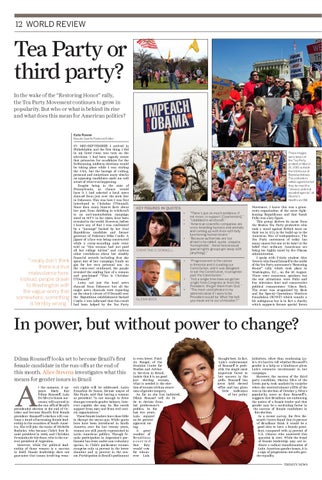
These images were taken at the Tea Party protest on March 21, 2010 outside the US House of Representatives. The protestors rallied against what they termed the “obvious policical socialist agenda” of Obama’s Healthcare Bill.
KEY FIGURES IN QUOTES • • •
•
CHRISTINE O’DONNELL •
• • GLENN BECK
“There’s just as much evidence, if not more, to support [Creationism].” “I dabbled in witchcraft.” “American scientific companies are cross-breeding humans and animals and coming up with mice with fully functioning human brains.” “Because authorities are too afraid to be called, quote, unquote, ‘homophobic’, these homosexual special rights groups get away with [anything].” “Progressivism is the cancer in America and it is eating our Constitution, and it was designed to eat the Constitution, to progress past the Constitution.” “Not a single time have we gotten a right from Congress or from the President. We get them from God.” “The most used phrase in my administration if I were to be President would be ‘What the hell you mean we’re out of missiles?’”
Movement. I knew this was a grassroots organisation of the more rightleaning Republicans and that Sarah Palin was a key figure. This group derives its name from the Boston Tea Party protesters who took a stand against British taxes on their tea in 1773 in the build-up to the American War of Independence. The Tea Party movement of today has many causes but one at its heart is the belief that ordinary Americans are being too highly taxed by the Obama administration. I spoke with Trinity student Alex Towers who found himself in the midst of the Tea Party movement’s “Restoring Honor” rally which took place in Washington, D.C., on the 28 August. There were numerous speakers but the star attractions were Palin and Fox television host and conservative political commentator Glenn Beck. The event was oraganised by Beck and the Special Operations Warriors Foundation (SOWF) which sounds a bit ambiguous but is in fact a charity which supports former special forces
In power, but without power to change? Dilma Rousseff looks set to become Brazil’s first female candidate in the run-offs at the end of this month. Alice Stevens investigates what this means for gender issues in Brazil
A
t the moment, it appears likely that Dilma Rousseff, Lula De Silva’s chosen successor, will succeed in the run-offs of Brazil’s presidential election at the end of October and become Brazil’s first female president. Rousseff’s election will continue a trend of increasing female leadership in the countries of South America. She will join the ranks of Michelle Bachelet, who became Chile’s first female president in 2006, and Christina Fernández de Kirchner, who is the current president of Argentina. However, while the political leadership of these women is a success in itself, female leadership does not guarantee that issues involving wom-
en’s rights will be addressed. Luiza Erundina de Sousa, former mayor of São Paulo, said that having a woman as president “is not enough to drive changes towards gender balance, however capable she may be. She needs support from men and from civil society organisations.” These female leaders have done little to disrupt the status quo. While quota laws have been introduced in South America over the last twenty years, women are still poorly represented in Latin American politics. Though female participation in Argentina’s parliament has risen under non-voluntary quotas, in Chile’s parliament women comprise only 14 percent in the lower chamber and 13 percent in the senate. Participation in Brazil’s parliament
is even lower. Patricia Rangel, of the Feminist Centre for Studies and Advisory Services in Brazil, insists that it is no good just electing women, what is needed is the election of women with an awareness of gender inequity. As far as she has indicated, Dilma Roussef will do little to deviate from her predecessor’s politics. In the last two years, Lula enjoyed an 80 percent approval rating. A great number of Brazilians asserted that they would vote for whomever Lula
thought best. In fact, Lula’s endorsement of Rousseff is probably the single most important factor to her success in the polls. Rousseff has never held elected office and has given little indication of her policy
initiatives, other than continuing Lula’s. It’s hard to tell whether Rousseff’s gender is a help or a hindrance given Lula’s extensive involvement in her campaign. However, the success of the third party candidate, Marina Silva of the Green party, took analysts by surprise when she received almost a fifth of the vote in the election of October 3. Silva’s popularity, more so than Rousseff’s, suggests that Brazilians are embracing the notion of a female leader and that gender may be a motivating factor in the success of female candidates in this election. In a recent survey, the Pew Research Centre found that 70 percent of Brazilians think it would be a good idea to have a female president, compared with 33 percent of U.S. citizens who answered this question in 2007. While the trend of female leadership may not indicate a radical transformation of Latin American gender issues, it is a sign of progression towards gender equality.
TRINITY NEWS