OPENERS
THE SUNSET OF MODERNISM DESIGN In the immediate neighbourhood of James Gandon’s Custom House and Busáras, by the firm of Michael Scott, stands a building complex which is not nearly as iconic, but aesthetically holds its own alongside these Dublin celebrities. Built between 1975-80, the Irish Life Centre, on Lower Abbey Street, is a mixed-purpose development consisting of blocks of various heights arranged around street-level and raised courtyards, with a large landscaped garden at its heart. Though obviously Modernist in style, the buildings follow classical principles of design, with a ground-floor arcade, equal strips of glazing and brick panels above giving a vertical emphasis and uniting
minating the tripartite scheme. Though simple rectangular volumes and strong clear horizontals and verticals dominate the overall impression, there are hardly any sharp angles to be seen, with rounded corners giving the buildings a surprising elegance and grace. The bush-hammered concrete, brick and mirrored glass are all simple industrial materials championed by the modernists, and when combined here with the wonderful plasticity of lines, their natural charm is revealled beautifully. If you are still not convinced, use a visit to see the sculpture Chariot of Life by Oisín Kelly in the plaza at the front of the Irish Life Centre as a pretext to find yourself there at the time around sunset, when the even-
the levels like an applied order ing light tints the windows in a (ie the classical system of col- fantastic, warm shade of aged umn and entablature), and a gold. Gabija Purlytė copper-clad mansard roof ter-
“A NEW SOURCE OF MUSICAL DELIGHT”
LITERATURE This volume, compiled by Bunting, was the first collection of Irish airs. It contains both ancient tunes and many airs by popular Irish harper and composer Turlough Carolan (1670–1738). Over 100 of his tunes are known, and this is believed to be only a fragment of his repertoire. Bunting comments that such is Carolan’s skill in “every stile of Music . . . that we can scarcely know to which of them his genius was best adapted.” Carolan’s Concerto, a piece that shows the influence of Baroque music on his work and is considered a masterpiece by harpers, is featured in this collection along with several of his other tunes. Originally there were lyrics to Carolan’s airs, but it is the music that has endured.
This was the main goal of Bunting’s collection, to preserve Irish music for future generations. As much Irish music is learnt by ear, this written record of music is crucial. Bunting collected the tunes at a gathering of harpers in Belfast in 1792 and this volume, A General Collection of the Ancient Irish Music, was published in 1796. Bunting was instructed not to add a note to the tunes he heard at the festival, and so the collection is not a perfect one. There are errors in the tunes, but that does not detract from the importance of this volume – both musically and historically. This book can be found and explored in the Early Printed Books Department of TCD Library. Jenny Duffy
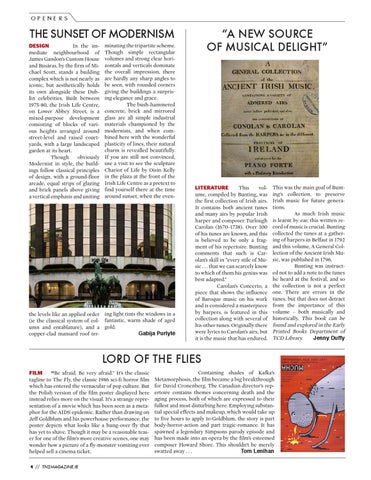
LORD OF THE FLIES FILM “Be afraid. Be very afraid.” It’s the classic tagline to The Fly, the classic 1986 sci-fi horror film which has entered the vernacular of pop culture. But the Polish version of the film poster displayed here instead relies more on the visual. It’s a strange representation of a movie which has been seen as a metaphor for the AIDS epidemic. Rather than drawing on Jeff Goldblum and his powerhouse performance, the poster depicts what looks like a hung-over fly that has yet to shave. Though it may be a reasonable teaser for one of the film’s more creative scenes, one may wonder how a picture of a fly-monster vomiting ever helped sell a cinema ticket. 4 // TN2MAGAZINE.IE
Containing shades of Kafka’s Metamorphosis, the film became a big breakthrough for David Cronenberg. The Canadian director’s repertoire contains themes concerning death and the aging process, both of which are expressed to their fullest and most disturbing here. Employing substantial special effects and makeup, which would take up to five hours to apply to Goldblum, the story is part body-horror-action and part tragic-romance. It has spawned a legendary Simpsons parody episode and has been made into an opera by the film’s esteemed composer Howard Shore. This shouldn’t be merely swatted away . . . Tom Lenihan