TRINITY NEWS
SPORT ORT
TRINITY NEWS November 25, 2008
New dawn for the Knights
HISTORY OF THE KNIGHTS SET UP in 1926, the club was given its own rooms on campus in 1957. It may have helped that the Provost at the time, Albert McConnell, was a Knight himself. They were removed from their perch at the top of House 27 some years ago, however; this may have had something to do with their tradition of what Dr. West describes as their “overenthusiastic hospitality”. Past Knights include the playwright Samuel Beckett (golf) and former Tánaiste Dick Spring (GAA). Trinity Senator David Norris is, according to his website, an honourary member.
In a rare glimpse into the inner workings of an organisation traditionally renowed for its secrecy, Conor James McKinney examines Trinity’s most exclusive club LIKE SCHOLS, portraits of deceased monarchs and cheap cans outside the Pav on a summer’s day, the Knights of the Campanile are one of those institutions that is uniquely Trinity. Like those other features of campus (well, apart from the cans), their existence does on occasion lead to charges of elitism. After all, a semisecret society open only to the College’s top sportsmen is by its very nature going to have a bit of a snobbish feel to it. The corresponding clubs in Oxford and Cambridge (Vincent’s and Hawks, respectivally) wouldn’t disabuse you of this notion, being very much gentlemen’s clubs with a sporting ethos. Our own Knights are a social outfit, to be sure, but are looking to shake off their aloof and secretive air. “I feel we have to be a bit more outward-looking”, says postgraduate student and current President
“what keeps the Knights going is the supposed prestige and the existence of the tie” Mark Raftery-Skehan. As Dr. Trevor West puts it in The Bold Collegians, his history of Trinity sport, the Knights of the Campanile “constitute not so much a club as a society of hospitable sportsmen with an elected membership”. But how does this election process work? In times gone by, only Knights could make nominations, but due to the decline of the organisation in recent times this led to many talented athletes being left out, as nobody from their club was active in the Knights. The decision was recently made, therefore, to open up the process somewhat, so that now club captains may make nominations as well. What happens then is up to the current members. While the Vincent’s and Hawks are restricted to holders of Blues, it seems that membership of the Knights does not depend upon possession of the equivilant honour in Trinity, the College Pink. Our sister publication Miscellany reported back in 1991 that while “the three main criteria are usually that you are a member
21 2 1
Tuesday, October 14, 2008
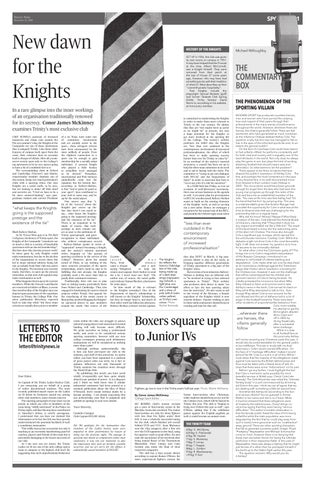
of a 1st Team, have some sort of committee involvement and are socially active in the sport… these stringent criteria have been surmounted by the most unlikely of people. Even the slightest connection to a sport can be enough to gain membership for a socially adept individual. A present Knight who played a little hockey at schoolboy level managed to be elected.” Nowadays, international and Pink honours undoubtedly come into the equation, but the bottom line, according to Raftery-Skehan, is that “you’ve gotta be good at your sport”, have contibuted to your club in some way, and be up for the social aspect. One source says that “a lot of the ‘secrecy’ about the Knights just covers up the fact that there’s not much to say... what keeps the Knights going is the supposed prestige and the existence of the tie.” There is an argument to be made, of course, that such prestige as does remain can act as spur to the ambitions of Trinity sportspeople, and gives recognition to those individuals who achieve conspicuous success – Raftery-Skehan speaks in terms of “aspiration” toward becoming a Knight, and the society’s mission statement refers elegantly to “the pursuit of sporting excellence in the service of the College”. However, given the annual award of Pinks, to say nothing of the more concrete attraction of the sports scholarships, which could be said to be fulfilling this role already, the Knights probably need a bit more than that to justify their continued existence. Traditionally, their role was to play host to visiting teams, particularly those from Oxford and Cambridge. They also engaged in fundraising for sports-related projects within Trinity. One appeal, for the resurfacing of the tennis courts in Botany Bay, involved flogging the Knights’ tie (pictured above) to past members around the world. One source of the
LETTERS TO THE EDITOR letters@trinitynews.ie
Dear Editor, As Captain of the Trinity Ladies Hockey Club, I am contacting you on behalf of a group of rather discontented students. The most recently published match report on the Ladies 1st XI defeat by Glenanne caused me, among other club members, some serious concern. The opening paragraph of your most recent article, in which you refer to members of the team being “wildly inebriated” in the Palace on Friday night, and that this may have contributed to Saturday’s defeat, is utterly outrageous. I understand that you have not claimed this information to be fact but feel you have grossly underestimated the potential backlash of such a scandalous insinuation. This wildly inaccurate accusation not only is insulting to an extremely hardworking panel of coaches, players and friends of this team but is potentially damaging to the future successes of our club. As I am sure you are aware, the Trinity Ladies 1st XI are one of the only college sports team to compete at the highest club level. By suggesting that such unprofessional behaviour
is committed to modernising the Knights in order to make them more relevant to Trinity in the 21st century. He admits that they are “not maybe been as active as we might be” at present, but sees a huge potential for the Knights to get more involved in the sporting life of the College. The society’s website professes the belief that the Knights are “less than ever outdated in the contemporary environment of increased professionalisation, the effect of which has been to make sporting success harder than ever for Trinity to come by”. In an overhaul of the society’s internal structures, a council has been set up to help the three-man committee in its work and to aid in liasing with the clubs. The committee is “trying to get into dialogue with DUCAC and the Department of Sport” in order to ascertain how best to “carve out a bit of a role for ourselves”. At a EGM held last Friday, as ever an occasion of well-lubricated merriment, there was serious business on the agenda as well. A six-point plan for presentation to DUCAC was discussed; Raftery-Skehan wants to build on the existing elements of the Knights’ work, as well as carving out a new niche. Hence, he envisages a reception for the annual visit of the MCC, and possibly the Oxford rugby team when
“less than ever outdated in the contemporary environment of increased professionalisation” £3,000 raised w a s Paris, from whence came a cheque and a note saying “Delighted to help the tennis court appeal. Don’t bother to send me a tie. I never wear one. Sam”. The author was, of course, the noted golfer and cricketer Samuel Beckett, also known for some plays. So how much of this is relevant to the Knights nowadays? One of the Department of Sport’s scholarships is still known as the Knights’ Scholarship, but they no longer fund it, and much of their other work has fallen into abeyance. Raftery-Skehan, a former cricket captain,
exists within the club, our struggle to attract talented young players and attain much needed funding will only become more difficult. We pride ourselves on being a professional outfit, and strive to be considered serious sporting contenders, however with our own college newspaper printing such defamatory insinuations we will be considered as nothing more than a joke! Although perhaps unintentionally, this is how you have portrayed our club to the students, and staff of this university. As sports editor, you have been appointed to a position of great power; what you write, be it fact or opinion, influences not only thousands of Trinity students but countless more through the World Wide Web. By publishing this article you have acted wholly irresponsibly and have quite simply abused your position of power. It is a disgrace and I think we both know that if similar unfounded comments had been printed in a national publication about the likes of Brian O‘Driscoll, there would without doubt be a lawsuit pending. I am simply requesting that you acknowledge your flaw in judgment and publish an apology in your next edition. Yours Sincerely, Caoimhe Costigan Club Captain DULHC 08/09 Ed: We apologise for the insinuation that members of the Ladies hockey team were impaired in their performance by reason of being out the previous night. The passage in question was meant as comparison rather than conjecture; it was not our intention to give the impression that such an incident actually occurred, and we are sorry for the offence it undoubtedly caused members of DULHC.
The Knights’ tie reflects the historic Oxbridge ties of the club, being made up of a dark blue stripe (representing Oxford), a light blue one (for Cambridge) and a sliver of pink (which looks rather yellow) as Trinity’s own colour. Photo: Rachel Kennedy
they play DUFC in March. A big pastpresent dinner is also on the cards, as bringing together different generations of Trinity sportsmen is a big part of the Knights’ ethos. But in terms of new intiatives, RafterySkehan is looking into an informal role to “be involved in trying to lure talented sportsmen to Trinity”. Their website also professes their desire to make “an effort to lure the best sporting talent into the university”. He also wants to aid in the revival of the Hereans, a female equivilant of the Knights which is now entirely defunct. Anyone wishing to join in these noble endeavours should keep on training and wait for that call.
Boxers square up to Junior IVs
Fighters go toe to toe in the Trinity exam hall last year. Photo: Martin McKenna By Conor James McKinney College Sport Editor DU BOXING Club’s newest recruits got a taste of Intervarsity action in the Mardyke Arena last weekend. The Junior Intervarsities are only for those fighters with less than five fights under their belt. It was a relatively successful outing for the club, which finished 3rd overall behind UCD and UCC. Sean Mulvaney won the 71kg catagorey after a fine win over his UCD opponent in the final, using his superior reach to good effect. He also took the top honour of the weekend after being named Boxer of the Tournament Meanwhile, Peter Linney and Luke Gordon also made the final of their respective catagories. The club has a busy season ahead, according to captain Ronan O’Brien: the more experienced fighters contest the
Senior Intervarsities after Christmas, while students should keep an eye out for the Colours even, which will be hosted by Trinity this year. The club is “hoping to bring over Oxford this year as well”, says O’Brien, adding that if the exhibition games against the English pugilists go well, it could become an annual event.
THE TRINITY TEAM 60kg: G. McGibney 63½kg: E. FitzGerald 67kg: M. Huston 71kg: S. Mulvaney 75kg: P. Linney 81kg: T. Pepper 86kg: L. Gordon 91kg: R. MacSweeney +91kg: P. Kerr
Michael Willoughby
THE COMMENTARY BOX THE PHENOMENON OF THE SPORTING VILLAIN MODERN SPORT has produced countless heroes, men and women who have earned the undying love and respect of their peers through their achievements in the many arenas of performance throughout the world. However, wherever there are heroes, the villains generally follow. There are few sportsmen who have generated as much contempt as the infamous Chelsea stalwart Ashley Cole. The question is why has this man has managed to fall so low in the eyes of the informed sports fan and, to an extent, the general public? On the face of it perhaps Cole could have reason to feel unfairly vilified; he performs consistently well for both club and country and is arguably one of the best left-backs in the world. Not only does he always play the game to win, but plays the kind of exciting, attacking football that should inspire awe and admiration. So what seems to be the problem? There appear to be three incidents that have shaped the public’s impression of Ashley Cole. The first, and perhaps the most contentious in the eyes of any Arsenal fans, is his well-documented move from Arsenal to their London rivals Chelsea in 2005. The move alone would have been grounds enough for anger from the fans who had seen this young man progress up through the ranks of the club and become an established member of the side. The view at the time was that Ashley had “bit the hand that fed him” by jumping ship. This view is understandable given that Arsène Wenger had provided the opportunity for Cole in what was at the time an Arsenal side that was challenging for the premiership title on a regular basis. Why did he move? Money? Respect? Most likely a mixture of the two. Cole blamed the Arsenal Board of Directors, claiming that “[They] didn’t show me any respect and treated me like a little kid.” The result of this feud meant a move into the welcoming arms of the über-rich Chelsea. The move also brought Cole a significant pay increase, which earned him the unfortunate nickname “Cashley Cole”. While this debacle might not show Cole in the most favourable light, it still does not answer my question as to how he became to be universally disliked. So what other crime has Cole been guilty of? This brings me on to Cole’s misguided interpretation of the Respect Campaign, introduced in an attempt to rid football of referee bashing and degradation. Cole made what can only be described as an horrendous challenge against the Tottenham player Alan Hutton which resulted in a booking for the Chelsea man. However it was not the challenge that will be remembered but the childish and ignorant reaction of Cole to being booked. He initially protested his innocence but when Mike Riley refused to listen and commenced to take Ashley’s name in the book, Cole turned his back on Riley while Riley attempted to talk to him. Even though Riley asked Cole to turn around, he flat out refused and this act of defiance led to a lot of anger in the football hierarchy. There have been other incidents of unsportsmanlike behaviour from Cole, most notably his attempt to get the attacker ...wherever there Birmingham Aliou Cissé sent off in 2002 by are heroes, the diving theatrically villains generally after a somewhat tame challenge. follow While it is clear to all football fans at this point why Ashley will not be receiving any Christmas cards this year, it would also be understandable for the general public to be indifferent. This ties in nicely with my final submission: Cole’s recent marital difficulties. On the face of it “marriage difficulties” makes it sound almost like Mr. Cole is a victim in all of this. While I must stress that the majority of the allegations made against Cole were by the British tabloid press and thus must be taken with a liberal dose of salt, it’s clear that there were some “indiscretions” on his part. Before I go any further, I must highlight the fact that Cole is married to quite possibly the most beautiful woman in British pop, Cheryl Cole (née Tweedy). The Girls Aloud star was voted the “ultimate fantasy body” in a poll commissioned by slimming aid Zotrim this year. I think we can all agree that we are dealing with something a little bit special here. And what did Ashley do (according to the Sun and various others)? You’ve guessed it. Aimee Walton is her name and she is no Cheryl. While it must be stressed that these allegations were all made by the tabloid press, Cheryl did go on record as saying that they were having “serious difficulties.” This author’s humble observation is that the female public hated the idea of him being unfaithful while the male population was more disgusted by the fact that he could play away from such a lovely home ground at such an “unattractive” away ground. There are other sporting characters that fail to generate a positive public image: Floyd “Prettyboy” Mayweather and Michael Schumacher come to mind. However there is no denying that these men are better known for being the ultimate performer in their respective fields. In the case of Mayweather, there was always a feeling that he might just be less of a villain then he portrayed himself in the build up to the Hatton fight earlier this year. The question remains: Why would you do it Ashley?