TRINITY NEWS
Tuesday 18th of September 2012
Editorial
18
Prepare yourself...
That Article
O Rónán Burtenshaw Editor
n Thursday last, Trinity News published on its website an article which attracted considerable controversy and criticism. I will use this space to answer what I consider to be the two most prominent themes of this criticism. Firstly, there is the question of the article’s accuracy. We have reviewed our records of the interviews conducted pursuant to the story, and remain convinced that these were represented accurately. In addition, I have seen the documentary evidence referenced in the article. I am satisfied that it was conveyed honestly and without distortion. Trinity News stands behind the journalism in this article; it was carried out in a professional manner and reasonable care was taken in checking facts before publica-
tion. The second question surrounds whether the article was in the public interest and, on that basis, appropriate for publication. This issue was discussed internally among members of our senior editorial staff before its publication, which I approved. TN understands that the public-interest value of a story should be weighed against concerns of individual privacy. In this instance, I made the decision that the public-interest value justified its publication because of the individual’s representative position and the serious nature of the situation as conveyed to us by Trinity TV. The situation had deteriorated to the degree that those involved in the committee were not sure that the society was going to be able to continue this year. Their allegations, as quoted in the article, were that
this was because of individual acts of dishonesty. My decision was not influenced by other motivations. Should Trinity News be made aware of a significant inaccuracy, misleading statement or distorted report, it will be corrected promptly and with due prominence; or, in a case where it would be the appropriate response, we will print an apology or retraction. However, we do not expect this situation to arise. This has not been a pleasant experience for any of the parties involved, and the publication of the article was not something that was done with relish. But this is the rule rather than the exception in student journalism. Due to the compact nature of the College community, those printing articles are often acquainted with those being reported on, and those
reading articles are in similar positions. But these personal relationships are not reasons to eschew journalism in favour of public relations. Neither do I, as editor, believe that it is appropriate to refuse to cover stories that make people uncomfortable. Nor that students and whatever mistakes they might make should be ignored or allowed to pass, as has been argued within student publications on many occasions over my four-year involvement with the industry. TN is a student newspaper and must cover student issues. Within that context, an article should not be held back from publication if it can be established that it is in the public interest. To do so would reduce student journalism to a triviality and Trinity News to something more closely approaching an advertorial.
The Broad Canvas
T Rónán Burtenshaw Editor
he continuing dispute over contracts of indefinite duration and compulsory redundancy emphasises the importance of a broad-canvas approach to political issues as austerity continues to turn the screw on the state and on public services. The Croke Park agreement is not legally-binding. It is, however, the foundation underpinning relative social tranquillity while spending cuts, salary freezes and tax increases are implemented to repay privatesector debts nationalised in the wake of the global financial crisis of 2008-09. It is the unambiguous opinion of the government, the agreement’s implementation body, the labour court and public service unions that it guarantees the workers laid off in Trinity the right to reinstatement. If Croke Park is to persist, then it isn’t sustainable for Trinity College to refuse to abide by its requirements, as established by the aforementioned bodies. However, College’s position in this case is not unreasonable. They have already implemented significant cuts, probably to the extent that they believe is possible without seriously impacting the quality of education in Trinity. A case could be made for cutting pay to senior academics, especially given that their current position
amounts to picking which parts of the Croke Park agreement they will follow and which they will not. Public discourse has recently been flooded with calls for reductions in the pay of public servants earning over €100,000, particularly those in academia. Certainly, managerial culture and the marketisation of the public service has led to some unjustifiable situations. For instance, the payment of a €232,000 annual salary to a university president in Cork (whose level of competence didn’t extend to understanding the crocodile tears inherent in talk of the “challenges” facing those making nearly a quarter of a million) has not met with a favourable response. This is a country where nearly one in four people lives with two forms of enforced deprivation. Apparently, if he’d moved across the water, he’d have doubled his salary and got a Jaguar. Meritocracy, eh? Libération responded to France’s richest man emigrating to avoid high tax rates with a front page inviting him to “get lost”. One wishes Ireland had a similarly assertive press. Despite this, it remains the case that most exhortations to cut top academics’ pay come from those whose interests lie in using it as a Trojan horse to undermine the Croke Park agreement in its entirety. They realise what Ireland’s unions,
high on the evaporated glories of the social partnership era, don’t: there is no way to maintain the Croke Park agreement, the welfare state and decent public services on the current trajectory. They’re betting that Croke Park, which protects the salaries and working conditions of public servants subject to a media campaign of vilification, is the low-lying fruit. And they’re probably right. College may lose this battle. But, unless there’s a significant change of path in Irish politics, those making their arguments – that we should prioritise protection of public services (particularly those, like higher education, which most matter to the middle-classes) over salaries – are going to win out. But these aren’t the questions we should be asking. They’re false choices. Those in powerful positions have enjoyed considerable success in narrowing the spectrum of acceptable political discourse. They have navigated the cynical embrace of immediacy from crisis to crisis without ever landing on the shore of ideological or systemic questions. Why should the state repay privately-accrued gambling debts at the expense of funding public services? And why should debts be repaid by cutting services and wages at all, when the combined wealth of the richest 1% of Ireland’s population (€130bn) is roughly equivalent to our total national
debt? The reason that these questions are systematically avoided is that they would force us to analyse the basics of our political regime. There’s been a lot of falsely mutual rhetoric – “We’re all in this together”, “Everyone’s had to take a hit”, etc – but to what extent do we really emphasise the social over the individual? To what extent does our state imbue us with equality, and to what extent does it reinforce relationships of power and control? How much power rests in the popular, and how much in the private? And what does this say about the nature of our democracy? If you’re a college student at the moment, you’re part of a generation that has seen historic political turmoil. If you’re one of our incoming freshers, you’re at the vanguard of a generation who was promised the world during the Celtic Tiger period before being introduced to a future as full of unemployment and emigration as that of their parents and grandparents. It has never been more important to maintain a broadcanvas approach to politics and to ask fundamental questions, because the effects of policies profoundly influenced by freemarket ideological preferences will increasingly affect your day-to-day life, including the quality of education you receive in this university.
Black and White and Red all over
O Hannah Cogan Public Editor
n 15th August the full staff of the Red & Black, the student newspaper at the University of Georgia, walked out of their offices to protest new editorial structures and guidelines. In a formal statement, the editor-in-chief, Polina Marinova, said the paper had been “feeling serious pressure from people who aren’t students”, citing incentives to take “grip and grin” photos and publicise student initiatives. Since the beginning of August, some ten non-student staff members had been hired by the board of the paper to “assist” in the production of the Red & Black, and a number of staff members claimed their stories had been edited, re-written, or censored altogether in the interest of improving public perception of the university. The paper itself receives no support from the university, financing itself primarily through ad sales. The strike itself was interesting, but not particularly newsworthy. The story was picked up by the New York Times, Slate, and a number of media blogs when Ed Stamper, a former chairman of the board recently promoted to “editorial director”, sent a memo to all student editorial staff entitled “Expectations of Editorial Director at The Red & Black”. Stamper laid out the criteria for acceptable content thus: “The newspaper needs a balance of good and bad. BAD
content that catches people or organizations doing bad things. I guess this is ‘journalism’. If in question, have more GOOD than BAD.” Allowed to function as true newspapers with no prescribed allegiance, student media is incredibly important. Student journalists and their editors too often make the mistake of trying to copy national media, which fails on two levels: students aspiring to work in newspapers don’t learn to research and develop stories on their own, while student papers, devoid of stories interesting or relevant to their readers, fail to serve the interests of colleges and universities as a whole. I’m very proud to be on the staff of Trinity News, but I don’t care about their coverage of the American election, because CNN will tell me first. The stories of value to me as a reader are college-based, with information I won’t find anywhere else. As a writer, writing an article that paraphrases the BBC news in brief is of no practical benefit. Student papers function best when they’re scaled to the colleges that produce them and are allowed to function as real, provocative news sources. Student journalism will never be perfect or infallible. We’re students, we’re learning, and sometimes we screw up, with far more frequency than we’d like to mention. In our heads, we’re writing the stories that will change the
world. In actuality, we’re half a deadline away from libel and inclined to mix our metaphors. Responding to a Facebook post, Red and Black board member Charles Russell suggested the changes were an improvement to training student journalists, stating, “What we’ve done at the board level, is authorize significant new expenditures from reserves to more fully deliver on our training mission, by providing the support staff to help the students learn how to juggle multiple media initiatives successfully – all while staying focused on why they’re in Athens in the first place: to get their education.” Suggesting that students would benefit from being more detached from their news sources and stories displays a profound misunderstanding of the importance of college newspapers: they serve a deeper purpose than CV-building and teaching students to “juggle multiple media initiatives”, whatever that means. On 17th August, Ed Stamper tendered his resignation from the board of the Red and Black, citing in part the embarrassment of the circulation of his memo to editorial staff; they were just internal editorial guidelines, he thought, and didn’t need much thought. “I’m a businessman,” he explained, “not a journalist.” Newspapers, physical or digital, are valuable and should be defended, but shouldn’t be popular by virtue of being easy to read. The
Huffington Post’s column on cute animals has phenomenal website traffic, but Gifs of snoring puppies should not have higher front page billing than supreme court justices. Editors need to provoke intelligently and challenge their readers and, if college newspapers are to fulfil both of their muchneeded functions, they need to confront existing prejudices and measure the results. Measuring is significantly harder when you have nothing to measure. Both UT and TN have published controversial stories in the last month, and they’ve generated outrage, disgust, and, generally, profound inaction. We want a better college press. So do you. Please, write letters to our editor, comment on our stories, and write to me at public@trinitynews.ie. Both this column and my blog at trinitynews.ie are outside the jurisdiction of our editorial staff and will never be censored, altered or edited. I answer to the Publications Committee, and not the editor of this paper. I’m here to give your reactions to our stories more airtime and higher visibility, functioning as a link between this paper and its readers. I want to question the stories we run and the standards we do or don’t uphold. Help us write stories that matter and hold the college to account. We look forward to hearing from you.
Photo: George Voronov
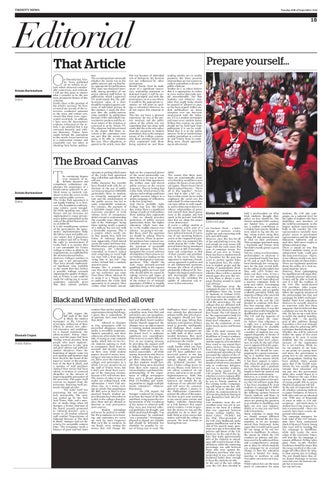
Elaine McCahill Editor-at-Large It’s Freshers’ Week – a kaleidoscope of societies, events, nights out and connecting with new and old friends. However, once this free-for-all of fun and drinking is over, the real assault on your senses will begin with the early onset this year of campaign season. For those of you new to Trinity, there has been a student march in November for the past two years to protest against hikes in registration fees, the reduction in student grants and the cutting of postgraduate funding. It is yet unconfirmed as to whether there will be a student march again this year. But never fear, there is always a campaign floating around to spam your inboxes. This Michaelmas term, the campaign du jour is to do with disaffiliation from the Union of Students in Ireland (USI). For those who are unaware, the USI represents the students of all of the universities, ITs and colleges that are affiliated with them. Any student in a member college can be elected to the officer board. The USI claims to be “the representative body for Ireland’s 250,000 students in third level education … working for the realisation of students’ needs, justice and human rights.” One of the main reasons why there have been motions to disaffiliate at Trinity’s students’ union council is that the USI and the majority of its members have voted to not amend their policy on fees. There have also been a few dodgy sit-ins, and a constitutional amendment that increased the salaries of the officers as well as their maximum number of terms in office – the details of which were circulated only to conference delegates, and not to member students, before being passed at the USI congress. The question of whether or not to remain affiliated with the USI will officially be put to Trinity students in the coming weeks. Campaigning will begin on the first official day of term, Monday 24th October. So, commiserations to all returning students hoping to ease themselves back into College life. Last academic term the referendum issue was put to students in the form of a debate that was organised between Trinity College Dublin Students’ Union (TCDSU) and the Phil. Then-president of the USI, Gary Redmond, spoke against disaffiliation and at the end of his speech many questions were put to him about the policies and future of the USI. However, by the end of the debate that night approximately 60% of the students in attendance still voted in favour of disaffiliation, while the remaining percentage was split between those who were against disaffiliation and those who were undecided. It was evident that Redmond hadn’t done enough to keep the students on side. At the end of the last college year, the USI then decided to
hold a preferendum on what Irish students thought their policy on fees should be. The choices included 100% exchequer funded fees, a graduate tax, a student contribution or a student loan system. Students were asked to log into the online voting system using their college ID and passwords and to click on their preference. This campaign spammed many a Facebook and Twitter feed, but didn’t exactly garner a great response. You see, voting in referendums, preferendums or elections is not considered trendy fare here in D2 and as such there have been shockingly low voting figures for the past several polls. In the online preferendum last May, only 1,879 Trinity students cast their votes. It was a very low number considering that our own SU had rolled out a massive campaign, both in print and online, encouraging students to vote. It was such a simple process, and yet apathy evidently prevailed. While the majority of those who voted did so in favour of a student contribution, in the end the USI decided to continue with their free fees strategy after a contentious conference. It was this decision that really brought the disaffiliation issue to the fore. The USI and the majority of students around the country believe that education is a right, not a privilege, and should therefore be available to all free of charge. However, a number of students last year argued eloquently in favour of campaigning for other means of funding third level education. As such, by the end of last year it appeared that the popular opinion here in Trinity was that the USI should be campaigning for a grant restructuring or a student loan system rather than free tuition, which, it has been argued, is untenable. Ideas about grant reform, loan schemes and a graduate tax have been debated at great length in both the student and mainstream media forums. However, as a result of the national preferendum on fees policy, the USI will now argue that it has been mandated by Irish students to campaign for 100% exchequer-funded fees. Due to the differing opinion between Trinity students and those in other institutions, our students’ union are putting the question to us whether to disaffiliate and fight our own case independently or to stay put and work with USI policies. Many continue to argue that we should remain affiliated and unite behind the free fees mandate, as we are stronger united than fractioned. Some argue that it would not be good for our image or for our students to disaffiliate. To others, the means by which the USI conducts its policies and elections need to be addressed first, and a comprehensive strategy put in place by which students can campaign for an eventual change to how the education system is funded. For many, marches to nowhere in cold November rain won’t cut it anymore. While tuition fees are the main point of contention for most
students, the USI also campaigns on a national level for the rights of students who have disabilities and members of the LGBTQ community. As the largest student representative body in the country, the USI representatives naturally have greater access to government representatives and the Higher Education Authority, and as such they hold more weight in debates and meetings. There is simply no way that Trinity’s students’ union, as an independent body, could gain the same sort of access – that is, if our officers would even have the time to take on these duties. There are legitimate questions about the utility of a rival national students’ union. However, those campaigning for disaffiliation will argue that, as Ireland’s premier university, Trinity will be able to hold its own if it left the confines of the USI. The newly-elected USI president, John Logue, has also confirmed that he is to follow the majority decision of the preferendum last May and campaign for 100% exchequerfunded third level education. However, he recently stated in an interview with Hot Press magazine that he believed that a graduate tax was the best option. He has set up a task force to tackle the student mandate, though, with “… the specific goal of this taskforce [being] to produce a five-year strategic policy plan for achieving 100% exchequer-funded education.” Whether this will be achieved within the space of five years remains to be seen. It seems doubtful. But the continuous increase of the registration fee is not working. While we (or our parents, or our loans, or our grant) are paying more and more, the government is giving less to our universities and postgraduate funding has been slashed. Many people agree that if the €2,250 registration fee was actually going towards their education and not just into the government debts, they would object to it less. Whatever the case, if fees increase further, the numbers of young people able to access third level education will fall. In the end, it’s important for us all, whether returning students or junior freshmen, to listen to both sides and cast an educated vote. With tens of thousands of euros at stake in USI subscriptions – and much more in student fees if our course of action is unsuccessful – there can scarcely have been a more important referendum. The campaign managers for both sides of the USI referendum have been announced. Mark O’Meara of Trinity Young Fine Gael will be heading the Yes campaign to disaffiliate, while Jack Leahy, the news editor of the University Times, will lead the No campaign to remain affiliated. Polling takes place from 1st-4th October. Freshmen should be aware that the issues involved in this campaign will affect them for longer than anyone else in College. The rest should know that, after dismal showings in serious votes last year, the turnout simply has to increase. Get out and vote.