16
Trinity News
Editor
LAW SCHOOL
13 April 2004 th
Kate McKenna
Celebrating 100 years of Trinity Women in Law O
ne hundred years since the inaugural admission of female students to proudly go where no woman had ever gone before, that is through the portals of front arch, all faculties of Trinity College have borne witness to some of Ireland’s most significant and influential women, but none more so than The Law Faculty. Looking back over the last 100 years it is very evident that the admission of women into college in 1904 which not only marked a significant achievement of equality for women in Ireland at the time but which also signified the genesis of an overhaul of the entire legal profession in Ireland allowing women to read the archaically written law reports alongside their male counterparts and partake in critical discourses regarding the legal reasoning behind Lord so and so’s ratio and legal theories in tort and then proceed to devil at the Kings Inns and learn soliciting skills at Blackhall. Degrees obtained by women from Trinity Law School became the catalysts for Ireland’s leading female pioneers who sought to break down the barriers and ostensible beliefs that the legal profession was more suitably a "job for the boys" where women did not feature despite the dress code requirement of barristers and judges which consists even today though at a more discretionary level of wigs and long black gowns!! Among those leading pioneers were Miss. Averil Deverell and Miss Frances Kyle, who became Ireland’s first women to be admitted to the Bar on the 1st November 1921. Frances Kyle was also a gold medalist during her time at Trinity college where she completed a BA and LLB. She then went on to win the John Brooke Scholarship, the top Irish students’ law prize, having come first in the class for the Bar
IVANA BACIK Reid Professor of Criminal Law I was an undergraduate in the Law School at Trinity between 1985-89 - a really exciting time to be based there. Among our lecturers were Mary Robinson (EC law) and Mary McAleese (criminal law), both of whom were to become Presidents of Ireland. Kader Asmal taught human rights law and labour law, subjects I loved - he was a leading light of the Irish Anti-Apartheid Movement and is now Minister for Education in the ANC government in South Africa. So we had a wide range of role models, both female and male, and a healthy diversity of political viewpoints represented among the staff. I became involved with both the Women's Group and the Labour Society during my time studying, and in my final year, was elected President of the Students' Union on a feminist and socialist platform. I was only the second woman ever elected to be President - the first had been Aine Lawlor, now working on Morning Ireland for RTE. The year I spent in the SU was highly charged politically; within a month of taking office, we were being threatened with prison simply for handing out SU guidebooks on campus. The guidebooks contained information on abortion along with information on all sorts of other issues useful to students, and SPUC (the Society for the Protection of Unborn Children) wanted to stop that information being provided anywhere in Ireland. Mary Robinson defended us in court, and we avoided being sent to jail, but the rest of
examinations. The Irish Times on the 26th October 1921 commenting on the scholarship award, noted "the possibility which Miss Kyles’s victory suggests-namely a women’s invasion of the law. We are a liberal minded people, as our universities have shown, and a large accession of women to the law would be quite consistent with the adventurous spirit of the age." Averil Deverell was the first woman to actually practice at the Bar in Ireland. She took up legal studies upon her return from the war where she worked in the ambulance corps in France. She then went on to study at the King’s Inns and was called to the Bar on the same day as Frances Kyle. She developed a reputation at the Bar as being a campaigner of gender equality and actively aided in the erosion of any intentional or unintentional prejudicial treatment in order to promote the ideal among their male colleagues that women were equally competent to carry out the same work and did not need to be treated differently, merely equally. Dr. Frances Moran was born in 1893 and was the fourth woman to be called to the Irish Bar in 1924. She took silk in 1944. She became the first female professor in Trinity in 1925 when she was appointed Reid Professor of Criminal Law. She then went on to become Professor of Laws in 1934 and was also made Professor at King’s Inns in 1938. She died in 1977 and her portrait hangs in the Law School at TCD. Despite the fact that the first female university law professor was appointed in 1925, there are today only 3 full-time female law school professors in Ireland today, Trinity College’s Honora Josephine Yvonne Scannell, M.A., L.L.M. (CANTAB.), Ph.D., F.T.C.D. the year was spent fighting court cases taken by SPUC, as well as campaigning against increases in fees, and cuts in student services. After a few years away studying and working in London, I came back to take up a lecturership in the Trinity Law School - a very strange feeling being back among my former lecturers! But I have received wonderful support from all my colleagues, and can honestly say that relations among staff in the Law School are very good. It's a great place to work! Out of 15 full-time teaching staff, unfortunately only onethird (5) are women, but this is still a better ratio than many other college departments, and we currently have a woman head of department, Dr. Hilary Delany. The Trinity Law School was in fact the first in Ireland to have a woman head of department - Professor Frances Moran, in the 1940s. Despite the huge progress that has been made for women academics since Professor Moran's time across most faculties in college, there are still many obvious problems. In promotions to professorship, and in appointments to Fellowship, in particular, men still dominate disproportionately. Positive steps should be taken to redress the gender imbalance in these and other areas. A system of mentoring, of encouraging women to seek promotion, should be instituted in Trinity as elsewhere. There is resistance to change in every institution; but I firmly believe that change is coming in Trinity, as it is in other universities, and I sincerely hope that when it does, it will be supported by all in the college community.
(1989), B.L. being one of them. Susan Denham was the first woman appointed as Judge of the Supreme Court in January 1993, having been appointed as the second woman judge on the High Court in 1991. Born in 1945, Judge Denham studied law in TCD in the 1960s and went on to the Kings Inns where she qualified as a barrister. She has also maintained close links with Trinity where she is President of the University’s Law Society, a committee member of the DU Law Alumni Association and she was also the Pro-Chancellor of TCD in 1996. Judge Denham is also the Chairperson of the Courts Services which was set up in November 1999 to review the management of the courts in Ireland. Catherine McGuinness was a TCD law undergraduate from 1974-1977 having also obtained a TSM degree in Modern Languages (French and Irish). She then qualified as a barrister as a mature student and took silk in 1989 ad was appointed to the Circuit Court Bench in 1994, to the High Court in 1996 and to the Supreme Court in 2000. Women now make up 25% of the Supreme Court, 11% of the High Court, 29% of the 21% of the District Court. This hopefully will provide other young women to see that it is possible to progress to the echelons of the judiciary despite only 1% of female law students in a recent survey carried out for the "Gender in Justice" book written by Ivana Bacik, Cathryn Costello and Eileen Drew (TCD 2003) aspiring to become judges. Ms. Ivana Bacik is Trinity’s current Reid Professor of Criminal Law, Criminology and Penology (previously held by Mary Robinson and President Mary
CATHERINE DUFFY Partner, A&L Goodbody I graduated from Trinity Law School 20 years ago. Hard to believe! Trinity was fun at that time and a lot less earnest than it seems to be now. The class was a relatively small one with 54 class members of which 25 were women. Those who survived partying in the Pav and O’Neills and coffee drinking in the Kilkenny Design Centre, went on to work in Ireland, UK, Europe and the US. The law school was run with a rod of iron by the wonderful Margot Aspel. Professor RFV Heuston was the Regius Professor. He was the author of Salmond and Heuston on Torts; Essays in Constitutional Law; and a volume of the Lives of the Lord Chancellors. A fascinating individual and the person I remember most vividly from my time in TCD. He had a most distinctive lecturing style: idiosyncratic but effective. Other fascinating characters included Professor Niall Osborough whose penchant for psychedelic handknit tanktops with plunging necklines was always a source of intrigue. Eldon Y. Exshaw’s typed lecture notes (capable of being purchased in the Students Union) were legndry. I can speak with less authority on his lectures but understand that as he turned each page, a Mexican wave of page turning followed in the room!! Patrick Ussher always lifted the heart. The women lecturer’s at the time were Yvonne Scannell and, of course, our current President, Mary McAleese and our former President, Mary Robinson, neither of whom had yet ventured into the world of fashion à la Miriam Mone and Louise Kennedy for which they would be now known. I graduated in 1984 and have been a partner in A&L Goodbody since 1997 and I currently head up the Banking and Financial Services Department there. There are those who refer to "glass ceilings" and many who congratulate me on breaking it. Personally speaking, I have never felt there was anything to "break".
McAleese) She graduated from Trinity in 1989 and went on to become President of the SU (1989-1990). She is currently running as a Labour Party candidate for the European elections. Ms. Bacik is an active campaigner in the field of social and human rights with a European dimension, most recently the movement against the war in Iraq and the Irish Social Forum and is also a prominent spokesperson for the Alliance for a No Vote in the successful campaign to defeat the referendum on abortion in March 2002. Liz O’Donnell is T.D. is also a graduate of TCD Law School and is currently the Chief Whip of t h e Progressive Democrats. She was
LIZ O’DONNELL
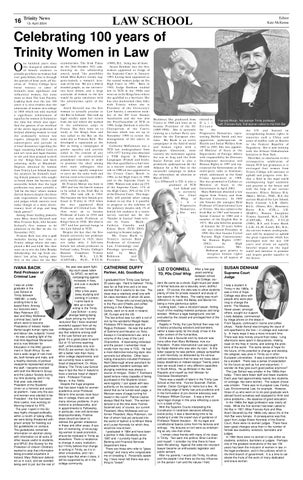
elected to Frances Moran, first woman Trinity professor D a i l Left: Frances Kyle, first woman called to the Irish Bar Eireann for the the UN and focused on Progressive Democrats, repre- strengthening human rights in senting Dublin South and was countries such a China and opposition spokesperson on areas of conflict such as Kosovo Health and Social Welfare from in the Federal Republic of 1992 to 1993. She was appoint- Yugoslavia. She is now working ed Minister of State at the with the Ethical Globalization Department of Foreign Affairs Initiative in New York. with responsibility for Overseas Therefore, in conclusion to this Development Assistance and retrospective celebration of Human Rights in 1997 and rep- female TCD law graduates, it is resented the Government at the envisaged that women from multi-party talks at Stormont, Trinity College will continue to which culminated in the Good uphold and progress even furFriday Agreement in 1998. ther a field in the legal world She was promoted to Cabinet as encompassing legal academia Minister of State to the and practice in the future and Government in April 2002. with the help of our current Mary Robinson obtained a law mentors; Hilary Delany B.A. degree from Trinity and from (Mod.), M.Litt., PhD., B.A the Harvard University. In 1969 current Head of the Law School, she became the youngest Reid Ruth Cannon L.L.B (Dub), Professor of Constitutional Law B.C.L. (Oxon), B.L., Rosemary at Trinity. She was called to the Byrne B.A. (COL.), J.D. Irish Bar in 1967 and became a (HARV.), Honora Josephine Senior Counsel in 1980 and a Yvonne Scannell, M.A., LL.M. member of the English Bar in (CANTAB), Ph.D., F.T.C.D 1973. She also held the position (1989), B.A and Ivana Bacik of Senator for 20 years before L.L.B., LL.M. (Lond), B.L, B.A., she was elected President in the current women undergradu1990. She then became United ates will be inspired to uphold Nations High Commissioner the great reputation which has for Human Rights (1997- developed over the last 100 2002). As High years and create an equally Commissioner, Mrs. forceful impact on the legal Robinson gave priority to world and continue to promote integrate human rights and inspire gender equality in concerns in all aspects of the future.
After a few gap TD, PDs Chief Whip years working between school and College, student life came as a shock. Eight hours per week of formal lectures set a leisurely, even, slothful pace. Of course, the idea was to allow students plenty of time for private research and study of law reports in the library. The reality was much different in my case; the Bailey and Bernie Inn being a more glamorous option. Looking back, I was a reluctant lawyer, finding much of the reading material pompous and longwinded. Without a legal background, one felt excluded by the closed and privileged feel of the profession. Happily in Trinity, the Law School then was not a factory producing solicitors and barristers, rather a base-camp for the study of law in the wider context of the humanities. Crime was a favourite and my lecturer was none other than Mary McAleese, now our President. Public International Law was taught by Kadar Asmal who was also my tutor. In this latter capacity he was perfect, always sympathetic and mercifully, so distracted by his various political endeavours that he was not fussy about essay deadlines or indeed essays! Twenty years later we would meet in very different capacities in South Africa. He as Minister in the new Republic and myself as Irish Minister for Overseas Development. There was a wealth of talent in the Trinity Law School at that time. Yvonne Scannell, Patrick Ussher, Ciaran Corrigan to name but a few. At the cutting edge of family law juris prudence and in the formulation of pro divorce advocacy was Professor William Duncan. It was a time of rapid legal change in this area reflecting a society in a state of flux. With the Superior Courts interpreting the Constitution in landmark decisions affecting social policy, it was a fascinating time to be studying it under the expert eye of guidance of Professor Robert Heuston. All my legal and constitutional basics come from his lectures and writings. His lectures on tort were as entertaining as any one-man show. I remain close friends with many of my class in Trinity. Two went into politics, Brian Lenihan and myself. I consider my time there to have been life-altering. Against the odds the reluctant lawyer became an enthusiastic legislator and public servant. After my parents, I would cite Trinity, its ethos and the people I met there as the key influence on the person I am and the values I hold.
SUSAN DENHAM Supreme Court Judge I was a student in Trinity in the 1960s. It was a time of hope. College was alive with people who were planning to change the world. The Maoists, flower power, amongst others, sought our support. Lively debates, commenced by mega phone on the steps in Front Square, continued in rooms and coffee shops. Kadar Asmal was bringing the issue of anti apartheid to the fore – in college and nationally. In many ways it was a more innocent time. There was less money around than today. Long afternoons were spent in discussions, making toast on the fires in rooms, and solving the problems of the world. The same sense of hope for the future, of the potential to change and develop, the zeitgeist, was alive in Trinity as in other European universities. It was a wonderful time to be a student. There was a sense of expectation for the future as well as fun and enjoyment. I wonder do they give such good parties anymore? The Law School was smaller in the 1960s than today. There were fewer staff and fewer students. Each year had approximately twenty two students, on average, two were women. The subject choice was smaller. There was no European Law, Family Law, Environmental Law, for example. However, those of us who went on to do post graduate work abroad found ourselves well equipped to think and solve problems – the essence of good education. In the 1960s the legal profession was nearly all male. While the first women had been called to the Bar in 1921 (Miss Frances Kyle and Miss Averil Deverell) by the 1960s only about 3% of the Irish Bar were female. A consequence was that, apart from Judge Eileen Kennedy of the District Court, there were no women judges. There have been great changes since then in the number of female law students, solicitors, barristers and judges. In 1904 there were no women in law, either as students, solicitors, barristers or judges. Perhaps one of the greatest revolutions of the last 100 years has been the inclusion of women in law, in the legal profession, and in the judiciary which is the third branch of government. It is a time to celebrate the fruits of the work of many dedicated and brave women.