RETHINKING THE CURRICULUM
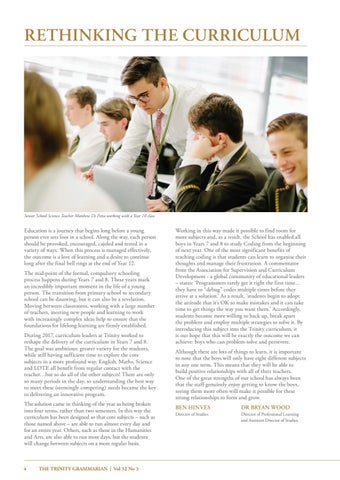
Senior School Science Teacher Matthew Di Petta working with a Year 10 class
Education is a journey that begins long before a young person ever sets foot in a school. Along the way, each person should be provoked, encouraged, cajoled and tested in a variety of ways. When this process is managed effectively, the outcome is a love of learning and a desire to continue long after the final bell rings at the end of Year 12. The mid-point of the formal, compulsory schooling process happens during Years 7 and 8. These years mark an incredibly important moment in the life of a young person. The transition from primary school to secondary school can be daunting, but it can also be a revelation. Moving between classrooms, working with a large number of teachers, meeting new people and learning to work with increasingly complex ideas help to ensure that the foundations for lifelong learning are firmly established. During 2017, curriculum leaders at Trinity worked to reshape the delivery of the curriculum in Years 7 and 8. The goal was ambitious: greater variety for the students, while still having sufficient time to explore the core subjects in a more profound way. English, Maths, Science and LOTE all benefit from regular contact with the teacher…but so do all of the other subjects! There are only so many periods in the day, so understanding the best way to meet these (seemingly competing) needs became the key to delivering an innovative program. The solution came in thinking of the year as being broken into four terms, rather than two semesters. In this way the curriculum has been designed so that core subjects – such as those named above – are able to run almost every day and for an entire year. Others, such as those in the Humanities and Arts, are also able to run most days, but the students will change between subjects on a more regular basis.
4
THE TRINITY GRAMMARIAN | Vol 32 No 3
Working in this way made it possible to find room for more subjects and, as a result, the School has enabled all boys in Years 7 and 8 to study Coding from the beginning of next year. One of the most significant benefits of teaching coding is that students can learn to organise their thoughts and manage their frustration. A commentator from the Association for Supervision and Curriculum Development - a global community of educational leaders – states: ‘Programmers rarely get it right the first time… they have to “debug” codes multiple times before they arrive at a solution.’ As a result, ‘students begin to adopt the attitude that it’s OK to make mistakes and it can take time to get things the way you want them.’ Accordingly, students become more willing to back up, break apart the problem and employ multiple strategies to solve it. By introducing this subject into the Trinity curriculum, it is our hope that this will be exactly the outcome we can achieve: boys who can problem-solve and persevere. Although there are lots of things to learn, it is important to note that the boys will only have eight different subjects in any one term. This means that they will be able to build positive relationships with all of their teachers. One of the great strengths of our school has always been that the staff genuinely enjoy getting to know the boys, seeing them more often will make it possible for these strong relationships to form and grow. BEN HINVES Director of Studies
DR BRYAN WOOD Director of Professional Learning and Assistant Director of Studies