15
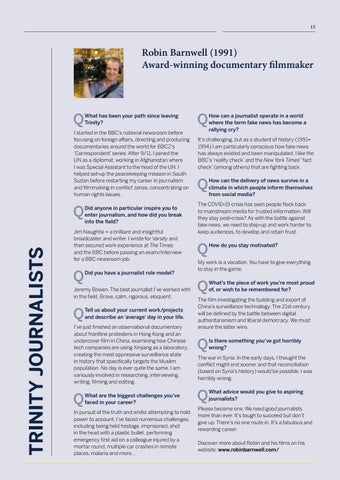
Robin Barnwell (1991) Award-winning documentary filmmaker
Q
What has been your path since leaving Trinity?
I started in the BBC’s national newsroom before focusing on foreign affairs, directing and producing documentaries around the world for BBC2’s ‘Correspondent’ series. After 9/11, I joined the UN as a diplomat, working in Afghanistan where I was Special Assistant to the head of the UN. I helped set-up the peacekeeping mission in South Sudan before restarting my career in journalism and filmmaking in conflict zones, concentrating on human rights issues.
TRINITY JOURNALISTS
Q
id anyone in particular inspire you to D enter journalism, and how did you break into the field?
Jim Naughtie – a brilliant and insightful broadcaster and writer. I wrote for Varsity and then secured work experience at The Times and the BBC before passing an exam/interview for a BBC newsroom job.
Q
Did you have a journalist role model?
Jeremy Bowen. The best journalist I’ve worked with in the field. Brave, calm, rigorous, eloquent.
Q
Tell us about your current work/projects and describe an ‘average’ day in your life.
I’ve just finished an observational documentary about frontline protesters in Hong Kong and an undercover film in China, examining how Chinese tech companies are using Xinjiang as a laboratory, creating the most oppressive surveillance state in history that specifically targets the Muslim population. No day is ever quite the same. I am variously involved in researching, interviewing, writing, filming and editing.
Q
What are the biggest challenges you’ve faced in your career?
In pursuit of the truth and whilst attempting to hold power to account, I’ve faced numerous challenges, including being held hostage, imprisoned, shot in the head with a plastic bullet, performing emergency first aid on a colleague injured by a mortar round, multiple car crashes in remote places, malaria and more…
Q
ow can a journalist operate in a world H where the term fake news has become a rallying cry?
It’s challenging, but as a student of history (1991– 1994) I am particularly conscious how fake news has always existed and been manipulated. I like the BBC’s ‘reality check’ and the New York Times’ ‘fact check’ (among others) that are fighting back.
Q
ow can the delivery of news survive in a H climate in which people inform themselves from social media?
The COVID-19 crisis has seen people flock back to mainstream media for trusted information. Will they stay post-crisis? As with the battle against fake news, we need to step-up and work harder to keep audiences, to develop and retain trust.
Q
How do you stay motivated?
My work is a vocation. You have to give everything to stay in the game.
Q
What’s the piece of work you’re most proud of, or wish to be remembered for?
The film investigating the building and export of China’s surveillance technology. The 21st century will be defined by the battle between digital authoritarianism and liberal democracy. We must ensure the latter wins.
Q
Is there something you’ve got horribly wrong?
The war in Syria. In the early days, I thought the conflict might end sooner and that reconciliation (based on Syria’s history) would be possible. I was horribly wrong.
Q
What advice would you give to aspiring journalists?
Please become one. We need good journalists more than ever. It’s tough to succeed but don’t give up. There’s no one route in. It’s a fabulous and rewarding career. Discover more about Robin and his films on his website: www.robinbarnwell.com/