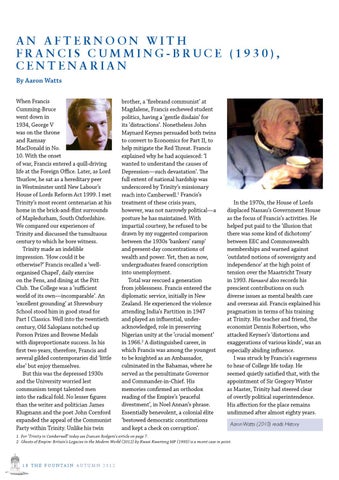
AN AFTERNOON WITH F R A NC I S CU M M I N G - B R UC E ( 1 9 3 0 ) , CENTENARIAN By Aaron Watts When Francis Cumming-Bruce went down in 1934, George V was on the throne and Ramsay MacDonald in No. 10. With the onset of war, Francis entered a quill-driving life at the Foreign Office. Later, as Lord Thurlow, he sat as a hereditary peer in Westminster until New Labour’s House of Lords Reform Act 1999. I met Trinity’s most recent centenarian at his home in the brick-and-flint surrounds of Mapledurham, South Oxfordshire. We compared our experiences of Trinity and discussed the tumultuous century to which he bore witness. Trinity made an indelible impression. ‘How could it be otherwise?’ Francis recalled a ‘wellorganised Chapel’, daily exercise on the Fens, and dining at the Pitt Club. The College was a ‘sufficient world of its own—incomparable’. An ‘excellent grounding’ at Shrewsbury School stood him in good stead for Part I Classics. Well into the twentieth century, Old Salopians notched up Porson Prizes and Browne Medals with disproportionate success. In his first two years, therefore, Francis and several gilded contemporaries did ‘little else’ but enjoy themselves. But this was the depressed 1930s and the University worried lest communism tempt talented men into the radical fold. No lesser figures than the writer and politician James Klugmann and the poet John Cornford expanded the appeal of the Communist Party within Trinity. Unlike his twin
brother, a ‘firebrand communist’ at Magdalene, Francis eschewed student politics, having a ‘gentle disdain’ for its ‘distractions’. Nonetheless John Maynard Keynes persuaded both twins to convert to Economics for Part II, to help mitigate the Red Threat. Francis explained why he had acquiesced: ‘I wanted to understand the causes of Depression—such devastation’. The full extent of national hardship was underscored by Trinity’s missionary reach into Camberwell.1 Francis’s treatment of these crisis years, however, was not narrowly political—a posture he has maintained. With impartial courtesy, he refused to be drawn by my suggested comparison between the 1930s ‘bankers’ ramp’ and present-day concentrations of wealth and power. Yet, then as now, undergraduates feared conscription into unemployment. Total war rescued a generation from joblessness. Francis entered the diplomatic service, initially in New Zealand. He experienced the violence attending India’s Partition in 1947 and played an influential, underacknowledged, role in preserving Nigerian unity at the ‘crucial moment’ in 1966.2 A distinguished career, in which Francis was among the youngest to be knighted as an Ambassador, culminated in the Bahamas, where he served as the penultimate Governor and Commander-in-Chief. His memories confirmed an orthodox reading of the Empire’s ‘peaceful divestment’, in Noel Annan’s phrase. Essentially benevolent, a colonial élite ‘bestowed democratic constitutions and kept a check on corruption’.
In the 1970s, the House of Lords displaced Nassau’s Government House as the focus of Francis’s activities. He helped put paid to the ‘illusion that there was some kind of dichotomy’ between EEC and Commonwealth memberships and warned against ‘outdated notions of sovereignty and independence’ at the high point of tension over the Maastricht Treaty in 1993. Hansard also records his prescient contributions on such diverse issues as mental health care and overseas aid. Francis explained his pragmatism in terms of his training at Trinity. His teacher and friend, the economist Dennis Robertson, who attacked Keynes’s ‘distortions and exaggerations of various kinds’, was an especially abiding influence. I was struck by Francis’s eagerness to hear of College life today. He seemed quietly satisfied that, with the appointment of Sir Gregory Winter as Master, Trinity had steered clear of overtly political superintendence. His affection for the place remains undimmed after almost eighty years. Aaron Watts (2010) reads History
1 For ‘Trinity in Camberwell’ today see Duncan Rodgers’s article on page 7. 2 Ghosts of Empire: Britain’s Legacies in the Modern World (2012) by Kwasi Kwarteng MP (1993) is a recent case in point.
1 8 T h e F o u n ta i n A u t u m n 2 0 1 2