4
TRINITONIAN.COM • APRIL 12, 2019 •
NEWS
New dining options find success on campus
Staff and students reflect on Starbucks and the new meal swipe exchange policy KAYLIE KING | NEWS REPORTER kking1@trinity.edu With the addition of several new dining options on campus last semester, some dining services staff were unsure of how these new options would affect business at dining options that have been open for years. Looking back on the last school year, however, all of the dining options on campus have done very well. “We’re pleased to see that with the increased options, all locations have benefited,” said Paul Wright, director of business operations for Tiger Card. “We were curious about the presence of particularly Chick-fil-A and Panda Express, what impact that would have on Einstein’s, Taco Taco and Freshii. It’s pleasing to see that their sales went up a little bit, as did the number of transactions. Intuitively, that just indicates to us that the changes that were implemented have hopefully worked well because of more options. That was the intent going in.” This school year, students also had the new option of using the board exchange, which allows them to use meal swipes at all dining locations. “The board exchange was implemented to give students an option for their meal plan,” Wright said. “It’s worked out really well. The intention was to give students more options to use their meal plan than they had before. We wanted to give students more options for dining plus more options to use their resources. You don’t want to see a lot left on the table, so that was the intent, to give you more options and the ability to use it differently than they had in the past.” Wright has noticed that Mabee Dining Hall has been less busy at lunch time since the
addition of options such as Chick-fil-A and Panda Express. “Mabee is not as busy as it was before, and I think a lot of that has to do with the board exchange,” Wright said. “For lunch — since most students are up on upper campus — they found it was a little challenging to get to Mabee and back, so with the expanded options at Revolve and also the board exchange have made a huge difference for upper campus dining during lunch.” New dining options within Mabee — Batch 101, the Daily Grind and the Root vegetarian station — have also been doing well. “I have spoken with quite a few students that are all really surprised how much better everything has been compared to when they first came to Trinity, and it has a lot to do with the better concepts, changes in food procurement and our amazing team,” wrote Charles Robles, food service director, in an email interview. “Batch 101 is easily our most popular option; its changing concepts have been well received and utilized the most. It’s been a very exciting year and stressful with construction and trying new concepts here at Trinity. We are constantly learning on how to make the program better, and we are already thinking of new ideas for next year.” Some students have found that the new dining options are especially convenient because of their location. “I’ve mostly just been going to Starbucks and Revolve,” said Jocelyn Suarez, junior. “I usually drink tea, so before Starbucks I just had my own stuff. When it comes to what the new stuff has brought, for me it’s been really helpful because
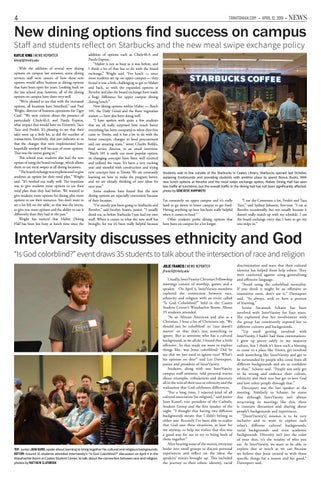
Students wait in line outside of the Starbucks in Coates Library. Starbucks opened last October, replacing EcoGrounds and providing students with another place to spend Bonus Bucks. With new lunch options at Revolve and the meal swipe exchange option, Mabee Dining Hall has seen less traffic at lunchtime, but the overall traffic in the dining hall has not been significantly affected. photo by GENEVIEVE HUMPHREYS
I’m constantly on upper campus and it’s really hard to go down to lower campus to get food. Having anything up here has been really helpful when it comes to food.” Other students prefer dining options that have been on campus for a lot longer.
“I use the Commons a lot, Freshii and Taco Taco,” said Sydney Johnson, first-year. “I eat at Revolve occasionally, but not usually because it doesn’t really match up with my schedule. I use the board exchange every day, I have to get my one swipe in.”
InterVarsity discusses ethnicity and God
“Is God colorblind?” event draws 35 students to talk about the intersection of race and religion JOLIE FRANCIS | NEWS REPORTER jfranci1@trinity.edu
TOP: Junior JUAN KAMEL spoke about learning to bring together his cultural and religious backgrounds. BOTTOM: Around 35 students attended InterVarsity’s “Is God Colorblind?” discussion on April 4 in the Waxahachie Room in Coates Student Center, to talk about the connection between race and religion. photos by MATTHEW CLAYBROOK
Usually, InterVarsity Christian Fellowship meetings consist of worship, games and a speaker. On April 4, InterVarsity members explored the connection between race, ethnicity and religion with an event called “Is God Colorblind?” held in the Coates Student Center’s Waxahachie Room. About 35 students attended. “As an African American and also as a Christian, I hear a lot of Christians say, ‘We should just be colorblind’ or ‘race doesn’t matter’ or that that’s just something to ignore. But as someone who has a cultural background, as we all do, I found that a little offensive. So that made me want to explore things like, was Jesus colorblind? Did he say that we just need to ignore race? What’s his opinion on this?” said Lee Davenport, junior and president of InterVarsity. Students, along with one InterVarsity campus staff minister, told personal stories about triumphs, tribulations and discovery all in the vein of their race or ethnicity and the realization that God celebrates differences. “For a long time, I rejected kind of all cultural association [in religion],” said junior Juan Kamel, vice president of the Catholic Student Group and the first speaker of the night. “I thought that having two different backgrounds meant that I didn’t belong to either one. Recently I’ve been able to realize that God uses these situations, at least for me anyway, to help me realize that this was a good way for me to try to bring both of them together.” After hearing some of the stories, everyone broke into small groups to discuss personal experiences and reflect on the ideas the speakers’ stories brought up. This included the journey to their ethnic identity, racial
discrimination and ways that their cultural identity has helped them help others. They were cautioned against using generalizing and offensive language. “Avoid using the colorblind mentality. If you think it might be an offensive or insensitive term, don’t use it,” Davenport said. “As always, seek to have a posture of learning.” Senior Savannah Schatte has been involved with InterVarsity for four years. She explained that her involvement with the group has consistently exposed her to different cultures and backgrounds. “Up until getting involved with InterVarsity, I hadn’t had these conversations. I grew up pretty safely in my majority culture, but I think it’s been such a blessing to come to a place like Trinity, get involved with something like InterVarsity and get to be surrounded by people who come from all different backgrounds and are so confident in that,” Schatte said. “People not only get to be strong and embrace their culture, ethnicity and their race but get to love God and love other people through that.” Davenport was the last speaker at the meeting. Similarly to Schatte, he states that although InterVarsity isn’t always structuring its meetings like this, there is constant discussion and sharing about people’s backgrounds and experiences. “[InterVarsity’s] mission is to be very inclusive and to want to explore each other’s different cultural backgrounds, racial backgrounds and even academic backgrounds. Diversity isn’t just the color of your skin, it’s the totality of who you are. At InterVarsity, we want to be able to explore that as much as we can because we believe that Jesus created us with those specific things for a reason and for good,” Davenport said.