PROFILE Images - Courtesy of the artist. Writer - Sulaf Derawy Zakharia, writer.
Ghada Khunji: FaRIDA An alter ego A woman stares out of a photomontage that is an
the lens on herself, she was producing work that was
unabashed recreation of a Frida Kahlo self-portrait.
uncharacteristically introspective.
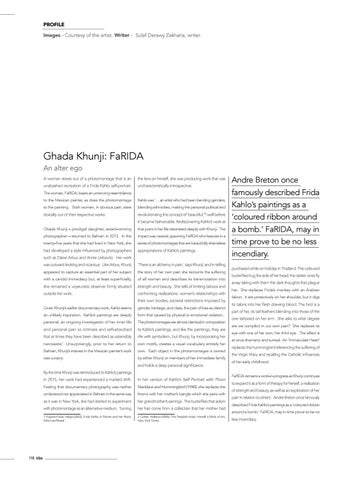
The woman, FaRIDA, bears an unnerving resemblance to the Mexican painter, as does the photomontage
Kahlo was ‘… an artist who had been bending genders,
to the painting. Both women, in obvious pain, stare
blending ethnicities, making the personal political and
stoically out of their respective works.
revolutionizing the concept of ‘beautiful,’’2 well before it became fashionable. Rediscovering Kahlo’s work at
Ghada Khunji – prodigal daughter, award-winning
that point in her life resonated deeply with Khunji. The
photographer – returned to Bahrain in 2013. In the
impact was visceral, spawning FaRIDA who features in a
twenty-five years that she had lived in New York, she
series of photomontages that are beautifully shameless
had developed a style influenced by photographers
appropriations of Kahlo’s paintings.
such as Diane Arbus and Annie Leibovitz. Her work was outward looking and vicarious. Like Arbus, Khunji
‘There is an alchemy in pain,’ says Khunji, and in telling
appeared to capture an essential part of her subject
the story of her own pain she recounts the suffering
with a candid immediacy but, at least superficially,
of all women and describes its transmutation into
she remained a voyeuristic observer firmly situated
strength and beauty. She tells of limiting taboos and
outside her work.
confronting realizations: women’s relationships with their own bodies, societal restrictions imposed by
Given Khunji’s earlier documentary work, Kahlo seems
gender, heritage, and class, the pain of loss as distinct
an unlikely inspiration. Kahlo’s paintings are deeply
from that caused by physical or emotional violation.
personal, an ongoing investigation of her inner life
The photomontages are almost identical in composition
and personal pain so intimate and self-absorbed
to Kahlo’s paintings, and like the paintings, they are
that at times they have been described as ostensibly
rife with symbolism, but Khunji, by incorporating her
narcissistic1. Unsurprisingly, prior to her return to
own motifs, creates a visual vocabulary entirely her
Bahrain, Khunji’s interest in the Mexican painter’s work
own. Each object in the photomontages is owned
was cursory.
by either Khunji or members of her immediate family and holds a deep personal significance.
By the time Khunji was reintroduced to Kahlo’s paintings
116 tribe
in 2015, her work had experienced a marked shift.
In her version of Kahlo’s Self Portrait with Thorn
Feeling that documentary photography was neither
Necklace and Hummingbird (1940), she replaces the
understood nor appreciated in Bahrain in the same way
thorns with her mother’s bangle which she pairs with
as it was in New York, she had started to experiment
her grandmother’s earrings. The butterflies that adorn
with photomontage as an alternative medium. Turning
her hair come from a collection that her mother had
1 Prignitz-Poda, Helga (2003), Frida Kahlo: A Painter and Her Work, Schirmer/Mosel
2 Cotter, Holland (2008), The People’s Artist, Herself a Work of Art, New York Times
Andre Breton once famously described Frida Kahlo’s paintings as a ‘coloured ribbon around a bomb.’ FaRIDA, may in time prove to be no less incendiary. purchased while on holiday in Thailand. The coloured butterflies hug the side of her head; the darker ones fly away taking with them the dark thoughts that plague her. She replaces Frida’s monkey with an Arabian falcon. It sits protectively on her shoulder, but it digs its talons into her flesh drawing blood. The bird is a part of her, its tail feathers blending into those of the one tattooed on her arm. She asks to what degree are we complicit in our own pain? She replaces its eye with one of her own, her third eye. The effect is at once shamanic and surreal. An ‘Immaculate Heart’ replaces the hummingbird referencing the suffering of the Virgin Mary and recalling the Catholic influences of her early childhood. FaRIDA remains a work-in-progress as Khunji continues to expand it as a form of therapy for herself, a realization of strength and beauty, as well as an exploration of her pain in relation to others’. Andre Breton once famously described Frida Kahlo’s paintings as a ‘coloured ribbon around a bomb.’ FaRIDA, may in time prove to be no less incendiary.