KIDS
28
JULY/AUGUST 2012 THE TRIBECA TRIB
Life in New York’s First Colony
It’s elementary at P.S. 89…
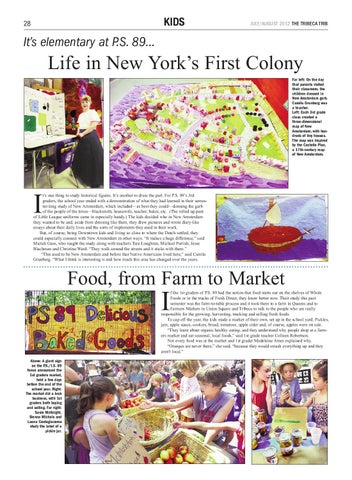
Far left: On the day that parents visited their classroom, the children dressed in New Amsterdam garb. Camila Grunberg was a teacher. Left: Each 3rd grade class created a three-dimensional map of New Amsterdam, with hundreds of tiny houses. The map was inspired by the Castello Plan, a 17th-century map of New Amsterdam.
I
t’s one thing to study historical figures. It’s another to dress the part. For P.S. 89’s 3rd graders, the school year ended with a demonstration of what they had learned in their semester-long study of New Amsterdam, which included—as best they could—donning the garb of the people of the times—blacksmith, housewife, teacher, baker, etc. (The rolled up pant of Little League uniforms came in especially handy.) The kids decided who in New Amsterdam they wanted to be and, aside from dressing like them, they drew pictures and wrote diary-like essays about their daily lives and the sorts of implements they used in their work. But, of course, being Downtown kids and living so close to where the Dutch settled, they could especially connect with New Amsterdam in other ways. “It makes a huge difference,” said Mariah Guss, who taught the study along with teachers Tara Loughran, Michael Parrish, Jesse Blachman and Christina Ward. “They walk around the streets and it sticks with them.” “This used to be New Amsterdam and before that Native Americans lived here,” said Camila Grunberg. “What I think is interesting is and how much this area has changed over the years.
Food, from Farm to Market
I
f the 1st graders of P.S. 89 had the notion that food starts out on the shelves of Whole Foods or in the trucks of Fresh Direct, they know better now. Their study this past semester was the farm-to-table process and it took them to a farm in Queens and to Farmers Markets in Union Square and Tribeca to talk to the people who are really responsible for the growing, harvesting, trucking and selling fresh foods. To cap off the year, the kids made a market of their own, set up in the school yard. Pickles, jam, apple sauce, cookies, bread, tomatoes, apple cider and, of course, apples were on sale. “They learn about organic healthy eating, and they understand why people shop at a farmers market and eat seasonal, local foods,” said 1st grade teacher Colleen Robertson. Not every food was at the market and 1st grader Madeleine Ames explained why. “Oranges are never there,” she said, “because they would smash everything up and they aren't local."
Above: A giant sign on the P.S./I.S. 89 fence announced the 1st graders market, held a few days before the end of the school year. Right: The market did a brsk business, with 1st graders both buying and selling. Far right: Susie McKnight, Sienna Michals and Laena Contegiacomo study the label of a pickle jar.