BUSINESS AND PUBLIC SERVICES
persons enrolled in such courses. Accreditation applies to any person, institution or organisation offering training or educational services. Accreditation adds value to the education sector in a various ways. For training providers, they gain assurance that their courses are regarded as of high quality and will therefore be widely accepted. For learners, studying at an accredited institution means that their qualifications will be recognized for employment and study purposes. With a quality assured qualification, learners are also able to move more freely between accredited institutions and have their previous learning recognised or cross-credited. The NQA also assists prospective learners to verify the accreditation status of institutions in Namibia and anywhere else in the world, thereby ensuring that they do not fall victim to bogus institutions.
EVALUATION OF QUALIFICATIONS
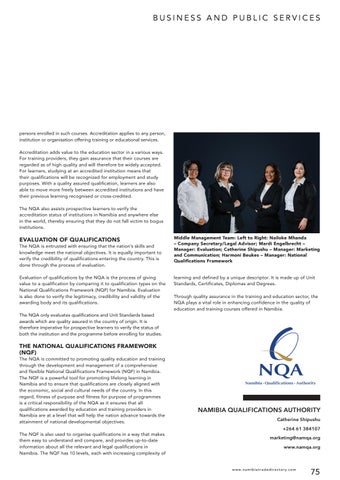
Middle Management Team: Left to Right: Nailoke Mhanda – Company Secretary/Legal Advisor; Mardi Engelbrecht – Manager: Evaluation; Catherine Shipushu – Manager: Marketing and Communication; Harmoni Beukes – Manager: National Qualifications Framework
Evaluation of qualifications by the NQA is the process of giving value to a qualification by comparing it to qualification types on the National Qualifications Framework (NQF) for Namibia. Evaluation is also done to verify the legitimacy, credibility and validity of the awarding body and its qualifications.
learning and defined by a unique descriptor. It is made up of Unit Standards, Certificates, Diplomas and Degrees.
The NQA is entrusted with ensuring that the nation’s skills and knowledge meet the national objectives. It is equally important to verify the credibility of qualifications entering the country. This is done through the process of evaluation.
The NQA only evaluates qualifications and Unit Standards based awards which are quality assured in the country of origin. It is therefore imperative for prospective learners to verify the status of both the institution and the programme before enrolling for studies.
Through quality assurance in the training and education sector, the NQA plays a vital role in enhancing confidence in the quality of education and training courses offered in Namibia.
THE NATIONAL QUALIFICATIONS FRAMEWORK (NQF)
The NQA is committed to promoting quality education and training through the development and management of a comprehensive and flexible National Qualifications Framework (NQF) in Namibia. The NQF is a powerful tool for promoting lifelong learning in Namibia and to ensure that qualifications are closely aligned with the economic, social and cultural needs of the country. In this regard, fitness of purpose and fitness for purpose of programmes is a critical responsibility of the NQA as it ensures that all qualifications awarded by education and training providers in Namibia are at a level that will help the nation advance towards the attainment of national developmental objectives. The NQF is also used to organise qualifications in a way that makes them easy to understand and compare, and provides up-to-date information about all the relevant and legal qualifications in Namibia. The NQF has 10 levels, each with increasing complexity of
NAMIBIA QUALIFICATIONS AUTHORITY Catherine Shipushu +264 61 384107 marketing@namqa.org www.namqa.org
w w w. n a m i b i a t r a d e d i r e c t o r y. c o m
75