TRANSPARENCY IN CORPORATE REPORTING: ASSESSING EMERGING MARKET MULTINATIONALS
Transparency International is the global civil society organisation leading the fight against corruption. Through more than 90 chapters worldwide and an international secretariat in Berlin, we raise awareness of the damaging effects of corruption and work with partners in government, business and civil society to develop and implement effective measures to tackle it.
www.transparency.org ISBN: 978-3-943497-39-7 ©2013 Transparency International. All rights reserved. Printed on 100% recycled paper. Authors: Barbara Kowalczyk-Hoyer, Susan Côté-Freeman Research assistants: Liliya D. Akhmadullina, Tim Bergman, Ting-Fung Chan, Kristine Suet Tuen Kwok, Juliana Mari Sakai Design: www.soapbox.co.uk © Cover photo: istockphoto.com/Nikada Every effort has been made to verify the accuracy of the information contained in this report. All information was believed to be correct as of August 2013. Nevertheless, Transparency International cannot accept responsibility for the consequences of its use for other purposes or in other contexts. We would like to thank all the individuals who contributed to all stages of the research and preparation of the report. Support was provided by Deutsche Gesellschaft für Internationale Zusammenarbeit (GIZ) GmbH.
CONTENTS 1. EXECUTIVE SUMMARY
4
2. INTRODUCTION
7
3. RATIONALE AND METHODOLOGY
9
4. REPORTING ON ANTI-CORRUPTION PROGRAMMES
12
COMPANY RESULTS
15
OWNERSHIP STRUCTURE
17
5. ORGANISATIONAL TRANSPARENCY
18
COMPANY RESULTS
20
OWNERSHIP STRUCTURE
22
6. COUNTRY-BY-COUNTRY REPORTING
24
COMPANY RESULTS
26
OWNERSHIP STRUCTURE
29
KEY FINANCIAL REPORTING ON DOMESTIC OPERATIONS
29
7. BRICS: SPECIAL SECTION
32
INDEX: BRICS RESULTS
34
REPORTING ON ANTI-CORRUPTION PROGRAMMES
35
ORGANISATIONAL TRANSPARENCY
36
COUNTRY-BY-COUNTRY REPORTING
37
8. RECOMMENDATIONS
38
9. ANNEXES
43
ANNEX 1: METHODOLOGY
43
ANNEX 2: QUESTIONNAIRE
46
ANNEX 3: DATA TABLES
48
LIST OF TABLES, DIAGRAMS AND BOXES
51
ENDNOTES 52
TRANSPARENCY IN CORPORATE REPORTING Diagram 1 Index results Scale 0–10 where 0 is least transparent and 10 is most transparent. This index is based on the unweighted average of results in all three categories. ACP result for reporting on anti-corruption programmes OT
result for organisational transparency
CBC result for country-by-country reporting
AVERAGE:
3.6/10 3 in 4 companies scored less than 5
Note: companies covered in this report may provide support to Transparency International chapters worldwide.
ACP
OT
CBC
Tata Communications
7.1
92%
88%
34%
Tata Global Beverages
6.6
92%
75%
31%
Tata Steel
6.6
92%
75%
30%
Bharti Airtel
6.4
85%
75%
34%
Petronas
6.3
88%
100% 1%
United Company Rusal
6.2
69%
100% 17%
Tata Chemicals
6.2
81%
75%
30%
Mahindra & Mahindra
6.1
73%
81%
30%
Tata Motors
6.0
77%
75%
29%
Tata Consultancy Services
5.9
85%
75%
17%
Saudi Basic Industries
5.8
85%
88%
2%
América Móvil
5.7
73%
81%
16%
Reliance Industries
5.7
65%
75%
30%
Wipro
5.7
77%
63%
30%
PTT
5.6
85%
75%
9%
Tenaris
5.5
77%
88%
0%
Falabella
5.4
38%
75%
50%
Sasol
5.4
88%
75%
0%
Lenovo Group
5.4
73%
88%
0%
Bumi Resources
5.3
85%
75%
0%
Lupin Limited
5.2
42%
75%
38%
Norilsk Nickel
5.2
50%
75%
30%
Sappi
5.1
85%
63%
6%
Femsa
5.0
69%
63%
19%
Dr. Reddy's Laboratories
5.0
50%
75%
25%
Vedanta Resources
4.9
92%
44%
10%
Bidvest Group
4.9
65%
75%
6%
Sabanci Holding
4.9
77%
69%
0%
Infosys Technologies
4.8
77%
38%
30%
Marcopolo
4.8
50%
75%
18%
Suzlon Energy
4.7
54%
56%
32%
Gazprom
4.7
65%
75%
0%
Hindalco Industries
4.7
35%
75%
30%
Petrobras
4.6
88%
50%
0%
ACP
OT
CBC
ACP
OT
CBC
LAN Airlines
4.6
65%
56%
16%
Haier
2.8
35%
50%
0%
DP World
4.6
62%
75%
1%
Yanzhou Coal Mining Company
2.8
19%
63%
3%
Gedeon Richter
4.6
38%
94%
5%
Etisalat
2.8
0%
75%
9%
Gerdau
4.6
58%
75%
4%
Camargo Corrêa Group
2.8
58%
25%
1%
Johnson Electric
4.5
35%
100% 1%
Thai Union Frozen Products
2.8
8%
75%
0%
Evraz Group
4.5
69%
44%
21%
Sinosteel
2.7
54%
25%
3%
Brasil Foods
4.4
77%
56%
0%
Alfa
2.7
50%
31%
0%
Embraer
4.4
54%
75%
3%
WEG
2.4
46%
25%
0%
Indorama Ventures
4.3
50%
75%
3%
Cosco Group
2.3
50%
19%
0.5%
Larsen & Toubro
4.2
19%
81%
26%
Lukoil
2.2
54%
13%
0%
Koç Holding
4.2
50%
75%
1%
Huawei Technologies
2.2
62%
0%
4%
Natura
4.2
50%
75%
0%
Baosteel Group
2.0
46%
13%
1%
Crompton Greaves
4.1
23%
75%
26%
China State Construction Engineering Corporation 1.9
50%
6%
1%
Bharat Forge
4.1
15%
75%
33%
Sinochem
1.9
31%
25%
0%
Gruma
4.1
27%
88%
8%
LDK Solar
1.9
12%
38%
7%
Zoomlion
3.9
42%
75%
0%
Sinomach
1.8
35%
19%
0%
Shanghai Electric Group
3.8
15%
100% 0%
Wanxiang Group
1.4
42%
0%
0%
Votorantim Group
3.8
88%
25%
0%
China International Marine Containers Group
1.3
8%
31%
0%
Indofood Sukses Makmur
3.7
19%
75%
18%
Coteminas
1.3
8%
31%
0%
ZTE
3.5
31%
75%
0%
Anshan Iron and Steel Group
1.3
38%
0%
0%
Grupo Bimbo
3.5
58%
44%
3%
Aluminium Corporation of China
1.3
19%
19%
0%
Mexichem
3.4
50%
38%
16%
Chint Group
1.0
31%
0%
0%
Emirates Airlines
3.4
0%
100% 2%
China Minmetals
0.8
15%
6%
2%
Magnesita Refratários
3.4
62%
38%
3%
China National Offshore Oil Corporation
0.8
23%
0%
0%
BYD Company Limited
3.4
19%
75%
7%
China Shipping Group
0.7
15%
6%
0%
Sinohydro
3.4
38%
63%
0%
Geely - Zhejiang Geely Holding Group
0.7
19%
0%
1%
Bajaj Auto
3.3
31%
38%
30%
China National Chemical Corporation
0.5
8%
6%
0%
El Sewedy Electric
3.1
0%
81%
13%
Galanz Group
0.4
12%
0%
0%
Suntech Power
3.1
42%
44%
7%
Fung Group
0.2
0%
6%
0%
Severstal
3.0
15%
75%
1%
Odebrecht Group
0.2
0%
0%
6%
JBS
3.0
58%
31%
0%
China Shipbuilding Industry Corporation
0.1
4%
0%
0%
China Communications Construction Company
2.9
12%
75%
2%
Chery Automobile
0.0
0%
0%
0%
Charoen Pokphand Group
2.9
0%
88%
0%
Mabe
0.0
0%
0%
0%
1. EXECUTIVE SUMMARY Transparency International conducted research into the public reporting practices of 100 emerging markets companies comprising a list of Global Challengers 2011.1 Based on the methodology of previous Transparency International studies, researchers collected and analysed publicly available data on three dimensions of transparency: • Reporting on anti-corruption programmes: covering inter alia bribery, facilitation payments, whistleblower protection and political contributions. • Organisational transparency: including information about corporate holdings. • Country-by-country reporting: including revenues, capital expenditure and tax payments. These three elements were assessed because of their importance in raising the level of corporate transparency and accountability which in turn helps minimise the risk of corruption. The information a company reports about its anti-corruption systems is an indicator of its awareness and commitment to combatting corruption. While robust disclosure practices do not reduce all risk of corruption, they are a sign of the right tone from top management, reflecting an awareness of corruption risks and a commitment to manage them effectively that is essential for companies operating across borders. Reporting on information related to company holdings, such as subsidiaries, branches, affiliates, joint ventures and the like is relevant in the context of combatting corruption because it lets citizens, civil society, regulators, lawmakers and investors know where a company is operating, and it makes the company more accountable in those countries. Country-by-country reporting provides the transparency needed for companies to be held accountable for their activity in a particular country. Disclosing key financial data enables citizens to evaluate whether the company is contributing in a manner appropriate to its level of activity and, as such, to identify potential cases of corruption. Despite some encouraging results the report finds that the disclosure practices of emerging market companies are inadequate. The observed levels of transparency fall short of the standards expected of large companies aspiring to become global players. Based on the data analysis, the average company score is 36 per cent (3.6 out of a maximum of 10 points in the overall index). Only one in four of the 100 companies achieved an overall score of at least 50 per cent. This result reflects a lack of recognition of the importance of transparency as a building block of good governance, including the management of corruption risks. These emerging market companies also lag behind in their acceptance of the responsibility that falls upon multinational companies to fulfil the transparency expectations of stakeholders. However, the fact that some companies perform well in certain aspects of the survey indicates that improvement is possible and dispels the argument often put forward by companies that disclosure puts them at a competitive disadvantage. The report dedicates a section to the performance of companies from the BRICS.2 This is of interest in view of their importance within emerging markets and in the world economy as a whole. Results show that companies from China lag behind in every dimension with an overall score of 20 per cent (2 out of a maximum of 10). Considering their growing
4
Transparency International
influence in markets around the world, this poor performance is of concern. In contrast, Indian firms perform best in the BRICS with a result of 54 per cent (5.4 out of a maximum of 10) and several occupy the top positions in the overall Index. In the third (country-by-country reporting) dimension of the study, an area of disclosure that has proven to be a challenge for most companies, Indian firms stand out against the weaker performances of the other BRICS firms with a score of 29 per cent. Publicly listed companies, whose shares are traded on stock exchanges, perform considerably better than unlisted companies which include privately held and state-owned companies. For example, the publicly listed firms score 53 per cent on reporting on anti-corruption programmes – whereas the state-owned and private companies score 30 per cent and 27 per cent respectively. Stock market listing requirements definitely have a positive impact on a company’s level of disclosure. This was also observed in a previous Transparency International study on the extractive sector where listed companies performed better than stateowned companies.3 Companies included in this report operate in a range of different industries. The biggest sub-sample is Basic Materials, comprised of 28 companies, followed by Industrials with 23 and Consumer Goods with 20 companies. The rest of the sample is distributed among six other industries (See Annex 1 for the details of the sample).
REPORTING ON ANTI-CORRUPTION PROGRAMMES With an average score of 46 per cent, company performance in this dimension varies widely. Whilst some companies achieve a near-perfect score, others, half of which are privately held, do not register a single point. Although public reporting on anti-corruption programmes is only a proxy for actual company performance in this area, weak levels of reporting may indicate poor or non-existent anti-corruption programmes and a lack of commitment to countering corruption. But there is ground for optimism. Fifteen companies achieve a score above 80 per cent which demonstrates that strong performance is possible and that substantial improvement over the next few years is an attainable target.
ORGANISATIONAL TRANSPARENCY The average result achieved in this dimension is 54 per cent. Approximately 10 per cent of the sample scores zero.4 A majority of companies provide information on their subsidiaries, but in spite of these results the concept of “materiality” – a threshold for disclosure which is defined by accounting standards, regulators and stock exchange rules – limits detailed disclosure by many companies. Very few companies disclose the countries of operations of their subsidiaries and other related entities, which means that these remain hidden from public view and scrutiny.
COUNTRY-BY-COUNTRY REPORTING Emerging market companies in the sample achieve an encouraging result in country-by-country reporting. Although it may appear low, the average score of 9 per cent registers well above the 4 per cent result of the 105 largest global companies assessed in the 2012 Transparency International report on transparency in corporate reporting.5 This result is largely due to the 20 Indian companies in the survey which score an average of 29 per cent.
Transparency in Corporate Reporting: Assessing Emerging Market Multinationals
5
In India, domestic legal requirements have led to Indian companies providing more extensive financial information on their subsidiaries. They also report on the countries in which their subsidiaries are incorporated. This information is useful and beneficial, although it is not a perfect substitute for country-by-country reporting. Information on country-level operations by the 20 Indian companies is therefore much more complete than the other companies in the sample. This demonstrates not only the transparency benefits of such legal requirements but also that companies can readily provide such information if they are so inclined or motivated. With the notable exception of the Indian companies, most emerging market companies in the sample are still a very long way from disclosing financial data across all countries of operations. Most of the companies disclose little or no financial data on a country-by-country basis, with companies from China disclosing the least.
RECOMMENDATIONS Based on these findings, Transparency International recommends that emerging market companies should, first and foremost, become more publicly accountable. An initial but critical step is for emerging market companies to recognise their responsibility to be transparent for the benefit of stakeholders, both domestic and international. The BRICS, in view of their importance among emerging markets and of their current efforts to formalise and expand the influence of their grouping, should collectively take the lead on this issue. BRICS companies should challenge firms from developed economies in all aspects of their activities including their anticorruption practices. Emerging market companies should develop and implement best practice anticorruption policies and programmes and publish comprehensive information on these programmes. They should also publish complete lists of their subsidiaries, affiliates, joint ventures and other related entities, including their stake in those entities and their locations and make public individual financial accounts for each country of operations. Governments and civil society also have a role to play in fostering greater transparency among emerging market companies. Governments can do so by strengthening the legal requirements for corporate disclosure. Civil society organisations can help shift company attitudes by focusing advocacy efforts on multinational businesses located or operating in their countries to encourage them to improve the depth and scope of their commitments to transparency, and in particular, to improve their level of anti-corruption reporting. Likewise, investors can exert additional pressure by demanding that emerging market companies report on anti-corruption programmes, organisational transparency and country-by-country reporting and factor this information into their investment decisions. An expanded list of recommendations can be found on page 38 of this report.
6
Transparency International
2. INTRODUCTION As the world continues to experience a period of rapid economic change and uncertainty, one fact is indisputable. The growing strength of emerging economies is reshaping the world order. According to some estimates, 70 per cent of world growth over the next few years will come from emerging markets, with China and India accounting for 40 per cent of that growth.6 In its latest Human Development Report, the United Nations Development Programme projects that by 2020, “the combined economic output of three leading developing countries alone – Brazil, China and India – will surpass the aggregate production of Canada, France, Germany, Italy, the United Kingdom and the United States.”7 This Transparency International study assesses the transparency of corporate reporting by 100 major emerging market companies that are seen as Global Challengers. These rapidly expanding companies, identified as rising stars of the world economy, come from 16 different countries. Corruption is a risk for all companies, whether they are based in London, Shanghai or Mexico City. In addition to the more well-recognised and devastating effects corruption has on society at large, corruption destroys corporate reputations, inhibits entrepreneurship, weakens free markets and undermines the stability vital to successful economies. For emerging market companies, as for all global multinationals, corporate transparency must be a key component of robust anti-corruption practice. Although transparency achieved through more comprehensive disclosure does not necessarily equal good performance, Transparency International believes that reporting demonstrates a company’s commitment to countering corruption and makes companies more easily accountable for shortcomings. Following the July 2012 publication of Transparency in Corporate Reporting: Assessing the World’s Largest Companies, a report which analyses the disclosure practices on a range of corruption-relevant measures among the 105 largest publicly listed multinational companies, Transparency International set out to conduct a new survey based on the same methodology that assesses large companies incorporated in emerging markets. When focusing on companies in rapidly developing economies, it is impossible to ignore the importance of the BRICS (Brazil, Russia, India, China and South Africa) with their demographic and geographic importance and dynamic economies. Furthermore, their influence on the world stage, as they become a more formalised geopolitical grouping via their annual summits and plans for common institutions, calls for a special focus on companies from these countries in this report. BRICS companies account for three-quarters of the sample in this survey. In view of the growing economic and political clout of emerging markets and the rapid advances of emerging market companies both domestically and across borders, the hope is that these Global Challengers will adhere not only to applicable legal and regulatory standards but that they will go above and beyond them to achieve the highest standards of ethics and transparency. As markets become global, company standards of behaviour and levels of transparency must become higher and more universally applied. As investors increasingly seek returns from emerging markets, it is in their interest to consider the serious risks posed by companies with inadequate anti-corruption
Transparency in Corporate Reporting: Assessing Emerging Market Multinationals
7
programmes and transparency. Transparency International has long advocated that by reporting publicly on relevant policies, procedures, activities and operations, companies not only mitigate the risk of corruption but also provide the necessary information to make them accountable to investors, journalists and civil society. The same applies to companies from emerging markets. Stakeholder demands for greater corporate transparency have led to the introduction of recent legislation mandating more detailed financial disclosure. For example, the United States 2010 Dodd-Frank Wall Street Reform and Consumer Protection Act8 requires country-level reporting of all payments to governments (US and foreign) by extractive companies registered on the US stock exchange. Similar rules were recently adopted for European companies in the oil, gas, mining and logging industries.9 A recent European proposal would compel companies to be more transparent about sustainability issues including governance and anti-corruption practices.10 These developments are relevant to emerging market companies and should influence their practice as they move into developed markets. In fact, emerging market companies have a unique opportunity to position themselves, not only as leading companies in the marketplace, but also as leading corporate citizens by adopting the most advanced anti-corruption and transparency practices. Global companies from developed markets have spent the last two decades learning, often at high cost to their bottom lines and their reputations, how to achieve improved levels of anti-corruption practice. Emerging market companies should make use of those lessons to raise their own standards and become world leaders in this area.
8
Transparency International
3. RATIONALE AND METHODOLOGY Transparency in Corporate Reporting: Assessing Emerging Market Multinationals builds on Transparency International’s existing work in combating corruption in the private sector. The methodology for this study has been used previously by Transparency International, most recently for the July 2012 report Transparency in Corporate Reporting: Assessing the World’s Largest Companies. This study assesses the transparency of corporate reporting by 100 major emerging market companies comprising the list of Global Challengers 2011, and is based on data collected or made available between 21 January and 18 March 2013. It is possible that relevant information may have been published by companies after 18 March 2013, but it could not be taken into account in this report as this was the closing date for data collection. Transparency is measured on corporate reporting of three dimensions: 1. anti-corruption programmes 2. organisational structure 3. country-by-country reporting of revenues, transfers and value sharing The principal outcomes of this report are: • The production of an overall index that ranks companies from the best to the worst performers across all three dimensions. • The production of three separate company rankings, one for each dimension. • The production of rankings for BRICS countries.
Transparency in Corporate Reporting: Assessing Emerging Market Multinationals
9
DATA COLLECTION AND ANALYSIS Multilingual researchers collected the data exclusively from information or documents publicly available on each company’s global website, including relevant links embedded in the websites. Data collection was guided by a questionnaire structured along the three dimensions of transparency of corporate reporting: • Reporting on anti-corruption programmes: the 13 questions in this section were based on the UN Global Compact – Transparency International Reporting Guidance on the 10th Principle Against Corruption.11 The guidance was derived from the Business Principles for Countering Bribery12 whose development was led by Transparency International. • Organisational transparency: the eight questions in this section focused on disclosure of the companies’ related entities, including subsidiaries, associates, joint ventures and other holdings. • Country-by-country reporting: five questions relating to country-level financial data were posed for each country in which a company stated it operated. In conducting the research, Transparency International did not investigate the veracity or completeness of the published information and did not make any judgement about the integrity of the information or practices disclosed. All data points were independently validated by a second researcher. The methodology and data were shared with each of the companies and they were given the opportunity to review their individual results. Of the 100 companies surveyed, 17 took advantage of the opportunity to review their data. This input from the companies was validated by the researchers and corrections to the scores were made if necessary. More details on methodology and the scoring system used to compile company rankings and the overall index can be found on page 43.
10
Transparency International
BOX 1: BEST PRACTICE TOP PERFORMER OVERALL WITH A SCORE OF 7.1 Tata Communications (India, Telecommunications, publicly listed) • 92% in reporting on anti-corruption programmes – discloses all information except for regular programme monitoring. • 88% in organisational transparency – discloses all information except for countries of operations for material subsidiaries. • 34% in country-by-country reporting – discloses revenues, pre-tax income and income taxes for all material subsidiaries, revenues on country-level for 13 countries out of 34.
BEST SCORES IN REPORTING ON ANTI-CORRUPTION PROGRAMMES: 92% • Tata Communications (India, Telecommunications, publicly listed) • Tata Global Beverages (India, Consumer goods, publicly listed) • Tata Steel (India, Basic materials, publicly listed) • Vedanta Resources (India, Basic materials, publicly listed)
BEST SCORES IN ORGANISATIONAL TRANSPARENCY: 100% • Emirates Airlines (UAE, Consumer services, state-owned) • Johnson Electric (China, Industrials, publicly listed) • Petronas (Malaysia, Oil and gas, state-owned) • Shanghai Electric (China, Industrials, publicly listed) • United Company Rusal (Russia, Basic materials, publicly listed)
BEST SCORES IN COUNTRY-BY-COUNTRY REPORTING: 50% • Falabella (Chile, Consumer services, publicly listed) – all information on revenues and income tax, partial information on community contributions – description of projects
BEST UNLISTED COMPANIES • Petronas (state-owned) – best overall index score: 6.3 • Votorantim Group (private) and Petronas (state-owned) – best in reporting on anti-corruption programmes: 88% • Emirates Airlines (state-owned) and Petronas (state-owned) – best in organisational transparency: 100% • Odebrecht Group (private) – best in country-by-country reporting: 6%
Transparency in Corporate Reporting: Assessing Emerging Market Multinationals
11
4. REPORTING ON ANTI-CORRUPTION PROGRAMMES
© istockphoto.com/MACIEJ NOSKOWSKI
92% HIGHEST PERFORMING TATA COMMUNICATIONS, TATA GLOBAL BEVERAGES, TATA STEEL, VEDANTA RESOURCES
46% AVERAGE
0% WORST PERFORMING CHAROEN POKPHAND GROUP, CHERY AUTOMOBILE, EL SEWEDY ELECTRIC, EMIRATES AIRLINES, ETISALAT, FUNG GROUP, MABE, ODEBRECHT GROUP
4. REPORTING ON ANTICORRUPTION PROGRAMMES For companies, the first line of defence against the risk of bribery and corruption must be a comprehensive anti-corruption programme which is fully implemented and monitored on a regular basis. The recommended elements of such a programme are described in the Business Principles for Countering Bribery,13 which were developed by Transparency International in collaboration with a multistakeholder group comprised of leading companies, business ethics experts, academics and trade union representatives. Transparency International believes that public disclosure of measures to counter corruption is key to improving corporate transparency, which in turn underpins good governance. Furthermore, the external communication of a company’s anticorruption programme confirms a company’s commitment to ethical conduct, not only in the eyes of its employees, but also in the eyes of other stakeholders including business partners, investors and citizens. In 2009, Transparency International and the UN Global Compact jointly issued Reporting Guidance on the 10th Principle Against Corruption.14 This tool derived from the Business Principles for Countering Bribery, sets clear recommendations to companies on the elements of their anti-corruption programmes that should be publicly disclosed. Since 2008, Transparency International has conducted four studies assessing disclosure practices among companies with respect to their anti-corruption programmes. These studies have highlighted significant progress on that front with many of the assessed companies having recognised the value of public reporting and the need to respond to stakeholder demands for greater transparency. As a result, they have opted to make public documents such as codes of conduct or anti-corruption policies and, in some cases, they have introduced new, more comprehensive anti-corruption policies and disclosed them to the public.
SIGNS OF PROGRESS There was a small overlap between the companies surveyed in this study and those covered in the June 2012 study Transparency in Corporate Reporting: Assessing the World’s Largest Companies. The five companies included in both reports are: América Móvil, Gazprom, Petrobras, Reliance Industries and Saudi Basic Industries. While the performance of Petrobras remained almost unchanged, the scores of the other four companies improved considerably in this study. The positive change was primarily observed in the first dimension, reporting on anticorruption programmes, and was in large part due to the publication of updated or newly disclosed documents on their websites.
14
Transparency International
BOX 2: IS REPORTING ON ANTI-CORRUPTION PROGRAMMES MEANINGFUL? Some argue that company reporting on anti-corruption programmes is a superficial indicator and that reporting and actual compliance or good behaviour are not the same thing. While recognising that reporting and compliance are not the same, there are strong arguments supporting the value of good reporting: • Public commitments make a company accountable to all its stakeholders and to the general public. • Public commitments facilitate monitoring by stakeholders and the general public. • The legal and reputational risks to which a company exposes itself by making false public statements act as a deterrent to false or exaggerated claims. • Reporting focuses the attention of the company on its practices and drives improvement. • The publication of anti-corruption policies by companies has a positive impact on employees at home and abroad because it underscores the company’s commitment and support for ethical behaviour.
COMPANY RESULTS The 100 emerging market companies evaluated in this study achieved an average result of 46 per cent in reporting on anti-corruption programmes, the first dimension in this study. This means that on average companies scored 6 out of a possible 13 points. In the 2012 Transparency International report assessing the reporting performance of the world’s 105 largest listed companies, the average score on reporting on anti-corruption programmes was 68 per cent. No company achieved the full score of 100 per cent. However, Tata Communications, Tata Global Beverages, Tata Steel and Vedanta Resources (all publicly listed companies incorporated in India) scored 92 per cent each, only a point short of a perfect score. Eight companies scored zero in this dimension: Charoen Pokphand Group, Chery Automobile, El Sewedy Electric, Emirates Airlines, Etisalat, Fung Group, Mabe and Odebrecht Group. Interestingly, 50 per cent of the worst performing companies in this dimension are privately owned, even though privately owned companies constitute only 12 per cent of the overall sample.
Transparency in Corporate Reporting: Assessing Emerging Market Multinationals
15
Diagram 2 Reporting on anti-corruption programmes Where 100% means full transparency on anti-corruption programmes
92%
Tata Communications, Tata Global Beverages, Tata Steel, Vedanta Resources
88%
Petrobras, Petronas, Sasol, Votorantim Group Bharti Airtel, Bumi Resources, PTT, Sappi, Saudi Basic Industries, Tata Consultancy Services
85% 81%
Tata Chemicals Brasil Foods, Infosys Technologies, Sabanci Holding, Tata Motors, Tenaris, Wipro
77%
América Móvil, Lenovo Group, Mahindra & Mahindra
73%
Evraz Group, Femsa, United Company Rusal
69%
Bidvest Group, Gazprom, LAN Airlines, Reliance Industries
65%
DP World, Huawei Technologies, Magnesita Refratários
62%
Camargo Corrêa Group, Gerdau, Grupo Bimbo, JBS
58%
Embraer, Lukoil, Sinosteel, Suzlon Energy Alfa, China State Construction Engineering Corporation, Cosco Group, Dr. Reddy's Laboratories, Indorama Ventures, Koç Holding, Marcopolo, Mexichem, Natura, Norilsk Nickel Baosteel Group, WEG
54% 50% 46%
Lupin Limited, Suntech Power, Wanxiang Group, Zoomlion
42%
Anshan Iron and Steel Group, Falabella, Gedeon Richter, Sinohydro
38%
Haier, Hindalco Industries, Johnson Electric, Sinomach
35%
Bajaj Auto, Chint Group, Sinochem, ZTE
31%
Gruma
27%
China National Offshore Oil Corporation, Crompton Greaves
23%
Aluminium Corporation of China, BYD, Geely – Zhejiang Geely Holding Group, Indofood Sukses Makmur, Larsen & Toubro, Yanzhou Coal Mining Company Bharat Forge, China Minmetals, China Shipping Group, Severstal, Shanghai Electric Group
19% 15%
China Communications Construction Company, Galanz Group, LDK Solar China International Marine Containers Group, China National Chemical Corporation, Coteminas, Thai Union Frozen Products China Shipbuilding Industry Corporation
12% 8%
Sample average 46%
4%
Charoen Pokphand Group, Chery Automobile, El Sewedy Electric, 0% Emirates Airlines, Etisalat, Fung Group, Mabe, Odebrecht Group 0%
20%
40%
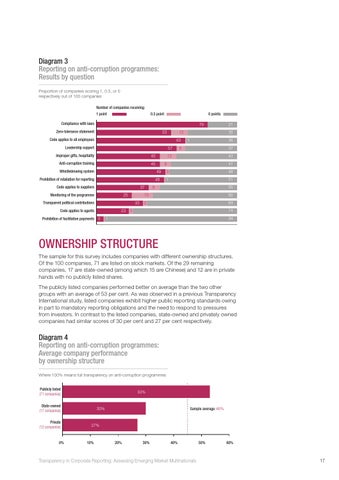
Companies scored very differently on each of the 13 questions measured in the first dimension. However, the question that achieved the highest score sought to assess whether their public documents included a commitment to complying with all relevant laws, including anti-corruption laws. Of the 100 companies surveyed, 79 published a statement to that effect. Only six companies were found to have a public statement on the prohibition of facilitation payments, the poorest result in this dimension.
16
Transparency International
60%
80%
100%
Diagram 3 Reporting on anti-corruption programmes: Results by question Proportion of companies scoring 1, 0.5, or 0 respectively out of 100 companies Number of companies receiving: 1 point
0.5 point
0 points
Compliance with laws
79
Zero-tolerance statement
12
53
Code applies to all employees
63
Leadership support
57
Improper gifts, hospitality
45
Anti-corruption training
45
Whistleblowing system
48
Code applies to suppliers
37
Monitoring of the programme
25
Transparent political contributions
33
Code applies to agents
23
Prohibition of facilitation payments 5
35 36
1
37
6
12
43
3
48
47
8 49
Prohibition of retaliation for reporting
21
51
1
55
8
15
60
3
64 74
3
94
1
OWNERSHIP STRUCTURE The sample for this survey includes companies with different ownership structures. Of the 100 companies, 71 are listed on stock markets. Of the 29 remaining companies, 17 are state-owned (among which 15 are Chinese) and 12 are in private hands with no publicly listed shares. The publicly listed companies performed better on average than the two other groups with an average of 53 per cent. As was observed in a previous Transparency International study, listed companies exhibit higher public reporting standards owing in part to mandatory reporting obligations and the need to respond to pressures from investors. In contrast to the listed companies, state-owned and privately owned companies had similar scores of 30 per cent and 27 per cent respectively.
Diagram 4 Reporting on anti-corruption programmes: Average company performance by ownership structure Where 100% means full transparency on anti-corruption programmes Publicly listed (71 companies)
53%
State-owned (17 companies) Private (12 companies)
0%
30%
Sample average 46%
27%
10%
20%
30%
40%
Transparency in Corporate Reporting: Assessing Emerging Market Multinationals
50%
60%
17
5. ORGANISATIONAL TRANSPARENCY
© istockphoto.com/Nikada
100% HIGHEST PERFORMING EMIRATES AIRLINES, JOHNSON ELECTRIC, PETRONAS, SHANGHAI ELECTRIC, UNITED COMPANY RUSAL
54% AVERAGE
0% WORST PERFORMING ANSHAN IRON & STEEL GROUP, CHERY AUTOMOBILE, CHINA NATIONAL OFFSHORE OIL CORPORATION, CHINA SHIPBUILDING INDUSTRY CORPORATION, CHINT GROUP, GALANZ GROUP, GEELY – ZHEJIANG GEELY HOLDING GROUP, HUAWEI TECHNOLOGIES, MABE, ODEBRECHT GROUP, WANXIANG GROUP
5. ORGANISATIONAL TRANSPARENCY Large international companies are often organised using complex structures. They include extensive networks of subsidiaries, affiliates, joint ventures and other holdings which may be incorporated in different jurisdictions, including secrecy jurisdictions, and whose relationships may be difficult to detect. Understanding complex company structures and other critical information such as intracompany financial flows is only possible if companies are transparent about their organisational structure. This study evaluates organisational transparency by assessing the amount of information companies disclose on their related holdings, particularly information on majority and minority holdings: names, percentages owned by the parent company, country of incorporation and countries of operations. The regulatory requirements for such disclosure are limited and differ from one country to the next. Organisational transparency is important for many reasons, not least because company structures can be made deliberately opaque for the purpose of hiding the proceeds of corruption. But on a more basic level, it is important because it allows local stakeholders to know which companies are operating in their territories, bidding for government licences or contracts, or have applied for or obtained favourable tax treatment. It also informs local stakeholders about which international networks these companies may belong to and how they are related to other companies operating in the same country. In addition, through full disclosure of corporate holdings, stakeholders can gain more complete knowledge of financial flows such as intra-company transfers and payments to governments. Organisational transparency allows citizens to hold companies accountable for the impact they have on their communities.
COMPANY RESULTS The average result for the organisational transparency dimension is 54 per cent. On average, companies scored 4.3 out of 8 possible points. This falls considerably below the average company score of 72 per cent achieved in the same category by the top 105 companies assessed in Transparency International’s 2012 report. Five companies achieved a perfect score of 100 per cent: Emirates Airlines, Johnson Electric, Petronas, Shanghai Electric and United Company Rusal. Three of these companies are publicly listed and two are state-owned. No specific industry or country pattern could be detected. Eleven companies scored zero in this dimension: Anshan Iron and Steel Group, Chery Automobile, China National Offshore Oil Corporation, China Shipbuilding Industry Corporation, Chint Group, Galanz Group, Geely – Zhejiang Geely Holding Group, Huawei Technologies, Mabe, Odebrecht Group and Wanxiang Group. Nine out of the eleven worst performers are incorporated in China, seven of which are privately owned and four state-owned.
20
Transparency International
Diagram 5 Organisational transparency Where 100% means full organisational transparency
100%
Emirates Airlines, Johnson Electric, Petronas, Shanghai Electric Group, United Company Rusal
94%
Gedeon Richter Charoen Pokphand Group, Gruma, Lenovo Group, Saudi Basic Industries, Tata Communications, Tenaris
88%
América Móvil, El Sewedy Electric, Larsen & Toubro, Mahindra & Mahindra
81%
Bharat Forge, Bharti Airtel, Bidvest Group, Bumi Resources, BYD Company Limited, China Communications Construction Company, Crompton Greaves, DP World, Dr. Reddy's Laboratories, Embraer, Etisalat, Falabella, Gazprom, Gerdau, Hindalco Industries, Indofood Sukses Makmur, Indorama Ventures, Koç Holding Lupin Limited, Marcopolo, Natura, Norilsk Nickel, PTT, Reliance Industries, Sasol, Severstal, Tata Chemicals, Tata Consultancy, Tata Global Beverages, Tata Motors, Tata Steel, Thai Union Frozen Products, Zoomlion, ZTE
75% 75%
Sabanci Holding
69%
Femsa, Sappi, Sinohydro, Wipro, Yanzhou Coal Mining Company
63%
Brasil Foods, LAN Airlines, Suzlon Energy
56%
Haier, Petrobras
50%
Evraz Group, Grupo Bimbo, Suntech Power, Vedanta Resources
44%
Bajaj Auto, Infosys Technologies, LDK Solar, Magnesita Refratários, Mexichem
38%
Alfa, China International Marine Containers Group, Coteminas, JBS
31%
Camargo Corrêa Group, Sinochem, Sinosteel, Votorantim Group, WEG
25% Sample average 54%
Aluminium Corporation of China, Cosco Group, Sinomach Baosteel Group, Lukoil China Minmetals, China National Chemical Corporation, China Shipping Group, China State Construction Engineering Corporation, Fung Group Anshan Iron and Steel Group, Chery Automobile, China National Offshore Oil Corporation, China Shipbuilding Industry Corporation, Chint Group, Galanz Group, Geely – Zhejiang Geely Holding Group, Huawei Technologies, Mabe, Odebrecht Group, Wanxiang Group 0%
Transparency in Corporate Reporting: Assessing Emerging Market Multinationals
19% 13% 6% 0% 20%
40%
60%
80%
100%
21
OWNERSHIP STRUCTURE When analysed by ownership structure, the companies achieved similar results to those in the first dimension on reporting on anti-corruption programmes, with publicly listed companies outperforming the rest of the sample. Publicly listed companies achieved an average score of 67 per cent. Johnson Electric, Shanghai Electric and United Company Rusal achieved 100 per cent. Lukoil came in last with a score of 13 per cent. Unlisted companies generally disclose the least amount of information with respect to their company structure and received low average scores: state-owned companies averaged 24 per cent and privately owned companies 15 per cent. Among the 17 state-owned companies, four received zero scores and two, Emirates Airlines and Petronas, achieved full scores, demonstrating that state ownership is not in and of itself a barrier to organisational disclosure. The rest of the sample scored between 6 per cent and 63 per cent. Among the 12 privately owned companies, seven scored zero, four remained in the below-average zone of 6 per cent to 31 per cent and only one company, Thailand’s Charoen Pokphand Group, achieved a high score of 88 per cent.
Diagram 6 Organisational transparency: Average company performance by ownership structure Where 100% means full organisational transparency
Publicly listed (71 companies)
67%
State-owned (17 companies)
24% Sample average 54%
Private (12 companies)
0%
22
15%
10%
Transparency International
20%
30%
40%
50%
60%
70%
80%
90%
100%
Š istockphoto.com/samxmeg
6. COUNTRY-BY-COUNTRY REPORTING
© istockphoto.com/tupatu76
50% HIGHEST PERFORMING FALABELLA
9% AVERAGE
0% WORST PERFORMING 38 OUT OF 100 COMPANIES
6. COUNTRY-BY-COUNTRY REPORTING This section evaluates country-by-country disclosure of international operations by the 100 emerging market companies in the sample. An industry-neutral set of criteria was used to measure the disclosure by country of financial reporting of revenues, capital expenditure, income before tax, income tax and community contributions. The importance of country-by-country reporting was first recognised and advocated in the extractive sector as a transparency practice required to help prevent the “resource curse” which has afflicted many resource rich countries in the developing world. Most prominent among relevant legislative changes is the 2010 DoddFrank Wall Street Reform and Consumer Protection Act which makes mandatory country-level reporting of all payments to governments (US and foreign) by extractive companies registered on the US stock exchange. In the European Union, legislators recently adopted similar rules for European companies in the oil, gas, mining and logging industries. However, this information is useful in preventing and detecting corruption in all industries. Key financial data give citizens the possibility to understand the activities of a particular company in their country and to monitor the appropriateness of their payments to governments.
COMPANY RESULTS In this dimension, the average score was 9 per cent. Although this score is low compared to the average results registered in the previous two dimensions (46 per cent and 54 per cent), when compared to the results for country-by-country reporting achieved by the largest 105 global companies evaluated in our 2012 study, it is more than twice as high as that group’s 4 per cent score. This encouraging result among emerging market companies can be credited in large part to the 20 Indian companies in the survey, which scored an average of 29 per cent. It should be noted that Indian law requires companies to provide key financial information on their subsidiaries.15 Without this strong Indian performance, the average result of the sample would have been similar to that of the weak score of the 105 largest global companies. The best performing company was Falabella, a Chilean retailer, which achieved a 50 per cent score. On the other side of the ledger, 38 companies, or more than onethird of the sample, scored zero.
26
Transparency International
Diagram 7 Country-by-country reporting Where 100% means a company is fully transparent in all its countries of operation
50%
Falabella
38%
Lupin Limited
34%
Bharti Airtel, Tata Communications
33%
Bharat Forge
32%
Suzlon Energy
31%
Tata Global Beverages Bajaj Auto, Hindalco Industries, Infosys Technologies, Mahindra & Mahindra, Norilsk Nickel, Reliance Industries, Tata Chemicals, Tata Steel, Wipro
30% 29%
Tata Motors Crompton Greaves, Larsen & Toubro
26%
Dr. Reddy's Laboratories
25%
Evraz Group
21%
Femsa
19%
Indofood Sukses Makmur, Marcopolo
18%
Tata Consultancy Services, United Company Rusal
17%
América Móvil, LAN Airlines, Mexichem
16%
El Sewedy Electric
13%
Vedanta Resources
10%
Etisalat, PTT
9%
Gruma
8%
BYD Company Limited, LDK Solar, Suntech Power Bidvest Group, Odebrecht Group, Sappi Gedeon Richter Gerdau, Huawei Technologies Embraer, Grupo Bimbo, Indorama Ventures, Magnesita Refratários, Sinosteel, Yanzhou Coal Mining Company China Communications Construction Company, China Minmetals, Emirates Airlines, Saudi Basic Industries Baosteel Group, Camargo Corrêa Group, China State Construction Engineering Corporation, DP World, Geely – Zhejiang Geely Holding Group, Johnson Electric, Koç Holding, Petronas, Severstal Cosco Group Alfa, Aluminium Corporation of China, Anshan Iron and Steel Group, Brasil Foods, Bumi Resources, Charoen Pokphand Group, Chery Automobile, China International Marine Containers Group, China National Chemical Corporation, China National Offshore Oil Corporation, China Shipbuilding Industry Corporation, China Shipping Group, Chint Group, Cosco Group, Coteminas, Fung Group, Galanz Group, Gazprom, Haier, JBS, Lenovo Group, Lukoil, Mabe, Natura, Petrobras, Sabanci Holding, Sasol, Shanghai Electric Group, Sinochem, Sinohydro, Sinomach, Tenaris, Thai Union Frozen Products, Votorantim Group, Wanxiang Group, WEG, Zoomlion, ZTE 0%
7% 6% 5%
Sample average 9%
4% 3% 2% 1% 0.5%
0%
10%
Transparency in Corporate Reporting: Assessing Emerging Market Multinationals
20%
30%
40%
50%
27
Diagram 8 Country-by-country reporting: Results by question Where 100% means a company is fully transparent in all its countries of operation Revenues
19%
Income tax
11%
Income before tax
9%
Community contribution
Sample average 9%
5%
Capital expenditure
2%
0%
5%
10%
15%
20%
Within this dimension, information on country-level revenues was the most frequently disclosed data point (19 per cent on average). Capital expenditure, on the other hand, was the least frequently disclosed information (only 2 per cent on average).
BOX 3: SUBSIDIARY-BY-SUBSIDIARY VS. COUNTRY-BY-COUNTRY REPORTING More than 20 companies in the sample report financial data on a subsidiary-by-subsidiary basis. They are: • all companies based in India • PTT (Thailand) This reporting is a positive step towards greater transparency because: • It constitutes a good basis to evaluate subsidiary performance and related payments. • It allows for more transparency in inter-company flows within multinational corporations. However, country-by-country reporting is preferable because: • Larger subsidiaries may have cross-border operations. In this case, country-level disclosure is lost by reporting only on a subsidiary level. • To comply with regulatory requirements, some companies report on “material” subsidiaries only but smaller subsidiaries may be omitted. There may be several such “non-material” subsidiaries in a given country, making the company’s presence in that country quite relevant overall. Why does Transparency International advocate country-by-country reporting? • It exposes the link between the parent company and the local jurisdiction in which it operates, making companies accountable in both places. • It provides a basis for comparison between companies operating in a particular country, making it possible for citizens to monitor the appropriateness of payments to governments. • It sheds light on any special arrangements between governments and companies, resulting in greater accountability. • It ensures disclosure of all holdings, material and non-material.
28
Transparency International
OWNERSHIP STRUCTURE It is in this dimension that the gap between the performance of publicly listed companies and unlisted companies was the most striking. The 71 publicly listed companies in the sample achieved an average score of 13 per cent, while private and state-owned groups each scored below 1 per cent.
Diagram 9 Country-by-country reporting: Average company performance by ownership structure Where 100% means a company is fully transparent in all its countries of operation
Publicly listed (71 companies)
12.7%
Private (12 companies)
0.9% Sample average 9%
State-owned (17 companies)
0.7%
0%
5%
10%
15%
20%
Only four out of twelve privately held companies and six out of seventeen stateowned companies scored above 0. The other 19 state-owned companies disclosed not a single data point on their international operations.
KEY FINANCIAL REPORTING ON DOMESTIC OPERATIONS In general, companies tend to report more fully on their domestic rather than on their international operations. In some cases, this is due to regulatory requirements, whereas in other cases it relates to the proportionately large size of the company’s domestic business. On average, companies in the sample scored 37 per cent in reporting on domestic operations, which means that they scored almost two points out of a possible five. Domestic revenues were most often disclosed whereas domestic income before tax was least often revealed. Russia’s Lukoil was the only company to report on all required items and to receive a full score for domestic disclosure, while 12 companies disclosed not a single required item on their domestic operations. Of these, nine were Chinese. It is important to note that the data on domestic operations is not included in the calculation of the overall Index. A single company ranking which includes both domestic and international operations would give an unintended comparative edge to companies operating in fewer countries.
Transparency in Corporate Reporting: Assessing Emerging Market Multinationals
29
BOX 4: EMERGING MARKET MUTINATIONALS VS. THE WORLD’S LARGEST GLOBAL COMPANIES In 2012, Transparency International published the study Transparency in Corporate Reporting: Assessing the World’s Largest Companies, which evaluated the reporting practices of the 105 largest publicly listed multinationals worldwide. Using the same methodology, the current study evaluates 100 emerging markets companies. On average, the global sample performed better in the first and second dimensions which were evaluated, while the emerging markets sample performed better in the third dimension.
Emerging market companies vs. largest global companies – comparison of sample averages 100% 80%
68%
67%
72%
60% 46% 40% 20% 9%
4%
0% Anti-corruption programmes Emerging markets sample
Organisational Transparency*
Country-by-country
Global sample
• The performance of emerging market companies was poorer than their global counterparts on each of the 13 questions related to reporting on their anti-corruption programmes with an average score of 46 per cent for the emerging market sample compared with 68 per cent for the global sample. • With respect to organisational transparency the two samples achieved reasonably similar scores. The score of the global sample was 72 per cent and the adjusted score of the emerging markets sample was 67 per cent (see the note in the diagram), representing only a 5 percentage points difference. • In the third dimension on country-by-country reporting, the emerging markets companies performed over twice as well as the global companies. This unexpected but encouraging result is mostly due to the performance of the Indian companies, which constitute one-fifth of the sample and achieved an average score of 29 per cent. * Organisational transparency scores were measured differently in the two studies. In the case of the July 2012 report, only six of eight questions pertaining to organisational transparency were included in the calculations due to methodological concerns. For the purposes of the comparison in this diagram, the scores for the emerging market companies were adjusted in the same way. This explains the difference between the 67 per cent score shown here and the 54 per cent highlighted in the main findings of the report.
30
Transparency International
Š istockphoto.com/Nikada
7. BRICS: SPECIAL SECTION
© istockphoto.com/visionchina
5.4/10 HIGHEST PERFORMING INDIA
3.5/10 AVERAGE
2/10 WORST PERFORMING CHINA
7. BRICS: SPECIAL SECTION The growing economic and political weight of the BRICS reflects the shifting of power from the developed economies towards emerging economies. The dynamism of the BRICS has spawned the emergence of an expanding group of multinationals based in these five countries but whose ambitions are much wider. As an increasingly formalised group whose influence is growing, the BRICS warrant particular attention in this report. BRICS countries make up 20 per cent of global economic output and 15 per cent of world trade. Their total contribution to global economic growth is estimated to have soared to 50 per cent following the financial crisis.16 Given the increasing economic weight of the BRICS, these companies should lead the way by adopting high standards of transparency and anti-corruption. Among the 75 companies from the BRICS in the sample, 33 are from China, 20 from India, 13 from Brazil, 6 from Russia and 3 from South Africa. Companies from India performed the best overall among the BRICS with a score of 54 per cent (5.4 out of a maximum score of 10) on the strength of their performance on country-by-country reporting. South African companies followed close behind, leading on the first two dimensions: reporting on anti-corruption programmes and organisational transparency. China lagged behind with a poor score of 20 per cent (2 out of a maximum score of 10). Russian companies averaged 43 per cent (4.3 out of a maximum score of 10).
Diagram 10 Index: BRICS – average results Scale 0 –10 where 0 is the least transparent and 10 is the most transparent. This index is based on the unweighted average of results in all three categories.
India (20 companies)
5.4
South Africa (3 companies)
5.1
Russia (6 companies)
4.3
Brazil (13 companies)
3.4
China (33 companies)
2
0
34
1
Transparency International
2
3
4
5
6
7
8
9
10
REPORTING ON ANTI-CORRUPTION PROGRAMMES The three South African companies in the sample scored highest in the BRICS group achieving an average score of 79 per cent with individual company results between 65 per cent and 88 per cent. The 20 Indian companies achieved the second highest average score at 63 per cent. The four best overall performers in this dimension were Indian companies with a score of 92 per cent. Even the worst performer among Indian companies, Bharat Forge, achieved a result of 15 per cent. Companies from Russia and Brazil performed similarly, achieving average results of 54 per cent. Russian scores ranged from 15 per cent to 69 per cent, while Brazilian scores varied from 0 per cent to 88 per cent. The worst performers in this group were the Chinese companies, which scored 28 per cent on average. Huawei Technologies was the best performer among the 33 Chinese companies with 62 per cent. Two Chinese companies, Fung Group and Chery Automobile, scored zero.
Diagram 11 Reporting on anti-corruption programmes: BRICS – average results Where 100% means full transparency on anti-corruption programmes
South Africa (3 companies)
79%
India (20 companies)
63%
Russia (6 companies)
54%
Brazil (13 companies)
54%
China (33 companies)
28%
0%
10%
20%
30%
40%
50%
60%
70%
80%
Transparency in Corporate Reporting: Assessing Emerging Market Multinationals
90%
100%
35
ORGANISATIONAL TRANSPARENCY As in the first dimension under study in this report (reporting on anti-corruption programmes), South Africa ranked highest followed by India, Russia, Brazil and China. However, the spread between the countries was not as pronounced as in the first dimension. The South African companies achieved an average result of 71 per cent. The Indian sub-sample came very close to the leader with an average score of 69 per cent, with individual company scores ranging from 38 per cent to 88 per cent. Also scoring above the sample average was Russia, with an average result of 64 per cent. It is interesting to note the sharp contrast between the strongest scoring Russian company, United Company Rusal, with a perfect score of 100 per cent, and the weakest, Lukoil, with just 13 per cent. Brazil and China both scored below the sample average, with 45 per cent and 31 per cent respectively. In Brazil, scores ranged between a low of 0 per cent for Odebrecht Group and a high of 75 per cent for Embraer, Gerdau, Marcopolo and Natura. In China, nine companies, all of them unlisted, scored zero whilst two publicly listed companies scored 100 per cent.
Diagram 12 Organisational transparency: BRICS – average results Where 100% means full organisational transparency
South Africa (3 companies)
71%
India (20 companies)
69%
Russia (6 companies)
64%
Brazil (13 companies)
45%
China (33 companies)
31%
0%
36
10%
Transparency International
20%
30%
40%
50%
60%
70%
80%
90%
100%
COUNTRY-BY-COUNTRY REPORTING Among companies from the five BRICS countries, the best performing by far were Indian. This was mostly related to the previously mentioned law that requires Indian companies to disclose key financial information for all their subsidiaries. Despite this legal obligation, however, the results among Indian companies still vary, mostly due to their performance on voluntary country-level disclosure of revenues and community contributions. The results ranged between 10 per cent and 34 per cent. Also performing significantly better than average was Russia, with a result of 12 per cent. The best performing among the Russian companies were Norilsk Nickel, Evraz Group and United Company Rusal.
Diagram 13 Country-by-country reporting: BRICS – average results Where 100% means full organisational transparency
India (20 companies)
29%
Russia (6 companies)
South Africa (3 companies)
Brazil (13 companies)
China (33 companies)
0%
12%
4%
3%
1%
10%
20%
30%
40%
50%
60%
70%
80%
90%
100%
The remaining BRICS performed well below average with South Africa at 4 per cent, Brazil at 3 per cent and China at a mere 1 per cent. Over half of the Brazilian companies and almost two-thirds of the Chinese companies scored zero.
Transparency in Corporate Reporting: Assessing Emerging Market Multinationals
37
8. RECOMMENDATIONS On the basis of the analysis in this report, Transparency International has formulated the following recommendations.
TO EMERGING MARKET COMPANIES 1. Companies in the BRICS countries should lead by example. Given their growing political and economic clout among emerging markets and globally, companies in the BRICS group of countries should strive to lead the way with the most advanced anti-corruption and transparency practices. BRICS companies should take this opportunity to challenge companies from developed economies not only in their products and services, but in all aspects of their business, including their anti-corruption behaviour.
2. Emerging market companies should recognise their transparency obligations to stakeholders. As rising stars aiming to operate globally, emerging market companies should recognise that they have an obligation to demonstrate more transparency to all their stakeholders, both at home and abroad. A commitment to transparency should not be dictated solely by legal disclosure requirements, where they exist, but by an understanding that transparency is a basic responsibility.
3. Emerging market companies should raise their level of anti‑corruption practice. Emerging market companies should work to develop best practice anti-corruption programmes to protect themselves against the risk of bribery and corruption. Compared to their global counterparts, emerging market companies, and in particular, unlisted and state-owned companies, have much work to do to improve their anti-corruption practices. They have an opportunity to improve their level of anti-corruption practice by taking advantage of the lessons learned by global companies in the last two decades. They should also seek opportunities to learn from each other through the sharing of good practices.
4. Emerging market companies should make their anti-corruption programmes publicly available. Easy-to-access public reporting on anti-corruption programmes increases credibility and accountability: it sends a strong and clear message to stakeholders, gives support to employees, and enhances anti-corruption efforts.
5. Emerging market companies should publish exhaustive lists of their subsidiaries, affiliates, joint ventures and other related entities. Emerging market companies should step up their disclosure practices by publishing information on all of their related entities and this should not be limited to “material” subsidiaries only.
38
Transparency International
The “materiality” criteria can result in the exclusion of many holdings that are relevant for understanding and evaluating a company’s tax structure and anti-corruption compliance. For example, a subsidiary operating in a given country may not meet the “materiality” criteria of a multinational company, although the scale of its operations may be significant to the local population. Such lists of all holdings do not have to be included in annual reports, but they should be easily accessible from corporate websites in one form or another. Ideally, they should include information on each company name, the percentage owned by the group, the place of incorporation and basic information on company operations (where it is and what kind of business it conducts).
6. Emerging market companies should publish individual financial accounts for each country of operations. Emerging market companies should publish their data on a country-by-country basis. Currently, it is not widespread practice for emerging market multinationals to publish this data, with the exception of Indian companies which have been required by law to do so. The Indian example shows that, at a minimum, this level of disclosure is achievable. While publishing individual financial accounts for each country represents a relatively small incremental effort for multinational companies, as the information is already available to them internally, it will have a big impact on the countries in which they operate. While most companies declare their commitment to supporting local communities, they significantly hamper the monitoring of this commitment by failing to publish adequate detailed financial information on their local operations. Transparency of country-level activity and disclosure of profit, transfers, taxes and government contracts are necessary preconditions to effective monitoring of a company’s impact on local economic development.
7. Emerging market companies should disclose their organisational structure in a reasonably accessible manner. Emerging market companies should clearly disclose and communicate their organisational structure and operations by providing complete and easy-to-understand information on company websites or in publicly available documents. The information that can be found on company websites with respect to a company’s organisational structure and countries of operations is often scant, incomplete and confusing. Ensuring that a straightforward and complete illustration or narrative explanation of how the company is organised and where it operates is available would improve stakeholder understanding of the company and enhance transparency. Such transparency is important because it builds trust with stakeholders, including investors who value clear and straightforward information when making investment decisions. A transparent, informative and unrestricted corporate website, available in at least one international language, should be the standard communication tool for all large emerging market multinationals. This applies to unlisted, state-owned and publicly listed companies alike. Most emerging market companies already make use of publicly available websites as a basic means of corporate communication. But some still reserve a great deal of corporate information for their registered investors, employees or selected stakeholders. Transparency International strongly encourages all emerging market companies to populate their public websites with the greatest possible number of financial and non-financial reports and corporate documents. This would offer numerous benefits: a well-founded reputation for openness and transparency attracts more ethical employees and investors, and enhanced reporting enables civil society to play its oversight role.
Transparency in Corporate Reporting: Assessing Emerging Market Multinationals
39
8. Unlisted emerging market companies and state-owned enterprises should improve their disclosure practices. Unlisted companies and state-owned enterprises are subject to fewer mandatory reporting requirements. Consequently, their levels of transparency tend to be lower. Privately held and state-owned companies from emerging markets should recognise the importance of transparency and accountability in building confidence among stakeholders and strive to improve their disclosure practices.
TO INTERNATIONAL FINANCIAL INSTITUTIONS 1. International Financial Institutions should consider the adoption of robust anti-corruption programme requirements. As recommended by the B20 business leaders to G20 governments in 2013, international financial institutions such as the World Bank and regional developments banks should be encouraged to make their loans, investments, guarantees and provision of other funding conditional on the beneficiaries of their financing having in place effective internal controls, ethical standards, and compliance and anticorruption programmes.17
TO GOVERNMENTS AND REGULATORY BODIES 1. National governments in emerging markets should consider adopting rules for mandatory company reporting on anti-corruption measures. Currently most company reporting on anti-corruption programmes is carried out on a voluntary basis. In April 2013, the European Commission announced a proposal that would require European companies with more than 500 employees to be more transparent about their efforts to combat corruption and bribery. Governments in emerging markets should follow suit by passing legislation making anti-corruption reporting mandatory.
2. National governments in emerging markets should require companies under their jurisdiction to disclose all subsidiaries, affiliates, joint ventures and other related entities. Most laws and regulations applying to publicly listed companies limit disclosure of holdings to material investments. This standard, although it provides a starting point for improved transparency, often results in limited disclosure and can lead to the omission of many group holdings. An exhaustive list of related entities for each multinational company should be publicly available: if not in an annual report, then as a separate document accessible on the corporate website. Such lists should include each entity’s name, the group’s ownership interest, and the countries of incorporation and operation. This information is a necessary precondition to enable the monitoring of financial flows into and from countries. Transparency International encourages national regulators to impose higher standards of transparency and require the publication of detailed information
40
Transparency International
on the organisational structures of multinational companies, regardless of industry and ownership structure.
3. National governments in emerging markets should require companies under their jurisdiction to report on a country-bycountry basis. The adoption of the Dodd-Frank legislation in the United States in 2011 was a positive and significant step towards ensuring more country-by-country transparency in international business by requiring extractive companies registered on a US stock exchange to report their governmental payments on a country-bycountry basis. EU legislators recently adopted new transparency rules for European companies in the oil, gas, mining and logging industries. These companies will be obliged to report payments of more than €100,000 made to the government in the countries where they operate. Transparency International recommends that all national governments in emerging markets follow this lead and adopt legislation that promotes the highest possible standards. Indeed, they should go beyond existing legislation and require all multinational companies incorporated or operating in their country, regardless of industry or ownership structure, to publicly disclose their financial accounts on a country-by-country basis. Such transparency would greatly enhance the monitoring of money flows, government contracts, and tax and royalty payments.
4. Accounting standards relating to financial accounting as well as to corporate social responsibility reporting should include corruption-relevant disclosures. International accounting standards requiring organisational transparency and country-by-country disclosure should be established. Such standards would benefit companies, investors, civil society and governments. They would introduce transparency to companies’ international operations and thereby expose the many related risks. The new standards would provide much needed information to civil society and governments, enabling them to follow financial inflows and outflows to and from their countries, allowing for better detection of illicit money flows.
TO INVESTORS 1. Institutional and private investors should demand reporting on anti-corruption programmes, organisational transparency and country-by-country reporting and factor this information into their investment decisions. Investors should demand that emerging market companies provide them with the information they need to make investment decisions that are consistent with their ethical standards and strategies. It is in the interest of investors to evaluate all of their investment risks. Transparent organisational structures, where each subsidiary, affiliate or joint venture is identified, accompanied by countryby-country reporting, are necessary to understand the company and identify significant risks – economic, political and reputational. Lack of transparency on this front is a serious risk factor, which in itself should be carefully considered by investors.
Transparency in Corporate Reporting: Assessing Emerging Market Multinationals
41
2. Risk rating agencies as well as corporate responsibility indices should include transparency measures as an integral part of their evaluation process. Transparency International encourages risk rating agencies, risk and corporate responsibility analysts and all institutions that publish indices of corporate responsibility to include transparency and anti-corruption compliance in their evaluation models. Anti-corruption programmes and transparency enhancing measures lower the risk and incidence of corruption. Therefore, ratings that fail to account for good standards in reporting on anti-corruption programmes, transparency in organisational structures and country-by-country operations are at best incomplete and at worst unreliable.
TO CIVIL SOCIETY ORGANISATIONS 1. Civil society organisations should get involved in the monitoring of multinational businesses located or operating in their countries to promote greater transparency. Transparency International strongly encourages civil society organisations in all countries, including emerging markets, to monitor transparency and integrity in multinational business. As their role and influence in the world economy increases, emerging market companies should adhere to higher standards of transparency. Civil society should encourage emerging market companies to apply ethical standards that are consistent with global best practice and to adhere to those high standards in all their operations. They should also be encouraged to report on these practices both in their home jurisdiction, as well as others, with equal detail and attention to the three dimensions identified in this report: anti-corruption programmes, organisational transparency and country-by-country reporting.
2. Civil society organisations should focus advocacy efforts on businesses located or operating in their countries to improve the depth and scope of their commitments to transparency, and in particular to improve their level of anti-corruption reporting. Transparency International encourages civil society organisations to focus advocacy efforts on achieving greater transparency in multinational business. Such advocacy should target governments, regulators and companies with the objective of countering illicit money flows and corruption generally. They should address all three dimensions of corporate transparency: reporting on anti-corruption programmes, organisational transparency and country-by-country reporting.
42
Transparency International
9. ANNEXES ANNEX 1: METHODOLOGY This report is designed and carried out to encourage increased levels of transparency in international business. It analyses reporting practices of 100 large emerging market companies from diverse industries and countries. The methodology was based on the previous Transparency International projects and was most recently used for our July 2012 report on Transparency in Corporate Reporting: Assessing the World’s Largest Companies. The table below compares the various corporate reporting studies undertaken by Transparency International.
Table 1 Comparison of Transparency International Studies on Transparency in Corporate Reporting
EVALUATED AREAS
TRANSPARENCY IN CORPORATE REPORTING (2012)
PROMOTING REVENUE TRANSPARENCY (2011)
TRANSPARENCY IN REPORTING ON ANTI-CORRUPTION (2009)
PROMOTING REVENUE TRANSPARENCY (2008)
Reporting on anti-corruption programmes
3
3
3
3
Organisational disclosure
3
3
3
Country-level disclosure
3
3
3
INDUSTRIES
Various
Oil and gas
Various
Oil and gas
NUMBER OF COMPANIES
105
44
500
42
OWNERSHIP
Publicly listed
Various
Publicly listed
Various
COMPANY SELECTION The selection of companies was based on the Boston Consulting Group list of Global Challengers 2011. The list of companies and the structure of the sample are presented in Annex 3. The subject companies were not selected with a view towards reaching geographic or industry-wide conclusions. The Industry Classification Benchmark was used to classify companies by industry. All companies were contacted in January 2013 when they were informed of the research and the publication of the report including a company ranking.
Transparency in Corporate Reporting: Assessing Emerging Market Multinationals
43
Sample structure BY INDUSTRY
BY COUNTRY 1
Argentina
1
1
Basic materials
28
2
Brazil
13
2
Consumer goods
20
3
Chile
2
3
Consumer services
6
4
China
33
4
Financials
0
5
Egypt
1
5
Health care
3
6
Hungary
1
6
Industrials
23
7
India
20
7
Oil & gas, energy
10
8
Indonesia
2
8
Technology
5
9
Malaysia
1
9
Telecommunications
4
10
Mexico
7
10
Utilities
1
11
Russia
6
12
Saudi Arabia
1
13
South Africa
3
BY OWNERSHIP
14
Thailand
4
1
Publicly listed
71
15
Turkey
2
2
Private
12
3
3
State-owned
17
16
United Arab Emirates
DATA COLLECTION AND VERIFICATION All data were collected by desk research conducted between 21 January and 18 March 2013. The team included researchers with fluency in English, Mandarin, Portuguese and Russian to ensure thorough understanding of original-language source materials where it was needed. The sources included company websites and the relevant links and documents directly accessible through them. Data for each question were recorded and the exact sources documented (e.g. corporate documents with page numbers or websites with dates of when the data were downloaded). The research was based on the latest available documentation. The reporting periods covered in the company documents may differ among the selected companies. All data points collected were independently validated by a second researcher. Transparency International has not undertaken to verify whether information disclosed on websites or in reports is complete or correct. In other words, if a company publishes what it refers to as “a full list of its fully consolidated material subsidiaries” this has been accepted at face value and scored accordingly. In addition, it is beyond the scope of this research to judge levels of integrity in company practices. Rather, the research focuses solely on reporting on transparency and anti-corruption in corporate policies and procedures, which Transparency International believes are crucial elements in ensuring good corporate governance and mitigating the risk of corruption.
DATA SHARING AND REVIEWING On 4 March 2013 preliminary data sets were shared with the companies. Each company was given the opportunity to review its own data and to provide feedback or propose corrections. Feedback was accepted until 18 March 2013.
44
Transparency International
Each data set consisted of four elements: • scores and data sources for questions 1–13 on anti-corruption programmes • scores and data sources for questions 14–21 on organisational transparency • country-by-country data (questions 22–26) • list of countries of operations The companies were asked to review the collected data in order to verify their completeness and accuracy. Of the 100 companies, 17 provided feedback. All requests for corrections were carefully analysed and discussed by the research team. Whenever necessary, further information, substantiation or documentation was requested and obtained from companies. This process resulted in a number of data point adjustments and in updates of some data sources which led to improvements in the scores for 12 of the 17 companies that provided feedback. For purposes of scoring, all sources that were published on corporate websites on or before 18 March 2013 were taken into account. Corrections were most often the result of one or more of the following: • the publication of new corporate documents or policies • changes to or updates of policies • identification of documents or sources that had been missed and therefore omitted by the initial review • clarification of specific terminology The following companies provided feedback during the data review process: Alfa, América Móvil, Bharti Airtel, Brasil Foods, Emirates Airlines, Gedeon Richter, Gazprom, Gerdau, Koç Holding, Mabe, Mahindra & Mahindra, Natura, Petrobras, Petronas, Saudi Basic Industries, Tata Communications, Votorantim Group. Transparency International greatly appreciates company engagement in this process as it contributes to the high quality of the data. As a result of this dialogue, a better overview and understanding of diverse reporting practices and standards was gained.
QUESTIONNAIRE STRUCTURE AND SCORING The questionnaire covers a broad spectrum of issues influencing corporate transparency. It was constructed in the same manner as the questionnaire used for the most recent report Transparency in Corporate Reporting: Assessing the World’s Largest Companies in 2012. It focuses on three dimensions: 1. reporting on anti-corruption programmes 2. organisational transparency 3. country-by-country reporting The first dimension is derived from the UN Global Compact – Transparency International Reporting Guidance on the 10th Principle Against Corruption. It includes 13 questions; each one is allocated a score of 0, 0.5 or 1. The maximum score is 13 points. The final score for this dimension for each company is then expressed as a percentage of the maximum possible score (between 0 and 100 per cent). The second dimension includes eight questions. It evaluates the level of disclosure of material, fully and non-fully consolidated entities. Reporting on names, percentages owned by the parent company, countries of incorporation and countries of operations is reviewed for all such entities. Again, each question is awarded a score of 0, 0.5 or 1.
Transparency in Corporate Reporting: Assessing Emerging Market Multinationals
45
The maximum score achievable in organisational transparency is 8 points. Companies that do not have any non-fully consolidated entities are evaluated on their disclosure of fully consolidated entities only (maximum 4 points). The final individual company score for this dimension is expressed as a percentage of the maximum possible score (between 0 and 100 per cent). The third dimension, country-by-country reporting, includes five questions, four of them relating to basic elements of financial accounts and the fifth to community and charitable contributions. The maximum achievable score per country is 5. The full set of five questions applies to each country of foreign operations only. Once all countries are scored for country-by-country reporting, a total score per country is calculated by adding up the scores received on each of the five questions. The individual country scores are aggregated and then divided by the number of countries to arrive at the total score per country. The final result in country-bycountry reporting is then expressed as a percentage of the maximum possible score (5 points per country). For example, if a company operates in 10 foreign countries and discloses its revenues for six of these countries, it receives one point for each of the six countries for question number 22 which relates to revenue reporting. If the company does not disclose any other relevant country-level information, it receives a score of zero for questions 23, 24, 25 and 26. For that dimension, the company’s score is 6 out of a possible optimal score of 50 (five questions per country multiplied by 10 countries). The actual score of 6 translates as 12 per cent of the best possible score of 50. Thus, the result for this company in country-by-country reporting is 12 per cent. The overall index is derived from taking a simple, unweighted average of the results achieved for each dimension, rescaled from 0–10, where 0 is the worst and 10 the best score.
ANNEX 2: QUESTIONNAIRE I. DISCLOSURE OF ANTI-CORRUPTION PROGRAMMES 1. Does the company have a publicly stated commitment to anti-corruption? 2. Does the company publicly commit to be in compliance with all relevant laws, including anti-corruption laws? 3. Does the company leadership demonstrate support for anti-corruption? For example: is there a statement in a corporate citizenship report or in public pronouncements on integrity? 4. Does the company’s code of conduct/anti-corruption policy explicitly apply to all employees? 5. Does the company’s code of conduct/anti-corruption policy explicitly apply to all agents and other intermediaries (third parties working on behalf of the company)? 6. Does the company’s code of conduct/anti-corruption policy explicitly apply to contractors, subcontractors and suppliers? 7. Does the company have an anti-corruption training programme for its employees in place? 8. Does the company have a policy defining appropriate/inappropriate gifts, hospitality and travel expenses? 9. Is there a policy that explicitly forbids facilitation payments?
46
Transparency International
10. Does the company prohibit retaliation for reporting the violation of a policy? 11. Does the company provide channels through which employees can report potential violations of policy or seek advice (e.g. whistleblowing) in confidence? 12. Does the company carry out regular monitoring of its anti-corruption programme? 13. Does the company have a policy prohibiting political contributions or if it does make such contributions, are they fully disclosed?
II. ORGANISATIONAL TRANSPARENCY 14. Does the company disclose the full list of its fully consolidated material subsidiaries? 15. Does the company disclose percentages owned in its fully consolidated material subsidiaries? 16. Does the company disclose countries of incorporation of its fully consolidated material subsidiaries? 17. Does the company disclose countries of operations of its fully consolidated material subsidiaries? 18. Does the company disclose the full list of its non-fully consolidated material holdings? 19. Does the company disclose percentages owned in its non-fully consolidated material holdings? 20. Does the company disclose countries of incorporation of its non-fully consolidated material holdings? 21. Does the company disclose countries of operations of its non-fully consolidated material holdings? (For qq.18–21: “Non-fully consolidated material holdings” include associated companies, joint ventures, entities consolidated by equity method)
III. COUNTRY-BY-COUNTRY DISCLOSURE For the purposes of this study, “countries of operations” are those countries (excluding the home country) in which a company is present either directly or through its subsidiaries. The relevant list of countries of operations is based on the company’s own reporting. For each country of the company’s operations the following set of questions was assessed: 22. Does the company disclose its revenues/sales in country X? 23. Does the company disclose its capital expenditure in country X? 24. Does the company disclose its pre-tax income (income before tax) in country X? 25. Does the company disclose its income tax in country X? 26. Does the company disclose its community/charitable contribution in country X?
Transparency in Corporate Reporting: Assessing Emerging Market Multinationals
47
ANNEX 3: DATA TABLES
48
#
COMPANY
COUNTRY
OWNERSHIP
INDUSTRY
ACP
OT
CBC INDEX FEEDBACK ON DATA
1
Alfa**
Mexico
publicly listed
Basic materials
50%
31%
0%
2.7
2
Aluminium Corporation of China**
China
state-owned
Basic materials
19%
19%
0%
1.3
3
América Móvil*
Mexico
publicly listed
Telecommunications
73%
81%
16%
5.7
yes
4
Anshan Iron and Steel Group
China
state-owned
Basic materials
38%
0%
0%
1.3
5
Bajaj Auto
India
publicly listed
Consumer goods
31%
38%
30%
3.3
6
Baosteel Group
China
state-owned
Basic materials
46%
13%
1%
2.0
7
Bharat Forge
India
publicly listed
Industrials
15%
75%
33%
4.1
8
Bharti Airtel
India
publicly listed
Telecommunications
85%
75%
34%
6.4
yes
9
Bidvest Group
South Africa
publicly listed
Consumer services
65%
75%
6%
4.9
yes
10
Brasil Foods
Brazil
publicly listed
Consumer goods
77%
56%
0%
4.4
yes
11
Bumi Resources
Indonesia
publicly listed
Basic materials
85%
75%
0%
5.3
12
BYD Company Limited
China
publicly listed
Consumer goods
19%
75%
7%
3.4
13
Camargo Corrêa Group
Brazil
private
Industrials
58%
25%
1%
2.8
14
Charoen Pokphand Group
Thailand
private
Consumer services
0%
88%
0%
2.9
15
Chery Automobile
China
state-owned
Consumer goods
0%
0%
0%
0.0
16
China Communications Construction Company
China
publicly listed
Industrials
12%
75%
2%
2.9
17
China International Marine Containers Group**
China
publicly listed
Industrials
8%
31%
0%
1.3
18
China Minmetals**
China
state-owned
Basic materials
15%
6%
2%
0.8
19
China National Chemical Corporation
China
state-owned
Basic materials
8%
6%
0%
0.5
20
China National Offshore Oil Corporation18 **
China
state-owned
Oil & gas, energy
23%
0%
0%
0.8
21
China Shipbuilding Industry Corporation
China
state-owned
Industrials
4%
0%
0%
0.1
22
China Shipping Group
China
state-owned
Industrials
15%
6%
0%
0.7
23
China State Construction Engineering Corporation
China
state-owned
Industrials
50%
6%
1%
1.9
24
Chint Group
China
private
Utilities
31%
0%
0%
1.0
25
Cosco Group**
China
state-owned
Industrials
50%
19%
0%
2.3
26
Coteminas
Brazil
private
Consumer goods
8%
31%
0%
1.3
27
Crompton Greaves
India
publicly listed
Industrials
23%
75%
26%
4.1
28
DP World
United Arab Emirates
publicly listed
Industrials
62%
75%
1%
4.6
29
Dr. Reddy’s Laboratories**
India
publicly listed
Health care
50%
75%
25%
5.0
30
El Sewedy Electric
Egypt
publicly listed
Industrials
0%
81%
13%
3.1
31
Embraer**
Brazil
publicly listed
Industrials
54%
75%
3%
4.4
32
Emirates Airlines
United Arab Emirates
state-owned
Consumer services
0%
100%
2%
3.4
yes
33
Etisalat
United Arab Emirates
publicly listed
Telecommunications
0%
75%
9%
2.8
34
Evraz Group
Russia
publicly listed
Basic materials
69%
44%
21%
4.5
35
Falabella**
Chile
publicly listed
Consumer services
38%
75%
50%
5.4
36
Femsa
Mexico
publicly listed
Consumer goods
69%
63%
19%
5.0
37
Fung Group**
China
private
Consumer services
0%
6%
0%
0.2
38
Galanz Group
China
private
Consumer goods
12%
0%
0%
0.4
39
Gazprom*
Russia
publicly listed
Oil & gas, energy
65%
75%
0%
4.7
Transparency International
yes
#
COMPANY
COUNTRY
OWNERSHIP
INDUSTRY
ACP
OT
CBC INDEX FEEDBACK ON DATA
40
Gedeon Richter
Hungary
publicly listed
Health care
38%
94%
5%
4.6
41
Geely – Zhejiang Geely Holding Group
China
private
Consumer goods
19%
0%
1%
0.7
42
Gerdau
Brazil
publicly listed
Basic materials
58%
75%
4%
4.6
43
Gruma
Mexico
publicly listed
Consumer goods
27%
88%
8%
4.1
44
Grupo Bimbo
Mexico
publicly listed
Consumer goods
58%
44%
3%
3.5
45
Haier
China
publicly listed
Consumer goods
35%
50%
0%
2.8
46
Hindalco Industries
India
publicly listed
Basic materials
35%
75%
30%
4.7
47
Huawei Technologies**
China
private
Technology
62%
0%
4%
2.2
48
Indofood Sukses Makmur
Indonesia
publicly listed
Consumer goods
19%
75%
18%
3.7
49
Indorama Ventures
Thailand
publicly listed
Basic materials
50%
75%
3%
4.3
50
Infosys Technologies**
India
publicly listed
Technology
77%
38%
30%
4.8
51
JBS
Brazil
publicly listed
Consumer goods
58%
31%
0%
3.0
52
Johnson Electric
China
publicly listed
Industrials
35%
100%
1%
4.5
53
Koç Holding**
Turkey
publicly listed
Industrials
50%
75%
1%
4.2
54
LAN Airlines
Chile
publicly listed
Consumer services
65%
56%
16%
4.6
55
Larsen & Toubro
India
publicly listed
Industrials
19%
81%
26%
4.2
56
LDK Solar
China
publicly listed
Oil & gas, energy
12%
38%
7%
1.9
57
Lenovo Group**
China
publicly listed
Consumer goods
73%
88%
0%
5.4
58
Lukoil**
Russia
publicly listed
Oil & gas, energy
54%
13%
0%
2.2
59
Lupin Limited
India
publicly listed
Health care
42%
75%
38%
5.2
60
Mabe19
Mexico
private
Consumer goods
0%
0%
0%
0.0
61
Magnesita Refratários
Brazil
publicly listed
Basic materials
62%
38%
3%
3.4
62
Mahindra & Mahindra**
India
publicly listed
Industrials
73%
81%
30%
6.1
63
Marcopolo
Brazil
publicly listed
Industrials
50%
75%
18%
4.8
64
Mexichem
Mexico
publicly listed
Basic materials
50%
38%
16%
3.4
65
Natura**
Brazil
publicly listed
Consumer goods
50%
75%
0%
4.2
yes
yes
yes
yes
yes
yes
66
Norilsk Nickel
Russia
publicly listed
Basic materials
50%
75%
30%
5.2
67
Odebrecht Group
Brazil
private
Basic materials
0%
0%
6%
0.2
68
Petrobras* **
Brazil
publicly listed
Oil & gas, energy
88%
50%
0%
4.6
yes yes
69
Petronas
Malaysia
state-owned
Oil & gas, energy
88%
100%
1%
6.3
70
PTT**
Thailand
publicly listed
Oil & gas, energy
85%
75%
9%
5.6
71
Reliance Industries*
India
publicly listed
Oil & gas, energy
65%
75%
30%
5.7
72
Sabanci Holding
Turkey
publicly listed
Industrials
77%
69%
0%
4.9
73
Sappi**
South Africa
publicly listed
Basic materials
85%
63%
6%
5.1
74
Sasol**
South Africa
publicly listed
Basic materials
88%
75%
0%
5.4
75
Saudi Basic Industries* **
Saudi Arabia
publicly listed
Basic materials
85%
88%
2%
5.8
76
Severstal
Russia
publicly listed
Basic materials
15%
75%
1%
3.0
77
Shanghai Electric Group
China
publicly listed
Industrials
15%
100%
0%
3.8
78
Sinochem**
China
state-owned
Basic materials
31%
25%
0%
1.9
79
Sinohydro
China
state-owned
Industrials
38%
63%
0%
3.4
80
Sinomach
China
state-owned
Industrials
35%
19%
0%
1.8
81
Sinosteel**
China
state-owned
Basic materials
54%
25%
3%
2.7
82
Suntech Power
China
publicly listed
Oil & gas, energy
42%
44%
7%
3.1
83
Suzlon Energy
India
publicly listed
Oil & gas, energy
54%
56%
32%
4.7
84
Tata Chemicals**
India
publicly listed
Basic materials
81%
75%
30%
6.2
85
Tata Communications
India
publicly listed
Telecommunications
92%
88%
34%
7.1
Transparency in Corporate Reporting: Assessing Emerging Market Multinationals
yes
yes
49
#
COMPANY
COUNTRY
OWNERSHIP
INDUSTRY
ACP
CBC INDEX FEEDBACK ON DATA
86
Tata Consultancy Services**
India
publicly listed
Technology
85%
75%
17%
5.9
87
Tata Global Beverages
India
publicly listed
Consumer goods
92%
75%
31%
6.6
88
Tata Motors**
India
publicly listed
Consumer goods
77%
75%
29%
6.0
89
Tata Steel**
India
publicly listed
Basic materials
92%
75%
30%
6.6
90
Tenaris
Argentina
publicly listed
Basic materials
77%
88%
0%
5.5
91
Thai Union Frozen Products
Thailand
publicly listed
Consumer goods
8%
75%
0%
2.8
92
United Company Rusal**
Russia
publicly listed
Basic materials
69%
100%
17%
6.2
93
Vedanta Resources
India
publicly listed
Basic materials
92%
44%
10%
4.9
94
Votorantim Group**
Brazil
private
Basic materials
88%
25%
0%
3.8
95
Wanxiang Group
China
private
Consumer goods
42%
0%
0%
1.4
96
WEG
Brazil
publicly listed
Industrials
46%
25%
0%
2.4
97
Wipro**
India
publicly listed
Technology
77%
63%
30%
5.7
98
Yanzhou Coal Mining Company
China
publicly listed
Basic materials
19%
63%
3%
2.8
99
Zoomlion
China
publicly listed
Industrials
42%
75%
0%
3.9
100
ZTE**
China
publicly listed
Technology
31%
75%
0%
3.5
* Companies evaluated in the 2012 report Transparency in Corporate Reporting: Assessing the World’s Largest Companies. ** Participant in the United Nations Global Compact.
50
OT
Transparency International
yes
LIST OF TABLES, DIAGRAMS AND BOXES TABLES 1. Comparison of Transparency International Studies on Transparency in Corporate Reporting
DIAGRAMS 1. Index results 2. Reporting on anti-corruption programmes 3. Reporting on anti-corruption programmes: Results by question 4. Reporting on anti-corruption programmes: Average company performance by ownership structure 5. Organisational transparency 6. Organisational transparency: Average company performance by ownership structure 7. Country-by-country reporting 8. Country-by-country reporting: Results by question 9. Country-by-country reporting: Average company performance by ownership structure 10. Index: BRICS – average results 11. Reporting on anti-corruption programmes: BRICS – average results 12. Organisational transparency: BRICS – average results 13. Country-by-country reporting: BRICS – average results
BOXES 1. Best Practice 2. Is Reporting on Anti-Corruption Programmes Meaningful? 3. Subsidiary-by-Subsidiary vs. Country-by-Country Reporting 4. Emerging Market Multinationals vs. the World’s Largest Global Companies
Transparency in Corporate Reporting: Assessing Emerging Market Multinationals
51
ENDNOTES 1. The list of companies assessed in this report was taken from the Boston Consulting Group list of Global Challengers 2011. See: www.slideshare.net/fred. zimny/2011-bcg-companies-on-the-moverising-stars-from-rapdily-developingeconomies-are-reshaping-global-industries 2. The term BRIC was originally coined by economist Jim O’Neill in 2001 to describe the four dynamic emerging economies of Brazil, Russia, India and China. In 2010, South Africa joined the group, following which the acronym was changed to BRICS. Companies from the BRICS including South Africa are studied in this report. 3. See: Promoting Revenue Transparency: 2011 Report on Oil and Gas Companies, Transparency International 2011. www. transparency.org/whatwedo/pub/ promoting_revenue_transparency_2011_ report_on_oil_and_gas_companies 4. When it is adjusted to be fully comparable to the score achieved by the largest companies in the 2012 report, the average score of emerging market multinationals is 67 per cent, which compares well with 72 per cent score achieved by the 2012 sample. 5. See: Transparency in Corporate Reporting: Assessing the World’s Largest Companies. Transparency International 2012. www. transparency.org/whatwedo/pub/ transparency_in_corporate_reporting_ assessing_the_worlds_ largest_companies 6. See: Tracking global trends: How six key developments are shaping the business world, Ernst &Young 2011. www.ey.com/ Publication/vwLUAssets/Tracking_global_ trends/$FILE/Tracking%20global%20 trends.pdf 7. See: Human Development Report 2013, The Rise of the South: Human Progress in a Diverse World. www.hdr.undp.org/en/ media/HDR_2013_EN_complete.pdf 8. See: www.sec.gov/about/laws/ wallstreetreform-cpa.pdf 9. For more information on the 9 April 2013 EU Agreement on disclosure requirements for the extractive industry and loggers of primary forests and on simpler accounting requirements for small companies, see: www.ec.europa.eu/internal_market/ accounting/country-reporting/index_en.htm
52
Transparency International
10. See: www.europa.eu/rapid/press-release_ IP-13-330_en.htm 11. See: www.unglobalcompact.org/docs/ issues_doc/Anti-Corruption/UNGC_ AntiCorruptionReporting.pdf 12. See: www.transparency.org/whatwedo/ tools/business_principles_for_countering_ bribery/1/ 13. See: www.transparency.org/whatwedo/ tools/business_principles_for_countering_ bribery/1/ 14. See: www.unglobalcompact.org/docs/ issues_doc/Anti-Corruption/UNGC_ AntiCorruptionReporting.pdf 15. Indian law requires that companies report key financial information on their subsidiaries. Such reporting, although it is a reasonable proxy for country-bycountry reporting provided the countries of incorporation of the subsidiaries are also disclosed, is not ideal. Considering the positive but limited aspects of such reporting we awarded half scores. See Box 3 for more information on this topic. 16. See: Backgrounder: Basic facts about BRICS, Xinhua 26 March 2013. www.news.xinhuanet.com/english/ world/2013-03/26/c_132262846.htm 17. See: B20–G20 PARTNERSHIP FOR GROWTH AND JOBS – Recommendations from Business 20, 2013. www.b20russia. com/B20_WhiteBook_web.pdf 18. China National Offshore Oil Corporation (CNOOC) is the parent company of CNOOC Ltd., which was evaluated in Transparency in Corporate Reporting: Assessing the World’s Largest Companies, Transparency International 2012. 19. The Mexican company Mabe restricts access to the Investor Relations pages on its company website. These pages can only be consulted with prior approval of the company. The restricted pages did include information which would have been scored positively, had it been freely available to the public. There were other instances where companies indicated that they had documents relevant to anti-corruption but that these were only available upon request and with prior approval. In all such cases zero scores were given, consistent with the intent of the study which measures public disclosure of information.
Transparency International International Secretariat Alt-Moabit 96 10559 Berlin Germany Phone: +49 - 30 - 34 38 200 Fax: +49 - 30 - 34 70 39 12 ti@transparency.org www.transparency.org blog.transparency.org facebook.com/transparencyinternational twitter.com/anticorruption