service agreement. Four years later in 2006, when the construction work for La Yesca was being planned, the CFE again wanted an SW, and as the legislation regulating SWs had been enacted in 2004, it requested that the Public Administration Department (SFP) assign the same SW as for El Cajón, due to its experience, credibility and high-quality work. In particular, the technical requirements of the project were very similar to El Cajón, so knowledge from the previous project would be useful. The SFP accepted the request and designated TM as SW, which in turn designated the Engineer José Manuel Covarrubias Solís as SW for La Yesca. The decision to use the SW in El Cajón was taken by the highest authorities within the Mexican Federal Government, who instructed CFE. At that time, the system was unknown to CFE officials in charge of procurement. It is possible that concerns with the technical, social and political complexity of the project prompted such instruction. By the time preparations for La Yesca had started, the CFE already had experience with El Cajón; in addition, this being a Federal Government project, it was covered by the Decree of 2004: due to the value of the contract, the use of an SW was mandatory. In both cases, the authorities’ decision to implement the IP was encouraged by TM’s reputation and experience.
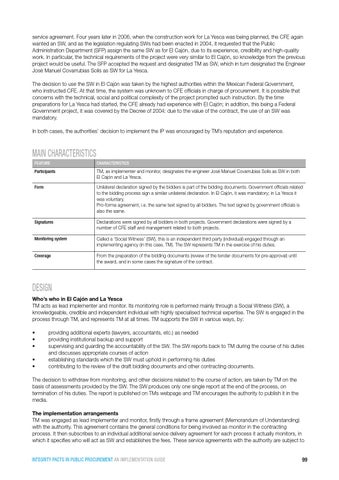
Main Characteristics FEATURE
CHARACTERISTICS
Participants
TM, as implementer and monitor, designates the engineer José Manuel Covarrubias Solís as SW in both El Cajón and La Yesca.
Form
Unilateral declaration signed by the bidders is part of the bidding documents. Government officials related to the bidding process sign a similar unilateral declaration. In El Cajón, it was mandatory; in La Yesca it was voluntary. Pro-forma agreement, i.e. the same text signed by all bidders. The text signed by government officials is also the same.
Signatures
Declarations were signed by all bidders in both projects. Government declarations were signed by a number of CFE staff and management related to both projects.
Monitoring system
Called a ‘Social Witness’ (SW), this is an independent third party (individual) engaged through an implementing agency (in this case, TM). The SW represents TM in the exercise of his duties.
Coverage
From the preparation of the bidding documents (review of the tender documents for pre-approval) until the award, and in some cases the signature of the contract.
Design Who’s who in El Cajón and La Yesca TM acts as lead implementer and monitor. Its monitoring role is performed mainly through a Social Witness (SW), a knowledgeable, credible and independent individual with highly specialised technical expertise. The SW is engaged in the process through TM, and represents TM at all times. TM supports the SW in various ways, by: • • • • •
providing additional experts (lawyers, accountants, etc.) as needed providing institutional backup and support supervising and guarding the accountability of the SW. The SW reports back to TM during the course of his duties and discusses appropriate courses of action establishing standards which the SW must uphold in performing his duties contributing to the review of the draft bidding documents and other contracting documents.
The decision to withdraw from monitoring, and other decisions related to the course of action, are taken by TM on the basis of assessments provided by the SW. The SW produces only one single report at the end of the process, on termination of his duties. The report is published on TMs webpage and TM encourages the authority to publish it in the media. The implementation arrangements TM was engaged as lead implementer and monitor, firstly through a frame agreement (Memorandum of Understanding) with the authority. This agreement contains the general conditions for being involved as monitor in the contracting process. It then subscribes to an individual additional service delivery agreement for each process it actually monitors, in which it specifies who will act as SW and establishes the fees. These service agreements with the authority are subject to
Integrity Pacts in Public Procurement An implementation guide
99