ALTERNATIVE TO SILENCE WHISTLEBLOWER PROTECTION IN 10 EUROPEAN COUNTRIES
www.transparency.org
Transparency International is the global civil society organisation leading the fight against corruption. Through more than 90 chapters worldwide and an international secretariat in Berlin, Germany, TI raises awareness of the damaging effects of corruption and works with partners in government, business and civil society to develop and implement effective measures to tackle it. www.transparency.org
Acknowledgements Authors: Anja Osterhaus and Craig Fagan. Contributions: Experts from TI national chapters: Victor Alistar, Emilia Beblava, Eliška Císařová, John Devitt, Adam Foldes, Giorgio Fraschini, Diana Kovatcheva, Neringa Mickeviciute, Laura Mikelsone, Sergej Muravjov, Pavel Nechala, Miroslava Pagacova, Asso Prii, Petras Ragauskas and Andrew Sheridan. Staff TI-Secretariat: Samuel Bakowski, Annelies de Coninck, Finn Heinrich,
EXECUTIVE SUMMARY
3
INTRODUCTION
5
1 CULTURAL AND POLITICAL CONTEXT 1.1 Connotations of whistleblowing 1.2 Political framework
7 7 8
2 LEGISLATION, POLICIES AND PRACTICE 2.1 Rights and obligations to report 2.2 Right to refuse to violate the law 2.3 Disclosure procedures 2.4 Protection 2.5 Follow-up procedures 2.6 Compensation for retaliation, and rewards systems 2.7 Other relevant findings
9 9 11 11 14 15 18 20
3 CONCLUSIONS AND RECOMMENDATIONS
22
4 SUMMARIES OF NATIONAL RESEARCH
24
5 ANNEX Recommended principles for whistleblowing legislation Methodology
44 44 47
Gypsy Guillén Kaiser, Robin Hodess, Casey Kelso, Miklos Marschall, Jana Mitermaier, Leonie Osthues, Michael Sidwell, Thomas Quine and Paul Zoubkov. Other experts: Dieter Frisch and Guido Strack. Proofreading: Stephanie Debere. Design: www.onehemisphere.se Every effort has been made to verify the accuracy of the information contained in this report. All information was believed to be correct as of November 2009.
Prevention of and Fight Against Crime 2007 With financial support from the Prevention of and Fight Against Crime Programme European Commission – Directorate-General Justice, Freedom and Security
Nevertheless, Transparency International cannot accept responsibility for the consequences of its use for other purposes or in other contexts. © 2009 Transparency International. All rights Reserved. ISBN: 978-3-935711-44-9. Printed on 100% recycled paper. 2nd edition.
Front cover © Stefan Redel/istock Other images © Luminis/dreamstime
ALTERNATIVE TO SILENCE WHISTLEBLOWER PROTECTION IN 10 EUROPEAN COUNTRIES
EXECUTIVE SUMMARY Whistleblowers play a vital role in exposing corruption, fraud and mismanagement and in preventing disasters that arise from negligence or wrongdoing. Prominent whistleblowers revealed the cover-up of SARS and other dangerous diseases that threatened millions of people in China; they disclosed corruption and nepotism in the European Commission and helped to avoid environmental hazards in the US.1 In most known cases, whistleblowers expose themselves to high personal risks in order to protect the public good. When speaking out against their bosses, colleagues, business partners or clients, they risk their jobs, their income and security. Nevertheless, rather than being heard and praised for their courage, most whistleblowers face indifference or mistrust and their reports are not properly investigated. They often end up in years of legal litigation, fighting for their own rights or for the case they have disclosed to be adequately investigated. The result can be health problems, depression and early retirement. At the same time, the value and importance of whistleblowing in the fight against corruption is increasingly recognised. International conventions2 commit the signatory countries to implementing appropriate legislation, and an increasing number of governments is willing to put related regulations in place. Ever more companies, public bodies and non-profit organisations put whistleblowing mechanisms in place for effective risk management and to ensure safe and accountable workplaces.
The value and importance of whistleblowing in the fight against corruption is increasingly recognised.
Legal frameworks can be essential in supporting this practice, provided they ensure full protection of the whistleblower as well as adequate and independent follow-up to the disclosure. Given that whistleblowers are in most cases insiders who are the first to detect wrongdoing, functioning internal whistleblowing systems are excellent tools for effective risk management in organisations. With the aim of contributing to more effective whistleblowing frameworks and protection mechanisms in the European Union, this report assesses whistleblowing legislation, policies and practice in 10 European countries. In this report, the concept of whistleblowing is defined as ‘the disclosure by organisation members (former or current) of illegal, immoral or illegitimate practices under the control of their employers, to persons or organisations that may be able to effect action’.3 The report builds on in-depth research carried out in Bulgaria, the Czech Republic, Estonia, Hungary, Ireland, Italy, Latvia, Lithuania, Romania and Slovakia. In addition, it takes existing whistleblowing legislation and best practice into account. The report identifies weaknesses, opportunities and entry points to introduce stronger and more effective whistleblowing mechanisms in these countries. Main research findings The research found that whistleblowing legislation in the countries covered by this report is generally fragmented and weakly enforced. There is no single, comprehensive legislative framework in place, with the exception of Romania, whose law is limited to the public sector. In Hungary and Lithuania comprehensive legislation is currently under consideration. Alternative to Silence
1 For examples of whistleblower cases see http://www.pcaw.co.uk/aboutus/whistleblowers.htm 2 E.g. the UN Convention against Corruption, the Council of Europe Civil Law Convention on Corruption, the Inter-American Convention Against Corruption, the African Union Convention on Preventing and Combating Corruption, etc. 3 J.P. Near and M.P. Miceli, Organizational dissidence: The case of whistleblowing, Journal of Business Ethics, 4: 4 (1985). This definition was used for conducting the research. In the context of this project, the following definition of whistleblowing was developed: ‘The disclosure of information about a perceived wrongdoing in an organisation, or the risk thereof, to individuals or entities believed to be able to effect action’. See recommended principles for whistleblowing legislation, Annex.
3
EXECUTIVE SUMMARY
Cultural and political factors pose an important obstacle to effective whistleblower protection. Across the 10 EU countries, most of which are located in Central and Eastern Europe and carry the legacy of the former Eastern bloc’s secret police networks, there are negative connotations surrounding whistleblowers. There is a general lack of will to pass and effectively enforce whistleblowing legislation. The act of reporting may be superseded by other laws which prohibit the release of information, and in many countries, libel and defamation regulations deter whistleblowers from making disclosures. While there is a legal duty to disclose corruption, fraud and other criminal acts, insufficient protection, and the absence of adequate follow-up mechanisms often create a dilemma for the individual who suspects wrongdoing. Existing legal provisions do not properly protect whistleblowers. They are inadequate in terms of outlining processes, establishing appropriate channels for disclosure, enforcing protection and setting out follow-up procedures for disclosure. They also fail to ensure effective sanctioning of reported wrongdoing. Where there are protection mechanisms, these are often drawn from labour codes. However, relying on questions of national labour laws means that only formal workers have some form of recourse. Consultants, contractors, third parties, suppliers and other individuals are typically outside the law. Policies regarding compensation for retaliation vary widely between countries: While they are mostly limited to compensation in cases of dismissal, some countries have included rewards for the disclosure of wrongdoing into their legislation. Although internal reporting mechanisms are available both for public sector workers and employees in private companies - multinationals and state-owned companies in particular tend to have whistleblowing mechanisms in place - there is little information about their procedures, effectiveness and results. Where the related codes and provisions are known, the reporting mechanisms tend to be limited to internal channels and they often fail to stipulate the body or office that is to receive the reports. When disclosures are reported anonymously, they are rarely pursued.
There is a general lack of will to pass and effectively enforce whistleblowing legislation. The act of reporting may be superseded by other laws which prohibit the release of information, and in many countries, libel and defamation regulations deter whistleblowers from making disclosures.
Across all 10 countries, there is no systemic data collection on the number of whistleblowing disclosures or the proportion of cases that result in legal action. Owing to the lack of data, it is impossible to assess the public benefit of whistleblowing, or the damage to the public interest when wrongdoing is not disclosed. Recommendations Given the negative connotations surrounding whistleblowing and the lack of political will, there is a need to raise awareness about the critical role whistleblowers can play in detecting wrongdoing. Ideally, there should be a single, comprehensive legal framework for whistleblower protection. Such a framework should include the private and public sectors. It should have clear and effective reporting and follow-up procedures that ensure independent review and appeal mechanisms, as well as adequate compensation for reprisals suffered by the whistleblower. Employer leadership is required to establish efficient internal reporting channels and follow-up mechanisms. Such mechanisms are an effective means of detecting fraud, corruption and gross mismanagement inside an organisation and pave the way for whistleblowers to report internally. An independent public body should ensure systematic data collection regarding the number of cases, their follow-up and the results. This would provide a starting point for evidence-based monitoring and review of whistleblowing in each country and across the European Union. Existing provisions of UNCAC and the Council of Europe Civil and Criminal Law Conventions on Corruption need to be implemented. In addition, it should be assessed whether a European framework for whistleblower protection could provide the necessary incentive for EU member states to develop related legislation and to promote effective whistleblower protection mechanisms.
4
Transparency International
ALTERNATIVE TO SILENCE WHISTLEBLOWER PROTECTION IN 10 EUROPEAN COUNTRIES
INTRODUCTION While some whistleblowers are lauded for protecting the public good and detecting unethical or criminal behaviour, the overwhelming majority of known cases do not receive any recognition or compensation. On the contrary, they may face victimisation or dismissal from the workplace; their employer may sue (or threaten to sue) them for breach of confidentiality or libel, and they may be subject to criminal sanctions. In extreme cases, they face physical danger.4 Whistleblowers are often confronted with an attempt to cover up the facts of the case, or their warnings are simply dismissed or ignored. For example, in the case of the US-based fraudulent hedge fund run by Bernard Madoff, no action was taken despite the fact that financial analyst Harry Markopoulos had repeatedly raised concerns. Madoff’s fake scheme eventually cost thousands of investors billions of dollars. The official investigation of the case found that between June 1992 and December 2008, when Madoff confessed, the United States Securities and Exchange Commission received six substantive complaints that raised significant red flags concerning Madoffs hedge fund operations. All complaints were dismissed. The report concludes that “the SEC never properly examined or investigated Madoff's trading and never took the necessary, but basic, steps to determine if Madoff was operating a Ponzi scheme. Had these efforts been made with appropriate follow-up at any time beginning in June of 1992 until December 2008, the SEC could have uncovered the Ponzi scheme well before Madoff confessed.”5
The United States Securities and Exchange Commission received six substantive complaints concerning Madoff’s hedge fund operations. All complaints were dismissed.
According to a survey, analysing 360 cases in Europe, Middle East and Africa, 25 per cent of occurrences of fraud discovered in enterprises surveyed came to light thanks to whistleblowers – more than any other actor, including regulators, auditors and the media.6 However, as found in a Czech survey, the majority of people who experience or suspect wrongdoing do not disclose the information.7 Apart from the fear of retaliation, the lack of trust in the ability of those responsible for acting on reports to follow them up may be the single most important barrier to effective whistleblowing. It is therefore of utmost importance not only to protect the individual willing to come forward, but also to ensure adequate, independent follow-up and investigation of the disclosure. This is not only needed to protect these individuals against unfair treatment: it is an essential tool to ensure safe and accountable workplaces, to reduce reputational and financial risks and to protect the public interest. Whistleblowing is increasingly recognised as an early warning system and an effective tool for fighting corruption, fraud and mismanagement. The UN Convention against Corruption (UNCAC) and the Council of Europe Civil Law Convention on Corruption call for whistleblower protection8 and the Organisation for Economic Cooperation and Development (OECD) has also made a number of recommendations for different instruments to encourage whistleblowing.9 Relevant provisions exist in many other regional agreements and conventions.10
Alternative to Silence
4 Banisar, David, Whistleblowing – International Standards and Developments. Background paper written for Transparency International, (2009), www.transparency.org 5 United States Securities and Exchange Commission - Office of Inspector General, Investigation of Failure of the SEC To Uncover Bernard Madoff's Ponzi Scheme, Case No. OIG-509, August 2009, http://www.sec.gov/news/studies/2009/oig-509-exec-summary.pdf 6 KPMG Forensic, Profile of a Fraudster, Survey, 2007, p. 26. Also see: Transparency International, Global Corruption Report 2009: Corruption and the Private Sector (Berlin, Germany: TI, September 2009). 7 According to a recent survey in the Czech Republic, two thirds of employees who had observed serious misconduct in the workplace failed to address the situation or only discussed it with colleagues: Survey mapping the perception of whistleblowing by employees in the Czech Republic, TI Czech Republic (2009) 8 See UNCAC Article 33 (adopted 2003), Council of Europe (CoE) Civil Law Convention on Corruption (adopted 1999), article 9 and CoE Criminal Law Convention (article 22). 9 E.g. the 2003 OECD guidelines for Managing Conflict of Interest in the Public Service and the OECD Guidelines for Multinational Enterprises, www.oecd.org. 10 E.g. the Inter-American Convention Against Corruption (article 3), the African Union Convention on Preventing and Combating Corruption (article 5), the Anti-Corruption Action Plan for Asia and the Pacific (pillar 3), the Southern African Development Community Protocol Against Corruption (article 4), etc.
5
INTRODUCTION
At national level, legal frameworks for whistleblower protection exist in several jurisdictions, and many other countries are currently developing legal regimes to encourage disclosures and to protect whistleblowers from retribution.11 However, many of these provisions are limited to the fight against corruption and do not apply in other instances of wrongdoing. In addition, most of the existing laws are limited in scope (e.g. covering only the public sector) or in ensuring proper follow-up to a disclosure, and the implementation of these laws is often insufficient.
Recent cases of corporate fraud and corruption in multinationals and investment banks have shown that the provisions of the SarbanesOxley Act are not sufficient to detect wrongdoing.
For the private sector, the Sarbanes-Oxley Act, passed in 2002 by the US Congress, has become a global reference for whistleblowing in companies and organisations. It requires all companies listed on the US Stock Exchange, whether based in the US or not, to have procedures and protection for the reporting of ‘questionable accounting or auditing matters’.12 However, recent cases of corporate fraud and corruption in multinationals and investment banks have shown that the provisions of the Sarbanes-Oxley Act are not sufficient to detect wrongdoing. The scope of this report The report, which is part of a European Commission co-funded project, assesses current policies and practice in 10 European countries. It builds on comparative in-depth research carried out between March and August 2009 in Bulgaria, the Czech Republic, Estonia, Hungary, Ireland, Italy, Latvia, Lithuania, Romania and Slovakia. Summaries of the research are included in chapter five. The full studies can be downloaded from the Transparency International website (www.transparency.org). In addition, the report draws on research and evidence from academics and practitioners around the world. It is worth noting that the assessment of these 10 countries should not be seen as representative of the whole European Union, given that eight of the countries were part of the Eastern bloc, with a specific authoritarian past and a legacy from their secret police. For a full picture of the situation in the European Union, these studies should be read with existing research and complemented with similar studies in other Western and Southern European countries.13
11 Most of these regulations are sectoral laws. See Banisar, David, Whistleblowing – International Standards and Developments. Background paper written for Transparency International, (2009), www.transparency.org 12 See: Sarbanes-Oxley Act (2002, sections 301 and 806). http://frwebgate.access.gpo.gov/cgibin/getdoc.cgi?dbname=107_cong_bills&docid=f:h3763enr.tst.pdf 13 See Banisar, David, (2009), and Speckbacher, Christophe, The protection of whistleblowers in the light of GRECO’s work, Secretariat of GRECO (March 2009).
6
Transparency International
1 CULTURAL AND POLITICAL CONTEXT
Rather than being seen as an example to follow and a champion of the public good, a whistleblower is often considered untrustworthy. The root cause of this problem lies, to a certain extent, in the apparent conflict between loyalty to the employer and disclosing wrongdoing within an organisation. The fact that whistleblowing is not only in the public interest, but constitutes an efficient tool for risk management within organisations, is often not recognised. 1.1 CONNOTATIONS OF WHISTLEBLOWING Across the 10 EU countries, the term ‘whistleblower’ is associated with being an informant (e.g. in the Czech Republic, Ireland, Romania and Slovakia), a traitor or spy (Bulgaria, Italy) and/or a snitch (Estonia, Hungary, Latvia and Lithuania). In many of the countries assessed, these negative perceptions of whistleblowing are the result of years of authoritarian regimes and the existence of secret police networks. During Soviet times, individuals provided the authorities with information, often secretly, on neighbours, coworkers and family members. In other cases, such as Ireland and Italy, there seems to be a general mistrust of public authorities and an emphasis on not speaking out against your neighbour or colleague. In countries with small populations – such as Estonia, Latvia and Lithuania – the close-knit nature of communities can pose a significant challenge for whistleblowing mechanisms, particularly in terms of encouraging disclosures and assuring the confidentiality of whistleblowers who come forward.
Across the 10 EU countries, the term ‘whistleblower’ is associated with being an informant, traitor, spy and/or snitch.
This context creates a sizeable obstacle to the pursuit of a more comprehensive legal framework of protection. In Estonia, for example, putting forward legislation is seen as impossible unless a more positive cultural shift takes place towards the idea of whistleblowers protecting citizens’ safety in a variety of areas, from corruption to public health. Yet negative connotations around whistleblowing are not limited to countries with an authoritarian past.
Alternative to Silence
7
1 CULTURAL AND POLITICAL CONTEXT
1.2 POLITICAL FRAMEWORK In many of the countries studied, there is a general disconnect between government actions and rhetoric when it comes to combating abuses, including those related to corruption. Many citizens report that their government is not doing enough to respond to the problem. Survey work completed in 2009 reports that fewer than one in 10 respondents in Bulgaria, the Czech Republic, Hungary and Lithuania consider their government’s anti-corruption efforts to be effective.14 In Ireland, corruption is estimated to cost the government as much as €3 billion each year in lost revenue and foreign investment. Although whistleblowing is highly recognised as an effective detector of fraud and misconduct, related legislation has been seemingly ‘disincentivised’ by the government.15
Only well-designed laws which include effective follow-up and enforcement mechanisms can protect the whistleblower and thus encourage disclosure.
A lack of political will to address inadequate whistleblower protection is apparent in many of the countries studied. In some cases this situation is changing: in Hungary and Lithuania comprehensive legislation is currently under consideration. However, political will is not only about passing the right legislation, but about enforcing it – and providing resources (human, financial and technical) for these efforts. Only well-designed laws which include effective follow-up and enforcement mechanisms can protect the whistleblower and thus encourage disclosure. Otherwise, laws can even be counterproductive because employees, believing they are genuinely protected against reprisal, may blow the whistle and still face retaliation.16
14 Findings are based on surveys carried out as part of TI’s Global Corruption Report (2009). For more information, see: Transparency International, Global Corruption Barometer, Berlin, Germany: TI (June 2009). 15 See: Pope, Conor: ‘Corruption costing State €3 bn, report claims’, The Irish Times, 2 March 2009. www.irishtimes.com/newspaper/breaking/2009/0302/breaking50.htm. 16 See: Devine, Tom, International Best Practices for Whistleblower Policies, Washington, DC: Government Accountability Project (2009).
8
Transparency International
2 LEGISLATION, POLICIES AND PRACTICE
Legal frameworks to facilitate the disclosure of wrongdoing are largely absent from the 10 countries assessed in this report. Most countries in the study rely on a patchwork of legislation that falls under different sectors and existing laws. There is no single piece of legislation except in Romania, which passed a Whistleblower Protection Act (Law 571) in 2004. Still, the law’s enforcement has been uneven and its reach is limited to the public sector. Ireland does have specific sectoral codes that provide for whistleblower protection, but they are not consistent or standardised.17 In many instances there is no stand-alone anti-corruption or freedom of information act that could facilitate whistleblowing rights and protections. Under the current legal context, except in Romania, the rights to report and to have protection tend to be included in or derived from national labour codes, employment provisions, public servant acts and criminal codes. In most of the countries surveyed, these laws do not have explicit language on whistleblowing, but do have measures that could provide de facto coverage. In most countries the labour code affords protection against unfair dismissal from work, while criminal and administrative codes enforce the right to report wrongdoing. However, the relegation of legal whistleblower safeguards to national labour laws means that only formal workers have some form of remedy. Consultants, contractors, third parties, suppliers and other individuals fall outside the law. Where whistleblowers testify during court proceedings, they can be covered under witness protection laws. Of the countries studied, two thirds have some form of witness protection laws while only one tenth have specific whistleblowing legislation. However, these laws do not necessarily apply, because whistleblowers often suspect wrongdoing without having formal evidence and would not be able – or willing – to testify. Furthermore, given that whistleblowers are usually insiders, they face very specific risks, such as harassment at work or dismissal, which are not normally covered by witness protection laws. The same goes for the need to receive compensation for salary losses, career opportunities, etc. Witness protection laws are therefore not sufficient to ensure adequate protection for whistleblowers.
The relegation of legal whistleblower safeguards to national labour laws means that only formal workers have some form of remedy. Consultants, contractors, third parties, suppliers and other individuals fall outside the law.
Internal codes can sometimes provide for whistleblower protection without the presence of a supporting legal framework at the national level. For example, Estonia’s police force and various Latvian ministries have adopted their own codes of ethics that allow for disclosure by staff, although both countries lack legislation that mandates whistleblowing reporting more broadly. 18 2.1 RIGHTS AND OBLIGATIONS TO REPORT In most countries studied, it is an obligation to disclose corruption, fraud and other criminal acts. In Slovakia, private sector employees who learn that another person has committed an act of corruption and do not report it to a law enforcement authority can be imprisoned for up to three years. Italy’s criminal code fines civil servants who fail to report or delay reporting a crime that they discover in the process of performing their duties.
Alternative to Silence
17 These are related to the protection of: persons reporting suspicions of child abuse or neglect to authorised persons; persons reporting alleged breaches of the Ethics in Public Office Acts; persons reporting breaches of competition law to the relevant authority (and also protection specific to employees for so doing); employees against penalisation for exercising any right under the workplace Health and Safety Act, and to An Garda Síochána (police) and Garda civilian employees reporting corruption or malpractice in the police force; and to protect those persons obliged to report suspected breaches of charities law from any liability arising from any such report. For more information, see: National analysis of whistleblower protection in Ireland, TI Ireland (2009), p.2. 18 This stipulation is in the codes for the Ministries of Health, Defence, Interior Affairs, Finance and Justice.
9
2 LEGISLATION, POLICIES AND PRACTICE
The protection of whistleblowers should be a logical consequence of the duty to report (suspicions of) criminal acts to the police or prosecution bodies.19 Yet in spite of the obligation to report, in many countries, insufficient protection, limited laws and weak enforcement of policies create a dilemma for the individual who suspects wrongdoing. In the Czech Republic, the criminal code covers situations where employees fail to report a crime and mandates their disclosure. Yet at the same time, other legal codes state that a whistleblower can actually perpetrate a crime through his or her disclosure and be vulnerable to charges of ‘false disclosure’. This can happen if the information that has been reported proves incorrect or if the person accused of wrongdoing opts to file a counter suit of slander before any investigation begins.20
In spite of the obligation to report, in many countries, insufficient protection, limited laws and weak enforcement of policies create a dilemma for the individual who suspects wrongdoing.
Overall, few of the countries studied have existing laws which stipulate that employees have a right to report. This right to report is often connected with the type of wrongdoing and the information it is permissible to disclose. For example, in Hungary, the notion of the right to report wrongdoing is applied to employees, both public and private, working in certain sectors. In Italy, the right to report is often applied to workers as a result of the general freedom of expression granted to them under the country’s labour code (as well as in its constitution) when disclosures involve irregularities, illegal acts or perceived risks within their workplace.21 In all the countries in the report, matters of national security cannot be publicly disclosed. In countries such as Hungary, banking and trade secrets are areas within which disclosures cannot be made.22 Latvia’s Criminal Law forbids and punishes the intentional leakage of classified information by officials who have acquired it ex officio.23 In many cases the whistleblower is confronted with a conflict of (legal) duties or, more broadly, a conflict of laws. For example, mandatory reporting can be in conflict with the duty to maintain confidentiality or with trade secrecy (see box). In the case of Guja vs Moldova the European Court of Human Rights ruled in favour of whistleblowing. In the case, a public employee who had released an unclassified document that revealed political manipulation of the justice system, was dismissed. The Court found a violation of the freedom of expression (Article 10 of the Convention). It “considered that the public interest in the provision of information about undue pressure and wrongdoing … was so important in a democratic society that it outweighed the interest in maintaining public confidence in the Prosecutor General's Office.”24 Duty of confidentiality versus disclosure of wrongdoing
19 Speckbacher, Christophe: The protection of whistleblowers in the light of GRECO's work, Secretariat of GRECO, (March 2009). 20 See: Criminal Code (Act. No. 140/1961, paragraphs 167 and 168). 21 See: Statuto dei Lavoratori/Italian Labour Code (article 1). 22 Disclosure is normally allowed when the information to be disclosed is in the interest of the public good. 23 The same law in Latvia allows for the disclosure of secret information provided that this act is of ‘extreme necessity’ (see sections 28 and 32). Deciding whether it meets these criteria includes looking at whether disclosure was less harmful than what would have resulted otherwise. 24 European Court of Human Rights, Case of Guja v Moldova (Application no. 14277/04) Judgement. Strasbourg, 12 Feb 2008 25 See: National analysis of whistleblower protection in Ireland, TI Ireland (2009), p. 3.
10
A prominent case of whistleblowing in Ireland is related to a disclosure that violated employment confidentiality clauses. Dating back more than a decade, the case involved an ex-employee of the National Irish Bank who had provided the state television channel with evidence supporting allegations that the bank had systemically promoted the evasion of taxes by its customers. The information was prima facie confidential and its disclosure to others outside the terms of employment clearly not allowed. The bank requested an injunction in the case, which was overruled by the courts. The case went to the Supreme Court, which ruled in favour of violating the terms of confidentiality on the basis that the information was in the public interest.25 Transparency International
2.2 RIGHT TO REFUSE TO VIOLATE THE LAW In all countries studied, provisions are in place to give employees the right to refuse to participate in illegal activities. However, while this is a general right in Bulgaria and Lithuania26, in other countries it is more nuanced. In Hungary, it is a general obligation of all employees to refuse instructions that would result in direct and grave risk to life, physical integrity or health, while public officials are not obliged to, but may refuse compliance in these cases. The provisions in Romania are the most comprehensive, even covering refusal to sign a document, while in Italy there are no provisions for the private sector. Ireland lacks a related provision, possibly because a duty on all persons not to engage in illegal behaviour is presumed. 2.3 DISCLOSURE PROCEDURES There is a plethora of different options to disclose wrongdoing and unethical behaviour, ranging from dedicated hotlines to comprehensive electronic whistleblowing systems which help organisations to receive and classify the disclosures and to process them adequately. The international website wikileaks publishes anonymous submissions and leaks of sensitive documents while preserving the anonymity and untraceability of its contributors. Within one year of its launch in December 2006, its database had grown to more than 1.2 million documents.27 Such a system, however, is limited to receiving and publishing the information and cannot ensure any follow-up.
The existence of a channel for disclosure is not sufficient… The challenge is to ensure that people know where to report and understand the channels through which a concern can be raised.
However, the existence of a channel for disclosure is not sufficient. The challenge is to ensure that people know where to report and understand the channels through which a concern can be raised. Researchers have found a positive correlation between levels of internal whistleblowing and the existence of specific, identified routes for whistleblowing, accompanied by a strong, non-retaliatory policy.28 The 10 studies revealed a jumble of codes that apply to individual ministries, and unclear lines of authority for making a disclosure, for both public and private sector workers. Even when there is some relevant legislation in place, the channels for reporting corruption, abuses or malfeasance are often diffuse and uncomplementary within a company, ministry or government agency.
The importance of clear steps and channels for reporting In Latvia, the lack of a clear set of steps for receiving and responding to a disclosure has even been evidenced within the Ombudsman’s Office, a government institution which oversees matters related to the protection of human rights and good governance. In 2007, nearly half of the Ombudsman’s Office employees complained of alleged misconduct by the Office’s director. The lack of clear reporting channels internally led to confusion about how to investigate and resolve the case. After pressure from non-governmental organisations, including the local TI chapter, the case was heard by a parliamentary body, which did not investigate the root of the claims. As a result, the case was ultimately dismissed.29 Alternative to Silence
26 Although there is no general legal provision in Lithuania, the caselaw now contains a widespread notion, that execution of an unlawful order does not exempt a person from liability. Thus, not only one does not have to, but is prohibited from executing it. However, there are certain specific laws that explicitly foresee it, ex. Statute of Special Investigation Services (Art. 6.4), Statute of State Security Department (Art. 8.2), Statute of Prison Department under the Ministry of Justice of Republic of Lithuania (Art. 19.3). 27 www.wikileaks.org 28 Miceli, Marcia et al: A Word to the Wise: How Managers and PolicyMakers can Encourage Employees to Report Wrongdoing, Journal of Business Ethics, (2009), 86:3, pp. 379–396. 29 National analysis of whistleblower protection in Latvia, TI Latvia (2009), p. 8.
11
2 LEGISLATION, POLICIES AND PRACTICE
2.3.1 INTERNAL AND EXTERNAL REPORTING Channels for reporting wrongdoing can be internal and external. In general, three different levels can be distinguished: channels provided by the organisation itself, such as ethics advisors or hotlines; channels provided by the regulator such as the police or the Ombudsman’s office, and other external channels such as the media or civil society organisations. Research and experience show that whistleblowers should have the opportunity to choose between different reporting channels – including independent external options, such as dedicated hotlines. The availability of multiple channels enables employees to select the person(s) with whom they are most comfortable sharing sensitive information, and the channel they find easiest to use.30 Whistleblowers tend to try internal reporting first and only go outside if their report is not being followed up. Recent research suggests that this holds across cultures: people in the UK, Turkey and South Korea would all prefer to blow the whistle through a formal internal procedure.31
Safe access to external reporting channels is indispensable to ensure that the internal process is accountable to a higher level or authority and to make organisations accountable for internal wrongdoing.
30 Miceli, Marcia et al: A Word to the Wise: How Managers and PolicyMakers can Encourage Employees to Report Wrongdoing, Journal of Business Ethics (2009) 86:3, pp. 379–396. 31 Park et al: Cultural Orientation and Attitudes Toward Different Forms of Whistleblowing: A Comparison of South Korea, Turkey and the UK, Journal of Business Ethics (2008) 82:929–939. 32 See: National analysis of whistleblower protection in Estonia, TI Estonia, (2009). 33 In Bulgaria, there is an Administrative Procedure Code which establishes the internal channels for disclosure but fails to specify which agencies or bodies are designated with fulfilling related functions.
12
From the point of view of the organisations themselves, internal channels are an opportunity to investigate allegations and correct wrongdoing instead of seeing it publicly exposed. In countries such as Estonia, for example, companies prefer to receive internal disclosures from whistleblowers in order to resolve cases privately.32 However, internal channels often do not work. In some countries, such as Bulgaria and the Czech Republic, internal reporting channels for public sector workers are outlined, but without stipulating the government body or office that is to receive reports.33 As a result, some ministries report that no cases are being received. Safe access to external reporting channels is therefore indispensable to ensure that the internal process is accountable to a higher level or authority and to make organisations accountable for internal wrongdoing. Many practitioners argue that a whistleblower should be able to choose freely whether to report internally or externally, for manifold reasons: Firstly, potentially ineffective internal channels pose an additional barrier to disclosure and may discourage the whistleblower from speaking out, particularly if he or she is convinced that internal reporting will not lead to any change. Secondly, given the duty of the state to protect the public interest, it can be argued that there should be no distinction, in terms of level of evidence required, between internal reporting and reporting to public authorities such as the police or the Ombudsman, while it is legitimate to request a higher level of evidence before reporting to public media or other external bodies. Thirdly, any related provision needs to be accompanied by clear conditions under which use of the respective channels is protected. Considering that, overall, whistleblowing should be encouraged and made as less burdensome as possible, it should be carefully assessed whether the additional burden of proof on the whistleblower, required by a progressive disclosure system, might end up discouraging the reporting of wrongdoing or the risk of it. Lastly, giving the whistleblower a right to choose would provide an incentive to organisations to establish transparent and trustworthy internal whistleblowing systems that work in practice, and not only on paper.
Transparency International
The three-tiered model of the UK Public Information Disclosure Act (PIDA) PIDA establishes three levels of disclosure, implying an increasing level of evidence: • protected internal disclosure (i.e. substance raising genuine suspicion) • protected disclosure to the regulator (i.e. factual substance for concern and no serious doubt) • protected wider disclosure (i.e. factual substance for concern, no serious doubt, good reason to go further and generally reasonable).34 In this respect, legislation differs significantly. The UK Public Interest Disclosure Act foresees three levels of disclosure, implying an increasing level of evidence the further the whistleblower goes outside the organisation (see box). On the contrary, the Public Interest Disclosure Act of the Australian Capital Territory (1994) specifies that internal channels must be in place, but there is no obligation to use these internal channels first.35 Of the countries included in the study, none has a progressive disclosure system in place. The Romanian law provides for three channels for disclosure, all of which can be cumulatively or alternatively accessed when blowing the whistle.36 2.3.2 ANONYMOUS AND CONFIDENTIAL REPORTING For reporting channels to work efficiently, another challenge to overcome is how to ensure that they provide the right degree of confidentiality or even anonymity to the whistleblower. The term ‘anonymous’ should be understood as relating to a disclosure made through a channel that assures no possible link to the person providing the information: a file of information sent without a return address, an untraceable telephone call to a hotline, an email sent from a blocked account, IT systems guaranteeing anonymity and preventing back contacts, etc. A ‘confidential’ disclosure is one where the identity of the whistleblower is known only by the recipient of the disclosure (e.g. an Ombudsman or the ethics advisor) who has an obligation to keep the name secret, both towards members of the concerned organisation and to the wider public.
For reporting channels to work efficiently, another challenge to overcome is how to ensure that they provide the right degree of confidentiality or even anonymity to the whistleblower.
EU data protection rules require the protection of the identity of both the whistleblower and the person incriminated. In this context, the EU’s Advisory Body on Data Protection and Privacy, the Article 29 Data Protection Working Party, expressed a number of concerns about anonymous reporting. These range from greater difficulties in following up a report, to the risk that an organisation may create a culture of anonymous reporting. Yet it does not exclude anonymous reporting and recognises that ‘whistleblowers may not always be in a position or have the psychological disposition to file identified reports’. It therefore suggests that anonymous reports be investigated with ‘due consideration for all the facts of the case, as if the report were made openly’.37 Confidential reporting provisions exist in all countries covered by this report. In Italy and Slovakia, private sector codes (based on internal procedures) provide for confidential and anonymous reporting, while there are no provisions for anonymous reporting in public sector laws.38 In the Czech Republic, a person can anonymously file a complaint to virtually any public administration body, but it does not mean that any follow-up processes will be launched. In Estonia, the private companies surveyed allow confidential reporting, but will not follow up reports received anonymously.39 Alternative to Silence
34 See: The UK Public Interest Disclosure Act 1998. www.opsi.gov.uk/acts/acts1998/ukpga_19980023_en_1. 35 Vandekerckhove, W. (forthcoming 2010) European Whistleblower Protection: Tiers or Tears?, in D. Lewis (ed.) A Global Approach to Public Interest Disclosure Legislation. Cheltenham/Northampton: Edward Elgar Publishing 36 Analysis of whistleblower protection in Romania, TI Romania (2009) p.38. 37 Article 29 Data Protection Working Party, 1 February 2006, p.11. 00195/06/EN 38 The International Chamber of Commerce (ICC) has left the decision open to companies whether to accept anonymous reports. 39 See: National analysis of whistleblower protection in Estonia, TI Estonia (2009).
13
2 LEGISLATION, POLICIES AND PRACTICE
2.3.3 HOTLINES AND ELECTRONIC PLATFORMS Whether reporting channels are internal or external, both electronic platforms and hotlines can facilitate individual disclosures. Hotlines exist in most of the countries studied, both for the private and public sectors. In the Czech Republic, 44 per cent of all private companies have established hotlines for protection against fraud.40 This level is greater than the international average (42 per cent) and that for Central and Eastern Europe (33 per cent). In many cases, company hotlines are underutilised – as in Estonia, Italy and Ireland – and often unknown to employees. In Hungary, on the other hand, a special witness hotline receives 10,000 calls a year, and Latvia’s State Labour Inspectorate hotline reported around 200 anonymous voice messages in both 2007 and 2008. In most cases, however, there is no detailed data available about the use of hotlines.
In none of the EU countries studied is there a comprehensive and clear set of whistleblower protection procedures.
In Lithuania, there tends to be no distinction between whistleblower hotlines and helplines or consultancy lines, therefore there is no adequate provision for the particular needs of the whistleblower for advice and anonymity, or at least confidentiality. The existence of a hotline by no means indicates that whistleblowing matters are being adequately treated. When asked about their whistleblower protection mechanisms, members of the Czech anti-corruption commission responded that the government has hotlines to deal with the problem. A reasonable assumption could be drawn that there is some confusion between reporting and protection. 2.4 PROTECTION Once a claim has been raised, there is a need to establish safeguards against reprisals which are easy for the whistleblower to access. There must be a way to encourage the conveying of the message while protecting the messenger41 and to guarantee that the individual (and his or her family) will be protected from retribution. For the whistleblower, workplace reprisals can include harassment, isolation, demotion or lack of promotion and even dismissal. Without protection, the cost of reporting may be too high for individuals to come forward. For retaliation against whistleblowers, the burden of proof should be reversed. It should be proven by the accused that any measures taken to the detriment of the whistleblower were motivated by reasons other than the latter’s disclosure.
40 Results are based on findings from the PriceWaterhouseCoopers report Global Economic Crime Survey (2007): 79 Czech companies were randomly selected for the survey. For more information, see: http://www.pwc.com/gx/en/economic-crime-survey/index.jhtml. 41 Dehn, Guy and Calland, Richard, Whistleblowing - The state of the art. The role of the individual, organisations, the state, the media, the law and civil society. London: Public Concern at Work (2004). 42 The law states that if any employee presents facts showing that he or she may have been punished or caused injuries for reporting corruption (directly or indirectly), the burden of proof is on the employer to demonstrate that this was not the case.
14
In none of the EU countries studied is there a comprehensive and clear set of whistleblower protection procedures. This is particularly troublesome in instances where individuals have an obligation to report wrongdoing. When there are protection mechanisms, these are often drawn from labour codes that prevent unfair dismissals and allow for a redress of grievances. In Latvia, for example, the labour law (Section 9) protects whistleblowers who report cases (or suspicions) of corruption from retribution in their workplace.42 Slovakia’s national labour code provides explicit guarantees for private sector workers and for civil servants, including that no one can be sanctioned at his or her workplace in connection with filing a complaint, action or petition for action against another employee. In Italy, it is not the law but the internal codes of the country’s largest companies that afford the whistleblower protection. Irish workers have rights under the labour code to make appeals for alleged unfair dismissal to the Labour
Transparency International
Relations Commission, which is tasked with hearing their complaints.43 However, in each of these examples, the relegation of the matter to questions of national labour laws means that only formal workers have some type of recourse. Consultants, contractors, third parties, suppliers and other individuals fall outside the law. Even if legal safeguards are available, there are often limited mechanisms and weak levels of enforcement for the protection of whistleblowers. For example, despite Romania’s having a stand-alone whistleblower law to protect public sector workers, 40 per cent of the whistleblowers whose cases the TI national chapter monitored suffered some form of retaliation immediately after coming forward. In the Czech Republic, where the national labour code outlines worker protection mechanisms44, opinion polls suggest that individuals still fear such reprisals if they report wrongdoing. A survey of employees working for multinational companies in the country found that 67 per cent would not come forward, out of fear of retaliation and reprisal.45 These findings are similar to findings in other countries regarding protection and retaliation once a report has been filed. A review of more than 200 fraud cases in the US between 1996 and 2004 found that in 82 per cent of cases where the employee was named, the employee reported ‘that they were fired, quit under duress or had significantly altered responsibilities as a result of bringing the fraud to light.’46 This shows that even in countries with comprehensive legislation, the psychological and economic burden of information disclosure stays with the whistleblower. 2.5 FOLLOW-UP PROCEDURES A key factor in deterring potential whistleblowers from disclosing information is the lack of trust in the ability or willingness of the relevant body to investigate the case and to hold the responsible to account. Trustworthy and effective follow-up mechanisms and clear procedures are therefore crucial to create an enabling environment for whistleblowing. Follow-up procedures in the 10 countries studied, however, are generally diffuse and unclear. With all these countries lacking comprehensive legislation that covers public and private sector workers, there is no standard legal recourse or equal application of procedures once information is received. Rather, the existing provisions cover certain types of disclosure which, as already highlighted, usually relate to criminal or labour-related matters. Romania is the only country that outlines a specific set of steps for following up reports. The referent law, passed in 2004, covers how disclosures involving public sector workers must proceed. It also tasks regulatory commissions with adjudicating the cases.47 Disciplinary commissions are the institutions empowered to assess the facts of the information disclosed by civil servants. They also determine whether there are irregularities that merit action, including the escalation of the matter to a criminal case.48 Laws in six of the countries studied (Bulgaria, the Czech Republic, Hungary, Latvia, Lithuania and Slovakia) require that an official government response be issued to formally filed complaints (including those about wrongdoing).49 In the Czech Republic, once an individual has lodged a crime-related complaint, a response from the government must be provided within 30 days.50 Such a stipulation allows whistleblowers to follow up the status of their disclosure and provides a feedback mechanism for the accountability of the institutions tasked with executing related laws.
Alternative to Silence
43 In Ireland, the Rights Commissioner is the body within the Labour Relations Commission that hears dismissal cases. The findings are not made public. If an appeal is made or if both parties do not agree to arbitration, the case goes to the Employment Appeals Tribunal (EAT), which does publish decisions. 44 See: The Labour Code (Act No. 262/2006, paragraph 52). 45 See: Ernst & Young, A Survey into Fraud Risk Mitigation in 13 European Countries (March 2007). http://www.ey.com/Publication/vwLUAssets/Fraud_Risk_Mitigation_ Survey_2007/$FILE/FIDS_Fraud_Risk_Mitigation.pdf. 46 Dyck, I. J. Alexander, Morse, Adair and Zingales, Luigi: Who Blows the Whistle on Corporate Fraud? (October 1, 2008). Available at SSRN: http://ssrn.com/abstract=891482 47 See: Government Decision No. 1344/2007. 48 Despite having these bodies set up, they are not the institutions or individuals tasked with receiving disclosures. Under Romanian whistleblowing law, a civil servant can come forward with information to anyone in the organisation who is his or her superior. For example, a public sector employee working in a ministry could tell his or her unit’s boss of wrongdoing or contact the minister’s office to make the disclosure. 49 In Bulgaria, the provision is in the Administrative Procedure Code (Art. 114, paragraphs 1 and 3) and the Law on Conflict of Interest. In the Czech Republic, the referent provisions are included in section 5, paragraph 2 of the Labour Inspection Act. In Hungary, the Act XXIX of 2004 is a lex imperfecta, i.e. there is no sanction if no response is provided, and the provisions are hidden and therefore not well-known. In Latvia, the referent law is the Applications Submissions Act (section 5). In Lithuania, the main laws are related to the Law on Public Service and the Labour Code (Article 35); in Slovakia, it is the Act on Complaints. In Bulgaria, the provision is the Administrative Procedure Code (Art. 114, paragraphs 1 and 3) and the Law on Conflict of Interest. In the Czech Republic, the referent provisions are included in section 5, paragraph 2 of the Labour Inspection Act. 50 These stipulations are per the country’s Administrative Code.
15
2 LEGISLATION, POLICIES AND PRACTICE
2.5.1 INDEPENDENT REVIEW MECHANISMS The independent review of cases is an essential aspect of effective whistleblower mechanisms. An independent review provides a check on authority and helps to balance powers within a government institution as well as a private organisation. In many countries the Ombudsman receives reports and institutes investigations of public bodies. However, Ombudsmen do have some limitations because they generally only have authority over public bodies and tend to have limited powers to order remedies.51
An independent review provides a check on authority and helps to balance powers within a government institution as well as a private organisation.
51 See Banisar, David Whistleblowing - International Standards and Developments, Background paper written for Transparency International (2009), www.transparency.org
16
In the 10 countries studied, only Ireland has an independent review mechanism for all cases brought by workers. Estonia has a stipulation for independent review, but only in cases of harassment. In Bulgaria, there is legal recourse for cases that fall under the Law on Conflict of Interest. The country’s Supreme Administrative Court decides on conflicts of interest and the decision can be appealed through the country’s Administrative Procedure Code. In Slovakia and in the Czech Republic, there is a soft law provision offered through the Office of the Ombudsman: while the Ombudsman cannot overrule or change a decision, he or she can rule whether the decision or action has been correct and can notify the relevant body. Independent Review: Is there an independent review mechanism and how comprehensive is it? Bulgaria
No special regulations for cases of whistleblowing.
Czech Rep.
An employee may turn to the Ombudsman’s Office, although the Ombudsman can only offer legal advice and notify the relevant administrative body. An employee may also seek recourse in independent courts in the areas of civil and labour law, in particular in action seeking determination of the invalidity of dismissal and in action seeking protection of personal rights.
Estonia
There is no independent review system specifically regarding whistleblowers. Private sector employees have the right to contest potential harassment and sanctions (termination of employment contract, disciplinary measures) in labour dispute committees or in court. This right is a general rule and does not make explicit reference to harassment resulting from whistleblowing. Public sector employees may also turn to a court for dispute settlement. If the harassing party is a public sector organisation, the Chancellor of Justice may be a mediator.
Hungary
No review mechanism for whistleblowing cases.
Ireland
Remedies exist in certain circumstances.
Italy
No guaranteed and specific independent review mechanisms for whistleblowers.
Latvia
The Ombudsman deals with whistleblowing cases in public institutions. There is no independent review mechanism particularly for whistleblowing.
Lithuania
No special regulations for cases of whistleblowing.
Romania
No.
Slovakia
No independent review system for the disclosure of illegitimate practices. The whistleblower has access to law-enforcement authorities and to other public bodies. Transparency International
2.5.2 WHISTLEBLOWER PARTICIPATION IN COURT PROCEEDINGS Whistleblowers take high personal risks when disclosing wrongdoing and therefore have, in most cases, a high interest in the case being investigated properly. Whistleblower networks and specialised organisations have therefore highlighted the need to keep the whistleblower informed about each stage of the investigation. He or she should receive confirmation of receipt of their disclosure, the opening of an investigation and its probable duration.52 Unless required for testimonies, whistleblowers should have the right to choose whether they want to participate in proceedings or not, and they should be allowed to comment on the final report. Given the absence of specific whistleblowing legislation in most countries studied, there is little reference to the participation of whistleblowers in court proceedings. In Estonia, changes proposed in 2009 to the country’s Anti-Corruption Act would protect confidentiality for whistleblowing that seeks to disclose alleged corruption. While the act only covers the public sector, the proposed amendments require that investigations triggered by a whistleblower’s disclosure maintain the confidentiality of the individual and enforce the principles of equal treatment.53 In Romania, the whistleblower has the right to participate, submit documentation and even appeal findings with the country’s courts throughout the commission’s review.
Whistleblowers take high personal risks when disclosing wrongdoing and therefore have, in most cases, a high interest in the case being investigated properly.
Participation in court proceedings: diffuse procedures in the Czech Republic Czech citizens are obliged to report any wrongdoing outlined in the country’s criminal code. While the law identifies where the report should be directed (e.g. the public prosecutor’s office, law enforcement agencies, the police chief), it does not provide a process for proceedings to be launched. From the perspective of criminal law, it is likely that a whistleblower lodging a complaint will be in the position of a witness when reporting to the authorities the basis for his or her suspicion. The procedural rights of the witness are very narrow in Czech law54: witnesses cannot view the case file, receive a copy of their own testimony or seek any remedial measures, such as damages. These restrictions are similar to provisions applied in Latvia and in Ireland for criminal proceedings. A whistleblower may become an aggrieved party who has suffered damage as a result of the crime being reported and whose legal position affords him or her additional procedural rights. He or she has the right to participate in criminal proceedings, to view the case file, to sue for damages and to lodge certain applications for remedial measures. However, the Criminal Code very narrowly defines the term ‘aggrieved party’. 52 See: Europe Needs More Whistleblowing! A Response to the Green Paper Modernising labour law to meet the challenges of the 21st century (2007) http://www.whistleblowernetzwerk.de/WB_EUGB_EN_final.pdf and Devine, Tom, International Best Practices for Whistleblower Policies, Washington, DC: Government Accountability Project (2009). 53 The concept of equal treatment is derived from Estonia’s Equal Treatment Act. Similar provisions have been included in Romania’s whistleblowing legislation. 54 Czech Criminal Code provisions.
Alternative to Silence
17
2 LEGISLATION, POLICIES AND PRACTICE
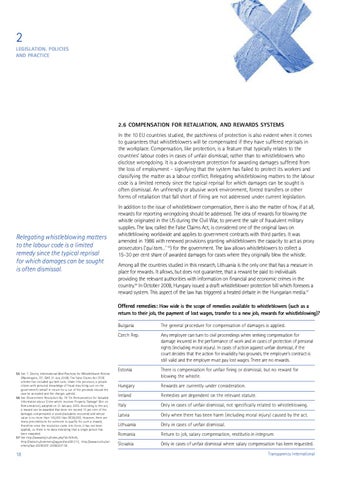
2.6 COMPENSATION FOR RETALIATION, AND REWARDS SYSTEMS In the 10 EU countries studied, the patchiness of protection is also evident when it comes to guarantees that whistleblowers will be compensated if they have suffered reprisals in the workplace. Compensation, like protection, is a feature that typically relates to the countries’ labour codes in cases of unfair dismissal, rather than to whistleblowers who disclose wrongdoing. It is a downstream protection for awarding damages suffered from the loss of employment – signifying that the system has failed to protect its workers and classifying the matter as a labour conflict. Relegating whistleblowing matters to the labour code is a limited remedy since the typical reprisal for which damages can be sought is often dismissal. An unfriendly or abusive work environment, forced transfers or other forms of retaliation that fall short of firing are not addressed under current legislation.
Relegating whistleblowing matters to the labour code is a limited remedy since the typical reprisal for which damages can be sought is often dismissal.
In addition to the issue of whistleblower compensation, there is also the matter of how, if at all, rewards for reporting wrongdoing should be addressed. The idea of rewards for blowing the whistle originated in the US during the Civil War, to prevent the sale of fraudulent military supplies. The law, called the False Claims Act, is considered one of the original laws on whistleblowing worldwide and applies to government contracts with third parties. It was amended in 1986 with renewed provisions granting whistleblowers the capacity to act as proxy prosecutors (‘qui tam…’ 55) for the government. The law allows whistleblowers to collect a 15–30 per cent share of awarded damages for cases where they originally blew the whistle. Among all the countries studied in this research, Lithuania is the only one that has a measure in place for rewards. It allows, but does not guarantee, that a reward be paid to individuals providing the relevant authorities with information on financial and economic crimes in the country.56 In October 2009, Hungary issued a draft whistleblower protection bill which foresees a reward system. This aspect of the law has triggered a heated debate in the Hungarian media.57 Offered remedies: How wide is the scope of remedies available to whistleblowers (such as a return to their job, the payment of lost wages, transfer to a new job, rewards for whistleblowing)?
55 See: T. Devine, International Best Practices for Whistleblower Policies (Washington, DC: GAP, 31 July 2009). The False Claims Act (FCA) scheme has included qui tam suits. Under this provision, a private citizen with personal knowledge of fraud may bring suit on the government’s behalf in return for a cut of the proceeds should the case be accepted and the charges upheld. 56 See: Government Resolution No. 75 ‘On Remuneration for Valuable Information about Crime which involves Property Damage’ (Act on Remuneration), adopted on 21 January 2003. According to the act, a reward can be awarded that does not exceed 10 per cent of the damages compensated or assets/valuables recovered and whose value is no more than 100,000 litas (€29,000). However, there are many preconditions for someone to qualify for such a reward, therefore since the resolution came into force, it has not been applied, i.e. there is no data indicating that a single person has been rewarded. 57 See http://www.bbj.hu/index.php?id=50545, http://index.hu/velemeny/jegyzet/vev081211/, http://www.nol.hu/vel emeny/lap-20090207-20090207-35
18
Bulgaria
The general procedure for compensation of damages is applied.
Czech Rep.
Any employee can turn to civil proceedings when seeking compensation for damage incurred in the performance of work and in cases of protection of personal rights (including moral injury). In cases of action against unfair dismissal, if the court decides that the action for invalidity has grounds, the employee’s contract is still valid and the employer must pay lost wages. There are no rewards.
Estonia
There is compensation for unfair firing or dismissal, but no reward for blowing the whistle.
Hungary
Rewards are currently under consideration.
Ireland
Remedies are dependent on the relevant statute.
Italy
Only in cases of unfair dismissal, not specifically related to whistleblowing.
Latvia
Only when there has been harm (including moral injury) caused by the act.
Lithuania
Only in cases of unfair dismissal.
Romania
Return to job, salary compensation, restitutio in integrum.
Slovakia
Only in cases of unfair dismissal where salary compensation has been requested. Transparency International
2.6.1 RIGHT OF APPEAL A key element of an effective whistleblower protection mechanism is the right of appeal for any whistleblower who believes he or she has suffered retaliation. Guaranteed and formal judicial due process must be respected, as for any individual aggrieved by illegality or abuse of power.58 Some of the countries studied have a legal measure in place through labour laws that allow employees an appeal process. In Romania and Ireland, measures are foreseen to facilitate disclosures and protect workers in the entire process of reporting. Yet in Romania, legal protection with regard to whistleblowing is limited to public sector workers; private employees have only the protection of the labour code. As in several other countries in the study, their claims of reprisal are left to the whims of the court system, which decides whether their dismissal was unjustified. In Ireland, the limited extent of the sectoral laws (which cover reporting on specific sets of issues, including the non-compliance of public office holders, unsafe work practices, the provision of health and social services, and corruption in the police force59) means that most workers, whether in the public or private sector, are left to seek remedy through the country’s labour code and tribunal. Labour-related claims of unfair dismissal resulting from whistleblowing can be appealed with the Employment Appeals Tribunal or the Labour Court. In the Czech Republic, labour offices, labour inspectorates and labour unions can be turned to on matters of labour complaints arising from an individual’s disclosure of wrongdoing. However, this has no effect on the enforcement of the individual rights of the employee. Does an appeal process exist for whistleblowers who believe they have suffered retaliation? Bulgaria
No, but whistleblowers can refer to the general appeal procedure.
Czech Rep.
Yes. In cases of unfair dismissal, discrimination or unauthorised infringement of personal rights, a whistleblower can turn to civil proceedings. Where the infringement of employee’s rights constitutes an infraction or administrative violation, the employee may act as an aggrieved party in a hearing and demand compensation for damage. If unsuccessful, the matter will be turned over to civil proceedings.
Estonia
No.
Hungary
General labour law provisions protect against retaliation, but currently there is no explicit protection for whistleblowers.
Ireland
In certain circumstances.
Italy
No.
Latvia
Yes, on the ground of labour law implementation.
Lithuania
No, but whistleblowers can refer to the general appeal procedure.
Romania
Yes.
Slovakia
Yes.
Alternative to Silence
A key element of an effective whistleblower protection mechanism is the right of appeal for any whistleblower who believes he or she has suffered retaliation.
58 The Government Accountability Project (GAP) has compiled a list of relevant policies on this matter from countries as well as international organisations: UN Policy. Section 6.3; OAS Model Law, Articles 11, 14; Foreign Operations Act (US policy for MDBs), Section 1505(11); PIDA (UK) Articles 3, 5; PDA (South Africa), Section 4(1); ACA (South Korea), Article 33; WPA (US), 5 USC 1221, 7701-02; SOX (US publicly traded corporations) 18 USC 1514A(b); Energy Policy Act (US government and corporate nuclear workers), 42 USC 5851; Romania WPA, Art. 9. 59 The complete list of offences includes: non-compliance of public office holders, child abuse and/or the neglect of any person, unsafe work practices, the provision of health and social services, non-EU worker employment permit system, communication regulation, unfair or aggressive consumer practices and pyramid schemes, and corruption in the police force. See: National analysis of whistleblower protection in Ireland, TI Ireland (2009).
19
2 LEGISLATION, POLICIES AND PRACTICE
2.7 OTHER RELEVANT FINDINGS 2.7.1 AVAILABILITY OF DATA In general, there is little data available about whistleblowing, even in countries with related legislation and mechanisms in place.60 This scarcity of data makes it difficult to understand the breadth of the problems surrounding whistleblowing, and to compare across time the nature of cases (by type, sector, organisation, etc.). The centralisation of information could support an individual’s right to report and be protected. It could also showcase the benefit of whistleblowing: Statistics published by the US Department of Justice show that the amount of civil recoveries obtained by the United States has reached $ 2 billion in 2007. It is also now well documented that whistleblower disclosures are responsible for the majority of all federal fraud recoveries from dishonest contractors.61
Statistics published by the US Department of Justice show that the amount of civil recoveries obtained by the United States has reached $ 2 billion in 2007.
Across all countries covered by this report, there is no systematic data collection about the number of whistleblowing disclosures, the percentage that result in formal cases or the outcomes of the cases in the court system. The limited follow-up mechanisms available to whistleblowers mean that it is extremely difficult to monitor the prevalence of whistleblowing cases and their outcomes. Only the Czech Republic, Estonia and Latvia have some aggregate level data available which largely includes information on corruption-related disclosures. In Latvia, the Bureau for Preventing and Combating Corruption keeps statistics on reports received dating back to 2003, and the State Labour Electorate maintains data on its hotline, although it does not specifically track calls from whistleblowers. The Czech State Labour Inspection Office keeps statistics on written complaints on workplace-related matters and the Office of the Ombudsman maintains its own records of citizens who have sought legal advice. The government anti-corruption hotline, established by the Ministry of the Interior and run by the local TI chapter, maintains statistics for people seeking legal advice.62 In Lithuania, all formally filed reports are registered, but statistics are not homogenous and institutions rarely make distinctions between different types of reporting, different content of reports and people who report. Thus the numbers that institutions separately provide (if they provide any) are hardly indicative of any settled practice.63
60 Dehn, Guy and Richard Calland: Whistleblowing - The state of the art. The role of the individual, organisations, the state, the media, the law and civil society. London: Public Concern at Work, 2004, p. 12. 61 http://www.whistleblowers.org 62 Since 2005, 15 per cent of the 240 cases where extensive and extended help was provided by the hotline were related to whistleblowing. 63 In Lithuania, whistleblowing in general is not treated as a separate type of reporting to public institutions. One of the reasons for this is the lack of concrete legislation; the other is a certain confusion over the use of external reporting systems. If a public institution operates a public helpline/hotline, it usually indicates that reports via this line can be submitted by any ordinary person as well as employees of that same institution.
20
Transparency International
2.7.2 SPECIFIC PRIVATE SECTOR PROVISIONS While private companies and non-profit organisations are governed by the overall rules and regulations assessed above, there are specificities and provisions that apply exclusively to private companies. Given that a quarter of the occurrences of fraud discovered in private enterprises came to light thanks to whistleblowers64, it is in the interest of companies themselves to establish adequate reporting mechanisms. Appropriate reporting channels and effective follow-up mechanisms encourage whistleblowers to use internal reporting systems, rather than going public with their disclosure. The International Chamber of Commerce (ICC) Anti-Corruption Commission adopted voluntary guidelines in early 2008, aimed at helping companies establish and implement internal whistleblowing programmes.65 The British Standards Institute’s code of practice regarding whistleblowing, also published in 2008, details key elements of effective arrangements, thus establishing best practice for organisations.66 In the 10 countries assessed for this report, many larger companies have whistleblowing mechanisms in place, particularly when they are international subsidiaries or partially owned by the government. The provisions are usually part of the companies’ codes of ethics or conduct. Multinational companies tend to have systems in place as a result of their own corporate governance and anti-fraud policies, as well as to comply with provisions such as the Sarbanes-Oxley Act, which mandates whistleblower protection mechanisms.67
Appropriate reporting channels and effective follow-up mechanisms encourage whistleblowers to use internal reporting systems, rather than going public with their disclosure.
However, little information is available about the detailed provisions in these codes or about their effectiveness. In Ireland, the majority of the largest companies do not release information about the level and nature of the use of internal whistleblowing procedures, and no current annual report of the 10 largest companies features instances of whistleblowing as examples of positive staff behaviour.68 In Estonia, few companies responded to related requests and only one code was made available. In this case, confidentiality was promised, but the provisions were limited to internal reporting channels.69 In Lithuania, only a small number of companies assessed referred to the code of ethics as an integral part of their business identity. Few companies have explicit and publicised norms on employee whistleblowing.70 Small and medium enterprises (SMEs) tend to lack internal reporting mechanisms. In Italy, a survey of SMEs revealed that among the main reasons for not setting up systems to allow employees an internal channel for reporting were the related costs and the question of necessity.
Alternative to Silence
64 See KPMG Forensic, Profile of a Fraudster, Survey, 2007, p. 26, mentioned above. 65 See ICC Guidelines on Whistleblowing, http://www.iccwbo.org/iccccfee/index.html For an analysis of these guidelines see the Government Accountability Project http://www.whistleblower.org/doc/2008/GAPICCEvaluationNovember 2008.pdf 66 PAS 1998:2008. Whistleblowing arrangements: Code of Practice (London, UK: BSI, 2008). 67 Sarbanes-Oxley Act (2002, sections 301 and 806). http://frwebgate.access.gpo.gov/cgibin/getdoc.cgi?dbname=107_cong_bills&docid=f:h3763enr.tst.pdf 68 See National analysis of whistleblower protection in Ireland, TI Ireland (2009). 69 See National analysis of whistleblower protection in Estonia, TI Estonia (2009). 70 See National analysis of whistleblower protection in Lituania, TI Lithuania (2009).
21
3 CONCLUSIONS AND RECOMMENDATIONS
3 CONCLUSIONS AND RECOMMENDATIONS
Current legislation and policies in the countries included in this report generally fall short in balancing the interest of the employer with that of the employee and the public at large, both in letter and application. Laws do not adequately protect whistleblowers or provide effective follow-up mechanisms to their disclosures, and the provisions in public institutions and private companies do not meet international best practice as outlined in the British Standards Institute’s Whistleblowing Arrangements. In many cases, existing legal provisions can provide the launch pad for extending the rights of whistleblowers to report and be protected. In several of the countries studied, a national act or law has been identified as being able to support the creation of a legal framework which could facilitate reporting by and the protection of whistleblowers. In Bulgaria, a law on conflicts of interest could provide the springboard for legislation and the labour codes in the Czech Republic and Italy have provisions that could serve as an entry point for expanded whistleblower legislation. The fact that most countries in the study have ratified the UNCAC and all are signatories to the Council of Europe Civil Law Convention also offers greater legal impetus for enacting more comprehensive whistleblower legislation.71 Attempts have been made to remedy the lack of comprehensive legislation, and whistleblower laws are currently under consideration in Hungary and Lithuania. Yet legal provisions will only be effective if the general perception of whistleblowers moves in a more positive direction. A recent survey in the Czech Republic seems to point to this: respondents agreed with the assertions that whistleblowers are necessary, but that much stands in their way and things often end badly for them.72 Improving the environment for whistleblowers in the EU countries assessed will require action that addresses legal as well as cultural shortcomings and barriers that could prevent the implementation and enforcement of whistleblower regulations. Each research identified specific recommendations for its respective country. The research leads to the following recommendations for the region as a whole:
71 UNCAC has been ratified by Bulgaria, Hungary, Italy, Latvia, Lithuania, Romania and Slovakia. All countries signed the CoE Civil Law Convention on Corruption, and all except Ireland and Italy have also ratified it. 72 Survey mapping the perception of whistleblowing by employees in the Czech Republic, TI Czech Republic (2009).
22
Transparency International
1. Cultural change Negative connotations surrounding whistleblowing and a lack of political will pose significant barriers to effective whistleblower protection mechanisms. In some countries, even before initiating a legislative process, there is a need to raise awareness about the critical role whistleblowers can play in detecting wrongdoing, both among the general public and within key target groups such as policy makers, journalists, trade unions and decision makers in private and public organisations. Authorities should carry out information campaigns to foster awareness of whistleblowing and to improve its public perception. 2. Comprehensive legal protection Effective legal provisions and enforcement mechanisms are necessary to provide whistleblowers with a safe alternative to silence. Ideally, there should be a single, comprehensive legal framework for whistleblower protection. Such a framework should include the private and public sectors, to bridge the current divide regarding policy and practice between individuals making disclosures in companies and state institutions. It should have clear and effective reporting and follow-up procedures that ensure independent review and appeal mechanisms, as well as adequate compensation for reprisals suffered by the whistleblower, as detailed in the recommended principles for whistleblowing legislation (see annex). 3. Effective reporting and protection mechanisms in organisations Efficient internal reporting channels and follow-up mechanisms are an effective means of detecting fraud, corruption and gross mismanagement inside an organisation. Employer leadership is required to establish such mechanisms in large and - potentially medium-sized organisations, ranging from public bodies to companies and non-profit organisations. In addition, trustworthy whistleblowing mechanisms pave the way for whistleblowers to report internally, rather than using external channels. 4. Data collection There is a general lack of data regarding whistleblowing in the countries assessed and in the European Union as a whole. In each country, an independent public body should ensure the systematic collection of data about whistleblowing, including the number of cases reported, the reporting channels and mechanisms used, the follow-up procedures and the harm prevented through whistleblowing. This would provide a starting point for evidence-based monitoring and review of whistleblowing. It would also help to better understand the contribution of whistleblowing to protecting the public good, to risk management and to saving taxpayers’ money. 5. A European framework for whistleblower protection? Existing provisions of UNCAC and the Council of Europe Civil and Criminal Law Conventions on Corruption need to be implemented. In addition, it should be assessed whether a European framework for whistleblower protection could provide the necessary incentive for EU member states to develop related legislation and to promote effective whistleblower protection mechanisms. The scope of such a European framework should go beyond the fight against corruption, but see whistleblowing as an effective risk management and early warning mechanism for wrongdoing, and as a tool to protect the public interest. Alternative to Silence
23
4 SUMMARIES OF NATIONAL RESEARCH
4 WHISTLEBLOWER PROTECTION IN BULGARIA KEY FINDINGS
there have not been any cases with a major impact on the public interest. There is no independent study on how many complaints are answered and how quickly, and the general public has little trust in existing reporting mechanisms. On several recent occasions, whistleblowers have been sued for defamation by the person accused of infringements. In this context, whistleblower protection is a necessity. Political and cultural context
Legislation
The public attitude in Bulgaria is generally negative towards whistleblowing: data from the TI Global Corruption Barometer 2009 reveals 82 per cent of the population as reluctant to report corruption-related cases. The main reasons include the widely shared conviction that reporting will not bring any change (72 per cent of respondents) and the fear that reporting will lead to reprisals (12 per cent). The effects of the ‘neighbour society’ (or ‘komshuluk affiliations’) experienced during the Soviet era still prevail in small and medium-sized communities. Because of the lack of a reporting culture with positive connotations, the whistleblower is all too often seen as a traitor or as being like a police informer.
There is no legal definition of ‘a whistleblower’ in Bulgarian legislation. The Administrative Procedure Code (APC) provides general procedures for reporting wrongdoing which affects state or public interests, as well as the rights or legitimate interests of other persons. The right to report is granted to every citizen, as well as to the Ombudsman, but the legislation does not specify the body charged with receiving the report. The APC does not contain explicit rules on how to guarantee the confidentiality of the whistleblower. Moreover, the legal provisions in place lack specific mechanisms to protect against retaliation.
No special whistleblower protection is provided to those who report wrongdoing and corruption. A related law was considered by the Ministry of State Administration and Administrative Reform, but was never presented to parliament. Despite numerous formal mechanisms for reporting wrongdoing and corruption,
24
Various laws provide regulations concerning whistleblowing, including the Civil Servant Law, the Labour Code and the Criminal Law. Recently, whistleblower protection provisions were introduced to the Prevention and Disclosure of Conflict of Interests Act. However, the scope of this regulation is limited to the reporting of conflicts of interest.
Current policies and practices Data from questionnaires sent to public institutions reveals a variety of practices relevant to whistleblower protection. All maintain communication channels enabling the reporting of unfair treatment at work, such as anonymous telephone lines or email addresses. Organisational practices differ between different types of administration. The ones specialised in the management of EU structural funds have adopted internal rules regarding whistleblower protection. These include clear steps and procedures on disclosure, based on limited burden of proof, to a specially designated structure or person, as well as feedback to the whistleblower. Nevertheless, no administration reported the receipt of any internal whistleblower reports during 2008. In general, public institutions possess internal disclosure channels, but there is no comprehensive and well-functioning system for disclosure or for protection of the whistleblower. Among external disclosure channels are free hotline or email reporting mechanisms provided by the majority of ministries and local administrations. However, all lack followup mechanisms and none are equipped with a special system for whistleblower protection. Whistleblowers must simply count on the goodwill of civil servants not to reveal their identity. No comprehensive system exists for protecting whistleblowers against retaliation, although the whistleblower has the right to compensation in the case of termination of employment, persecution, physical or moral harassment or unlawful dismissal.
Transparency International
Once the report is made, the relevant body is obliged to inform the whistleblower about follow-up investigations, as well as to give him or her any requested documents, data and explanations under terms determined by the administrative body. If that body considers the report favourably, it is obliged to immediately undertake measures to counter the violation. Private sector companies apply various approaches, depending on their size and ownership. Larger companies linked to foreign capital or otherwise influenced by Western business culture tend to have internal systems for disclosing illegitimate practices, laid down in detail in their codes of ethics. Most carry out training for employees and have established mechanisms for both internal and external reporting. Medium-sized companies, owned by local businessmen, allow for the disclosure of illegitimate practices either through Human Resource departments or through internal security control systems, but they lack specific internal rules for whistleblower protection. Conclusions
Recommendations The Labour Code and Civil Servant Law, providing for the specific rights of whistleblowers in employment relations, should be amended to include unlimited liability of an employer for the unfair dismissal of a whistleblower. Provisions for the enforcement of whistleblower protection should be established. The use of criteria of ‘good faith’ should not automatically mean that the information given is correct. The law should not oblige the whistleblower to investigate or prove the corrupt act. It is also necessary to establish a clear correlation between existing whistleblower provisions and the relevant amendments. The establishment of clear reporting guidelines and procedures, based on the ‘stepped’ approach of increasing levels of evidence as a whistleblower moves from internal to external reporting channels, should be considered. Account should be taken of existing reporting obligations, with regard to the regulation of disclosure channels. Finally, whistleblowing registers and internal monitoring procedures should be established by the relevant inspectorates.
In 2006–7 the government considered the introduction of specific whistleblowing legislation in both the public and private sectors, but no draft law was submitted. Since then, the protection of whistleblowers has been neither on the political agenda nor in the general public focus. Generic provisions are made in the Administrative Procedure Code, but there is no free-standing whistleblower law. The existing legal framework does not provide a coherent system of efficient regulation on the issue of whistleblowing and no judicial precedent is available.
Alternative to Silence
25
4 SUMMARIES OF NATIONAL RESEARCH
WHISTLEBLOWER PROTECTION IN CZECH REPUBLIC KEY FINDINGS
The historical confusion about the term ‘public interest’, the current complexity of the rule of law, the ineffectiveness of law enforcement and the general lack of trust in the ‘system’ play significant roles in the low level of ‘civic courage’. An analysis of the media in 2009 revealed that it makes no distinction between a source, a witness or a whistleblower. Legislation Political and cultural context Whistleblowing is an unfamiliar concept in the Czech Republic, as demonstrated by the fact that there is no standardised term for ‘a whistleblower’ in the Czech language. When used by different public authorities or the media, the term and concept are often associated with a notion of a complainant or person discriminated against in a workplace. Whistleblowing is also often incorrectly understood as a duty to report, as under the Criminal Code. Individuals who blow the whistle are often perceived negatively and called ‘informants’. The whistleblower’s essential role in protecting the public good and detecting criminal behaviour is often bypassed. The idea of reporting is stigmatised by the Czech historical experience. In the past century, the country has experienced two totalitarian regimes. Plurality of interests was suppressed for more than 40 years and critics were usually the first who were silenced. A 2009 survey of Czech public opinion found that the majority of respondents who had paid a bribe or witnessed wrongdoing during the past year did not make a formal complaint, owing to their conviction that it would not help (44 per cent of respondents) or fear of reprisals (23 per cent). 26
No comprehensive legislation exists in the Czech Republic to regulate whistleblowing and whistleblower protection. Labour-law regulations are primarily applied in this area, though the protection they afford is uncertain and strictly limited to matters of employment. The Criminal Code and the Administrative Procedure Code are also applied to the process of reporting wrongdoing. The Administrative Procedure Code defines the process for lodging a complaint. An employee may report to a civil infraction authority or may seek recourse through administrative bodies tasked with control and oversight. The decision to investigate a complaint is discretional. The Criminal Code does not determine how to proceed at all. The Labour Code determines that employees may take complaints to their employer (it also covers workplace health and safety protection and the threat of incurring damage). Nevertheless, the Labour Code does not state how the employee and employer should proceed in handling such complaints. According to the Labour Code, an employer may not arbitrarily and groundlessly dismiss an employee. However, it is up to the employee to sue the employer to determine invalidity of dismissal. The Labour Code does not afford
special protection for employees who act to protect the public interest and call attention to the violation of regulations beyond labour law. Some potential obstacles pose barriers to disclosure, such as provisions for slander or false accusation, and the protection of confidential or personal information. While an employee has a duty to report (as stipulated in the Criminal Code, which includes bribery) and can be prosecuted for breaching this duty, he or she is not protected against allegations of slander or false accusation when fulfilling this duty. Current policies and practices Information on the use of available whistleblowing options is scarce and difficult to find. Official statistics published by competent agencies and institutions to which citizens direct their complaints are available, but do not show whether individual cases involved a whistleblower. The absence of specific legislation makes it impossible to determine, for example, whether an employee suffering retaliation had previously reported wrongdoing internally. In the public sector, no internal reporting mechanism was found, with the exception of anonymous telephone lines or email addresses, which enable the reporting of unfair workplace practices and afford some whistleblower protection. Anticorruption hotlines and anonymous emails are usually run within an organisation, where the take-up of these channels is negligible. In 2007, the government instigated a central anti-corruption hotline and gave its daily operation to the TI national chapter. The use of the central hotline is much higher. Transparency International
The private sector uses anonymous complaint lines and other mechanisms, and whistleblower protection can be addressed through internal rules of procedure. Surveys conducted in 2007 and 2009 provide a snapshot of the situation in the private sector: whistleblower policies were in place in 44 per cent of companies surveyed; 16 per cent of fraud cases had been uncovered thanks to whistleblowers. The companies operate mostly anonymous information lines. Only 13 per cent of interviewed employees believed that management acts honestly and, alarmingly, 64 per cent think management is ready to compromise business ethics to fulfil business plans. An analysis of selected cases shows that reports are sometimes not even investigated and very rarely lead to corrective action, while the protection provided by the Labour Code is often circumvented.
Recommendations In legislative terms, whistleblowing should be handled via a stand-alone law, offering clear guidance in place of the currently fragmented legal framework. The lodging of complaints and their handling within public institutions should be regulated (including an obligation to keep registries of complaints). The right to confidentiality and anonymity should be specified, in order to reduce the fear of reprisal, and legal incongruities in labour and criminal law should be clarified. The capacity of legal aid centres providing advice to whistleblowers should be bolstered, and specialised centres established to provide such advice. Finally, the authorities should carry out an extensive information campaign fostering awareness of whistleblowing and helping to improve its public perception.
Conclusions Whistleblowing is a new concept in the Czech Republic, and is often misunderstood and confused with the reporting duty under criminal or public service regulation. There is a lack of clarity in the reporting process, including followup procedures. Although there is a duty to report corruption and fraud under the Criminal Code, adequate protection for whistleblowers is lacking. There is a certain degree of legal protection for whistleblowers, provided mainly by the Labour Code and the prohibition of discrimination and reprisal. However, this protection is highly fragmented and often circumvented. It is up to the employee to sue the employer to determine invalidity of dismissal. Alternative to Silence
27
4 SUMMARIES OF NATIONAL RESEARCH
WHISTLEBLOWER PROTECTION IN ESTONIA KEY FINDINGS
Legislation Estonian legal regulations on whistleblowers focus mostly on the public sector. There is no free-standing law on whistleblowing and the main law referring to it is the Anti-Corruption Act, which is limited to public sector employees. There are other minor regulations in the Public Service Act, the Equal Treatment Act and the Penal Code, which provide some protection. Political and cultural context Surveys and interviews with key stakeholders illustrate a generally negative perception of whistleblowing in Estonia. The majority of respondents (74 per cent) in surveys carried out by the Ministry of Justice indicated that they would react passively when witnessing bribery, and a survey of public opinion in 2007 reported that only one per cent of the general population, five per cent of public sector employees and one per cent of entrepreneurs who have had contact with corruption actually reported the case to law enforcement institutions. Civil servants interviewed in the current study pointed out that the prevailing attitude among them towards whistleblowing is negative, as there is strong scepticism over whether anything would change as a result of whistleblowing. The media tackles whistleblower cases carefully, trying to stay neutral. However, people are becoming more eager to report to the authorities cases which imply a threat to human life, e.g. through drunk drivers or doctors.
28
The Anti-Corruption Act is currently under review by the Estonian parliament. The new draft includes substantial changes regarding whistleblower protection. Under current provisions, officials are obliged to report corrupt activity. This provision will be changed into the obligation not to withhold information on corrupt acts. The related penalty for misdemeanours will also be removed, owing to the lack of practical application of existing regulations, which failed to foster whistleblowing in the public sector. Failure to report corrupt activity will now result in loss of confidentiality and disciplinary measures. Whistleblowers are also protected under the Equal Treatment Act, even though there is no explicit mention of whistleblowing. For example, if a person is subject to unequal treatment by an official after having made a disclosure about corruption, the official is obliged to prove that the treatment was not motivated by the disclosure. Furthermore, the Employment Contract Act and Public Service Act give employees the right to demand compensation from their employer if they have been punished or illegally released from office.
An ethics council for public service is currently in formation; one of its tasks will be to provide an independent opinion on civil servants’ behaviour. Officials with the right to impose disciplinary measures may seek advice on cases before initiating disciplinary proceedings. Officials who do not have the right to impose a disciplinary penalty may refer to the council in matters concerning themselves, if disciplinary proceedings have not been initiated and internal options for resolving the matter have been exhausted. For the private sector, there are almost no regulations bar two paragraphs in the Penal Code which specify that nondisclosure and failure to report firstdegree criminal offences (including some cases of bribery) are punishable. Current policies and practices Whistleblowing is relatively unknown in society and it is therefore difficult to gather information about related practice. There are neither known cases of whistleblower harassment, nor is there any information on public officials being prosecuted for knowing of corrupt or other illegal activities and not reporting them. Information on existing public and private sector whistleblower cases is also protected by confidentiality clauses, and therefore difficult to analyse. However, some cases have been reported by the media, based on disclosures of infringements made to journalists. Recently, a court ruled in favour of a city council opposition leader who experienced unjust disciplinary proceedings after having disclosed information related to the use of public money. Analysis of case law on corruption has also provided some Transparency International
examples of whistleblower cases in state institutions which have led to the conviction of corrupt individuals. In the private sector there is no data available regarding whistleblower cases. Questionnaires sent to private companies received virtually no replies, as companies are not obliged to respond (contrary to public institutions). In 2004, a telephone hotline for the anonymous reporting of corruption cases was opened by the Security Police Board. The number of calls fell from 46 in 2005 to 12 in 2008 – most likely as a result of decreasing media coverage after the initial launch. Internal disclosure channels for the public sector include organisational mechanisms (a trustee system; talking to superiors) as well as informing the police or the prosecutor's office. No whistleblowing systems were found in organisational codes of conduct or other references to internal reporting mechanisms. Conclusions The legal regulation of whistleblowing is limited, particularly for the private sector. The existing regulation does not meet the recommendations made by the Council of Europe’s Group of States against Corruption (GRECO) in reports that suggest developing institutional protection measures and more legal regulation (AntiCorruption Strategy 2008-2012, p. 23). The new draft of the Anti-Corruption Act will introduce changes to public sector whistleblower protection, but it is too soon to assess whether they will imply substantial steps towards fulfilling the recommendations of GRECO and UNCAC (which is currently being ratified).
Alternative to Silence
Organisational practices vary considerably in the public as well as the private sector, but well-developed organisational practices for promoting whistleblowing are an exception rather than the rule. Institutions with higher corruption risks seem to have stronger organisational regulations, but internal measures are clearly preferred over external ones. The public attitude is negative towards whistleblowing owing to the legacy of ‘KGB snitches’, but there are some indications of changing opinion. It is too early for the adoption of an independent whistleblower law, not because there is a negative public opinion of whistleblowing, but because this law could not be applied in practice and would therefore not foster whistleblowing. Recommendations To pave the way for the adoption of a whistleblowing law, effort and resources should be spent to inform the public of cases of whistleblowing and how it can help to detect corruption, fraud and mismanagement. Institutional reporting systems should be developed in different state and government bodies. Clear guidelines on how to report corruption should be developed for high-risk areas (e.g. the medical sector, public procurement, etc.). Advice on systems and procedures as well as ethics training should be offered to public and private sector organisations. To encourage the reporting of wrongdoing, organisational culture should be supported and codes of ethics strengthened throughout the private sector. Companies should be informed of the advantages of sound whistleblowing systems for their internal risk management. 29
4 SUMMARIES OF NATIONAL RESEARCH
WHISTLEBLOWER PROTECTION IN HUNGARY KEY FINDINGS
Legislation There is no comprehensive whistleblower protection legislation in Hungary. However, there are sporadic provisions, for example, in the fields of environmental protection, labour safety, intelligence services and law enforcement.
Political and cultural context Whistleblowers in Hungary are often considered as snitches who betray their colleagues, organisation or group. This attitude is deeply rooted in history: the country was governed by authoritarian regimes or dictatorships between 1919 and 1989 (with the exception of three years after the Second World War, which were still under Soviet occupation). During this period, reporting to the political police took place regularly and could result in severe consequences for the individuals concerned and their families. Passing information about other people to the authorities is considered immoral and is not supported by the public. However, this does not mean that the reporting culture has not survived the postSoviet transition. In most cases it is now used for retaliation against personal enemies, for example, when a person reports someone else to the tax authorities for suspected tax evasion. It is considered by experts that for these reasons, no whistleblower will ever be a national hero in Hungary (unlike in the US after the Enron case). Nevertheless, recent media reports on corruption cases focus on the crime and portray whistleblowers as positive figures who helped uncover wrongdoing. 30
In the Labour Code (which is valid in both the private and public sector), there are some general rules which may foster reporting and provide some protection to whistleblowers. The law prescribes that employers and employees shall cooperate in good faith and the employee shall inform the employer about all facts and conditions of importance regarding exercising rights and fulfilling obligations. This can be interpreted as a reporting obligation. The law also states that it is an abuse of rights if they are applied to injure the rightful interests of others, to harass them or to suppress their opinions, which might be seen as seeds of whistleblower protection. In October 2009 the Ministry of Justice and Law Enforcement introduced to Parliament two bills specifically dedicated to whistleblowing. One would set up a new body with investigative powers, the Directorate for the Protection of Public Interest (DPPI), which would receive reports of wrongdoing, investigate them, assist whistleblowers, analyse corruption trends in Hungary, advise public and private bodies in adopting anti-corruption measures, design codes of conduct and provide anti-corruption training. The DPPI would deal with abuses of public funds or decision-taking powers by public administrative bodies, public officials or other entities or persons entrusted with such power. The Directorate would be obliged to report crimes to investigative authorities or to the prosecutor. The new
law would also provide protection to whistleblowers working in any kind of contractual relationship in both the public and private sector. The second law would cover all kinds of disadvantage related to whistleblower reporting, including all aspects of labour relations where discrimination could occur. The employee would have to prove that he or she had submitted a whistleblower report, and the employer would have to prove that punitive measures carried out against the employee were unrelated to that report. The DPPI would provide the whistleblower with financial assistance for legal representation and living costs. The whistleblower would also receive ten per cent of the fine imposed on the wrongdoer by the DPPI. Current policies and practices There is no research on the practice of whistleblowing in Hungary. The omnibus surveys on corruption do not contain questions on whistleblowing and there are no studies of public opinion or media analysis in this field. The only available data, gathered by PricewaterhouseCoopers in 2007, mentions that 17 per cent of economic crimes in a sample of 77 marketleader companies in Hungary were discovered through whistleblowing, which is the second most important method of fraud detection (excluding accidental discovery). This percentage rose from 13 in 2005. In the private sector, it is mainly multinational companies which regulate whistleblower protection in their codes of conduct. None of the ministries and few publicly owned companies have codes of conduct.
Transparency International
In 2001 a Telephone Witness Programme (a hotline for reporting any crime) was set up, operated by the Crime Prevention Department of the National Police Headquarters, but there are no statistics on corruption-related crime reported through this channel. In 2007 the National Development Agency (responsible for managing EU funds received within the framework of the National Development Plan) set up a website (www.anti-lop.hu) for reporting abuses of EU funds provided to development projects. Reports can be submitted anonymously and the website shows the status of procedures initiated by reports. Since November 2007, 477 reports have been received, of which 321 have been concluded. In 175 cases there was no substantive examination of the reports owing to lack of relevant information, or the reports expressed only the opinion of individuals. In 104 cases the agency acted under its own competence; in 37 cases it investigated and found no wrongdoing. It referred five cases to other authorities, such as the tax authority, customs authority or State Audit Office. In the last 10 years there have been very few court cases involving whistleblowing in Hungary. There have been three cases in which the court explained the notion of reporting in the public interest, but only one of them was a defence case involving a slander charge. In a civil defamation case the court discussed the relationship between public interest reporting and freedom of expression. In another, the public interest argument was used in defence against disciplinary measures, but the court dismissed the arguments of the employee. There are only two genuine whistleblower court cases, in which whistleblowers experienced reprisals and the court decided on labour law claims. In Alternative to Silence
one, the Supreme Court held that the extraordinary dismissal was unlawful and ordered a new procedure regarding the amount of compensation; in the other, the court overturned the dismissal of the whistleblower and his colleagues. There are no statistics collected by any public body or research institution on whistleblower reporting or on retaliation against whistleblowers. There is also scant research about the use of reporting channels and whistleblower protection provisions by courts, law enforcement bodies, administrative authorities, or the internal control departments of public or private entities. There is no assessment of the state funds saved thanks to whistleblowing, except for October 2006–September 2007 covering the performance of the www.anti-lop.hu website, where 95 million Forints (more than US $520,000) had been recovered in cases of abuse of public funds or maladministration. Conclusions The existing whistleblowing provisions in Hungary are scattered and diverse and do not provide sufficient protection to whistleblowers or substantial support for preventing and investigating wrongdoing. Codes of conduct could help change organisational cultures and, in the long run, public attitudes towards reporting and the role of whistleblowers. The public attitude on whistleblower reporting and protection is barely studied, and there is little knowledge of the issue among public officials. These questions could easily be researched.
Recommendations The government introduced a whistleblower protection bill in Parliament, with adequate provisions for whistleblower protection, most of which are in line with received good practice. However, the new DPPI authority should not have investigative powers, as it would duplicate the competence of the police and the prosecutor’s office, which are already under-resourced, and owing to structural problems their performance in the fight against corruption is suboptimal. The DPPI would still have to report crimes to investigative authorities or to the prosecutor, which would have to start investigative procedures from zero. As long as the anti-corruption work of the police and the prosecutor’s office is not reformed, no real achievement can be realised in the prosecution of corruption. A code of conduct should be adopted for the entire public administration. Codes of conduct are even more important for state-owned companies than for private ones, as they manage public assets and use public funds. The adoption of codes of conduct should be promoted among privately owned companies above a certain size (i.e. when the owner no longer has direct overview of the daily business of the company). Research and analysis are needed on labour law and civil law practice of the courts, on public and private sector employees’ attitudes towards whistleblowing, and on the personal background of whistleblowers. On the basis of this research an awareness-raising campaign could be initiated to motivate whistleblowers and change negative public opinion towards them.
31
4 SUMMARIES OF NATIONAL RESEARCH
WHISTLEBLOWER PROTECTION IN IRELAND KEY FINDINGS
media coverage and popular praise. The coverage of individual instances of whistleblowing in the media is generally supportive, with national TV and radio producing documentary series and a highprofile dramatised account of the role of whistleblowers in Ireland. With increasing awareness of the issue, there is some cause to be hopeful that wider cultural attitudes may lead to a similar change of mind within both political and corporate circles. Political and cultural context The traditional view of the whistleblower in Ireland has been equated with that of the ‘informer’ – a term with negative connotations arising from Ireland’s history of political rule by Britain. Native informers were widely perceived to have assisted the British authorities in their rule of Ireland. ‘Informer’ became synonymous with ‘traitor’. Ireland continues to be a culture where loyalty is valued highly, political clientelism is practised openly, elite networks are tight, and the person who ‘gets one over’ on the state for personal gain will as often enjoy popular praise as censure. However, traditional attitudes may have changed somewhat in recent times and there is evidence to suggest that the culture is now far more fertile ground for the support of whistleblowing. Political and corporate scandals too numerous to detail have dominated Irish public discourse in recent decades. A number of these were brought to light by whistleblowers who received some positive
32
Legislation Ireland does not have an overarching whistleblower protection law. After a series of political corruption scandals a bill proposing one was tabled in 1999. However it languished on the government programme for seven years before being dropped because of ‘legal complexities’ which were never fully explained. The government instead chose to introduce legislation on a ‘sectoral’ basis, leaving employees and other potential whistleblowers in some sectors with little if any legal protection. Existing Irish legal whistleblower safeguards cover persons reporting suspicions of child abuse or neglect; breaches of the Ethics Acts; competition law; matters relating to workplace health and safety; Gardaí (police) and Garda civilian employees reporting corruption or malpractice; health care employees who report threats to the welfare of patients; offences relating to employment permits; the regulation of communications; consumer protection; offences relating to chemicals and breaches of charities law.
Current policies and practices Although various ‘sectoral’ whistleblower protection mechanisms have been enacted from 1998 to date, a common thread running through them is their relative weakness where faced with powerful constituencies. There is no whistleblower protection relating to offences under company law or in relation to the provision of financial services, nor at all in relation to the civil service. The whistleblower provisions for members of the Gardaí are inadequate and those relating to medical and nursing home malpractice are weaker than other whistleblower protection provisions in Irish law. Whistleblower provisions have yet to be introduced in the anti-corruption acts, although an amendment bill containing whistleblower safeguards has been published by the government. The majority of legislative whistleblower provisions have been attached to laws creating new oversight authorities with specific remits. This was the case in respect of provisions relating to competition law, workplace health and safety, the health service, communications regulation, the police service, specific matters relating to ethics in public office, and consumer protection. In their typical form, legal provisions protect disclosures to specified external authorities. They also offer cover only for reports alleging offences under the given act or related acts where the disclosures are made reasonably and in ‘good faith’.
Transparency International
As a quid pro quo for this protection, corresponding criminal offences are created for knowingly making false claims. An unwelcome anomaly is found in the Health Act 2007, where making a claim one ‘ought to know’ is false is accorded the highest penalty of all such offences in Irish law. This caveat can only have a chilling effect on any prospective whistleblower who might look to the law for comfort. A central feature of enacted whistleblower protection is the recognition of the risk of whistleblower reprisal. This has been brought into effect by the creation of a specific ‘cause of action’ for reprisals against the whistleblower, which allows him or her to seek redress. The typical course is for the whistleblower who has suffered reprisal (up to and including dismissal) to lodge a complaint with the Labour Relations Commission. Most such provisions cap potential compensation at two years’ salary. This is inadequate as there are documented examples of whistleblowers who have lost their jobs and have never been able to secure employment of equivalent status. While the respective acts recognise whistleblower reprisal as a wrongful act and establish it as a specific ground for the wronged individual to seek redress, none creates an offence of whistleblower reprisal. The provisions seek to partly compensate wronged individuals for their loss but none seeks to punish the perpetrator of the wrongdoing.
Alternative to Silence
Conclusions
Recommendations
While it is recognised that Ireland has enacted many whistleblower protection provisions in recent years, it must also be recognised that there are very significant gaps in protection. In some areas where formal provision of protection has been made, it is not clear how this will work in practice. Some provisions could deter whistleblowing altogether. The ‘ought to know’ clause in the Health Act, for instance, places an unfair and unbalanced legal onus on the whistleblower. Whistleblower codes and guidance throughout the public service are virtually non-existent. Whistleblower systems in An Garda Síochána (the police force), for example, provide for a ‘confidential recipient’ for disclosures from members of the service. Yet as of March 2009, only three reports had been made to the responsible official. In addition no helpline or guidance exists for members of the force.
Ireland should adopt a generic whistleblower protection law covering whistleblowers in the public, private and non-profit sectors. The successful generic UK Public Interest Disclosure Act runs to a mere nine pages and applies to the entire private and public sectors in the United Kingdom. It is an example of a simple and very effective law adopted by the jurisdiction most resembling that of Ireland.
The most obvious gaps in coverage of whistleblower protection relate to the reporting of offences under company law and in the provision of financial services. A cursory reading of news headlines from the past year provides plentiful evidence of unethical and even criminal practices in some Irish enterprises, yet the government remains actively opposed to the introduction of overarching legislation to protect whistleblowers in both the private and public sector.
In the absence of the adoption of a generic provision, whistleblower protection provisions should be extended to company law and financial services as a matter of urgency. Amendments should also be made to the Health Act whistleblower provisions, removing the ‘ought to know’ clause. Whether a generic or a sectoral whistleblower approach is adopted, the level of awards to whistleblowers who have been subject to reprisal should be of an amount that is ‘just and equitable in the circumstances’. This is the case under the Safety, Health and Welfare at Work Act, 2005 and Employment Permits Act, 2006.
33
4 SUMMARIES OF NATIONAL RESEARCH
WHISTLEBLOWER PROTECTION IN ITALY KEY FINDINGS
Political and cultural context Whistleblowing is barely known in Italy and is often confused with treason. There are some public hotlines, but they are rarely used, particularly because they are not well promoted. Some public agencies’ leaders have recommended the introduction of whistleblowing procedures or a related law, but so far there has been no such initiative. It is difficult to track a consistent picture of the Italian context given that denunciation of wrongdoing is more common in some areas than in others. Consequently, views on whistleblowing differ widely in Italy. While some stakeholders think rewarding whistleblowers could be an effective way to promote the reporting of crimes, others are fiercely against it because they perceive the reporting of infringements as a general and personal responsibility towards the community. Judicial authorities protect whistleblowers against unfair dismissal but it is left to the whims of the court system to decide whether other acts of retaliation are justified. There has been growing media coverage of whistleblowing cases, but in many cases they are not pursued thoroughly. 34
Legislation
Current policies and practices
Italy does not have a free-standing whistleblower law and there is no specific anti-corruption act. However, in order to comply with the OECD Convention on Combating the Bribery of Foreign Officials, compliance programmes for risk prevention and related liability for companies were recently introduced, accompanied by strict oversight mechanisms and covering a large number of crimes. Italy has just ratified UNCAC, but has not yet developed the related procedures (in particular UNCAC, art. 33 ‘Protection of reporting persons’).
In the public sector, there is little to no consideration for internal reporting. Civil servants have a general duty to report crimes they encounter in the workplace, but reports are rare and sanctions have never been handed down for noncompliance with this duty.
Rules and provisions which can be applied to whistleblowing are fragmented in several acts and codes. The Criminal Code provides for a fine for civil servants who do not report crimes they encounter while performing their duties. The Italian Constitution, Labour Code and Consolidating Act for Security provide a general freedom of expression for workers. The Labour Laws strongly protect workers against dismissal, but not against other forms of reprisal (physical threat, demotion, transfer, etc.). The Civil Code provides general protection for industrial secrecy, intellectual property and companies’ right to prevent the disclosure of internal information. There is a specific law for the protection of witnesses who cooperate with the judiciary over organised crime. Other rules are included in the Civil Code, in the Consolidated Act on Financial Mediation, in a CONSOB (the stock market authority) directive and in the Legislative Decree on the Prevention of Money Laundering.
In the private sector, some big companies have recently established specific whistleblowing procedures, often in order to comply with the Sarbanes-Oxley Act. Medium and small companies, which carry out the vast majority of economic activity in Italy, usually have no internal reporting procedures, mainly owing to the shorter chain between employees and management or ownership. Legislative Decree 231/2001 provides an internal reporting procedure for companies, to help reduce such risks. Possible reporting channels for workers witnessing wrongdoing differ considerably between public bodies and private companies. Public bodies usually do not provide internal mechanisms, therefore concerned employees can only refer to their line manager or go externally to the relevant public bodies for receiving disclosures about crime. The big private companies included in the research tend to have a plurality of internal reporting mechanisms in place, but do not specify external reporting mechanisms. Smaller companies usually do not provide any mechanism. The National Authority for the Protection of Private Data Privacy is considering protection issues related to the scope of a disclosure and the legitimacy of confidential or anonymous disclosures.
Transparency International
Both confidential and anonymous disclosures exist in the public sector, but some public agencies which receive internal reports do not pursue any anonymous disclosures. A few public agencies promote internal reporting among their employees, but the results are ineffective and limited to a few bodies. Protection to whistleblowers under companies’ policies provides for compensation for the possible damages suffered, but does not include the possibility of reward for the reporting person. False and malicious disclosures are usually treated with a financial sanction by private companies and may result in allegations of defamation. There are no default procedures regarding the followup of reports. Each company decides whether or not to involve the whistleblower in the next steps of the procedure. Usually, the whistleblower is involved only when it is deemed necessary or helpful to the investigation. No time limits are set for the duration of protection after a disclosure, either by companies or public bodies. Other than the police and public prosecutors, no specific public bodies or agencies have been appointed to receive disclosures or reports about crimes or irregularities.
Alternative to Silence
Conclusions
Recommendations
There is no specific whistleblowing legislation in Italy. Some protection mechanisms exist, but they are fragmented and are not intended specifically to protect whistleblowers, such as the provisions protecting witnesses of organised crimes. Some big private companies have established whistleblowing procedures. In the public sector, despite recommendations by some public agencies’ leaders to introduce related provisions, whistleblowing or other kinds of internal reporting are barely considered.
A national law on whistleblowing or a related European Union directive is desirable. Such a law should cover both the public and private sectors. There needs to be a change in the public perception of whistleblowing and a specific emphasis on raising awareness of the need for effective reporting mechanisms in small and medium enterprises. Side tools and procedures would help the correct and efficient use of whistleblower mechanisms, such as the establishment of hotlines or other services to assist citizens in reporting. Sound institutional communication on the advantages of possible whistleblower legislation (for workers, organisations, the wider community and the financial markets) is a necessity.
Workers are generally protected against unjust dismissal under existing labour laws; however, there is no specific protection against other kinds of reprisal (e.g. demotion, transfer or hostile behaviour). In the absence of specific and effective whistleblower protection provisions, the Italian cultural context does not favour reporting illegal activities.
35
4 SUMMARIES OF NATIONAL RESEARCH
WHISTLEBLOWER PROTECTION IN LATVIA KEY FINDINGS
Legislation There is no single, comprehensive legal provision defining the concept of whistleblowing and outlining the specific protection mechanisms for whistleblowers. At present, related protection mechanisms are derived from a number of different laws: Civil Law, Criminal Law, Criminal Procedure Law, Labour Law, Law on Civil Servants, Law on Prevention of Conflicts of Interest among Government Officials and Law on Free Access to Information. Political and cultural context The current context for whistleblowing in Latvia is the unravelling deep economic, political and social crisis that hit the country in the second half of 2008. The heritage of autocratic government during Soviet times is still evident and hinders deeply the general understanding of whistleblowing as a sound and ethical deed. Whistleblowers are frequently seen as ‘informants’ and are often treated as betrayers of the community. Autocratic and non-transparent management styles are still prevalent in many organisations and public administrations. Employees are reluctant to undermine the legitimacy and the authority of their superiors and are often ready to keep quiet about their ineffective and sometimes illegitimate actions, disregarding the cost of such actions to their organisations and broader society.
Some legal provisions require the reporting of wrongdoing and include sanctions and penalties for failing to do so. The Criminal Law states that there is a duty to disclose information on serious crime (bribery, money laundering, etc.). The Code of Administrative Offence provides an obligation to disclose information on dangerous substances, or other noxious and polluting products, to environmental or other institutions. The only law containing a clause directly related to whistleblower protection is the Labour Law, which prohibits the punishment of employees for whistleblowing and gives the employer primary responsibility for ensuring compliance. However, neither the State Labour Inspectorate nor any other institution interviewed could name a case where this clause has been used in practice.
In September 2009, the Cabinet of Ministers approved a proposal for strengthening whistleblower protection through amendments in the current Law on Prevention of Conflicts of Interest among Government Officials. The Cabinet agreed to include a confidentiality clause forbidding the disclosure of a whistleblower’s identity without the individual’s consent and protecting him or her against reprisals. It also declared it a duty for state officials to report suspicions of conflict of interest or corruption to controlling bodies or institutions. Current policies and practices There are no clear, transparent and wellfunctioning whistleblower reporting channels or sound protection mechanisms in either the public or private sectors. The norms related to the whistleblower concept and protection in the Codes of Ethics of the five ministries (Defence, Justice, Internal Affairs, Finance and Health) can be characterised as rather weak. There is no special provision for whistleblower practice and no clear internal and external information disclosure mechanisms. The norms are aimed at the resolution of internal conflicts. With regard to external information disclosure there is discrepancy between the duty to report illegal actions and obligations of confidentiality.
Latvia is still in the process of developing sound instruments for dealing with dissent and wrongdoing in organisations and in the country. Whistleblowing is one such instrument.
36
Transparency International
In the private sector, the subsidiaries of multinational companies have clearer whistleblowing channels, and a willingness to protect whistleblowers is more evident. Nevertheless, Ernst & Young Latvia reveals that its consultancy and organisation development tools on whistleblowing, which are implemented internationally, have never been used in companies in Latvia. This indicates that the implementation of sound whistleblower protection mechanisms has not been on the corporate leadership agenda so far. The state institutions that receive reports of wrongdoing in the workplace, including whistleblowing incidents, are the Corruption Prevention and Combating Bureau (KNAB), the Ombudsman and the State Labour Inspectorate. Although all receive claims from the general public, both anonymously and openly, none keeps statistical records on the incidence of whistleblowing – although their overall statistical records give some evidence about the nature and number of reports, including whistleblowing. More positively, all three institutions have a duty to follow up any reports submitted, unless they are anonymous. Conclusions
implemented as a reaction to the demands of international institutions (the EU, GRECO, etc.) rather than from internal political will and public demand. Recommendations In order to promote whistleblowing, it is important to continue improving existing legal mechanisms, while at the same time educating society and facilitating the cultural shift needed if whistleblowing is to be accepted as a sound and necessary instrument in a well-functioning democracy. A free-standing law for whistleblower protection is required, although the timing might not be right given the current severe economic and political crisis. Much effort needs to be invested in educating general society and representatives of the public and private sectors to accept and appreciate the notion of whistleblowing. The work of the Labour State Inspection, KNAB and the Ombudsman should be extended to address whistleblowing, including education, promotion and improved data collection on whistleblowing cases (including specifying which claims are received by each institution).
The concept of whistleblowing is new and underdeveloped in Latvian society, both in terms of existing legal regulations and the practice of whistleblowing. It is largely absent in both state and private institutions. It is evident that national legislation is slowly being improved to strengthen protection mechanisms for whistleblowers, especially in the public sector and state institutions. However, these amendments have most often been
Alternative to Silence
37
4 SUMMARIES OF NATIONAL RESEARCH
WHISTLEBLOWER PROTECTION IN LITHUANIA KEY FINDINGS
Political and cultural context The Soviet legacy continues to be used often by politicians and public and private sector representatives as an excuse to compare whistleblowers with snitches, ‘plants’ and collaborators – and to justify the reluctance to take political action and grant whistleblowers adequate protection. However, recent studies conducted by TI Lithuania show growing public willingness to participate in anti-corruption initiatives and a positive public perception of whistleblowers as brave and proactive people. The Lithuanian Map of Corruption 2008, released in February 2009, revealed that more than 80 per cent of respondents took a positive view of whistleblowers, but only one respondent in five indicated a personal willingness to engage in anticorruption activities, and a number of those who actually do so is even smaller: around two to three per cent.
38
On the other hand, the ConservativeChristian Democrat government elected in autumn 2008 has shown a promising anti-corruption attitude. It included whistleblower protection in its action plan and requested TI Lithuania (which participates in a government anticorruption working group) to develop a whistleblower protection law. Despite the high levels of corruption (and nepotism in particular) in the public sector, as reported by the Lithuanian Map of Corruption 2008, the issue of whistleblowing is gaining attention. Legislation By ratifying major anti-corruption treaties such as the UNCAC and Council of Europe Civil Law Convention on Corruption, Lithuania has made commitments to ensuring appropriate whistleblower protection. However, so far there is neither a free-standing national law nor any sectoral legal provisions on whistleblower protection. The only act explicitly concerning whistleblowing, although from a remunerative perspective, is the Government Resolution ‘On Remuneration for Valuable Information about Crimes which include Damage to Property’. Yet this resolution has significant shortcomings and has not been applied in practice. Recent amendments to the resolution proposed by the Ministry of Justice also do not address the issue cohesively. As long as there is no coherent whistleblower protection framework in place, or at least a definition of what whistleblowing is, it is unfeasible to offer any kind of compensation for retaliation or financial losses, or reward for whistleblowing acts.
The current legal framework in Lithuania does not offer any specific whistleblower protection. There are a number of laws related to the protection of witnesses and members of national defence and security departments, as well as laws covering the protection of journalistic sources. Under certain circumstances whistleblowers can fall into these categories. Yet currently, the rights of potential whistleblowers are most likely to be protected (and with greatest effectiveness) by regular law, i.e. the Labour Code and Law on Public Service. However, these laws only provide for regular mechanisms to protect employees and do not take into account the special situation of whistleblowers. Current policies and practices TI Lithuania conducted two surveys on internal and external reporting practices. The majority of public institutions surveyed have some sort of internal reporting and protection mechanisms in place that fall into line with current legislation. However, protection is mainly limited to general guarantees for all employees as laid down by the Labour Code, other relevant laws and the internal rules and regulations of a particular institution. The effectiveness of internal whistleblowing systems is highly questionable. Most respondent institutions noted few cases of employee reporting. TI Lithuania also identified and surveyed more than 50 public institutions that operate external public hotlines and helplines. Organisations operating such external lines, and society in general, do not make distinctions between different types and purposes of such lines. Likewise no distinction is made as to who can submit reports, which means complainants Transparency International
can be employees. This makes it harder to maintain anonymity and confidentiality. There is also no detailed structure for following up reports, which weakens trust in the system. The situation in the private sector is more obscure. The corporate culture of whistleblower protection appears underdeveloped in Lithuania. Few codes of ethics or conduct address whistleblower protection. Lithuanian-based subsidiaries of international companies tend to have the best level of understanding and standards around whistleblowing, often in compliance with rules and expertise developed by their parent company. However, such data is not readily available.
Recommendations There is need to advance a whistleblower protection law in Lithuania and to ensure the effective implementation of current internal and external reporting mechanisms. The authorities should undertake a wide awareness-raising campaign in order to promote greater public understanding about the positive contribution of whistleblowers to the protection of the public interest.
Conclusions There is no free-standing whistleblower protection law in Lithuania. Analysis of current legislation shows that only regular labour law and provisions for the protection of other categories of person can be used to protect whistleblowers. While cultural and social factors continue to be used as an argument against the smooth adoption and functioning of whistleblower protection mechanisms, TI Lithuania’s research reveals a generally positive public view of whistleblowers. Analysis of institutional reporting practices shows that the public sector, by and large, has reporting and ordinary protection systems in place. However, the number of internally reported cases is low. External reporting channels are more broadly used but the way these function and are regulated remains sketchy and underdeveloped. Only a small number of private companies have established provisions for whistleblowing.
Alternative to Silence
39
4 SUMMARIES OF NATIONAL RESEARCH
WHISTLEBLOWER PROTECTION IN ROMANIA KEY FINDINGS
Legislation
Political and cultural context In post-Communist Romania, there is a certain resistance to whistleblowers rooted in confusion between whistleblowers and informants. The transition to democratic rule, characterised by widespread corruption, and the existence of a public sector composed of anonymous and silent civil servants, mean whistleblowing involves high personal cost, through both formal and informal sanctions. In the private sector, confidentiality agreements are becoming increasingly popular, which threatens to limit the potential advances of eventual legislative reform. Only a few companies have whistleblower policies or internal regulations regarding disclosure, and even fewer have functioning procedures. For many employers, whistleblowing is a new notion not even included within general business principles. The media only rarely reports whistleblower cases, and yet must play a key role in the whole process of whistleblowing.
40
In 2004, a specific law on whistleblower protection was passed in Romania. The Whistleblower Protection Act covers the protection of personnel who file a complaint about an infringement within public authorities, public institutions or public companies. This protection is extended to both permanent and temporary staff, regardless of how they were hired or appointed, whether they are paid or not and what kind of duty they fulfil. The Whistleblower Protection Act regulates the protection of people who provide information and data concerning an infringement of the law or of professional or ethical standards, including corruptionrelated crimes. The scope of the act is limited to the public sector. In case of conflict with other legal provisions, the Whistleblower Protection Act has priority. The Act was the outcome of TI Romania’s advocacy. Its aim was to break with a tradition of silence and complicity in the public sector and to match internal channels of complaint with more responsive exterior ones. In 2008, a TI Romania study reported that the majority of assessed regional public institutions had not harmonised their internal regulations with the Whistleblower Protection Act during the three years since the promulgation of the law. Thus, even if legal provisions are comprehensive and offer proper protection mechanisms, implementation at local level is problematic.
In the private sector, there are no specific regulations for whistleblower protection. Several legislative measures can be used as a starting point for measures similar to the public ones, but the approach is dependent on company policies. The Witness Protection Law contains nods to whistleblowing and protects people who report criminal offences, including corruption and fraud. The Labour Code contains provisions regarding abusive dismissal. Current policies and practices Article six of the Whistleblower Protection Act provides a range of internal, external or additional disclosure channels which can be used alternatively or cumulatively. However, Romanian legislation does not distinguish between internal and external disclosure. Internally, a whistleblower can address the supervisor of the person who has violated legal provisions; the director of the public authority or institution in which the accused works, or in which the illegal practice is reported (even if it is not possible to identify the actual culprit); or the disciplinary commissions or other similar organisations within the framework of the public institution in which the infringement was committed. In addition or as an alternative to internal channels, a whistleblower may use external disclosure channels, including judicial bodies (either criminal or civil); bodies charged with ascertaining and investigating conflicts of interest or incompatibilities, and professional organisations, unions or industry organisations. A whistleblower may also address additional disclosure channels such as parliamentary commissions, the mass media and nonTransparency International
governmental organisations. Whistleblower protection also concerns the right to refuse to sign a document or to participate in an illegal activity. The whistleblower participates in all processes of the disciplinary commission. He or she receives assistance, has the opportunity to submit documents and other relevant proof, and may also appeal in court against the decision of the commission. Given the priority of the Whistleblower Protection Act over other laws, if a whistleblower has already been sanctioned through labour litigation or in a case related to the duty to report, the court may order sanctions to be annulled if they were the result of whistleblowing. To assess this, the law provides that the court can verify whether the sanctions against the whistleblower are justified in comparison to similar cases. The whistleblower can be compensated to a level depending on the retaliation suffered. Conclusions
Recommendations In terms of legislation, it is highly recommended that the scope of personnel protected by the Whistleblower Protection Act is extended so as to cover all public sector employees, as well as public utility and court employees. The Act must also provide for legal liability and sanctions for those responsible for violations (and for enforcement of the law), and also for cases when minor mistakes are sanctioned contrary to current regular practice. It should be assessed whether similar legal mechanisms for whistleblower protection can be extended to the private sector. A detailed review should be carried out to identify best corporate ethical practices, including an assessment of the most vulnerable sectors and operations in terms of corruption risk. A list of the most frequent labour conflicts should be the starting point in determining the necessary legal provisions for improving the labour relations framework. It should be followed by an extensive legal review to identify the key points in labour relations that present higher threats to integrity.
Since 2004, public sector whistleblowers have been protected by a comprehensive law which takes priority in case of conflict with other legal provisions. However, the number of whistleblower cases in Romania is still low, owing largely to the sociocultural context. Whistleblowing is not well known by the public or not sufficiently appreciated. Civil society has tried several approaches to improve the take-up of the law, but the promotion of whistleblower mechanisms still requires concentrated effort. Weaknesses remain at the internal enforcement level of institutions or in the levels of media coverage and awareness of whistleblowing. Alternative to Silence
41
4 SUMMARIES OF NATIONAL RESEARCH
WHISTLEBLOWER PROTECTION IN SLOVAKIA KEY FINDINGS
Political and cultural context Reporting people to official institutions is not perceived positively in Slovak society. The activities of ŠTB, the former state secret police, which operated through agents and gathered information on third parties, still play a negative role in this context. Only seven per cent of citizens would definitely notify the police if they were asked to provide a bribe, or if they knew of someone accepting bribes. Almost two thirds of respondents would not report bribery, of whom forty one per cent would probably not report it and 23 per cent would definitely not do so. This reveals citizens’ distrust of reporting cases to the police, and their unwillingness to disclose wrongdoing. Another factor influencing their decision-making is the fear of reprisals.73 73 Interview with Daniela Gemerska, Slovak National Centre for Human Rights, 22.5.2009 74 These include, for example, the employees of ministries and other central state administration bodies, local state administration bodies and other state administration bodies defined under special acts. 75 Organisational unit within the organisation. 76 The Civil Service Act does not state the right of an employee explicitly but makes references to the numbers of sections in the Labour Code which should be used proportionally. Such an approach makes the reading and understanding of legal provisions more difficult for employees. 77 This act applies to a) state authorities and organisations established by them b) municipalities and organisations established by them c) legal entities and natural persons entrusted by law with the making of decisions concerning the rights and obligations of natural persons or legal entities.
42
Legislation
Current policies and practices
Slovakia does not currently have freestanding regulation addressing whistleblowing: the concept is not directly referred to in any legislation. Nevertheless, there are some legal provisions which can be used to protect a whistleblower against retaliation.
There is little experience in the use of protection schemes for public employees when disclosing illegitimate practices. The understanding and implementation of whistleblowing differs significantly between the public and private sectors.
The Civil Service Act governs the rights and obligations of civil servants74 and grants the right to submit to their office complaints related to the execution of their work.75 The Act also contains a reference to the Labour Code, which grants civil servants a similar level of protection as employees in the private sector.76 The Act on Complaints enables people to complain to a public body, and obliges that public body to address such complaints. The Act on the Performance of Work in the Public Interest allows for the investigation of complaints concerning an employee, which may be submitted by another employee or a third party. The private sector follows the Labour Code, which decrees that the exercise of rights and obligations arising from labour relations must be in accordance with good faith. No one may abuse these rights and obligations to the detriment of other participants in the labour relationship or of fellow employees. No one can be persecuted or otherwise sanctioned in the workplace for filing a complaint, action or petition for prosecution against another employee. According to the Criminal Code, a person who learns in a reliable manner that another person has committed a crime – for example, of corruption – and fails to notify immediately the law-enforcement authority or police of such an offence or crime, commits a criminal act.
In the public sector, the Act on Complaints applies to a relatively large group of public administration bodies.77 Yet reports under the Act are only acceptable if they meet certain criteria. This leads to an ambiguity in the regulation and its possible unintelligibility for employees in state and public institutions. The state administration strictly follows its legal obligations and individual organisations do not take innovative approaches to whistleblower protection. The right to submit reports on illegitimate practices is guaranteed, but there is no guarantee of a trustworthy, impartial investigation of a disclosure. Ministries do not publish or evaluate whistleblower cases concerning illegitimate practices reported through external mechanisms such as auditors or consultants. It is not possible to identify the exact procedures for whistleblowing in ministries, since these are not described anywhere. Training for civil servants in this issue is also non-existent. There is no provision for compensation in case of retaliation. The only redress lies in a court decision on the nullity of the dismissal of an employee, if the employee was dismissed in connection with the disclosure of illegitimate practices. In such cases, the employee is entitled to compensation of their salary for the period without employment.
Transparency International
A more favourable situation exists in the private sector, where the concept of whistleblowing is better known and mechanisms are implemented in various forms. However, there is a gap between policy and the actual use of the developed mechanisms. All large companies involved in this research have codes of ethics which contain provisions concerning whistleblowing. Large companies ensure various whistleblower communication channels, including external consultants or corporate Ombudsmen. Other tools include mailboxes, hotlines and special email addresses. Large companies maintain confidentiality concerning whistleblower identity and specific incidents of whistleblowing through the use of external channels and rules guaranteeing the respect of confidentiality. Medium-sized companies are not able to guarantee confidentiality successfully. Conclusions The fact that there is no explicit whistleblowing regulation is not the biggest problem with regard to whistleblower protection. The guarantees brought by such regulation in other states can also be achieved by the modification of existing legislation, which already partially covers such guarantees. The legal regulation speaks relatively clearly of the opportunity and, in criminal cases, of the obligation to disclose illegitimate practices. However, this regulation does not pay sufficient attention to whistleblower protection mechanisms.
Recommendations The implementation of existing whistleblower rules, especially of credible protection schemes for public sector whistleblowers, should be strengthened. Communication channels for whistleblowers should also be reinforced, especially in the state administration. External communication channels which could build higher trust among potential whistleblowers are lacking. Such a system could be provided for through existing institutions, e.g. the Ombudsman, or on a contractual basis with private companies and consultants. The legal regulation in the Anti-Discrimination Act might serve as an implementation model. Information for whistleblowers on how to proceed and where to turn with their disclosure should be concentrated in one location, e.g. through the creation of an advisory centre. To allow for the monitoring of reports and their handling, data should be collected systematically, including statistics concerning lawsuits. Whistleblowers should have the right to compensation and should receive a reward for disclosing illegitimate practices.
A more serious problem is the relatively high fragmentation of the legal regulation, and the lack of familiarity with whistleblowers’ rights. It is difficult for an employee to find out which institution is designated to handle a report of illegitimate practices. Alternative to Silence
43
5 ANNEX
RECOMMENDED PRINCIPLES FOR WHISTLEBLOWING LEGISLATION
The whistleblowing definition and principles were developed by Transparency International with the support of experts and practitioners from around the world, namely Canadians for Accountability, members of the secretariat of the Council of Europe's Parliamentary Assembly (PACE) and the Council's Group of States Against Corruption (GRECO), International Federation of Journalists (IFJ), Federal Accountability Initiative for Reform (Canada), Government Accountability Project (USA), Integrity Line (Switzerland), representatives of the International Chamber of Commerce (Anti-Corruption Commission), National Whistleblowers Center (US), Open Democracy Advice Centre (South Africa), Project on Government Oversight (US), Public Concern at Work (UK), Risk Communication Concepts (Germany), Whistleblower Network (Germany), as well as TI chapters from Bulgaria, Czech Republic, Estonia, Hungary, Ireland, Italy, Latvia, Lithuania, Romania and Slovakia. This process took place in the context of the European Commission co-funded project ”Blowing the Whistle Harder – Enhancing Whistleblower Protection in the European Union”.
44
The principles take the experience of existing whistleblowing legislation into account. They are meant to be guiding principles which should be adapted to individual countries’ specific contexts and existing legal frameworks. These principles are still under review and any contribution to their further development is welcome. Definition 1. Whistleblowing – the disclosure of information about a perceived wrongdoing in an organisation, or the risk thereof, to individuals or entities believed to be able to effect action. Guiding principles 2. Disclosure of information – whistleblowing legislation shall ensure and promote the disclosure of information in order to avert and sanction harm. 3. Protection of the whistleblower – the law shall establish robust and comprehensive protection for whistleblowers, securing their rights and ensuring a safe alternative to silence.
Transparency International
Scope of application
Disclosure procedures
Protection
4. Broad subject matter – the law shall apply to disclosures covering wrongdoing including, but not limited to, criminal offences, breaches of legal obligation, miscarriages of justice, danger to health, safety or the environment, and the cover-up of any of these.
7. Incentivise internal reporting – the law shall encourage the establishment and use of internal whistleblowing systems, which are safe and easily accessible, ensure a thorough, timely and independent investigation of concerns and have adequate enforcement and follow-up mechanisms.78
12. Protection of identity – the law shall ensure that the identity of the whistleblower may not be disclosed without the individual’s consent, and shall provide for anonymous disclosure.
5. Broad coverage – the law shall apply to all those at risk of retribution, including both public and private employees and those outside the traditional employee-employer relationship (e.g. consultants, contractors, trainees, volunteers, temporary workers, former employees, job seekers and others). For the purpose of protection, it shall also extend to attempted and suspected whistleblowers, those providing supporting information, and any individuals closely associated with the whistleblower.
8. Ease of external reporting – at all times, the law shall provide for easy external disclosure, including, among others, to regulatory bodies, legislators, professional media and civil society organisations. If there is a differentiated scale of care in accessing these channels79, it shall not be onerous and must provide a means for reporting on suspicion alone.
6. Requirement of good faith limited to honest belief – the law shall apply to disclosures made in good faith, limited to an honestly held belief that the information offered at the time of the disclosure is true. The law shall stop short of protecting deliberately false disclosures, allowing them to be handled through the normal labour, civil and criminal law mechanisms.
9. National security – where disclosure concerns matters of national security, additional procedural safeguards for reporting may be adopted in order to maximise the opportunity for successful internal follow-up and resolution, without unnecessary external exposure. 10. Whistleblower participation – the law shall recognise the whistleblower as an active and critical stakeholder to the complaint, informing him or her of any follow-up and outcomes of the disclosure and providing a meaningful opportunity to input into the process. 11. Rewards systems – depending on the local context, it shall be considered whether to include further mechanisms to encourage disclosure, such as a rewards system or a system based on qui tam which empowers the whistleblower to follow up ~ their allegations.80
Alternative to Silence
13. Protection against retribution – the law shall protect the whistleblower against any disadvantage suffered as a result of whistleblowing. This shall extend to all types of harm, including dismissal, job sanctions, punitive transfers, harassment, loss of status and benefits, and the like. 14. Reversed burden of proof – it shall be up to the employer to establish that any measures taken to the detriment of a whistleblower were motivated by reasons other than the latter’s disclosure. This onus may revert after a sufficient period of time has elapsed. 15. Waiver of liability – any disclosure made within the scope of the law shall enjoy immunity from disciplinary proceedings and liability under criminal, civil and administrative laws, including libel, slander laws and (official) secrets acts. 16. No sanctions for misguided reporting – the law shall protect any disclosure that is made in honest error. 17. Right to refuse – the law shall allow the whistleblower to decline participation in suspected wrongdoing without any sanction or disadvantage as a result. 18. No circumvention – the law shall invalidate any private rule or agreement to the extent that it obstructs the effects of whistleblower legislation. 78 For a guide to the establishment and operation of internal whistleblowing systems, see PAS Code of practice for whistleblowing arrangements, British Standards Institute and Public Concern at Work, 2008. 79 For example, see Public Interest Disclosure Act (UK). 80 Under Qui Tam, a citizen can sue on behalf of the government. Such a provision is used in the US False Claims Act.
45
5 ANNEX
Enforcement
Legislative structure, operation and review
19. Whistleblower complaints authority – the law may create an independent body (or appoint an existing one) to receive and investigate complaints of retaliation and/or improper investigation. This may include the power to issue binding recommendations of first instance and, where appropriate, to pass on the information to relevant prosecutorial and regulatory authorities.
23. Dedicated legislation – in order to ensure certainty, clarity and seamless application of the framework, standalone legislation is preferable to a piecemeal or a sectoral approach.
20. Genuine day in court – any whistleblower who believes he or she has suffered injury to his or her rights shall be entitled to a fair hearing before an impartial forum with full right of appeal. 21. Full range of remedies – the law shall provide for a full range of remedies with focus on recovery of losses and making the complainant whole. Among others, this shall include interim and injunctive relief, compensation for any pain and suffering incurred, compensation for loss of past, present and future earnings and status, mediation and reasonable attorney fees. The law shall also consider establishing a fund for compensation in cases of respondent insolvency. 22. Penalty for retaliation and interference – any act of reprisal or interference with the whistleblower’s disclosure shall itself be considered misconduct and be subject to discipline and personal liability.
46
24. Whistleblowing body – the law shall create or appoint a public body to provide general public advice on all matters related to whistleblowing, to monitor and review periodically the operation of the whistleblowing framework, and to promote public awareness-building measures with a view to the full use of whistleblowing provisions and broader cultural acceptance of such actions. 25. Publication of data – the law shall mandate public and private bodies of sufficient size to publish disclosures (duly made anonymous) and to report on detriment, proceedings and their outcomes, including compensation and recoveries, on a regular basis. 26. Involvement of multiple actors – it is critical that the design and periodic review of any whistleblowing legislation involves key stakeholders, including trades unions, business associations and civil society organisations. 27. Protection of media sources – nothing in the law shall detract from journalists’ rights to protect their sources, even in case of erroneous or bad faith disclosures.
Transparency International
METHODOLOGY
This report is part of the project “Blowing the Whistle Harder: Enhancing Whistleblower Protection in the European Union”, co-financed by the European Commission, DG Justice, Freedom and Security. The methodology of the research was developed jointly between the 10 project partners and the TI-Secretariat in Berlin. Based on discussions at a Planning Meeting in February 2009, and on the findings of an initial research paper,81 participants agreed on a common research framework and established terms of reference for the assessment of current legislation, policies and practice regarding whistleblower protection in their countries.82 Researchers were tasked to draft a country report of around 15 pages on whistleblowing protection. Data collection methods Desk review of existing analysis and documents on whistleblowing protection in the country (academic papers, policy papers, and documents by national and international whistleblowing organisations, e.g. the national Anti-Corruption Commission, etc.). Legal review of existing laws regarding whistleblowing and whistleblower protection, covering both the public and private sector. The review covered generic law (e.g. a Whistleblower Protection Act), sectoral laws (e.g. Anti-Corruption Act, Civil Servants Act, Labour Law, Witness Protection Act, Freedom of Information Act, etc.), case law, (e.g. Individual Court Cases, Tribunals, Ombudsman decisions) and other (e.g Secondary Legislation/statutory instruments/binding legal rules, parliamentary debates and legal opinions). Alternative to Silence
Review of institutional policies for five national ministries (Interior, Defence, Health, Justice, Finance) and ten companies (five largest by company turnover, i.e. total sales, and five medium companies (between 50 and 200 employees), randomly selected via list of Chamber of Industry). Key informant interviews with whistleblowing experts and practitioners (e.g. Ombudsman, Anti-Corruption Agency, Ministry of Labour officials, corporate governance experts) and other wellinformed persons in order to enhance the validity of the responses. Media analysis, including a review of media reporting on whistleblowing in the country’s main media outlets during the year 2008. Research Instrument 1. Description of existing laws, the actual use of whistleblowing mechanisms and the cultural context in the country. Guiding questions: • What are the existing legal provisions covering whistleblowing in the public and in the private sector? • To what extent is the implementation/enforcement of these protections being promoted by government and the private sector?
2. Assessment of the existing legislation and its application according to a set of international best practices The indicators used for the assessment in part two included the subject matter, (definition of wrongdoing), internal and external disclosure channels, confidentiality, protection against reprisal/retaliation, offered remedies, right to refuse, independent review, etc. Analysis of data and results The research was carried out between February and August 2009 and the results of the assessments were discussed and analysed at an international expert roundtable in July 2009. Participants of the roundtable included all project partners as well as experts and practitioners from around the world.83 Based on the discussions at the expert roundtable, the research was reviewed and complemented by all project partners and the findings were compiled in this report. An additional result of the roundtable and subsequent electronic consultation among project partners, experts, practitioners and whistleblowers are the draft recommended principles for whistleblowing legislation (annex to this report).
• How common is the practice of whistleblowing in the country? • What is the public attitude towards the act of whistleblowing?
81 Banisar, David: Whistleblowing – International Standards and Developments. Background paper written for Transparency International, (2009) 82 The full methodology can be seen at www.transparency.org 83 Namely representatives from the secretariat of the Council of Europe’s Parliamentary Assembly (PACE) and the Council's Group of States Against Corruption (GRECO), Ernst & Young Czech Republic, the International Federation of Journalists, the Federal Accountability Initiative for Reform (Canada), the Government Accountability Project (USA), Integrity Line (Switzerland), the International Chamber of Commerce (Anti-Corruption Commission), the National Whistleblowers Center (USA), the Open Democracy Advice Centre (South Africa), the Project on Government Oversight (USA), Public Concern at Work (UK), Risk Communication Concepts (Germany).
47
Transparency International International Secretariat Alt-Moabit 96, 10559 Berlin, Germany Phone: +49-30-34 38 200 Fax: +49-30-24 70 3912 ti@transparency.org www.transparency.org Transparency International