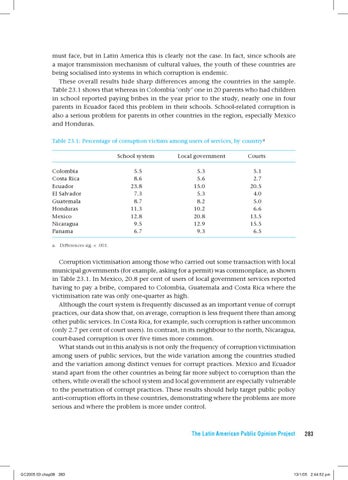
must face, but in Latin America this is clearly not the case. In fact, since schools are a major transmission mechanism of cultural values, the youth of these countries are being socialised into systems in which corruption is endemic. These overall results hide sharp differences among the countries in the sample. Table 23.1 shows that whereas in Colombia ‘only’ one in 20 parents who had children in school reported paying bribes in the year prior to the study, nearly one in four parents in Ecuador faced this problem in their schools. School-related corruption is also a serious problem for parents in other countries in the region, especially Mexico and Honduras. Table 23.1: Percentage of corruption victims among users of services, by countrya School system Colombia Costa Rica Ecuador El Salvador Guatemala Honduras Mexico Nicaragua Panama
5.5 8.6 23.8 7.3 8.7 11.3 12.8 9.5 6.7
Local government 5.3 5.6 15.0 5.3 8.2 10.2 20.8 12.9 9.3
Courts 5.1 2.7 20.5 4.0 5.0 6.6 13.5 15.5 6.5
a. Differences sig. < .001.
Corruption victimisation among those who carried out some transaction with local municipal governments (for example, asking for a permit) was commonplace, as shown in Table 23.1. In Mexico, 20.8 per cent of users of local government services reported having to pay a bribe, compared to Colombia, Guatemala and Costa Rica where the victimisation rate was only one-quarter as high. Although the court system is frequently discussed as an important venue of corrupt practices, our data show that, on average, corruption is less frequent there than among other public services. In Costa Rica, for example, such corruption is rather uncommon (only 2.7 per cent of court users). In contrast, in its neighbour to the north, Nicaragua, court-based corruption is over five times more common. What stands out in this analysis is not only the frequency of corruption victimisation among users of public services, but the wide variation among the countries studied and the variation among distinct venues for corrupt practices. Mexico and Ecuador stand apart from the other countries as being far more subject to corruption than the others, while overall the school system and local government are especially vulnerable to the penetration of corrupt practices. These results should help target public policy anti-corruption efforts in these countries, demonstrating where the problems are more serious and where the problem is more under control.
The Latin American Public Opinion Project
GC2005 03 chap08 283
283
13/1/05 2:44:52 pm