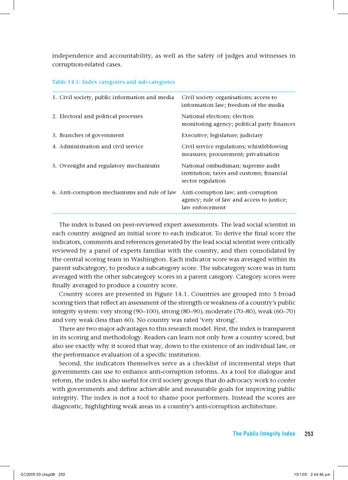
independence and accountability, as well as the safety of judges and witnesses in corruption-related cases. Table 14.1: Index categories and sub-categories 1. Civil society, public information and media
Civil society organisations; access to information law; freedom of the media
2. Electoral and political processes
National elections; election monitoring agency; political party finances
3. Branches of government
Executive; legislature; judiciary
4. Administration and civil service
Civil service regulations; whistleblowing measures; procurement; privatisation
5. Oversight and regulatory mechanisms
National ombudsman; supreme audit institution; taxes and customs; financial sector regulation
6. Anti-corruption mechanisms and rule of law Anti-corruption law; anti-corruption agency; rule of law and access to justice; law enforcement
The index is based on peer-reviewed expert assessments. The lead social scientist in each country assigned an initial score to each indicator. To derive the final score the indicators, comments and references generated by the lead social scientist were critically reviewed by a panel of experts familiar with the country, and then consolidated by the central scoring team in Washington. Each indicator score was averaged within its parent subcategory, to produce a subcategory score. The subcategory score was in turn averaged with the other subcategory scores in a parent category. Category scores were finally averaged to produce a country score. Country scores are presented in Figure 14.1. Countries are grouped into 5 broad scoring tiers that reflect an assessment of the strength or weakness of a country’s public integrity system: very strong (90–100), strong (80–90), moderate (70–80), weak (60–70) and very weak (less than 60). No country was rated ‘very strong’. There are two major advantages to this research model. First, the index is transparent in its scoring and methodology. Readers can learn not only how a country scored, but also see exactly why it scored that way, down to the existence of an individual law, or the performance evaluation of a specific institution. Second, the indicators themselves serve as a checklist of incremental steps that governments can use to enhance anti-corruption reforms. As a tool for dialogue and reform, the index is also useful for civil society groups that do advocacy work to confer with governments and define achievable and measurable goals for improving public integrity. The index is not a tool to shame poor performers. Instead the scores are diagnostic, highlighting weak areas in a country’s anti-corruption architecture.
The Public Integrity Index
GC2005 03 chap08 253
253
13/1/05 2:44:46 pm