‘Folklife Traditions’
FQ 43, Oct 2014, p42 v ‘F-F-D (sh-sh-sh) [The Foggy-foggy Dew]’, by Roy Palmer
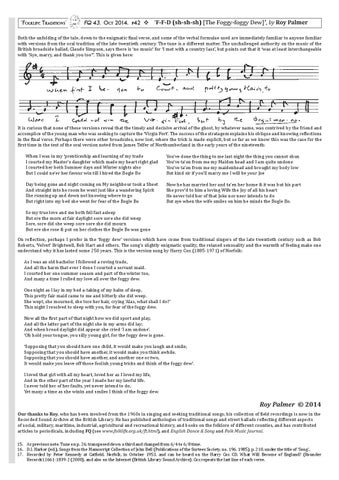
Both the unfolding of the tale, down to the enigmatic final verse, and some of the verbal formulae used are immediately familiar to anyone familiar with versions from the oral tradition of the late twentieth century. The tune is a different matter. The unchallenged authority on the music of the British broadside ballad, Claude Simpson, says there is ‘no music’ for ‘I met with a country lass’, but points out that it ‘was at least interchangeable with “Aye, marry, and thank you too”’. This is given here:
It is curious that none of these versions reveal that the timely and decisive arrival of the ghost, by whatever name, was contrived by the friend and accomplice of the young man who was seeking to capture the ‘Virgin Fort’. The success of the stratagem explains his oblique and knowing reflections in the final verse. Perhaps there were other broadsides, now lost, where the trick is made explicit, but so far as we know this was the case for the first time in the text of the oral version noted from James Telfer of Northumberland in the early years of the nineteenth: When I was in my ‘prenticeship and learning of my trade I courted my Master’s daughter which made my heart right glad I courted her both Summer days and Winter nights also But I could ne’er her favour win till I hired the Bogle Bo Day being gone and night coming on My neighbour took a Sheet And straight into he room he went just like a wandering Spirit She running up and down not knowing where to go But right into my bed she went for fear of the Bogle Bo So my true love and me both fell fast asleep But ere the morn at fair daylight sore sore she did weep Sore, sore did she weep sore sore she did mourn But ere she rose & put on her clothes the Bogle Bo was gone
You’ve done the thing to me last night the thing you cannot shun You’ve ta’en from me my Maiden head and I am quite undone You’ve ta’en from me my maidenhead and brought my body low But kind sir if you’ll marry me I will be your Joe
Now he has married her and ta’en her home & it was but his part She prov’d to him a loving Wife the Joy of all his heart He never told her of that Joke nor neer intends to do But aye when the wife smiles on him he minds the Bogle Bo.
On reflection, perhaps I prefer in the ‘foggy dew’ versions which have come from traditional singers of the late twentieth century such as Bob Roberts, ‘Velvet’ Brightwell, Bob Hart and others. The song’s slightly enigmatic quality, the relaxed sensuality and the warmth of feeling make one understand why it has lasted some 250 years. This is the version sung by Harry Cox (1885-1971) of Norfolk: As I was an old bachelor I followed a roving trade, And all the harm that ever I done I courted a servant maid. I courted her one summer season and part of the winter too, And many a time I rolled my love all over the foggy dew.
One night as I lay in my bed a-taking of my balm of sleep, This pretty fair maid came to me and bitterly she did weep. She wept, she mourned, she tore her hair, crying ‘Alas, what shall I do?’ This night I resolved to sleep with you, for fear of the foggy dew. Now all the first part of that night how we did sport and play, And all the latter part of the night she in my arms did lay; And when broad daylight did appear she cried ‘I am undone’. ‘Oh hold your tongue, you silly young girl, for the foggy dew is gone.
‘Supposing that you should have one child, it would make you laugh and smile; Supposing that you should have another, it would make you think awhile. Supposing that you should have another, and another one or two, It would make you leave off those foolish young tricks and think of the foggy dew’. I loved that girl with all my heart, loved her as I loved my life, And in the other part of the year I made her my lawful life. I never told her of her faults, yet never intend to do, Yet many a time as she winks and smiles I think of the foggy dew.
Roy Palmer © 2014
Our thanks to Roy, who has been involved from the 1960s in singing and seeking traditional songs; his collection of field recordings is now in the Recorded Sound Archive at the British Library. He has published anthologies of traditional songs and street ballads reflecting different aspects of social, military, maritime, industrial, agricultural and recreational history, and books on the folklore of different counties, and has contributed articles to periodicals, including FQ (see www.folklife.org.uk/ft.html), and English Dance & Song and Folk Music Journal.
15. As previous note. Tune on p. 26, transposed down a third and changed from 6/4 to 6/8 time. 16. D.I. Harker (ed.), Songs from the Manuscript Collection of John Bell (Publications of the Surtees Society, no. 196, 1985), p. 210, under the title of ‘Song’.. 17. Recorded by Peter Kennedy at Catfield, Norfolk, in October 1953, and can be heard on the Harry Cox CD, What Will Become of England? (Rounder Records11661-1839-2 (2000), and also on the Internet (British Library Sound Archive). Cox repeats the last line of each verse.