• Consider a land banking program by aggressively pursuing properties that have tax liens to be banked as potential sites for redevelopment/renovation. As a largely “built-out” city, existing properties and potential renovations or construction on vacant lots present key opportunities for Manchester to enhance its existing housing stock.
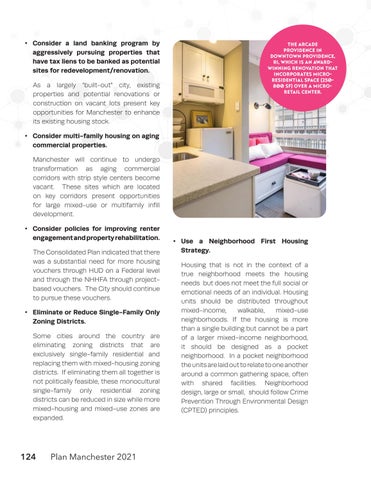
The Arcade Providence in downtown Providence, RI, which is an awardwinning renovation that incorporates microresidential space (250800 sf) over a microretail center.
• Consider multi-family housing on aging commercial properties. Manchester will continue to undergo transformation as aging commercial corridors with strip style centers become vacant. These sites which are located on key corridors present opportunities for large mixed-use or multifamily infill development. • Consider policies for improving renter engagement and property rehabilitation. The Consolidated Plan indicated that there was a substantial need for more housing vouchers through HUD on a Federal level and through the NHHFA through projectbased vouchers. The City should continue to pursue these vouchers. • Eliminate or Reduce Single-Family Only Zoning Districts. Some cities around the country are eliminating zoning districts that are exclusively single-family residential and replacing them with mixed-housing zoning districts. If eliminating them all together is not politically feasible, these monocultural single-family only residential zoning districts can be reduced in size while more mixed-housing and mixed-use zones are expanded.
124
Plan Manchester 2021
• Use a Neighborhood First Housing Strategy. Housing that is not in the context of a true neighborhood meets the housing needs but does not meet the full social or emotional needs of an individual. Housing units should be distributed throughout mixed-income, walkable, mixed-use neighborhoods. If the housing is more than a single building but cannot be a part of a larger mixed-income neighborhood, it should be designed as a pocket neighborhood. In a pocket neighborhood the units are laid out to relate to one another around a common gathering space, often with shared facilities. Neighborhood design, large or small, should follow Crime Prevention Through Environmental Design (CPTED) principles.