COVER STORY market phenomenon through the 1970s and 1980s. The Take the Time to Smile campaign spread out from France Soir to include De Telegraaf, Blick and Lavanguardia. By the 1980s, Smiley had become the iconic image of the up and coming electronic music scene and the face of defiant optimism for a generation finding refuge on the dance floors of the subversive underground. And by 1988 the second Summer of Love defined a major evolution of global youth culture. Smiley had grown from being a promotional tool to embracing the music and fashion of the day. By early 1993 however, Smiley was past its previous peak and in 1996, Franklin persuaded his son, Nicolas, to join the business.
As Nicolas explains, “My father had a really hard time persuading me. At the time, I was working for fashion designer Ozwald Boateng and I was used to the high-end fashion market. Smiley at the time simply didn’t fit that.” Nevertheless, despite his initial reservations, Nicolas joined Smiley. He gave the brand its name – Smiley – and relaunched it. Suddenly interest in Smiley began to grow again.
TOTAL BRAND LICENSING
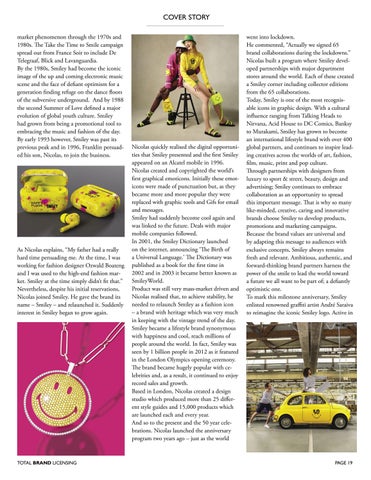
Nicolas quickly realised the digital opportunities that Smiley presented and the first Smiley appeared on an Alcatel mobile in 1996. Nicolas created and copyrighted the world’s first graphical emoticons. Initially these emoticons were made of punctuation but, as they became more and more popular they were replaced with graphic tools and Gifs for email and messages. Smiley had suddenly become cool again and was linked to the future. Deals with major mobile companies followed. In 2001, the Smiley Dictionary launched on the internet, announcing ‘The Birth of a Universal Language.’ The Dictionary was published as a book for the first time in 2002 and in 2003 it became better known as SmileyWorld. Product was still very mass-market driven and Nicolas realised that, to achieve stability, he needed to relaunch Smiley as a fashion icon – a brand with heritage which was very much in keeping with the vintage trend of the day. Smiley became a lifestyle brand synonymous with happiness and cool, reach millions of people around the world. In fact, Smiley was seen by 1 billion people in 2012 as it featured in the London Olympics opening ceremony. The brand became hugely popular with celebrities and, as a result, it continued to enjoy record sales and growth. Based in London, Nicolas created a design studio which produced more than 25 different style guides and 15,000 products which are launched each and every year. And so to the present and the 50 year celebrations. Nicolas launched the anniversary program two years ago – just as the world
went into lockdown. He commented, “Actually we signed 65 brand collaborations during the lockdowns.” Nicolas built a program where Smiley developed partnerships with major department stores around the world. Each of these created a Smiley corner including collector editions from the 65 collaborations. Today, Smiley is one of the most recognisable icons in graphic design. With a cultural influence ranging from Talking Heads to Nirvana, Acid House to DC Comics, Banksy to Murakami, Smiley has grown to become an international lifestyle brand with over 400 global partners, and continues to inspire leading creatives across the worlds of art, fashion, film, music, print and pop culture. Through partnerships with designers from luxury to sport & street, beauty, design and advertising; Smiley continues to embrace collaboration as an opportunity to spread this important message. That is why so many like-minded, creative, caring and innovative brands choose Smiley to develop products, promotions and marketing campaigns. Because the brand values are universal and by adapting this message to audiences with exclusive concepts, Smiley always remains fresh and relevant. Ambitious, authentic, and forward-thinking brand partners harness the power of the smile to lead the world toward a future we all want to be part of; a defiantly optimistic one. To mark this milestone anniversary, Smiley enlisted renowned graffiti artist André Saraiva to reimagine the iconic Smiley logo. Active in
PAGE 19