the call to adventure spring 2025 — issue two
GuidinG utah RaFtinG & BiKinG adventuRes since 1966
Rafting trips in the Green, Colorado, Yampa & San Juan Rivers Biking the White Rim Trail, Maze & San Rafael Swell Trips range from 2 to 6 days, beginner to expert level
800-624-6323 • www.BikeRaft.com • Follow us on Instagram ~ bikeraft
the call to adventure
Open Roads is a community of creative adventure lovers who are ready to unplug from distractions, experience joy in nature and build uplifting human connections. Our goal with this Journal is not to encourage everyone toward bold and daring outdoor adventures (although we love this and can certainly help you get there), but to remind you that adventure comes in all forms; it simply needs to challenge you, to make you feel vibrant, and to leave you fulfilled. As Howard Thurman wisely put it:
“Ask what makes you come alive, and go do it. Because what the world needs is people who have come alive.” Thanks to our subscribers and the generous support of a few small foundations, we proudly distribute the Open Roads Journal at no cost to schools and youth organizations across the country. We believe this will inspire the next generation to be stewards of our natural world and compassionate leaders ready to embrace adventure as a way of life.
SUBSCRIBE TO THE JOURNAL openroadsjournal.com
YOUTH ACADEMY openroads.org
|1
contents ISSUE II
2 | openroads roads
The Creative Conservationist 6 Photographs by Chad Brown
Join two remarkable adventures into the Arctic National Wildlife Refuge (ANWAR), where BIPOC leaders are immersed in the traditions of the Gwich’in and Iñupiat people and explore the role they can play in the protection of one of the last largely untouched natural landscapes on earth.
Safari As a Way of Life 24 The Journals of Dan Eldon Introduction by Trevor Hall
To meet Dan Eldon through the pages of his journals is to be taken on a wild journey of the imagination, guided by insatiable curiosity, blinding creativity and a love of the human condition in all its forms.
Beneath the Waves, Beyond the Self 44 Photographs by Kramer Wimberley
See through the lens of Kramer Wimberley and his ocean-loving team from Diving with a Purpose as they bring youth of all backgrounds to learn about the conservation and protection of submerged heritage resources, with a focus on the documentation and interpretation of African slave trade shipwrecks and the maritime history of African Americans.
Changemakers 62
Photographs by Nikki Hausherr Program Lead, Zaira Barajas It is an honor to introduce a group of brave and motivated young Latina leaders from New York State as they embark on an adventure into the dark sky world of Dinosaur National Monument, which is part of a yearlong program to learn how they can become the change they want to see in the world.
From Mountains to Rivers the Water Flows 80
Photographs by Paul Ryan Introduction by Maxwell Taylor Kennedy Join us in celebrating the trailblazing adventure photographer and award-winning cinematographer Paul Ryan as his story reminds us to say “yes” to life’s invitations, even when they lack the luxury of certainty.
|3
Editor’s Story
A
s we send out our second issue of the Open Roads Journal, we can’t help but recognize a growing sense that we live in a world increasingly marked by change and uncertainty. From fires to floods, from the suffering of war to the fractured egos of the warlords who start them, we are surrounded by evidence of how quickly things can fall apart when we live out of alignment with nature — or with our shared human values of empathy and compassion. However, we also want to use this moment to remind ourselves that those realities inevitably, eventually, bend to our most unwavering tendency toward resilience, love and the strength of our interconnected human ecosystem. This, of course, is best modeled by the cycles of the natural world, where vibrant life always emerges from the ashes of even the most devastating change. With that in mind, we hope this issue encourages all of us to get outside again, to lay down our digital distractions and connect with the awe-inspiring people and places that surround us. Most of all, we hope the stories ahead stir and activate our adventurous curiosity and guide us to celebrate all that is still good in this world. As you join us on this journey, prepare to travel far and wide in word and image both. We begin with the work of Chad Brown, a true creative conservationist, as he combines his commitment to protecting our natural lands with his talent for convening people of all backgrounds to reunite with mother earth and to think in the realms of hope and solutions. From there, we celebrate a most beloved noisy spirit, Dan Eldon, who has been our longtime guide from within, and whose journals serve as an inspiration for the ethos and beliefs that drive Open Roads. We then circle up with a group of young Latina Changemakers from New York State as they set out to learn the lessons of personal growth and social change, while expanding their belief systems on an awe-inspiring river adventure. Next, we dive into one of the most remarkable lives of service as we meet Kramer Wimberley and admire his lifelong commitment to the ocean, and to sharing his love of the underwater world. We are also excited to offer poetry for the first time, with the dream-filled words of Saba Husain, in response to her daughter’s first time in dark sky country. Finally, we pay tribute to a trailblazing adventure photographer and filmmaker, Paul Ryan, as he reminds us that those simple moments stepping outside your house — even just to play in the shadows of a Boston forest — can lead to unimaginable adventures and a wonderful life. We just need to follow the roads that life opens for us, while embracing the uncertainty of the adventure. Thanks for joining us on the open roads ahead, The Editors
4 | openroads roads
Editor and Creative Director Trevor Hall
Publishers
Vicki Kennedy Jaunt Media Collective
Art Director
Sam Hartman
Design Consultant Kitty Nicholason
Fulfillment Coordinator Natalie Luongo
Founding Editors Pixie Mudge Pam Boll Jenn Gross Dr. Joanne Marien Penny Rhodes John Heffernan Jade Rhodes
Head of Programs & Partnerships Roger Bristowe
Publisher Circle
Cara Casey Judy Wise Kathy Eldon Amy Eldon-Turteltaub Jon Turteltaub Bill Rossi Nick Rhodes Jimmy Hunter Grant Kirsh Patti Hausherr Marshall Whiting Amy Paige Artemis Joukowsky Bonnie Strauss Dan & Peggy Hoover Deric Redmond Jason Goldberg Jeff Goldman Jon Rubin Nancy Rubin Warner Paige & Judy Hall Larry Hall & Flinn Dallis John & Carol Casey
Cover Photograph
Rick Ridgeway Mammoth to Yosemite Ski Tour, 1975 Photo by Paul Ryan Open Roads Company LLC 1223 Wilshire Boulevard, #351 Santa Monica, California 90403 To contact or for sponsorship opportunities, email: trevor@openroads.org Phone: 312-320-5909 Copyright ©2025 All rights reserved. No part of this publication may be reproduced in any form or by any means without prior written permission. Printed in Colorado. Committed to environmental preservation, we use PrintReleaf to calculate paper usage and plant trees in certified forests globally.
opening the outdoors to all since 2001
The Creative Conservationist Photography by Chad Brown
C
HAD BROWN is a celebrated photographer, filmmaker, creative strategist and proud Veteran. He is also a wonderfully devoted conservationist who has a knack for convening remarkable groups of leaders to embark on journeys into our most treasured wild spaces. Chad’s recent adventures are run through the organization Love is King (LIK), which is committed to creating a reimagined outdoor environment focused on participation, representation, inspiration and advocacy. The mission of LIK Operation ROAM (Rapid Ongoing Advance Missions) is to provide an opportunity for BIPOC individuals (21 and over) to step into the realm of public land and freshwater conservation. Historically, BIPOC voices were not invited in government, congressional or decision-making spaces when it came to wildlife and indigenous policies, recreation, permitting, land management and advocacy in the outdoors. LIK ROAM magnifies the voices of BIPOC leaders and provides representation where it counts.
6 | openroads roads
In the pages ahead, we are invited to peek into two adventures: one shared by a group of inspiring female leaders, and another uniting five veterans. In both cases they traveled to the Arctic Village in the Arctic National Wildlife Refuge (ANWAR), where they were immersed in the culture, lifestyle and traditions of the Gwich’in and Iñupiat people — two communities whose connection to the land and subsistence way of life has guided the management of this unique landscape for millennia. This land is now threatened by the Ambler Access Project. AAP is a proposed 211-mile controlled industrial-access road in Northwest Alaska that would open this fragile ecosystem to mineral extraction and destroy one of the last largely untouched natural landscapes on earth. Both initiatives not only enable a powerful journey of self-discovery in the Arctic but also aim to develop stories that highlight the role these leaders (and perhaps all of us) can play in protecting this sensitive natural treasure.
|7
8 | openroads roads
|9 brown
10 | openroads roads
| 11 brown
12 | openroads roads
| 13 brown
14 | openroads roads
| 15 brown
16 | openroads roads
| 17 brown
18 | openroads roads
| 19 brown
20 | openroads roads
| 21 brown
22 | openroads roads
brown Learn more about Love is King, Operation ROAM
Chad Brown Mother — Sisterhood in the Wild film page
To learn more about Soul River and support their work, visit https://soulriverinc.org/.
To see more of Chad’s stunning photography, visit chadocreative.com.
| 23
Safari As a Way of Life The Journals of Dan Eldon INTRODUCTION BY TREVOR HALL
T
HE FIRST TIME I encountered Dan’s journals, they tore open my heart to reveal a part of myself that I had not yet dared to dream I could have. What I quickly learned about his alluring way of being was that while born in London, Dan Eldon was in fact a child of Africa. His mother, Kathy, a proud Iowa writer and his father, Mike, a distinguished British businessman, were brought to Nairobi, Kenya for work when Dan was seven years old. The spirit of the place quickly put a stamp on Dan’s soul that inspired a curious, adventurous, kind and creative kid to live life with a unique flair, pluck and passion that now influences generations of creative activists. It started simply, though. From the jump, when Dan heard of a problem, he instinctively thought in terms of solutions … and fun! As a teenager, Dan heard that a local Masai girl needed heart surgery, so he threw a raucous party and raised the money she needed. When he heard of a famine in Malawi, he set up a charity, which he named Student Transport Aid (STA) so he and a ragtag collection of friends could bring aid to the region. STA attracted the interest of local television stations and newspapers, and together with 15 friends, they raised $25,000 for their venture. The friends, representing six countries, met in Nairobi and traveled thousands of miles together in three vehicles (including his beloved Deziree — a cranky old 1970s Land Rover often featured in his journals) to a refugee camp in Malawi. There, they donated one of their vehicles to the Save the Children Fund, as well as
24 | openroads roads
money for three wells and blankets for a children’s hospital. As would become a pattern for so many people touched by Dan, those brave “kids” from STA were forever changed by his energy in a way that shaped all their lives. Each of them went on to chart big, bold lives: Christopher Nolan winning Academy Awards; Elinor Tatum becoming Publisher of the New York Amsterdam News, which is the largest and perhaps most influential Black-owned and operated newspaper in the country; Roko and Adrian Belic winning Emmys for documentaries that moved the hearts of millions; Hayden Bixby becoming a beloved teacher and founding an orphanage back in Kenya — and on it goes. But at the time, they were all just scrappy young adults moved into action by Dan. As you will soon learn, Dan did all of this with his eyes wide open and his creative energy pouring onto the pages of his journals. In Dan’s final act of compassionate storytelling, in the summer of 1992 while the famine in Somalia was raging, Dan flew from Kenya to the southern Somali town of Baidoa, where he shot some of the first pictures to touch the conscience of millions. The international news agency Reuters spotted his work, and by Christmas Dan was working for the company, shooting the increasingly desperate situation. He became the youngest Reuters photojournalist and his images, featured on the cover of Newsweek and other publications, played a key role in bringing international aid to the region.
Despite the dire realities there, Dan always felt protected in Mogadishu. He spoke the African languages of Swahili and enough Somali to swear at the thieves who often tried to steal his equipment. He moved easily from the notorious Bahara Market, home of Mogadishu’s most dangerous criminals, to dine with the heads of aid missions, generals and UN advisors. Initially viewed as another enthusiastic youngster, he soon earned the title of a true professional, along with the respect of his colleagues, friends and locals, who called him “The Mayor of Mogadishu” because of his friendliness to all. Dan eventually lost his life on that assignment, caught in an angry mob that was turning on foreign-looking journalists — even though Dan had become anything but foreign. The details are heartbreaking and perhaps don’t need to be recounted here. Because far more important than the story of his passing, was the brilliance of the way he lived his all-too short 22year life, and the invitation he gave us to follow his lead. After his passing, friends and family started to discover his journals tucked in closets in Iowa, trunks of cars in Kenya, under beds in flats of London. In all, 17 spectacular bound journals were found and brought together, every page a piece of art — drawings, photographs, scraps of paper, dirt and sundry artifacts from a man who had traveled to over 40 countries and lived with the zest of someone who believed safari could be a way of life. Today, Dan’s legacy is carried on by his mother, Kathy, and his sister, Amy, through the Creative Visions Foundation in Malibu, California. They are now supporting thousands of creative activists who, like Dan, use media and the arts to change the world for the better. They also created a vast outreach program in partnership with Discovery Education that
reaches millions of students every year. The Creative Visions Center is also the place Dan’s physical journals call home. On a more personal level, Dan’s story has always been part of the Open Roads story. It was in the pages of our mother magazine, DoubleTake, that Dan’s journals were put in print for the first time, which led to the publication of books, as well as the production of documentary films and a narrative feature film, Journey is the Destination, about his life. Those first images also gave fuel to the start of Creative Visions and Open Roads. Over the years his family, with their ever-extended warmth, humor and boundless generosity, became our family. To share Dan’s artwork on our pages today is much more than just a full circle moment — it is another magical pass on an infinity loop of love, one that extends beyond the known and is lined with the energy of one beautifully noisy spirit.
Creative Visions
| 25
26 | openroads
| 27 eldon
28 | openroads
| 29 eldon
30 | openroads roads
| 31 eldon
32 | openroads roads
| 33 eldon
34 | openroads roads
| 35 eldon
36 | openroads roads
| 37 eldon
38 | openroads
| 39 eldon
40 | openroads roads
| 41 eldon
42 | openroads roads
We are eternally grateful for the brave firefighters who risked their lives to protect all of us during the catastrophic Eaton and Palisade Fires of 2025.
We also want to extend our deep and heartfelt gratitude to the local firefighters as well as Dr. Chester Griffiths and the small crew of neighbors who spent sleepless nights protecting one micro community on PCH that included the Creative Visions Center, where Dan’s journals are kept, and where they are safe today.
creativevisions.org
| 43
Beneath the Waves, Beyond the Self Photographs by Kramer Wimberley
44 | openroads roads
D
R AW N T O T H E WAT E R at an early age, Master Scuba Diver Trainer Kramer Wimberley was destined to spend his life below the surface of the water. From his early days as a youth on the shores of Sandy Hook, New Jersey, he developed an interest in what the underwater world had to offer. It wasn’t until the summer of 1985 that he would get a chance to explore off the shores of Bermuda’s spectacular crystal-clear waters and coral crushed pink sand beaches that the ocean quickly became a second home. Kramer has now spent 40 years of his life as a scuba diver and Master Scuba Diver Trainer, teaching all around the world through his company Dive Tours International. Kramer is also a tireless and admirable volunteer. He spent several years serving with the Boys and Girls Club of Newark, New Jersey, as well as offering his time as a volunteer diver for the State of New Jersey Camden Aquarium. He has spent years volunteering his time as a scuba instructor to teach inner city youth and others new to the water. Kramer furthers his volunteer work as Safety Officer for several scuba clubs: Aquatic Voyagers Scuba Club, Urban Network Dive Education Resource Center and as one of the Safety Officers for the National Association of Black Scuba Divers.
| 45
Diving With a Purpose
D
IVING WITH A PURPOSE is a group of dedicated divers and water lovers who are dedicated to the conservation and protection of submerged heritage resources by providing education, training, certification and field experience to adults and youth in the fields of maritime archaeology and ocean conservation. Their special focus is the protection, documentation and interpretation of African slave trade shipwrecks and the maritime history and culture of African Americans. In addition to the Underwater Survey Archeology program, Kramer is also working with YDWP to teach Coral Restoration as a means of preserving one of our nation’s most valuable resources. When we first spoke to Kramer about sharing his story in the Open Roads Journal, he recalled the first time he
46 | openroads roads
entered the water with the Diving with a Purpose team. What was originally imagined as a nice vacation with some alluring dives turned into an invitation to join the work of gently cleaning and restoring the underwater coral. After an hour of scrubbing the precious coral and seeing the results, Kramer came back to the surface with one thought: “If this is all I do with the rest of my life, it will be a life well lived.” This from a man with a life of service and purpose that is exemplary in every way. Needless to say, Kramer has never looked back and we are honored to offer a glimpse into his world of teaching. Use this to learn more and support or join the Diving with a Purpose team.
| 47 wimberley
48 | openroads roads
| 49 wimberley
50 | openroads roads
| 51 wimberley
52 | openroads
| 53 wimberley
54 | openroads roads
| 55 wimberley
56 | openroads roads
| 57 wimberley
58 | openroads roads
wimberley Kramer Wimberley Diving with a Purpose
| 59
When Naila Paul returned from her first trip into true wilderness, she tried to explain to her mother what it was like to look up into the clear dark skies and for the first time see a seemingly endless universe of stars. Her mother, Saba, a seasoned poet, responded by crafting a poem meant to mirror the emotion and wonder shared by her daughter. This is that poem.
Sitara You spoke of the stars not those of any sky but the ones you said were prophecies silhouetting dusky mountains in the desert and I found myself slipping into the vowels of a poet’s tongue— knowing full well of the darkness which pulls from eons upon eons of sequined night and a universe inside of a universe I may never lay eyes on and having long turned into the dust I always knew I was molded from will hold my silence in solidarity with billions and billions — Saba Husain Purchase Saba’s recent book of poems, Elegy for My Tongue
60 | openroads
Open Roads partnered with Fervor & Zeal to recruit an artist to craft a design inspired by our work. They connected us with the amazing Matese Fields, who created this stunning design. You can purchase merchandise showcasing this design by following the QR code. And buy happy knowing 50% of profits made from each purchase are shared with both Matese and Open Roads.
Fervor & Zeal
Matese Fields
| 61
Changemakers Photographs by Nikki Hausherr
F
or the past few years, a group of daring young Latina women from Westchester County, New York, have embarked on the yearlong Changemakers Program to learn the fundamental value of civic engagement and leadership development. The result is a cohort of visionary women who are poised to be the leaders of a vibrant future for all of us. Drawn from the Tarrytown, Ossining and Peekskill School Districts — guided by the vision of Dr. Joanne Marien and Dr. Ray Sanchez, and led by the wildly talented educators Dr. Madeline Diamond and Zaira Barajas — these inspiring women spend the better part of a year learning the essential elements of positive social
62 | openroads roads
change and personal growth. The program culminates with a public exhibition where participants declare the impact they want to have in their communities. As part of the program, they also agree to join an awe-inspiring personal development adventure where they experience the raw beauty of Utah’s Dinosaur National Monument on a four-day river rafting trip through the majestic Gates of Lodore Canyon, on our country’s mighty Green River. What’s ahead is a glimpse into the joy and transformation they experience by venturing outside of their comfort zones and into a Changemaker’s mindset.
| 63
64 | openroads
| 65 changemakers
66 | openroads
| 67 changemakers
68 | openroads
| 69 changemakers
70 | openroads
| 71 changemakers
72 | openroads
| 73 changemakers
74 | openroads roads
| 75 changemakers
76 | openroads
| 77 changemakers
78 | openroads
| 79 changemakers
From Mountains to Rivers the Water Flows Spotlight: Paul Ryan INTRODUCTION BY MAXWELL TAYLOR KENNEDY
P
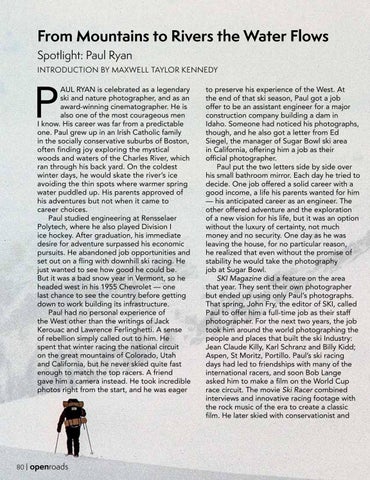
AUL RYAN is celebrated as a legendary ski and nature photographer, and as an award-winning cinematographer. He is also one of the most courageous men I know. His career was far from a predictable one. Paul grew up in an Irish Catholic family in the socially conservative suburbs of Boston, often finding joy exploring the mystical woods and waters of the Charles River, which ran through his back yard. On the coldest winter days, he would skate the river’s ice avoiding the thin spots where warmer spring water puddled up. His parents approved of his adventures but not when it came to career choices. Paul studied engineering at Rensselaer Polytech, where he also played Division I ice hockey. After graduation, his immediate desire for adventure surpassed his economic pursuits. He abandoned job opportunities and set out on a fling with downhill ski racing. He just wanted to see how good he could be. But it was a bad snow year in Vermont, so he headed west in his 1955 Chevrolet — one last chance to see the country before getting down to work building its infrastructure. Paul had no personal experience of the West other than the writings of Jack Kerouac and Lawrence Ferlinghetti. A sense of rebellion simply called out to him. He spent that winter racing the national circuit on the great mountains of Colorado, Utah and California, but he never skied quite fast enough to match the top racers. A friend gave him a camera instead. He took incredible photos right from the start, and he was eager
80 | openroads
to preserve his experience of the West. At the end of that ski season, Paul got a job offer to be an assistant engineer for a major construction company building a dam in Idaho. Someone had noticed his photographs, though, and he also got a letter from Ed Siegel, the manager of Sugar Bowl ski area in California, offering him a job as their official photographer. Paul put the two letters side by side over his small bathroom mirror. Each day he tried to decide. One job offered a solid career with a good income, a life his parents wanted for him — his anticipated career as an engineer. The other offered adventure and the exploration of a new vision for his life, but it was an option without the luxury of certainty, not much money and no security. One day as he was leaving the house, for no particular reason, he realized that even without the promise of stability he would take the photography job at Sugar Bowl. SKI Magazine did a feature on the area that year. They sent their own photographer but ended up using only Paul’s photographs. That spring, John Fry, the editor of SKI, called Paul to offer him a full-time job as their staff photographer. For the next two years, the job took him around the world photographing the people and places that built the ski Industry: Jean Claude Killy, Karl Schranz and Billy Kidd; Aspen, St Moritz, Portillo. Paul’s ski racing days had led to friendships with many of the international racers, and soon Bob Lange asked him to make a film on the World Cup race circuit. The movie Ski Racer combined interviews and innovative racing footage with the rock music of the era to create a classic film. He later skied with conservationist and
The North Face founder, Doug Tompkins, who taught him to fly and even sold him his first Cessna airplane. Paul was making it a habit to say yes to life’s unexpected invitations, and it was starting to pay off for him. Soon enough, though, Paul’s talent and dedication were noticed beyond the ski world and he was invited to study with some of the great photographers of the 20th Century: Minor White, Ansel Adams and W. Eugene Smith to name a few. But Paul came to prominence on his own terms, chronicling the 1960s San Francisco counterculture through still photography and cinema. He was involved in the social ferment of the times and photographing the music: The Grateful Dead, Jim Morrison, the Monterey Jazz Festival and Anna and Lawrence Halprin’s Experimental Workshops at Sea Ranch. He made a documentary film on the San Francisco Hells Angels and once tied himself, facing backward, onto the Harley Davidson of Sweet William to film the bikers speeding along the highways through the hills of Marin. He also came upon Stokely Carmichael on his travels and photographed him giving his historic Black Power speech at Berkeley. Paul’s original draw to the mountains eventually led him to follow a flow to the rivers. Wayne Kakela, one of those met-by-chance friends, invited him to join a month-long rafting trip down the Colorado River, where it carves its deep path through the Grand Canyon. The four weeks moving slowly at the river’s pace altered his perception of the elements of nature, as well as insights into the spirit of the people who were pulled to such a daring trip, as revealed on the pages ahead. Paul’s talent with the visual image soon led him to feature films, and to a remarkable
string of success. Paul took the set photos for American Graffiti and amassed a wonderful run of credits, including second unit cinematography on Terrence Malick’s classic, Days of Heaven, and Robert Redford’s A River Runs Through It. Both won the Oscar for Best Cinematography. He would return to work with Redford as second unit director on The Horse Whisperer. Most recently, Paul has been working for Wondros, filming social justice issues for foundations and educational institutions around the world, including a feature film on George Soros that opened at the Telluride Film Festival. His recent book, Above Ground Level, depicts in word and image his view of the land from his single-engine Cessna aircraft — camera in one hand, yoke in the other. I asked Paul why he loves making photographs after all these years. “The photographs often reveal what I didn’t see when I took the picture. My photography began as an effort to record my many activities, on the land, the snow and on the water. Then, as I explored the images, I saw that the photographs took on their own identity. And juxtaposing disparate images revealed a language that transcended words to create another complex manifestation of my experience — a synthesis greater than the rational sum of the parts.” I am, personally, forever grateful to Paul for capturing images of my parents, Ethel and Senator Robert F. Kennedy. They met Paul skiing … his photos hung on the walls of our Hickory Hill home in Virginia. So, I was long familiar with his work before I met Paul. Those images are lasting reminders for our family that adventure in the outdoors was a treasured part of our parents’ life and legacy, and one we intend to uphold and hand forward.
| 81
Billy Kidd & Karl Schranz Bugaboos, Canada
82 | openroads roads
ryan | 83
Mountaineer Gary Hemming and son in Grenoble, France
84 | openroads roads
ryan | 85
86 | openroads roads
ryan These photos are from Paul’s profile of Nancy Greene in SKI Magazine. Nancy was arguably the best woman skier of her era, winning successive World Cups in 1967 and 1968.
| 87
88 | openroads roads
ryan | 89
90 | openroads roads
ryan | 91
92 | openroads roads
ryan Henry Barber (center), solo climbing pioneer and perhaps the best rock climber in the world at that time. Paul was filming Henry for ABC Sports, cliff climbing in Wales with the local climbers. | 93
94 | openroads roads
ryan | 95
Paul Ryan in competition
96 | openroads
ryan
Senator Robert F. Kennedy and Ethel Kennedy Sun Valley, Idaho
| 97
Paria Canyon, Utah 98 | openroads roads
ryan | 99
Anne Peterson, Grand Canyon
100 | openroads
ryan | 101
Wayne Kakela and fellow adventurers, Colorado River
102 | openroads
ryan | 103
Paul tied to Sweet William Fritsch’s Harley, filming Hells Angels PHOTO BY DON MCKINNON
104 | openroads roads
ryan Paul in kayak preparing to film from the water PHOTO BY MELISSA PAINTER
| 105
106 | openroads roads
ryan Paul in kayak, filming A River Runs Through It PHOTO BY JERRY JOHNSON
| 107
SELF PORTRAIT, 2013 Taken the year Leica introduced their MONOCHROM Camera, whose sensor took only black and white images. It had much higher quality than converting from color. Given Paul’s extensive black and white photography, they loaned him one for several weeks.
Robert Redford Interview
Ski Racer 1969 World Cup 108 | openroads roads
ryan Paul on the glaciers above Val-d’Isère, Jean-Claude Killy’s hometown, riding the hills on a Bultaco motocross bike lent to him by Killy after the filming of Ski Racer, 1969. PHOTO BY JEAN CLAUDE KILLY
To see more of Paul’s work , subscribe to his Substack
| 109
A THOUSAND SUMMERS Scholarship Opportunities
Support Our Work
A Thousand Summers (ATS) supports the
Our mission is to change kids’ lives through
development of youth across the United States
transformative summer camp experiences.
through a variety of culturally responsive programs
Individuals, companies, and brands that share
centered around a multi-year adventure summer
our values can play a pivotal role in supporting the
camp experience. The ATS Campership Program
expansion and reach of our programs. By working
provides scholarships to remove the barriers to high-
together we can make a significant impact on the
impact summer camp experiences that are proven to
lives of the youth we serve, the communities to
advance youth toward a successful future.
which they belong, and the future we will all share.
Scan the QR code to learn how you can become a
Scan the QR code to learn how YOU can help
Summer Camp Scholarship Recipient and begin
cultivate the next generation of leaders!
your journey of a thousand summers.
Scan for Scholarship Opportunities
110 | openroads roads
Scan to Support Our Work
Visit AThousandSummers.org to learn more.
Sabina was a student on the second ever Open Roads trip, in 2002! She was also a peer mentor before going on to spend many years as an Outward Bound instructor, a teacher, a camp director, and a middle school teacher. She returned as an Open Roads Guide in 2024, and is currently a humanities teacher at Our Sisters School in New Bedford, Massachusetts.
Shania was a participant on Open Roads’ 2023 Changemakers Program. She went on to receive a full ride scholarship to Cornell College, where she is studying Environmental Policy. She has received numerous prestigious awards, and participated in our 2024 Outdoor Leaders Program to continue her commitment to teaching in the outdoors.
Quamae was a high school participant in 2015 and then became a peer mentor on two subsequent adventures. Soon after, Quamae earned a degree in Photography from of Northern Michigan University and has now been a leader on nearly a dozen Open Roads programs. He is currently a media specialist for the beloved teacher, Jason Wilson and his Cave of Abdullah youth development program in Detroit, Michigan.
ALUMNI PROFILES OVER THE DECADES
OPEN ROADS ACADEMY TO LEARN HOW OPEN ROADS ACADEMY PARTNERS WITH SCHOOLS, YOUTH ORGANIZATIONS AND FOUNDATIONS TO CREATE LIFECHANGING ADVENTURES FOR OUR FUTURE LEADERS, VISIT: Instagram @openroadsoutdoors
facebook.com/ theopenroads
Website openroads.org
Special Thanks Blue Chip Foundation William Jeff and Jennifer Gross Family Foundation Peter Stengaard Boll Family Trust Strauss Family Foundation The Foundation for Systemic Change Dr. Joanne Marien The Joukowsky Family Foundation Tillie Walton Squid and Squash Foundation Nancy Rubin Bonnie Strauss Gould Ilene Resnick Dr. Ray Sanchez Andrea “Chilly” Hanson Camp Thunderbird Charitable Foundation The Rhodes Family Laurence Hall & Flinn Dallis Nancy Olin Natasha Joukowsky Marshall Whiting Michael Bedner Torre Brannon | See a Man Be a Man Jazmin Miranda Wendy Jacobson & Bill Smee Dr. Robert Coles Asa Baber Dr. Charlie Abramson Cara, Harper & Casey Hall … and Bear and Surfer The 500+ Alumni of Open Roads (and growing!)
Lifestyle magazines that
INFORM + INSPIRE! + SP RIN WI NT ER 3-24 202 WI NT ER
+
SP RIN
SU MM
+
20 22
G
G
ER
SU MM
+
ER
FAL L
FAL L
20 23
2024
2023
FOR TIPS N N TA I MOU ETES AT H L
E E RID IS TH HE TH T WOR ? RISK
f Rise O ork te W Remo the in ins Mounta
+
TA L MEN S LNES WEL E IN TH NS N TA I MOU
n Fire Art O turn in Min ay: Getawatt, Zerm and rl ze it Sw
VA IL +
M IN TU
RN +
EA
A RD + ED W
AV ON A IL + G LE -V
G LE S + EA
+ G YP
ing a BecomMama
SU M Mountain
VA IL +
T H
E
B
H U
O F
A D
V E
M IN TU
U N T
RN +
R E
EA
I N
AV ON
e On Th E R
WAT
g
unnin Trail RTips Safety
uide to Your G room Mush ing ra Fo g A IL + G LE -V
ING L E AV Y G AC A LE
AR DS + ED W
+ EA G
LE + G
Family I F E owere VA N L R x a M + Natu lower Wildf N D O R on Art SU M SPLE + G YP EA G LE
YP SU M
VA IL +
W E
S T
E R
N
L O
C O
R A
M IN TU
RN +
EA G LE
+ AV -VA IL
ON +
ED WA RD
S +
VA IL +
M IN TU
RN +
EA
A IL + G LE -V
AV ON
AR DS + ED W
+ EA G
LE + G
YP SU M
D O
S 14 OOM RT BL DESE S ARE G IN R SP HOT ASON 46 IN SE Y RMON G HA R P S INONIA 64 IN PA O OFF T S 70 HATS LE CHEF FEMA
SPRING
l l e W
In sp
the
RENEW
AL
ir ed
Li vi n
g
LE WHO H T L H E A U R AN G O
issue
OD S PE T E S C A T S P R IN G HO
In sp
ir ed
Li vi n
V ITAg Athletes in
For Ag
RE
AT B
E N TAT JU V E ay
YL LIFEST
E • CO
In Co
IL D R E W or Gear
E S of C Y C LL E N E S S ailea WHO rand W
MMUN
ITY •
WELLN
E
202 2 FAL L
VEMEN
VENTU
RE
With Ev
SU MM
T • AD
i
In Mau
ONS LESS ep L IF E ery St
ER +
UAL SPIRIT
E • MO
T
At G
T L IFNEATAUFRAL HGEEATLAINWGAYS AT U R SS • N
O DY
NG
NGTH S T R Emmunity
iss W
The Sw
utdo
+
19
AL I L H E TICS T U R A H E R APE U
Your O
S ER LOS
/ ISSUE
g
NA
L IT Y
2022
WIN
TER
R + SP
ING
202
3 -2 4
SUM
MER
+ FA
02 LL 2
4
coveredbridgevail.com | spokeandblossom.com | yogalifelive.com | wellmagco.com
d o w h a t m a ke s yo u co m e a l i ve