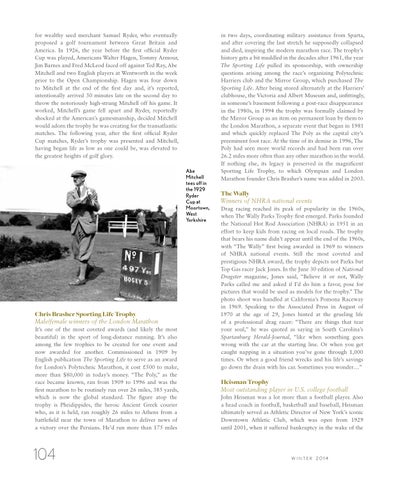
for wealthy seed merchant Samuel Ryder, who eventually proposed a golf tournament between Great Britain and America. In 1926, the year before the first official Ryder Cup was played, Americans Walter Hagen, Tommy Armour, Jim Barnes and Fred McLeod faced off against Ted Ray, Abe Mitchell and two English players at Wentworth in the week prior to the Open Championship. Hagen was four down to Mitchell at the end of the first day and, it’s reported, intentionally arrived 30 minutes late on the second day to throw the notoriously high-strung Mitchell off his game. It worked, Mitchell’s game fell apart and Ryder, reportedly shocked at the American’s gamesmanship, decided Mitchell would adorn the trophy he was creating for the transatlantic matches. The following year, after the first official Ryder Cup matches, Ryder’s trophy was presented and Mitchell, having began life as low as one could be, was elevated to the greatest heights of golf glory. Abe Mitchell tees off in the 1929 Ryder Cup at Moortown, West Yorkshire
Chris Brasher Sporting Life Trophy
Male/female winners of the London Marathon It’s one of the most coveted awards (and likely the most beautiful) in the sport of long-distance running. It’s also among the few trophies to be created for one event and now awarded for another. Commissioned in 1909 by English publication The Sporting Life to serve as an award for London’s Polytechnic Marathon, it cost £500 to make, more than $80,000 in today’s money. “The Poly,” as the race became known, ran from 1909 to 1996 and was the first marathon to be routinely run over 26 miles, 385 yards, which is now the global standard. The figure atop the trophy is Pheidippides, the heroic Ancient Greek courier who, as it is held, ran roughly 26 miles to Athens from a battlefield near the town of Marathon to deliver news of a victory over the Persians. He’d run more than 175 miles
104
in two days, coordinating military assistance from Sparta, and after covering the last stretch he supposedly collapsed and died, inspiring the modern marathon race. The trophy’s history gets a bit muddled in the decades after 1961, the year The Sporting Life pulled its sponsorship, with ownership questions arising among the race’s organizing Polytechnic Harriers club and the Mirror Group, which purchased The Sporting Life. After being stored alternately at the Harriers’ clubhouse, the Victoria and Albert Museum and, unfittingly, in someone’s basement following a post-race disappearance in the 1980s, in 1994 the trophy was formally claimed by the Mirror Group as an item on permanent loan by them to the London Marathon, a separate event that began in 1981 and which quickly replaced The Poly as the capital city’s preeminent foot race. At the time of its demise in 1996, The Poly had seen more world records and had been run over 26.2 miles more often than any other marathon in the world. If nothing else, its legacy is preserved in the magnificent Sporting Life Trophy, to which Olympian and London Marathon founder Chris Brasher’s name was added in 2003.
The Wally
Winners of NHRA national events Drag racing reached its peak of popularity in the 1960s, when The Wally Parks Trophy first emerged. Parks founded the National Hot Rod Association (NHRA) in 1951 in an effort to keep kids from racing on local roads. The trophy that bears his name didn’t appear until the end of the 1960s, with “The Wally” first being awarded in 1969 to winners of NHRA national events. Still the most coveted and prestigious NHRA award, the trophy depicts not Parks but Top Gas racer Jack Jones. In the June 30 edition of National Dragster magazine, Jones said, “Believe it or not, Wally Parks called me and asked if I’d do him a favor, pose for pictures that would be used as models for the trophy.” The photo shoot was handled at California’s Pomona Raceway in 1969. Speaking to the Associated Press in August of 1970 at the age of 29, Jones hinted at the grueling life of a professional drag racer: “There are things that tear your soul,” he was quoted as saying in South Carolina’s Spartanburg Herald-Journal, “like when something goes wrong with the car at the starting line. Or when you get caught napping in a situation you’ve gone through 1,000 times. Or when a good friend wrecks and his life’s savings go down the drain with his car. Sometimes you wonder…”
Heisman Trophy
Most outstanding player in U.S. college football John Heisman was a lot more than a football player. Also a head coach in football, basketball and baseball, Heisman ultimately served as Athletic Director of New York’s iconic Downtown Athletic Club, which was open from 1929 until 2001, when it suffered bankruptcy in the wake of the
winter 2014