OldGolfImages.com
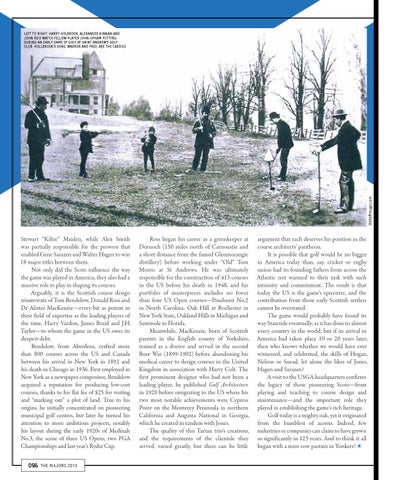
LEFT TO RIGHT: HARRY HOLBROOK, ALEXANDER KINNAN AND JOHN REID WATCH FELLOW PLAYER JOHN UPHAM PUTTING DURING AN EARLY GAME OF GOLF AT SAINT ANDREW’S GOLF CLUB. HOLLBROOK’S SONS, WARREN AND FRED, ARE THE CADDIES
Stewart “Kiltie” Maiden, while Alex Smith was partially responsible for the prowess that enabled Gene Sarazen and Walter Hagen to win 18 major titles between them. Not only did the Scots influence the way the game was played in America, they also had a massive role to play in shaping its courses. Arguably, it is the Scottish course design triumvirate of Tom Bendelow, Donald Ross and Dr Alister MacKenzie—every bit as potent in their field of expertise as the leading players of the time, Harry Vardon, James Braid and J.H. Taylor—to whom the game in the US owes its deepest debt. Bendelow, from Aberdeen, crafted more than 800 courses across the US and Canada between his arrival in New York in 1892 and his death in Chicago in 1936. First employed in New York as a newspaper compositor, Bendelow acquired a reputation for producing low-cost courses, thanks to his flat fee of $25 for visiting and “marking out” a plot of land. True to his origins, he initially concentrated on pioneering municipal golf centres, but later he turned his attention to more ambitious projects, notably his layout during the early 1920s of Medinah No.3, the scene of three US Opens, two PGA Championships and last year’s Ryder Cup. 096
THE MAJORS 2013
Ross began his career as a greenkeeper at Dornoch (150 miles north of Carnoustie and a short distance from the famed Glenmorangie distillery) before working under “Old” Tom Morris at St Andrews. He was ultimately responsible for the construction of 413 courses in the US before his death in 1948, and his portfolio of masterpieces includes no fewer than four US Open courses—Pinehurst No.2 in North Carolina, Oak Hill at Rochester in New York State, Oakland Hills in Michigan and Seminole in Florida. Meanwhile, MacKenzie, born of Scottish parents in the English county of Yorkshire, trained as a doctor and served in the second Boer War (1899-1902) before abandoning his medical career to design courses in the United Kingdom in association with Harry Colt. The first prominent designer who had not been a leading player, he published Golf Architecture in 1920 before emigrating to the US where his two most notable achievements were Cypress Point on the Monterey Peninsula in northern California and Augusta National in Georgia, which he created in tandem with Jones. The quality of this Tartan trio’s creations, and the requirements of the clientele they served, varied greatly, but there can be little
argument that each deserves his position in the course architects’ pantheon. It is possible that golf would be no bigger in America today than, say, cricket or rugby union had its founding fathers from across the Atlantic not warmed to their task with such intensity and commitment. The result is that today the US is the game’s epicentre, and the contribution from those early Scottish settlers cannot be overstated. The game would probably have found its way Stateside eventually, as it has done to almost every country in the world, but if its arrival in America had taken place 10 or 20 years later, then who knows whether we would have ever witnessed, and celebrated, the skills of Hogan, Nelson or Snead, let alone the likes of Jones, Hagen and Sarazen? A visit to the USGA headquarters confirms the legacy of those pioneering Scots—from playing and teaching to course design and maintenance—and the important role they played in establishing the game’s rich heritage. Golf today is a mighty oak, yet it originated from the humblest of acorns. Indeed, few industries or companies can claim to have grown so significantly in 125 years. And to think it all began with a mere cow pasture in Yonkers! ★