entertainment
may 17, 2013
Album photo courtesy of deeppurple-nowwhat.com
Movie photo courtesy of thegreatgatsby.warnerbros.com
Exhibit
11
TV photo by Jennifer Walter
photo courtesy of undrerthedome.com
‘Now What?!’
‘The Great Gatsby’
‘Real Pirates’
‘Under the Dome’
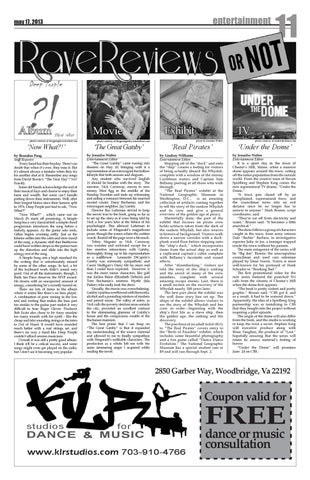
by Brandon Pang Staff Reporter Every band has their heyday. There’s no doubt that when it’s over, they miss it. But it’s almost always a mistake when they try for another shot at it. Remember any songs from David Bowie’s “The Next Day”? No? Exactly. Some old bands acknowledge the end of their musical days and choose to enjoy their fame and wealth. But some can’t handle putting down their instruments. Well, after their longest hiatus since their famous split in 1976, Deep Purple just had to ask, “Now What?!” “Now What?!” , which came out on March 29, starts off promising. A Simple Song has a very classical feel: a simple chord progression introduces the song before a melody appears. As the guitar solo ends, Gillan begins crooning softly. Just as the listener settles into the calm and slow mood of the song, a dynamic shift that Beethoven could have written drops as the guitars turn up the distortion and slide into the high energy rest of the song. A Simple Song sets a high standard for the writing that is unfortunately missed by some of the other songs. In fact, a lot of the keyboard work didn’t sound very good. Out of all the instruments, though, I think Ian Paice deserves the MVP award. He drums with an unexpected amount of energy, considering he’s recently turned 64. There are lots of times in the album where it seems like there’s no bass player. A combination of poor mixing in the low end and writing that makes the bass part too similar to the guitar part makes it very difficult to hear Roger Glover. Producer Bob Erzin also chose to let Airey emulate too many sounds with his synth – like the cheap and fake sounding strings in the intro to Out of Hand. It would have sounded much better with a real strings set, and there’s no way a band like Deep Purple couldn’t afford session musicians. Overall, it was still a pretty good album. I think it’ll be a critical success, and some songs might even get played on the radio, but I don’t see it becoming very popular.
by Jennifer Walter Entertainment Editor “The Great Gatsby” came roaring into theaters on May 10, bringing with it a representation of an extravagant but hollow lifestyle that both amuses and disgusts. Any student who survived English 11 should be familiar with the story. The narrator, Nick Carraway, moves to new money West Egg in the middle of the Roaring Twenties and ends up witnessing and aiding a romance between his married second cousin, Daisy Buchanan, and his extravagant neighbor, Jay Gatsby. Director Baz Luhrman strived to keep the movie true to the book, going so far as to set up the story as if were being told by Nick a few years later at the behest of his psychologist. This allowed Luhrman to include some of Fitzgerald’s magnificent prose, though the scenes where the written words floated off the page were a bit much. Tobey Maguire as Nick Carraway was wooden and awkward except for a few emotive interactions with Gatsby, thoroughly living up to his representation as a wallflower. Leonardo DiCaprio’s Gatsby was extremely sympathetic and Carrie Mulligan’s Daisy felt far more real than I could have expected. However, it was the more minor characters, like golf star Jordan Baker (Elizabeth Debicki) and Tom Buchanan’s mistress Myrtle (Isla Fisher) who really took the show. Visually, the movie was overwhelming. Gatsby’s parties overflowed with fireworks, alcohol and a pounding mixture of modern and period music. The valley of ashes, as Nick calls the poverty stricken areas outside the city, provided an excellent contrast to the shimmering glamour of Gatsby’s house and the conspicuous wealth of the Buchanan mansion. The best praise that I can heap on “The Great Gatsby” is that it expanded my understanding of the source material and allowed to me to finally sympathize with Fitzgerald’s unlikable characters. The production as a whole left me with the same simmering anger I acquired while reading the novel.
by Lindsay Williams Entertainment Editor Stepping off of the “dock” and onto the “ship” creates a feeling for visitors of being actually aboard the Whydah, complete with a window of the stormy Caribbean waters and Captain Sam Bellamy peering at all those who walk through. “The Real Pirates” exhibit at the National Geographic Museum in Washington, D.C., is an amazing collection of artifacts coming together to tell the story of the sunken Whydah and its crew and give a general overview of the golden age of piracy. Masterfully done, the part of the exhibit that focuses on pirate crew holds artifacts taken from the deck of the sunken Whydah, but also weaves in historical background. Visitors walk down a narrow corridor with a dockplank wood floor before stepping onto the “ship’s deck,” which incorporates items from the actual ship as well as a replicated captain’s cabin complete with Bellamy’s facsimile and sound effects. After “disembarking,” visitors are told the story of the ship’s sinking and the arrest of many of the crew members, complete with several amazing escape stories. Last, there is a small section on the recovery of the Whydah nearly 300 years later. The best part about the exhibit was the well done story line set up. The shape of the exhibit allows visitors to see the story of the Whydah and her crew in order—beginning with the ship’s first life as a slave ship, then the golden age, the sinking and the discovery. The purchase of an adult ticket ($11) to “The Real Pirates” covers entry to the “Birds of Paradise” exhibit, which includes some beautiful photography and a fun game called “Dance Dance Evolution.” The National Geographic Museum has a special student rate at $9 and will run through Sept. 2.
by Jennifer Walter Entertainment Editor It is a quiet day in the town of Chester’s Mill, Maine, when a massive dome appears around the town, cutting off the entire population from the outside world. From the creative team of Steven Spielberg and Stephen King comes the new supernatural TV drama, “Under the Dome.” “A town gets closed off by an unexplained, supernatural force, and the councilman turns into an evil dictator since he no longer has to answer to anyone.” Mark Bruner, script coordinator, said. “They’re cut off from electricity and water,” Bruner said. “It becomes a little anarchical.” The show follows a group of characters caught in the town, from army veteran Dale “Barbie” Barbara, to investigative reporter Julia, to Joe, a teenager trapped inside the town without his parents. The main antagonist of the series will be “Big Jim” Rennie, the unscrupulous councilman and used cars salesman played by Dean Norris. Norris is most well-known for his portrayal of Hank Schrader in “Breaking Bad.” The first promotional video for the new series featured the panicked 911 calls from the citizens of Chester’s Mill when the dome first appears. “The book is pretty violent and pretty graphic,” Bruner said. “CBS got it, and as a result, it had to be watered down.” Apparently, the idea of a Spielberg-King partnership was so tantalizing to CBS that they bought into the project without requiring a pilot episode. The origin of the dome will also differ from the book, and the studio is working to keep the twist a secret. Stephen King will executive produce along with Brian Vaughan, the producer of “Lost,” hopefully ensuring that the series will retain its source material’s feeling of horror. “Under the Dome” will premiere June 24 on CBS.
2850 Garber Way, Woodbridge, Va 22192
Coupon valid for studios
for
DANCE & MUSIC www.klrstudios.com 703-910-4766
FREE dance or music consultation