P R A X I S
20.2 Influences in the Writing Center: From Micro to Macro
a writing center journal
VOL.

VOL.
ABOUT THE AUTHORS
COLUMNS
From the Editors: Influences in the Writing Center: From Micro to Macro
Kiara Walker and Kaitlin Passafiume
The Art and Craft of Sentence-Level Choices
Michelle Cohen
FOCUS ARTICLES
What’s Your Plan for the Consultation? Examining Alignment between Tutorial Plans and Consultations among Writing Tutors Using the Read/Plan-Ahead Tutoring Method
Diana Awad Scrocco
Faculty Writing Groups for Writing Center Professionals: Rethinking Scholarly Productivity
Kara Poe Alexander, Erin M. Andersen, Julia Bleakney, and Jennifer Smith Daniel
A Model for Infusing a Creative Writing Classroom with Writing Center Pedagogy
Kelle Alden
Reading the Online Writing Center: The Affordances and Constraints of WCOnline
Pratistha Bhattarai, Aaron Colton, Eun-hae Kim, Amber Manning, Eliana Schonberg, and Xuanyu Zhou
What Our Tutors Know: The Advantages of Small Campus Tutoring Centers
Ana Wetzl, Pam Lieske, and Mahli Mechenbier
Advocates for Education in Prison-Based Writing Centers
Julie Wilson
Kelle Alden, PhD is an Assistant Professor of English and Director of the Hortense Parrish Writing Center at The University of Tennessee at Martin.
Kara Poe Alexander, PhD is Professor of English in Professional Writing and Rhetoric and Director of the University Writing Center at Baylor University. She is also the submissions editor for Literacy in Composition Studies. Her work has appeared in College Composition and Communication, College English, Composition Forum, Composition Studies, Computers and Composition, Journal of Business and Technical Writing, Literacy in Composition Studies, Rhetoric Review, Technical Communication Quarterly, and other scholarly journals and edited collections. She also has a co-edited book, Multimodal Composition and Writing Transfer, forthcoming with Utah State University Press.
Erin M. Andersen, PhD is an Associate Professor of Writing in the Business, Media, and Writing department and Director of the Writing Collaboratory at Centenary University where she teaches first-year writing, queer and feminist theory, and tutor training classes. Her current research interests focus on the intersections of writing centers, assemblage theory, assessment, and social justice. Her work has been published in Writing Program Administration, Peitho, and WLN: A Journal of Writing Center Scholarship.
Pratistha Bhattarai is a Ph.D. candidate in the Program in Literature at Duke University.
Julia Bleakney, PhD is Director of The Writing Center, within the Center for Writing Excellence, and Associate Professor of English at Elon University, North Carolina. Her research focuses on writing center tutor education, student leadership, and writing beyond the university. Her publications include a co-edited book, Writing Beyond the University: Preparing Lifelong Writers for Lifewide Writing as well as articles in The Writing Center Journal, WLN: A Journal of Writing Center Scholarship, Kairos: A Journal of Rhetoric, Technology, and Pedagogy, and Composition Forum.
Michelle Cohen, PhD is an assistant professor and faculty tutor in the Center for Academic Excellence/Writing Center at the Medical University of South Carolina. She has worked in writing centers since 2010. Her research interests include writing center theory, multimodal composition, and style.
Aaron Colton, PhD is a lecturer in writing studies and the assistant director of the TWP Writing Studio at Duke University. He is currently researching writer’s block both in the classroom and in fictional representations.
Jennifer Smith Daniel, MA is Director of Writing Center and Writing Across the Curriculum Programs at Queens University of Charlotte. Her research focuses on engaged pedagogies, rhetoric and literacy, tutor education, mentorship, and first-year writing. She is currently the chair of the SWCA CARE certification committee. Currently, she is working on a dissertation in which she proposes a method for assessing how tutors’ ecological pedagogies impact their tutoring praxis. She has published in Community Literacy Journal and MacMillan Learning’s Tiny Teaching Stories
Eun-hae Kim is a Ph.D. candidate in the Department of English at Duke University.
Pam Lieske, PhD is a Professor of English at the Trumbull campus of Kent State University at Trumbull where she teaches courses in writing and literature. A former coordinator of English at her campus, she is interested in, among other things, issues related to distance learning and teacher and tutor training.
Amber Manning is a Ph.D. candidate in the Department of English at Duke University.
Mahli Mechenbier, MA & JD teaches Technical Writing, Professional Writing, and College Writing at Kent State University at Geauga as a three-year-renewable Senior Lecturer. She was a member of NCTE’s Committee for Effective Practices for Online Writing Instruction and was an editor for the OWI’s Open Resource (2013 – 2016). Her research focuses on how academic administrations manage distance learning and the intellectual property rights of contingent faculty.
Eliana Schonberg, PhD is an associate professor of the practice in writing studies and the director of the TWP Writing Studio at Duke University. Her current research centers on knowledge transfer in writing centers and writing fellows programs and on changing conceptions of time in writing center studies.
Diana Lin Awad Scrocco, PhD is an associate professor of English at Youngstown State University where she directs the Public and Professional Writing Program and teaches professional writing, composition, and pedagogy. Her recent research has appeared in Programmatic Perspectives, Journal of Argumentation in Context, and Communication and Medicine. She earned a Ph.D. in Literacy, Rhetoric, and Social Practice from Kent State University before collaborating with Joanna Wolfe at Carnegie Mellon University to establish the first communication center on the campus. Address for correspondence: Department of English, Youngstown State University, One University Plaza, Youngstown, OH 44555. Email: dlawadscrocco@ysu.edu.
Ana Wetzl, PhD is Associate Professor of English at Kent State University at Trumbull where she specializes in first-year composition, specifically developmental writing. She was the English Coordinator for the campus Learning Center between 2011 and 2020. Her research focuses on the intersection between first and second language writing and tutoring center work.
Julie Wilson, PhD holds a doctorate in Education from UNC-Chapel Hill and directs the Writing Studio at Warren Wilson College.
Xuanyu Zhou is a first-year clinical epidemiology master's student at Stanford University with an infectious disease concentration.
In Praxis issues of the recent past, we (Kiara and Kaitlin) have aimed to shine a light on the many ways that writing center work resounds throughout university life, in and beyond the walls of the center. We have recognized how the writing center guides students towards success, enjoining the wider educational system to follow our lead on many pressing issues like inclusion. We have celebrated the transformative nature of writing center work, uncovering how our practices help not only writers to transform, but how writing center administrators and faculty alike can evolve through the work that we do.
In this issue, we celebrate the micro-influences that writing center work produces, even as our practices reach outside of the buildings that house us. The authors included in this edition echo this sentiment, as evidenced by their varied qualitative and quantitative studies. There is one thing each author communicates invariably, despite the plethora of themes and formats you will find herein. These practitioners express the influential nature of writing center work, beginning with the microcosmic element of the sentence itself. This fragment of a writer’s work begins its journey on paper, reverberating on each new level until our purpose is felt outside of the wider educational institution. Closing the issue, writing center pedagogy informs prison curricula as a true testament to the resounding impact of writing center work.
In her column “The Art and Craft of SentenceLevel Choices,” Michelle Cohen kicks off the current issue as she blurs the line between art and craft. The author advocates for the micro, exposing LOCs (lowerorder concerns) as that methodology which can make artists out of writers. Cohen’s metaphor comparing sentence construction to ceramics does the work of placing sentence craft squarely in the artistic realm, illustrating “the inherent relationship between form and content.”
Next, Diana Awad Scrocco widens the lens in her focus article “What’s Your Plan for the Consultation? Examining Alignment Between Tutorial Plans and Consultations Among Writing Tutors Using the Read/Plan-Ahead Tutoring Method.” In this case study, Scrocco exposes a tension between consultation agenda setting and use of the read/plan-ahead method, used primarily when tutors encounter advanced writing or
Kaitlin Passafiume University of Texas at Austin praxisuwc@gmail.comunfamiliar topics. She examines the benefits and drawbacks of each consultation priority, looking at thirteen separate consultation moments where each method can be found at work. The author gives due consideration to both the agenda-setting and read/planahead strategies, ultimately reminding us that writers should unwaveringly be the center of every consultation choice that a tutor makes.
In “Faculty Writing Groups for Writing Center Professionals: Rethinking Scholarly Productivity,” the authors take their experiences as writing center professionals into a writing group. Through this group, authors Kara Poe Alexander, Erin M. Andersen, Julia Bleakney, and Jennifer Smith Daniel come to better understand their own approaches and possibilities when considering scholarly work. The authors’ insights in three areas of productivity scholarly and intellectual, professionalization and mentoring, and social support are of use for other writing center professionals making the case about the value of their work that may not fit into common notions of scholarly productivity.
Kelle Alden follows in “A Model for Infusing a Creative Writing Classroom with Writing Center Pedagogy,” empowering the very methodology that fuels our centers to inspire greater scholarly collaborations. The author applies writing center theory using statistical data in an unaffiliated writing class, showing one example of how our discoveries can benefit the institution beyond the wring center itself.
Bhattarai et al follow, backing farther away from the center’s walls as they present “Reading the Online Writing Center: The Affordances and Constraints of WCOnline.” This focus on virtual practice is timely, considering an educational shift to incorporate technology and answer demands for multidimensional curriculum. Pratistha Bhattarai, Aaron Colton, Eun-hae Kim, Amber Manning, Eliana Schonberg, and Xuanyu Zhou highlight the ways in which pandemic trauma forced educators to catch up to the demands of a digital society. In much the same way that pen-and-paper academia values a book review, these authors offer “critical digital pedagogy,” creating a guideline for the oft discussed WCOnline. This collective employs an analytical approach to the platform’s benefits and shortcomings, ultimately suggesting best practices to
maximize this online tool’s usefulness for writing center work.
Next in “What Our Tutors Know: The Advantages of Small Campus Tutoring Centers,” Ana Wetzl, Mahli Mechenbier, and Pam Lieske take us to a set of regional campuses in Ohio, arguing for the value of writing centers in these spaces in response to rise of eTutoring. By surveying tutors at the featured regional campuses, the authors gain insight into the communities of practice developed there and the possibilities of on-campus tutoring that are not likely to be reproduced in eTutoring spaces and practices. Based on their survey, the authors advocate for preserving and maintaining writing centers on regional campuses, arguing for the benefits that can be had in communities of practice present in local, face-to-face interactions.
Julie Wilson closes our issue by looking at writing center collaborative work in an often-disregarded space for intellectual and educational experiences. In “Advocates for Education in Prison-Based Writing Centers,” Wilson presents her findings from developing a writing studio in a women’s prison. By using a qualitative action research design, Wilson was able to design and redesign a supportive writing center that took into consideration student experience and the knowledge of system impacted scholars. Based on the study, Wilson encourages writing center practitioners to genuinely seek out, center, and respond to student advocacy and students’ ability to recognize their own needs.
In the spirit of employing our work outside the writing center and ushering in new practices and policies, it is with excitement for the future that we bid goodbye to our co-editor Kaitlin Passafiume, as she transitions into a new role. In this next phase, she will undoubtedly rely on what writing center practice has taught her even as she works to promote decolonizing versions of democracy in Latin America. She signs off this chapter, humbled by the potency of writing theory and policy to transcend sentence creation, the walls of our centers, our educational institutions, and our nations’ boundaries, leaving us with the following message:
“The past two years have served to etch the value of writing center work beyond merely helping writers help themselves. The University Writing Center at UT and our premier journal Praxis have given me a greater purpose in academia, and the diverse roles I have been able to play have afforded me a complexity that shall shape my future career path. Each author and collaborator have taught me new applications for our work, and I am forever grateful for your continued
contributions, even as we continue to tap away and toss new thoughts into the writing arena.”
When I was in graduate school, I had the good fortune of finding a home for my studio art practice in the university’s ceramics facilities. I worked on my sculptures in a space primarily dedicated to advanced undergraduate ceramics students, and I joined in their critiques.
A sensitive issue that would often arise was the tension between art and craft. Ceramicists have to think seriously about this binary because we work in what is often called a “craft medium.” In the art world, that often means justifying one’s own legitimacy. One student devoted his work to upsetting the art-craft distinction, intentionally breaking his mugs or covering them in sharp spikes. In critique, he would ask, “If I take away function, then is it art?” Another student painstakingly carved her vessels with mandala patterns. In critiques, she bristled when her peers tried to navigate delicately around the word craft: “Why would I be offended? I’m a craftsperson. That doesn’t mean I’m not an artist.”
I watched as these students questioned a familiar hierarchy in the art world one where skill and function are seen as values of a mere hired hand, whereas the illustrious concept occupies the mind of a “true artist.” At the same time, I found these art-craft debates paralleling issues I encountered in my work as a compositionist, particularly in the writing center.
In the writing center, the division between hand and mind, between form and content, was mirrored in the distinction between higher order concerns (HOCs)1 and lower order (or “later order”) concerns (LOCs).2 When working with a client, I had been trained to prioritize “HOCs before LOCs,” dismissing sentence-level issues unless I noticed patterns of error or local obstructions to clarity. While this stratified approach to writing center sessions worked well for many students, I quickly found as many of us have that not all students want or need an exclusive focus on global concerns in order to improve as self-aware, rhetorically savvy writers.
Why weren’t we teaching the medium-specific knowledge that would help each student succeed in their rhetorical composing? When learning in a clay-based medium, I needed to understand at the very least the basic technical aspects: how to wedge the air bubbles out of clay so my piece wouldn’t blow up in the kiln; the
properties and application of glaze so as not to damage expensive equipment in firing; or how to throw basic shapes on the potter’s wheel so I could begin to experiment more with my own forms. These examples are not simple cases of “learning the rules before you can break them” to maintain the status-quo; rather, abiding by certain conventions of physics, chemistry, and craft tradition could mean the difference between producing a vitrified ceramic object and opening the kiln to find glaze-damaged shelves and piles of rubble. In sum, I had to understand the medium to produce the artistic outcome I wanted.
Words are a different medium than clay, of course intangible, shaped first and foremost by society rather than geology. Still, in rhetorical composing, skillful use of words is often integral to successful verbal communication. Yet, whether in my graduate program or in the writing center itself, I had received little formal training on helping writers with sentence-level concerns; these were all seemingly subsumed under a nebulous “grammar” umbrella or worse, currenttraditionalism and therefore tacitly positioned as the antithesis of rhetoric.
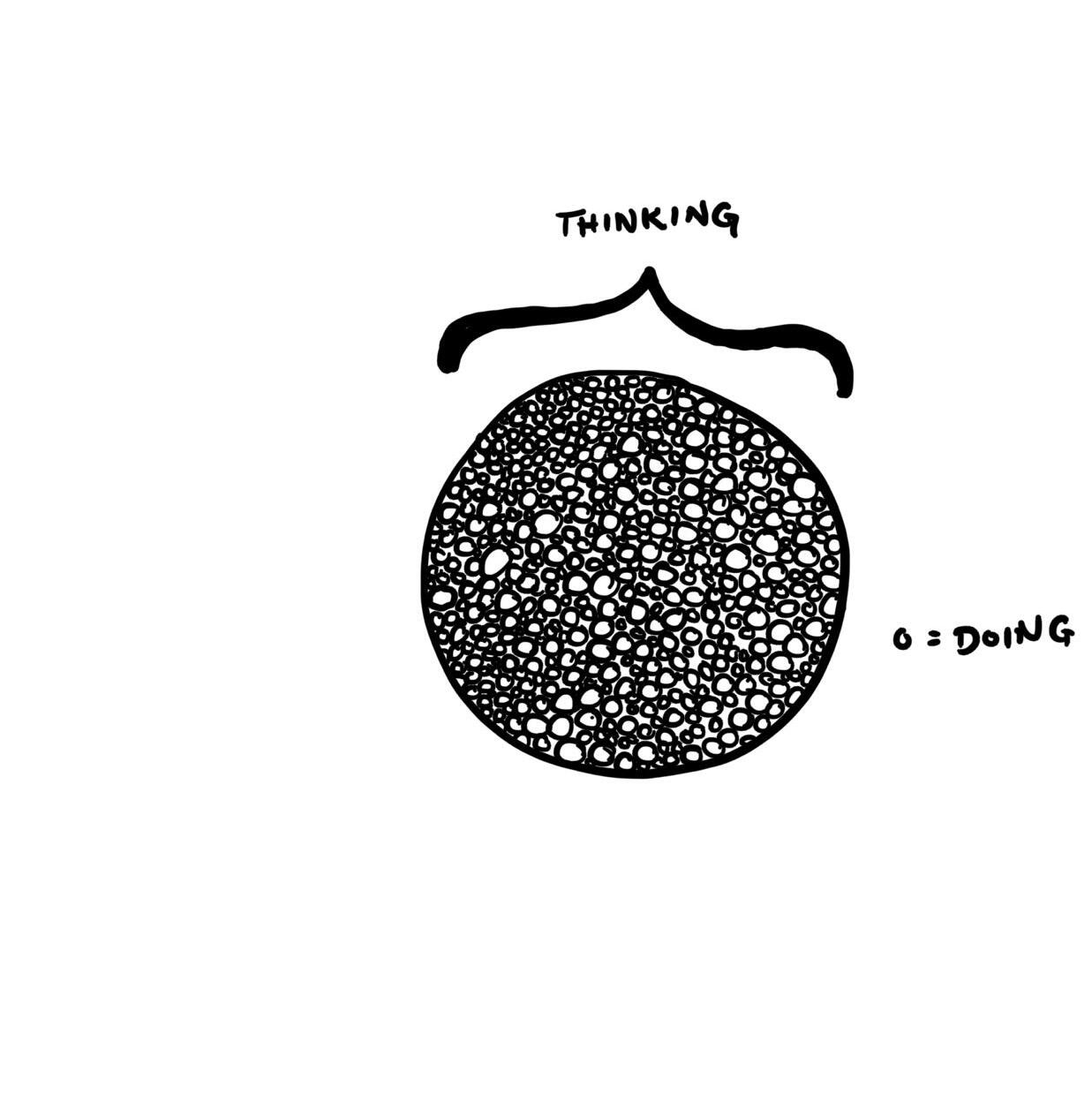
The musings and struggles that I encountered simultaneously in the ceramics studio and the writing center are woven into a larger tapestry of the contentform binary, one in which we separate out synergistic concepts, elevating thinking over doing, message over medium, and creativity over technical skill (see fig 1). Simply put, LOCs were seen as matters of “craft,” not “art.”
Before revising our approach to the concerns we’ve neglected, I think it important to note where these parallel binaries i.e., art/craft and HOCs/LOCs each came from. Both can be contextualized within historical power dynamics, and in both cases, we can read the dominant term (i.e., art and HOCs, respectively) as emerging to defend labor perceived as undervalued or marginalized. The earliest distinctions between art and craft have been dated back to the Italian Renaissance, when makers such as da Vinci and Vasari separated their work from the “manual labor” of guild workers to justify their intellectual labor (Rath 26-28; Rosati, 116). Public art historians remind us that artists at this time operated within a system of patronage; by
elevating their status, they sought secure respect and fair compensation for contracted work (Morelli; Harris & Zucker).
Similarly, the division between HOCs and LOCs seems to have emerged in part to justify the intellectual labor of writing center work. In 1984, Stephen North published “The Idea of a Writing Center,” pushing back against misconceptions that “a writing center can only be some sort of skills center, a fix-it shop” (435). The same year, Thomas Reigstad & Donald McAndrew introduced the terms HOCs and LOCs in their guide booklet Training Tutors for Writing Conferences This division allowed consultants to prioritize certain concerns over others in order to focus on the most “significant problems,” but also to relieve the consultant of “detect[ing] and correct[ing] all the problems” (Reigstad & McAndrew 26, emphasis in original) a worthy goal, and one we can update in the context of today’s writing center.
So how do we explore sentence-level pedagogies without reinforcing the age-old misconceptions of our work? I argue that it’s a two-fold shift: first, in how we view the relationship between HOCs and LOCs (perhaps better described as local and global concerns); and second, in training and pedagogical approach. The first shift leads to what I call an embrace of techné; the second, to an embrace of holistic consulting.
First, we must acknowledge the inherent relationship between form and content. In writing, we simply could not communicate our thoughts without the words on the page. Every word, punctuation, sentence, paragraph, and so forth marks a choice that helps construct and execute the larger concept. Therefore, I suggest a return to the classical concept of techné, what Susan Delagrange describes as an “incorporation of thinking and doing … a productive oscillation between knowledge in the head and knowledge in the hand” (35). Through a techné framework, writing center stakeholders can begin to see the interdependence of local and global concerns. The metaphor of techné positions writing as neither art nor craft exclusively, but as skillful creative labor, a marriage of thinking and doing. Embracing techné means breaking down the vertical hierarchy of the HOCs/LOCs binary (shown in fig. 1) and replacing it with a model wherein local choices are recognized as collectively constructing a global whole (see fig. 2).
This first shift implies a second: a holistic approach to writing consulting. Every writing center session necessarily requires prioritization; writers and consultants simply cannot attend to every choice made within a piece of writing. A HOCs/LOCs framework mitigates this overwhelming challenge by pre-sorting concerns for the consultant, anticipating those which will likely bear the most weight in revision and steering the session away from proofreading. This framework plays the odds, wagering that most writers in most situations will receive the greatest benefits from a bigpicture discussion of argument and organization.
While a more detailed and more advanced approach, a techné framework could yield a higher return when applied thoughtfully and creatively. By understanding the paper as an act of synthesis, we can focus on the most salient local instances (the “loadbearing sentences,” if you will) that come together to make a meaningful whole. This framework suggests that the consultant and the writer possess or can develop both the genius and skill (the artistry and craftsmanship) to select, discuss, and reimagine salient global and local decisions.
By providing consultants with a holistic theoretical foundation for their practice, we can above all embrace the writing center as a site for innovative composition pedagogy. As Jesse Kavadlo argues, “A return to language not just what students are trying to say, but the diction that they use to say it, and the relationship between what they say and how they say it seems just the sort of balanced approach that one-on-one tutoring and collaboration can foster” (218). When we delve into those concerns relegated as “lower” or “later,” we reimagine the writing center as a studio for medium exploration. I’m excited to see what we make.
1. Including big-picture concerns such as “thesis or focus; audience and purpose; organization; and development” (Purdue OWL).
2. Including concerns such as “sentence structure, punctuation, word choice, [and] spelling.” (Purdue OWL).
Delagrange, Susan H. Technologies of Wonder: Rhetorical Practice in a Digital World. E-book, Computers and
Composition Digital Press/Utah State UP, 2011, https://ccdigitalpress.org/book/wonder/
Harris, Beth, & Zucker, Steven. “What makes art valuable then and now?” Khan Academy, n.d., www.khanacademy.org/humanities/approaches-to-arthistory/questions-in-art-history/a/what-made-artvaluablethen-and-now Accessed 9 Jan. 2020.
Kavadlo, Jesse. “Tutoring Taboo: A Reconsideration of Style in the Writing Center.” Refiguring Prose Style: Possibilities for Writing Pedagogy, edited by T. R. Johnson & Thomas Pace, Utah State UP, 2005, pp. 215-226. Morelli, Laura. “What’s the difference between art and craft?” TedEd, Mar. 2014, https://lauramorelli.com/whats-the-differencebetween-art-craft/
North, Stephen M. “The Idea of a Writing Center.” College English, vol. 46, no. 5, 1984, pp. 433-446.
Purdue Online Writing Lab. “Higher Order Concerns (HOCs) and Lower Order Concerns (LOCs).” n.d., https://owl.purdue.edu/owl/general_writing/mechani cs/hocs_and_locs.html, accesed 9 Jan. 2020.
Rath, Pragyan. The “I” and the “Eye”: The Verbal and Visual in Post-Renaissance Western Aesthetics. Cambridge Scholars Publishing, 2011.
Reigstad, Thomas J. & McAndrew, Donald A. Training Tutors for Writing Conferences. ERIC Clearinghouse/National Council of Teachers of English, 1984, https://files.eric.ed.gov/fulltext/ED240589.pdf
Risatti, Howard. A Theory of Craft: Function and Aesthetic Expression. University of North Carolina Press, 2007.

Writing center scholars and tutor-training manuals historically emphasize the importance of tutors and writers collaboratively negotiating consultation agendas to maintain writers’ ownership over their writing. However, when tutors encounter advanced student writers, writers from unfamiliar fields, or writers with complex linguistic repertoires, they may struggle to read student writing, identify writing issues, and negotiate effective, mutual agendas. One tool for navigating these challenges is the “read-ahead method” in which tutors read student writing in advance and prepare for consultations (Scrocco 10). While this method offers potential advantages, a brief survey reveals that some writing center administrators worry that tutors who read student writing in advance may hijack consultation agendas. This exploratory mixed-methods study examines thirteen tutor-supervisor planning conversations and subsequent consultations to assess the correspondence between tutors’ plans and consultations and to consider what factors may support or undermine writers’ agendas. Results suggest that tutors who use the read/plan-ahead method do not fervently push their planned agendas over writers’ agendas. However, very detailed or particularly vague pre-consultation planning may set tutors up for sessions that fail to negotiate and carry out cohesive, well-prioritized shared agendas. The most collaborative, coherent consultations in this study balance tutor and writer agendas. They begin with writers’ submitted concerns, identify high-priority global writing issues, engage in substantive agenda-setting with writers, explicitly link tutors’ plans with writers’ agendas, and abandon tutors’ plans when needed. The read/plan-ahead model works best when tutors remember to place writers at the heart of building, revising, and enacting consultation agendas.
In the writing consultation excerpt in figure 1 between a graduate student tutor and multilingual international graduate student 1 , the tutor opens with a common writing-center move: he invites the writer to negotiate the session agenda. Unlike tutors in many centers, though, this tutor works in a center that uses the “read-ahead method” (Scrocco 14), in which writers submit written work prior to their appointments so tutors can read and plan an instructional approach. While reviewing writers’ drafts in advance may afford tutors and writers advantages, one key risk emerges: tutors who plan for consultations may assume a more dominant role in a context where writers expect authorial control. In this study, I ask: when using the read/plan-ahead method, how can tutors maximize the method’s instructional benefits and simultaneously involve writers in agenda setting?
To explore affordances and constraints of this model, I analyze thirteen tutor-supervisor planning conversations and tutors’ subsequent consultations. My analysis considers writing center administrators’ common concerns about the read/plan-ahead model, offers guidance for using this model prudently, and proposes avenues for future research. A brief survey of writing center administrators suggests that the read/plan-ahead model remains fairly uncommon in part because many administrators worry that tutors who use this tool might be more likely to control the consultation with their planned agendas instead of collaboratively building agendas with writers. My results suggest that while tutors who use the read/plan-ahead method do introduce their instructional plans during consultations, most of the tutors in this study also elicit and address writers’ agenda items; this finding should reassure writing center administrators that tutors who use the read/plan-ahead method typically still seek and cover writers’ concerns during consultations. My qualitative analysis points to some strategies administrators and tutors can employ when using the read/plan-ahead method in order to minimize the likelihood of tutors sidelining writers’ agendas. These approaches include preparing a limited list of higherorder concerns to consider during consultations and formulating a list of questions to ask writers to encourage their active involvement in consultations.
Historically, writing center scholarship has touted the importance of collaborative consultation agenda setting, in part because writers feel more satisfied with consultations that focus on their preferred agendas (Black 155; Mackiewicz and Thompson 60; Thompson et al. 82; Walker 72). Jointly constructed agendas afford writers ownership over their writing process and improve the likelihood that they will utilize tutor/teacher feedback during revision (Mackiewicz and Thompson 64; Thompson 417; Williams 185). Moreover, collaborative agenda setting enriches tutorwriter relationships (Black 21; Corbett 84) and keeps consultations on track (Newkirk 313; Severino 109). Shared agenda setting ideally ensures that consultations
consider key global writing issues and that writing tutors do not dominate consultations (Mackiewicz and Thompson 15; Nickel 145; Severino 109; Valentine 93).
Achieving a mutually accepted writing consultation agenda is sometimes presented as an uncomplicated collaborative endeavor (Harris 374; Macauley 3). Tutors have traditionally been discouraged from bringing concrete plans to their conferences (Harris 33-34) and encouraged to ask writers to identify their concerns (Caposella 11; Kent 152; (Newkirk 303; Thonus 111). Non-directive, “student- centered” approaches (Reigstad and McAndrew 36) avoid “impos[ing] our agenda onto a writer and their text” (Anglesey and McBride). Tutor- training manuals outline how tutors and writers can negotiate “mutually agreeable goal[s]” (Gillespie and Lerner 39) for consultations: ask writers open- ended questions (Gillespie and Lerner 28- 29; Ryan and Zimmerelli 16); build agendas around high - priority writing issues (Caposella 12- 13; Ryan and Zimmerelli 14); and do not “ presume… [to] understand better than the writer[s] what the session needs to be about” (Macauley 6). Warnings about tutors exercising undue control over session agendas have appeared in tutortraining guides for decades (Gillespie and Lerner 41-42).
Contrary to this advice, though, research suggests th at some writers need more direction during agenda setting (Thompson 418-419). Moreover, tutors and writers sometimes disagree on the appropriate degree of directiveness during sessions (Clark 44; Thonus 124). Cultural norms and perceptions of teacher/tutorstudent relationships inhibit some writers’ active participation in agenda setting (Ewert 2544; Lee 431; Weigle and Nelson 219). During agenda setting, some writers may interpret non-directive approaches as frustrating or directive approaches as disrespectful to their autonomy; either scenario can create negative perceptions that may influence writers’ satisfaction with consultations and their likelihood of using tutor feedback.
Undoubtedly, some writing center contexts create real challenges for negotiati ng well- prioritized, shared agendas. When students bring advanced writing from fields and genres unfamiliar to tutors, tutors may struggle to read student writing, identify key writing issues, and set shared agendas with writers (Scrocco 13). In such consultations, tutors may have trouble reading and evaluating writers’ texts during consultations and identifying high -priority writing issues (Scrocco 11). For example, Jo Mackiewicz’s research reveals that tutors who lacked content-area knowledge in engineering assumed too much control over consultation agendas (“The Effects” 317), focused on lower- order concerns,
and provided incorrect advice (319-320). Such tendencies contradict fundamental writing-center principles of placing writers’ concerns at the center of sessions and prioritizing global writing issues.
One emerging tool for navigating these challenges is the read/plan -ahead method: tutors read students’ writing in advance and develop well- prioritized, research -driven instructional plans (Scrocco 10). In centers where writers come from advanced, highly technical fields, bring genres unfamiliar to tutors, or possess diverse linguistic repertoires, the read/planahead method may represent a game -changing strategy for improving tutor feedback (Scrocco 17). Furthermore, tutors with specific identity traits and conditions, such as anxiety, learning differences, or neurological disorders (e.g., attentiondeficit/hyperactivity disorder, autism spectrum disorder), may benefit from the opportunity to prepare for consultations with writers who bring challenging texts and writing needs. Despite the potential benefits of the read/plan- ahead method, this practice may encourage tutors to promote their own agendas more ardently than they might if they had arrived at consultations without premeditated plans. And if writers “sense an undeclared agenda, they can feel manipulated” (Cogie 40), potentially leading them to feel disengaged or resistant to tutors’ advice.
To assess the current prevalence of the read/planahead tutoring method and administrators’ apprehensions about this practice, I emailed a short IRB-approved survey to the Wcenter listserv and contacts at the seventy writing centers in my original review of websites (Scrocco 11). My survey asked respondents the following:
• whether their centers use the read/plan-ahead method and under what circumstances
• whether respondents have concerns about the practice.
Findings of this brief survey show that among eighteen responses, 11.11% allow the read- ahead method for any writer, 27.78% allow the practice only under specific circumstances, and 61.11% do not allow the practice at all. Among centers that allow the practice for certain consultations, only graduate-level or post -doctoral writers, faculty, and students working on lengthy projects may submit work in advance.
This short survey suggests that the read/plan-ahead method remains limited by logistical constraints (e.g., extra time and pay for tutors) and pedagogical concerns. Some respondents fear that tutors who read student writing in advance may hijack consultation agendas. Others worry that the read/plan-ahead model positions tutors as expert instructors rather than peer collaborators. Still others believe this method inhibits tutor-writer dialogue, encourages tutors to be overly directive, places undue focus on editing, and limits the traditional practice of reading writers’ work aloud. Conversely, survey respondents who use the read/planahead method praise the practice for relieving tutor anxiety particularly in sessions with advanced writers and for helping tutors offer better feedback. My survey reveals some perceived concerns and benefits of the read/plan-ahead method and highlights the importance of collecting concrete data on the practice to identify evidence-based affordances and constraints.
To interrogate common views of the read/planahead method, this study examines the dynamics of tutor-supervisor planning conversations and subsequent tutor-writer consultations. I consider which factors in read/plan-ahead consultations appear to support or detract from writers’ agendas. This study examines thirteen tutors’ pre-consultation planning mee tings and subsequent consultations in a writing center that exclusively uses the read/plan-ahead method. I seek to answer these research questions:
• During read/plan-ahead consultations, to what extent do the agenda items tutors and supervisors plan align with agendas that are proposed and covered during consultations?
• What potential benefits and constraints emerge in read/plan-ahead consultations as tutors and writers negotiate and enact tutorial agendas?
In this exploratory, mixed-method study, I use quantitative tools to trace the correspondence between tutors’ pre-consultation plans, proposed agendas discussed with writers, and covered agendas addressed during consultations. To add context to these results, I qualitatively analyze tutor-writer exemplars from my data set to examine advantages and limitations of this tutoring method. Armed with evidence from read/planahead consultations, writing center professionals can consider and modify this practice to meet the needs of their center’s tutors and writers.
This study occurred at a private, doctoral-granting institution in 2017 when 56% of writers at this writing center were graduate-level or postgraduate writers. Writers were predominantly non-humanities, multilingual international students. Most tutors were graduate students, and all tutors completed a semesterlong tutor-training course taught by rhetoric and composition faculty. The tutor-training course covered writing-pedagogy scholarship and instructional methods aimed to assist research writers across disciplines e.g., common “novelty” moves in research-based introductions, genre moves in “IMRaD” papers, and the notion of “bottom line up front.” During the first few semesters of tutoring, tutors regularly participated in pre-consultation planning meetings with their supervisors; thereafter, tutors read and planned for consultations independently, only seeking supervisors’ advice when neede d.
Data collection occurred on three days one day at the end of spring semester and two days about one month apart during the subsequent fall semester. All scheduled tutors were invited to participate. Thirteen tutor-writer case s were included in this study. All tutors read student writing in advance and consulted with supervisors and the researcher, who previously codirected the center for one year five years earlier. 2 The university’s institutional review board approved the research, and all participants provided consent for their planning conversations, consultations, and electronic appointment data to be recorded. Recordings were transcribed using Deborah Tannen’s me thod.3
Analysis involved 1) labeling and categorizing writing issues identified in tutors’ pre-consultation planning conversations (planned agenda items); 2) labeling agenda-setting phases and writing issues proposed and covered during tutor-writer consultations; and 3) tracing the alignment of writing items across planned, proposed, and covered domains.
I analyzed tutor-supervisor planning conversation transcripts using Mackiewicz and Thompson’s notions of pedagogical topics and actions (28). I coded agendafocused independent clauses as planned topics (writing issues or concepts) or actions (concrete pedagogical
exercises, resources, or actions that apply writing topics). I then synthesized related topics and actions into broad categories of “writing items.” I created a master list of writing items (see Appendix A), which encompasses general writing issues and competencies (e.g., thesis, grammar, content development) and common sections of genres (e.g., discussion section, executive summary, literature review).
Next, I analyzed writer -tutor consultation transcripts. I identified agenda-setting exchanges in which tutors and writers propose writing topics or actions to address during consultations. Using Reinking’s “agenda-setting components” ( ix), Mackiewicz and Thompson’s “opening stage” (4) and “closing stage” (78), and Thonus’s “diagnosis period of a tutorial” (256), I defined agenda-setting phases as marked conversational exchange(s) in which tutors or writers propose to address writing questions, topics, or issues. I included direct agenda-setting turns (e.g., “What are your concerns?”) and indirect turns (“Do you have any other questions?”) throughout sessions.
I then labeled “proposed agenda items” and “covered agenda items” in consultations. Proposed topics and actions include the writing issues either interlocutor proposes and/or explicitly plans to discuss during consultations. Covered topics and actions include writing items writers and tutors give sustained attention during “teaching stage[s]” of consultations (Mackiewicz and Thompson 173), regardless of whether they explicitly proposed the topic or action during agenda setting. I define “sustained attention” as exchanges involving more than a few cursory conversational turns related to a writing item.
For my quantitative analysis, I consolidated lists of agenda topics and actions into “planned agenda items,” “proposed agenda items,” and “covered agenda items” and traced the extent to which tutors’ plans emerge during subsequent consultations. To ensure analytical accuracy, I independently coded my transcripts three separate times to generate lists of planned, proposed, and covered writing items for all tutor-writer cases. Then, I collaborated with an outside rater to refine my analysis.4 The outside rater and I first met to review and refine my master list of writing items and definitions. Next, we independently used the master list of writing items/definitions to analyze all transcripts and generate
lists of planned, proposed, and covered writing items for each tutor-writer case. We met to compare our lists, negotiate discrepancies, and achieve consensus in the final lists.
Once we established final lists of writing items for all case s, I created agenda-alignment tables that mapped the writing items across planned, proposed, and covered domains. I examined individual rows within tutors’ agenda-alignment tables and tallied correspondence between writing items. I counted the presence or absence of the same writing item across three domains of planning, proposing, and covering, and I generated the following agenda-alignment percentages :
• planned/proposed percentage: total number of agenda items tutors plan with supervisors divided by total number of agenda items tutors and writers propose to cover during agenda setting
• planned/covered percentage: total number of planned agenda items divided by total number of items covered during teaching/instructional stages of subsequent consultations
• proposed/covered percentage: total number of planned items divided by total number of covered items
• planned/proposed/covered percentage: total number of writing items appearing in all three domains divided by the total number of writing items for the entire tutor-writer case
To synthesize these alignment percentages, I counted the number of tutor-writer cases that fell into the 0-24% range, 25-49% range, 50-74% range, and 75-100% range for each combination. See table 1 for an example of full alignment across domains and table 2 for an example of no alignment across domains. Table 3 is an example of a consultation in which the tutor and writer propose and cover some of the tutor’s planned items; fail to propose and cover some planned items; and add some additional writing items not planned or proposed.
To avoid relying on reductive quantitative findings, I wrote qualitative descriptions of each tutor-writer case. These descriptions note the nature of the tutorsupervisor planning conversations, the global and local writing concerns addressed, and the dynamics of tutorsupervisor and tutor-writer interactions. I used the contexts of preparation chats and consultations to theorize explanations for the alignment across domains.
This section summarizes individual tutor-writer alignment statistics and alignment percentages of all tutor-writer cases.
Table 4 outlines the backgrounds of tutors and writers, requested feedback from writers’ intake forms, attached documents reviewed during session planning, and time spent on individual tutor-supervisor meetings and tutor-writer consultations. About half of the tutors in this study are first-semester tutors (7), and about half are second- (2) and third-semester (4) tutors. More tutors are graduate students (8) than undergraduates (5), and most come from English-related programs (9) rather than non-English programs (4). Most writers in these consultations are multilingual international students (10) rather than domestic students5 (3). About half of these consultations are first visits to the center (6), and about half are repeat visits (7). About half of the writers are undergraduates (7), and approximately half are graduate-student writers (6). All 13 writers attached written drafts, and 10 writers attached assignment rubrics to their intake forms for tutors to review. Tutors’ preparation/planning conversations with supervisors run an average of 4 minutes and 49.5 seconds, and tutorwriter consultations run an average of 49 minutes and 44.7 seconds.
Table 5 shows statistics for individual tutor-writer cases:
• number of writing items mentioned across planned, proposed, and covered domains;
• in parentheses, numbers of writing items for each tutor-writer case’s planned, proposed, and covered lists;
• alignment percentages across four combinations of domains:
o planned/proposed alignment
o planned/covered alignment
o proposed/covered alignment
o planned/proposed/covered alignment
Most tutors’ alignment percentages fall into the ranges of 25-49% or 50-74% alignment. For planned/proposed alignment, planned/covered alignment, and proposed/covered alignment, 2 tutorwriter cases fall below 25% alignment, and 2 tutor-writer cases exceed 74% alignment in any column. For alignment of writing items across all three domains, 5 tutor-writer cases fall below 25% alignment; 6 tutor-
writer cases fall into the 25-49% alignment range; and 2 tutor-writer cases fall into the 50-74% alignment range.
As table 6 and figure 2 illustrate, most tutor-writer cases fall into the 25-74% alignment ranges for all combinations of domains. For alignment between planned/proposed writing items, 7 tutor-writer cases fall into the 25-49% alignment range, 5 cases fall into the 50-74% range, and 1 case falls into the 74-100% range. For alignment between planned/covered writing items, 6 tutor-writer cases fall into the 25-49% alignment range, and 6 cases fall into the 50-74% range. For alignment between proposed/covered writing items, 2 tutor-writer cases fall into the 0-24% alignment range, 5 cases fall into the 25-49% range, and 6 cases fall into the 50-74% range. For alignment across all three domains (planned, proposed, and covered), most tutor-writer cases fall into the 0-49% alignment range: 5 cases fall into the 0-24% range, 6 cases fall into the 25-49%, and 2 cases fall into the 50-74% range.
Table 7 displays measures of central tendency across all 13 tutor-writer cases, demonstrating the mean, median, mode, and range of the following: total number of writing items mentioned across the three domains, and alignment percentages between planned and proposed writing items, planned and covered writing items, proposed and covered writing items, and across all three domains. An average of 12 writing items emerges per tutor-writer case across planning conversations and consultations. Tutors plan an average of 7.6 writing items, propose 5.8 items, and cover 10.9 items. An average of 50.97% of writing items tutors plan ultimately emerges as proposed agenda items during consultations. An average of 52.88% of writing items tutors plan with supervisors receives coverage during consultations. An average of 45.09% of writing items tutors and writers propose during agenda-setting phases of consultations receives coverage during teaching phases of consultations. As for alignment percentages across all three domains, approximately one-third (33.84%) of writing items tutors plan to address emerges in both proposed and covered domains during consultations.
This section adds texture to my quantitative results by qualitatively analyzing three tutor-writer cases. These cases reflect quantitative results slightly above or below this study’s averages (see tables 5 and 7). I aim to analyze some scenarios that unfold when tutors use the read/plan-ahead method, and I highlight both missteps
and strategic use of this practice. The first exemplar, the Tutor 7- Writer 7 case (see table 8), characterizes a planning conversation in which the tutor and supervisor engage in detailed planning much of which the tutor covers during the consultation. The second example, the Tutor 4-Writer 4 case (table 9), examines a planning meeting in which the tutor and supervisor prepare vaguer plans, and the ensuing consultation seems unfocused. The third exemplar, the Tutor 1-Writer 1 case (table 10), illustrates a tutor who appears to balance pre-consultation plans and the writer’s concerns, establishing and covering a well -prioritized, shared agenda.
In this study, very detailed pre-consultation planning particularly with inexperien ced tutors appears to contribute to tutors taking more control over their consultations. One quantitative clue to this scenario is a higher-than -average planned/covered alignment percentage. For instance, Tutor 7, a firstsemester tutor, makes specific, co mprehensive plans with a supervisor and later directs most agenda-setting and instructional phases of his session, repeatedly relegating the writer’s concerns to a lesser status than his plans. During teaching phases of the consultation, the tutor does not deviate much from his instructional plan, and he redirects or only briefly addresses the writer’s proposed agenda items. In this case, roughly two-thirds of the tutor’s planned agenda items receive coverage during the instructional phase of the consultation (higher than the average of about half).
Tutor 7 engages in a longer- than- average preparation conversation that produces a detailed consultation plan a total of eight specific writing issues. First, he mentions that the writer’s main concern on the intake form is the grammar in his reading response document. Disagreeing with this priority, the tutor tells his supervisor, “The main thing I need to focus on here is, um, like, the rhetorical situation.” With the advisor, Tutor 7 highlights the writer’s key problem a failure to answer the prompt. They discuss concrete options for supporting the writer’s revision process, such as using the center’s “bottom -line -upfront” handout to explain how to foreground claims in a thesis and topic sentences. They also discuss how generating a reverse outline might address the draft’s organizational problems.
Entering the consultation equipped with a comprehensive plan and presuming that the writer lacks awareness of his writing issues, Tutor 7 directs or redirects most agenda-setting and instructional phases
of the consultation. The writer, a multilingual international graduate student with prior experience at the center, presents some agenda items but largely defers to the tutor. Marking the first agenda- setting phase, for instance, the tutor begins by introducing his planned areas of concern. When the writer interrupts to articulate his interest in discussing content development and grammar, the tutor explicitly opposes these proposed agenda items, redirecting the focus: “Uh, so, I would actually say, rather than adding more points, I think you have a lot of points here, and, like, a lot of good information. Uh, what I think is more important is to, kind of, like, reorganize them in, in, like, like, based on what the prompt is asking.” The writer responds with a brief, “Ok,” followed by the tutor asking about the context of the assignment.
Soon after, mirroring his supervisor’s advice to focus on structure, Tutor 7 proposes discussing the “bottom -line -up -front” notion and handout. He asserts, “Uh, I think, the thing that could, like, help your essay the most, um… is the idea of, um, bottom line up front… um, where we have one of our handouts that we love to use, um ” As Tutor 7 explains the benefit of placing key ideas in primary positions in the text, Writer 7 mainly provides brief backchannel. He interjects at one point to inquire again about adding details: “They’re asking about a minimum seven hundred words, so, I don’t know if I sho uld add more, or just keep I don’t know.” Maintaining control over the agenda, the tutor reassures the writer that they will likely add content while rearranging paragraphs. He resumes discussing structure, reinforcing his planned agenda: “I say, I say let’s start by reorganizing the paragraphs, and I bet you’ll find that, like, once you do that, then you, you’ll find there’s, like, more you can say about it.” Again, dismissing the writer’s proposed agenda items, Tutor 7 positions the writer as a novice whose articulated concerns hold lesser value.
Later, the tutor takes the lead once more by proposing another pre-planned agenda item:
So, so, now, I think, the best way to go, is to, kind of, like um, and, and, like, once again, uh, feel free to stop me if you’d rather do something else […] you, kind of, have these ideas… And, now, you want to create paragraphs that will, like, support these ideas, and, like, kind of, go into more detail.
While the tutor offers a perfunctory opening for the writer’s agenda here, Writer 7 passively accepts the tutor’s recommended course of action. In a similar way, later, Tutor 7 returns to another planned agenda item,
directing the next activity: “So, I’m thinking, kind of, leave these paragraphs, but, like, also, we’ll work on putting topic sentences for them,” with the rationale that “now I understand what you’re doing with these paragraphs, it was, kind of, hard to tell at the time because of the lack of topic sentences.” The writer again accepts the shift in the consultation focus without objection, and they begin developing topic sentences.
With just a few minutes remaining, Tutor 7 returns to the writer’s primary concern from the intake form one the writer reiterated early in the consultation. The tutor asks, “Do you want to spend some time I mean, we have, like, six or seven minutes left. Do you want to spend some time talking about grammar a little bit?” Finally giving credence to the writer’s main concern, the tutor offers to address grammar for a few minutes. After identifying and correcting various surface-level errors, though, he admits that his grammatical instruction amounts to mere editing, and he suggests that they move on. The writer agrees, stating that generating ideas has been useful.
Overall, this tutor appears committed to executing his initial plan for the consultation, perhaps because he lacks tutoring experience and views the detailed plan he developed with his supervisor as an unalterable consultation blueprint. Problematically, he assumes that the writer is unaware of his writing problems, and he directs most of the agenda and teaching phases instead of prioritizing the writer’s concerns.
Unlike very detailed pre-consultation planning, when tutors and supervisors and/or tutors and writers sketch very general or vague plans, the results are higher-than-average proposed/covered alignment percentages; these sessions tend to be more reactiondriven consultations. For instance, Tutor 4 develops a broad plan for the consultation with his supervisor with a total of five general writing items (fewer than the average). During this consultation, the tutor and writer do not engage in substantive agenda setting; instead, they spontaneously propose agenda items throughout the appointment and address those items as they arise. This approach, while strongly aligning proposed and covered agenda items, undermines the goal of building a cohesive, well-prioritized session that balances tutor, supervisor, and writer concerns. In this way, this consultation lacks the key benefit of reading and planning ahead: carefully considering complementary topics and actions that writers might most benefit from addressing. Less-developed planning and consultation agenda negotiation may create a reactive tutoring session
that presents disconnected impressions of the text rather than an organized, well-prioritized, memorable consultation.
In his planning meeting, Tutor 4, an undergraduate tutor concluding his first year of tutoring, and the supervisor discuss the writer’s research paper. Evaluating the paper as “pretty close” to completion, the tutor points out a missing connection between the writer’s “overarching theme” and conclusion. He highlights the rubric’s requirement that the paper articulate a novel claim, and he assesses the argument as an unelaborated, “kind of, like, a standard, um kind of, opinion.” The tutor proposes addressing one broad writing issue: clarifying the novelty of the writer’s main argument by distinguishing it from secondary-source claims. They do not discuss concrete actions or resources to utilize during the appointment.
The ensuing consultation reflects the vagueness of this pre-consultation meeting. The tutor opens the consultation with the writer, a repeat visitor to the center who is an international undergraduate in her first year, by eliciting her concerns: “Um, real quickly before we get started, um, I had a couple of things that I wanted to go over with you, but I wanted to ask, in terms of setting an agenda, um, did you have anything in mind, like, specifically, you wanted to go over in the paper, or, like, a specific section?” Couching the invitation to shape the agenda in his own pre-determined instructional plan, the tutor limits the writer’s contribution to the agenda by asking her which section she wants to review. The writer points to the section of the paper that most concerns her, and the tutor agrees without clarifying what writing issues require attention: “Um, so, you just wanted to go over that, and see if that, kind of, flows, and your argument’s clear...” His follow-up question, “Just, kind of, general quality?” launches a broad, poorly defined agenda that parallels the unclear plan generated with his supervisor.
This incomplete agenda-setting stage prompts a conversation that primarily alternates between the writer’s descriptions of her intentions and the tutor’s reactions to the paper. Rather than a rich, dialogic interplay centered on related global writing issues, each interlocutor takes extended conversational turns, explaining their perspectives on the paper’s claims before asking the interlocutor a broad question. For instance, after a protracted commentary on the writer’s argument, Tutor 4 asks a general question: “Ok, so first paragraph: what do you think?” The writer replies to this broad question with a lengthy explanation of her paragraph’s goals, which the tutor accepts with backchannel before engaging in his own extended
explanation of his confusion. He then proposes another vague agenda item discussed with his advisor: “Um… so, what I would suggest is we can try to work on, kind of, expanding this connection in this last paragraph.” The writer passively accepts this recommendation, and they resume their pattern of alternating lengthy conversational turns that analyze the overall argument.
About halfway through the consultation, Tutor 4 presents the writer with several options for what to discuss next. The writer responds in general terms: “Um, I also wanted to go over previous… sections.” The tutor does not ask her to specify which sections or writing issues she wants to consider; instead he refers to the abstract and introduction sections. They resume alternating between extended conversational turns, offering disconnected impressions, ideas, and suggestions for the paper.
My analysis of the Tutor 4-Writer 4 consultation suggests that during read/plan-ahead consultations, a vaguely planned agenda paired with a poorly negotiated agenda may lead to a reaction-driven consultation. An undeveloped plan may reflect the tutor’s uncertainty about appropriate instructional topics and techniques. Such ambiguity might signal the tutor’s need for more specific direction and guidance from a supervisor or colleague. In this case, a vague tutor-supervisor plan combines with an unfocused tutor -writer agenda to set up a disorganized, disjointed consultation. This consultation broadly addresses various writing issues thesis, introduction, content development, organization, and bottom-line -up-front but the absence of meaningful back-and-forth dialogue between the interlocutors implies a lack of cohesion and comprehensibility that may inhibit the writer’s revision or growth.
In the most qualitatively effective consultations in my study, tutors develop short but precise lists of writing items with supervisors and, later, elicit and incorporate into the agenda several of the writers’ concerns. These tutors demonstrate how the read/planahead model might be used constructively to prepare tutors for consultations without undermining the writing-center ideal of establishing shared agendas. For example, Tutor 1, a first-semester tutor in the literature MA program with three years of high-school teaching experience, consults with Writer 1, a multilingual international graduate student in his first visit to the center. In the consultation, they establish alignment percentages that fall slightly below the averages in this
study, indicating the tutor’s responsiveness to the writer’s agenda.
In a longer-than-average pre-consultation conversation, the tutor, supervisor, and researcher generate a list of five specific writing items to address. They first speculate about whether the writer understands the purpose and trajectory of his literature review. The tutor plans to prompt the writer to explain the “main news” of each literature-review subsection. They also discuss missing and unclear research-novelty moves. Identifying concrete supporting resources, the tutor mentions the center’s literature -review handout with examples showing how literature reviews craft arguments. This planning conversation robustly analyzes the writer’s text, and the tutor proactively strategizes specific writing topics and corresponding instructional actions.
Although the tutor enters the consultation with a concrete plan, he begins by meaningfully soliciting the writer’s concerns: “So, I think, the first thing we should do is set an agenda about what we want to talk about today. So, were there any, uh, questions, comments, issues, uh, that you wanted to look at in this literature review?” In response, the writer proposes that they discuss whether his literature review includes sufficient content and organizes ideas appropriately. Listening attentively, Tutor 1 agrees with these writing areas, adding one of his own planned items: discussing the key claim the audience should understand. This early agenda-setting discussion maintains equilibrium between the tutor’s plan and the writer’s expectations for the session a balance the tutor continues as the consultation progresses.
Later, echoing a concept discussed during his planning meeting, the tutor connects his own and the writer’s agendas with a specific, guided question: “So, is the literature review what, what is the purpose of the literature review in, kind of, the larger project for you?” The writer begins explaining the project’s main foci, prompting the tutor to address the document’s subheadings and his previously articulated concern about the literature review’s structure. Tutor 1 explains, “The reason I’m doing this is so that, you know, because you wanted to talk about structure, and I agree that’s definitely something very important. So, I definitely wanted to figure out, kind of, what the, the main ideas you’re communicating [are].” Harkening back to the writer’s concern about the paper’s organization reveals the tutor’s commitment to addressing the writer’s proposed agenda an act that links the tutor’s plan with the writer’s concerns. This apparently intentional effort to reconcile his own and the writer’s priorities shows
that tutors who plan ahead can still place writers at the center of consultations; they can make productive, meaningful associations between supervisor, tutor, and writer concerns.
Again linking his plans with the writer’s concerns, the tutor then presents a new direction for the second half of the appointment: “So, um, what I want to do for the next, I guess, twenty-five minutes is, um, talk about maybe how we can structure this so that it’s more of, it’s more of an argument, um… What, what do you know about literature reviews? What experience do you have about literature reviews? Have you written any before?” Here, Tutor 1 segues from the writer’s interest in structure into his plan to discuss how literature reviews craft arguments. The tutor’s open-ended, guided questions encourage the writer to articulate his understanding of a literature review and reveal areas of confusion. As the writer answers these questions, Tutor 1 broaches an instructional action discussed with his advisor reviewing the literature -review handout. A logical outgrowth of their conversation about the genre’s structure, the tutor shows a literature-review example, and they collaboratively mark similar rhetorical moves in the writer’s draft.
The case of Tutor 1 reveals how tutors who read and plan ahead can balance their instructional plans with writers’ concerns by beginning with dedicated agendasetting exchanges and drawing on but not pushing their own planned agendas. Tutor 1 takes advantage of the read/plan-ahead model, preparing focused, researchbased plans with a knowledgeable supervisor but he does not follow that agenda strictly. Instead, he elicits the writer’s concerns and draws explicit connections between his own plans and the writer’s agenda. After a rich, dialogic consultation, one might expect the writer to retain both the tutor’s advice and his ownership over the text.
This exploratory, mixed-methods study considers how the read/plan-ahead method may be used in writing centers. Although limited to thirteen tutor-writer cases with undergraduate and graduate tutors in their first three semesters of tutoring, this study offers a glimpse into the affordances and constraints of this emerging practice. Unsurprisingly, all thirteen tutors introduce some of their planned instructional topics and actions into their consultations; this finding demonstrates that tutors who plan for sessions with more-experienced supervisors carry some of those plans into their consultations. Thus, the read/plan-ahead model achieves its intended goal of allowing tutors to
strategize some direction for their consultations. In sessions with advanced writers from unfamiliar fields, many tutors would welcome pre-consultation planning and guidance from more-experienced supervisors and colleagues.
Nonetheless, only about half of the writing items tutors and supervisors plan to for consultations arise during tutor-writer agenda setting, and only about half of planned items receive coverage during instructional phases of consultations. Moreover, roughly one-third of writing items appear across tutors’ planned, proposed, and covered domains, suggesting that these tutors do request and prioritize writers’ agenda items, abandon their plans when writers resist their agendas, and address new writing items as consultations progress. Tutors who use the read/plan-ahead method do not appear to fervently push their planned agendas once they enter writing consultations. These quantitative results might reassure writing center administrators who are hesitant about this tutoring model: tutors who prepare for consultations do not ignore or disregard writers’ agendas and priorities. Indeed, tutors who plan for consultations can engage in the “active listening” Anglesey and McBride and others advocate and can remain collaborative peers rather than directive instructors.
While my quantitative findings suggest most tutors in this study balance planned, proposed, and covered agendas, my qualitative findings complicate these results. My qualitative analyses reveal differing degrees of receptiveness to writers’ agendas and varying abilities to address coherent agendas. In this portion of my analysis, we observe how one tutor whose alignment percentages fall slightly below the study’s alignment averages exhibits skill in connecting his planned agenda with the writer’s concerns. We also observe a tutor whose planning conversation addresses broad writing issues as he ultimately engages in a reaction-driven consultation, and we see how a less-experienced tutor who engages in quite detailed planning pushes his plans over the writer’s concerns. These cases reinforce the importance of limiting the number of planned writing topics and actions to avoid placing too much pressure on tutors to cover a long list of specific writing issues. In addition, these cases point to the significance of regularly observing tutors as they use the read/planahead method; such observations should ascertain how tutors manage conflict between their planned agendas and writers’ articulated concerns. Conducting consultation observations and meeting with tutors afterward to analyze observation notes may enable
administrators to pinpoint examples of successful and ineffective uses of this practice.
Ultimately, the question of why some tutors enact their plans more stringently than others remains unanswered. Without systematically analyzing a larger sample of planning meetings and consultations and interviewing tutors about their intentions, one cannot definitively state what factors influence the degree of correspondence between tutor’s plans and proposed and covered items in their consultations. Determining factors may include the nature of pre-consultation meetings, consultation contexts and dynamics, and tutor and writer experience levels and traits. Regardless of what affects alignment across domains, decades of writing center scholarship on the pedagogical value of tutors and writers collaboratively building consultation agendas suggest that tutors who use the re ad/planahead method should never strictly enact their preplanned agendas at the expense of writers ’ concerns. Instead, based on the results of this exploratory study and my firsthand experience working in a center that uses the read/plan-ahead method, I propose that tutors should use this method to formulate tentative instructional plans and then, present those plans to writers for collaborative modification. Although students come to writing centers pursuing writing advice, they simultaneously seek and deserve to exercise autonomy in their writing process. The read/plan-ahead model does not inevitably threaten this ideal; if tutors’ preparation sessions begin with the concerns writers list on their intake forms and formulate tentative agendas that complement writers’ concerns, the read/plan-ahead method can reinforce the traditional principle of placing writers at the center of consultations.
Because tutoring is a complex endeavor, no universal degree of alignment exists across planned, proposed, and covered domains in read/plan-ahead consultations. Tutors and writers address and ignore instructional topics and actions for various reasons either deliberately or inadvertently. Tutors may plan to discuss specific topics and corresponding actions, but once they begin negotiating agendas with writers, they may decide to give other topics and actions precedence. In other cases, tutors may intentionally abandon planned agenda items, forget to suggest and address planned items, or reject planned items when writers challenge them. Tutors and writers may also agree to cover certain topics or actions but find they lack time to address the items during teaching phases of their consultations. In short, tutors and supervisors should not expect or strive for total alignment across all three domains of planned, proposed, and covered agendas.
Instead, the goal should be approximate correspondence between high-priority topics and actions that tutors plan, negotiate with writers, and attend to during consultations. Ultimately, administrators and tutors should always remember the philosophy underpinning the read/plan-ahead method: tutors can more effectively guide consultations (especially with advanced writers from unfamiliar fields) if they carefully prepare cohesive agendas and then present those plans to writers for revision.
While this study of the read/plan-ahead tutoring method remains limited by the number of tutor-writer cases and the context of this writing center, its conclusions offer some direction for administrators. One takeaway is that planning too much or too little may set tutors up for consultations that fail to negotiate and carry out well-prioritized, mutually accepted agendas. Planning lengthy, detailed lists of concrete agenda items might place undue pressure on tutors to accomplish too much during consultations and could lead tutors to push their planned agendas over writers’ concerns. On the other hand, vaguely planned agendas may provide insufficient guidance for tutors especially inexperienced tutors or tutors working with advanced writers from unfamiliar disciplines; ambiguous plans may lead to disorganized, reaction-driven consultations.
Future research on the read/plan-ahead model should examine some common concerns articulated by my survey respondents about this practice. One frequently mentioned fear about this emerging model from my survey is that reading and planning in advance stifles peer dialogue a main benefit of writing center consultations. A related concern is that tutors who read ahead might focus disproportionately on lower-order concerns or editing. Studies comparing read/plan-ahead consultations with traditional consultations might examine some of these apprehensions. For instance, a study might compare whether tutors in read/plan-ahead consultations talk more often or more authoritatively than tutors in traditional consultations. Another study could examine whether tutors who read and plan ahead focus more of their sessions on editing than tutors in traditional sessions. Some survey respondents also worry that tutors who use the read/plan-ahead method may enter consultations in a hierarchically different position than tutors who read student writing during consultations; a similar concern is that writers may expect tutors who read and plan ahead to act as teachers who guarantee “perfect” writing. To test these assumptions, surveys or interviews with writers
participating in both read/plan- ahead and traditional consultations could compare writers’ perceptions of tutors’ roles and their expectations of what tutors should provide during consultations.
Another avenue for future research might consider the role of tutor identity in read/plan- ahead consultations. One unanswered question from this study is whether certain tutors might benefit more from the read/plan -ahead method than others; for instance, tutors who suffer from anxiety or have specific learning differences or neurological conditions might benefit from using this tool more than tutors without these traits. Because this study did not collect data on participating tutors’ traits and neurological conditions, one can only speculate about whether the efficacy of this tutoring method depends on tutors’ identity. Future research on the read/plan -ahead method might more fully account for the role of tutor identity in these types of consultations For example, a survey study could examine whether tutors with specific traits or conditions express higher levels of preference for the read/planahead method than tutors without the same traits or conditions. To examine whether tutor identity influences the efficacy of the read/plan- ahead method, an observational study could collect data on tutors’ traits and conditions, record the tutors in traditional consultations and in read/plan -ahead consultations, and compare the consultations in terms of tutors’ reported levels of anxiety or stress, tutors’ and writers’ satisfaction with consultations, and other metrics that determine the success of tutoring sessions.
In the absence of evidence on these matters, administrators may confront common concerns about th e read/plan - ahead model in tutor professional development. Administrators should emphasize that consultation preparation should always start with writers’ listed concerns on intake forms, and consultations must always begin by eliciting and prioritizing writers’ concerns. Tutors might practice strategies for explicitly connecting their plans with writers’ concerns. They might role play common agenda-negotiation scenarios and rehearse how to manage tension between tutors’ and writers’ agendas. While the read/plan -ahead method does not require experienced tutors to meet with supervisors to plan for consultations, supervisors should regularly observe their tutors’ read/plan -ahead consultations, note how tutors balance and connect their plans with writers’ agen das, and discuss with tutors how to navigate agenda- based conflicts.
Administrators can use the read/plan - ahead model and maintain a culture of collaboration and peer
dialogue in their center. Center websites and outreach materials should clarify that although tutors prepare for consultations, writers’ priorities always take precedence, and tutor-writer conversation remains central to all consultations. Administrators should clarify how much of a writer’s text can typically be covered during appointments and should explain what types of writing issues tutors prioritize higher -order global concerns. Outreach materials should also articulate that tutoring always aims to support writers’ processes, not create perfect documents.
Ultimately, deciding whether the read/plan- ahead model can be used productively in a center requires understanding local tutor and writer populations and adapting the model to meet student needs. This study’s most collaborative, coherent read/plan- ahead consultations balance tutor and writer agendas. These cases begin with robust tutor-supervisor planning conversations that consider writers’ listed concerns, identify a few related global writing topics and actions, and generate guiding questions to ask writers. Subsequent consultations involve substantive agendasetting exchanges with writers in which tutors genuinely elicit writers’ concerns, explicitly link their plans with writers’ agendas, and change direction when their plans conflict with writers’ agendas. Like any writing consultation, the read/plan -ahead model works best when tutors remember to place writers at the heart of building, revising, and enacting consultation agendas.
1. “Multilingual international students” are international students for whom English is an additional language.
2. One potential limitation to the researcher participating in planning conversations is that tutors may have felt pressured to execute plans because the researcher observed their subsequent consultations. Future research might examine correlations between participants in planning conversations and tutors’ commitment to pre-consultation plans.
3. This study uses elements of Tannen’s (1989) transcription method:
sentence final falling intonation , clause-final intonation (‘more to come’) a pause of 1⁄2 second or more (with brackets indicating the number of seconds) perceptible pause of less than 1⁄2 second ‘‘ dialogue
4. The outside rater brought extensive tutoring and administrative experience from another writing center: serving as a graduate writing center administrator, transcribing one hundred writing center research files, training writing center consultants, and writing an in-house writing center handbook.
5. “Domestic students” are students born in the United States whose first language is English.
Anglesey, Leslie, and Maureen McBride. “Caring for Students with Disabilities: (Re)defining Welcome as a Culture of Listening.” The Peer Review, vol. 3, no. 1, 2019, https://thepeerreviewiwca.org/issues/redefining-welcome/caring-forstudents-with-disabilities-redefining-welcome-as-aculture-of-listening/. Accessed 2 June 2022.
Black, Laurel Johnson. Between Talk and Teaching: Reconsidering the Writing Conference Utah State University Press, 1998.
Caposella, Toni-Lee. Harcourt Brace Guide to Peer Tutoring Harcourt Brace College Publishers, 1998.
Clark, Irene. “Perspectives on the Directive/NonDirective Continuum in the Writing Center.” Writing Center Journal, vol. 22, no. 1, 2001, pp. 33–58.
Cogie, Jane. “Peer Tutoring: Keeping the Contradiction Productive.” The Politics of Writing Centers, edited by Jane Nelson and Kathy Evertz, Boynton/Cook Publishers-Heinemann, 2001, pp. 37-49.
Ewert, Doreen. "Teacher and Tutor Conferencing." The TESOL Encyclopedia of English Language Teaching. 2018, pp. 1-7.
Gillespie, Paula, and Neal Lerner. The Allyn and Bacon Guide to Peer Tutoring Allyn and Bacon, 2000.
Harris, Muriel. “Collaboration Is Not Collaboration Is Not Collaboration: Writing Center Tutorials vs. Peer-Response Groups.” College Composition and Communication, vol. 43, no. 3, 1992, pp. 369–83. Teaching One-to-One: The Writing Conference The WAC Clearinghouse, 1986.
Kent, Richard. “SLATE Statement: The Concept of a Writing Center by Muriel Harris.” Guide to Creating Student-Staffed Writing Centers, Grades 6-12, edited by Richard Kent, Peter Lang, 2006, pp. 151-62.
Lee, Cynthia. (2015). “More Than Just Language Advising: Rapport in University English Writing Consultations and Implications for Tutor Training.” Language and Education, vol. 29, no. 5, 2015, pp. 430-52.
Macauley, William. “Setting the Agenda for the Next 30 Minutes.” A Tutor’s Guide: Helping Writers One to One, edited by Ben Rafoth, Boynton/Cook Publishers-Heinemann, 2000, pp. 1-8.
Mackiewicz, Jo. “Hinting at What They Mean: Indirect Suggestions in Writing Tutors' Interactions with Engineering Students.” IEEE Transactions on Professional Communication, vol. 48, no. 4, 2005, pp. 365-76.
Mackiewicz, Jo, and Isabelle Thompson. “Instruction, Cognitive Scaffolding, and Motivational Scaffolding in Writing Center Tutoring.” Composition Studies, vol. 42, no. 1, 2014, pp. 54–78.
Talk About Writing: The Tutoring Strategies of Experienced Writing Center Tutors Routledge, 2018.
Newkirk, Thomas. “The First Five Minutes: Setting the Agenda in a Writing Conference.” The Allyn and Bacon Guide to Writing Center Theory and Practice, edited by Robert Barnett and Jacob Blumner, Allyn and Bacon, 2001, pp. 302-15.
Nickel, Jodi, et al. “When Writing Conferences Don’t Work: Students’ Retreat from Teacher Agenda.” Language Arts, vol. 79, no. 2, 2001, pp. 136–47.
Reigstad, Thomas, and Donald McAndrew. Training tutors for writing conferences. National Council of Teachers of English, 1984.
Reinking, Laurel. Writing Tutorial Interactions with International Graduate Students: An Empirical Investigation. 2012. Purdue University, PhD dissertation.
Ryan, Leigh, and Lisa Zimmerelli. The Bedford Guide for Writing Tutors. 6th ed., Bedford/St. Martin’s, 2016. Scrocco, Diana Awad. “Reconsidering Reading Models in Writing Center Consultations: When is The Read/plan-ahead Method Appropriate?” Praxis: A Writing Center Journal, vol. 14, no. 3, 2017, pp. 4864.
Severino, Carl. “Reviewed Work: A Tutor's Guide: Helping Writers One to One by Ben Rafoth.” The Writing Center Journal, vol. 22, no. 1, 2001, 104-9.
Tannen, Deborah. Talking Voices: Repetition, Dialogue, and Imagery in Conversational Discourse Vol. 26. Cambridge University Press, 2007.
Thompson, Isabelle. “Scaffolding in the Writing Center: A Microanalysis of an Experienced Tutor’s Verbal and Nonverbal Tutoring Strategies.” Written Communication, vol. 26, no. 4, 2009, pp. 417-53.
Thompson, Isabelle, et al. “Examining Our Lore: A Survey of Students’ and Tutors’ Satisfaction with Writing Center Conferences.” Writing Center Journal, vol. 29, no. 1, 2009, pp. 78-105.
Thonus, Terese. “Tutor and Student Assessments of Academic Writing Tutorials: What Is ‘Success’?” Assessing Writing: An International Journal, vol. 8, no. 2, 2002, pp. 110-34.
Valentine, Kathryn. “The Undercurrents of Listening: A Qualitative Content Analysis of Listening in Writing Center Tutor Guidebooks.” Writing Center Journal, vol. 36, no. 2, 2017, pp. 89-115.
Walker, Caroline. “Teacher Dominance in the Writing Conference.” Journal of Teaching Writing, vol. 11, no. 1, 1992, pp. 65-87.
Weigle, Sara Cushing, and Gayle Nelson. “Novice Tutors and Their ESL Tutees: Three Case Studies of Tutor Roles and Perceptions of Tutorial Success.” Journal of Second Language Writing, vol. 13, no. 3, 2004, pp. 203-25.
Williams, Jessica. “Tutoring and Revision: Second Language Writers in the Writing Center.” Journal of Second Language Writing, vol. 13, no. 3, 2004, 173–201.


Abstract
In this article, we discuss how participating in a writing group during and after the COVID-19 pandemic helped us reimagine what scholarly productivity means for us as writing center professionals (WCPs). Drawing on our experiences in an online writing group for almost three years with WCPs from four different institutions, we identify three themes that emerged across our experiences: (1) writing center work as scholarly and intellectual; (2) professionalization and mentoring; and (3) social support. Identifying these themes made visible for us a broader notion of scholarly productivity. It also helped us think more strategically about the complex and layered work we do as WCPs as we consistently juggle competing work demands. We hope this article can help WCPs not only re-conceive what it means to be productive as writing center scholars but also to integrate a broad range of scholarly work more fully into what they are already doing.
Introduction
For the past two years, the four of us all Writing Center Professionals (WCPs) at different institutions have participated in an online “Write Club” together. Initially formed in May 2020 through the International Writing Centers Association’s (IWCA) summer writing program, our writing group has continued for almost three years. This group has proven valuable to us as we have sought to maintain active research agendas while also navigating our jobs and the COVID-19 pandemic. At the group’s formation, we each had modest goals to keep our research agendas going, yet the Write Club has provided us with an unexpected opportunity to rethink the value of writing productivity more broadly, particularly in a context where efficient productivity and high levels of output are often the main elements of faculty evaluation. Such a rethinking not only has helped each of us move our research agendas forward but also to recognize how to integrate our research with our other work as WCPs (e.g., teaching, administrative duties, tutor education, faculty outreach).
WCPs have long grappled with their conflicted and overlapping identities as administrators, instructors, and researchers (Caswell, McKinney, and Jackson; Geller and Denny). The responsibilities of WCPs in each of
Erin M. Andersen Centenary University Erin.Andersen@centenaryuniversity.edu Jennifer Smith Daniel Queens University of Charlotte danielj@queens.eduthese distinct roles makes the work of WCPs varied and rewarding, but it can also be challenging when attempting to prioritize this time-consuming labor. For example, Caswell et al. focus on the difficulty WCPs face in maintaining an active research agenda. This challenge largely emanates from being pulled in many different directions and being required to fill many roles at once. From vision-casting, collaborating with campus partners, working with faculty, and budgeting to hiring, supervising, and training staff, directing a writing center can be stressful, overwhelming work (Geller and Denny).
In spite of these challenges, many WCPs, particularly those tenured or on the tenure-track, are expected to maintain a productive research agenda. The combination of administrative work with research expectations, as well as the blending of theory and practice in ways that live outside or straddle traditional disciplinary boundaries, means that many writing center positions are distinctly different from their departmental colleagues’ positions, especially those faculty with traditional teaching and research roles and no administrative responsibilities. Such dissimilarities can lead WCPs to face barriers when making their case for tenure and/or promotion to which most of their departmental colleagues are immune. For WCPs whose positions do not require publication, staying up to date on relevant research, integrating scholarship with practice, and developing evidence-based programs and training are important aspects of professional practice; however, these practices also add additional work that is not visible or compensated. Thus, the challenge for WCPs is maintaining active research agendas within these (and other) constraints.
One practical action many faculty have taken to help maintain a productive research life is to start or join a writing group. Writing groups have historically been an important part of the work faculty do and have proven particularly valuable for women and other marginalized groups in increasing motivation, fostering
mentoring and social support, and decreasing feelings of anxiety, doubt, and fear (Alexander and Shaver; Bosanquet et al.; Gere; Shaver and Alexander). Writing groups also create accountability (Alexander and Shaver; Friend and González) and allow members to broaden their networks and find friends (Aitchison and Guerin; Shaver and Alexander). Together, these outcomes foster scholarly productivity and career satisfaction and help jumpstart or maintain an active research agenda (Aitchison and Guerin; Shaver, Davis, and Greer).
For WCPs, writing groups may counteract some of the constraints for engaging in scholarly work, especially for WCPs who may not be explicitly required to conduct research but are motivated to do so. Although little research currently exists on WCPs and writing groups, research is available on how writing centers support faculty and staff writers in general: they coordinate writing retreats, writing boot camps, writing workshops, and write-ins and often make their centers available to faculty and staff writers (Aitchison and Guerin; Brinthaupt, et al.; Cuthbert et al.; Geller and Eodice; Lee and Boud; ). While many writing centers today support faculty and staff writing, WCPs themselves who coordinate and run these faculty writing programs also need support with their writing if they are to foster the scholarly part of their work and identity. Additional research therefore is needed on the efficacy of writing groups for WCPs. To be sure, any community composed of members from a particular field can and do create and maintain effective writing groups; there are also advantages to writing in groups with folks from various positions across a campus community. However, given the specifics of our roles as WCPs, we discovered that working with members of the same field and in the same administrative roles proved to have more longevity and effectiveness for us because of the shared purpose (e.g., a scholarly agenda; administrative challenges) and particular professional experiences. Our group’s design is not better (or worse) than other such writing groups; we merely hope to add another perspective to the rich narrative about the positive possibilities for writing groups. Such research is important if we are to better understand the ways that WCPs can continue to develop and expand their scholarly identities while also balancing their other obligations.
WCPs can face additional pressure and scrutiny, especially if they are at an institution with concerns regarding budgets for tutoring or training, enrollment decline, or reduced funding for research. Increased scrutiny on academic productivity and demands for more accountability became more present in the 1990s (Townsend and Rosser), and faculty workload in terms
of both teaching load and expectations for publication has only continued to increase. Due to this reality of ever-rising expectations for scholarly output, some scholars have begun to offer counterpoints to this narrow concept of academic productivity, a concept modeled after the fast-paced efficiency drive of industry and business. Starting with Ernest Boyer, who offered a reframing of scholarly productivity beyond discovery (Scholarship; “Scholarship”), and continuing with books such as The Slow Professor (Berg and Seeber), articles such as “For Slow Agency” (Micciche), and the Connecting Writing Centers Across Borders podcast “Slow Agency” (Habib, Namubiru, and Li), scholars are inviting faculty to broaden their notions of scholarship and to also slow down and reclaim deep thinking as central to their work. This line of scholarship helped us rethink what productivity meant to us. In fact, through this group we came to understand that designing tutor education, preparing annual reports, drafting proposals, or tracking center usage were as much knowledge-making activities as authoring a public-facing article. WCPs must navigate between the push for more accountability and productivity and the pull to slow down and think more deeply about writing center praxis and their own scholarly identity. As they navigate these complexities, they also have to negotiate the need to justify the value of their writing centers to upper administrators. Within such complex and demanding contexts, we have walked a line in our Write Club between sustaining a productive research agenda and reimagining what a productive research agenda should look like, all while in a global pandemic. As part of this reimagining, we decided to use Write Club to emphasize the process of writing rather than the artifacts it produces (for example, we don’t give each other feedback on drafts; we don’t ask if someone has submitted an article for review). Our weekly writing goals are based on time spent writing, rather than amount written, and on making progress with various writing projects that support the praxis of our centers. We also continually reflect together on what counts as academic productivity and how our own values align with that. As one example, Erin expressed how thinking about productivity differently has worked for her. Reflecting on her experience writing scholarship prior to our writing group, she notes:
I had been approaching scholarship as something to which I should be dedicating large blocks of time, that I should even be spending my weekends on. I carried around this awful guilt for not being more productive and for not using my days off as writing and research days. But in joining the writing group, I saw that, well, not everyone does those things at least not the successful, awesome people in my
group. And if they could be successful and awesome without that kind of self-flagellation, so could I. Erin has rethought what writing, research, and scholarly productivity means to her, and it is this kind of reimagining we explore here.
In what follows, we first describe the background and context of our writing group and situate ourselves within our individual institutional contexts and roles. Next, we explore three themes that emerged across our experiences: (1) sharing an understanding of writing center work as scholarly and intellectual, (2) professionalization and mentoring, and (3) social support. Together, these themes demonstrate the value of this writing group to us in particular but also the value of writing groups for WCPs more generally, especially those consistently juggling competing work demands. These themes also make visible a broader notion of scholarly productivity both by expanding what may be included in scholarship (to include evidence-based work that is not published, for instance) and by demonstrating that productivity in a writing group does not need to be defined by scholarly output but by a more capacious sense of community and connection. By reconceiving scholarly productivity, we think WCPs will also be able to integrate time for scholarship more fully into what they are already doing.
In Spring 2020, after the annual in-person IWCA Summer Institute was canceled due to the COVID-19 pandemic, the IWCA Board, led by Jackie Grutsch McKinney and John Nordlof, put out a special call for an “IWCA Write Club.” The purpose of this venture was to help individuals in writing center studies maintain active research agendas throughout the difficult and challenging time of a pandemic, with the support and encouragement of other WCPs. Participants would write on their own throughout the summer and then come together weekly for video check-ins with other participants. At the beginning of the summer, the leaders encouraged us to set goals based on the SMART (specific, measurable, attainable, relevant, and timebased) system and to visually track our goals on a calendar or chart. Almost 100 people participated in the program in June and July 2020.
In addition to the large group check-ins, participants were invited to join a smaller writing group formed by the IWCA Write Club leaders. Those who volunteered were then divided into groups of four or five, with the purpose of checking in weekly with a more intimate group to discuss progress and goals. Each group could decide what kind of writing group it would be (sharing feedback, write-on-site, weekly check-in,
etc.). Our group decided that rather than just checking in with each other or spending our time commenting on each other’s drafts, we would spend our time actually writing together over Zoom one day a week for three hours. We chose this format because several of us were already in writing groups where we shared drafts, and others were working on long-form projects like dissertations, books, or tenure and promotion portfolios that did not lend themselves well to sharing pages or drafts. Still others were overwhelmed by the pandemic and a three-hour time spent writing together was all they could dedicate. Ultimately, an approach focused on writing together at the same time over Zoom best suited our needs.
For the first 20-30 minutes of each week’s writing time, we checked in with each other about how our writing centers were running, shared our writing progress from the previous week, noted our writing goals for this session’s writing time, and encouraged one another on our individual research projects. For the remainder of the time, we muted our volume, kept our cameras on, and wrote together in the same “space.” We continued our writing group throughout the IWCA Write Club that summer, and we decided to continue throughout the next academic year. After that year was over, we extended the group a year longer, and we are now in our third year together (It is February 2023 as we are writing this.). The reasons we have continued for over two and a half years now are varied but include: accountability, designated writing time, moving our research agendas forward, networking with other writing center directors, social support, motivation, and creating a habit. Together, these reasons helped us also to consider how this writing group has structured and supported our changing notions of scholarly productivity.
Our approach to drafting this piece was to each write out our individual goals for joining the Write Club, reflect on how the writing group has been beneficial to us, and consider how the group has helped us define what “productivity” means in this group. We build a connected story of the value of our writing group that showcases our common experiences but also leaves room for our individual voices. This approach is a common one in feminist methodology, as we create a dialogue that is multi-voiced (Burnett and Rothschild Ewald) and collaborative (Lunsford and Ede). Informed, as well, by recent work on “slow scholarship” (Berg and Seeber), we made the decision that focusing on outcomes or the products of our time together was not an effective way to examine how Write Club has benefited us; rather, we deemed the process and habits of writing as more important.
All four of us work at private, not-for-profit universities, though our institutions have different Carnegie classifications. The similarity in our institutions was important in helping us better understand our different publication expectations and how our writing centers operate within these contexts. We were all writing center directors, but we were at different places in our careers. We also all identify as female and white and recognize that our stories by necessity come from our own positionalities.
Kara’s Story: I am professor of English and director of the University Writing Center at Baylor University, a private mid-sized Research 1 university in the Southwest. I have been on faculty at Baylor since 2006 when I finished my PhD. I became writing center director in 2017 and have a onecourse reduction per semester to direct the writing center (I teach a 1-1 load, with administration being 25%, teaching 25%, and scholarship 50%). At the time this group was created, I was in two other faculty writing groups, both at my university: one write-on-site group that meets weekly and where members write together in a shared space and an interdisciplinary writing group that meets monthly and exchanges drafts. I decided to join the IWCA Write Club because, as a fairly new writing center director, I wanted to learn more about writing center scholarship and expand my research into this area. I had participated in the IWCA Summer Institute in Summer 2019 and one of the aspects emphasized by the leaders was research and publication in the field. Since I had never published in writing center studies, I joined the group to learn more about what others were doing, to bounce ideas off of others, and to begin forming my own writing center research projects. I also wanted to connect professionally with IWCA colleagues and other directors, most of whom I did not know. Finally, I wanted to find some semblance of productivity when the country was on lock-down at the beginning of the COVID-19 pandemic. This group provided a valuable entryway into the scholarship and practice of the field.
Erin’s Story: I am associate professor of English and the director of the Writing Collaboratory at Centenary University, a private small liberal arts college (SLAC) in the Northeast. I have been in my
position since fall 2016 and have a 2-3 teaching load (the standard is a 3-4). When I joined the writing group, my goal was to break out of my writing funk and to get something published. In graduate school, writing seminar papers alongside friends and classmates had made me productive and made the activity joyful, and I wanted some of those feelings back. I finished my dissertation in 2017 but had not been able to get any substantial writing done since then due to my teaching and administrative responsibilities at work and some personal issues with which I had been dealing. My goals were to form better writing habits, see how more successful academic writers worked, and produce at least one piece of publishable scholarship over the summer. I also was going up for promotion in AY2021-2022 and wanted to work on publishing for reasons of promotion in addition to my personal writing goals.
Julia’s Story: I am associate professor of English and director of The Writing Center within the Center for Writing Excellence at Elon University. I have been at Elon, a private doctoral/professional university with a strong commitment to undergraduate education, since 2016, but I have been directing writing centers since 2004. My current position is administrator with faculty rank, and scholarship is an important and expected part of my job. I have a 1-1 teaching load. At my university, there are no general guidelines regarding number, quality, or type of publication that leads to promotion and tenure; rather, we each must make our own case for the value of our work. Teaching is paramount, and the university values the integration of teaching, scholarship and other professional activities, mentoring, and service. I went up for promotion to associate professor in the fall of 2021. I was already in a writing group with femaleidentifying colleagues at my university and found it productive and useful to have the weekly time scheduled on my calendar. Because my writing group members were doing scholarship on teaching and learning, we understood each other’s broad scholarly agendas. Yet my group met for just 90 minutes each week, so I was certainly feeling that I needed more dedicated time to write. In addition, Write Club initially was a summer commitment and I work in the summer (I have a 12-month contract), but my writing center is quiet, so I felt like the group would provide me with some structure and accountability, which would help ensure my summer work included meaningful scholarship and reflection.
Jen’s Story: I am director of the Writing Center and the Writing across the Curriculum (WAC) Programs at Queens University of Charlotte, a small, regional comprehensive in a major urban city in the Southeast. Currently, I hold a staff classification with the faculty rank of instructor for my role as the director of the writing center and an administrative classification in my role as the director of the writing across the curriculum program. Simultaneously, I am a PhD candidate working on my dissertation. I also teach in our writing major and first-year writing program, with a 1-1 teaching load. My current classification does not afford me a path to tenure but neither am I expected to participate in the responsibilities of a tenure-track position such as publication or university service. I do both, however, because I think they are vital to performing my job well. Research keeps me in touch with myself as a teacher; university service gives me ways to build cross-campus relationships that support both the writing center and WAC programs. Originally, I joined the group to develop a habit of dedicated writing time. I was beginning the dissertation process and starting a new part of my job as WAC director. Both of those factors meant I needed to be more intentional about writing. Finally, I liked the idea of writing with folks who understood what it meant to be a writing center director. The joy and challenge of this position is that you are often pulled in a multitude of ways. Some of the duties consistently take time and attention from less urgent matters such as writing and research as they relate to supervision or teaching. Writing always seemed to be the runnerup for me.
Although our stories are specific to each of us, we hope that readers both can see themselves in our stories and recognize some of the challenges that WCPs face as they seek to retain a scholarly identity while also teaching and completing administrative duties.
The value of writing groups for writing studies scholars has been well documented in the literature, yet their value for WCPs whose diverse range of duties may impede widely accepted definitions of scholarly productivity is less studied. In this section, we explore the three themes that emerged from our writing group experiences, themes that demonstrate the value of
writing groups for WCPs and that both reconfigure and broaden the notion of scholarly productivity.
One theme that emerged that stimulated new ways of thinking about scholarly productivity for us was the idea of administrative work as scholarly and intellectual. Writing center administration is often considered and categorized within departments and universities as service. Upper administrators may view writing center administration the same as any administrative position, which fall into a category distinct from intellectual and scholarly work. Over the last four decades, scholars in writing studies have argued for writing program administration which includes first-year writing, WAC/WID programs, and writing centers, amongst others to be considered scholarship (e.g., Bullock; CWPA; Day et al.; Enos and Borrowman; Hult; Ianetta et al.; Rose and Weiser). These scholars argue that writing program administration requires scholarly expertise and disciplinary knowledge to be effective and that it also produces new disciplinary knowledge (CWPA). Such a focus separates it from other administrative positions within the university that primarily have financial or managerial responsibilities (Day et al.). Because writing center administration requires disciplinary expertise and contributes to the field of writing studies more broadly, like others, we believe it should “count” towards scholarship in the tenure and promotion process.
One benefit we found of centering a writing group around administrators was that we could take for granted that the work we were doing both in terms of research and administration would be valued as scholarship. It can be demoralizing as a WCP to constantly have to explain your work or justify your worth, yet the fact that our writing group was made up of all writing center administrators proved invaluable. Three of us (Kara, Jen, and Julia) had been longtime members of writing groups on our own campuses, but we all realized very quickly that having a group of writing center administrators who were doing writing centerrelated work was an added level of benefit, providing common ground, cohesion, and camaraderie.
One of the pervasive myths of academic life is that research must fit into the traditional notions of what counts as scholarship in order to be valuable (e.g., monograph, single-author, print-based work) (BernardDonals; Boyer, Scholarship; Guillory). Although the writing center field has consistently advocated for more capacious definitions of scholarship, scholars in writing studies still face difficulty because they are often evaluated by tenure committees that do not accept such
broad views of research (see Alexander). These challenges are compounded for WCPs who face even more difficulty due to the integrative nature of our work, where the lines between administration, teaching, mentorship, and scholarship are intertwined and blurred. This reality can make it difficult to explain to others how some of these areas should be considered scholarly. In our writing group, however, we took it for granted that others in the group both understood and valued our research. We did not have to explain, rationalize, or justify the kind of work we were doing or its value to the field. This common ground was beneficial because it allowed us to spend our time together in more meaningful ways, such as focusing on the writing process, finding delight in making new discoveries, and encouraging one another in our individual research projects.
In a similar vein, as writing center directors, we knew that we would not be judged for the kind of writing we were completing during our weekly meetings. We know that administrative and service work is sometimes seen as a barrier to finding time for writing, yet for WCPs who are expected to do research, administration and service are just as important as research. In our field, administrative work is evidenceand research-based, and research agendas and projects inform administrative practice. It is hard to separate out the various pieces of our work. As one example, Julia found that being in a writing group with others who understand this view affirmed for her that this integrated approach to work is valued and that it was acceptable to use the writing group to work on scholarship one week, reporting the next, assessment the next that all writing counted because it was valuable to our work. There was a common level of respect for the intellectual labor we undertake as WCPs, which proved effective for us in our work and writing.
Another reason this writing group was so effective was because each of us understood the daily ebb and flow and pressure of writing center work. Jen, for example, viewed this group successful because all members understood the demands that accompany our jobs as WCPs. She remarked, “If one of us was having a difficult day, we knew we could quickly vent to this group and that they would understand and empathize and likely be going through something similar.” The ability to acknowledge the issues and offload the stress and anxiety that are regular parts of our jobs with others in similar situations helped us then focus our time on the writing and leave the other stuff until later. We could put aside the affective burdens until there was time to properly respond, and they wouldn’t become a barrier to our writing processes.
Finally, the commonalities among our positions established an affinity group that benefited us in our work. As WCPs, not only did we make assumptions about the ways other group members thought about the value of the work, but we also got feedback on writingcenter related issues from colleagues who understood the challenges. For instance, when questions came up about an issue facing one person’s center, others responded by sharing stories of how they navigated that or a similar challenge. Erin commented:
It was good to be able to get feedback on research and everyday work that was specific to writing centers. Although I’m extremely lucky and have a great relationship with the WPA on my small campus (who has deep knowledge of the field of rhetoric and writing studies in general and has published prolifically), her background is not in writing centers. Sometimes it is important to get feedback from folks who have read the literature in your specific sub-field and can point you in the right direction for your project.
Erin’s comment points to the importance of writing groups centered around a common theme or identity. For us, having similar roles on campus proved to be an invaluable part of the group.
The writing center element also fostered affinity as we navigated the COVID-19 pandemic in our own writing centers. Kara was a fairly new writing center director at the time, and she was writing her first article in the field. She decided to join the group to have an audience of other administrators who understand scholarship in writing center studies. This writing group was vital to her not only in terms of the kind of research she was doing but also in learning about the ways that other writing centers and writing center directors were navigating the challenges of COVID both online and inperson. In short, listening to how others handled the constantly changing landscape of education and writing center work as different waves hit, as well as helping others through decision-making moments, had direct impacts on our writing centers and our work as WCPs. The support of fellow WCPs during the pandemic was invaluable.
The second theme to emerge that helped us think more strategically about scholarly productivity was professionalization, which came in the form of mentoring and other forms of professional development. In their 2020 review of the IWCA’s Mentor Match Program, Maureen McBride and Molly Rentscher highlight the importance of field-specific mentoring at times of promotion and career transition
for WCPs. The authors describe their own experiences and the benefits of having someone in one’s scholarly field to take counsel with during a promotional cycle (McBride and Rentscher 78). Their experiences mirror ours in many ways, although we did not set out to develop formal mentoring relationships. McBride and Rentscher ultimately argue for more mentoring opportunities in our field (83), and we would argue that our sustained, long-term writing group provided us with exactly that: much-needed field-specific professionalization and mentoring opportunities.
The writing group functioned as a place to find acknowledgement, support, and legitimization of our work as both writing center directors and professional women in higher education during COVID times. Two of us (Julia and Erin) submitted tenure or promotion application materials in the first full year of the group; another (Jen) was working on her dissertation; and yet another (Kara) found herself in a fairly new administrative role on a campus without the fieldspecific knowledge and experience others had. Working towards these professional goals with the support of other professionals in our field made all the difference for us as we were all undergoing challenges during a time when we were also siloed from members of our campus communities. This group kept us anchored to a professional support community at a crucial time for all of us.
For Kara, the writing group was beneficial because of the regular conversations at the beginning of our writing sessions about the day-to-day operations of our centers. These discussions were especially helpful in terms of navigating uncharted waters as a writing center director in the midst of a pandemic. We often discussed how we were handling safety protocols, face masks, social distancing, and other COVID-related issues in our own centers. We also discussed the logistics of online and video conferencing, as well as training consultants to tutor online. Learning from others about what they were doing not only gave Kara ideas as to how she could implement those approaches in her writing center, but it also gave her confidence to make these decisions in light of the turbulent situation we were all facing. Julia and Jen, mid-career writing center professionals, felt similarly, as navigating COVID was a new challenge we all faced.
Erin similarly appreciated hearing of the everyday work of her fellow group members, as it helped her transition from feeling like a “junior” faculty member to a more experienced one. Listening to the day-to-day lives of each group member grew to be just as important to her as hearing about what they were working on during our weekly sessions and even the writing time
itself because the others’ struggles were often so similar to hers (despite the fact that not all of the group members’ schools are similar). Moreover, sometimes Erin was the one posing a solution to a question or problem they were facing, which gave her confidence in her professional abilities and experiences. Jen also appreciated having access to feedback from peers who understand the ways that institutions can undermine or dismiss ideas because it helped to legitimize her expertise, especially since most campus colleagues operate within other goals and frameworks. These kinds of opportunities would not be gained from either a campus-based writing group or from a short-term conference environment. Rather, they come from the co-mentoring that occurred in a group like ours.
Julia and Erin also benefited from the mentoring offered through the group as they prepared materials for tenure and promotion. Julia, who would be going up for promotion, was able to get feedback on approaches she was taking, how to make the case for the value of aspects of her writing center work, and even the organization of her materials. Since other group members had already been through these processes, she drew from their experiences to make decisions about how to make her own case most successfully. Erin, too, was preparing her materials to apply for promotion and tenure, and she found it helpful to check in with someone else also going through that process but without the pressure of worrying if she was doing it “correctly,” a feeling both Julia and Erin had when they were speaking with campus colleagues.
The writing group thus offered opportunities for practical individualized professionalization experiences for each of us. These moments of conversation, information-sharing, and professionalization could be “counted” as scholarship, as they offered opportunities for showcasing administrative discussions that we recognize as intimately connected with our scholarly activities. Those informal moments of professionalization and mentoring provided us with opportunities to slow down, break away from the tasks we had assigned ourselves for the group that day, and listen and learn from each other. By allowing ourselves to follow those lines of discussion and inquiry, we were participating in Laura Micciche’s “slow agency.” We were consistently negotiating what it meant to be productive during each particular session, recognizing that often conversations about managing difficult situations with colleagues, handling promotion, article, or review deadlines, or navigating conversations with departments or administrations had to take precedence over pumping out a certain number of words on the page. In our group, then, part of being productive was
allowing time for this informal professionalization and mentoring conversations.
The third theme that surfaced from our writing group and another important element in our shifting definitions of scholarly productivity was social support. Our writing group modeled a concept of enclave thinking, “a dialogical context of shared trust and learning that precedes the emergence of shared expectations and negotiated projects” (Bradbury, Lichtenstein, Carroll and Senge 111; see also Friedman), and our enclave was constituted by a shared relational space. This shared trust and learning constituted by our enclave made us effective in offering social support. This enclave helped us navigate a myriad of material realities that defined our roles, the most pressing early on being the COVID-19 global pandemic. Thinking and risk-taking in our enclave was less fraught than in the larger fields of writing center studies or even higher education generally because the very purpose of our group was imbued with trust as a space for learning and sharing.
Kara received encouragement and support through her participation in the group. As a newcomer, she looked to the other three in the group to answer her questions and provide reassurance. She enjoyed learning about how other writing centers function and how to advocate for her own writing center with relevant stakeholders. On one occasion, Kara was working on an article written for a writing center audience. However, since she had never published in writing center studies before, she was unsure where to submit it. She also thought that it might be relevant for the larger field of rhetoric and writing studies (RWS). She brought this dilemma to the group, and they encouraged her to submit the article to the RWS journal, pointing out that both the larger field and writing center studies would benefit from an article on writing centers being published more broadly. Kara had to revise the article fairly extensively to make it fit with the larger RWS audience, but, in the end, she thinks this choice was a good one. This article has been accepted and is forthcoming with the RWS journal.
Jen also found the emotional support of the group essential as she navigated difficult experiences. Collaboration and coalition building are part of Jen’s ethos, not only as a teacher but also as a human, and as we moved towards our initial ending date of summer, Jen found herself lamenting the loss of the collaborative and supportive space, the invaluable resources of the group, and the dedicated time to do the work. This writing enclave meant that she could pose questions and
dilemmas to the group with minimal contextualization since they were in similar roles, thus saving time and energy. The group kept Jen from feeling lonely and demonstrates how groups like this support members who may be frustrated with the institutional gatekeeping both at the local level and the larger field of education in general.
Like Kara and Jen, social support also fostered a sense of well-being and camaraderie for Julia. Ever since she first became involved with writing centers, she has always felt more “at home” with other WCPs than with scholars in adjacent fields, even as she has some amazing collaborative and supportive colleagues in RWS at her institution. Attending writing center conferences and working on research collaborations with writing center colleagues from other institutions has always been important and sustaining, but due to COVID’s impact, conferences were a no-go and many of her crossinstitutional collaborations stopped. The Write Club thus came at an important time for maintaining important connections with other writing center colleagues and keeping motivated to maintain a writing agenda.
Erin also noted social support as important to her. She feels lucky to be working at a small campus with incredibly supportive colleagues and a fellow RWS scholar to share ideas and commiserate with but having this writing group gave her a level of support in the field that she had lacked since graduate school. Formerly, she was surrounded by other campus writing center practitioners and administrators. Since finishing grad school, however, she has only had steady contact with one other director (a friend from graduate school who lives relatively close), and this became worse as COVID impacted conference attendance and the ability to keep up her network of contacts. The formation and longevity of this writing group filled a valuable space to help her feel more connected to the field and more invigorated to take on new research projects. The group ultimately provided a renewed sense of belonging.
In short, explicitly spending time on social support during our Write Club helped us reimagine what scholarly productivity can look like. Without social support, the writing would have been harder and the work would have been less meaningful and more isolating. As WCPs whose scholarly work includes publications, teaching, administration, and service, social connection led to useful conversations that informed all the areas of our work. Time spent on social support during our designated meeting time was not time away from writing but time spent in service of writing. This realization was crucial for us, especially during COVID when so much of our working lives moved online and
the casual connections possible in a physical working environment were almost completely lost.
In conclusion, because we are all WCPs who understand the value of writing center work, we recognize and value a broad range of what counts as scholarship. We share an understanding of the inherent value of writing center work and have been able to help each other develop professionally through mentoring, encouragement, and social support. All in all, this writing group helped us redefine scholarly productivity and to more fully integrate the work we are already doing with our research and writing goals.
Our writing group produced some expected benefits for all four of us in terms of accountability, motivation, and protecting time. Kara, for example, found that the group provided her with accountability in terms of maintaining her writing productivity, especially during a challenging time as a parent. Kara has three children and states, “I became a homeschool mom off-and-on for the better part of two years. This writing group provided motivation and accountability, as well as a sense of camaraderie.” For Kara, the weekly writing time was a motivator and a benefit in terms of continual writing, even though the writing process was much more slow-going for her than prior to the pandemic. Julia discovered how useful the group has been to protect her writing time. She notes: “What I find useful is using the time in a focused/productive way in other words, knowing what I want to work on during the time so that I can ‘hit the ground running’ once I log onto Zoom.” Jen, too, used the writing group as a way to protect her time: “By committing to this writing group, I found myself actively protecting this writing time, which had long been a practice of my male colleagues. Having dedicated time with this writing group meant that I was more loath to allow other events/needs to encroach on the time.” Jen also reflects on how the group has been helpful as she writes her dissertation, stating: “Writing the dissertation is a lonely business for anyone, which is quite difficult for me as an extroverted person who sees writing as a social activity. Moreover, the pandemic protocols made it lonelier, so having this group there for encouragement and brainstorming helped ease the fraughtness of that space a bit for me.” These narratives reflect the tangible benefits for our group, which are common in many writing groups.
Write Club also provided some unexpected benefits in terms of stress management and work-life balance that can interfere with productivity. Protecting her writing time during the weekly meetings helped Jen
manage the stress around the writing that her role requires: “Just the knowledge that I would have the time at some point in the week to write actually worked to reduce my stress about writing or not writing. I could show myself some grace if I didn’t accomplish as much as I wanted towards writing on any given day because I knew this space would be available. It reduced my stress level.” Julia found that dedicated writing time helped protect non-writing time for other things: “It is helpful for me to write during this time and not write outside of this time it helps contain my work and protects the rest of my time for other work and, in turn, it protects my evenings and weekends as non-work time.” Our writing group was particularly important to us at a time when we each had to recalibrate what was possible in the midst of a global pandemic. We learned quickly how writing time can suffer due to physical, emotional, and mental exhaustion. This exhaustion, among other factors, prompted each of us to rethink our work priorities, yet the movement to reimagine what counts as scholarly productivity has long preceded COVID. Our writing group helped us carve out and protect time for research and writing, which helped us adapt and even flourish in a very difficult time. This was only possible because we talked intentionally about what we wanted our writing group to be: acknowledging the importance of slowing down, measuring writing success in terms other than publication output, and elevating the types of administrative writing we do as WCPs to the same level of importance as writing for publication.
For those interested in creating a writing group of fellow writing center colleagues, we close by sharing some questions that you can use to get your group started and to be more intentional about the identity, pacing, substance, and outcomes of your group:
● What are each participant’s writing goals? How do those goals relate to their writing center goals and/or their scholarly goals?
● What counts as scholarly writing in your group (annual reports, tutor training materials, internal grant proposals, conference proposals, etc.)?
● Does the group want time for a check-in? What will that look like? What is the purpose of the check-in? What will you discuss?
● How can the group celebrate successes not just measured by article acceptance or publication rate?
We often coach our tutors to consider the impacts of emotions, stress, and other external pressures on the writers they tutor and how these factors impact learning. Our experience reminds us that when we apply that same advice to ourselves, we find a space that is more
productive. We find a productivity that is generative and not oppressive. Because of our lived experiences as WCPs and our shared understanding of what that means, we were able to decide collectively what productivity looks like for us.
Aitchison, Claire and Cally Guerin, editors. Writing Groups for Doctoral Education and Beyond: Innovations in Practice and Theory, Routledge, 2014. https://doiorg.libproxy.uncg.edu/10.4324/9780203498811
Alexander, Kara Poe. “Composing Arguments of Scholarly Worth: A Case Study of the Portfolio Letter.” Rhetoric Review, vol. 35, no. 3, 2016, pp. 254-267. https://dx.doi.org/10.1080/07350198.2016.1179075
Alexander, Kara Poe and Lisa Shaver. “Disrupting the Numbers: The Impact of a Women’s Faculty Writing Program on Associate Professors.” College Composition and Communication, vol. 72, no. 1, 2020, pp. 58-86.
Berg, Maggie and Barbara Karolina Seeber. The Slow Professor: Challenging the Culture of Speed in the Academy. University of Toronto Press, 2016.
Bernard-Donals, Michael. “It’s Not about the Book.” Profession, 2008, pp. 172–184. https://www.jstor.org/stable/25595892
Bosanquet, Agnes, et al. “An Intimate Circle: Reflections on Writing as Women in Higher Education.” Writing Groups for Doctoral Education and Beyond: Innovations in Practice and Theory, edited by Claire Atchison and Cally Guerin, Routledge, 2014, pp. 204-17.
Boyer, Ernest L. “The Scholarship of Engagement.” Journal of Public Service & Outreach, vol. 1, no. 1, 1996, pp. 11–20. https://www.jstor.org/stable/3824459
. Scholarship Reconsidered: Priorities of the Professoriate. Carnegie Foundation for the Advancement of Teaching, 1990.
Bradbury-Huang, Hilary, et al. “Relational Space and Learning Experiments: The Heart of Sustainability Collaborations.” Research in Organizational Change and Development, vol. 18, 2010, pp. 109-148.
Brinthaupt, Thomas, et al. “How Can CTLs Create and Support a Culture of Faculty Writing?” Journal on Centers for Teaching and Learning, vol. 13, 2021, pp. 17-38.
Bullock, Richard H. “When Administration Becomes Scholarship: The Future of Writing Program Administration.” WPA: Writing Program Administration, vol. 11, nos. 1-2, 1987, pp. 13-18.
Burnett, Rebecca and Heather Rothschild Ewald. “Rabbit Trails, Ephemera, and Other Stories: Feminist Methodology and Collaborative Research.” Research
Journal of Advanced Composition, vol. 14, no. 1, 1994, pp. 21-5. https://www.jstor.org/stable/20865946
Council of Writing Program Administrators. “Evaluating the Intellectual Work of Writing Program Administration.” WPA: Writing Program Administration, vol. 22, nos. 1/2, 1998, pp. 85–104. https://wpacouncil.org/aws/CWPA/pt/sd/news_arti cle/242849/_PARENT/layout_details/false.
Cuthbert, Denise, et al.. “Disciplining Writing: The Case for Multi-Disciplinary Writing Groups to Support Writing for Publication by Higher Degree by Research Candidates in the Humanities, Arts and Social Sciences.” Higher Education Research and Development, vol. 28, no. 2, 2009, pp. 137149. https://doi.org/10.1080/07294360902725025
Day, Michael, et al. “What We Really Value: Reevaluating Scholarly Engagement in Tenure and Promotion Protocols.” College Composition and Communication, vol. 65, no. 1, 2013, pp. 185206. https://www.jstor.org/stable/43490813
Enos, Theresa and Shane Borrowman. The Promise and Perils of Writing Program Administration. Parlor Press, 2008.
Friedman, Victor J. “Revisiting Social Space: Relational Thinking about Organizational Change.” Research in Organizational Change and Development, vol. 19, 2011, pp. 233-258. https://doi.org/10.1108/S08973016(2011)0000019010
Friend, Jennifer I. and Juan Carlos González. “Get Together to Write.” Academe, vol. 95, no. 1, 2009, pp. 31-33. https://www.aaup.org/article/get-togetherwrite?wbc_purpose=Basic%23sidebar%23main%3FPF %3D1
Geller, Anne Ellen and Harry Denny. “Of Ladybugs, Low Status, and Loving the Job: Writing Center Professionals Navigating Their Careers.” The Writing Center Journal, vol. 33, no. 1, 2013, pp. 96-129. https://www.jstor.org/stable/43442405
Geller, Anne Ellen and Michele Eodice. Working With Faculty Writers. Utah State UP, 2013.
Gere, Anne Ruggles. Writing Groups: History, Theory, and Implications. Southern Illinois UP, 1987.
Guillory, John. “Valuing the Humanities, Evaluating Scholarship.” Profession 2005. New York: MLA, 2005, pp. 28-38. https://www.jstor.org/stable/25595795
Habib, Anna Sophie, et al. “Slow Agency Podcast.”
Connecting Writing Centers Across Borders, a blog of WLN: A Journal of Writing Center Scholarship
https://www.wlnjournal.org/blog/slow-agency/ Hult, Christine. “The Scholarship of Administration.”
Theorizing and Enacting Difference: Resituating Writing Programs within the Academy, edited by Joseph Janangelo and Christine Hansen, Boynton/Cook-Heinemann, 1997, pp. 119-131.
Ianetta, Melissa, et al. “Polylog: Are Writing Center Directors Writing Program Administrators?”
Composition Studies, vol. 34, no. 2, 2006, pp. 11-42.
https://www.jstor.org/stable/43501656
Lee, Alison, and David Boud. “Writing Groups, Change and Academic Identity: Research Development as Local Practice.” Studies in Higher Education, vol. 28, no. 2, 2003, pp. 187-200.
Lunsford, Andrea and Lisa Ede. “Rhetoric in a New Key: Women and Collaboration.” Rhetoric Review, no. 8, 1990, pp. 234-41.
https://doi.org/10.1080/07350199009388896
McBride, Maureen and Molly Rentscher. “The Importance of Intention: A Review of Mentoring for Writing Center Professionals.” Praxis: A Writing Center Journal, vol. 17, no. 3, 2020, pp. 7486. http://www.praxisuwc.com/173-mcbride-and-rant
Micciche, Laura. “For Slow Agency.” WPA: Writing Program Administration vol. 35, 2011, pp. 73-90.
Rose, Shirley K., and Irwin Weiser. The Writing Program Administrator as Researcher. Boynton/Cook, 1999.
Shaver, Lisa and Kara Poe Alexander. “Mobilizing Women Associate Professors through Investment Mentoring, Cross-University Networking, and Social Support in a Faculty Write-on-Site Group.” College English, vol. 84, no. 3, 2022, pp. 266-290.
Shaver, Lisa, et al. “Making Feminist Rhetorical History Five Minutes at a Time: A Cross-Institutional Writing Group for Mid-Career Women in the Academy.” Peitho, vol. 22, no. 1, 2019, pp. 48-69. https://cfshrc.org/article/making-feminist-rhetoricalhistory-five-pages-at-a-time/
Townsend, Barbara K., and Vicki J. Rosser. “Workload Issues and Measures of Faculty Productivity.” Thought & Action, 2007, pp. 7-20.
In response to criticisms about the methods and goals of traditional creative writing workshops, I used the foundational tenets of writing center pedagogy to develop an alternative workshop model and taught two upper-division creative writing classes using the new approach. I collected data inductively through class observation and field notes as well as students’ preliminary surveys and corpus of class assignments. The results suggested that using writing center practices in the workshop increased students’ civility toward one another and that prioritizing verbal conversations over written responses helped the students develop better feedback overall.
Despite being a mainstay in university pedagogy, certain creative writing workshops receive criticism for how professors and students are taught to respond to the work of writers. Scholars trace the roots of these unquestioned norms back to the first Iowa creative writing workshops, which were designed for professional writers rather than undergraduate students (Myers; Swander). However, there is no official name for the type of workshop that receives these criticisms; as Rosalie Kearns explains in her essay on theorizing creative writing pedagogy, the most problematic creative writing workshop practices are so ingrained in tradition that they were never named (792).
When criticizing certain workshops, therefore, scholars and writers often refer to the “traditional,” “normative” or “conventional” workshop, and they define these workshops based on the following pedagogical characteristics:
● The professor is positioned as an ultimate authority whose personal aesthetics are treated as unquestionable truths (Kearns 796; see also Leahy, Power and Identity).
● The overall goal of the workshop is to produce publishable work (Mayers 9). The drafts introduced in workshop are considered complete products that will be judged based on students’ and professors’ assumptions about what makes writing “good” (Kearns 797).
● Authors are encouraged or required to stay silent and listen for faults in their work (Kearns 793-795; Chavez).
Scholars have pinpointed several issues caused by the traditional pedagogical approach to the workshop. The
fault-finding mode of workshopping fails to recognize writing as a process (Kearns 797), the silent workshop increases toxic behavior while othering diverse voices, and authorities in the workshop go unexamined and unchallenged, even when their analyses are subjective or flawed (Kearns 796). Challenging and revising the assumptions of the traditional workshop is a major focus of scholars in Creative Writing Studies, and I argue that Writing Center Studies can serve as a useful framework for reimagining the creative writing workshop.
The threshold concepts and theories that inform writing center scholarship directly confront the problems that take root in traditional workshops. Writing centers are grounded in process-oriented and social-constructivist pedagogy, and they prioritize the development of both tutor and student. As North explained in his seminal article outlining the goals of modern writing centers, writing centers focus on producing better writers, not better writing (69). The product-oriented mode of traditional workshopping is therefore contrary to writing center philosophy, in which drafts are rarely spoken of as finished documents and students and tutors work at any stage of the writing process. Similarly, complaints about the smothering of diversity, the toxic behavior, and the lack of student agency in traditional workshops all stem from unhealthy power imbalances between writers, their classmates, and their professors, and these power imbalances are addressed in foundational writing center pedagogies such as student-centered, conversational, and nondirective instruction. North describes writers as involved collaborators in the tutoring process (70), and Lunsford elaborates on the complex challenges tutors undertake when creating a true collaborative environment, cautioning that unless tutors pay careful attention to how control is exercised in their centers, their environment can easily become a facsimile of collaboration rather than a true practice (97). Rejecting authority in favor of a true collaborative environment remains a central goal of writing centers to this day.
In particular, writing centers’ commitment to enabling conversation between tutor and writer is pedagogically oppositional to the silent workshop. Instead of relying on authority or editorializing, tutors strive to create a peer dialectic: a conversation between equals where ideas are built and refined through joint effort (Bruffee). The benefits of conversation are well documented; Mackiewicz and Thompson demonstrated in 2015 that it is possible to systematically analyze the conversations between experienced tutors and students to identify the variety of educational strategies the tutors use. Their case studies highlight the ways that nearly every moment of a tutoring conversation, from asking clarifying questions to telling jokes, connects to cognitive and motivational scaffolding strategies.
Conversation and student-centered pedagogies also reflect writing centers’ understanding of diversity issues in the university as well as how they recommend addressing those issues. Scholars working on issues of diversity in writing centers recognize that larger forms of systemic or societal oppression impact how writing is taught as well as how students perceive themselves and their writing. In particular, scholars point out the ways that minority students feel silenced, not just when a classroom explicitly demands it, but by their experience with the educational system in general (Suhr-Sytsma and Brown). Writing center tutors, therefore, use studentcentered tutoring and conversation as tools to help students regain agency and identity in their writing. For example, Suhr-Sytsma and Brown provide a list of actions that tutors can take to challenge oppressive systems during sessions:
1. Clarify meanings together
2. Express understanding of one another’s meanings
3. Discuss meaning and use of sources
4. Pose counterarguments
5. Maintain a non-combative tone
6. Address language without accusations of intentional oppression
7. Name the “elephant in the room”
8. Learn to better identify and address language that perpetuates oppression (514).
Each of these steps requires tutors and students to use conversation as a pedagogical tool. Without it, conveying tone and clarifying statements becomes significantly more difficult.
Research published on the relationship between writing centers and the creative writing workshop does suggest that writing center pedagogy can benefit creative writers and that programmatically, writing centers and
creative writing classrooms can benefit each other (Kearns, Kostelnik, Adsit). However, one-on-one tutoring conversations and peer response groups developed in different contexts, and usually, writing center tutors avoid conflating the two (Harris). Combining writing center pedagogy with a creative writing workshop requires reconfiguring the structure and policies of the workshop.
Scholars who have theorized models for a writing center-inspired creative writing workshop present a diverse range of potential setups. While authors agree that writers deserve a greater voice in the workshop, the mode, degree, and timing of the student’s voice varies depending on each scholar’s vision. Kearns imagines a peer discussion led and facilitated entirely by the writer (804), while Kostelnik suggests training undergraduates in writing center pedagogy and then replacing the workshop with one-on-one conversations (134). Adsit’s workshop description is the most similar to the one I developed, as she proposes three changes to the workshop format:
1. A metadiscursive cover sheet should accompany the draft submitted to workshop to help contextualize the story or poem;
2. Peer workshoppers should not make suggestions for revision, but should instead dramatize their reading in a written response sheet; and
3. the cardinal rule of the traditional workshop should be done away with the writer in the hotseat should be a central participant in a workshop conversation that analyzes, rather than evaluates, her text. (177)
I agree with Kostelnik and Adsit that training students in tutor pedagogy and providing context for drafts are both theoretically sound ways to adapt writing center ideas to the workshop. I also hoped, like Kearns, to keep the students gathered together and conversing as a class so they could experience as many benefits of verbal dialogue as possible. Would it even be possible to recreate writing center conversations in a group setting, and if so, what would that workshop look like? How would students react?
To explore these questions, I used the foundational tenets of writing center pedagogy to develop my own alternative approach to the traditional creative writing workshop, then taught two upper-division creative writing classes using the model. I present here my reflections on how students responded to the workshop model as well as suggestions for how others can incorporate writing center pedagogy in creative writing settings.
When designing the core structure of this class, I utilized writing center pedagogy in several specific ways. To emphasize student-centeredness in the classroom, I prioritized the goals and wishes of the writer being workshopped by giving them more opportunities to speak up and provide context for their drafts. In keeping with process-oriented pedagogy, I pushed students to refer to their drafts as works in progress that could go in many reasonable directions. I also encouraged more peer-oriented dynamics by reorganizing the workshop to minimize my own authority. Finally, to encourage dialectic in the classroom, I deemphasized the role of written feedback in the workshop and instead required students to discuss the drafts verbally.
Students in each class were divided into workshop groups, and every week, 2-4 students submitted a workshop draft to Canvas. Each writer submitted a letter with their draft explaining their craft choices and asking their classmates questions (see Appendix). Everyone read the drafts and letters and submitted written feedback to Canvas by midnight before the workshop. Students received homework credit for their written feedback, which verified that they read one another’s work before class, but the homework assignments remained private, and responders were free to give verbal feedback during the workshop that differed from what they wrote.
On workshop day, all members of class, including me, the writers, and the responders, sat in a circle. I began each individual workshop by summarizing what the writer said in their letter to the class before asking two standard writing center tutor questions: “What would you like us to focus on during this workshop?” and “Do you have any particular questions you hope we will address?” Sometimes writers ceded their right to ask additional questions; at other times, they expressed anxiety about some of their craft choices or explained the direction they hoped to go with their work. Responders were reminded to treat each draft as a work in progress that could go in many reasonable directions depending on each writer’s goals.
After I completed the introductions, each respondent gave verbal feedback to the writer one-byone, starting from either my left or my right. I encouraged responders to speak directly to the writer and ask questions. They were also encouraged to disagree with each other and discuss options. I always gave my feedback last and avoided interrupting what students had to say unless they needed redirection. This
method ensured that every responder in the class would have to deliver verbal feedback before anyone would learn my opinion of the work. Removing my authoritative voice from the workshop, even temporarily, allowed students to speak to each other as equal peers. Responders and writers discussed drafts while I listened.
I introduced the writing center-inspired workshop format in two upper-division English classes. Eleven students enrolled in the first class, a memoir workshop called Personal Creative Nonfiction. In that group, almost everyone was an English major, and three were also student tutors in the writing center I direct. The second workshop, called The Art of the Essay, consisted of nine students. The essay workshop, which is designed to broaden students’ understanding of the essay as a form of creative expression, is a required part of the Education curriculum, so most of the students in this class were Education majors. One was a writing center tutor.
I did my best to anticipate the issues students could have with the writing center workshop format. On the first day of both the memoir workshop and essay workshop, I surveyed students about their prior level of experience with workshops as well as their hopes and fears for the class. Most of the memoir workshop students had already taken one or more creative writing classes at UT Martin. When discussing their hopes, seven students wrote that they wanted to advance their writing skills further, while three more shared that they hoped to grow personally from the workshop experience.
When discussing their worries, the memoir students’ responses suggested that they were aware of some of the potential problems associated with workshop settings. Although their confidence in their ability to handle criticism varied, several of them also expressed concern about the negative impact their critiques could have on others. One student worried that in-class debates would become arguments in which he would not want to participate.
The Art of the Essay students had significantly less experience in workshop settings than the Memoir students. Many of them were Secondary Education majors, but out of nine, only five had ever participated in any kind of workshop, and three claimed to have never participated in any kind of peer review at all. Almost every student in The Art of the Essay hoped their writing skills would improve, and several hoped that discussing drafts would improve their social skills. When asked what concerns or worries they had about
the workshop, the majority of the Art of the Essay students expressed worry about what their experience might be like. Several shared fears that their work wouldn’t measure up to the expectations set by their peers.
While individual students in each class differed, the overall experience gap between the Memoir students and the Essay students did affect how they responded to the writing center workshop format. The memoir students were more confident, experienced, and nuanced responders. They were also cognizant of the differences between this workshop model and others they had completed. The Essay students accepted the workshop format without question, but they also needed more assistance building their skills as readers/responders.
The majority of my students in both classes had no experience with writing center theories, and some of them had no experience with peer review of any kind. I also suspected that some of my students would struggle to master writing center pedagogy because it asks tutors to demonstrate a high degree of “soft skills,” such as patience, listening skills, and empathy (see Ryan and Zimmerelli). The problem was exacerbated by the histories the students built with each other prior coming to my classroom, some of which were negative. I worried that these students, when given room to speak, would start arguments or fail to deliver the kind of nuanced and caring feedback I would expect from a tutor.
Hoping to immerse students in the foundational concepts behind the workshop format and mitigate problems before they began, I dedicated the first two weeks of class to introducing the model, piloting the workshop, and establishing norms for the class. I described how writing center tutors respond to works even when they feel underprepared or uncomfortable and provided a list of strategies that tutors rely on when providing feedback.
In each class, I selected two short essays from Brevity for students to practice workshopping. I searched the archives for stories that were grammatically experimental as well as works that dealt with traumatic incidents, such as addiction and death, because these were the types of stories my students reported feeling the most uncertain about workshopping. After giving the essays to the students, I announced that we would practice workshopping the essays. To make sure the practice session resembled interaction between writer and responder, I played the role of the writer. The Art of the Essay students’ lack of experience showed during
the initial roleplaying sessions: their feedback was less substantive overall. However, both groups successfully modeled the format.
During and after every class, I recorded observational notes on how the writing center workshop format was progressing. I received IRB approval for studying each class discussed in these notes, and every student whose work is mentioned signed a consent form agreeing to have their work anonymously discussed. All names have been changed for privacy.
I used the following questions to guide my observations:
1. Does encouraging in-class conversation impact students’ behavior toward each other?
2. How will changing the workshop format and policies affect students’ views on writing?
3. How does prioritizing verbal over written feedback change the quality of the feedback given?
The writing center workshop format directly influenced the ways students spoke to each other in workshop. In particular, it affected how responders engaged with each writer. Because their comments were delivered in the context of a conversation, individual responders behaved as if they were speaking to the writer one-on-one as the rest of the class listened in. One-on-one conversations between responders and writers emphasized consent and mutual connection.
Responders in both workshops actively requested permission from writers before talking about certain aspects of each writer’s draft. Sometimes the responders asked writers if they were comfortable expanding on certain scenes or background details, especially when the writers wrote about sensitive topics like bullying, abuse, or death. However, the responders also showed awareness of consent when discussing potentially embarrassing issues, like sentence-level problems, as the following conversation from the first Art of the Essay workshop shows:
Mina (to Winona): “Is it okay if I talk about confusing sentences?”
Winona: “Yes, that’s fine because I need help with that.”
Mina’s brief question (and Winona’s response) immediately established a positive tone between the two of them. Mina could comfortably give sentence-level feedback without feeling that she was judging Winona in front of an audience. Winona, meanwhile, could be secure in the knowledge that Mina had considered her boundaries. Additionally, their interaction established a positive norm for the rest of the class: it was okay to say something about unclear sentences to people who wanted to hear it. Other students began following Mina’s example for how to talk about awkward sentences; as one classmate told her, “I like that you asked first.” Silent workshop pedagogy might insist that Winona submit to the feedback whether she wanted to hear it or not, but that kind of force was not necessary here and might only have served to make one or both students uncomfortable for no reason.
Students also began using relatability as a way to form connections, even during critiques. For example, Winona began her comments about the wordiness of Sam’s essay by asking what sort of tone he wanted for his work. When Sam responded that he felt he’d gone too formal in places, Winona said she felt the same way about her own essays.
Providing the writer with an active voice gave students the confidence to take risks with their content and reveal their personal struggles to the class. Students opened up about injustices they faced due to their race or sexual orientation as well as physical challenges, mental illness, and learning disabilities, secure in the knowledge that they had an equal voice when sharing these issues with the class and that they had the power to refuse to share certain details at any time. As the connections between individual respondents and writers developed, they began inspiring each other to push the boundaries of what they initially felt comfortable sharing in workshop. In the memoir workshop in particular, one writer shared an experience with sexual assault, which led two other students to broach the topic in later drafts. During the later workshops, those students used their ability to hold direct conversations in class to uplift and support each other, as the following example shows:
Carol: I felt anxious about my last essay until I read yours.
Dorothy: I turned in this draft because I read yours.
Unsilencing the writers and encouraging direct conversation allowed these two students to comfort and reassure each other publicly and immediately rather than waiting until after class to speak to each other in private (or not speak to each other at all).
Occasionally, students realized that they disagreed on certain topics, but encouraging dialogue between the writers and responders meant that students were able to engage with their differences as equals rather than sitting in forced silence while their essays (and by extension, their worldviews) were critiqued. In Art of the Essay, in particular, the debates often made subsequent drafts of their research essays more effective: Will’s essay about his negative experiences with standardized testing was strengthened by his in-class conversations with Mina, a homeschooled student who relied on standardized tests to prove that she was as qualified as others. Ross, a committed patriot, and Sylvia, who had become disillusioned with the American Dream, expressed mutual respect for each other’s essays despite their opposing worldviews about the country.
I had worried prior to workshop that students could silence a classmate with a differing opinion. Creative writing scholars often discuss the experience of being “othered” in a workshop (see Chavez; Haake; Hegamin), and I soon learned that many of my students had felt the effects of being “othered” in prior educational settings on account of race, sexuality, learning disability, family issues, etc. However, I found that, rather than attacking others for their differences, many of the students in my classes were afraid to criticize the work of classmates whose experiences were different from their own because they didn’t want to seem judgmental of situations they hadn’t lived through. Therefore, while class opinion did sometimes divide in a lopsided manner, the only time I felt I had to step in as a professor was when I thought that students’ worries about the dynamics of a situation were preventing them from speaking, at which point I relaxed my rule about staying silent long enough to spark a craft discussion.
For example, when Sam (who was the only student of his race in our class) shared an essay about racial injustice, he included an abundance of page-length quotes from authors. The first three or four students to deliver feedback briefly mentioned the quotes but avoided suggesting he take any action about them. I therefore asked Sam and the class which quotes they thought were the most important and which could be shortened or paraphrased, which sparked a good discussion about which quotes they reacted the most strongly to as readers.
At its best, emphasizing student-centeredness in the workshop format offers some protection against othering because it empowers writers to share information that, in turn, provides respondents with a better understanding of how to best work together. For example, Louise, a conscientious and hardworking student, has several learning disabilities that impact her
writing as well as her conversation skills. She unintentionally interrupts others and veers off-topic. I could not tell the students about Louise’s diagnoses and had to settle for asking annoyed students to be patient with her. However, Louise soon felt comfortable enough with her classmates to tell them about her disabilities, and from then on, the respondents, as if by unspoken agreement, worked together to refocus Louise during class.
For example, when the time came for Louise to have her interview essay workshopped, the following exchange occurred:
Richard: I think you could add more of your family’s responses to your interview questions.
Louise: My family is short and to the point. [From here, Louise started to tell stories about her father and then her extended family.]
Richard: Maybe you should describe your family in your essays more, like how you describe them to us.
[Mina and Sylvia jumped in to offer additional support for this idea. Louise agreed with everyone and took down notes.]
Again, while silent workshop pedagogy would deny Louise the right to speak during workshop as a way of minimizing problematic behavior, it’s an unnecessary, and in this case, ableist response to a student who may have difficulty staying silent in a workshop. In contrast, student-centered pedagogy gave students the tools they needed to help Louise without excluding or silencing her.
In addition to my fear that students could bully each other in workshop, I worried that some students did not have the personality of a tutor and would be unable to articulate feedback with grace. While no one actively refused to be kind in their verbal feedback, a few students did respond in ways that would not be acceptable in a tutoring environment. Lydia occasionally made statements like “You could have at least used Grammarly,” though she reserved most of those comments for one classmate with whom she was already friends. In a more potentially incendiary instance, David started his response by blurting out to Lydia that he hated everything in first four pages of her memoir. (Fortunately, Lydia laughed and said it was okay, accepting his flustered apologies.) Students who gave overly blunt commentary in class were subjected to jokes from their peers, and David’s unfortunate statement became a running gag. However, in the reflective portfolios and end-of-year evaluations, no student reported feeling bullied or uncomfortable as a result of what their classmates said. On the contrary, in
their portfolios at the end of the semester, students reported feeling not only that they had improved as writers and responders, but that their classmates had been supportive.
Creative writing classrooms provide a necessary challenge to students’ unquestioned assumptions about how writing works. As Leahy says about beginning writers, “They want to fix, implying flaws, instead of reenvision, which implies potential and looking forward rather than inward” (60). In addition to observing student interactions, therefore, I made notes on students’ opinions about the act of workshopping in order to learn more about how the changes to the workshop format affected students’ views on writing. As part of my workshop redesign, I wanted students to reconsider the myths they had been taught about revision and reading/responding. In particular, I wanted students to take a healthier approach to the writing process and stop characterizing their drafts as either “perfect” or “flawed.” In the end, however, resetting students’ longstanding conceptions of writing took more than a workshop redesign: I had to actively use my authority in the classroom to advocate for my strategies, model behavior I wanted to see, and redirect or reassure students.
From day one, students in both workshops expressed concerns that they weren’t giving feedback correctly, and their worries matched some of the philosophies that authors criticize about traditional workshop pedagogy: namely, that certain opinions are unquestionable and that the purpose of a workshop is to find issues with drafts. Students sometimes felt that they were doing something wrong if they didn’t adhere to fault-finding models of writing, which was complicated for them because they also hated finding fault with the work of their classmates. For example, in one of the first Art of the Essay workshops, Will confessed, “I couldn’t find anything wrong and felt bad about it. But I also feel shitty saying it when things are wrong.” When I gave Will a gentle reminder that we don’t have to categorize writing as bad versus good and asked him to instead consider ideas for where the draft could go from here, he immediately asked a series of clarifying questions about the work. Will exemplified the ways that the fault-finding mode of looking at writing silences both the writer and the reviewer of that writing. Reframing the discussion led to an immediate improvement in his perception of the task ahead of him and freed him to explain the thoughts that were in his head all along.
Students also expressed anxiety that asking questions or contradicting what other students had to say would make their feedback less effective. During the first Memoir workshop, Peter confessed what he felt was a flaw in his methods by saying, “Sometimes I ask questions when I am afraid to say anything declarative about the work.” I directly reassured Peter that asking questions is a fundamental part of a writing center tutor’s toolkit and a good way for responders to achieve the goal of helping writers take their work in the direction the writers want it to go. However, Peter’s initial feelings about his role as a respondent were interesting because he seemed to equate declarations with knowledge and confidence, while clarifying questions betrayed a possible flaw in his abilities. The writing center workshop model actively challenged some of my students’ perceptions about what experts look like in practice.
As one method of combatting the authoritarian, fault-finding mode of workshopping, I encouraged responders to frame their ideas as possibilities. Sometimes responders politely debated each other about possibilities, often reaching consensus or mutual understanding through dialogue. For example, when discussing the work of their classmate, Winona, three students had the following discussion:
Mina: Some of the information in this paragraph was confusing. I think you should consider revising or removing that paragraph.
Sylvia: But I loved that paragraph! That scene was so good!
Richard: I see what you both mean. [To Winona] I think you should have more context for that paragraph.
Conversations like these explained why respondents reached such different conclusions about the same section of writing, demonstrating the value of having respondents speak to both the writer and each other. Their conversations led to feedback that was more nuanced and helpful than a set of contradictory written critiques would have been.
Emphasizing the agency of the writer as the ultimate decision-maker also helped students feel better about giving contradictory advice because it reduced the pressure my students felt to give the “correct” feedback. Sometimes writers specifically requested ideas for how to handle certain frustrations they had about their drafts. For example, prior to being workshopped, Lydia requested that her classmates give feedback on her introduction because she didn’t like it. As a result of class-wide brainstorming, Lydia received six different
suggestions for how she might revise her introduction, which thrilled her. Respondents were able to give ideas freely despite their contradictory advice because they did not have to worry about finding the best answer: as they pointed out in class, that decision was up to Lydia.
While students were largely successful at reframing their ideas about authority or contradiction, some students struggled all semester with rejecting the faultfinding model of writing. As a result, a couple of Art of the Essay students purposely ignored the questions writers had about their drafts and insisted on delivering nothing but praise. One student in particular, Ross, filled his written and verbal remarks with superfluous admiration, insisting that he couldn’t find a single fault with any of his classmates’ papers.
Throughout the semester, I observed that Ross’s behavior was not the result of pressure from his classmates. On the contrary, the students reported that they did not want to solely hear praise for their own work. When discussing their survey responses in class, students in both classes expressed the frustration they felt when they didn’t receive substantive feedback on papers. One student even listed the issue as one of her fears about the workshop: she worried that classmates would say something blandly positive about her work but offer no criticism. I asked both classes if they trusted feedback that was entirely positive, and they unanimously said they did not. I also asked if they believed their teachers read their work if they didn’t leave feedback, and everyone said no.
Despite their distrust of vague praise on papers, writers did appreciate receiving Ross’s adulations on their first essays, when they felt the most insecure. However, the feeling did not last. As the semester wore on, Ross’s classmates occasionally joked about the shallow nature of his feedback. In private, one writer told me with regret, “All that praise felt good at the time, but now I have no idea what I’m supposed to revise.” At first, I suspected that Ross was not actually reading his classmates’ drafts, but I noticed that Ross did sometimes offer substantive ideas and feedback after comments made by another classmate inspired him to add to their assessments. He replied to other responders with “Yes, and” statements, accidentally revealing that he had seen potential ideas for how his classmates could improve their drafts and chosen not to say anything. However, despite multiple reminders and interventions, Ross rarely gave a direct suggestion to a classmate about their work. Both writing center and creative writing scholars have discussed the difficulty of determining the correct level of authority to assume when working with students. Peter Carino, Linda K. Shamoon, and Deborah H. Burns all caution against taking too militant
of a stance in favor of non-directive tutoring approaches, especially when the tutor knows much more about a particular writing task than the student does (Carino; Shamoon and Burns). In creative writing scholarship, Mary Swander advises instructors that our ingrained idea of traditional creative writing instruction (which she refers to as “the abusive basketball-coach model”) is guaranteed to impact our pedagogy and our students’ expectations: “Every creative writing instructor… must struggle with the inheritance of the basketball-coach method that shrewd-criticism, buckup, for-your-own-good approach and how s/he establishes authority. And students must be made aware of what they’re working with or against” (169).
Helping students see the wider context behind their actions as reader-responders requires active instruction, which means finding a balance or alternative between what Mary Ann Cain calls the “Charming Tyrant” and “Faceless Facilitator” roles that an instructor might play in a workshop. When describing her own attempts to define her role over time, Cain writes, “I did not want to be the object of my students’ unquestioned reverence and slavish devotion. And yet if I were not to remain “dead” to the social order that my students lived by… I needed their respect and recognition a Face” (35). In the end, while the writing center workshop did not require me to give conclusive, binding opinions on any students’ drafts, I did have to be direct and exert my authority regarding the workshop philosophy. Classroom policies helped reinforce the messaging, but I had to consistently challenge unwanted behavior and directly explain to students how I wanted them to approach workshopping and why.
Perhaps the most significant and unusual difference between my writing center workshop and other workshops is its complete adherence to verbal, synchronous, conversational feedback. Although I was nervous about implementing these changes, I observed that prioritizing verbal over written feedback brought a number of significant advantages to the creative writing workshop. Verbal feedback freed students to revise their comments based on new information, and it also enabled them to clarify their remarks in person. Verbal remarks also helped to soften the impact of commentary from the more abrasive students, and students who tended to fixate on sentence-level correction were forced to instead prioritize global concerns. However, convincing students to accept a verbal model was sometimes challenging, and it was difficult to keep the conversations under a reasonable time limit.
Because the verbal workshop design encouraged students to converse and change their minds whenever they wanted, respondents often deviated from their original written feedback mid-workshop as a result of hearing new information from the writer. Sometimes writers gave important contextual information in their answers, which led to good discussions about what extra information or scenes they could include in their essays. Additionally, writers applied active listening when receiving feedback, and respondents were often able to clarify their comments upon request, as the following exchange shows:
Sylvia: The ending image in your essay was cool, but I think you could dial it back.
Will: Do you mean like simpler language, or less detail?
Sylvia: Hmm. I think I mean more like shortening that section. Less detail, yeah.
Anyone who has puzzled over an instructor’s inscrutable commentary knows that idiomatic or vague language in writing is easily misunderstood. In contrast, Will’s request for clarification helped Sylvia improve the specificity of her verbal feedback.
Although I had worried that verbal feedback would embolden abrasive students to cause a scene in workshop, the opposite happened: verbal delivery led opinionated students to work through their statements, often with the help of the writers they were critiquing. For example, in his pre-workshop letter, Peter told the class that he felt he had written a theme about his middle school experience, but not a full memoir. He wasn’t sure why he felt that way, but he requested advice on how to resolve the issue. Lydia shared his sense of dissatisfaction but said she’d struggled to write down the reason behind her impression of the draft. Normally, Lydia delivered her opinions with full confidence, but with Peter’s essay, she made several halting attempts to verbally explain her feelings. Eventually, Lydia said that she felt the piece was “one-dimensional emotionally,” and she wished it was in the setting of middle school. She asked Peter if anything she had said was making sense to him.
Peter then spoke up, telling Lydia, “I think I see what you’re saying. I’m in the emotional place of middle school, not looking back at middle school. It’s because I’m just angry and venting.”
Relieved, Lydia said that he was right. “I didn’t know how to put it into words.”
The exchange struck me as especially positive, not only because writer and reader worked together to do a complex analysis, but because both students showed
emotional growth. The normally brash Lydia was considerate and careful, and Peter, an anxious student, showed confidence and initiative. To fully understand the impact of verbal feedback on the workshop, however, I looked up the written feedback Lydia had submitted the night prior. It read as follows:
“Were you trying to make this about your mom and y’alls argument? If yes, redo this because it, I think, is set all in your middle school self. I am highly confused by the time line in this story because it is so intermingled with your current inner monologue. On pages 2-4 I started to lose sense of your memoir. Are you still speaking in your middle school past? Or are you angsting irl? Make a distinction. There are also some parts where you say “I’m fine” and some of them look more introspective others look like they should be turned into dialogue instead because otherwise it looks awkward and out of place. I also see a lot of repetition in your sentence style where it is independent sentence comma independent sentence. Try and add a little more variety there.”
While I can see Lydia beginning to articulate ideas about authorial distance in her written feedback, she was correct that her commentary was confusing and could easily be interpreted as harsh. Had the official feedback in this class been written instead of verbal, perhaps Lydia would have given up on fully explaining her feedback, or her feedback would have come off as overly cruel, causing Peter to disengage. Even if given the opportunity to converse about the feedback later, Lydia and Peter would not have started off well. Therefore, I argue that verbal conversation was the most productive way for Lydia and Peter to work on his draft.
An early challenge of the memoir workshop was that the students were initially uncomfortable with the idea of not providing written feedback. After the first workshop, several students asked why their written comments weren’t being sent directly to their peers. The students worried that they wouldn’t be able to share sentence-level feedback, which for some, was the vast majority of what they’d written. One student asked whether she could make a Google Doc for students who wanted “editorial” comments.
While I encouraged students to focus beyond the sentence level in their feedback, as a compromise, I agreed to create a Canvas discussion board where students could submit written feedback to each other after the discussions were done. However, I insisted that students not share written feedback until after the class had time to discuss the paper in person because some of them were changing their feedback based on new
information learned during workshop. Three students waited until after class to confess that they had changed their feedback. They wanted to make sure I wasn’t upset. One student asked me if students needed to go back and change the written feedback to reflect what they said in class.
While I reassured the students that changing their minds based on new information was a good and fine thing to do, I noted the exchange because it revealed some concerning ideas my students had about the feedback process. Just as Peter had worried that asking questions was a weakness, these students believed that changing their minds mid-critique was a negative behavior, and that their official responses needed to be both consistent and written to receive a good grade.
Despite the initial pushback, after the first few weeks, students accepted the verbal feedback model. No one posted their written feedback on the Canvas discussion board I created. Some students said that they had begun talking to each other and sharing feedback outside of class, where I unfortunately could not observe it. However, much of that feedback appeared to be conversational: students who were friends outside of class often started their in-class discussions by saying, “I know we already talked about most of this, so…” The need for formal written feedback did not seem to apply to conversations between friends.
Unlike the Memoir students, the inexperienced Art of the Essay students accepted the idea of verbal feedback without question. However, upon further observation, I realized that part of the reason for this was that the Art of the Essay students were more likely to bring their written comments to class and read them verbatim instead of engaging in discussion or even making eye contact with the writer. I responded to this problem by stepping in more often and asking the class discussion questions about the draft, forcing the Art of the Essay students to provide commentary that they hadn’t prepared in advance.
Students also realized after week one that I did not intend to give them written feedback on their workshop drafts: like everyone else, I committed to delivering all my draft feedback verbally in the workshop. If students wanted to know what I thought beyond what I said in workshop, they had to come talk to me about their draft. Several students did so on a regular basis. Although I never received any complaints about my methods in my student evaluations (and students never demanded written feedback), I still struggled with the feeling that I was being a bad teacher, which in turn made me consider how much I, like my students, have absorbed
the idea that written feedback is intrinsically more valid than verbal feedback.
Research doesn’t appear to support this idea. A 2020 meta-analysis of 70 studies published in the last twenty years revealed that as of now, there is not enough data to determine whether written or oral modes of feedback are more effective. However, the analysis did show that good feedback needs to have certain characteristics, including timeliness, positivity, and specificity. It should also encourage active student engagement (Haughney et al.). By these measures, the verbal conversations I had with the workshop students might be more effective than any written feedback I’ve ever produced. In general, verbal feedback carries a number of advantages and may be undervalued by both students and professors.
The largest threat to my model was time management. At our first memoir workshop, which twelve people attended, asking each writer questions, giving our opinions one at a time, and holding conversations about the work took 25 minutes per writer. We only completed three workshops, and a fourth student was bumped to the following week. After class, Dorothy approached me, and we had the following discussion:
Dorothy: “I have a solution to the time issue. In the poetry workshop, the writers have to stay silent until every student gives feedback, and then they can talk. It goes a lot faster.”
Me: “It is faster. But if we do that, we can’t have a conversation with the writers anymore.” Dorothy: “Hmm. I do like the conversations.”
Like several other students at that point, Dorothy had tailored or revised her feedback based on what she learned about the writer in conversation. Dorothy did not express a wish to silence the writers because she found their feedback annoying or because she thought silence had a pedagogical advantage. She was worried about time.
Writing centers (and all service-oriented sectors of the university) receive constant pressure to go faster or be more efficient. The work of conversing and thinking about drafts is time consuming. While factory-grade efficiency decreases the efficacy of our work, writing center tutors do employ time-management methods such as structured conversation to manage the length of sessions. Therefore, I decided to tell all respondents to ask any questions they had about the work at the beginning of workshop before we began sharing
thoughts in a circle. Starting with questions brought the average length of each workshop down to a barely manageable 15-20 minutes.
In Art of the Essay, I anticipated the time concerns and arranged for no more than three students to have their drafts workshopped per class. However, the problem of how to facilitate meaningful verbal feedback in a larger workshop remains. Some students were better at producing unguided conversations than others, so I am hesitant to rely on small group discussion. However, there may be ways to bring in additional facilitators for larger creative writing classrooms, either by inviting the assistance of TAs, writing center tutors, or student leaders with structured guidelines to follow.
My goal in creating a workshop inspired by writing center pedagogy was to positively impact students’ behavior toward one another as well as their views on writing and the quality of their feedback. Based on my observations and the corpus of coursework produced by students, I argue that the writing center workshop model directly and positively addressed many of the communication issues and unhealthy power dynamics that can affect writing workshops. As a result of this model’s emphasis on verbal conversation, students experienced positive personal interactions, and the quality of their feedback improved in real time.
However, to successfully run this classroom format, instructors must be ready to consistently model the behaviors and philosophies they want students to embrace. The students in my classes were unfamiliar with thinking about writing as a process, and they had internalized a number of myths about what it means to give feedback on writing. In the future, I plan to reinforce the concepts students needed to understand by providing more readings and activities related to the writing and drafting process. Instructors must also be prepared to deal with time limitations. For classes with more than twelve students, instructors may need to reconfigure the format suggested by this model or find alternative ways to manage the limited time available in class.
As for the larger picture, writing center pedagogy absolutely benefits the creative writing classroom, which suggests that writing programs would be well served by stronger partnerships between writing centers and creative writing departments. Creative writing instructors can train writing center tutors on useful terminology for discussing poetry. Writing center tutors can give classroom presentations on how to
thoughtfully respond to writers. The programs can host joint events, expressing a shared goal of encouraging the growth of writers and readers. As long as members of both programs agree on the central tenets of feedback and the writing process, any number of joint ventures are possible.
Adsit, Janelle. “Adapting Writing Center Pedagogy for the Undergraduate Workshop.” In Dispatches from the Classroom: Graduate Students on Creative Writing Pedagogy., edited by Chris Drew, Joesph Rein, and David Yost, 175-189. Continuum International Publishing Group, 2012.
Brevity: A Journal of Concise Literary Nonfiction https://brevitymag.com/. Accessed 16 May 2022.
Bruffee, Kenneth A. “Peer Tutoring and the ‘Conversation of Mankind’.” The Allyn and Bacon Guide to Writing Center Theory and Practice, edited by Robert W. Barnett and Jacob S. Blumner, Allyn and Bacon, 2001, pp. 206–18.
Cain, Mary Ann. “Charming Tyrants and Faceless Facilitators: The Lore of Teaching Identities in Creative Writing.” In Can It Really Be Taught? Resisting Lore in Creative Writing Pedagogy., edited by Kelly Ritter and Stephanie Vanderslice. Boynton/Cook, 2007.
Carino, Peter. “Power and Authority in Peer Tutoring.” In The St. Martin’s Sourcebook for Writing Tutors., edited by Christina Murphy and Steve Sherwood, 112–32. Boston: Bedford/St. Martin’s., 2011.
Chavez, Felicia Rose. The Anti-Racist Writing Workshop : How To Decolonize the Creative Classroom. Haymarket Books, 2021. eBook Collection (EBSCOhost), EBSCOhost, https://search.ebscohost.com/login.aspx?direct=true &AuthType=sso&db=nlebk&AN=2642301&site=eds -live&scope=site&custid=s2860907.
Haake, Katharine. What Our Speech Disrupts: Feminism and Creative Writing Studies. National Council of Teachers of English, 2000. ERIC (ED445332).
Harris, Muriel. “Collaboration Is Not Collaboration Is Not Collaboration: Writing Center Tutorials vs. PeerResponse Groups.” The Allyn and Bacon Guide to Writing Center Theory and Practice, edited by Robert A. Barnett and Jacob S. Blumner, Allyn and Bacon, 2001, pp. 272–87.
Haughney, Kathryn, Shawnee Wakeman, and Laura Hart. “Quality of Feedback in Higher Education: A Review of Literature.” Education Sciences 10, no. 3 (March 1, 2020): 1n. https://doi.org/10.3390/educsci10030060.
Hegamin, Tonya C. “‘We Don’t Need No Creative Writing’: Black Cultural Capital, Social (In)Justice, and
the Devaluing of Creativity in Higher Education.” Can Creative Writing Really Be Taught?: Resisting Lore in Creative Writing Pedagogy (Tenth Anniversary Edition), edited by Stephanie Vanderslice and Rebecca Manery, Bloomsbury Academic, 2017, pp. 123–34.
Kearns, Rosalie Morales. “Voice of Authority: Theorizing Creative Writing Pedagogy.” College Composition and Communication. 60, no. 4 (June 2009): 790–807.
Kostelnik, Kate. “Writing Center Theory and Pedagogy in the Undergraduate Creative Writing Classroom.” Creative Writing Pedagogies for the Twenty-First Century, edited by Alexandria Peary and Tom Hunley, Southern Illinois University Press, 2015, pp. 126–52.
Leahy, Anna. “Creativity, Caring, and The Easy ‘A’: Rethinking the Role of Self-Esteem in Creative Writing Pedagogy.” Can It Really Be Taught? Resisting Lore in Creative Writing Pedagogy., edited by Kelly Ritter and Stephanie Vanderslice, Boynton/Cook, 2007, pp. 55–66.
Leahy, Anna, editor. Power and Identity in the Creative Writing Classroom: The Authority Project. Multilingual Matters LTD, 2005.
Lunsford, Andrea. “Collaboration, Control, and the Idea of a Writing Center.” The St. Martin’s Sourcebook for Writing Tutors, edited by Christina Murphy and Steve Sherwood, Bedford/St. Martin’s, 2011, pp. 92–99.
Mackiewicz, Jo, and Isabelle Kramer. Talk About Writing: The Tutoring Strategies of Experienced Writing Center Tutors Routledge: Taylor & Francis Group, 2015.
Mayers, Tim. “Invention and Early Process: A Framework for the Introductory Multi-Genre Creative Writing Course.” Creative Writing Innovations: Breaking Boundaries in the Classroom., edited by Trent Hergenrader et al., Bloomsbury Academic, 2017.
Myers, D.G. The Elephants Teach: Creative Writing Since 1880. The University of Chicago Press., 2006.
North, Stephen. “The Idea of a Writing Center.” In The St. Martin’s Sourcebook for Writing Tutors., edited by Christina Murphy and Steve Sherwood, 44–58. Boston: Bedford/St. Martin’s., 2011.
Ryan, Leigh, and Lisa Zimmerelli. The Bedford Guide for Writing Tutors. Sixth edition, Bedford/St. Martin’s, 2015.
Shamoon, Linda K., and Deborah H. Burns. “A Critique of Pure Tutoring.” In The St. Martin’s Sourcebook for Writing Tutors., edited by Christina Murphy and Steve Sherwood, 133–47. Boston: Bedford/St. Martin’s., 2011.
Suhr-Sytsma, Mandy, and Brown Shan-Estelle. “Addressing the Everyday Language of Oppression in the Writing Center.” The Oxford Guide for Writing Tutors: Practice and Research, edited by Lauren Fitzgerald and Melissa Ianetta, Oxford University Press, 2016, pp. 508–32.
Swander, Mary. “Duck, Duck, Turkey: Using Encouragement to Structure Workshop Assignments.” In Power and Identity in the Creative Writing Classroom: The Authority Project., edited by Anna Leahy, 167-179. New Writing Viewpoints. Multilingual Matters LTD, 2005.
Dear Writer,
As part of your Canvas essay submission, please write a letter to the class answering the following questions about your latest piece:
1) What inspired you to write this piece?
2) What are your goals for this essay? What do you hope it will achieve?
3) While writing this piece, did you make any particular craft choices that you want to discuss? What do you hope to achieve with these choices?
4) Overall, do you have any questions for your readers?
Pratistha
Bhattarai Duke Universitypratistha.bhattarai@duke.edu
Amber Manning Duke University
amber.manning@duke.edu
Aaron Colton Duke University
aaron.colton@duke.edu
Eliana Schonberg Duke University
eliana.schonberg@duke.edu
Eun-hae Kim Duke University
eunhae.kim@duke.edu
Xuanyu Zhou Stanford University
xz277@stanford.edu
Abstract
While online synchronous writing consultations predate the COVID-19 pandemic by at least a decade, the contingencies of the pandemic have left many writing centers scrambling to shift to online-only or hybrid formats. Amid such sudden changes in operations, center administrators and consultants often miss the opportunity to examine the tools that facilitate digital consultations. After analyzing trends in the foci of consultations at the Duke University Thompson Writing Program (TWP) Writing Studio prepandemic, early-, and mid-pandemic, this article offers a “critical digital pedagogy” reading of one the most popular online writingconsultation platforms, WCOnline. Close reading the aesthetics and features of WCOnline such as the whiteboard, LiveChat, and video windows we highlight the software’s implicit pedagogical biases. In response to these close readings, we offer a set of best practices for maximizing the pedagogical affordances of WCOnline, paying particular attention to rapport building, gestural language, written chat and notetaking, and textual annotations.
Like many writing centers, the Duke University TWP Writing Studio found itself forced to shift entirely online in spring 2020, and the emergency switch led us to stick, operationally speaking, with what we knew: WCOnline’s text-chat platform, already in place for the 10% of our appointments that occurred synchronously online pre-pandemic. With breathing space over the summer and with half a semester of Zooming under our collective belts writing-center consultants and administrators subsequently decided to incorporate WCOnline’s audio-video functions for the 2020-2021 academic year.
When rushed, without prior training, to transpose consultations onto digital platforms like WCOnline, the specific affordances, limitations, and assumptions (pedagogical and otherwise) of those platforms can go under-examined. This is not only to suggest that synchronous online consultations will not replicate faceto-face consultations neither better nor worse, just different it is also to say that the tools consultants rely on for virtual consultations come loaded with values that themselves merit substantial analysis. What does it mean for consulting pedagogy, for example, that
WCOnline provides a chat-box next to the writer’s document (see Appendix A, Figure 4)? How might the mere presence of the chat-box affect a writer’s expectations for a consultation?
In this article, therefore, we examine Writing Studio usage data to determine whether the layout and functions of WCOnline may correlate with trends in the main foci of writing consultations. We pair this examination with an interpretation of WCOnline from the perspective of “critical digital pedagogy”: a method of “looking under the hood of edtech tools” to identify the aspects of those tools that bolster, modify, or “wor[k] directly at odds with our pedagogies” (Morris and Stommel). To do so, we close read not only the functions but also the aesthetics of WCOnline, interpreting how features such as visual layout and relative element size (e.g., the size of the live-video window vs. the size of the whiteboard) may implicitly privilege certain pedagogies. And in describing and evaluating the affordances and limitations of WCOnline and modeling how consultants may undertake such work themselves we hope to make possible rich and necessarily complex considerations of how writing centers and consultants can best integrate, or limit the use of, WCOnline’s digital consultation platform in their daily operations and consulting practices.
To understand how WCOnline tacitly encodes pedagogic biases in its various features, we turn to the heuristic of framing. The term was first coined by Gregory Bateson in his seminal work on metacommunication, where he argued that any act of communication entails the passing of a message and of an interpretive framework (67). In a media-theoretic sense, one can consider a frame as a window, and our consultation practices frame the learning situation much in the same way that windows frame a view, bringing certain aspects of a writer’s practice into focus while cutting out others.
Similarly, one may consider how windows have historically been instruments for painters to introduce perspective and with that, a point of view into their paintings. An expansively framed window, in the context of our present inquiry, would be one that enables writers to see past and future learning contexts, putting their writing assignment into perspective. In this way, the idea of framing-as-window centers the writer as viewer rather than examining only the frame qua frame. How, then, we might ask, can we play with WCOnline’s different frames the whiteboard, the video-box, and the live chat not only in order to negotiate the software’s pedagogical biases, but also to deepen writers’ perspectives on their writing processes?
Following Bateson, scholars have asked how a learning context might be framed to encourage knowledge transfer, that is, to communicate to students that what they learn in one context may be applied to other, future contexts. Engle et al. make a distinction between a bounded framing of learning experiences, which takes those experiences as one-time events, and a comparably expansive framing, which keeps in mind “opportunit[ies for students] to contribute to larger conversations that extend across time, places, people, and topics” (603). Eodice et al. similarly argue that an expansive framing enables students to take full ownership of the assignment at hand, to focus on what is “meaningful for them not for their parents, instructors, or employers” (5). An expansive framing fosters “learning that connects to previous experiences and passions and to future aspirations and identities” (5). In other words, an expansive framing puts the assignment at hand into perspective for the writer, positing the writer as an agentive participant, an author not just of their ideas but also of their evolving self. This observation about expansive framing and its effects on writerly agency is directly relevant for writing centers, considering the field’s focus on long-term development. Importantly, we contend, an expansive framing of a consultation should not be reduced to discussing a writer’s process (what we refer to in this article as “meta”-level writing foci). So, in considering WCOnline, we seek to understand which of the platform’s framing practices are most conducive to developing writers’ senses of authorship and which may inhibit a writing center’s pedagogical aims.
In a comparative study of the conversational content of face-to-face and online writing consultations,
Wisniewski et al. find with statistical significance that online sessions are more likely to focus on micro-level concerns than face-to-face sessions (282). To determine how session foci were, or were not, shifting in our own center during the transition to online-only consultations, we examined session data from client report forms that were completed as standard practice after each consultation. To arrive at our broad categories, the research team of three graduate students, one undergraduate student, and two faculty first individually sorted all foci into “micro,” “macro,” or “meta” categories. We then discussed points of disagreement and arrived at consensus categories for each of the foci, keeping in mind that these notes did not indicate the amount of time spent in a session working on any particular focus or foci. In considering these categories, we took into account both the ways in which we, as writing consultants, interpreted them in sessions and the ways in which writers interpreted them. For example, while some members of the research team considered “citations” to have meta properties, the consensus was that most actual writing consultations treat citations as a micro issue rather than a discussion of disciplinary orientations or epistemology. (See Appendix A, Figure 1 for the final categorization of foci.)
After determining the categories for each focus, we exported the WCOnline client report form data into Excel and divided the data into three time periods: 2017 fall - 2019 spring (the pre-pandemic face-to-face and text-only online session), 2020 spring (the transition to online-only, still with text-only online sessions), and 2020 fall to 2021 spring (the online-only year in which consultations incorporated audio and video components). The pre-pandemic face-to-face and textonly sessions (2017 fall - 2019 spring) totaled 7,829 appointments; 2020 spring totaled 848 appointments; and 2020 fall - 2021 spring totaled 1,633 appointments. Excluding placeholder appointments, e-tutoring appointments (asynchronous online sessions only available to students located outside time zones within North America and constituting less than 5% of our total consultations), and missed or no-show appointments, we tagged appointments as “micro,” “macro,” and/or “meta” if at least one focus from a category was selected by the consultant on the WCOnline client report form. For example, if, in a client report form, the consultant checked “grammar,” “citations,” and “talk about my writing process,” the session was tagged as “micro” and “meta” even though two “micro” foci and only one “meta” focus was checked. The percentage of appointments under each
focus was calculated by dividing the number of appointments tagged as micro, macro, or meta over the total number of valid appointments within the time interval. (See Appendix A, Figure 2 for the distribution of foci in client report forms over each time period; see Appendix B for total foci selected in consultation reports over each time frame.)
Based on Wisniewski et al.’s research, we expected the shift to entirely online sessions to be accompanied by a change in consultation foci, but our data did not manifest such a shift. While Wisniewski et al.’s research was conducted in a writing center offering a range of inperson and online options to students (263), our data suggests that, when given no choice as to modality, writers’ priorities remain their priorities. We found no statistically significant difference in the foci of consultations between a mostly in-person (note that only 10% of appointments pre-pandemic were synchronous online, probably because these sessions did not offer audio-video capabilities to students) and an entirely online year.
Given the parity of foci across online-only and mixed years, the most urgent question for writing centers operating in-person and online is not “how do online sessions affect writers’ concerns? ” but instead “what are the best practices for working with writers online?”: a question that we believe is best approached through a critical digital pedagogy analysis, and specifically a close reading of the software’s layout. In searching for answers, we keep in mind Rejon-Guardia et al.’s conclusion that using online consultation features works most effectively when all participants discuss (and ideally agree upon) the purposes of consultation tools and the goals of the consultation (219). We thus consider WCOnline as software qua software, and as one consultation tool within the range of consultation tools available to consultants both online and in-person.
A close reading of WCOnline’s visual layout begins most logically with the first thing a writer sees when they log into the system and before they join their one-onone consultation: the scheduling page. Here, writers are greeted by a multi-tiered edifice with neatly lined windows as seen in Appendix A, Figure 3.
From one perspective, seeing the “faces” of writers through these windows that is, the appointment slots already occupied by other writers could help writers to think of themselves as part of a writing public and their writing practice as exceeding the scene of their own writing. However, the specific arrangement of the
windows into efficient rows and columns could also produce the opposite effect. The scheduling interface may simulate the experience of tightly packed cubicles, giving the writing center a sense of organizational bureaucracy as opposed to community. Whether this potentially bureaucratic orientation might encourage writers to adopt a more instrumental attitude and focus on lower-order concerns is an important and open question that we will explore more fully below.
During a writing session on WCOnline, the writer and the consultant can video conference, use a “chat” feature, and view the whiteboard space, in which both participants have equal cursor control (see Appendix A, Figure 4 ).1 Just as the online writing consultation in general creates a frame for collaboration, the shared whiteboard space can craft a frame for the goals, mechanisms, and outcomes of the writing consultation. Scholars such as Rabu and Badlishah have argued that shared typing spaces can inspire a discussion of writing that focuses on lower-level thinking as opposed to higher-order thinking on issues such as structure, organization, and argument (539). In WCOnline, the visual centering of the whiteboard space, with the whiteboard disproportionately large and placed in the middle of both writers’ and consultants’ gazes, increases the likelihood that both will attend to the prose written or copied onto the whiteboard rather than converse with each other about goals, process, or other higherorder issues. Thus, in our critical digital pedagogical reading of WCOnline, the whiteboard space, in creating a media frame, can implicitly steer the consultation to grammatical, syntactical, or stylistic issues in writing.
Overshadowed by the whiteboard, WCOnline’s video interface sits in the top-left corner of the screen, with one participant stacked above the other, as seen in Appendix A, Figure 4. The two video windows tightly frame the faces of the writer and the consultant, cutting out their bodies and body language. Of particular consequence is the invisibility of participants’ hands. As Laura Feibush argues, the deictic gestures of pointing, grasping, and ordering not only communicate messages within writing consultations, but may also emphasize writing’s status as a craft. In other words, gestures frame the writing process as an act of construction, signaling to the writer that they are, in fact, the engineer of their own ideas. In the absence of such a framing, writers may be less likely to consider their writing assignment in relation to their own scholarly and personal goals. Writers may treat the consultation as a one-time learning event and thereby focus on lower- rather than higherorder problems.
Despite the constraints of the compact video screens, the WCOnline layout may be preferable to an alternative layout that would maximize the participants’ video windows. For one, a wide-angled video interface risks drawing participants’ attention to unnecessary details and movements in the other person’s environment. Further, environmental details signal information that may establish a hierarchy between participants. As Yergeau et al. note, videoconferencing may reveal participants’ class status to each other by putting their homes and workspaces on display.2 Thus, an additional merit of the compact video interface, and the enjambed framing, is its self-awareness as a medium. Unlike the more wide-angled view of traditional videoconferencing softwares such as Teams and Zoom, WCOnline’s video interface makes no pretensions to showing everything captured by a user’s camera, signaling to participants that the presence of another and the discourse between the writer and consultant must be created rather than taken for granted. However, despite the benefits of this self-awareness, the maximized whiteboard and minimized video interface may also make it more challenging for consultants to engage the writer in conversation when the whiteboard dominates the consultation.
WCOnline also offers participants the option to use the audio feature while disabling their video. This function may alleviate what Erin Bardner and Gloria Mark describe as the “evaluation apprehension” caused by video interaction (160). In offline social interactions, the gaze of the other beckons one to act and respond. But as Heath and Luff (1993) note, video-mediated interactions, despite participants’ “mutual visual access… [may dampen their] ability to successfully perform gestures and other forms of bodily conduct” (48). Put differently, video produces a need for one’s gestures to be seen that it simultaneously disavows. Heath and Luff contrast videoconferencing with not just face-to-face interactions but also with other technologically mediated communication, such as the telephone, suggesting that it is the visual rather than the sonic aspect of videoconferencing that introduces an element of incompleteness to virtual interactions (13). Like the telephone, WCOnline’s interface, if used solely with audio enabled, instills in participants a desire not to be seen but to be heard, a desire that Heath and Luff suggest is less likely to be thwarted in a virtual setting. With video enabled, however, the gaze of the consultant remains fixed on the screen and from the writer’s perspective, on the writer and their text potentially causing a sense of surveillance.
Exploring WCOnline through the framework of critical digital pedagogy asks writing center consultants to reexamine long-established customs and practices. In what follows, we shift from critical digital pedagogy critique to considerations of how certain practices that occur frequently during face-to-face consultations may or may not transfer successfully on WCOnline. We also ask how we might adapt our practices to maximize the tools and resources available on the platform.
When we shift to an online synchronous consultation, the ‘setting up’ and ‘settling in’ time during which the consultant and writer get acquainted with each other, the space, and the occasion of the consultation alter. Online, this phase may either be skipped entirely or replaced with what may feel like a stilted, limited, and streamlined introductory moment. However, omitting introductions entirely and proceeding directly to agenda-setting impedes the ability of consultant and writer to build rapport.3 Given, as previously discussed, that the screen may impose a barrier to connection, attention to bridging these possible physical, cognitive, and emotional gaps becomes crucial.
To enable a successful online session, we suggest that consultants preserve the opening small talk that happens during a face-to-face consultation. Consultants may ask the writer for their preferred name and about their day, week, or semester/quarter. These first few minutes will enable both the writer and consultant to get comfortable in the digitally mediated environment and to orient themselves for the consultation.
As in all online environments, some of the immediacy of reading facial or gestural cues might be lost in WCOnline. Additionally, we have found in our own practice that conversational overlaps might occur more frequently online because it may be more difficult to gauge in an audio video session whose turn it is to talk. Smoother conversational flow can be facilitated by spacing out each speaking ‘turn’ in longer intervals.
Common consultant backchanneling cues that demonstrate active listening such as “uh-huh-ing,” nodding, or smiling may not transfer as easily in an online consultation. Even eye contact turns tricky in a virtual context because it is unclear where, exactly, one should be looking. Should one look at the other person’s
eyes, the computer camera, or the screen in order to feign a realistic eye contact that is, in fact, almost impossible to achieve (Feibush, 2018)? One way to alleviate this sense of disjuncture, arising from a screensaturated context, is for consultants to practice what Feibush calls “gestural listening”: a form of active listening that highlights nonverbal communication cues. These “embodied listening behaviors” include eye contact, posture and body positioning, and hand gestures (Feibush). Considering that WCOnline’s small video window further minimizes what is already typically a shoulder-up view of the participants, consultants may want to consider exaggerating physical cues related to listening, perhaps using larger hand gestures to signal positive feedback, such as a thumbs up, or offering verbal expressions of enthusiasm.
The role of silence also changes in online consultations. While silence can be a source of discomfort even during in-person consultations, that sense of discomfort can be heightened online due to the difficulty of reading facial expressions through the screen. It might be more difficult to recognize, for example, whether a silent writer is confused about a consultant’s question or is instead taking a moment to reflect before answering. Given this context, we encourage consultants to understand silence as an opportunity to give the writer space to think rather than as an awkward moment that needs to be overcome. If we are to work with silences rather than against them, consultants should also bear in mind that most elements of consultations tend to take longer in a virtual learning setting. If, in a face-to-face consultation, a writer might pause for ten seconds to respond to a question, our experience suggests that in an online consultation, we may need 20 seconds.
To give writers the time and space to reflect without feeling like they are under surveillance, consultants can offer writers the option to turn their camera and/or audio off for thinking periods. Additional complications can also arise from interruptions stemming from the writer’s environment family members, pets, Internet trouble, etc. Reminding writers at the beginning of a session that they are free to pause and turn off their camera at any time can alleviate writers’ concern about these types of interruptions.
Online consultations require a great degree of care when it comes to marking text. Perhaps due to the conspicuous presence of the whiteboard space during online consultations, as well as the ease of typing
compared to handwriting, consultants can unconsciously find themselves intervening directly into the writer’s text more often than they would during faceto-face consultations. A 2012 study conducted by Wolfe and Griffin found that online consultations result in “a decrease in the number of notes participants took about planned changes to the text and an increase in the quantity of new text generated during the session” (83). Thus, the question for us becomes, “who is generating new text?” In other words, consultants should keep in mind whether or not their annotations are motivating writers to take active ownership of their writing and learning. In order to maintain the writer’s engagement, consultants might consider questions within sessions similar to the following research questions posed by Wolfe and Griffin: Who is driving the flow of conversation? Do consultants’ annotations outnumber writers’ own? And what type of document marking is taking place (e.g., editing, generating ideas, note-taking for future changes to implement) (68-69)?
While the annotation tools of WCOnline (the capacity to bold, underline, italicize, and cross out text in the whiteboard) are pedagogically beneficial, consultants must be aware not only of how much they’re annotating but also how they are preparing writers for their annotations. In a face-to-face consultation, a writer can see the consultant’s next “move” when the consultant raises their hand with the pen; and if a writer has concerns, they have a chance to forestall or influence a consultant’s intervention before it happens. During online consultations, however, a next move isn’t likely to be visible to a writer until the text has been altered in some way. Thus, we recommend that consultants clearly verbalize what type of markup they intend to implement and for what purpose. A consultant, for example, might indicate an annotation by saying “I am going to underline what I think is your thesis” or “I’m going to bold areas I have questions about so we can come back to them later.” (For examples of these strategies in action, see Appendix A, Figures 4 and 5.)
In instances such as these, participants toggle productively between auditory and visual registers, switching from verbalizing ideas to testing them out on the page. For example, when a writer reads their writing out loud, in all likelihood hearing for the very first time how their words sound, the consultant may also annotate the writer’s text using the bolding, underlining, and italicizing features, giving the writer an added sense of how their words appear to another set of eyes. That these processes occur in parallel is also significant. Parallel processing of the writer’s text construes the
consultant’s annotations as an act of exchange rather than of instruction, visually signaling that the consultant is listening to the writer. Thus, if used judiciously that is, annotating to signal attention and emphasis rather than evaluation the whiteboard can enhance collaborations between writer and consultant.
LiveChat
Writers sometimes struggle to translate their ideas into written words and may find that they are more articulate verbally than they are on the page. This disparity has less to do, perhaps, with writers’ comfort with the verbal medium than it does with the natural distancing and perspectives that writers find when they verbalize their ideas. Thus, what makes in-person consultations particularly fruitful is the opportunity they afford writers to talk about their writing, to separate their writing more generally from the particular piece of work they have come to a writing center to discuss.
Online consultations, too, can produce this effective separation by encouraging students to use WCOnline’s LiveChat feature.4 If the whiteboard can be considered a window through which writers might look into their assignment, then the chat-box can be considered a window through which they might look out that is, a chat-box dialogue distances writers from their work and allows them to reflect on their writing practice. However, unlike an in-person dialogue, the chat-box encourages writers to write not just to represent their ideas, but also to gain perspective on those ideas. In this way, the LiveChat can be especially conducive to meta-dialogues about the writing process.
Synchronous chatting opens a different type of linguistic exchange than face-to-face and video conferencing conversations. LiveChat often relies on a form of digitally mediated language, which David Crystal refers to as “netspeak.” Netspeak is characterized by “highly colloquial grammar and nonstandard usage,” in addition to the incorporation of “emoticons, abbreviations, uncorrected typing errors, and a heightened use of question marks, exclamation points, and ellipses” (Crystal qtd. in Werner and Scrocco). For consultants, these ostensibly informal tools can establish intimacy through a demonstration of shared digital literacy. If the consultant thus establishes a positive and informal tone, then the writer too may feel more comfortable actively using the LiveChat feature without being overly concerned about their grammar or written voice in this space.
However, when generating actual text, it may be more effective to ask the writer to write the sentences
onto the Whiteboard rather than the chat box. In these situations, the chat box can function as a virtual notepad where the consultant can transcribe the writer’s words. When a writer is casually thinking out loud, the consultant can jot down the writer’s not-yet-fullyformed ideas without worrying about typing full sentences and with the possibility of emphasizing certain words using exclamation points. Additionally, active use of the LiveChat as a virtual notepad might mitigate some of the shifting annotation patterns observed by Wolfe and Griffin (74), for instance, that online sessions involve less notetaking and more text generating than face-to-face sessions. Using the chat box as a notetaking forum is especially advantageous since WCOnline automatically saves transcripts that writers can return to at any time. Capitalizing on this archival feature, the chat window can also be used effectively for consultants to share handouts or website URLs with the knowledge that writers can easily access them later (see Appendix A, Figure 5).
Wisniewski et al. suggest in their recent study that the foci of online writing consultations tend to trend toward lower-order, sentence-level concerns (274-75). While our data disagrees with Wisniewski et al.’s (i.e., there was no statistically significant change in foci during the pandemic), we concur that the design of online writing-consultation software may steer consultations in a lower-order direction. However, our critical digital pedagogy reading of WCOnline suggests that such biases can be averted. Specifically, we suggest that with attention to the software’s visual design and judicious use of the WCOnline’s features, consultants can in fact adapt WCOnline to serve the same array of pedagogical purposes available in face-to-face sessions.
As we contend, online consultations only seemingly deprive the writer and consultant of a shared space. If they remove us from the intimate space of the writing center, they erect in its stead a proliferation of digital sub-spaces. The whiteboard, the chat-box, the video screens, and even the scheduling page are all spaces that writers and consultants co-inhabit. Our perception of these spaces is only ever partial, mediated as it is by various frames, and these spaces are admittedly without the immediacy and plenitude of physical spaces. But rather than think of the different levels of mediation as raising barriers, as introducing sensory gaps into our interactions, we can choose to think of them neutrally as recoding our sensorium. When we narrate our actions to make them more “visible,” enact gestural listening, or
engage in the parallel processing of a writer’s text through visual and auditory channels, we effectively relearn the uses of our senses for effective collaboration. Thus, as we transpose consultations into the digital space of WCOnline, we may have to transpose our sensoriums critically as well, re-evaluating and remapping our centers’ values in the process. As online sessions are likely to continue to make up a significant portion of our work, shifts between inperson and online consultations may also become more frequent. While the tools for online consultations continue to evolve, we must continue to develop not only our familiarity with digital tools, but also our capacities to interpret those tools critically and thus deploy them in ways that bolster our pedagogical aims regardless of modality.
1. After the drafting of this article, WCOnline added a screenshare feature that was not available at the time of our research.
2. Note that while in certain videoconferencing softwares such as Zoom, participants can blur their backgrounds, at the time of this article’s drafting, WCOnline had not incorporated such a feature.
3. We recognize that for some writers, removing physical barriers to accessibility may in fact support their ability to build rapport with consultants. Even in situations where the online setting may be preferable, ensuring time for both consultant and writer to settle into the session seems crucial.
4. Note that WCOnline’s LiveChat feature is especially important when technical issues prevent a session from incorporating audiovisual elements.
Bateson, Gregory. “A Theory of Play and Fantasy.” Steps to an Ecology of Mind, New York: Ballantine Books, 1972, pp. 177-193. (Original work published 1955)
Bradner, Erin, and Gloria Mark. “Social Presence with Video and Application Sharing.” Proceedings of the 2001 International ACM SIGGROUP Conference on Supporting Group Work, ACM, 2001, 154-161. ACM Digital Library, doi: 10.1145/500286.500310.
Engle, Randi A., et al. “The Influence of Framing on Transfer: Initial Evidence From a Tutoring Experiment.” Instructional Science, vol. 39, 2011, pp. 603628.
Eodice, Michele, et al. The Meaningful Writing Project: Learning, Teaching, and Writing in Higher Education. Logan, UT, Utah State UP, 2016.
Feibush, Laura. “Gestural Listening and the Writing Center’s Virtual Boundaries.” Praxis: A Writing Center Journal, 15.2, 2018. http://www.praxisuwc.com/feibush-152
Heath, Christian, and Paul Luff. “Disembodied Conduct: Interactional Asymmetries in Video Mediated Communication,” in Technology in Working Order: Studies of Work, Interaction, and Technology, ed. Graham Button. London, Routledge, 1993, pp. 35-54.
Morris, Sean Michael, and Jesse Stommel, 2017. “A Guide for Resisting Edtech: the Case against Turnitin.” Hybrid Pedagogy, https://hybridpedagogy.org/resisting-edtech/ Rabu, Siti Nazleen Abudul, and Nor Shahida Badlishah. “Level of Students’ Reflective Thinking Skills in a Collaborative Learning Environment Using Google Docs.” TechTrends, vol. 64, 2020, pp. 533-541.
Rejon-Guardia, Francisco., et al. “The Acceptance of a Personal Learning Environment Based on Google Apps: The Role of Subjective Norms and Social Image.” Journal of Computing in Higher Education, vol. 32, 2019, pp. 203-233.
Werner, Courtney L., and Diana Lin Awad Scrocco. “Tutor Talk, Netspeak, and Student Speak: Enhancing Online Consultations.” Praxis: A Writing Center Journal, vol.17, no. 2, 2020. http://www.praxisuwc.com/172-wernerand-scrocco
Wisniewski, Carolyn, et al. “Questioning Assumptions about Online Tutoring: A Mixed-Method Study of Face-to-Face and Synchronous Online Writing Center Tutorials.” The Writing Center Journal, vol. 38, nos. 1-2, 2020, pp. 261-294.
Wolfe, Joanna, and Jo Ann Griffin. “Comparing Technologies for Online Writing Conferences Effect of Medium on Conversation.” The Writing Center Journal, vol. 32, no.2, 2012, pp. 60-92.
Yergeau, M. Remi, et al. “Expanding the Space of f2f: Writing Centers and Audio-Visual-Textual Conferencing.” Kairos: A Journal of Technology, Rhetoric, and Pedagogy, vol. 13, no. 1, 2008.


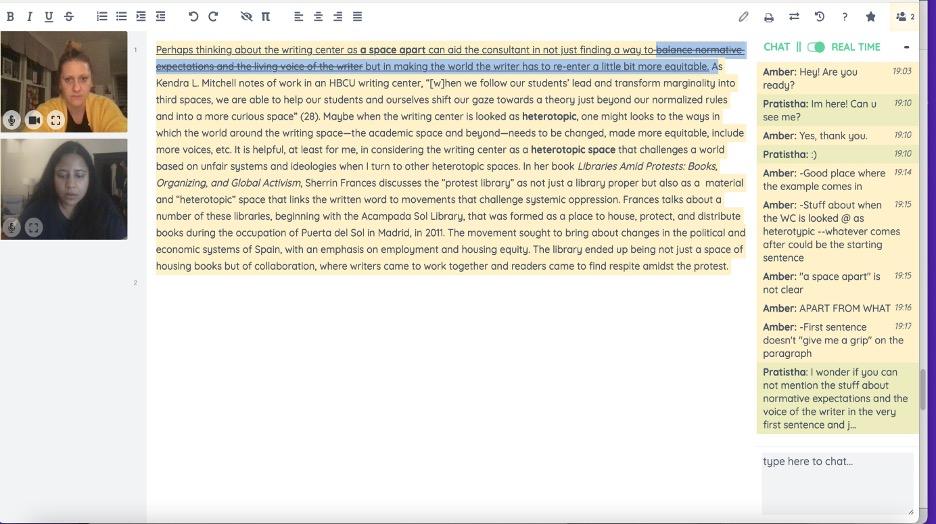
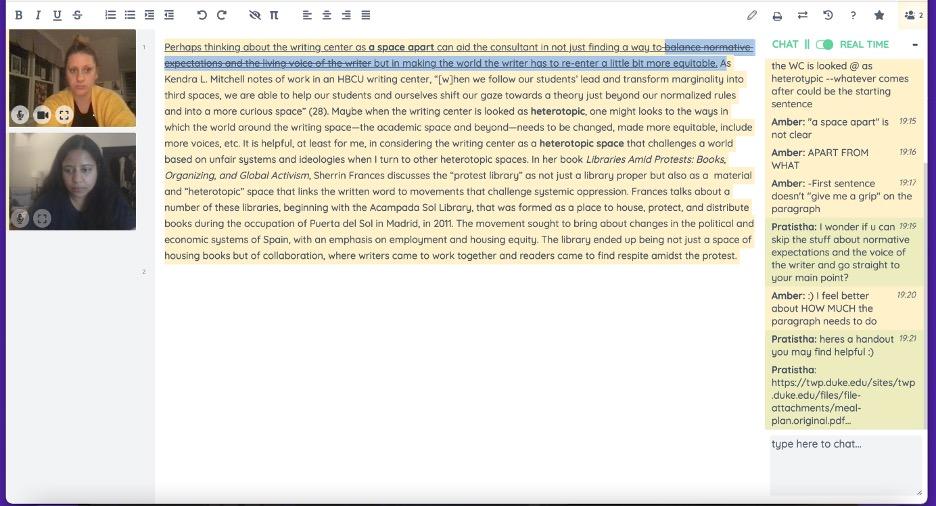

Abstract
Tutoring centers from small, open-admission campuses provide a much-needed service to students, but they also have to compete with other tutoring options such as eTutoring and private tutoring companies. As university budgets shrink and administration begins to look at cutting costs, outsourcing tutoring may sound like a good idea. Yet, there are certain aspects of tutoring that cannot be easily created when tutoring is cut off from the campus environment, such as the knowledge that tutors accumulate from being part of the campus attending courses, tutoring, and just being part of the same communities of practice as their tutees. The article draws from the theoretical framework about communities of practice developed by Etienne Wenger and looks into how tutors build this knowledge. Additionally, the article explores ways in which this knowledge can be incorporated more in initial and ongoing tutor training. Qualitative and quantitative data collected from our regional campus current and former tutors show that belonging to some of the same communities as the tutees, both on and off campus, allows our tutors to provide an individualized campus-centered tutoring experience that relies on tutors’ previous knowledge of what professors look for. This knowledge can be obtained in organic ways, such as from having had courses with the professor, working with multiple students asking for help with the same assignment, or collaborating with other tutors who may be familiar with the professor. This knowledge cannot be duplicated by other tutoring services that are not affiliated with a specific campus.
Open admission universities, such as the regional campuses for the midwestern public university where we teach first-year writing courses, rely on various support services to help students succeed academically. Tutoring represents one such support service, and each of our university’s seven small regional campuses has a learning center providing tutoring for a variety of subjects, including writing. Other online tutoring companies, such as eTutoring1, Khan, Etutoring World, and Chegge market their services to students and contract with universities to offer other tutoring options. At first glance, outsourced tutoring may seem advantageous as running a campus tutoring center can be expensive. However, outsourced tutoring services are largely unregulated and do not provide the same level of individualized attention that on-campus learning centers
offer. Regional campus tutoring centers also have an inherent advantage that is impossible to duplicate by external companies: tutors’ knowledge of the student population and their familiarity with campus faculty. The training of on-campus tutors also is more intimate and individualized than outsourced options. It includes formal training and supervision provided by faculty and ongoing informal training or learning through conversations between and among tutors, tutees, faculty members, and other members of the educational community. These learning opportunities provide tutors a solid understanding of the context in which students write which helps to improve students’ writing and their experience in the tutoring center. This led us to investigate how belonging to a small regional campus and the overlapping communities around it may shape the knowledge that tutors bring to the tutoring session, and how they go about obtaining it.
Most learning does not happen in isolation. As the social learning theorist Etienne Wenger explains in Communities of Practice: Learning, Meaning, and Identity, individuals rarely arrive at new knowledge or insights in formal settings where they are isolated from others. More often they learn in informal, communal, and spontaneous ways by conversing with others, and the result of all this interaction is a “community or communities of practice.” As Wenger states, “participation in social communities shapes our experience, and it also shapes those communities; the transformative potential goes both ways. Indeed, our ability (or inability) to shape the practice of our communities is an important aspect of our experience of participation” (56-57). Since Wenger’s seminal work first appeared in print, he and others have critiqued, developed, and applied the concept of “communities of practice” idea to different settings, and Wenger has broadened the idea and recognized it is more complex or nuanced than first conceived. In a 2014 interview, he states: “Instead of focusing centrally on a community of practice and membership in that community of practice,
the focus [now] is more on multiple communities and systems of practice, landscapes of practice, and identity as formed across practices and not just within practices” (qtd. in Omdivar and Kislov 269). In other words, learning does not just move into the community on a one-way street, or even return to the individual from a community in a holistic way. Making meaning, or learning, is more complicated than that and also involves the formation, in whole or in part, of one’s identity in a community.
Wenger’s ideas are important to our current study as they help us understand the unique role that regional campus student tutors play in the education of tutees and the formation of their identity as tutors. These tutors do not just interact with tutees; they often also interact with their fellow tutors, students in their classes, faculty supervisors and other faculty, and at times even administrators, librarians, and student services staff. They also are members of both the university’s and the global community of practice of writing tutors. Wanting to understand their communities of practice more fully, as well as the knowledge they wish they had is why, in the fall of 2020, we surveyed current and former tutors from our university’s seven regional campuses. We wanted to better understand how tutors know what they know and the role that familiarity with the campus and its instructors play in tutor performance. We also wanted a better understanding of the role that sharing the same spaces plays in the tutor-tutee interaction. Through our research, we found that this space-sharing was vital to their job; there are certain aspects of tutoring that cannot be easily created when tutoring is cut off from the campus environment. The results of our research may help tutoring programs design more targeted tutor training opportunities centered on developing and preserving knowledge about the campus and its instructors. It may also help regional campuses such as ours fight to preserve tutoring centers that may become threatened by budget cuts or mandatory outsourcing of its services.
Tutoring services are sorely needed on open admission regional campuses like ours as campuses struggle to improve retention and students struggle to pass courses. Many of our students come underprepared and are placed in developmental writing and reading classes. From fall of 2016 through fall of 2020, 29.1% of new freshmen students who enrolled in regional campuses were placed in ENG 01001, the first semester developmental writing course, and of those students, 48% either dropped the course or earned a grade of D or lower (Kent State University, Institutional Research,
“Kent Campus Retention” and “Retention Rates for the RC System”). Additionally, retention rates are much lower on the regional campuses than they are on the central campus. In 2019, our university’s retention rate for first-time, full-time freshmen was 81.6% while the regional campuses’ retention rate for first-time full time and part-time students was 57.5% (Kent State University, Institutional Research, “Kent Campus Retention” and “Retention Rates for the RC System”). One reason regional campus students struggle with academic writing is because of the poor condition of secondary education around many regional campuses. The campus where two of the authors teach draws students from the neighboring city school district where high schools are routinely assigned failing grades by the state when it comes to academic preparedness (Ohio Department of Education). A researcher from another regional campus for our university claims that “81% of . . . [its] students require remediation of some kind” (Pfrenger et al. 22). The open-admission designation of the seven regional campuses, which vary in size and student preparation, gives underprepared students a chance at higher education, but without the assistance of tutoring services, they may be less likely to acquire the academic skills they need to succeed.
Having access to an on-campus tutoring center is also an issue of social justice; in their article “A Blueprint for Scaling Tutoring and Mentoring Across Public Schools”, Matthew Kraft and Grace Falken point out that while tutoring has seen a mind-blowing expansion in the last thirty years, it is mostly the wealthier communities who can afford it. Edward Kim et al.’s research shows that “[a]s of 2016, 44 percent of tutoring centers were in areas representing the top fifth of the income distribution, and 55 percent of tutoring centers newly opened between 2000 and 2016 opened in such areas” (2), serving students who are already academically strong, but looking to gain an edge over their peers (27). Ironically, the students who need tutoring most have the least access, which is why Kraft and Falken call for policy makers to “equalize access to individualized instruction and academic mentoring” (1). They propose that we “view tutoring and mentorship as core parts of students’ schooling” (Kraft and Falken 14) and rely on local resources “to shape programs to their local contexts” (Kraft and Falken 14) as we develop a nationwide system that provides equal access to all students.
We know that tutoring helps with retention in our population. Wendy Pfrenger et al.’s 2017 study examined the short- and long-term effects of required
Learning Center visits on retention at one of our regional campus. Their research suggests that working with writing tutors may help developmental writing students pass their courses. As reported, students who were required to visit the writing center and did so were significantly more likely to pass the course than students who were required but did not visit the writing center (χ2 [194] = 10.54, p = .001). Only 48% of students who did not use the writing center when required passed the course while 71% of students who used the writing center when required received passing grades.(25)
Moreover, statistical analysis for this study revealed that “students were more likely to pass their second-semester writing course (69.4% versus 79.6%) and less likely to withdraw (14% versus 8.5%)” (Pfrenger et al. 24) when they visited the campus writing center. These researchers also followed the participants over the period of three semesters and observed that persistence also improved as a result of working with a writing tutor.
As Pfrenger et al. explains, “[s]tudents who were required to use the writing center and did so were not only more likely to pass the course [they were taking], but less likely to withdraw or stop attending the course (χ2 [194] = 13.78, p = .008)” (25). While other factors may have contributed to the success of these developmental writing students who sought tutoring help, this study provides a powerful argument in favor of tutoring considering that the researchers’ assertions were based on statistically relevant data collected from a large population of 1301 participants over the span of three years. While Pfrenger el al.’s research focuses on only one of our regional campuses, it nonetheless provides insight into how central these on-campus writing centers are to students’ success.
Pfrenger et al.’s results align with a study by Jacyln Wells on developmental writers’ perceptions of writing centers. Wells discovered that close to 70% of the 140 developmental writers surveyed responded “yes” to the question of whether developmental writers should be required to visit the writing center (93). Why participants felt this way can be explained, in part, by the second half of the study which consisted of interviews with 15 of the 140 participants. One salient finding from the interviews was that while “[i]nterview participants were never directly asked about tutors . . . all 15 commented at least generally on writing center staff. The most interesting comments . . . had to do with finding a tutor who fit the student’s preferences, needs, or even personality” (Wells 103). Students are also more willing to accept tutoring if instructors are excited about tutoring and emphasize its benefits, including likely
improvement of grades (Wells 106-7). The students participating in Pfrenger et al.’s article described “the writing center as a place for ‘guidance,’ especially noting how it either supplemented course lessons or provided benefits the students found lacking in the classroom.” This suggests that if students do not feel comfortable with their instructor, they benefit from freely discussing with a tutor their concerns and questions they may have about a piece of writing.
The importance of tutor-tutee rapport has long been emphasized in writing studies; in The Oxford Guide for Writing Tutors, Melissa Ianetta and Lauren Fitzgerald state that “rather than one person talking or asking questions while the other person quietly listens or answers, tutors and writers often engage in a dynamic back-and-forth in which both of them talk, listen, ask, and answer” (54). Cynthia Lee’s empirical study on developing rapport in writing consultations builds on this work, but it also recognizes that “directive tutoring acts and tutor dominance” can occur in tutoring sessions (431). Terese Thonus also sees a disconnect between advice in tutorial manuals that see tutors as “supportive peers,” and what occurs in reality where tutors also evaluate and teach students in such a way that their “roles . . . [are] negotiated anew in each tutorial” (“Triangulation” 60). Having a regional campus tutor may help with the lack of connection between tutor and tutee because the two share the same communities of practice in and out of school and can therefore connect in more meaningful ways than when the tutor is not part of the tutee’s community.
Tutoring can build confidence in writers who struggle as research indicates that “[t]utorials in which both tutor and student demonstrated high and roughly equal rates of interactional features were rated as among the most successful” (Thonus, “Tutor” 127). In other words, students benefit from tutoring sessions when rapport is present and both parties converse freely and easily. Belonging to overlapping communities of practices can help create this rapport between students and tutors. This mutually beneficial interpersonal interaction and synergy may not be present when tutoring is outsourced because the tutor is not part of the same communities of practice as the tutee. Because tutoring is relational and interactive, being able to relate to the tutee helps tutors better communicate necessary insights and information to their tutee. As Isabelle Thompson explains, “[d]eveloping comfort and trust making the personal connection that to some extent stimulates students’ readiness to learn demands that conferences be highly interactive” (446).
To get a better understanding of the types of knowledge that regional campus tutors bring to the tutoring session and how they go about obtaining it, we designed a survey study conducted in Fall 2020. The data2 was collected from current and former writing tutors from our seven regional campuses learning centers that generally employ between two and five English tutors. English coordinators who oversee writing tutors were contacted by email during the first week of September 2020 and asked to forward their current and former tutors a survey designed to collect both qualitative and quantitative data.3 A reminder email to the coordinators followed two weeks later, and the survey link was deactivated at the end of the month. Twelve tutors participated in the survey, with most (11 out of 12) identifying as female, and most (8 of 12) working as tutors at the time of the survey. Half of the survey pool were at least 22 years of age at the time when they obtained employment as tutors, which is representative of the nontraditional student population typically found on regional campuses. The tutors’ declared majors varied from English (8) to Nursing (1), Psychology (1), Education (1) and Liberal Studies (1).
In addition to collecting demographic information, the survey the tutors received in September 2020 had several multiple-choice and open-ended questions4. The questions asked about tutor confidence in their ability to tutor, formal and informal tutor training, what has helped tutors to understand what “students’ professors are looking for,” how tutors work to “understand professors’ expectations,” what English professors “seem to value in their students’ writing,” what tutors do if they lack information about a professors’ expectations,” and finally, what the “tutoring center/campus community [could] have done to help [tutors] . . . better understand the tutees’ professor[s’] expectations.” The authors of the paper processed the data by looking for salient themes in the qualitative data, also taking into consideration the quantitative data provided by the participants.
The data in this self-reporting study provides insight into what the tutors perceive as campus- and disciplinerelated knowledge that is important for running a successful tutoring session. One theme identified from the survey data was that participants had an arsenal of strategies they deployed in order to understand what their tutees and their professors wanted to see in the writing projects that were brought to the tutoring center. Some of these strategies were non-campus specific, meaning it was not necessary for tutors and tutees to be from the same campus. For example, the tutors read the
course materials (essay prompt, syllabus) that the tutees provided. We also discovered, however, that tutors also relied on campus-specific tactics that were only possible because tutors and tutees belong to the same communities of practice. Due to the small size of regional campuses– population at the seven regional campuses ranges from roughly 500 to 3,000 students–the tutors were familiar with the tutees’ home communities, campuses, and even specific courses and professors (Kent State University, “Student Enrollment Data,” Institutional Research). The data in our study confirms the importance of the numerous ties that these tutors have with their tutees, and it also emphasizes the benefits that come from tutors being familiar with the professors whose students they were tutoring.
Many strategies did not require that tutors share the same communities of practice with their tutees, such as reading the feedback that the professor left on the students’ papers, because it allowed them to understand their tutees’ professors’ expectations; in fact, six participants mentioned looking at the feedback provided by the instructors on drafts. Reviewing the instructors’ feedback may provide the tutor with insight into their expectations for revision. The drawback, however, is the need to rely on the tutee to share that information, and that is not always made available during the session, which may be the reason why only half of the participants mentioned this as a helpful strategy.
Another strategy involved asking the tutees to explain what their professors were looking for in an assignment. This was suggested by four participants, and is, indeed, a valuable aspect of the tutor-tutee interaction, as best tutoring practices require a tutor to follow the tutee’s lead at all times. When asked what they would do when they had no or very limited information about a professor’s expectations, T9 stated:
This is when I get the student to talk a bit more. Before even reading their paper, I urge the student (in a natural manner) to tell me what their paper is about and whatever they can retain about the assignment. Sometimes, if this is not easy to get from them, I begin reading and at random intervals, may stop and ask them to explain a topic point/idea so that I can better understand. I try as many methods as needed to get the student to converse with me on what they need their paper to do.
T9’s answer confirms that tutors understand the importance of having the student “talk to them more,” something Thompson associates with “directiveness,” which requires the tutees to take charge of their own
learning and tell the tutors what they want to see accomplished during the session. According to Thompson, “Directiveness relates to how tutors get students to do things to make revisions, to develop ideas through brainstorming” (446) by inviting them to figure out where they need help. Getting the students to open up and talk about their writing is the first step toward “directiveness.” Thonus also acknowledges that tutors instruct and provide direction to the tutees, but at the same time they warn about the danger of the tutor taking over the tutoring session and showing “‘too much’ involvement in the student’s work” (“Triangulation” 64). To counterbalance this tendency, Thonus emphasizes the important role of small talk (65). Engaging in small talk and using laughter to balance or temper directiveness is an important skill that seasoned tutors and teachers rely on. This skill is more easily developed when tutors utilize knowledge they have learned from observing the teachers on campus and their fellow tutors.
Even when students do talk, asking them to explain the assignment to their tutor is not always helpful as students may misunderstand what they were asked to do or leave out important information. This can be easily corrected when the tutees provide the assignment sheet, but, again, that does not always happen. What can be even more helpful is the tutor’s familiarity with the professor or the assignment, which happens when the tutees and tutors belong to the same campus. However, the burden of clarifying expectations for assignments does not solely fall upon the instructor. Students must be active learners and accountable for their own success in tutoring. They must take detailed notes in class, clarify questions about a writing assignment with their professor, and then actively engage with their writing during a tutoring session.
The aforementioned strategies are not necessarily tied to a specific campus since they can be used when tutors and tutees come from multiple locations and institutions. Still, each strategy may be more effective when the participants in the tutoring process share the same spaces. This points to the need to consider the benefits of keeping regional campus centers open and available to students, even when other tutoring options are available and may be more cost-effective.
Some strategies mentioned by our participants may be more likely to work when the tutors and tutees belong to a more compact unit, such as a regional campus. The tutors emphasized how helpful it is to share the same physical space because that allowed them to rely on one another and their tutoring coordinator for
advice and support, especially when they begin tutoring. T115 stated: “I knew that if there was anything I needed I almost always had someone right around the corner who could answer even my smallest questions.” This points to how important it is for the tutors to be surrounded by peers and have the support of the coordinator, who are all likely to be familiar with the campus culture and the students’ needs. This type of informal help seemed to replace more formal ways of tutor training, such as taking a peer-tutoring course, which, surprisingly, only five tutors stated that they were required to do as part of their training. Eight tutors pointed to the training they received from the tutoring coordinator, and four participants specifically mentioned other tutors as a source of support and inspiration during their first semester on the job; in some cases, such mentoring was formally required. T12 stated: “As part of my training, I had to observe sessions with other tutors. When I felt comfortable enough to do a session on my own, I had another tutor observe me and give a report to the coordinator. Then the coordinator observed me before I officially became a writing tutor.” Wenger explains that the members of a community of practice must interact and communicate with one another, and this engagement is essential to how they co-construct knowledge (74). He goes on to state that members in a specific community of practice “work together, they see each other every day, they talk with each other all the time, exchange information and opinions, and very directly influence each other’s understanding as a matter of routine. What makes a community of practice out of this medley of people is their mutual engagement in” the subject matter (75). It is true, however, that such cooperation does not necessarily depend on a tutor’s location; technology can facilitate the collaboration among tutors even when they do not share the same physical space, as may be the case with online tutoring companies.
Open collaboration with professors from the tutors’ home campus was also emphasized by participants. While reading the assignment directions is instrumental in the tutors’ ability to help tutees complete their work, at times instructors can leave out relevant information that may be conveyed verbally when the assignment is introduced in class. Without the context of the live classroom or clear prompts from instructors, tutors may not understand what direction or focus the paper should take. The solution to this problem is provided by T12 who wanted to see more clearly written prompts and collaborative relationships between instructors and writing centers. T12 stated:
I think some professors need to realize that the writing center is there to help their students
succeed, and working together with us does wonders. Providing clearer expectations in assignments is a good start. I think it is important for there to be a relationship between the writing center and instructors.
Tutors’ familiarity with the courses and instructors especially at regional campuses can help resolve any miscommunication between students and faculty about a writing assignment or feedback on a paper. If asking the student for clarification or insight does not help, tutors can directly contact faculty for clarification which can lessen “miscommunication between student and instructors” (Calvo and Ellis 428). Miscommunication or a breakdown in communication can still occur, however, as students may not fully understand future comments or prompts by an instructor or even fully understand a clarified writing prompt that a tutor explains to a student. This said, the intervention of a tutor may still help. As Thonus explains, “more communication between course instructors and writing center personnel is desirable and in the tutees’ best interest,” and “in addition to the guidance a tutor offers, meeting with the instructor during a tutoring session may clarify points of confusion for students”
(“Triangulation” 77; “Tutor” 125).
Reaching out to the course instructor can, according to Laura Palucki Blake and T. Coleen Wynn, “yield new levels of efficiency and productivity, as well as new connections that contribute to student success” (48). Blake and Wynn also stress the importance of collaborative work between faculty and student services so that students are more successful learners. Thanks to the smaller size of regional campuses, this level of professor-tutor interaction promotes student engagement and connection to the campus and coursework since “[t]here is considerable strength in working within a broad partnership of campus constituents to leverage expertise and work collaboratively on shared issues” (Blake and Wynn 55). Moreover, “[t]he level of support and social interaction peer tutors provide to other students is especially important during the pandemic, when students are more likely to be isolated and lacking connection to their institutions,” asserts George Kuh of Indiana University (qtd. in Anderson). Again, in a regional campus environment, tutors who possess familiarity with the institution are more likely to foster and encourage connections between students and their professors. When asked what was most helpful when trying to understand the professor’s expectations during a tutoring session, eight participants pointed to the syllabi and assignment sheets. While undoubtedly helpful, there
are obvious limitations to this strategy as not all students may be willing or prepared to share their course materials, including the assignment sheet, with tutors. Aware of this fact, having direct access to these materials was the participants’ number two answer to a later question that asked what the institution could do to help tutors do their job. Seven out of the twelve participants wanted to see all instructors provide the tutoring center with a copy of course materials, and only three mentioned having had access to a folder with professors’ syllabi and assignments during their first semester of tutoring. T5 stated: “Professors could bring a copy of their assignments directly to the tutors at the writing center for those students who don’t bring or lose their copies of their assignment expectations.” The solution providing the tutoring centers with the course materials in advance would only be possible on small regional campuses where tutors interact with only a handful of professors and their students. Since the eTutoring consortium, for example, provides tutoring to students from twelve states (eTutoring), it would not be feasible for writing instructors to send in their course materials directly to the eTutoring tutors.
Data from the survey also showed that tutors often struggled to understand what the tutee needed, and while the suggestion they provided was to seek clarification directly from professors, some were hesitant to reach out. When asked what else could be done to help the tutors with their job, five participants mentioned having conversations with students’ instructors. Two of the four participants specifically suggested that instructors provide a written document about their expectations as readers of student writing; T9 explained that they had used such a strategy in the past with good results:
Being a tutor that has often worked with professors and with peer tutors to create more resources for the center, I think it may help the tutoring center to perhaps work alongside professors to create a document that summarizes what each professor's main concerns may be. That way, tutors who have not had a particular teacher might be able to know them a little better. This strategy is another aspect of the tutoring experience that cannot be easily duplicated when tutoring is outsourced because of the large number of professors who would have to be contacted by the outside tutoring company. Moreover, while helpful, creating such a document can nonetheless be burdensome for our regional campus professors who are already tasked with a high teaching load (4 and 5 courses per semester for tenured and non-tenure track professors, respectively). Additionally, this information already exists in rubrics
and assignment prompts, but then the tutors have to rely on tutees to share them, unless professors make them available to the tutoring center.
Although direct communication with campus instructors was the most valued strategy singled out by the tutors, none mentioned it as being part of their training. Involving instructors in tutor training can be particularly beneficial for many reasons. First, it provides the tutors and instructors with an opportunity to ask and answer questions, and, in general, to share ideas. This is useful especially as not all instructors look for the same characteristics in their students’ writing. One of our survey questions required our participants to think of two English professors from their campus whose students they have helped and identify what the professors seemed to value in their students’ writing. The variety in the answers provided was staggering, ranging from rather vague statements such as “[e]ach professor is different, but they all want their students to learn something from the paper they are writing” (T4) to very specific points such as “having a strong thesis or evidence for their argument” (T12). Table 1 provides the list of issues mentioned by the tutors and the number of times they were brought up. This is not a comprehensive list of everything the tutors stated, and each item had to be mentioned more than once to be included here.
These writing concerns are definitely not new, and they are likely to be familiar to the tutors simply because they are good writers themselves. What makes this list interesting, however, is the tutors’ assertion that specific instructors seemed to value different aspects of academic writing; there was not a lot of overlap beyond having the tutor help the students understand the assignment and work with sources, which were the only two issues singled out by half of the participants. Overall, this highlights the challenges tutors face in anticipating what instructors want, and how demanding their job can be as they try to help students meet the course expectations. While the tutors are accomplished writers themselves, the feedback we received from them suggests that they value the input they can receive from professors who are the main audience for the students’ paper. In other words, the tutors’ understanding of students’ writing needs is augmented by their knowledge about various professors that they obtained from being part of the campus community.
Inviting instructors to be part of the tutor-training process can help facilitate the ongoing communication between tutors and instructors that so many of our participants seemed to crave. When asked for suggestions for improving their ability to help students, the tutors overwhelmingly mentioned contacting the
instructor as one of the strategies they would like to see implemented more. T11 stated:
Potentially make a direct line of contact between tutors and professors. That way if I get the same question presented by multiple students in one course, I can take free time during a shift to get in contact with the professor myself for reference for future sessions. Even if we were given a list of professors who's [sic] students we will most likely/definitely be seeing that semester and we have their email, their office hours, if they have any other contact information, etc. That way if I have something I need to address I can check a sheet for reference and see that the professor has office hours soon, so maybe I can drop in and bring my questions/concerns.
When tutors feel comfortable contacting the course instructors, they do not have to rely solely on guessing what students need to work on in a tutoring session. T11, however, pointed out that such access does not happen often as some instructors do not make themselves available even when the students themselves reach out to ask questions: “It helps immensely if the professors make themselves available for quick questions through email … I have had a lot of writers come in with zero access to a professor outside of class (or just EXTREMELY slow emails).” While meeting the instructors can be beneficial, it may not be a realistic goal even on a small regional campus, simply due to conflicting course schedules and the sheer number of faculty teaching there. In a study from a large institution, Elizabeth Maffetone and Rachel McCabe recognize that “instructors and tutors are always supposed to be working to support student writers, [but] . . . also acknowledge the limitations set in place by institutional hierarchies . . . and the lack of resources (particularly time) available for developing direct lines of collaboration” (65). Moreover, the English faculty are not the only instructors who send students to the tutoring center; instructors from other disciplines may assign papers as well. This is something T1 pointed out, stating that it would be beneficial for tutors to “[s]pend at least a little bit of time meeting each English professor. However, not every writing assignment comes from English classes. In fact, the majority of people that I seem to get in the writing center come from science classes/disciplines.”
Considering that numerous courses outside of freshman writing require students to write papers, it is not feasible for tutors to meet all instructors, especially as many campuses rely extensively on an ever-growing number of contingent faculty. Still, having some direct contact with the professors who are willing and able to attend
meetings with tutors, is preferable since whenever instructors are included in tutor training or even interact with tutors, they may be more willing to encourage or even require tutoring for their students.
Another strategy that the tutors mentioned is learning about instructors’ expectations from working with multiple students taking the same course. This allows them to piece together a more complete picture of assignment requirements and what the tutees may need by combining what they have learned from several students about a particular instructor or assignment. This, however, can only happen on smaller campuses, where the tutoring center serves a limited number of courses. It would not be possible to use this strategy when dealing with students from multiple campuses.
One other advantage that tutees have when working with a regional campus tutoring center is when tutors have taken courses with the same instructor that the tutee currently has. A total of four participants mentioned how helpful this direct experience can be; although they may not have been in the same classroom as the tutees or even enrolled in the same course, they nonetheless have direct knowledge of how an instructor teaches and what they may value in student work. T9 explains that classroom experience with a professor translates into expertise to be shared with tutees: “I became known as the "expert" for one of our full-time English professors, and, as a result, I had tutees and tutors alike come to me for that professor specifically. I even had a repeat tutee come back to me to ask me for clarity on that particular professor's comments and marks.” This expertise, however, is more likely to happen when the tutoring center serves a smaller campus with a limited number of instructors. T4 stated: “Because I work for a smaller campus and was an English major, I had personal experience with a lot of the professors. So, I naturally knew from my own papers what they were looking for.” This feeling was echoed by another participant who stated that “I have had all of the full-time English professors at my campus, and I can gauge assignments based on that experience” (T9). In this instance, size does impact the ability to interact with faculty.
Finally, it is also important for tutors and tutees to share the same communities of practice outside of the campus because that may help them understand their tutees better. This is possible on commuter campuses where the tutors and students live within a limited radius. The demographic data we collected revealed that all but one tutor lived in the community surrounding their campus for at least three years prior to their tutoring job, and all but three had attended a local high school. When asked how familiar they were with most
of their tutees’ home communities, five stated that they were very familiar, and two others claimed to be familiar. Only five participants selected the option “somewhat familiar,” and none chose “not familiar at all.” This familiarity is conducive to the type of tutor-tutee relationship based on “comfort and trust” that Thompson recommends (446). Wenger explains that belonging to several overlapping communities strengthens the members’ ability to create relevant knowledge (76) as they draw on “overlapping forms of competence” (76). Such familiarity that leads to knowledge-making is difficult, if not impossible, to duplicate when tutoring is outsourced.
Although limited in terms of participants, our study nonetheless provides insight into what makes regional campus tutoring centers so valuable: the knowledge that tutors amass from sharing the same academic spaces with their tutees. Wenger explains that “[f]or organizations, ... learning is an issue of sustaining the interconnected communities of practice through which an organization knows what it knows and thus becomes effective and valuable as an organization” (8). While formal training that tutors receive impacts how they tutor, they also learn relevant information working informally with other tutors and with students. This is because regional campus tutors are familiar with and have easier access to students’ instructors, and they may know what instructors value in their students’ writing and the types of writing prompts they assign. Therefore, belonging to some of the same communities as the tutees, both on and off campus, allows our tutors to provide an individualized campus-centered tutoring experience that cannot be duplicated by other tutoring services that are not affiliated with a specific campus. Our study points to the many ways in which students may benefit from working with small regional campus tutors who can provide a personalized tutoring experience. As tutors help students make sense of an assignment and the professor’s feedback, they can use their past experience with that particular professor or their students to shape what happens during the tutoring session. This is particularly important for struggling writers who need the tutors’ expertise to make sense of the course requirements and the professor’s expectations. We argue that the campus tutoring center provides students on regional campuses with an individualized experience driven by community-specific knowledge.
Any tutoring service can be improved, and our participants’ detailed and thoughtful answers to our inquiries point to the need to provide tutors more
opportunities to enrich their knowledge. Suggestions to improve tutoring sessions include the following:
➔ Encouraging students to be accountable for their own success by bringing necessary materials to their tutoring session and actively participating in tutoring
➔ Actively collecting course materials from campus instructors
➔ Supporting peer-to-peer mentorship within the tutoring center
➔ Nurturing direct communication between tutors and instructors
➔ Including instructors in initial and ongoing tutor training
➔ One way to strengthen regional campus tutoring centers' relevance is to increase tutor participation in on-campus student activities (especially when they are academic versus social in nature) that work to solidify the connection between tutors and the institution. Tutoring center leadership can also take active steps toward developing tutor knowledge, such as facilitating ongoing conversations among tutoring center staff or between tutors and campus instructors. As our research demonstrates, this level of familiarity and experience does materialize autonomously to a certain extent, but we see value in actively promoting the benefits of individualized tutoring and the resultant interpersonal associations which arise from the intimate setting specific to small regional campus writing centers. This approach can place them in a more compelling bargaining position when communicating with the administration for additional resources.
As small tutoring centers face budget cuts and competition from outside electronic tutoring services, it is crucial for them to justify their importance to student success and campus engagement and even argue that the campus should invest more not less in their services. This is especially important for campuses serving working-class communities, considering that private online tutoring services, such as Kegg, require students to cover part of the cost. As Shayla Griffin explains, tutoring becomes a matter of social justice as workingclass students may not afford these private tutoring options. Kraft and Falken point out that “[a]ccess to tutoring is inherently unequal,” and working-class communities such as the ones served by our regional campuses have the greatest need for equitable access to tutoring, but are currently benefiting the least from it.
By investing in the campus tutoring center, universities can provide affordable access to this service that is fundamental to student success.
1. eTutoring is particularly relevant for our campus because, unlike the other private tutoring companies mentioned here, eTutoring represents consortium of state and private universities across several states who pool resources in order to provide access to online tutoring to their students. As the website explains, “eTutoringOnline is an online tutoring platform which allows tutors to work with students synchronously and asynchronously, … [and is] used across North America in over 130 two and four-year, public and private colleges and universities.”
2. The study was approved by the authors’ institutionIRB 20-352.
3. The exact number of tutors invited to participate in the survey is unknown as we collected only completed surveys and each regional campus English coordinator was responsible for distributing surveys to their tutors.
4. A copy of the survey can be found in Appendix B
5. Each anonymous survey response was randomly assigned a number from T1 to T12.
Anderson, Greta. “As Students Dispersed, Tutoring Services Adapted.” Inside Higher Ed 16 March 2021. www.insidehighered.com/news/2021/03/16/faceface-peer-tutoring-decimated-pandemic-universitiesturn-new-tools-times-and. Accessed 22 June 2021.
Blake, Laura Palucki, and T. Colleen Wynn. “An Integrated View of Student Success at Small Colleges.” New Directions for Institutional Research, no. 184, 2020, pp. 47-59. https://doi.org/10.1002/ir.20321
Calvo, Rafael A., and Robert A. Ellis. “Students’ Conceptions of Tutor and Automated Feedback in Professional Writing.” Journal of Engineering Education, vol. 99, no 4, 2010, pp. 427-37.
https://doi.org/10.1002/j.2168-9830.2010.tb01072.x eTutoring. “About Tutoringonline.org.” eTutoring, https://etutoringonline.org/about.cfm Accessed 28 May 2021.
Griffin, Shalya. “If ‘Most Students Should Stay Home,’ What Do I Do with My Kids?” Medium. 23 July 2020, https://medium.com/@shaylargriffin/if-moststudents-should-stay-home-what-do-i-do-with-mykids-b7b7f32e11df
Ianetta, Melissa and Lauren Fitzgerald. The Oxford Guide for Writing Tutors: Practice and Research, Oxford University Press, 2016.
Institutional Research, Kent State University. Email 24 March 2021 to authors.
Kent State University, Institutional Research. “Kent Campus Retention.” Retention & Graduation Rates, www-s3-live.kent.edu/s3fs-root/s3fspublic/file/KC%20Retention%20Rates%202020%20F
all_0.pdf. Accessed 28 May 2021.
. “Retention Rates for the Regional Campus System.” Retention & Graduation Rates, 5 www-s3-live.kent.edu/s3fs-root/s3fspublic/file/KC%20Retention%20Rates%202020%20F
all_0.pdf. Accessed 28 May 2021.
. “Student Enrollment Data.”
https://www.kent.edu/ir/student-enrollment-data
Accessed 5 February 2023.
Kim, Edward. et al. “Kumon In: The Recent, Rapid Rise of Private Tutoring Centers,” EdWorkingPaper, 2021, pp. 21–367. https://doi.org/10.26300/z79x-mr65
Kraft, Matthew A., and Grace T. Falcon. “A Blueprint for Scaling Tutoring and Mentoring Across Public Schools,” AERA Open, vol. 1, no. 1, 2021, pp. 1-2. https://journals.sagepub.com/doi/pdf/10.1177/2332
8584211042858
Lee, Cynthia. “More than just Language Advising: Rapport in University English Writing Consultations and Implications for Tutor Training,” Language and Education, vol. 29, no. 5, 2015, pp. 430-52. https://doi.org/10.1080/09500782.2015.1038275
Maffetone, Elizabeth, and Rachel McCabe. “Learning Institutional Ecologies for Inventive Collaboration in Writing Center/Classroom Collaboration.” Composition Studies, vol. 48, no. 3, 2020, pp. 53–69.
Ohio Department of Education, Ohio School Report Cards. “Prepared for Success, Warren City School District, reportcard.education.ohio.gov/district/prepared/0449 90, Accessed 28 May 2021.
Omdivar, Omid and Roman Kislov. “The Evolution of the Communities of Practice Approach: Toward Knowledgeability in a landscape of Practice An Interview with Etienne Wenger-Trayner.” Journal of Management Inquiry, 2014, vol. 23, no. 3, 266-275. https://journals.sagepub.com/doi/pdf/10.1177/1056
492613505908
Pfrenger, Wendy et al. “At First It Was Annoying”: Results from Requiring Writers in Developmental Courses to Visit the Writing Center.” Praxis: A Writing Center Journal, vol. 15, no. 1, 2017, pp. 22- 35.
http://www.praxisuwc.com/pfrenger-blasiman-andwinter-151
Thompson, Isabelle. “Scaffolding in the Writing Center: A Microanalysis of an Experienced Tutor’s Verbal and Nonverbal Tutoring Strategies.” Written Communication, vol. 26, no. 4, 2009, pp. 417-453.
https://journals.sagepub.com/doi/pdf/10.1177/0741
088309342364
Thonus, Terese. “Triangulation in the Writing Center: Tutor, Tutee, and Instructor Perceptions of the Tutor’s Role.” The Writing Center Journal, vol. 22, no. 1, 2001, pp. 58-82. https://www.jstor.org/stable/43442136
. “Tutor and Student Assessments of Academic Writing Tutorials: What is “success”?” Assessing Writing, vol. 8, no. 2, 2002, pp. 110-34.
https://doi.org/10.1016/S1075-2935(03)00002-3
Wells, Jaclyn. “Why We Resist ‘Leading the Horse’: Required Tutoring, RAD Research, and our Writing Center Ideals.” The Writing Center Journal, vol. 25, no. 2, 2016, pp. 87-114.
https://www.jstor.org/stable/43824058
Wenger, Etienne. Communities of Practice: Learning, Meaning, and Identity. Cambridge University Press, 1999
Table 1: List of ideas suggested by participants when asked what instructors looked for in an assignment.
Issue that instructors seem to value, according to tutors Number
1.
2.
3.
4.
5.
Thank you for participating in this research project. We are looking at strategies tutors use to obtain the institutional knowledge needed to help their tutees. Please answer each question in detail whenever possible. The survey is anonymous as you will not be asked to provide your easily identifying information such as your name, email, or campus. The survey (State University IRB Protocol #20-328) should take about 10-15 minutes. If you have questions, email the investigators at ___________
This survey is for current and former English tutors from Kent State regional campuses.
1. Do you identify as male, female, or other?
Male Female Other: ___________
2. What age were you when you began tutoring at a Kent State regional campus?
3. Had you lived in our area for at least 3 years prior to starting your tutoring job?
Yes No
4. Did you attend a local high school for at least one year?
Yes No
5. Are you a current or former English tutor for a Kent State regional campus?
6. During your tutoring years, are/were you an undergraduate or graduate student? (select all that apply)
Undergraduate Freshman
Undergraduate Sophomore
Undergraduate Junior
Both undergraduate and graduate
7. What is/was your major during your tutoring years?
8. For how many semesters have you been tutoring? If you are a former tutor, how many semesters total did you tutor?
9. How familiar are you with the communities where most of your tutees live?
Very familiar Familiar Somewhat familiar Not familiar at all
10. How confident were you in your tutoring ability during the first semester tutoring?
Very confident Confident Somewhat confident Not confident at all
11. Why? In a few sentences, explain your answer.
12. How confident were you in your tutoring ability during the second and/or third semester tutoring?
Very confident Confident Somewhat confident Not confident at all
13. Why? In a few sentences, explain your answer.
14. What formal training were you given prior or during your first semester tutoring? (select all that appl y)
Did not receive any formal training
Took a peer tutoring course
Was trained by the coordinator
Was provided a book or journal articles to read
Other:
15. What type of informal training were you given prior or during your first semester tutoring? (select al l that apply)
● Observed the other tutors
● Was mentored by another tutor
● Took some of the courses for which tutees visit the tutoring center
● Approached or was approached by some professors with information from the course
● Had access to a folder with information about individual instructors where you were able to view the materials (syllabi, assignments, etc.)
● Other:
16. During the tutoring session, what helped you understand the assignment expectations of the student’s professor? (select all that apply)
The student provided course materials (syllabi, assignments, blackboard access, etc.)
The student explained the professor’s expectations
Another tutor or your coordinator explained the professor’s expectations
Another student from the same course provided information about the professor’s expectations
Other:
17. In general, what has helped you understand what the students' professors are looking for?
18. Explain at least three strategies or resources that you used to understand professors’ expectations.
19. Think of two English professors at your campus whose students you have helped. What did the professors seem to value in their students’ writing? (You do not need to identify the professors here.)
20. What do you do when you have no or very limited information about a professor’s expectations?
21. What else could the tutoring center/campus community have done to help you better understand the tutees’ professor expectations?
22. What else do you wish you could do/have done to better understand the tutees’ professor expectations?
Prison-based writing centers are needed to support the academic achievement of college students who are incarcerated. This study describes the author’s work designing a writing studio to support credit-bearing courses in a women’s prison. I used a qualitative action research design combining scholarship, observations, surveys, and interviews with iterative practice. I approached the work with a generalist tutoring mindset based in my campus-based center’s work, but found that students needed access to course-based expertise in an isolating environment with scarce resources. Scholarship and interviews revealed pitfalls educators can bring to prison-based writing programs, including pressures to adapt to the prison’s “rehabilitative” mindset and unexamined low academic expectations. Also revealed was the expertise of incarcerated students in surviving this dehumanizing environment and recognizing their own academic needs. Recognizing this expertise, established programs successfully employ incarcerated students who also have academic credibility with their peers, as peer tutors. To improve our program, we initiated more communication with faculty to anticipate students’ needs for resources and to answer students’ questions more directly. Also, we created ways for students to have some degree of control over their sessions, through signing up for sessions in advance and moving between independent work and sessions in a computer lab. Whatever tutors a program uses, it needs to recognize their knowledge and use training to complement that knowledge. All writing centers can learn from the voices herein that we must create room in our spaces for students to advocate for their education.
Introduction
“Higher education in prison is not for the fainthearted,” writes Rebecca Ginsburg, director of the Education Justice Project at the University of Illinois. “There is much at stake…. College in prison is not inherently beneficial or righteous. To be honest, a poorly designed or implemented program can do more harm than good” (Ginsburg xiv). In 2016, I offered to expand our writing studio in support of a colleague’s initiative to offer courses in a nearby women’s prison. A writing center to support college courses in prison seemed, to use Ginsburg’s words, “inherently beneficial” in assisting incarcerated students to complete their writing assignments outside of class. But time would show that, just as writing centers on campus do not serve all students equitably without continuous reflection and action, our prison-based writing center needed careful attention and revision to successfully respond to the varied experiences of incarcerated students.
Each and every incarcerated student faces a difficult climb in achieving an education within a system that suppresses critical inquiry, access to resources, and equal
humanity. But within the constancy of confinement, individuals have varied educational backgrounds and goals. The challenge writing centers in prisons face is in generating methods that address systemic barriers to learning, without flattening the incarcerated student into a generic victim of the system who needs our help to flourish. This is a challenge made visible to outsiders by the concrete features of the setting the guarded and surveilled entrances and exits; the uniforms, lockdowns, and label of “offenders” that incarcerated students endure. But it’s a challenge that extends to our campusbased spaces as well: how to develop tutoring methods that serve disenfranchised populations without flattening students into problems we can solve.1
How does a writing center successfully support the academic goals of incarcerated students? I sought to answer this question through a qualitative action research process. Action research is a research paradigm whereby educators develop research questions based in their teaching context, employ varied methodologies to answer those questions, and feed their findings back into their teaching (Pine). Action research is situated whereby researchers recognize the unique context of their work and are cautious to claim generalizability of their findings and collaborative: “by, with, of, and for people, rather than on people” (Pine 31).
In essence, the research has accompanied our prison-based writing center’s design and redesign. The faculty director had initiated a partnership with a staterun minimum security women’s prison in a semi-rural setting close to our campus, offering two credit-bearing courses each semester from different departments. The program is based on the National Inside-Out model, that brings non-incarcerated students into prison to study alongside incarcerated students; additionally, we were committed to all students receiving college credit for the experience and obtained grant funding to make that possible. My piece of the partnership was to develop writing center support for the incarcerated students to match what is available on campus.
To give a brief overview of the methodology with details to be filled in later, in fall 2017, I based the initial design on our campus writing center. After some missteps, in spring 2018, I collected anonymous surveys from 14 students and interviewed 39 stakeholders in our program (students, teachers, prison staff, tutors,
director). I also sent out a survey about academic support on several professional listservs and interviewed 29 educators who responded to the survey. After transcribing and coding interviews and surveys, in Fall 2019 I channeled findings into a collaborative redesign, which worked until March 2020 when we had to leave the prison due to COVID, and which starting in January 2022 we are reviving. My study was approved by my college’s Institutional Review Board (IRB), and I followed research guidelines of the Inside-Out Prison Exchange Program to which my institution’s college-inprison program is connected. These guidelines helped me to carry out my research ethically through the practice of transparency regarding my research topic and goals, informed consent with the ability of participants to withdraw their consent, the use of pseudonyms to protect participants’ privacy, and where possible collaboration in the interpretation of findings: I shared a draft of my findings with participants and asked for their feedback.
This article represents a slice of my findings from these three years of work. To situate readers, I begin with framing commentary about the U.S. carceral system, college-in-prison programs, and writing centers. Next, I merge interview data with published scholarship to describe pitfalls that writing educators can face in prisons, and to describe programs that successfully resist these pitfalls in part by involving incarcerated students as tutors. Where possible, I prioritize accounts by system impacted scholars, who combine academic and lived experience. Then, I describe our program’s first three years, again with an emphasis on student perspectives. I end with brief thoughts about what the writing center field as a whole can learn from what may seem at first glance a sidebar to our work.
Our country has the highest incarceration rate in the world, 2.2 million people or 0.86% of the population in 2016 (Gramlich). When people leave prison, they face lifelong “collateral consequences” past the length of their sentence, with diminished post-incarceration access to life necessities including employment, education, housing, public benefits, and voting rights (Alexander; Vesely-Flad). The US carceral system disproportionately impacts Black and Hispanic people, especially Black men (Gramlich), as well as people from low wealth backgrounds (Forman) and LGBTQ people (A. Jones). While the overall incarceration rate has declined over the last decade, the incarceration of women is on the rise (Sentencing Project). Most
incarcerated women have a history of victimization and trauma, as well as related mental health and substance use disorders (Sawyer). If one believes that the carceral system is flawed but necessary, that it segregates dangerous and immoral people from good and lawabiding ones, it may be possible to swallow these uncomfortable facts. However, if one instead examines how prisons disproportionately house Black, brown, poor, and LGBTQ people; if one reflects on genderbased victimization and trauma; then one must reject the fundamental premise that prison separates good and evil and instead see that the prison is a mirror of systemic racism, classism, sexism, and heterosexism in society, and that for many people the traumatic prison environment fills in for our society’s lack of a basic social safety net. The collateral consequences associated with incarceration mean that preexisting inequalities are often exacerbated post-release.
Colleges and universities must not ignore the nearly one percent of our adult population who are behind bars, their need to pursue education and work upon reentry (for those who do leave prison in their lifetimes), nor the massive system whose complexities system impacted2 individuals can help others understand. Ginsburg writes, “By providing opportunity for accreditation, leadership development, and the accumulation of cultural capital… for incarcerated scholars; and by creating pathways that can lead to enrollment in college upon release, college-in-prison programs can play a role in… comprehensive efforts to change the American system of incarceration” (5). College classrooms are rare spaces in prison where “inmates” become “students” and can sharpen critical thinking, communication, and collaboration skills toward the kind of societal leadership that Ginsburg describes. James Davis, who graduated from Wesleyan University while in prison states, “I cannot overemphasize how problematic it is for the socioeconomically disadvantaged to be unable to articulate their reality” (10). Of his college experience, Davis writes,
It is special to be within this harsh prison environment and be able to experience, even momentarily, some semblance of normalcy. There is also a positive culture within that community that is entirely different from the culture in general population. In the classroom space ideas are shared and debated, intellectual growth is fostered, and friendships can transcend prison and the normal prison routine of separation.
Davis’s words speak to how prized intellectual spaces can be in a punitive setting where distrust, surveillance, and segregation are the norm. College-in-prison
programs can’t redeem mass incarceration, but their presence is a step forward: a space for people inside to articulate their own reality, form relationships with others on the basis of shared intellectual pursuits, and gain credentials to, in the words of Michelle Jones, who produced groundbreaking historical scholarship while in prison, “interpret the lived experience of incarceration and synthesize its individual impact and societal consequences to academia and the world” (108).
Writing centers play a small but vital role in ensuring college-in-prison programs offer an education equivalent to their out-of-prison counterparts. In 2018, an estimated 270 colleges and universities offered creditbearing courses in prisons (Castro et al.). With Congress restoring Pell Grant access to incarcerated students in December 2020, this number will grow. Erin Castro and Mary Gould argue that college-in-prison programs should be evaluated, not on whether they reduce recidivism rates as is common, but on standard collegiate learning outcomes such as communication and critical thinking. Yet, writing tools and supports are highly limited in carceral settings (Castro and Gould; Jones).
Writing centers need to put themselves forward as collaborators to emerging or established college-inprison programs and seek resources and training to sustain this work. Writing centers have had mixed success in responding effectively to the needs of students with identities underrepresented in higher education. In Out in the Center, Denny et al. identify that writing centers are both marginalized on college campuses and also often marginalizing of students across race, multilingualism, gender, sexuality, faith, class, and disability. We are presented with a dual call to action: to create more pluralistic spaces through open conversation and critique, and to seek and embrace leadership opportunities that move writing center work beyond our spaces. Both of these orientations are essential for writing centers partnering with college-inprison programs. We must deeply appreciate intersectionality in identities, to look beyond incarceration as “the identifier that appears as most legible on… bodies” (Denny et al.) to incarcerated students as whole, complex human beings, with multiple facets to their identities that can come into play in the writing center. Simultaneously, we need to stretch beyond what I would call a kind of passivity inherent in writing center methods wait for students to come to us, wait for students to show us their assignments, wait for students to state their goal and instead become proactive collaborators with prison-based faculty, preparing specific, relevant assistance that in a resource-
poor and isolated setting will equip incarcerated students to excel as writers.
“Staying in Our Own Lane” as Academics
On the most foundational level, writing center practitioners need to be clear in our minds, against sometimes great pressures, that we serve the college, not the prison. That our aims are academic, not rehabilitative (Ginsburg). That we serve, not “inmates” or “offenders,” but students (Inside-Out 10-11). This clarity of purpose and a person-centered mindset must guide all of our communications.
Similarly, we need to enter prisons as educators, not saviors or charity workers (Ginsburg). Castro and Gould recognize that many people assume education serves fundamentally different purposes in prison; college-inprison programs are inevitably measured by a unique statistic: their impact on recidivism. But for educators to judge a program’s success solely by its impact on recidivism is to buy into the purported rehabilitative function of the carceral system (Castro and Gould; Ginsburg). Such thinking skews the purposes of a college education, turns students into broken, flawed human beings that classrooms can fix. It doesn’t help, Ginsburg notes, that most college educators are white, and in many prisons, students are people of color.
The literally centuries long legacy of domination makes it difficult for middle-class whites to avoid approaching African-Americans, in particular, without a gloss of paternalism and what has come to be called a ‘white savior’ complex. A rehabilitation framework slides easily into the narrative that people of color are almost by definition in need of help, and that white people can and should provide it. (Ginsburg 6-7)
Educators can resist rehabilitation and savior narratives in part by differentiating their purposes from the prison’s. Ginsburg writes, “It is easy and tempting to adopt the rhetoric of criminal justice reform and crime prevention…. I encourage instructors and program administrators to stay in our own lane” (6).
A boundary around academic life can be tricky to maintain in the arena of writing instruction. If collegein-prison programs are to be excellent, students must write for many purposes and audiences and with increasing levels of complexity, just as they would on campus (Berry). However, there is a strong tradition of autobiographical writing in prisons. In literacy programs, personal narratives do often empower writers, producing what Tobi Jacobi calls “small
ruptures” in a system that would render them voiceless. But emphasizing personal writing in college courses could obscure the multiplicity of academic writing, and perhaps play into a rehabilitative mindset if educators, intentionally or not, ask students to describe their life trajectories including some kind of transformation in prison. In an interview, Logan Middleton, coordinator of writing workshops with the University of Illinois’ Education Justice Project, explained:
In terms of the types of writing [college] students are being asked to do, and given the range of where students want to go after–some want to pursue college on the outside, some don't–I guess a concern that I have about success and what that might look like going forward, is, will students think that writing looks a certain way, or embodies certain characteristics that aren't necessarily valorized or prioritized on the outside? I get very concerned about prison narratives, and students being encouraged to write into more redemptive arcs that plant some not great stereotypes about incarcerated folks.
On a related note, in an interview Ann Green who teaches in Saint Joseph University’s college-in-prison program said if she were to bring tutors into a prison, she would screen against judgmental or selfaggrandizing attitudes. “I would want to avoid a student who was interested in fixing either the prison system or the prisoners, mostly the prisoners, a person who would attribute incarceration to illiteracy in a really simplistic way.” Green’s observation is a critical insight for writing centers looking to recruit and train tutors whose goals align with an academic focus.
The “Wow! Factor” and Upholding High Expectations
In addition to avoiding the rehabilitative “lane,” educators need to steer away from the pitfall of low expectations, frequently revealed in prison settings when educators express surprise at the intellectual gifts they encounter. Andra Slater calls this common reaction the “Wow! Factor.” Slater describes seeing this while a student inside, for example when a visitor from the university said, “Don’t take offense to this, but you guys are really intelligent.” Slater writes, “While I imagine this guest had good intentions, his ignorance regarding our academic capability as incarcerated people was revealed in his statement.” Slater continues:
Even the most enlightened among [nonincarcerated people] may uncritically bring with them perceptions and stereotypes about who inhabits these spaces. They may believe that incarcerated people, even if implicated in a discriminatory system of mass incarceration, are not
smart, let alone, intellectual. Notions of race, ethnicity, and class likely tie into why educators underestimate the intellect of incarcerated minority students. (25)
It’s not just educators who need to unlearn expectations. Many incarcerated students enter college courses doubting they can achieve. Among traumas that incarcerated students have experienced are educational traumas: in educator Em Daniels’ words, “emotional and spiritual wounds inflicted during the process of learning, as students are shamed for HOW they learn” (39). Daniels writes, “The spectrum of educational trauma, which includes standardized testing, bullying, and chemical restraints…is a major factor in students’ entry into the prison pipeline” (Gray as cited in Daniels 55). BIPOC students and disabled students are particularly targeted by school disciplinary policies that lead students from public schools into the carceral system (Daniels).
Students need opportunities to rebuild confidence in educational settings, which educators can do by pairing high expectations with trusting in students’ abilities and providing high levels of connection and support. In reflecting on what our students need, our program director Rima Vesely-Flad calls confidence “the engine that moves you forward....Work that involves thinking, reflecting, and strategizing demands starting with a level of confidence that you can actually do it, that you trust yourself, that other people trust you.” Salt Lake City Community College English professor Jessie Szalay explained that her writing classes begin with “confidence building” in the power of one’s own critical thinking.
One of my goals is... helping students feel that sense that they have … a right to share their opinions, that they have a right to write them down, to analyze how other writers work, and share not just what they think of it, but how they see it working, to evaluate it and analyze it critically, that their opinions matter. Because students in any population will struggle, but this especially if they haven’t had great experiences in school before…. If that confidence building isn’t done early on and continuously, they are more likely to just shut down. Once she realized her students needed more support, Szalay advocated to her department chair for funding to hold office hours in the prison. This type of effort fosters “connection” between educators and students, which Em Daniels states is essential to mitigating educational trauma and building positive classroom experiences.
From a three-year national study of college programs in prisons, two of eight recommendations for
improving student outcomes involve writing and academic support: improvement of student readiness for college-level coursework, especially around reading and writing skills, and enhancement of peer support networks (Meyer et al.). Starting a writing center in a prison to accompany a college-in-prison program is a necessary step toward students achieving at the same level as their non-incarcerated peers. Without a writing center, faculty may feel reluctant to enforce high standards because they see students without adequate resources or academic preparation to achieve. Students may face an even more isolating college experience, with minimal access to teachers, classmates, and resources outside class.
While writing centers have essential expertise, we must build programs that empower experienced students and alumni of college-in-prison programs to use their layered expertise to guide new students. As an established program, the Bard Prison Initiative has a powerful mentor network between its bachelor’s and associate’s degree programs (College Behind Bars). In looking at how such programs begin, I am drawn to the writing center in University of North Park’s master’s program at Stateville Correctional Center, where graduate students who are incarcerated train to become writing advisors. Writing Center director Melissa Pavlik and three writing advisors have documented this work in recent publications. They describe the valuable expertise of inside students in translating writing center pedagogy for their environment. Writing advisor Rayon Sampson likens scaffolding to a preexisting concept in the prison of “building with someone…. I am not sure where this term is derived from, but it is commonly used when cellmates bond or engage in conversations to get to know each other better.”
Also from North Park, writing advisors Benny Rios and Scott Moore address the necessity of extracurricular group discussions and the structural limitations on such gatherings. Moore writes,
Not only is there a very strict sense of the actual time you have to learn from the teacher, but class can also be cut short at any moment if a lockdown occurs. Then there is the issue of students spread throughout different housing units, so once class is over you have limited contact with most peers until the following week….That is why there is such a premium put on the hour you have with classmates in the chow hall before you are escorted to the school building each week.
During chow, it is not uncommon to be part of a group consisting of seven or eight peers
brainstorming ideas or discussing the best approach to a writing assignment. Everyone’s point of view is respected, and the informal setting provides a laidback environment.
Recognizing the value of collaborative discussions among peers, Rios argues that students need more than just class and mealtimes. His understanding of communication networks inside the prison leads him to an idea for the center’s expansion.
In prison… we deal with… an authority that has absolute control over what goes on and puts security as its highest priority…. There is no way to decentralize the authority of the prison administration; as a result, we are confronted with barriers that include: 1) limited mobility for students; 2) no internet access; 3) limited access to the education building; 4) little communication with peers, tutors, and teachers; 5) no opportunities to work formally in small groups or hold conference aside from our weekly classes and study halls; 6) the possibility of lockdowns; and 7) stress caused by the prison environment….
One way to address limited mobility is to try to get permission from administration to allow students who reside in the same cell house opportunity for small group sessions on the first floor of the cell house or in the bullpen for an hour a day…. Another thing we could do is utilize letter writing to offer reader response and peer critiques to fellow peers within the same cell house with the help of inmate porters, workers who do custodial work in the cell house. (Rios 27-28)
Across several interviews, I heard suggestions for building a successful tutoring program with incarcerated peer tutors. First, tutors need to have academic credibility with their peers. One professor, who chose to remain anonymous, chooses teaching assistants (TAs) who have done well in her course, even sharing their papers with new students. She said, “I really think a lot of the benefit has been just assuring them that they are capable and they are prepared…. That goes a long way.” She also uses “outside TAs,” graduate students from her institution. “The grad TAs are very well-liked,” she says, “but there is something particularly helpful about having incarcerated students as TAs. They just get it. They are peers in a sense that is quite different.”
Second, tutors should be compensated. At Notre Dame, Matthew Capdevielle has been able to compensate writing center tutors with service-learning and academic credit, which supports degree completion and time off their sentence. A couple of interviewees said their TAs were employed through the prison and received prison wages.
Third, writing centers need to consider how employing inside tutors can affect interpersonal dynamics inside. One interviewee described the prohibition of anything appearing to be a personal relationship between a professor and a student; they navigated this by giving several names to prison staff and letting them choose a TA. Capdevielle spoke of not conferring a “superior status” on some students. “We want [being a peer tutor] to be something that [students] aspire to, but not something that kind of separates them from others in a way that might be lorded over others or just create an obstacle to their functioning well as a community.”
Our program takes place in a minimum-security state women’s prison. In Eastern Appalachia, the facility sits beside a small, forested mountain range and is ringed by tall, barbed-wire topped fences. The facility comprises a cluster of one-story buildings dorms, chapel, cafeteria, gym, educational building, gatehouse with grassy spaces and walkways in between, and several garden beds.
The nearby college campus of Warren Wilson, whose writing studio I have run for fourteen years, is a small private liberal arts college distinctive for our “Triad” curriculum of academics, work, and community engagement. Our program founder, Rima Vesely-Flad, worked here as a professor of Religious Studies after teaching at New York’s Sing-Sing Prison. She wanted to start a college-in-prison program here, and chose the model of the Inside-Out Prison Exchange Program, where classes are mixed with non-incarcerated and incarcerated students. Vesely-Flad’s research has focused on the racist theological and philosophical texts that underpin wrong assumptions of criminality inside and virtuosity outside prison walls. With the prison where we operate being 80% white and 20% people of color, we recognize that here, race less visibly contributes to incarceration than do social class and gender; at the prison’s annual training for educators, we learn that almost all residents have experienced genderbased violence in their lifetimes.
Inside-Out allows both sets of students to face misconceptions of the “other” in the shared venture of being students. For the program to be equitable, VeselyFlad committed to granting college credit for inside students, not positioning outside students as learning from inside students, but with. With college contributions and grant funds, we currently offer 8 academic credits (2-3 courses) each semester, with faculty from Creative Writing, Education, Philosophy, Psychology, Religion, Social Work, and Theater.
In fall 2017, after two years of piloting non-creditbearing reading/writing groups (while also meeting regularly with prison and college staff, and fundraising), we offered our first credit-bearing courses: Introduction to Creative Writing and Introduction to Social Work. For the several “inside” students who continued from our non-credit-bearing groups into the regular college courses, the shift in academic rigor was a bit of a shock. In the reading groups, written work had been exploratory rather than formalized, responded to rather than evaluated. We’d even published and celebrated a volume of students’ expressive work. The Social Work course introduced long formal assignments with lengthy guidelines and rubrics. In the Creative Writing course, some students found the caliber of work that had been celebrated in our informal groups was graded down. Inside students were stressed by not feeling like they had the knowledge or the resources to succeed at these new standards.
A writing center was what inside students in our program needed, but it took us a while to figure out what that would like primarily because we quickly learned the model of generalist peer tutoring with undergraduates available back on our campus was not a great fit. Generalist peer tutoring proved inadequate in a setting where students had limited college background, and especially where other resources were scarce to nonexistence. Inside students needed access to the expert knowledge of their faculty members; they needed additional references to support their studies; they needed computers. In a move that taught me as much about student resourcefulness as about writing centers’ blind spots, the inside students worked with me to orient our writing center time toward fulfilling their needs.
I did initially try peer writing assistance, recruiting several inside students who had some past exposure to college, a junior Social Work major from our campus, and a retired teacher who volunteered from the community. I showed up for our first training with photocopies of the first two chapters of the Longman Guide to Peer Tutoring and handouts on brainstorming and outlining: classic generalist texts I’d prepared for us to discuss. Our hours were announced over the loudspeaker, repeated twice as all announcements are. I pulled the six-foot tables into a rectangle so we could face one another in the small room whose one window faced the mountains. The pale walls were hung with flip chart paper from earlier meetings, with magic marker lists that on that day might have included a list of emotional reactions to stressful situations, side-by-side
with calming or problem-solving strategies. Gradually, the others joined me.
“How do we write a paper in APA?”3 The peer tutors in the Social Work class did not want to discuss peer tutoring. They set down their notebooks, textbooks, and thick, detailed syllabuses. Their first writing assignment, the students informed me, in tones not without urgency and stress, was due in two weeks, and it required APA formatting.
I was not prepared for this opening gambit. On campus, students would rarely come in for a three-page paper due in two weeks. On campus, I don’t bother remembering APA; I look it up on Purdue OWL. I hadn’t spoken with the professors about their writing assignments for the courses because that’s not something I do on campus.
“I talked to my old GED teacher,” one student told me. “We looked through their reference books, but no luck.”
Another student pulled out some papers. “I asked the psychologist; she found this in one of her books.” Sure enough, APA guidelines.
“I can take this down to the GED classroom,” a third student said, “and make copies.”
My mind was racing: APA formatting can wait if you can look it up when you need it. Prioritize higher order concerns? The whole concept had never seemed so subjective.
In those early days at the prison, my mouth always felt dry, a sign I was nervous, a student told me. “I’ll bring more resources on APA next time,” I said.
In my embarrassment, I couldn’t absorb another lesson: the students had pulled together and solved their own problem. Knowing the environment and the resources available, scant though they were, was the key.
“I like that whenever you are in these classes, you feel like you’re in college,” Candace told me in an interview the following semester.4 She had been in that first group of peer tutors. “They are extra-special classes they have here in prison,” she said wryly. “They are mainly for rehabilitating you. These are classes you are getting credit for to get your degree. The material is college material.”
Candace and other students taught me, it was not only the shift from our reading/writing groups that surprised students, it was the shift from prior coursework in prison (e.g., horticulture, hospitality, personal finance, reentry programming). Our students had taken advantage of every program they could access, but many had not experienced Ginsburg’s academic lane.
Other students seldom came to our center hours, but the peer tutors and I evolved in the way we used our
time. They wanted information and resources; I became the conduit. I found APA handouts, background articles on topics they were studying, I relayed their questions and their concerns to the faculty members. They passed on what they learned to other students.
“When we met together,” Candace remembered, “we could shoot off ideas to you and you shoot off ideas and collectively we decide what we need and what would be helpful [with whatever problem] we were having and whatever research we needed, and help us reach our potential… Even though the people didn’t come, we could go off into the community: ‘This is what we learned.’ Whenever someone brought a problem we hadn’t thought of then we could bring it down to you.”
“In a way that’s how our center functions on campus,” I said. “Students come with questions and, if we can’t answer them, we often point them to the librarians, or their professor. Like emissaries, or liaisons.”
“More like middlemen,” Candace said.
Halfway through that first semester, Vesely-Flad sat down with students to hear their feedback on the program. Some had real concerns about college writing, but they wanted someone whose authority they could trust. Several also seemed to find distasteful the idea that peers from their classes had been elevated to another kind of status in the classroom through the peer assistance program. One student mentioned that one of the peer tutors was always coming up offering to help her, even after she’d declined the help.
We realized, even though we had retooled the center, if it was serving just a few students, our writing center was inequitable. For the peer tutors and perhaps for the students in their social networks, we were a conduit for resources. For students outside their networks, we didn’t offer what they needed, or felt condescending.
In interviews in a subsequent semester, several students traced their skepticism of peer writing tutors to the fact that, for many college students in this prison, their prior educational background consisted of getting their GED in prison. Some felt that the GED was not a strong preparation for collegiate writing. Marcia, who had completed her GED in prison and was now taking one of our college classes, shared her sense of the gap. “In GED, when we did writing, the teacher… made sure the sentences were complete, the grammar. These [college] grades are based on the ideas of the class.” Another student was adamant about tutors needing significant college background. She stated, “I’m not going to go to someone who got their GED in prison. Now if you have a degree or are actively seeking one, that’s who I [would go to].”
I disbanded the peer support. Vesely-Flad and I began offering regular office hours ourselves, and we asked faculty to make themselves available through weekly office hours in the prison. Students came, some to us, some to their faculty. Their anxieties subsided. Going into our second semester, I recruited five community volunteers with college degrees and teaching or related experience. Perhaps because they had not been trained in writing center theory, they were not bound by traditional ideas about what we did and didn’t do. They wanted copies of all the textbooks so they could read along. They wanted to have the instructors’ assignment sheets well in advance. They wanted to sit in on classes. Like the students, they saw writing success as intimately bound up with the particular class, not something that could be addressed in a general way.
Two years later, in Fall 2019, our writing studio looked quite different. We had moved from the small classroom into a computer lab down the hall. This lab had twelve desktops around the periphery, and a desk with a computer linked to a printer. The room was about twice as big as the classroom, open in the middle with a window looking toward the road. It felt more spacious. People could be working independently, or side-by-side with a friend, or in a session with a tutor. Whereas in the classroom, staff had opened the room for us and called students down, when we arrived in the lab students were already there working, some waiting for sessions, others not. It was an academic workspace into which we entered.
In response to students’ requests for increased access to technology and study space, we had collaborated with the Education Program Director to keep the computer lab open every weekday for our students. This was a huge boost to our program, especially after dorm computer labs were closed due to infractions. Some students spent hours a day in the lab. Some arranged to meet friends from classes. While there was no internet, the students were resourceful in discovering the PCs’ tools, and generous in showing each other. They learned to use the APA citation tool within Microsoft Word. They found folders of images to enliven their PowerPoints. Each semester, with the superintendent’s permission, we loaned students USB drives and issued allowed paper allotments.
Also at students’ request, we switched from drop-in hours to faculty passing around sign-up sheets in class. Students could pick their time and tutor. Three volunteers had continued to tutor with me, and we had used grant money to underwrite several hours of academic advising, in response to students’ desires to
connect coursework with academic and career pathways. The advising also included access to classroom accommodations for students with documented disabilities.
Most students used the Studio during their first semester in the program or with a new professor, and less so subsequently. In interviews, some expressed an initial need for reassurance that eventually faded. One student said, “At first I thought I can’t do this.” Another, “I was scared to death to take anything because I’d been out of school for so long.” For some of these students, we were an essential resource. One described coming because her professor said she had great ideas, but she wasn’t confident about structuring her paper. “It goes back to the college setting and what they expect of you.... I don’t understand how you can’t go straight to the point and not just go one paragraph. She has helped me extend my idea and have a whole paper related to that idea.”
In interviewing students, I learned more about why some didn’t use the center. Many were studying with classmates. “Here we have a good peer support program. We don’t call it that,” Lavender explained, with an air both amused and self-confident. “In our class, we support each other. Even if you don’t get along with each other, you support each other’s academics.” Yvette shared, “Three of us used to get together Sunday afternoons. We would read over one another’s reflections and critique those. The first paper, we didn’t know what he was looking for. We looked at each other’s.” These observations were consistent with those of North Park writing advisors Scott Moore, Benny Rios, and Rayon Sampson, referenced earlier, who described how students benefitted from meeting together informally and brainstormed ways to address structural barriers to peer gatherings.
Other students didn’t use the center because the classes were not so challenging as to necessitate that kind of support. One student noted, “For some reason, I thought the class would be harder.” Another said that most of the writing assignments for her class were “reflections…. Sometimes I think people are more into thoughts and feelings than facts and skills.” Another student noted that our classes varied in the kind of challenge they provided, with some being more readingbased and others more “hands-on.”
We reshaped our writing studio based on interviews and observations. Having initially assumed that people in prison have lots of free time, I’d learned that our students had heavily scheduled days. Many held jobs in the prison and belonged to other programs; their movements were also heavily controlled, for example by “the count” which happened at scheduled and
unscheduled times throughout each day. Marcia explained that scheduling was her biggest challenge: “I work third shift, and school is in the evening. Having an everyday life schedule with being in school has been a lot of exercise for me. At times, it’s been,” she sighed dramatically, “it’s been a lot to be in a school program and hold down a job as well. It hasn’t been easy or hard. It’s exercise for the real world. It has been challenging, but, you know, what you have to do. You’re like,” Marcia smiled as she sighed demonstrably again, ‘When am I going to ever have a break?’
Heavy scheduling coexisted with sudden changes from above. An unscheduled swath of time could be taken away, like that, in a lockdown. The computer lab could be shut down as punishment. You could get sent to “big Raleigh” in the middle of the night for a medical appointment. When I joked with students about how early they started on their papers, what “good” students they were compared to on-campus students, one told me it wasn’t that. “It’s because anything can be taken from us at any time,” she said.
We tried to adjust our program to give students a little control in their interactions with us. In a system that takes away control, I learned how much this mattered. Like students on campus, these students wanted to choose the tutor whose style best suited their goals. Early on, I had erred toward heavily encouraging students to use the center, resulting in some students feeling patronized. We learned we needed to show up, consistently, and maintain a more neutral affect about sessions. Not to be excited if lots of people showed up, or disappointed if no one did. Sometimes, I took a book and read while students worked at computers independently. Availability became a huge piece of our program.
Rob Phillips, the Education Program Director, suggested that students needed to ask for assistance in their own time, and that this relates to their experiences with trauma.
Residents are tentative about new people. It takes a while to build up trust. Everyone wears a face here, to me, to you truth is somewhere in the middle. To [tutoring] volunteers, they’ll show a face. There’s an acclimation time before they can get down to work. It takes time to get yourself into a role. It’s trauma-related, related to substance abuse. There’s a mishmash of problems here, and enmeshed in that is a person looking to turn themselves around. You have to work from a place that is trauma-informed. You need to say, ‘I’m here to assist, let me know if I can help.’
For Phillips, “trauma-informed” entailed being consistent in one’s availability as an educator, letting
someone know you are there when they are ready, not insisting they need your help. He calls allowing this time for trust to build “acclimation time.” I had needed a type of acclimation time as well. I had learned to discuss assignments with faculty at each semester’s outset, to gather needed resources and prep the tutors. We could assure students: this thing we’re suggesting you do, it matches your professor’s purpose in this assignment. Students trusted us more when they saw consistency between our suggestions and their professor’s. In addition, I gained confidence in my own abilities in this new environment. My mouth wasn’t as dry. It was easier to take jokes, to make jokes.
A few of our incarcerated students held jobs as teaching assistants in the prison’s GED program. I was very curious about how they experienced the tutoring dynamic. Rosalin illuminated for me the dynamic of being present and available, without forcing assistance on students.
Some people may be hesitant because it’s an inmate. A lot of people are hesitant to ask for help.
[If inside students worked as TAs in the college classes], it would be better to have a TA actually be in the class so they get to know the person, so they know them and sit down to talk to them. It doesn’t have to be every class. It could be every other class…. They’ll be more likely to come down to get that help…. Some people are more shy. You don’t know what kind of background they are coming from.
Whenever I first came in the GED room, people were more reluctant to reach out to ask for help. The longer I’m here, the more willing they are to ask me for help. Sometimes they need someone to talk to about what’s going on. Then we can start homework. Some people have something going on in their personal life. One girl came in here. It was the anniversary of her father’s death. [We talked about it] and then she was ready to move past it... . Some … people want to get something off their chest: my grandmother is sick; I’m scared about the GED. Then they’re ready to work….
Some teachers get aggravated with me. ‘They should be doing their work.’ But that’s me. I want them to feel they can talk to me
Here, Rosalin shows that she can calmly accept a student bringing emotional distress into an educational space. I believe Em Daniels, whose work on trauma-responsive practice I referenced earlier, would appreciate how Rosalin prioritizes emotional self-awareness. A peer tutor’s acceptance of trauma can be an important offering in a student’s learning process and their ability to occupy an educational space.
At the start of the Covid pandemic in March 2020, our in-person programs were shut down, and without internet access at the prison, virtual classes were impossible. We finished that semester’s programming through exchanging physical packets, and that summer we used the same approach to run book groups with our continuing students. Then for three semesters we were not able to have a presence in the facility; during that time, thank God, most of our students seem to have been released. We resumed in-person classes in January 2022, and the writing studio is rebuilding, and even at the time of completing this article moving into a third iteration of our services.
This study has taught me that a writing center’s success doesn’t depend on if you have inside peer tutors, outside peer tutors, volunteers, faculty tutors. It depends on complementing the existing expertise of the tutors you have, with expertise they lack. For those new to an academic discipline, they need training in its writing standards. For those new to tutoring, training in writing center pedagogy. For those who aren’t themselves system impacted, who are prone to the blind spots that outsiders bring, they need access to the expertise of those who are system impacted, and to educate themselves from multiple perspectives about the carceral context.
Let’s return to a challenge stated at the outset: how centers can address systemic barriers to learning in a population without reducing that population to its most obvious features, without stifling individual variation or imposing passivity. This study has taught me that the answer is we need to make room for student advocacy. Our program would have failed had we not recognized in students their capacity to know their own needs. In their study of working-class students, Denny, Nordlof, and Salem reveal the hypocrisy in writing centers that purport to be student-centered yet dismiss or deprioritize certain student requests. “If a student comes to the writing center saying they want us to proofread their paper,” they write, “we are thoroughly versed in the methods of not hearing that request. We think to ourselves, ‘that’s not really what you want,’ or ‘It’s better if I don’t give you that’ (73). I can’t read this without remembering the first day in our prison-based writing studio, when I wanted to teach the writing process and got asked about APA. From there, our prison-based students’ greatest needs in regard to writing were access to computers and access to their professors. How many students on our campuses might have similar needs that they are trying to address instead of coming into our spaces?
Writing centers are supposed to be student-centered but sometimes it takes getting outside of our everyday reality to imagine new possibilities for what studentcentered looks like. Many voices in this paper, some from our program, others from scholarship, represent advocacy for education from inside prisons. At a time when many in the free world are questioning education’s value, we ought to respond to those demanding knowledge.
The author could not have completed this work without the contributions of many people. Warren Wilson College provided a sabbatical for this research. John Steele listened to, read, and gave patient, discerning feedback on many unwritten and written drafts, even one New Year’s Eve. Rima Vesely-Flad open-heartedly invited me to join her project, becoming a generous mentor, colleague, and friend. The editors and anonymous peer reviewers from Praxis helped me finally realize what I wanted to say and gave skilled feedback that helped me say it. Tiffany Rousculp critically nurtured an earlier draft of this work, drawing from her experience developing the community writing center movement. Thank you to those at other colleges who generously shared experiences in interviews. The faculty and students of Warren Wilson Inside-Out taught me much more than I have been able to include here thank you.
1. The language of W.E.B. DuBois’ always salient question about being Black in America is consciously echoed here: “How does it feel to be a problem?”
2. “System Impacted includes those who have been incarcerated, those with arrests/convictions but no incarceration and those who have been directly impacted by a loved one being incarcerated” (Cerda-Jara et al., 2019).
3. Quotations approximate what was said.
4. I use pseudonyms for all students, choosing first name pseudonyms in keeping with program culture.
Alexander, Michelle. The New Jim Crow: Mass Incarceration in the Age of Colorblindness. The New Press, 2012. Berry, Patrick. Doing Time, Writing Lives: Refiguring Literacy and Higher Education in Prison. Southern Illinois University Press, 2018.
Castro, Erin., and Gould, Mary. “What is Higher Education in Prison?” Critical Education, vol. 9, no. 10, 2018, pp. 116, https://ices.library.ubc.ca/index.php/criticaled/article /view/186439/185511
Castro, Erin., et al. “The Landscape of Postsecondary Education in Prison and the Influence of Second Chance Pell: An Analysis of Transferability, CreditBearing Status, and Accreditation.” The Prison Journal, vol. 98, no. 4, 2018, pp. 405-426, https://journals.sagepub.com/doi/10.1177/00328855
18776376
Cerda-Jara, Michael, et al. Language Guide for Communicating about Those Involved in the Carceral System. Underground Scholars Initiative, UC Berkeley, 2019, https://undergroundscholars.berkeley.edu/blog/2019
/3/6/language-guide-for-communicating-about-thoseinvolved-in-the-carceral-system College Behind Bars. Directed by Lynn Novick, PBS, 2019, https://www.pbs.org/show/college-behind-bars/ Daniels, Em. Building a Trauma-Responsive Educational Practice Rutledge, 2021.
Davis, James. “Caught Somewhere Between.” Critical Education, vol. 9, no. 15, 2018, pp. 1–12, https://ices.library.ubc.ca/index.php/criticaled/article
/view/186355
Denny, Harry, et al. “Conclusion: Identity Politics Redux: A Call for Sustainable Action.” Out in the Center: Public Controversies and Private Struggles, edited by Harry Denny, et al. University Press of Colorado, 2018, pp. 239–45. http://www.jstor.org/stable/j.ctvbqs9mw.29
Denny, Harry, John Nordlof, and Lori Salem. “‘Tell Me Exactly What It Was That I Was Doing That Was So Bad’: Understanding the Needs and Expectations of Working-Class Students in Writing Centers.” Writing Center Journal, vol. 37, no. 1, 2018, pp. 67-100, https://www.jstor.org/stable/26537363?seq=1
Forman, Jr., James. “Racial Critiques of Mass Incarceration: Beyond the New Jim Crow.” New York University Law Review, vol. 87, 2012, pp. 21-69, https://www.nyulawreview.org/issues/volume-87number-1/racial-critiques-of-mass-incarcerationbeyond-the-new-jim-crow/
Ginsburg, Rebecca. Critical Perspectives on Teaching in Prison Routledge, 2019.
Gramlich, John. “America’s Incarceration Rate is at a TwoDecade Low.” Pew Research Center, 2018, https://www.pewresearch.org/facttank/2018/05/02/americas-incarceration-rate-is-at-atwo-decade-low/
Gramlich, John. “Black Imprisonment Rate Has Fallen by a Third since 2006.” Pew Research Center, 2020, https://www.pewresearch.org/facttank/2020/05/06/share-of-black-white-hispanicamericans-in-prison-2018-vs-2006/
Inside-Out Prison Exchange Program. “Perspectives on Ethical Inquiry,” 2020, https://www.insideoutcenter.org/PDFs_new/IO%20Perspectives%20on%20Ethical%20Inquiry%20 Final%20Nov%202016.pdf
Jacobi, Tobi. “Slipping Pages through Razor Wire: Literacy Action Projects in Jail.” Community Literacy Journal, vol. 2, no. 2, 2008, pp. 67-86, https://digitalcommons.fiu.edu/communityliteracy/vo l2/iss2/5/
Jones, Alexi. “Visualizing the Unequal Treatment of LGBTQ People in the Criminal Justice System.” Prison Policy Initiative, 2021, https://www.prisonpolicy.org/blog/2021/03/02/lgbt q/
Jones, Michelle. “Incarcerated Scholars, Qualitative Inquiry, and Subjugated Knowledge: The Value of Incarcerated and Post-Incarcerated Scholars in the Age of Mass Incarceration.” Journal of Prisoners on Prison, vol. 25, no. 2, 2016, pp. 98–111, http://www.jpp.org/documents/back%20issues/JPP %2025-2.pdf
Meyer, Stephen, et al. “Implementing Postsecondary Academic Programs in State Prisons: Challenges and Opportunities.” Journal of Correctional Education, vol. 61, no. 2, 2010, pp. 148-184, https://www.jstor.org/stable/23282637
Moore, Scott. “Collaborative Learning in a Prison Context.” Praxis: A Writing Center Journal, blogpost, 2019, http://www.praxisuwc.com/praxisblog/2019/6/3/collaborative-learning-in-a-prisoncontext?rq=prison
Pavlik, Melissa. “Three Cs of Stateville: A Writing Center in Prison.” WLN, vol. 45, no. 1-2, 2020, pp. 2-9, https://www.wlnjournal.org/archives/v45/45.1-2.pdf
Pine, Gerald J. Teaching Action Research: Building Knowledge Democracies. Sage Publications, 2009.
Rios, Benny. “Tutors’ Column: A Writing Center in Prison: The Value of Collaborative Learning.” WLN, vol. 45, no. 1-2, 2020, pp. 26-29, https://www.wlnjournal.org/archives/v45/45.1-2.pdf Sampson, Rayon. “Building with Someone.” Praxis: A Writing Center Journal, blogpost, 2020,
http://www.praxisuwc.com/praxisblog/2020/2/21/building-with-someone
Sawyer, Wendy. “The Gender Divide: Tracking Women’s State Prison Growth.” Prison Policy Initiative, 2018, https://www.prisonpolicy.org/reports/women_overti me.html#drugs
Sentencing Project. Incarcerated Women and Girls, 2020, https://www.sentencingproject.org/publications/incar cerated-women-and-girls/
Slater, Andra. “Underestimating Carceral Intellect: Problematizing the “Wow!” Factor Among Prison Educators.” In Castro, Erin L., et al. “Higher Education in an Era of Mass Incarceration: Possibility Under Constraint,” Journal of Critical Scholarship on Higher Education and Student Affairs, vol 1, no. 1, 2015, https://ecommons.luc.edu/jcshesa/vol1/iss1/2
Vesely-Flad, Rima. Racial Purity and Dangerous Bodies: Moral Pollution, Black Lives, and the Struggle for Justice. Fortress Press, 2017.