MONTESSORI PROGRAMS
The Four Common Types of Infant-Toddler Programs Parent-Infant Programs
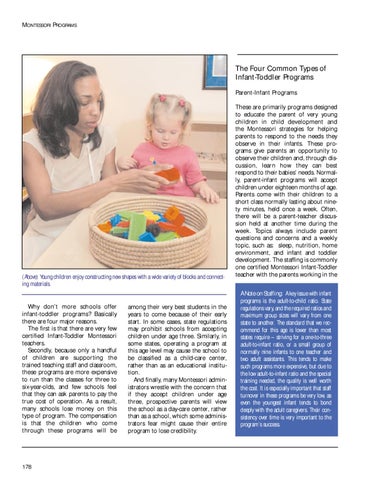
(Above) Young children enjoy constructing new shapes with a wide variety of blocks and connecting materials.
Why don’t more schools offer infant-toddler programs? Basically there are four major reasons. The first is that there are very few certified Infant-Toddler Montessori teachers. Secondly, because only a handful of children are supporting the trained teaching staff and classroom, these programs are more expensive to run than the classes for three to six-year-olds, and few schools feel that they can ask parents to pay the true cost of operation. As a result, many schools lose money on this type of program. The compensation is that the children who come through these programs will be
178
among their very best students in the years to come because of their early start. In some cases, state regulations may prohibit schools from accepting children under age three. Similarly, in some states, operating a program at this age level may cause the school to be classified as a child-care center, rather than as an educational institution. And finally, many Montessori administrators wrestle with the concern that if they accept children under age three, prospective parents will view the school as a day-care center, rather than as a school, which some administrators fear might cause their entire program to lose credibility.
These are primarily programs designed to educate the parent of very young children in child development and the Montessori strategies for helping parents to respond to the needs they observe in their infants. These programs give parents an opportunity to observe their children and, through discussion, learn how they can best respond to their babies’ needs. Normally, parent-infant programs will accept children under eighteen months of age. Parents come with their children to a short class normally lasting about ninety minutes, held once a week. Often, there will be a parent-teacher discussion held at another time during the week. Topics always include parent questions and concerns and a weekly topic, such as: sleep, nutrition, home environment, and infant and toddler development. The staffing is commonly one certified Montessori Infant-Toddler teacher with the parents working in the A Note on Staffing: A key issue with infant programs is the adult-to-child ratio. State regulations vary, and the required ratios and maximum group sizes will vary from one state to another. The standard that we recommend for this age is lower than most states require – striving for a one-to-three adult-to-infant ratio, or a small group of normally nine infants to one teacher and two adult assistants. This tends to make such programs more expensive, but due to the low adult-to-infant ratio and the special training needed, the quality is well worth the cost. It is especially important that staff turnover in these programs be very low, as even the youngest infant tends to bond deeply with the adult caregivers. Their consistency over time is very important to the program’s success.