>
tourism
Authentic Aboriginal Sharing First Nations culture's fastest growing segment in Island tourism
F
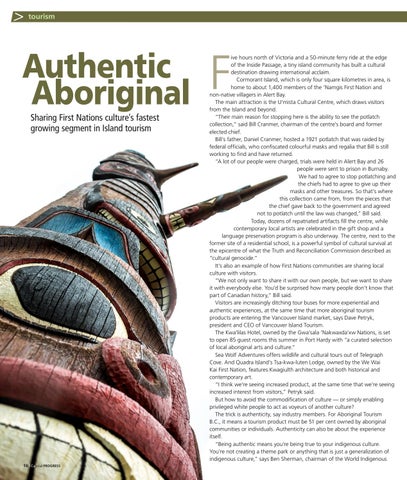
ive hours north of Victoria and a 50-minute ferry ride at the edge of the Inside Passage, a tiny island community has built a cultural destination drawing international acclaim. Cormorant Island, which is only four square kilometres in area, is home to about 1,400 members of the ‘Namgis First Nation and non-native villagers in Alert Bay. The main attraction is the U’mista Cultural Centre, which draws visitors from the Island and beyond. “Their main reason for stopping here is the ability to see the potlatch collection,” said Bill Cranmer, chairman of the centre’s board and former elected chief. Bill’s father, Daniel Cranmer, hosted a 1921 potlatch that was raided by federal officials, who confiscated colourful masks and regalia that Bill is still working to find and have returned. “A lot of our people were charged, trials were held in Alert Bay and 26 people were sent to prison in Burnaby. We had to agree to stop potlatching and the chiefs had to agree to give up their masks and other treasures. So that’s where this collection came from, from the pieces that the chief gave back to the government and agreed not to potlatch until the law was changed,” Bill said. Today, dozens of repatriated artifacts fill the centre, while contemporary local artists are celebrated in the gift shop and a language preservation program is also underway. The centre, next to the former site of a residential school, is a powerful symbol of cultural survival at the epicentre of what the Truth and Reconciliation Commission described as “cultural genocide.” It’s also an example of how First Nations communities are sharing local culture with visitors. “We not only want to share it with our own people, but we want to share it with everybody else. You’d be surprised how many people don’t know that part of Canadian history,” Bill said. Visitors are increasingly ditching tour buses for more experiential and authentic experiences, at the same time that more aboriginal tourism products are entering the Vancouver Island market, says Dave Petryk, president and CEO of Vancouver Island Tourism. The Kwa’lilas Hotel, owned by the Gwa’sala ‘Nakwaxda’xw Nations, is set to open 85 guest rooms this summer in Port Hardy with “a curated selection of local aboriginal arts and culture.” Sea Wolf Adventures offers wildlife and cultural tours out of Telegraph Cove. And Quadra Island’s Tsa-kwa-luten Lodge, owned by the We Wai Kai First Nation, features Kwagiulth architecture and both historical and contemporary art. “I think we’re seeing increased product, at the same time that we’re seeing increased interest from visitors,” Petryk said. But how to avoid the commodification of culture — or simply enabling privileged white people to act as voyeurs of another culture? The trick is authenticity, say industry members. For Aboriginal Tourism B.C., it means a tourism product must be 51 per cent owned by aboriginal communities or individuals. Authenticity can also be about the experience itself. “Being authentic means you’re being true to your indigenous culture. You’re not creating a theme park or anything that is just a generalization of indigenous culture,” says Ben Sherman, chairman of the World Indigenous
16 | Capital PROGRESS
CapPROGRESS_2017_FINAL.indd 16
4/11/17 9:49:07 AM