TIMBER CONSTRUCTION NEWS
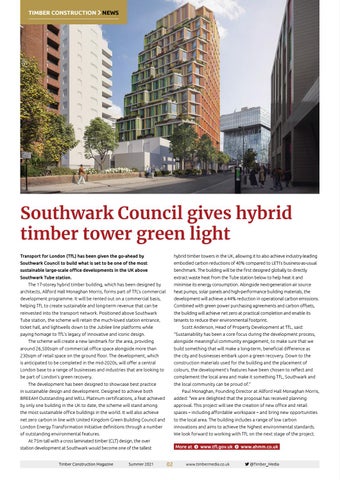
Southwark Council gives hybrid timber tower green light Transport for London (TfL) has been given the go-ahead by
hybrid timber towers in the UK, allowing it to also achieve industry-leading
Southwark Council to build what is set to be one of the most
embodied carbon reductions of 40% compared to LETI’s business-as-usual
sustainable large-scale office developments in the UK above
benchmark. The building will be the first designed globally to directly
Southwark Tube station.
extract waste heat from the Tube station below to help heat it and
The 17-storey hybrid timber building, which has been designed by
minimise its energy consumption. Alongside next-generation air source
architects, Allford Hall Monaghan Morris, forms part of TfL’s commercial
heat pumps, solar panels and high-performance building materials, the
development programme. It will be rented out on a commercial basis,
development will achieve a 44% reduction in operational carbon emissions.
helping TfL to create sustainable and long-term revenue that can be
Combined with green power purchasing agreements and carbon offsets,
reinvested into the transport network. Positioned above Southwark
the building will achieve net zero at practical completion and enable its
Tube station, the scheme will retain the much-loved station entrance,
tenants to reduce their environmental footprint.
ticket hall, and lightwells down to the Jubilee line platforms while paying homage to TfL’s legacy of innovative and iconic design. The scheme will create a new landmark for the area, providing
Scott Anderson, Head of Property Development at TfL, said: “Sustainability has been a core focus during the development process, alongside meaningful community engagement, to make sure that we
around 26,500sqm of commercial office space alongside more than
build something that will make a long-term, beneficial difference as
230sqm of retail space on the ground floor. The development, which
the city and businesses embark upon a green recovery. Down to the
is anticipated to be completed in the mid-2020s, will offer a central
construction materials used for the building and the placement of
London base to a range of businesses and industries that are looking to
colours, the development’s features have been chosen to reflect and
be part of London’s green recovery.
complement the local area and make it something TfL, Southwark and
The development has been designed to showcase best practice
the local community can be proud of.”
in sustainable design and development. Designed to achieve both
Paul Monaghan, Founding Director at Allford Hall Monaghan Morris,
BREEAM Outstanding and WELL Platinum certifications, a feat achieved
added: “We are delighted that the proposal has received planning
by only one building in the UK to date, the scheme will stand among
approval. This project will see the creation of new office and retail
the most sustainable office buildings in the world. It will also achieve
spaces – including affordable workspace – and bring new opportunities
net zero carbon in line with United Kingdom Green Building Council and
to the local area. The building includes a range of low carbon
London Energy Transformation Initiative definitions through a number
innovations and aims to achieve the highest environmental standards.
of outstanding environmental features.
We look forward to working with TfL on the next stage of the project.
At 75m tall with a cross laminated timber (CLT) design, the over More at www.tfl.gov.uk www.ahmm.co.uk
station development at Southwark would become one of the tallest
Timber Construction Magazine
Summer 2021
02
www.timbermedia.co.uk
@Timber_Media