NEWS
WEDNESDAY, NOVEMBER 20, 2019 • 3
Students protest in response to Pompeo’s visit RYND MORGAN ASST NEWS EDITOR
About 20 students participated in protests organized by Rice Left Friday morning in response to Secretary of State Mike Pompeo’s visit to the Baker Institute for Public Policy. The organizers of the die-in also cited the new five-year, $30 million cooperative agreement between Rice University and the U.S. Army as an aim of their protest. After dipping their hands in a mix of water and red food coloring, protesters taped flyers to Coffeehouse doors and laid down on the floor in front of Coffeehouse at 10:50 a.m as a die-in protest. At 11:08 a.m., an officer from the Rice University Police Department arrived on the scene, approached a protester and told them that the protest was not registered and was causing a blockage in the hallway. When he said that the protesters needed to leave, they did not respond. The RUPD officer walked toward the Information Desk but did not leave the Rice Memorial Center. According to Rice University Policy 820 titled “Campus Demonstrations, Protests, and Organized Expressions of Opinion,” activities such as protesting and installing posters are allowed as long as they do not violate local, state or federal laws. RUPD Chief of Police James Tate said the officer arrived at the scene of the protest following a complaint they received. “Someone actually complained to us and said, ‘Hey, is this allowed? Do we really have to accept this?’” Tate said. “And no, we don’t. So that’s when our officers asked the kids to get up and they moved — no issues at all.
YI LUO / THRESHER
About 20 students took part in a die-in protest outside of Coffeehouse in the Rice Memorial Center, where they laid down on the floor at approximately 10:50 a.m. on Friday.
And what I’m looking at here [at the Baker Institute], this is very peaceful.” At 11:10 a.m., one of the organizers for the protest announced that the die-in was over. The protesters headed back to the Multicultural Center together, where they departed at 11:25 a.m. to head to the Baker Institute. According to McMurtry College junior Arija Forsyth, Rice Left produced flyers regarding Pompeo’s foreign policy and civilian deaths in countries with U.S. military intervention before the protest. The flyers had been stamped for approval by the Info Desk and posted to the RMC bulletin board, but taken down within thirty minutes of being posted, according to Forsyth. Hania Nagy, a Martel College senior, said she felt like the protesters were being
babysat by RUPD, and that demonstrations should take place in populated areas where they can be seen. “Isn’t the point of a protest being disruptive and jarring people enough to make them walk out of their daily bubble?” Nagy said. “How are you supposed to do that if they put you in a bubble that’s separate from the fucking islamophobic and violent imperialist bubble [where Pompeo is]? It needs to be in the same space.” Hannah Meeks, a Hanszen College junior, said the protest was civil and nonviolent. “I think the concept of having to register protests is silly because then it no longer becomes a protest, it becomes a sanctioned gathering,” Meeks said. At 11:30 a.m., the protesters gathered on the sidewalk between the Central Quad and
the Baker Institute, on the Central Quad side. Almost immediately, the protesters were approached by RUPD officers, who told them that they had to stand within the roped-off area in the Central Quad that had been designated for protests. The protesters did not respond directly to RUPD. Soon after, RUPD officers told the students that as long as they stayed on the Central Quad side of the street, they were “good to go.” At 11:37 a.m., President David Leebron exited the Baker Institute and walked toward the students after they called out to him. The students handed Leebron copies of the flyers Rice Left produced regarding Pompeo’s foreign policy and civilian deaths in countries with U.S. military intervention. At the scene, Leebron said that students are entitled to voice their opinions, but that the locations of protests taking place need to be discussed beforehand with the Secret Service and others when prominent political figures visit campus. “We do want to make sure that the rules are an appropriate accommodation between safety and the freedom of speech on campus,” Leebron said. Drew Carter, a Jones College sophomore at the protest, said that Pompeo’s position as secretary of state does not necessarily qualify him for the speaking engagement. “I think the most important takeaway is that there are a good number of students who refuse to turn a blind eye to injustice whether it’s domestic or abroad,” Carter said. “We shouldn’t be bringing bigoted speakers to campus in the name of solely respecting the office they’re in if they don’t deserve it.”
Pompeo makes ‘quid pro quo’ visit to Baker Institute RISHAB RAMAPRIYAN NEWS EDITOR
Secretary of State Mike Pompeo spoke about the “natural hunger for human freedom,” criticized the Communist Party of China and fielded questions regarding U.S. foreign policy in countries such as Syria and Mexico as part of his Friday visit to the Baker Institute for Public Policy. Outside the event and in the Rice Memorial Center, students staged demonstrations in response to his visit. Pompeo previously served as the director of the Central Intelligence Agency from January 2017 to April 2018. More than 300 people attended the event, including a handful of undergraduate students, some of whom raised concerns about the exclusivity of the event. James A. Baker III, the honorary chair of the institute that bears his name, introduced Pompeo. Baker, who served as the 61st secretary of state under President George H.W. Bush, noted the dramatic nature of current U.S. foreign policy. “As someone honored to serve as secretary of state, I fully understand the sometimes agonizing difficulty of prioritizing U.S. interests and values in a geopolitical setting where the United States possesses immense but still limited power,” Baker said. Pompeo opened his brief 15-minute remarks by describing his visit as a “quid pro quo” arrangement with Baker, a reference to the language currently being used on Capitol Hill in the ongoing impeachment proceedings. Besides his “quid pro quo” comment, Pompeo did not directly address the proceedings. Pompeo said he invited Baker to visit him at the CIA headquarters upon being appointed as secretary of state, a visit Pompeo said has greatly helped him in his role. “[Baker] said ‘Here’s the deal, you have got to come to the Baker Institute’ and I’m now upholding my end of the quid pro quo,” Pompeo jokingly said, eliciting laughter from the audience. “You’ve got to have fun along the way.” Pompeo’s speech highlighted the “natural hunger for human freedom” and
recounted the fall of the Berlin Wall, a segment of which currently stands outside the Baker Institute. Pompeo remarked that America has a responsibility to assist all those around the world seeking human freedom. “We should never forget what a force for good that America was in the [fall of the Berlin Wall],” Pompeo said. “We see the same fight for freedom. We see it in the people in the Islamic Republic of Iran, we see it in the people in Venezuela and we see it in the people of Hong Kong and we should never devalue their deep desire for personal freedom and for their personal liberty.” Jefferson Ren, a Jones College junior in attendance, said that he was invited directly by the Baker Institute, since he works there as a research assistant. “I thought that the speech was generally structured to be inoffensive as Pompeo gave broad platitudes about how the U.S. stands for democracy and freedom,” Ren said. Following the speech, Pompeo took part in a Q&A session moderated by Warren Tichenor, former U.S. ambassador to the United Nations, who asked Pompeo a set of questions including those submitted by the audience. The questions spanned U.S. foreign policy across five continents, with topics ranging from America’s role in the North Atlantic Treaty Organization to U.S.-Mexico relations. Ren said that many students, including himself, wished there was time for more questions. Despite Pompeo’s relevance in the ongoing impeachment proceedings, Tichenor did not ask any questions about either the proceedings or former U.S. Ambassador to Ukraine Marie Yovanovitch, who was coincidentally testifying before the House Intelligence Committee that same morning. Pompeo has been sharply criticized for failing to support Yovanovitch, who was abruptly fired by President Donald Trump earlier this year as part of an alleged smear-campaign. Rice Young Democrats President Maddy Scannell, who was in attendance, said she had submitted a question about the impeachment proceedings, specifically about the nature of Pompeo’s instructions to Gordon Sondland regarding Ukraine
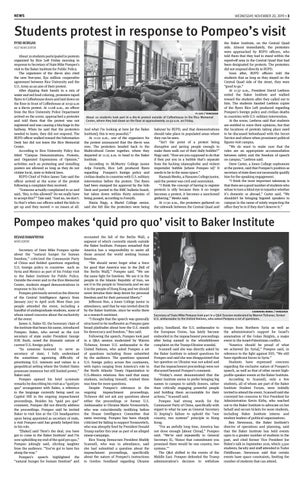
CHANNING WANG / THRESHER
Secretary of State Mike Pompeo took part in a Q&A Session moderated by Warren Tichenor, former U.S. ambassador to the United Nations, who asked Pompeo a set of questions.
policy. Sondland, the U.S. ambassador to the European Union, has lately become embroiled in the impeachment proceedings after being named in the whistleblower complaint on the Trump-Ukraine scandal. Scannell said she was directly asked by the Baker Institute to submit questions for Pompeo and said she was disappointed that her question on Ukraine was not asked and that the impeachment proceedings were not discussed beyond Pompeo’s comment. “Friday’s event demonstrated that the Baker Institute seems to prefer bringing big names to campus to satisfy donors, rather than critically engaging powerful people and holding them accountable for their actions,” Scannell said. Pompeo had strong words for the Communist Party of China, specifically with regard to what he saw as General Secretary Xi Jinping’s failure to uphold the “one country, two systems” principle in Hong Kong. “For an awfully long time, America has not done enough [about China],” Pompeo said. “We’ve said repeatedly to General Secretary Xi, ‘Honor that commitment you promised there would be one country, two systems.’” The Q&A shifted to the events of the Middle East. Pompeo defended the Trump administration’s decision to withdraw
troops from Northern Syria as well as the administraton’s support for Israel’s annexation of the Golan Heights, a major event in the Israel-Palestinian conflict. “America should be proud of what we achieved [in Syria],” Pompeo said, in reference to the fight against ISIS. “We still have significant forces in Syria.” Students have expressed concerns regarding the exclusive nature of Pompeo’s speech, as well as that of other recent highprofile speaker events at the Baker Institute. According to Scannell, only a few students, all of whom are part of the Baker Institute Student Forum, were initially invited to attend the event. Scannell said she conveyed her concerns to Vice President for Administration Kevin Kirby, who reached out to the Baker Institute to advocate on her behalf and secure tickets for more students, including Baker Institute interns and student leaders of political organizations. Ben Stevenson, the Baker Institute’s director of operations and planning, said that the Baker Institute has held events open to a greater number of students in the past, and cited former Vice President Joe Biden’s talk in September 2016, which 3,500 students, faculty and staff attended in Tudor Fieldhouse. Stevenson said that certain events have space constraints, limiting the number of students that can attend.