T H I S D AY, T H E S U N D AY N E W S PA P E R ˾ NOVEMBER 24, 2019
15
LETTERS Curbing The Menace of Open Defecation
O
pen defecation has been a common practice in many nations, towns and villages for centuries. It is a practice whereby a person defecates in an open area unmindful that it’s unhealthy and unhygienic. Out of about one billion people that still practice open defecation worldwide, about 49 million are Nigerians while 600 million reside in India. It is, however, estimated that around 68 million Nigerians are likely to be added between now and 2025, if concerted efforts were not made to arrest the problem. Open defecation is fundamental aspect of sanitation, and it reflects the level of development in any society where it is rampant. It is a bad practice with grievous implications on human health, dignity and security, the environment and socialeconomic development. The profoundly damaging health and developmental consequences of this menace has often been overshadowed by other aspect of our socioeconomic life that is also in decay. According to the World Health Organisation, (WHO) 2.5 billion of the world's seven billion people do not have proper sanitation while 1.1 billion people still defecate
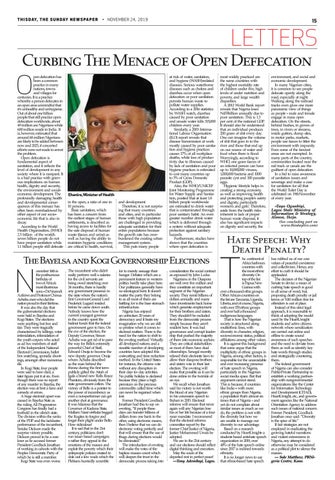
Ehanire, Minister of Health in the open, a ratio of one in 10 persons. Basic sanitation, which has been a concern from the earliest stages of human settlements, is described as having access to facilities for the safe disposal of human waste (faeces and urine) as well as having the ability to maintain hygienic conditions are critical to health, survival,
and development. Therefore, it is not surprising that many countries and cities, and in particular those with high population are challenged in providing adequate sanitation for their entire populations because the growth rate has overburdened the existing urban management system. This puts many people
at risk of water, sanitation, and hygiene (WASH)-related diseases. Serious waterborne diseases such as cholera and diarrhea occur when open defecation or poor sanitation permits human waste to pollute water supplies. According to a 2016 statistics by WASH watch, diarrhea caused by poor sanitation and unsafe water kills 315,000 children every year. Similarly, a 2003 International Labour Organisation (ILO) report reveals that disease transmission at work mostly caused by poor sanitation and hygiene practices causes 17% of all workplace deaths, while loss of productivity due to illnesses caused by lack of sanitation and poor hygiene practices is estimated to cost many countries up to 5% of Gross Domestic Product (GDP). Also, the WHO/UNICEF Joint Monitoring Programme for Water Supply and Sanitation, posited that at least 1.8 billion people world-wide are estimated to drink water that is contaminated through poor sanitary habit. An even greater number drink water which is delivered through a system without adequate protection against sanitary hazards. Furthermore, studies have shown that the countries where open defecation is
The Bayelsa and Kogi Governorship Elections
N
ovember 16th is the posthumous birthday of two of Africa’s most illustrious sons – Dr.Nnamdi Azikiwe and Professor Chinua Achebe, men who did the nation proud in their lifetime. It was also the day that the gubernatorial elections were held in Bayelsa and Kogi States. The elections were anything but free and fair. They were tragically characterized by killings, voter intimidation, intimidation of the youth corpers who acted as ad hoc members of staff of the Independent National Electoral Commission, ballot box snatching, sporadic shootings, amongst other numerous ills. In Kogi State, four people were said to have died, a later figure put it at six. Even though there was no report of any murder in Bayelsa, the election was at best a farce and comedy of errors. A huge electoral upset was caused in Bayelsa State as the ruling All Progressives Congress has finally had a foothold in the oil-rich state. The division within the ranks of the PDP and the lacklustre performance of the incumbent, Seriake Dickson made the surprise victory possible. Dickson proved to be a sore loser as he accused former President Goodluck Jonathan of working in cahoots with the Peoples Democratic Party of which he is still a member. Kogi State was even worse.
The incumbent who didn’t really perform well – salaries for the civil servants are being owed stretching over 24 months, there is hardly any government presence in the state where the nation’s first Governor-General Lord Frederick Lugard resided before he came down south. Nobody knows how the current youngest governor in the country spent the bailout funds that the federal government gave to him. On the eve of the election, the Deputy Governor, Simon Achuba was got rid of to pave the way for Bello’s extremely powerful Chief of Staff, Edward Onoja to become the new deputy governor. Onoja whom Achuba described as the man behind the throne during the first term publicly gifted the Attah of Igala a brand new Rolls Royce Phantom, obviously from the state government coffers. The victory of Bello is a pointer to the power of incumbency as even a non-performer can get another shot at governance. It was hilarious that the Governor of Kaduna State, Mallam Nasir el-Rufai begged the Kogites to forgive and forget their plight under Bello. How ridiculous! It is sad that in the 21st century, politicians don’t run issue- based campaigns – rather they appeal to the emotions of the masses and exploit the poverty which their anti-people policies created to dole out a few wads which the Plebians hurriedly scramble
for to merely assuage their hunger. Debates which are a permanent feature in western politics hardly take place here. Our politicians generally have no ideological bent. It doesn’t matter the party they belong to as all most of them are battling for is the base stomach infrastructure. Nigeria has enjoyed an unbroken 20 years of democracy and it beats my imagination why we are still so pristine when it comes to electoral matters. There is the need for the nation to shift to the e-voting method. Virtually all developed nations and a sizeable number of developing countries have adopted this cost-cutting and time reduction method. In the United States for instance, the citizens vote without any disruption in their day- to- day activities. No public holiday is declared because they place a high premium on the precious commodity called time which can never be regained when lost. Former President Goodluck Jonathan had this to say on e-voting, “If people these days can transfer billions of dollars from one bank to the other, using electronic means, then I believe that we can do electronic voting perfectly and that will ensure that the use of thugs during elections would be eliminated.” The introduction of e-voting will make the votes of the hapless masses count which will deepen the trust in the democratic process taking into
consideration the social contract as espoused by John Locke. Nigerians in the Diaspora are well over five million and they constitute an important segment of the Nigerian society. They remit billions of dollars annually and many have investments back home which generate employment for their brothers and sisters. They shouldn’t be excluded from the democratic process simply because they aren’t resident here. It was bad governance and corrupt leadership that pushed the majority of them into economic asylum. They are critical stakeholders as most of them have dual citizenships. Senegal recently relaxed their electorate laws to allow their diaspora brothers and sisters vote in their last election. The e-voting will make that possible as it can be done online in the twinkle of an eye. We recall when Jonathan said his victory is not worth the blood of any Nigerian in his concession speech to Buhari in 2015. Electoral reforms will ensure that never again will any Nigerian lose his or her life because of a four -year mandate. I recommend that the electoral reforms committee report by the former Chief Justice of Nigeria, Justice Mohammed Uwais be adopted. We are in the 21st century and our elections should reflect digital thinking and execution. May the souls of the departed rest in perfect peace! ––Tony Ademiluyi, Lagos.
most widely practiced are the same countries with the highest mortality rate of children under five, high levels of under nutrition and poverty, and large wealth disparities. A 2012 World Bank report reveals that Nigeria loses N455billion annually due to poor sanitation. This is 1.3 per cent of the national GDP. It should also be understood that an individual produces 200 gram of shit every day. One can imagine the volume of shit that goes in to the river and those that end up on our source of water and food when there is flood. Worryingly, according to WHO, one gram faeces of an infected person can have up to 10,000,000 viruses, 1,000,000 bacteria and 1000 parasite cyst and 100 parasite eggs. Hygienic lifestyle helps in creating a strong economy, as well as improving health and protecting people’s safety and dignity, particularly women’s and girls’. Therefore, aside from the health risks inherent in lack of proper human waste disposal, it also has significant impacts on dignity and security, the
environment, and social and economic development. In many Nigerian cities, it is common to see people defecate openly along the road, especially at night. Walking along the railroad tracks even gives one more panoramic view of things as people - male and female engage in mass open defecation. On the streets, behind bushes, in groves of trees, in rivers or streams, inside gutters, dump sites, in motor parks, markets, people use faeces to litter the environment with impunity. Even some of the fanciest areas are not exempted. In many parts of the country, communities located near the rail track or canals are the guiltiest of open defecation. In a bid to raise awareness of sanitation issues and sewerage and make a case for sanitation for all that the World Toilet Day is celebrated on 19thNovember of every year. –Tayo Ogunbiyi, Lagos State Ministry of Information & Strategy, Alausa, Ikeja. (See concluding part on www.thisdaylive.com)
Hate Speech: Why Death Penalty?
T
he continent of Africa harbours countries with the most ethnic diversity. On top of the list is Papua New Guinea with over a thousand ethic groups. Other African countries on the list are Tanzania, Uganda, Liberia, and of course, Nigeria, with over 370 ethnic groups and over half a thousand indigenous languages. That is how the Nigerian society is structured along multiethnic lines, with diversity in character, religion, socio-economic status, political affiliations among other values. It is against this background that some argue that the multiplicity of ethnic groups in Nigeria, among other factors, is responsible for the unavoidable and ever increasing presence of hate speech in Nigeria, particularly in the Nigerian social media space. But that argument cannot stand. This is because, if countries like India – with more ethnic groups than Nigeria, a population that’s almost six times that of Nigeria - and yet do not complain about similar issues as much as we do, the problem is not with the diversity but how we are unable to manage our diversity to our advantage. Based on a research conducted by HeartUmight- a student- based anti-hate speech organization in 2019, over 48% of the hate speech online since 2017 is inclined towards ethnicity. It is no longer news to say that ethnic-based hate speech
has rubbed us of our core values of peaceful coexistence and collectivism. Hence, any effort to curb it should be applauded. The decision of the Nigerian Senate to device a mean of curbing hate speech is good in all sense of word, but, proposing death penalty or jail terms or N10 million fine for offenders is out of place. Instead of this strict legal approach, it is reasonable to think of adopting the model used by the HeartUmight students and active citizens network where sensitization are carried out online and offline to create sound awareness of such speeches and the need to deviate from them as well as identify key hate words through studies and strategically countering them. The federal government of Nigeria can also consider Public-Private Partnership to establish a working partnership with nongovernmental organizations like the Center for Information Technology and Development (CITAD), HeartUmight, etc., and government agencies like the National Orientation Agency to address such issues of national concern. Former President, Goodluck Jonathan once said: “Diversity is the spice of life.” If fair strategies are not employed in eradicating the growing hateful narrations and violent extremisms in Nigeria, any attempt to do otherwise may be considered as a political plot to silence the masses. –– Sule Matthew, PRNigeria Centre, Kano.