8
WEDNESDAY, ˜ ͺͺ ˾ T H I S D AY
NEWS
With N381/$1 Exchange Rate Adjustment, FG, States Get More Cash AfDB pushes for rates' cut to stimulate growth Projects $189.7bn GDP losses for Africa Obinna Chima and Dike Onwuamaeze The adjustment of the official naira exchange rate from N361/$ to N381/$ by the Central Bank of Nigeria (CBN) means that the three tiers of government will have more naira to share during their monthly Federation Account Allocation Committee (FAAC) meetings. The new rate was posted yesterday on the website of FMDQ OTC Securities Exchange, the Lagos-based platform that oversees foreignexchange trading. Revenue from Petroleum exports accounts for about 80 per cent of Nigeria’s earnings and makes up a significant portion of the amount that is shared monthly by the federal, state and local governments. According to analysts, the exchange rate adjustment would benefit the three tiers
of government as the new naira exchange rate at the official market means that they would get more naira to. Others that are expected to benefit from the development according to analysts are the Foreign Portfolio Investors (FPIs) who invest in the Nigerian market as well as institutional investors with a huge dollar position. However, the downside of the development according to analysts is that prices of goods and services are likely to rise as well as the landing cost of petrol. The official exchange rate adjustment comes less than one week after the central bank adjusted the naira exchange rate at the Secondary Market Intervention Sales (SMIS) to N380/$1, which also used to be N360/$1. A top central bank official had told THISDAY at the weekend that from time
NCAA Suspends Private Jet Operators for Regulatory Infraction Chinedu Eze The Nigerian Civil Aviation Authority (NCAA) has suspended the operations Specs Part G of the Air Operator’s Certificate of Sky Power Express Airways Nigeria Limited and some private charter aircraft due to non-compliance and or violations of the provision of NCARS (Nigeria Civil Aviation Regulations) Part 9.2.3.4(b). The regulatory authority had threatened to suspend airlines operating charter service with aircraft not registered for commercial service. THISDAY learnt that an aircraft under Sky Power Express Airways was grounded in Dubai due to non-compliance with the regulations of the United Arab Emirates (UAE) regulatory authorities and NCAA. NCAA in a letter dated June 30, 2020, with reference number NCAA/DG/AIR/11/16/129 signed by the Director-General, Captain Musa Nuhu, and entitled: Suspension of the Ops Specs Part G (Aircraft Leasing Operations) of your organisation’s Air Operator’s Certificate (AOC), issued the suspension, which was addressed to the Managing Director of Sky Power Express. The letter read in part: “NCARS Part 9.2.3.4(b) refers to Wet Leasing aircraft and states: (b) No holder of an AOC issued under this Part 9 may allow another entity or air operator to conduct wetlease operations on its behalf (a wet lease in) unless “(1) That air operator holds an AOC or its equivalent from a contracting state that authorises those operations;(2) The AOC holder advises the authority of such operations and provides a copy of the AOC under which the operation was conducted;(3) Such operation does not exceed a period of 12 months and(4) The authority approves the operations. “Be informed that by this
action, your organisation ceases to exercise all the privileges associated with Part G authorisation. “Furthermore, the operations of the following aircraft listed on the Part G of your organisation’s operations specifications are hereby suspended pending a full audit of your organisation and compliance with all the relevant Nig. CARS: Hawker 800XP: N838B, Hawker 800XP: N552ME, Hawker 800XP: N749WW, Hawker 800XP: ZSEXG, CL604-D-ANGB, CL604T7-NMN, CL601-N580KR, Gulfstream 200-N100EK. Other aircraft affected by the audit include: CL604-N605JA operated by Jedidiah Air, CL604-N880ET operated by OmniBlu, CL604-N604WL operated by West Link Airlines, G.IV-N990EA operated by NestOi, CL601-N253LA operated by West Link Airlines, G1159A-N313MS operated by Izy Air and and CL604-G-FABO operated by Jet Support Services." THISDAY also learnt that many aircraft are also operated under Sky Power Express Airways because the company has AOC, so those aircraft operate under its core sign. The Managing Director of Sky Power Express Airways, Capt. Mohammed Joji, did not respond to calls made by THISDAY. However, NCAA has released one of the two aircraft belonging to West Link Airlines currently grounded, having erroneously added it to the grounded list. The aircraft, a Challenger CL604-N604WL operated by West Link Airlines, was released having not fallen under the category of Part G category as it is said to be owned solely by the airline and not leased. The other aircraft, the CL601N253LA, however, falls under the category and will still have to undergo a full audit and compliance with all the relevant Nig. CARS.
to time, the exchange rate adjustment would continue to happen, either upward or downward in line with market fundamentals. “Certainly, no single rate can be achieved, but we would keep moving towards I&E rate,” the source had said. The CBN Governor, Mr. Godwin Emefiele, recently assured investors that the desire of the central bank was to achieve exchange rate unification” around the Nigerian Autonomous Foreign Exchange Market (NAFEX)/ I&E rate. Emefiele had explained thus: “What we mean by exchange rate unification is moving towards the NAFEX. NAFEX is our dominant market for the purchase and sale of forex and it is a free market where everybody is free to sell their dollars and those who want to buy are free to buy dollars. “That means that whether you are a businessman, a bank, CBN, and you have dollars, you can bring it to the market to sell and if you want to buy dollars, you can come to the market. “Like some of you must have seen, three years before 2019, we saw a relatively stable forex market because the NAFEX rate and even the rate at which the central bank transacts business outside the NAFEX were substantially close
to each other. So, the CBN will continue to pursue unification around the NAFEX.” Members of the Organised Private Sector (OPS) have commended the move by the CBN, saying the development would allow the exchange rate to reflect the market fundamentals and avoid distortions in the economy. The Director-General of the (LCCI), Dr. Muda Yusuf, described the unification of the rates as an important move to stem the looming liquidity crisis in the foreign exchange market. Yusuf stated that multiple exchange rates were a major source of distortion in the foreign exchange market as the system complicated the management of the foreign exchange market and perpetuated a rent economy that created opportunities for arbitrage, which engendered resource misallocation. “It is imperative for the exchange rate to reflect the market fundamentals in order to ensure sustainability and promote efficiency in allocation mechanism. This is also critical for investors’ confidence. This should, however, be complemented with appropriate trade policy regime, fiscal policy measures and institutional strengthening to achieve the objective of heightening self-reliance and
economic diversification,” Yusuf said. He added that the disadvantages of the multiple exchange rate system are the impediments it posed “to the attraction of investment as well as inhibiting the inflow of foreign exchange and creation of transparency issues in the allocation of foreign exchange.”
AfDB Pushes for Rates' Cut to Stimulate Growth The African Development Bank (AfDB) has advised the Central Bank of Nigeria (CBN) and other central banks on the continent to quickly ease financial conditions by cutting interest rates in their respective economies. The multilateral institution also advised central banks to apply a combination of macroprudential and unconventional monetary policy tools to support the vulnerable sectors of the economy, just as it recommended that targeted interventions should be implemented for affected firms and sectors. The AfDB gave the advice yesterday when it launched its African Economic Outlook (AEO) 2020 Supplement, which was presented by its Director of Macroeconomic Policy, Forecasting and Research,
Dr. Hanan Morsy, during an event, held online. Morsy said: “Central banks could resort to their own forms of quantitative easing, targeted at funding the most affected sectors such as firms in the hospitality and entertainment industry like airlines, hotel chains, logistics and sports by temporarily re-profiling or restructuring their debts. “To support vulnerable groups, a programme could be targeted to micro-enterprises and the unbanked in the informal sector, financed by the government and potentially run by other agencies closer to the ground.” The AEO report projected that the real GDP in Africa would contract by 1.7 per cent in 2020, dropping by 5.6 percentage points from January 2020 pre-COVID –19 projection if the virus has a substantial impact over a short period. However, the report stated that there could be a deeper GDP contraction in 2020 of 3.4 per cent, down by 7.3 percentage points from the growth projected before the outbreak of COVID–19 if the pandemic continues beyond the first half of 2020. “Cumulatively, GDP losses could range between $173.1 billion and $236.7 billion in 2020–2021. Continued on page 30
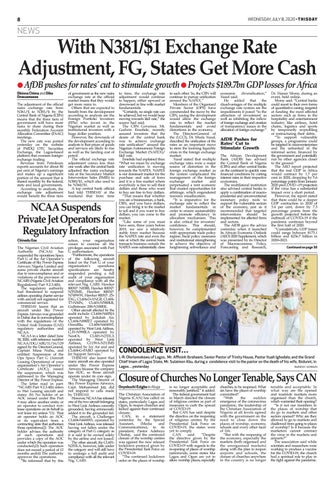
CONDOLENCE VISIT… L-R: Oloriomokewu of Lagos, Mr. Affininh Ibraheem; Senior Pastor of Trinity House, Pastor Ituah Ighodalo; and the Grand Chief Imam of Lagos State, Mr. Sulaimon Abu, during a condolence visit to the pastor on the death of his wife, Ibidunni, in Lagos…yesterday sunday adigun
Closure of Churches No Longer Tenable, Says CAN Onyebuchi Ezigbo in Abuja The Christian Association of Nigeria (CAN) has called on states, particularly Lagos and Ogun, to reopen churches and kicked against their continued closure. CAN, in a statement yesterday by the Special Assistant, (Media and Communications), to its president, Pastor Adebayo Oladeji, said the continued closure of the worship centres was against the new relaxed lockdown protocol given by the Presidential Task Force on COVID-19. “The continued lockdown order on the places of worship
is no longer acceptable and reasonably justified,” it added. The federal government had in March directed the closure of religious centres as part of measures to curb the spread of COVID-19. But CAN has said despite the directive on the reopening of religious centres by the Presidential Task Force on COVID-19, the states were yet to comply. CAN said: “Despite the directive given by the Presidential Task Force on COVID-19 with regards to the re-opening of places of worship nationwide, some states like Lagos and Ogun are yet to allow worship places, especially
churches, to be reopened. What sin have the places of worship committed? “With the sudden emergence of the coronavirus pandemic, the leadership of the Christian Association of Nigeria at all levels agreed with the government on the need to close down the places of worship, economy, schools and every other facet of life. “But with the reopening of the economy, especially the markets (both organised and the unorganised markets) along with the plan to reopen airports and schools, the closure of churches anywhere in the country is no longer
tenable and acceptable. In what way are the opened and roadside markets more organised than the church, which warranted their opening? “Is it not our members in the places of worship that do go to markets and other sectors opened? Why are they allowed to go to markets and disallowed from going to places of worship? Is it because the marketers cannot contract the virus in the markets and airports?” The association said while scientists and researchers were working to produce a vaccine for the COVID-19, the church had a spiritual role to play in the fight against the pandemic.