T H I S D AY ˾ WEDNESDAY, NOVEMBER 1, 2017
37
FEATURES RISING DRUG ABUSE
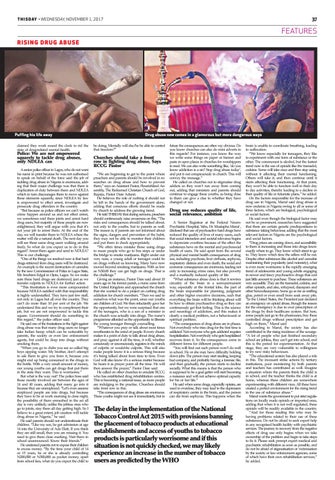
Puffing his life away claimed they work round the clock to rid the state of drug-related mental health.
Police: We are not empowered squarely to tackle drug abuses, only NDLEA can
A senior police officer in Lagos, who do not want his name in print because he was not authorised to speak on behalf of the force said the job of tackling drug abuse in Nigeria is enormous, adding that their major challenge was that there is duplication of duty between them and NDLEA which in turn discourages them to move against these elements squarely, since NDLEA by law is empowered to effect arrest, investigate and prosecute drug offenders in the country. “But because as police officers we can’t watch crime happen around us and not effect arrest, we sometimes raid these joints and arrest hard drug users, but majority of these people are now enlightened, they will argue with you that it’s not your job to arrest them. At the end of the day, we will transfer them to NDLEA where the matter will die a natural death. The next day you will see these same drug users walking around freely. So what do you expect us to do in this regard? Arrest them again and send to NDLEA? This is our challenge. “One of the things we resolved now is that hard drugs retrieved from drug users will be destroyed. An example is the recent destruction of cannabis by the new Commissioner of Police in Lagos State, Mr. Imohimi Edgal in Ojota, Lagos. So we make sure these hard drugs are destroyed, just as we transfer culprits to NDLEA for further action “This frustration is even more compounded because NDLEA saddled with that responsibility is highly understaffed. They have just few staff, not only in Lagos but all over the country. They can’t do more than 10 per cent of the job. We understand this and we try to compliment their job, but we are not empowered to tackle this square. Government should do something in this regard,” the police officer said. He said one of the frustrations in the fight against drug abuse was that many drug users no longer take Indian hemp which can be noticeable by parents, the society or even law enforcement agents, but could be deep into drugs without smoking them. “When you go to clubs you see so called big boys sipping water. My brother, don’t attempt to ask them to give you from it, because you might end up being consumed in the drugs in the bottle. With a very small amount of money, our young youths can get drugs that put them in the state they want. This is worrisome.” But what is the way out? The police boss said those mostly involved are between the ages of 14 and 40 years, adding that many go into it because they are unemployed. “Let’s even assume employed people are into drugs, but because they have to be at work morning to close night, the possibility of them enmeshed in the act all day is very unlikely, unlike the jobless ones who go to joints, stay there all day getting high. So I believe to a great extent, job creation will tackle drug abuse in Nigeria,” he said. He said parents should not underestimate their children. “Like my son, he got admission at age 14 into the University of Ado Ekiti. If you think they are still small, then you are missing it. You need to give them close marking. Visit them in school unannounced. Know their friends.” He cautioned parents not to expose their children to excess money. “By the time your child of 14 or 15 years, he or she is already controlling N200,000 or N300,000 as pocket money, apart from school fees, what do you expect the child to
Drug abuse now comes in a glamorous but more dangerous ways be doing. Mentally will she/he be able to control that freedom?”
Churches should take a front row in fighting drug abuse, Says RCCG Pastor “We are beginning to get to the point where preachers and parents should be involved in researches on drug abuse and how to prevent them,” says an Assistant Pastor, Flourishland Assembly, The Redeemed Christian Church of God, Ilupeju, Pastor Dare Adanri. He believes the role of curbing it should not be left in the hands of the government alone, adding that conscious efforts should be made by church to address the growing trend. He told THISDAY that during sermons, preachers should continuously raise awareness on this. “The risks and consequences should be talked about, not only to the youths, but to parents as well. The reason is, if parents are not informed about the signs, dangers and prevention of the habit, they may not be able to monitor their children and put them in check appropriately. “We often times mistake those using drugs to mean people who go to bus stops or under the bridge to smoke marijuana. Right under our very nose, a young adult or teenager could be on drugs without us knowing. Many have now moved beyond smoking marijuana. With as low as N30.00 they can get high on drugs. That is the challenge.” Giving an instance, Pastor Dare said about 10 years ago in his former parish, a nurse came from the United Kingdom and approached the church that she wanted to do a project on curbing drug addiction for church members. “Then we said to ourselves what was the point, since our youths are children of God. We then reluctantly gave her the opportunity, but we were surprised that one of the teenagers, who is a son of a minister in the church was actually into drugs. The nurse’s programme afforded us the opportunity to liberate the young teenager through counselling. “Whatever you pray or talk about most times reverberates in the mind of people. If every church makes it a point of duty to talk about drug abuse, and pray against it all the time, it will, whether consciously or unconsciously, registers in the minds of culprits or would-be culprits. This will also make people know it is a serious thing because it’s being talked about from time to time. Even God will also know it’s a serious matter because he hears it as prayer point all the time. He will then answer the prayer,” Pastor Dare said. He called on other churches to emulate RCCG who has established drug rehabilitation centres. This is becoming a national issue, as more people are indulging in the practise. Churches should take front row in this. “The consequences of drug abuse are enormous. These youths might not see it immediately, but in
future the consequences are often vey obvious. Do you know churches can also do mini adverts in this regards? For instance, you know the way we write some things on paper or banner and paste in open places in churches for worshippers to read. We can also write something like, ‘do you know addiction is a sin? Stop drug abuse today’, and put it out conspicuously in church. This will convey the message.” He called on churches not to stigmatise drug addicts so they won’t run away from coming out, adding that ministers and parents should continue to engage these youths, as being close to them can give a clue to whether they have changed or not.
Drug use reduces quality of life, social relevance, ambition A Senior Registrar at the Federal NeuroPsychiatric Hospital, Yaba, Dr. Mustapha Maruf , disclosed that use of psychoactive hard drugs have reduced the quality of lives of many users, such that social interaction and societal relevance begins to depreciate overtime because of the effect the substances have on the mental and psychosocial health of users. He said apart from the several physical and mental health consequences of drug use, including psychosis, liver cirrhosis, asphyxia, respiratory distress and even death, the social and economic consequences are enormous, leading not only to increasing crime rates, but also poverty and a markedly reduced quality of life. “What substance abuse does is that it rewires circuitry of the brain in a semi-permanent way, especially at the frontal lobe, the part of the brain responsible for planning, judgment and other higher executive decisions, such that everything the brain will be thinking about will be how to obtain psychoactive drug so they can continuously get that feeling. This is the science and neurology of addiction, and this makes it clearly a medical problem, not a behavioural or spiritual problem. “The consequences of drug abuse are in phases. Not everybody who tries drug for the first time is addicted. Not everyone who gets addicted requires hospitalisation. Not everybody who gets hospitalised recovers from it. So the consequences come in different forms for different people. “You will find out such person won’t do well in school. He or she may have difficulty holding down jobs. The person may start stealing, keeping bad company, and probably having a forensic file, and then gradually, the person starts to decline socially. What this means is that the person who is supposed to be a goal getter will start becoming a nuisance and will not achieve optimal capacity for his or her life.” He said when some drugs, especially opiates, are used in overdose, they may lead to the depression of respiratory centre in the brain, and the person can die from asphyxia. This happens when the
The delay in the implementation of the National Tobacco Control Act 2015 with provisions banning the placement of tobacco products at educational establishments and access of youths to tobacco products is particularly worrisome and if this situation is not quickly checked, we may likely experience an increase in the number of tobacco users as predicted by the WHO
brain is unable to coordinate breathing, leading to suffocation. “We know especially for teenagers, they like to experiment with one form of substance or the other. The commonest is alcohol, but the fastest trend now is the use of opioids like the tramadol, codeine. Some will take once and then stop using without it affecting their mental functioning. Others will take it, and then continue until it starts affecting their functioning. At that point, they won’t be able to function well in their day to day activities, thereby leading to a decline in their quality of life or futuristic plans,” he added. On the factors responsible for the increase of drug use in Nigeria, Maruf said drug abuse is now endemic in Nigeria owing to all or some of three factors, which are biological, psychological or social factors. He said even though the biological factor may not be so prominent, researches have suggested that there are certain genetic predispositions to substance taking behaviour, adding that the most relevant factors in Nigeria are the psychological and social factors. “Drug prices are coming down, and accessibility to them is increasing and those into drugs know exactly where to go. They know which street to go to. They know which time the sellers will be out. Despite other substances like alcohol and cannabis maintaining their popularity (and notoriety), what is even more worrisome is the rapidly emerging trend of adolescents and young adults engaging in newer and fancy psychoactive drugs that cost just little amount to purchase. These substances are very accessible. They are the tramadol, codeine, and other opioids, and also, rohypnol, diazepam and other benzodiazepenes. Some go as far as sniffing glue, petrol or even smell from soak away pits. “In the United States, the President just declared an emergency on opioid abuse, though the reason for the emergency is due to over prescription of the drugs by their healthcare system. But here, some people just go to the pharmacies, buy these controlled drugs without prescription and get high on them,” Maruf said According to Maruf, the society has also contributed to the rising incidence of the scourge. “A lot of people who just finished secondary school are jobless, they can’t get into school, and this is the period for experimentation. At that stage, they are very vulnerable to willingness to try new risky behaviours. “The educational system has also played a role in this. The incessant strike actions by tertiary institutions, poor monitoring by both parents and teachers has contributed as well. Imagine a situation where the parents think the child is in school, and the teacher thinks the child is at home, whereas these children are somewhere experimenting with different vices. All these have created a perfect environment for the rising trend in the use of substance abuse.” Maruf wants the government to put strict regulations on locally made opioids or imported ones, adding that when it is not well regulated, these opioids will be readily available in the country. “And for those reading this who may be having problems related to their use of these substances. Do not be afraid to seek expert help in any recognised health facility with psychiatric services. The journey to recovery from the negative effects of drug use only begins when we take ownership of the problem and begin to take steps to fix it. Please seek prompt expert medical and psychiatric rehabilitation as soon as possible, and do not be afraid of stigmatisation or victimisation by the society or law enforcement agencies, some of which have their own rehabilitation services,” he added.