DESIGN Modern European sculpture F
rench sculptor Auguste Rodin (1840–1917)
as a means of moulding his sculptures. He managed
is the progenitor of modern sculpture. He
to create a new aesthetic.
rebelled against idealised forms in order to express
The conference brought scholars from all over
the inner truths of humanity in his artworks.
Europe to discuss these and other European sculptors.
His successors went on to challenge his work,
The scholars debated topics from the mutation of
continuing to explore the aesthetic revolution he
the human form to an artist’s sense of heritage. The
had started. Key examples include Henry Moore
event focused on pioneering sculptors who went
(1898–1986), Alberto Giacometti and the largely
beyond their current socio-political context. It also
undiscovered Swiss sculptor Hans Josephsohn
helped place Malta’s own Kalleya deservedly on the
(1920–2012).
international map.
Design
These artists were studied alongside Maltese
10
sculptor Josef Kalleya (1898–1998) at the
The conference and exhibition were organised by
conference entitled ‘Peripheral Alternatives to
the Department of History of Art, Faculty of Arts,
Rodin in Modern European Sculpture’ (December,
University of Malta. The events were convened
2015). The international speakers created
by Dr Giuseppe Schembri Bonaci and curated
significant links between works by renowned
by Nikki Petroni. Other participants included Dr
sculptors and Kalleya, who has been poorly
Sophie Biass-Fabiani (Musée Rodin, Paris), Dr Jon
understood by his contemporaries and is unknown
Wood (Henry Moore Foundation, Leeds), Barbara
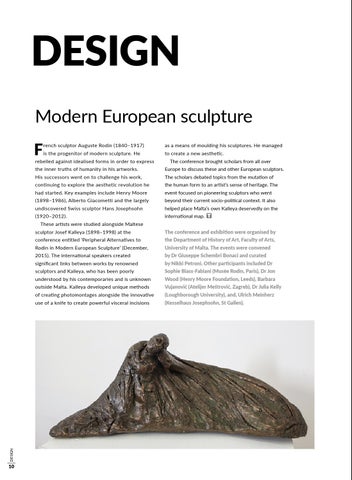
outside Malta. Kalleya developed unique methods
Vujanović (Atelijer Meštrović, Zagreb), Dr Julia Kelly
of creating photomontages alongside the innovative
(Loughborough University), and, Ulrich Meinherz
use of a knife to create powerful visceral incisions
(Kesselhaus Josephsohn, St Gallen).