THINK FEATURE
8,000 species exist in Malta. Like other living organisms, insects are subdivided into various groups according to how they are related to each other. Some 30 different orders are currently recognised, depending on which scientist you agree with. The beetles (Order Coleoptera) have the largest number of species and locally there may be more than 1,700 species. Alien species are organisms that establish themselves in a new territory. Cataloguing of insects is essential to figure out if an insect is natural to Malta or an alien. Once established in a new territory such organisms may cause several problems. The lack of natural enemies in the new territory often means that their population explodes. These pests can
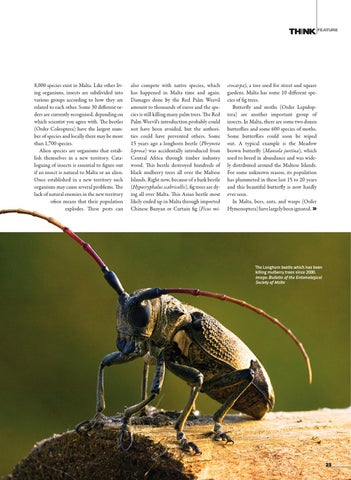
also compete with native species, which has happened in Malta time and again. Damages done by the Red Palm Weevil amount to thousands of euros and the species is still killing many palm trees. The Red Palm Weevil’s introduction probably could not have been avoided, but the authorities could have prevented others. Some 15 years ago a longhorn beetle (Phryneta leprosa) was accidentally introduced from Central Africa through timber industry wood. This beetle destroyed hundreds of black mulberry trees all over the Maltese Islands. Right now, because of a bark beetle (Hypocryphalus scabricollis), fig trees are dying all over Malta. This Asian beetle most likely ended up in Malta through imported Chinese Banyan or Curtain fig (Ficus mi-
crocarpa), a tree used for street and square gardens. Malta has some 10 different species of fig trees. Butterfly and moths (Order Lepidoptera) are another important group of insects. In Malta, there are some two dozen butterflies and some 600 species of moths. Some butterflies could soon be wiped out. A typical example is the Meadow brown butterfly (Maniola jurtina), which used to breed in abundance and was widely distributed around the Maltese Islands. For some unknown reason, its population has plummeted in these last 15 to 20 years and this beautiful butterfly is now hardly ever seen. In Malta, bees, ants, and wasps (Order Hymenoptera) have largely been ignored. Âť
The Longhorn beetle which has been killing mulberry trees since 2000. Image: Bulletin of the Entomological Society of Malta
25