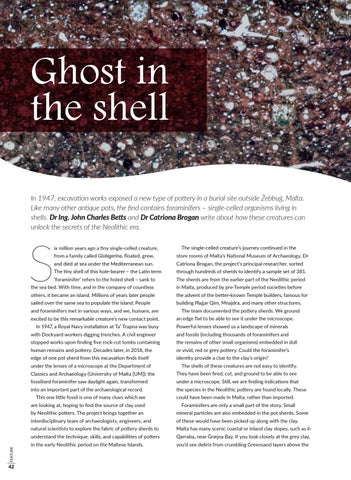
Ghost in the shell In 1947, excavation works exposed a new type of pottery in a burial site outside Żebbuġ, Malta. Like many other antique pots, the find contains foraminifers – single-celled organisms living in shells. Dr Ing. John Charles Betts and Dr Catriona Brogan write about how these creatures can unlock the secrets of the Neolithic era.
S
ix million years ago a tiny single-celled creature,
store rooms of Malta’s National Museum of Archaeology. Dr
and died at sea under the Mediterranean sun.
Catriona Brogan, the project’s principal researcher, sorted
The tiny shell of this hole-bearer – the Latin term
through hundreds of sherds to identify a sample set of 381.
‘foraminifer’ refers to the holed shell – sank to
The sherds are from the earlier part of the Neolithic period
the sea bed. With time, and in the company of countless
in Malta, produced by pre-Temple period societies before
others, it became an island. Millions of years later people
the advent of the better-known Temple builders, famous for
sailed over the same sea to populate the island. People
building Ħaġar Qim, Mnajdra, and many other structures.
and foraminifers met in various ways, and we, humans, are excited to be this remarkable creature’s new contact point. In 1947, a Royal Navy installation at Ta’ Trapna was busy
Powerful lenses showed us a landscape of minerals and fossils (including thousands of foraminifers and
stopped works upon finding five rock-cut tombs containing
the remains of other small organisms) embedded in dull
human remains and pottery. Decades later, in 2018, the
or vivid, red or grey pottery. Could the foraminifer’s
edge of one pot sherd from this excavation finds itself
identity provide a clue to the clay’s origin? The shells of these creatures are not easy to identify.
Classics and Archaeology (University of Malta [UM]): the
They have been fired, cut, and ground to be able to see
fossilised foraminifer saw daylight again, transformed
under a microscope. Still, we are finding indications that
into an important part of the archaeological record.
the species in the Neolithic pottery are found locally. These
This one little fossil is one of many clues which we are looking at, hoping to find the source of clay used
FEATURE
The team documented the pottery sherds. We ground an edge flat to be able to see it under the microscope.
with Dockyard workers digging trenches. A civil engineer
under the lenses of a microscope at the Department of
42
The single-celled creature’s journey continued in the
from a family called Globigerina, floated, grew,
could have been made in Malta, rather than imported. Foraminifers are only a small part of the story. Small
by Neolithic potters. The project brings together an
mineral particles are also embedded in the pot sherds. Some
interdisciplinary team of archaeologists, engineers, and
of these would have been picked up along with the clay.
natural scientists to explore the fabric of pottery sherds to
Malta has many scenic coastal or inland clay slopes, such as il-
understand the technique, skills, and capabilities of potters
Qarraba, near Ġnejna Bay. If you look closely at the grey clay,
in the early Neolithic period on the Maltese Islands.
you’d see debris from crumbling Greensand layers above the