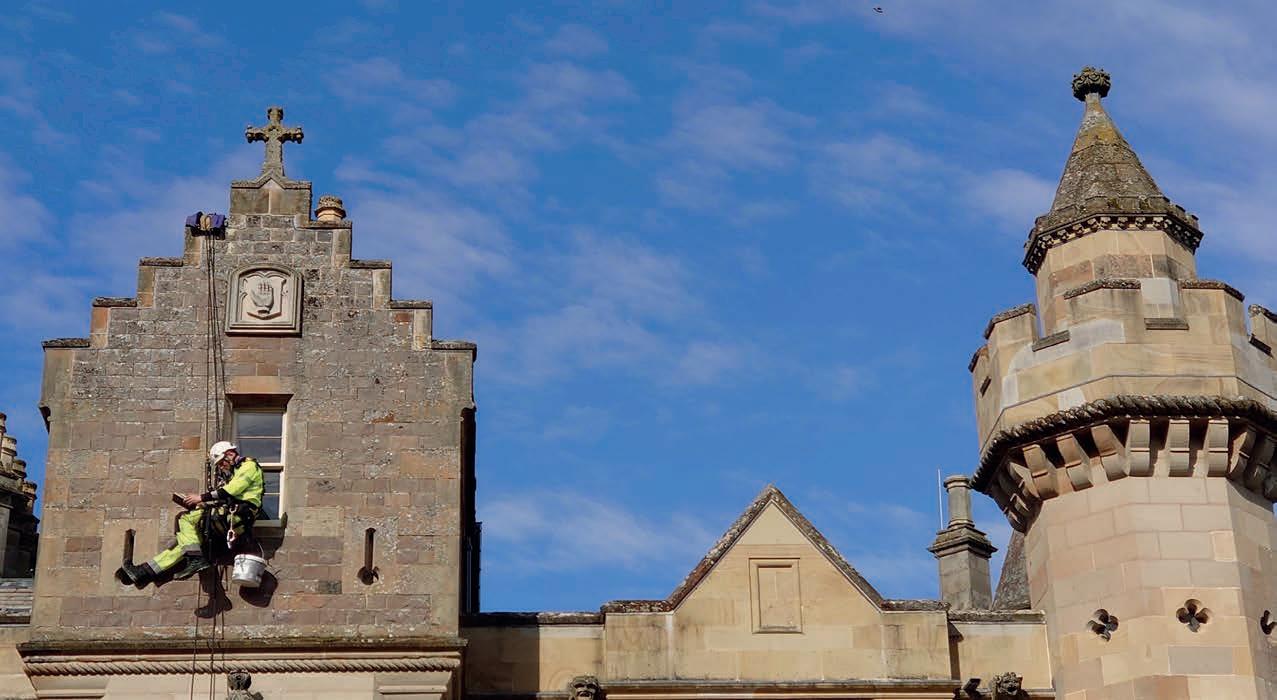
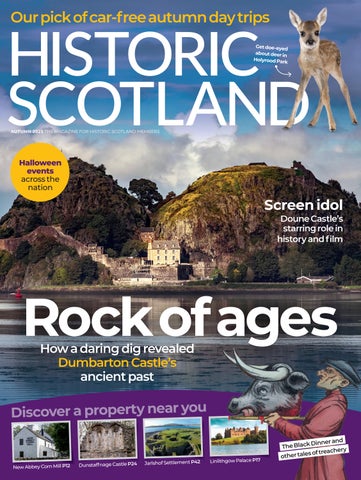
Getdoe-eyed aboutdeerin HolyroodPark







Screenidol
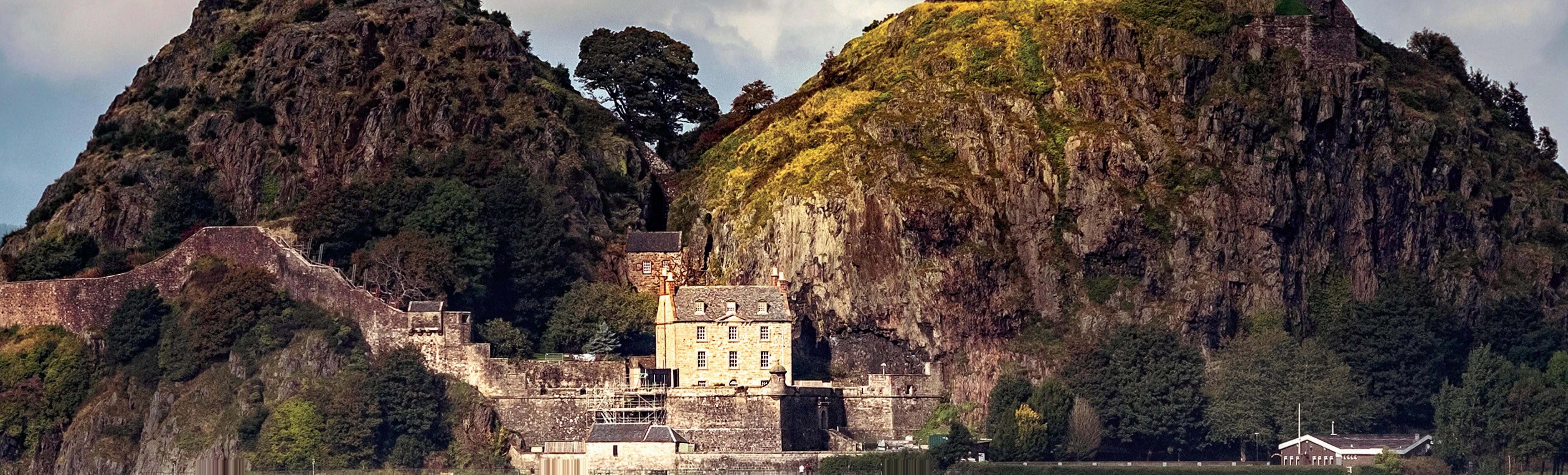
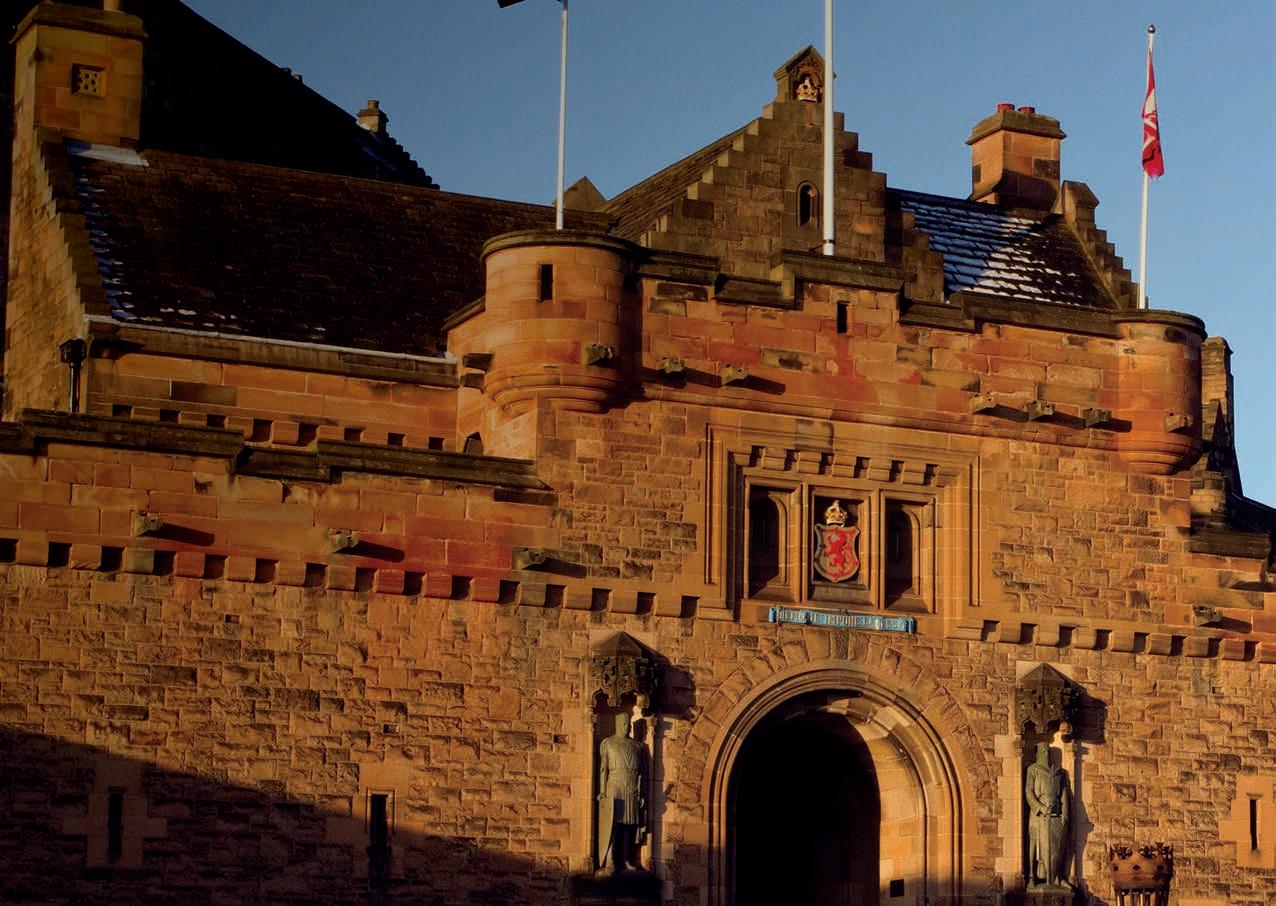
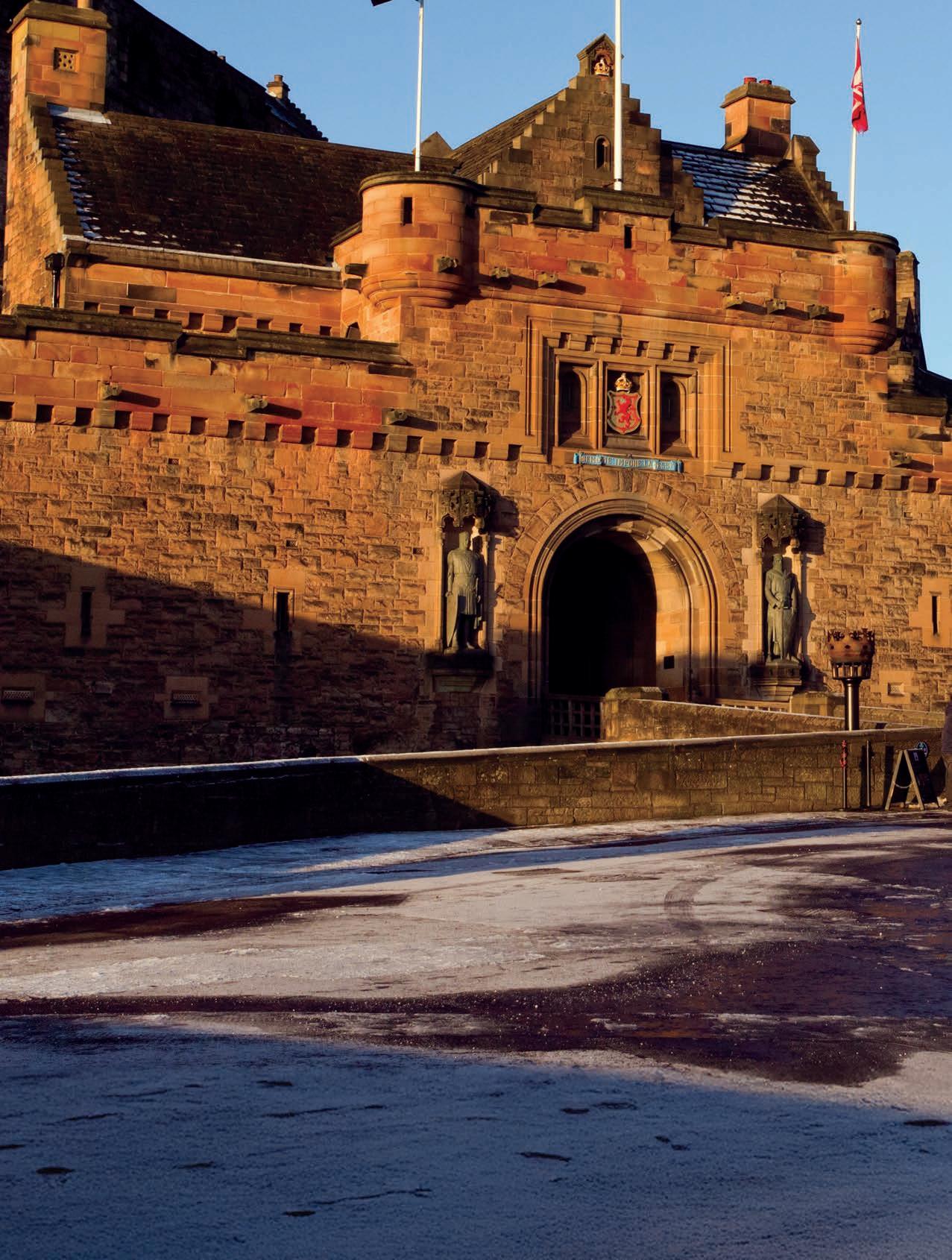
DouneCastle’s starringrolein historyandfilm






















Getdoe-eyed aboutdeerin HolyroodPark
Screenidol
DouneCastle’s starringrolein historyandfilm
Thegloriousdaysandhuesofautumn bringanotherdimensiontoourhistoric sites,andthisissueofHistoricScotlandhas plentyofinspirationforgreatdaysoutforallages.
We’reexcitedtorollouttheGreatBigLivingHistoryWeek onceagain,withsitesacrossScotlandbroughtcolourfully tolifebyacastofhistoricalcharacters.Ifit’sgoosebumps you’reafter,checkoutthedarkersideofStirlingCastleon ourLanternTours,orhearwhispersofthepastatEdinburgh Castle.Formoredetails,turntopage52.
Elsewhereinyourmagazine,wedelveintosomeofthe deliciouslydarktalesoftreacherythatoursiteshave witnessed(page22),andexploremillenniaofprehistory andhistoryinShetland,aswecelebrate100yearssince Jarlshofcameintostatecare(page42).
Youwon’twanttomissabrand-newexhibitionat DumbartonCastlechartinglifeontheRockfrom earliesttimes.Readaboutadaringdiginthe1970s, whichfoundevidenceofanancientfortress(page30).
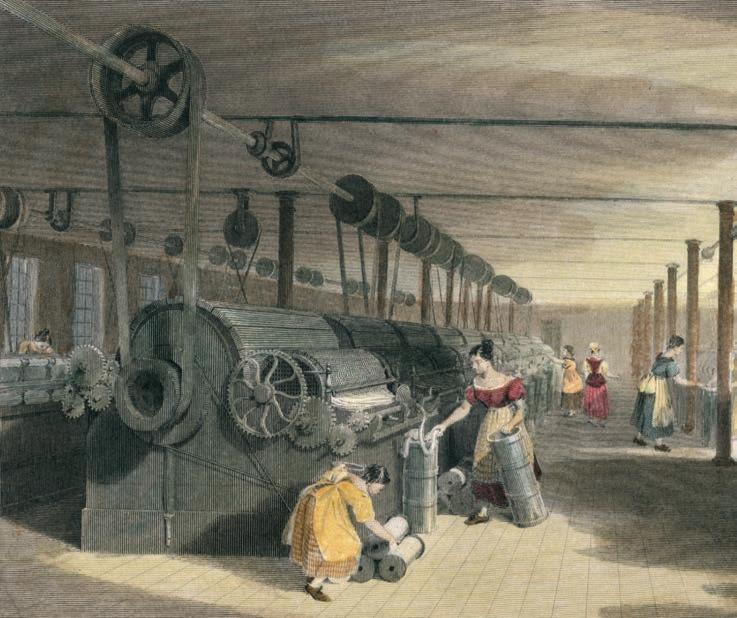
You’llalsodiscoverfirst-handwhatlifewaslikefor thewomenandchildrenemployedatStanleyMills duringthe19thcentury,throughtheeyesofIshbel,a younggirlworkinginthenoisyandhazardous environmentoftheBellMill(page36).
Wewishyouanepicautumnexploringallthat ourwonderfulheritagehastoofferthisseason.
CLAIREBOWIE Head of Membership & CRM

GORING isanauthorofhistorical novelsandformerliterary editorofTheHerald
PAGE 22

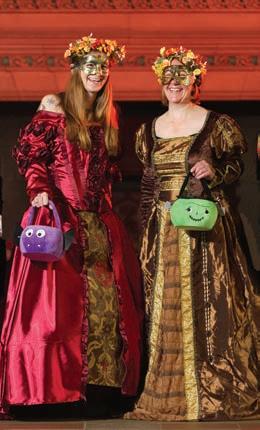
Haveyoumade plansyetforthe Octoberbreakand Halloween?From ourGreatBigLiving HistoryWeek toHalloween Shenaniganevents atpropertiesacross thenation,we’ve loadstokeepyou andyourlittle guisersentertained.
Turn to page 52 for further details.
CAMPBELL works as an Interpretation Officer for HES, telling stories about Scotland’s past through exhibitions and interpretation. PAGE 30

HANNAHBROWN is an Interpretation Officer for HES, helping to bring our sites to life for visitors.
PAGE 36

NICOLAMORE is a journalist, providing communications and strategy services through her agency Rebel Creative.
PAGE 42
CORRECTION
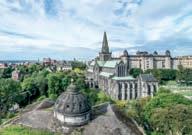
Onpage31ofthesummer issue,itwasstatedthatSt Mungofoundedthecityof Glasgow.Heisthoughtto havebeenitsfirstbishop. Later,in1175,Glasgow gainedburghstatusand associatedtradingrights.
HISTORIC ENVIRONMENT
SCOTLAND
Longmore House, Salisbury Place, Edinburgh EH9 1SH 0131 668 8600
historicenvironment.scot
Membership enquiries 0131 668 8999
members@hes.scot
Editorial enquiries
members@hes.scot
Head of Membership & CRM
Claire Bowie
Membership Marketing Manager
Julia Haase-Wilson
Editor Indira Mann
indira.mann@ thinkpublishing.co.uk
Assistant Editor
Jonathan McIntosh
Design
Matthew Ball
Managing Editor
Andrew Littlefield
Advertising Sales
Jamie Dawson
jamie.dawson@ thinkpublishing.co.uk
0203 771 7201
Executive Director, Think John Innes
john.innes@thinkpublishing.co.uk
Think 65 Riding House Street
London, W1W 7EH 020 3771 7200
Photography
All images provided by Historic Environment Scotland unless otherwise stated. For access to images of Scotland and our properties, call 0131 668 8647/8785 or email images@hes.scot
Historic Scotland is published quarterly and printed on Galerie Brite Bulk, which is from wellmanaged FSC®-certified forests and from other controlled sources.
The views expressed in the magazine do not necessarily reflect those of Historic Environment Scotland. All information is correct at the time of going to press.
© Historic Environment Scotland.
All rights reserved. Reproduction in part or in whole is prohibited without prior agreement of the Membership and CRM Manager of Historic Environment Scotland.
Historic Environment Scotland
(HES) is a Non Departmental Public Body established by the Historic Environment Scotland Act 2014.
HES has assumed the property, rights, liabilities and obligations of Historic Scotland and RCAHMS.
Visit hes.scot/about-us
Scottish Charity No. SC045925.

Revisiting the past at Jarlshof Prehistoric and Norse Settlement
A brother betrayed and other tales of treachery
Great days out for all 56 TIME TRIP 8
REGULARS
8 THE SCRIPT
Your guide to experiences at our properties this autumn
20 SPOTLIGHT
Caerlaverock Castle
48 SHOP
52 EVENTS
FEATURES
22 TREACHERY AND TREASON
Meet some of the nation’s great rogues and radicals
30 ROCK OF AGES
Revisiting an archaeological dig at Dumbarton Rock
36 INSIDE STANLEY MILLS
A young worker guides us around the cotton industry
42 ANCIENT SHETLAND
Uncovering 4,000 years of island history

hes.scot/doune-video
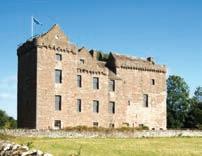
Uncover this 14th-century courtyard castle’s starring role in Scottish fact and fiction
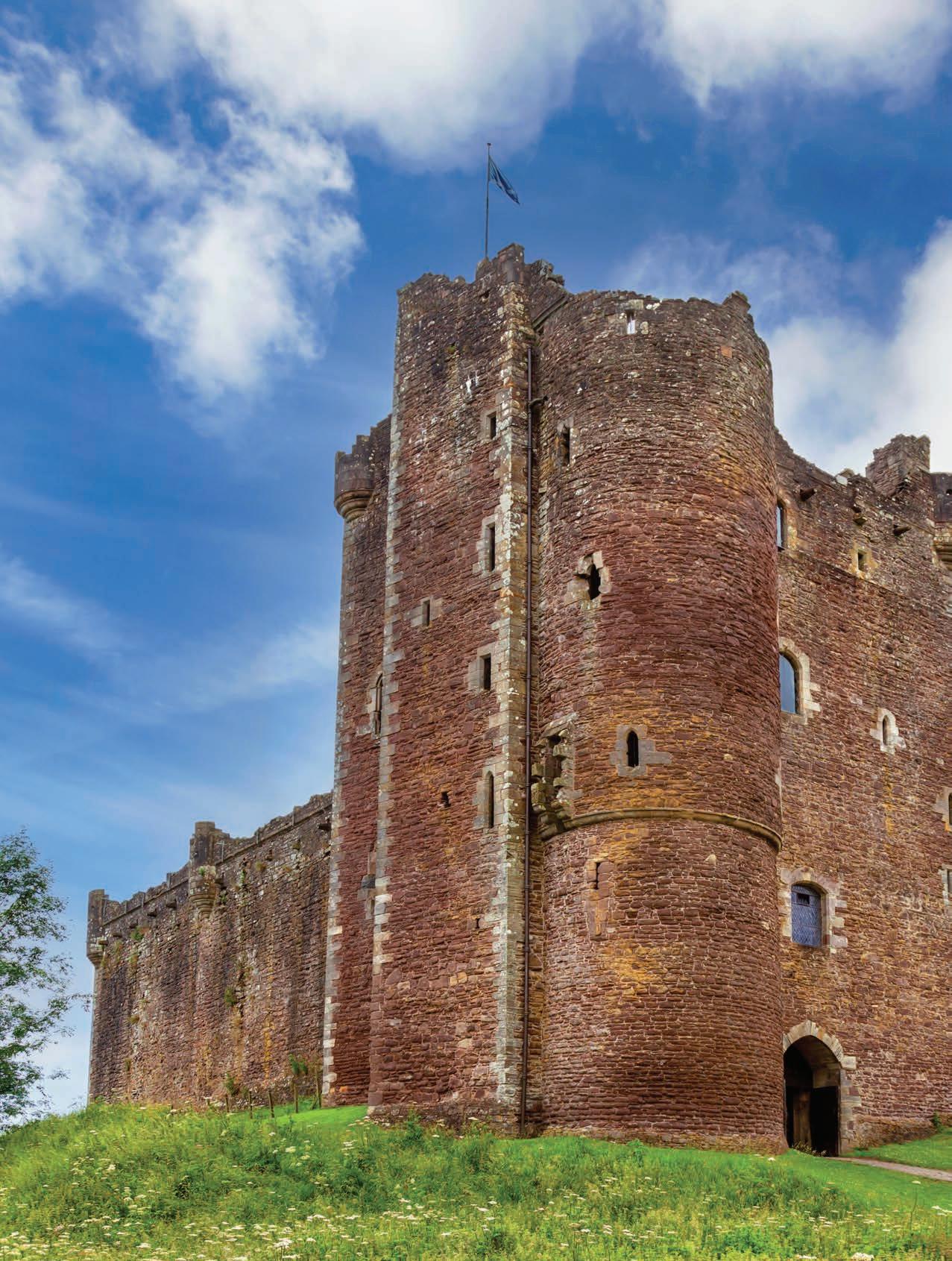
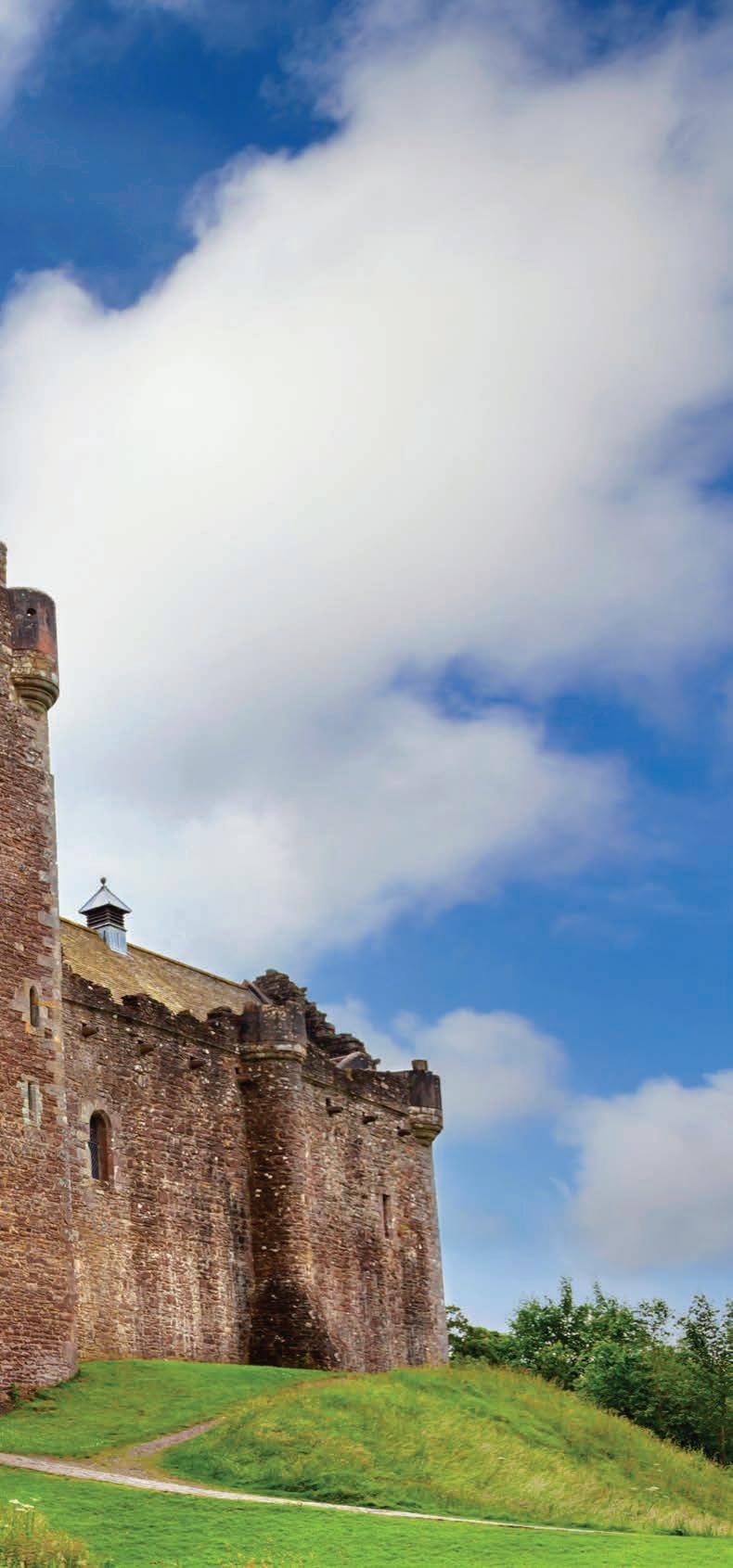
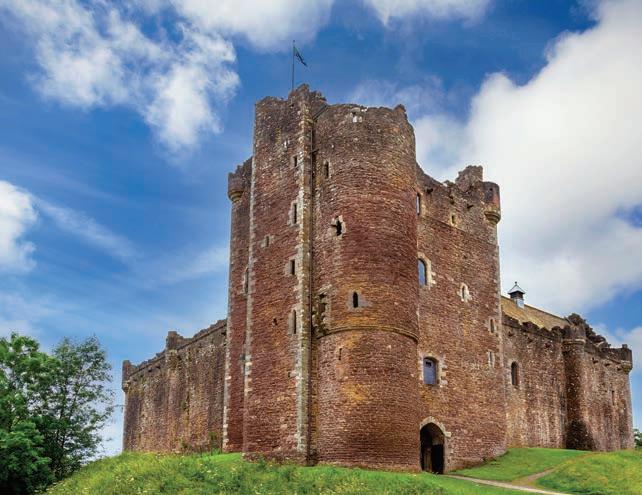
Boasting a 100-foot-high gatehouse and impressively preserved Great Hall, Doune Castle is certainly striking. Robert Stewart, 1st Duke of Albany, acquired the castle in 1361 after marrying Margaret Graham, Countess of Menteith. He’s largely responsible for its architectural splendour.
Albany was the younger brother of Robert III and was made high chamberlain of Scotland in 1382 and guardian of Scotland in 1388. Due to his sibling’s political weakness, Albany essentially ruled Scotland from 1388 until his death in 1420, earning him the nickname of ‘Scotland’s Uncrowned King’. Doune became a royal castle following Albany’s death and the execution of his son Murdoch by James I in 1424.
The extensive keep-gatehouse featured the Lord’s Hall with its carved oak screen, musicians’ gallery and double fireplace. Doune Castle’s
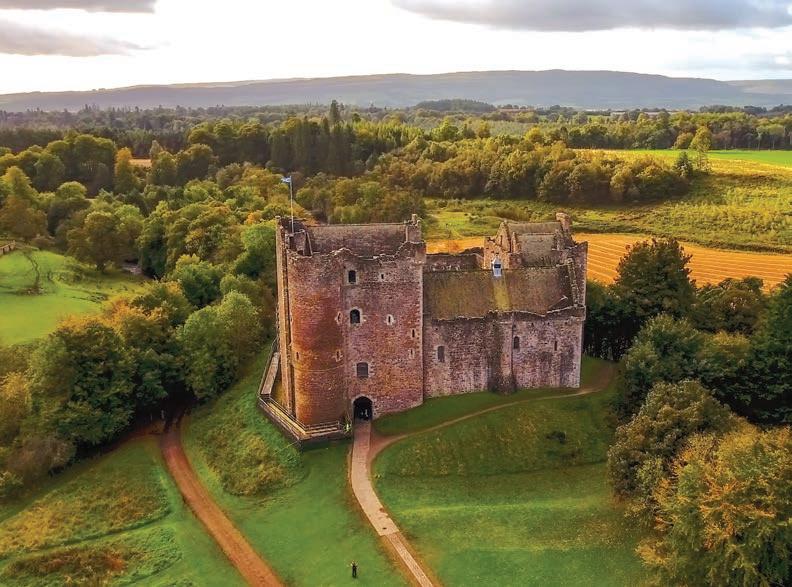
inhabitants enjoyed battlement views of the River Teith and Ben Lomond, and it was a revered hunting retreat for monarchs such as Mary Queen of Scots.
In 1570, Sir James Stewart, the first Lord Doune, was granted Doune Castle by James VI. His eldest son, James, became the Earl of Moray after marrying the Regent Moray’s daughter, Elizabeth Stewart, in January 1581.
Doune’s royal significance waned when James VI became James I of England in 1603.
The Earls of Moray were strong supporters of the exiled Stuarts, and Doune Castle was occupied by Bonnie Prince Charlie during the Jacobite rising of 1745 as he fought to retake the British throne.
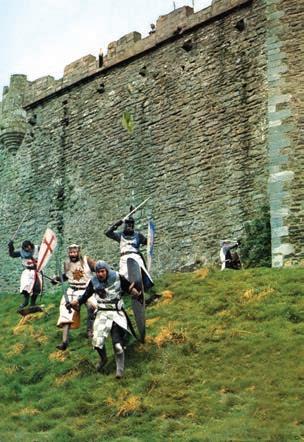
One of Doune Castle’s most iconic screen roles is its appearance in Monty Python and the Holy Grail (1975). The castle’s facades were used to represent several of its locations –including Castle Anthrax, Swamp Castle, the Castle of Guy de Lombard and Camelot – with locals playing peasants, knights and soldiers.
Storm the castle with Terry Jones from Monty Python and learn about the filming of the Outlander series with Sam Heughan on our digital audio guide. Bring your mobile phone or device with internet
access to download it. Don’t forget your headphones!
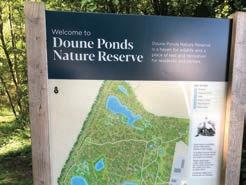
There is restricted parking at the castle. Be savvy by parking at the Draggie Burn Park & Stride, just a 20-minute walk from Doune Castle. You’ll avoid traffic and can take in the beauty of Doune Ponds Nature Reserve and the historic village en route.
Doune Castle appeared in the classic comedy Monty Python and the Holy Grail, which celebrated its 50th anniversary this year
With its impressive defences, the castle served as a prison for government troops captured by the Jacobites at the Battle of Falkirk. Six of them escaped down the walls above Doune’s kitchen on knotted bedsheets!
Doune Castle lets you walk in the footsteps of both historical and fictional figures. It’s been a popular filming location over the years, appearing in Monty Python and the Holy Grail – which celebrated its 50th anniversary earlier this year –doubling as Winterfell in the Game of Thrones pilot and standing in as Castle Leoch in the Outlander series.
Screen lovers should look out for sights from their favourite scenes when visiting the castle.
The 275-metre path to the castle starts off on tarmac at a slight incline and ends with a very steep gradient and rough, uneven cobbles. For more information visit hes.scot/ doune-castle-access
There’s an adapted toilet in the cottage just 25m along an artificial grass path from the car park.
Assistance dogs have full access to the site. Other dogs are not allowed in the castle but can explore the woodland walk and grounds.

Plan your next trip to Doune Castle at historyawaits.scot
For directions to Doune Castle see hes.scot/ doune-directions
“Runaway!”
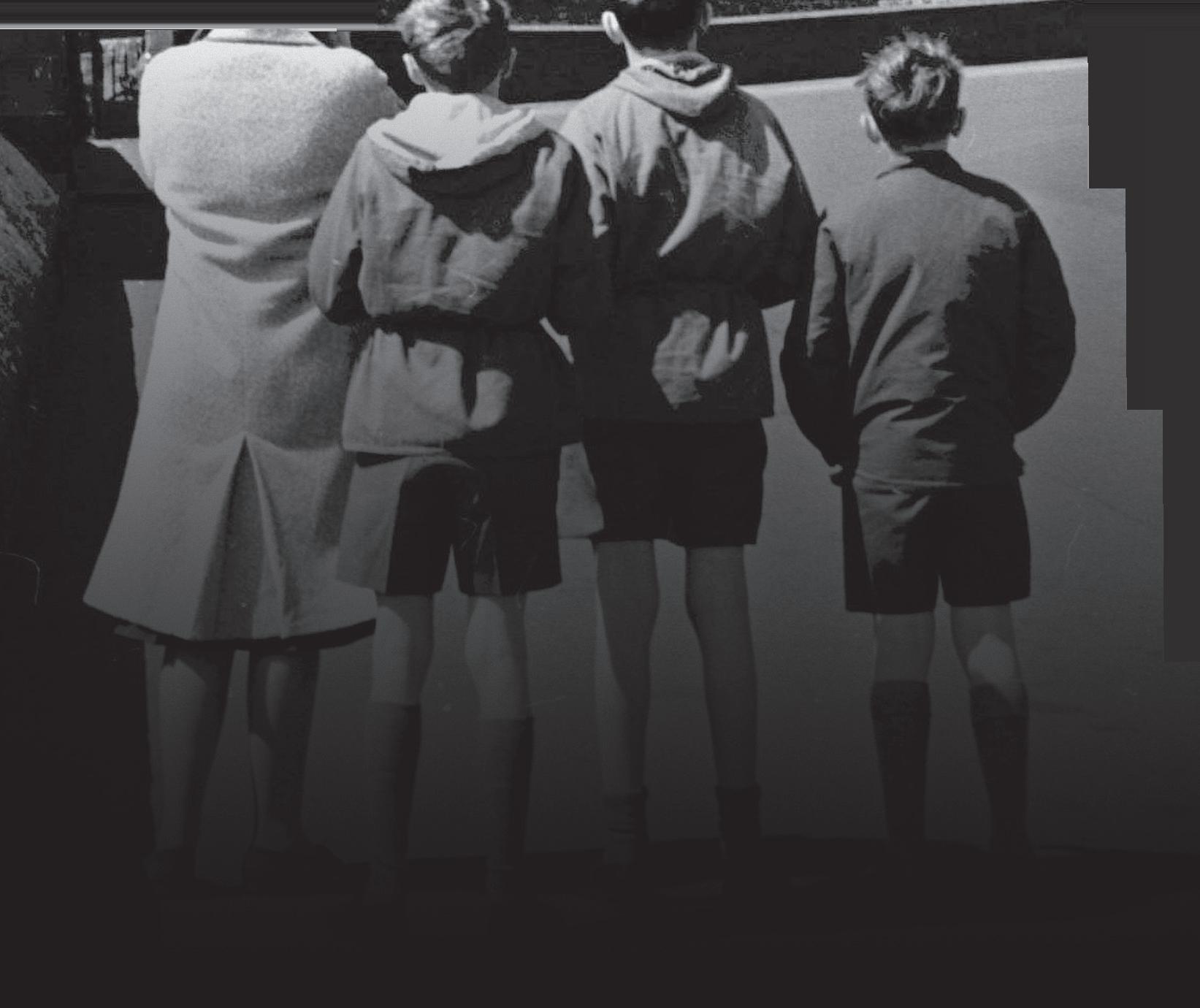
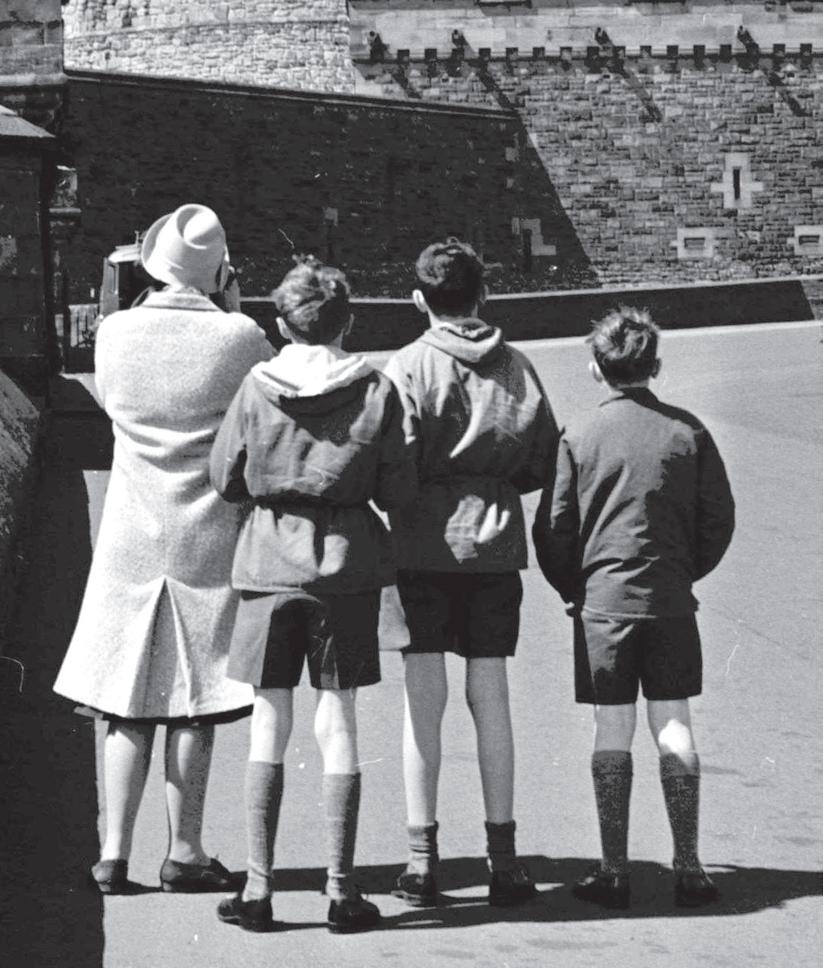



MEMBERS’ PHOTOGRAPHY COMPETITION 2025
Send your best shots to hesphotocomp@ thinkpublishing.co.uk by 5pm on 28 November for a chance to win top prizes. T&Cs at hes.scot/memberscompetition
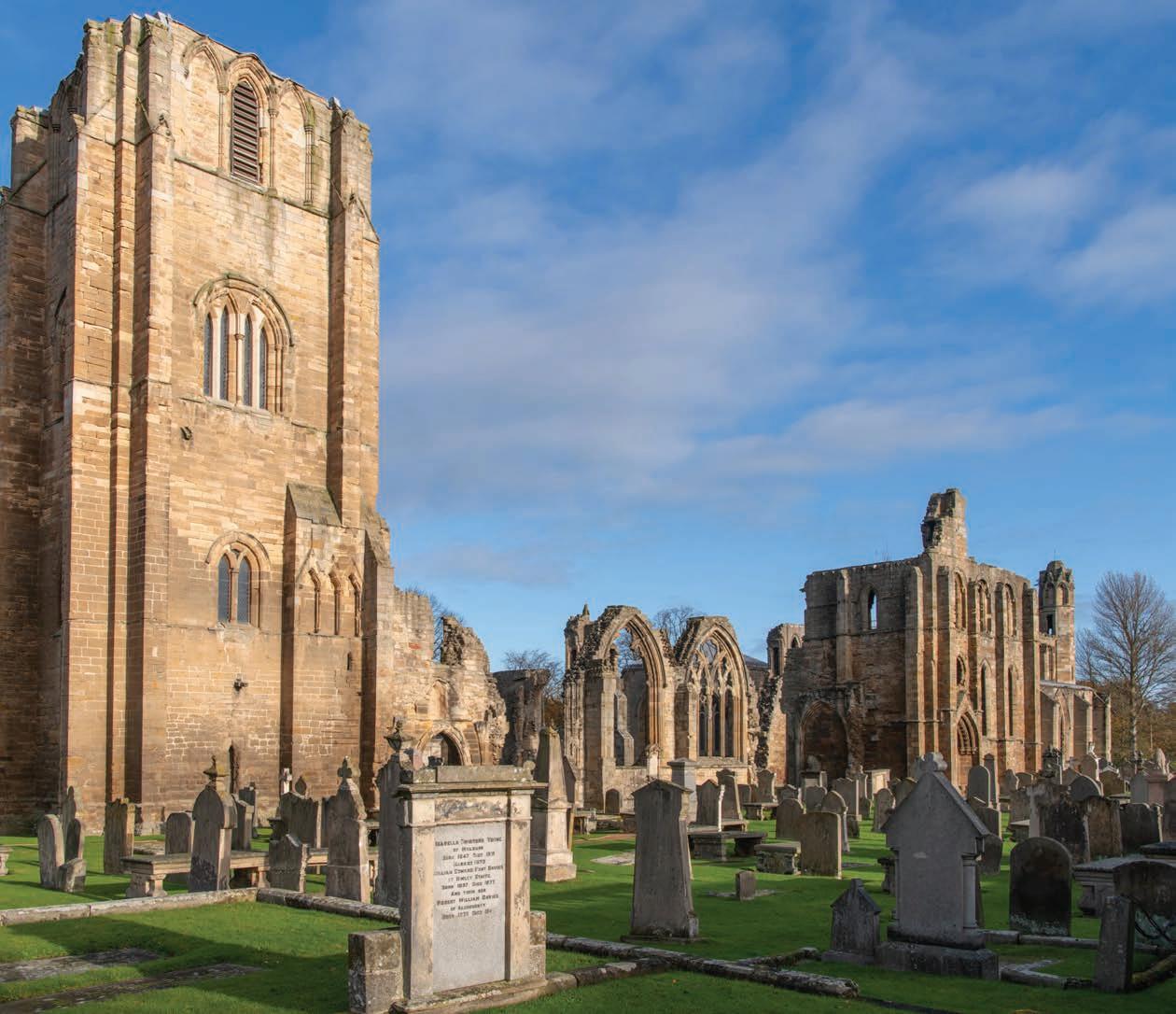
Our behind-the-scenes tour leads through the graveyard at Elgin Cathedral
Explore Elgin Cathedral’s gravestones on this exclusive members’ tour
Our ‘Stories on Headstones’ tour at the ‘Lantern of the North’ delves into the history, symbolism and craftsmanship of the carved gravestones to be found in the grounds of the cathedral. This exclusive members’ event takes place at 11am on Saturday 4 and Saturday 11 October. During the 1.5-hour guided walk, you’ll find out about symbols adorning the grave markers, the mechanics of wall tombs and the enthralling stories behind some of the historic notables buried here. Your tour guide will also discuss the influence of geology on the headstones you’ll come across, which have become surprisingly good habitats for flora and fauna.
Check your membership eNewsletter for exclusive event information
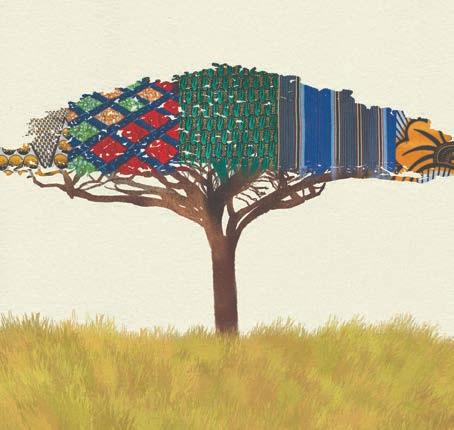

New Blackness Castle exhibition uses a range of voices and stories to re-examine the imperial past
On from 31 October until 9 March 2026, Blackness Castle’s ‘Traces of Empire’ exhibition explores histories connected to the British Empire. It represents different voices and viewpoints while providing the opportunity for healing past wrongs.
Drawing on the experiences of the people and communities who lived under British rule during the Empire, this exhibition places their stories front and centre.
You’ll discover a breadth of themes ranging from belonging and language to reclaiming past and future narratives.
Traces of Empire, which will tour some of our other sites next year, seeks to better understand the legacy of the British Empire and how we can all move forward together.
For more events visit hes.scot/events
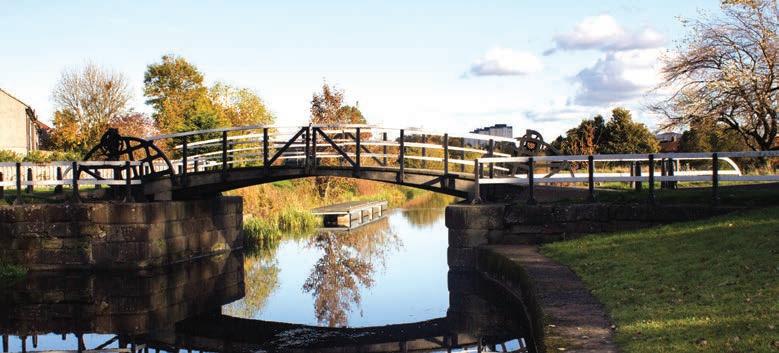
The Forth and Clyde Canal
Wander off the beaten track with our Doors Open Day events
Go behind the scenes at popular properties and those usually closed to public view with our Doors Open Day programme.
In partnership with Scottish Canals, we’re offering a sneak peak behind the doors of Lock 16 – located along the Falkirk Flight section of the Forth and Clyde Canal – on 20 September.
It’s a great time to view the site ahead of its opening, which will see a former Irn-Bru factory converted into Scotland’s Centre of Excellence for Canals and Traditional Skills.
Dive deeper into Leith’s maritime history, meanwhile, at Trinity House on 28 September. Little ones can follow our family trail, listen to stories of the high seas and get hands on with crafts.
And at the Engine Shed on 27 and 28 September, you’ll have the chance to discover time-honoured techniques used to protect our built environment and explore the labs of our dedicated building conservation centre.
More details at hes.scot/doors-open-day
Make the most of half term at our sites
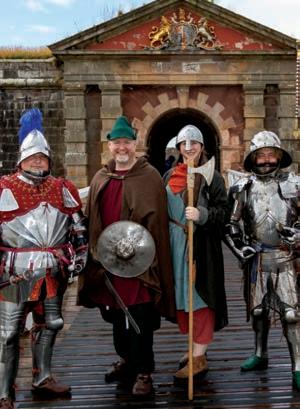
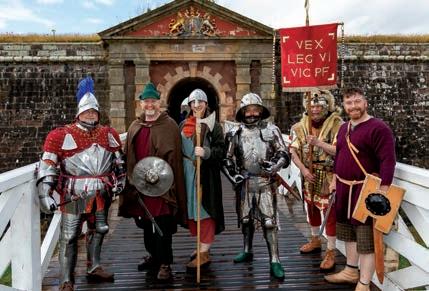
Great Big Living History Week makes a grand return to properties nationwide – including Dunstaffnage Castle, St Andrews Castle, Melrose Abbey and Caerlaverock Castle –from 11 to 19 October. Whether you’re keen to natter with a knight at Urquhart Castle or meet a medieval musician at Aberdour Castle, our characters are on hand to tell you all about our sites…and pose for selfies.
Those with a taste for the fantastical should try The Mythical Mystery Hunt, appearing at participating sites between 11 October and 2 November. Look out for legendary creatures from Scottish folklore while wandering family-friendly footpaths.
For more school holiday inspiration, turn to page 52
Enjoy a ghoulishly great time at sites across the nation
Join our boo-rilliant Halloween happenings during this scary season – if you’re brave enough!
Craig-thriller Castle: Halloween Shenanigans is for mischief lovers. On 25 and 26 October, you’ll meet our master of owls and listen to yarns spun by our resident storyteller, Ravina. And we’ve other ‘Halloween Shenanigans’ events that weekend at Stirling Castle, Edinburgh Castle and Urquhart Castle.
Top spots for all tastes
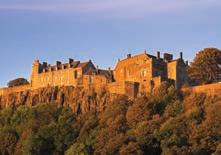
With a name inspired by depictions of Scotland’s national animal within the castle, the Unicorn Café’s wideranging menu is ideal for refuelling after a day spent exploring.
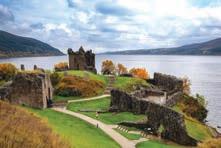


From delicious soups to salads and scones, Lochview Café has something for everyone.
Boasting stunning views, the outdoor seating area is perfect for alfresco feasting –weather permitting!
Searching for something even scarier? Whispers of the Past: The Dark History Of Edinburgh Castle is for you. Starting at 11am and 2pm on select dates throughout October until 1 November, this 18+ tour navigates shadowy corners and shares haunting tales that shed light on this ancient site’s darker side.
Find out more about our Halloween events on page 52.
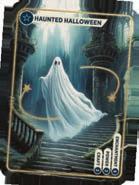
Visit hes.scot/history-hunt to see where you can get your Haunted Halloween History Hunt card
FORT GEORGE
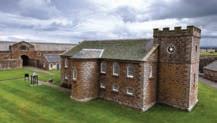
Worked up an appetite while immersing yourself in military history? Retreat to this café – uniquely located in this mighty fortress’s barracks – to warm up with freshly-made bites and a cuppa. Find more tasty snack stops at historyawaits.scot
OURFAVOURITEBOOKS
ThisScottishfolkhistoryclassic hashookedFrederick Alexander-Reid,ourLibraryand SearchRoomManager
One of my favourite books is John Gregorson Campbell’s Witchcraft and Second Sight in the Highlands and Islands of Scotland. Sporting a distinctive orange and maroon dust jacket, this medium-sized hardback gathers stories, anecdotes and translations of folk histories relating to witchcraft in Scotland.
As well as being a 19th-century minister in the Free Church of Scotland, Campbell was a passionate folklorist interested in traditional Scottish tales. He was fluent in Scottish Gaelic and was secretary to the University of Glasgow’s Gaelicspeaking Ossianic Society.
In the late 19th century there was a lot of excitement about researching Scottish folk
Ourmember’sportal atmembers. historic-scotland.gov.uk willberetiringsoonaswe worktocreateanew platformandimproveyour membershipexperience
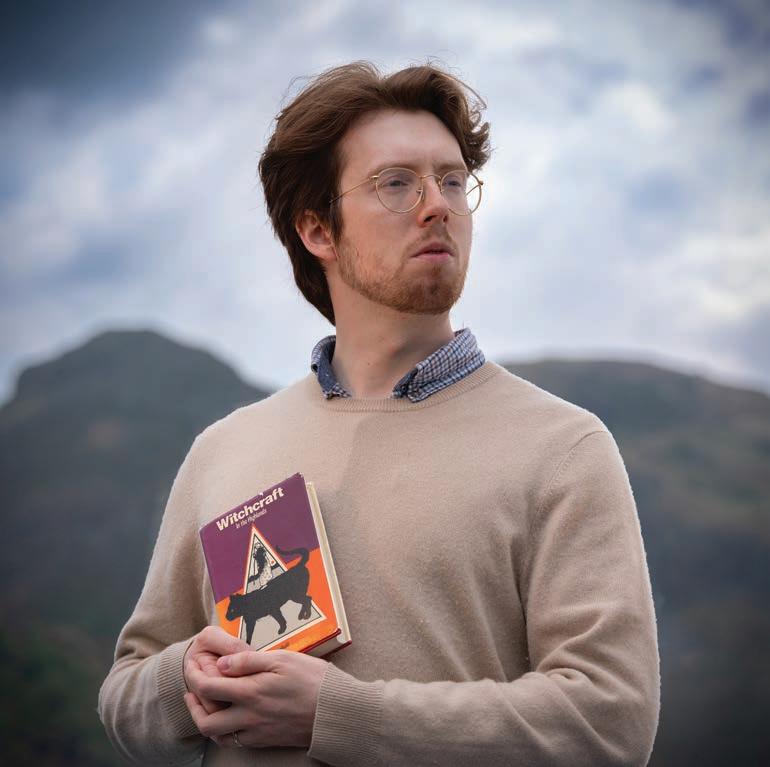
Witchcraft in the Highlands was first published posthumously in 1902, author John Gregorson Campbell having died in 1891
history. Campbell was responsible for translating folk histories – many of which he transcribed directly from Gaelic speakers.
Our library holds the 1974 edition distributed by EP Publishing. It continues Campbell’s attention to Scottish Gaelic origins by stating, “these tales…[do] not neglect their Gaelic origins but take many opportunities to quote the Gaelic words and phrases.”
This interest in Scottish folk history intersects with the historic injustices of laws punishing witchcraft in Scotland. Scotland passed its
You’ll continue to receive updates via your membership eNewsletter. Find everything you need at hes.scot/membership,
where you can also renew and buy memberships or gift memberships. Find out about member benefits there too, and download digital and accessible copies of this magazine, Historic Scotland. Don’t forget to use our Historic Scotland app for visit inspiration and easy
Witchcraft Act in 1563, leading to a century and a half of witch hunts. These trials caused thousands of deaths, many victims being women. The Witchcraft Act was repealed in 1736. In 2022, the then First Minister of Scotland, Nicola Sturgeon, issued an apology for the historic persecution and execution carried out by the act, describing it as “injustice on a colossal scale.”
To view this book and other texts on Scottish folk history, visit our archives at hes.scot/hes-archives
access to your digital member card.
Thank you for your patience while this change takes place. Look out for updates via email and in future issues.
If you have any questions please email our Membership Team at members@hes.scot or call on 0131 668 8999


Sustainable Travel Trainee, Paulina Czekala, shares eco-conscious itineraries to make your visits to our properties a little greener
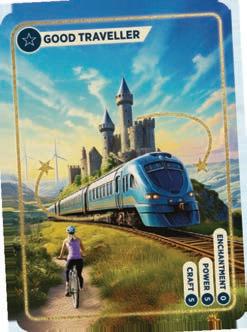
This autumn, choose to travel to some of our properties by train, bus, bike or foot. Ditch the car-related stresses of traffic jams and the ‘Are-we-there-yets?’ for slower paced journeys and more time to enjoy the amazing sights, sounds and surroundings that our sites have to offer – all while doing your bit for the planet. And don’t forget to collect your Good Traveller History Hunt card at some of our sites featured here.
For a full list of properties where you can collect Good Traveller cards visit hes.scot/history-hunt
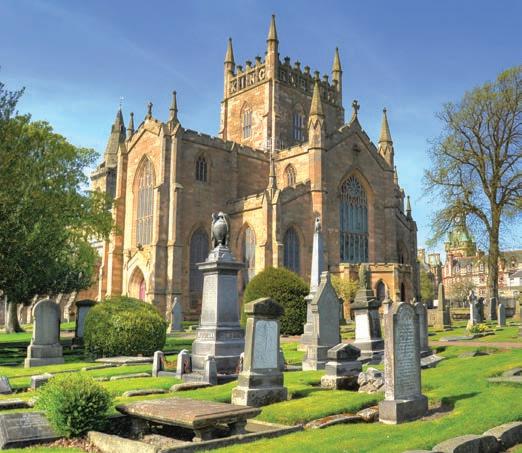












Dunfermline Abbey and Palace to Aberdour Castle and Gardens

DUNFERMLINE ABBEY AND PALACE TO ABERDOUR CASTLE AND GARDENS

Travel by: Train and bike. Cycling distance: 13-mile return journey. Route conditions: Mostly flat.
Itinerary: Catch a train to Dunfermline City Station and cycle four minutes to Dunfermline Abbey and Palace. David I elevated the Benedictine priory of Queen Margaret to an abbey in 1128, and it features impressive Romanesque architecture. It is also home to Robert the Bruce’s burial site –look for the lettering adorning the new abbey

church tower. Fuel up at a nearby café after exploring Pittencrieff Park before cycling National Cycle Network routes 746, 1 and 76 to take in Inverkeithing and Dalgety Bay on the way to Aberdour Castle and Gardens (the section of NCN 76 between Dalgety Bay and Aberdour is part of the Fife Coastal Path). With its terraced walled garden, apple orchard and views of the Forth, there’s lots to enjoy at Scotland’s oldest stone castle. Catch a train for your return leg from Aberdour Station.




Travel by: Train and bike.
Cycling distance: Six-mile return journey.
Route conditions: Mostly flat.
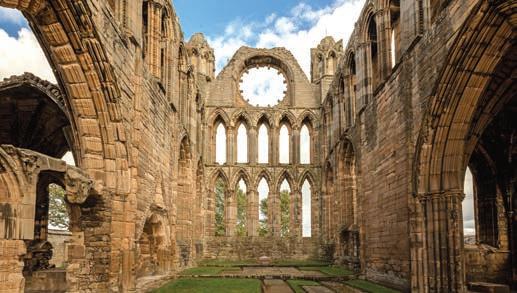
Itinerary: Take a train to Elgin Station and then cycle five minutes to Elgin Cathedral, built in 1224 as the bishops of Moray’s principal church.
After seeing Scotland’s tallest gravestone at the cathedral, pedal the
Moray Coast Cycle Route to Spynie Palace.
Cycle back to Elgin Station for the train to Huntly Station, then it’s just a five-minute cycle to Huntly Castle. You’ll be wowed by the intricate frontispiece added to this stately palace for the the 1st marquess and marchioness of Huntly around 1599.
Travel by: Train, bus and walking.
Walking distance: Four miles.
Route conditions: Mostly flat.
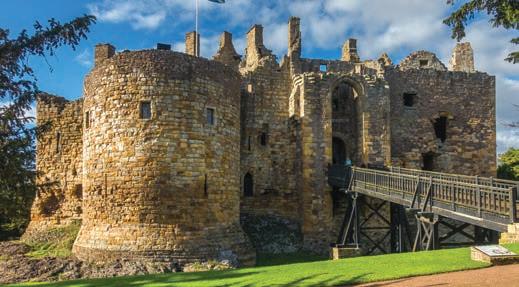
Itinerary: Board a train to North Berwick Station then get the East Lothian 124 bus to Dirleton Castle. This 13th-century fortress housed three noble families for over 400 years.
Beautiful gardens grace the castle grounds. Next, join the John Muir Way for one mile then stroll along the sands of Yellowcraig Beach for three miles to North Berwick. Look out for Fidra Island’s lighthouse, an inspiration for the novel Treasure Island. Catch a train back from North Berwick Station.
Travel by: Bike.
Cycling distance: 19-mile return journey.
Route conditions: Quiet minor roads. Relatively flat at first, then rather hilly.
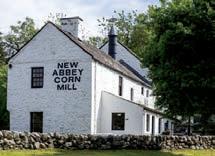
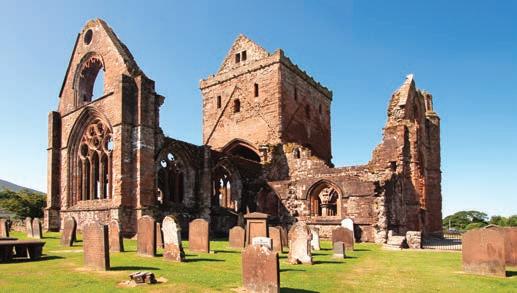
Itinerary: Hop on a train to Dumfries Station then cycle for around an hour to New Abbey Corn Mill. Join a tour to learn how this 18th-century water-powered mill produced oatmeal.
Sweetheart Abbey lies nearby. Discover its romantic tale, which saw monks name it Dulce Cor – Latin for ‘Sweet Heart’ – in memory of Lady Dervorguilla, who founded the Cistercian abbey in tribute to her husband, John Balliol, who died in 1268. Cycle back to Dumfries Station for your homeward journey.
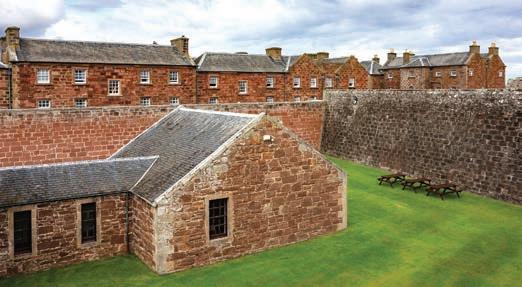
Travel by: Bus and walking. Walking distance: Three-mile round trip. Route conditions: Flat gravel shore path and loose pebble surface. Itinerary: Board an 11 bus from Inverness and get off at the turning circle near Ardersier Church. Head to the sea and follow the signposted shore path to Fort George. Built after the Battle of Culloden in 1746,
the fort’s high ramparts provide excellent views of the Moray Firth, where you may spot dolphins. Don’t miss out on a visit to the Highlanders Museum before returning to the 11 bus stop and heading back to Inverness.










with Ranger Gordon Smith
Gordon Smith fawns over Holyrood Park’s roe deer legacy
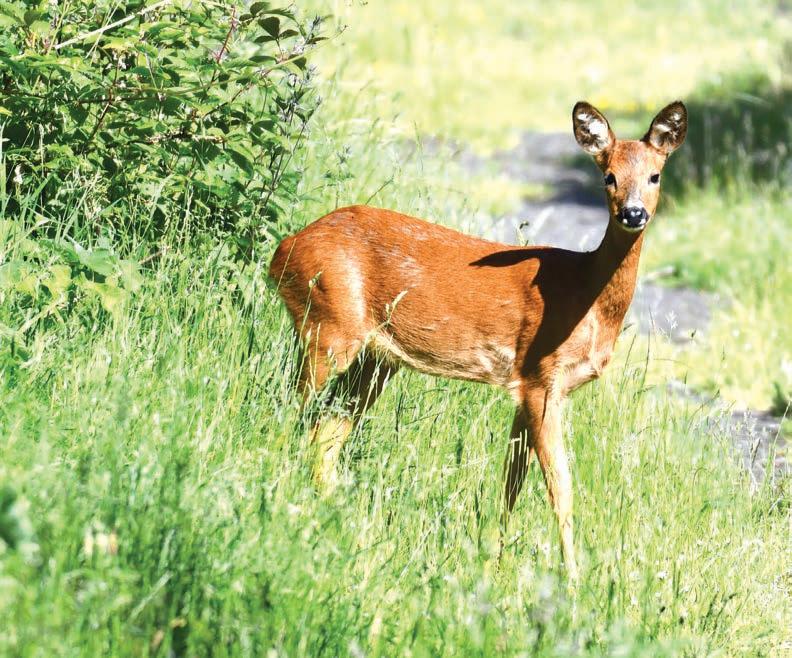
Roe deer are becoming an increasingly common sight amidst Holyrood Park’s trees, inaccessible slopes and quieter corners. No longer restricted to rural woodlands or farmland, these graceful creatures are moving into cities, golf courses and cemeteries across Scotland.
Not as large or imposing as the iconic red deer, roes are the most numerous and widespread deer species in the country.
They’re best identified by their coats, which are red in the summer months and greyish brown in chillier times. Their white, tailless rumps are easy to spot when they’re acrobatically leaping away in search of cover, if disturbed.
Roe deer are elusive creatures. They’re skilled at avoiding detection
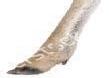
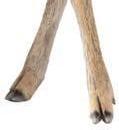

and can reach impressive speeds of up to 37 miles per hour when they need to disappear quickly. They also bark like a dog when threatened.
The males, called bucks, are identifiable by their short antlers, which usually have two or three points. Bucks shed their antlers from October after completing their breeding season, known as the rut. However, their antlers gradually regrow again throughout the year.
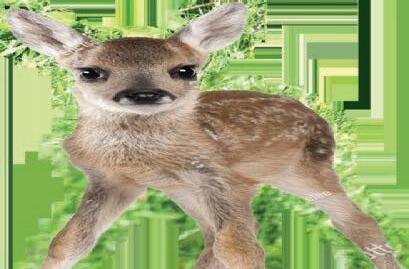
Female roe deer, or does, typically give birth to twin fawns in late spring or
Lookoutforroedeerthisseasonatthistrioofproperties
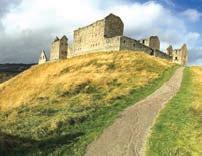
RUTHVENBARRACKS
BuiltforGeorgeI afterthefailed1715 JacobiteRising,this site’sprominent moundisanexcellent vantagepointfrom whichtoviewdeer.
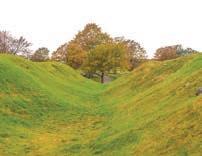
ANTONINEWALL
TheRomanEmpire’s mostnortherly frontierincludes severalhabitatsthat areidealforroe deer,including SeabegsWood.
CASTLE
Roedeerarefrequent visitorsatthisformer residenceofthe RuthvenandMurray families.Spotthem grazinginthearea.
Bambi is a male roe deer in the original 1923 novel. Early mornings or evenings are the best times to spot roe deer at Holyrood Park
summer. They have a small white tuft on their rump during wintertime –a telltale sign to look out for when the temperature drops.
Roe deer were a rare sight in 18th-century Britain. Overhunting and forest clearances even saw them become extinct across the border in England by 1800. Today, however, roe deer populations are overabundant, and they lack natural predators. High populations can prevent forest regeneration, which in turn has an adverse effect on other woodland species.
In Holyrood Park’s long history, there is a legend linked to the roe deer’s native cousin, the red deer. While hunting in Holyrood in 1128, David I is said to have battled a mystical white stag. He was holding a large cross and, when it touched the stag’s antlers, the animal miraculously disappeared. In one version of the legend, St Andrew appears to David in a dream, instructing him to show gratitude for what he experienced by founding an abbey.
Whether this is fact or fiction remains unclear, but David I did found Holyrood Abbey at the site that same year. He even dedicated it to the miracle of the holy cross. Today this legend lives on and is depicted locally at the Canongate Kirk and the Palace of Holyroodhouse.
While the abbey grounds and visitor centre are open to the public, some access restrictions are in place
WHOLIVEDHERE?
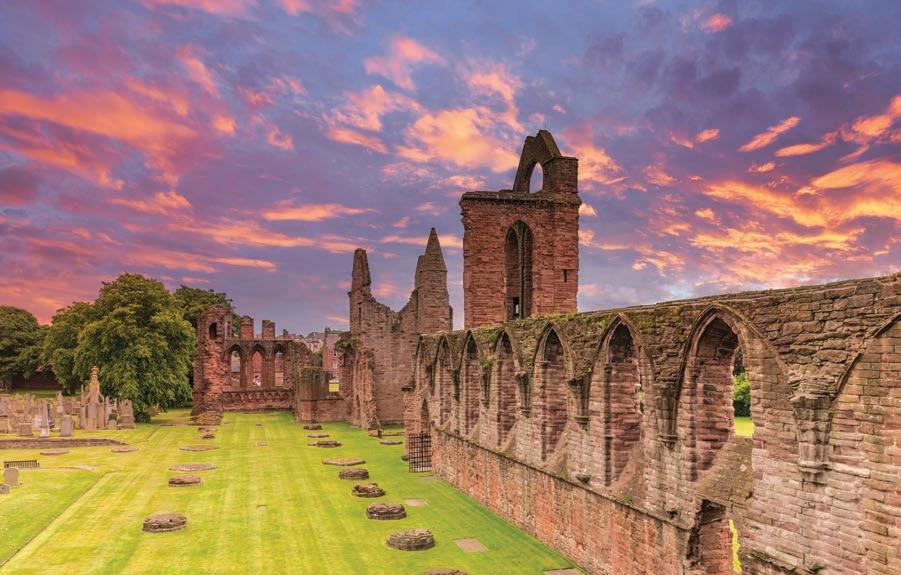
Bernard (died c.1331) became the abbot of Arbroath Abbey in 1310. He was buried at Kilwinning Abbey, having been a monk there earlier in his career. It is thought that Bernard oversaw the drafting of the Declaration of Arbroath, which was sent to Pope John XXII in April 1320 to demand freedom for the Scots and recognition of King Robert the Bruce. This document’s most famous lines are: “It is in truth not for glory, nor riches, nor honours that we are fighting, but for freedom – for that alone, which no honest man gives up but with life itself.”
New Dirleton Castle exhibition focuses on the women who shaped its gardens
Inspiration from found objects
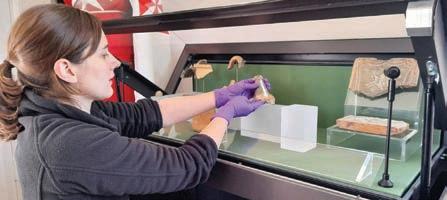
There’s a new display to see in Dirleton Castle’s recently upgraded gazebo. It celebrates the achievements of the inspirational women who influenced the design of this site’s impressive gardens, home to the world’s longest herbaceous border. These stories are told within new interpretation panels, which chart the gardens’ beginnings as
a medieval orchard, the significance of its Renaissance and Victorian floral designs, and how it became a popular tourist attraction in the 19th century. Archaeological objects on show at Dirleton Castle helped our team to dig deeper into these chapters of the stronghold’s story. Plan your Dirleton Castle visit at historyawaits.scot
Margaret imagined
Hannah Brown, Interpretation Officer, on how we’re commemorating Margaret Hall
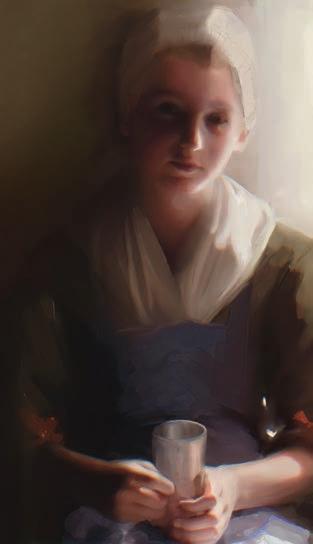
Located at Holyrood Park’s Meadowbank entrance is a stone memorial cairn dedicated to Margaret Hall, who was murdered here by her husband, Nicol Muschat, in 1720. The cairn was erected in her memory by locals. Today it’s one of Edinburgh’s oldest memorials devoted to a woman.
We’ve added a new interpretation panel near the cairn so people can learn more about Margaret, who was born in Edinburgh on 16 May 1703 and married Muschat in 1719. When researching Margaret, we found that most historic sources focused on Nicol instead of her. To refocus the narrative, we studied contemporary paintings to identify what someone of Margaret’s age and social status would have worn. We then commissioned an illustrator to create an imaginary portrait of her for this panel.
Look out for her cairn and new interpretation reframing Margaret’s life the next time you’re in the area.
The television personality, radio broadcaster, journalist and co-host of the How to Be 60 podcast reflects on Linlithgow Palace’s longstanding presence in her life

Kaye Adams is one of Scotland’s most experienced live TV presenters
Iwas brought up in Grangemouth, so my family shuttled between Glasgow and Edinburgh for days out. Linlithgow Palace was one such destination, so I’ve always been aware of it.
As a university student in Edinburgh, I used to drive past it on my way to my parents. I’ve always thought it looks especially beautiful at night.
When my kids came along, we’d head here when visiting my mum for granny duties or during the school holidays.
One of my friends even got married at St Michael’s Parish Church next door. The church’s crown of thorns looked stunning glistening in the sunshine.
I’ve got a real affection for Linlithgow Palace. This special place has been a constant landmark in my life. Now it acts like a marker reminding me that I’m home.
From the peel to the nearby loch and the splendour of the palace ruins, the site has a really nice vibe – making it a great place to explore. I recommend wandering around the picturesque loch before finding a prime spot to sit and take in its charm.
The palace’s history is incredible too. James I initiated the building of a palace here in 1424. The Stewart kings then added to it over two centuries, resulting in this stunning Renaissance residence. It became a favourite rest stop for
royals travelling between Edinburgh Castle and Stirling Castle.
The Stewart queens were especially fond of it, resulting in it being a royal nursery for monarchs, including James V and Mary Queen of Scots. It’s amazing to think about all the notable figures that Linlithgow Palace has drawn in over the centuries, and in recent history.
Modern-day fashion royalty took their place in the pages of the palace’s history in 2013, when Chanel hosted its incredible Métiers d’Art collection here. Karl Lagerfeld chose it because he loved its rough romance and a magic that draws you back again and again.
I agree with Mr Lagerfeld’s sentiment. There’s something comforting in Linlithgow Palace’s permanency. Your life changes, but it’s always there standing romantically as ever.
Linlithgow Palace is an evocative place and one that has sentimental value to me. It’s the keeper of many special memories with friends and family, and of events that shaped Scotland’s story.
This makes the work Historic Environment Scotland does to protect its cultural legacy so important – and why I can’t recommend enough that you pay this gem an autumnal visit!
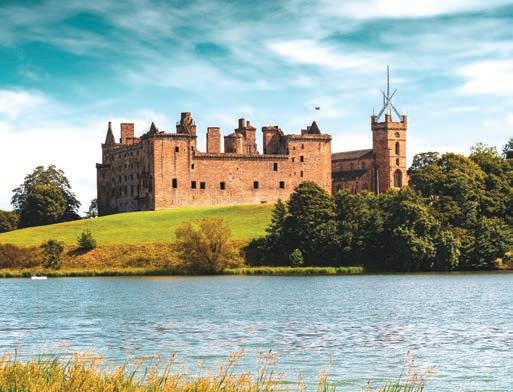
KAYE’S TOP SPOT
Linlithgow Palace is packed with plenty of vantage points that let you see its picture-perfect scenery from all angles. Don’t miss visiting Queen Margaret’s Bower, where you can enjoy stunning views over the peel and loch to the Forth bridges.
Jack Handscombe chats about his Stone Carving Craft Fellowship as part of Heritage Careers Week
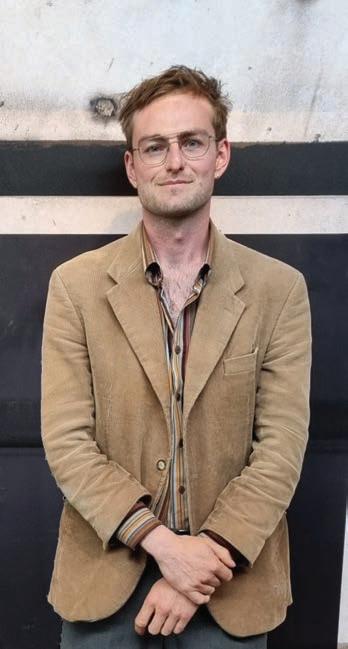
Our Craft Fellow programme helps craftspeople hone their traditional building and conservation skills, such as blacksmithing and thatching.
Mentored by expert stone carver Michelle de Bruin at Hutton Stone, Jack Handscombe’s fellowship in stone carving has seen him work with modern as well as traditional practices.
The 31-year-old gifted sculptor and stone carver has created carvings for Longniddry village, replaced carvings weathered by climate change and cut letters for memorials. Jack’s Craft Fellowship has been varied, and it’s a role he encourages people to get involved in.
“As a Craft Fellow and sculptor, it’s important to encourage the understanding and development of sculpture past mechanical replication,” he says.
“A creative dialogue with historic forms gives us knowledge of the artefacts and the work needed to care for them – allowing stone carving culture to be conserved.”
THANK YOU FOR MAKING YOUR MARK
Volunteer Development Officer, Joanna Todd, reflects on a very special celebration
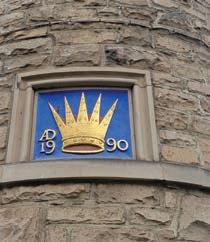
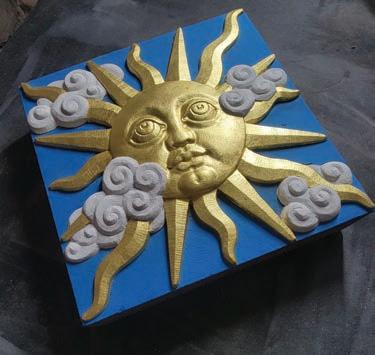
When talking about these historic artefacts, Jack names Doune Castle’s gargoyles among his favourite carvings.

the UK-wide 41st
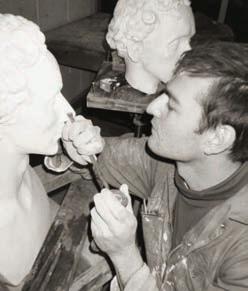
“Comprising two lions, a goat, a boar and a Mesoamerican-influenced anthropomorphic form, these grotesque sculptures have a surprising gentleness and solidity,” says Jack.
“Added during architect Andrew Kerr’s restoration in 1883, their abstracted modelling complements the castle’s austere architecture.”
Craft fellowships such as Jack’s, and our traineeships and apprenticeships, are spotlighted in the upcoming Heritage Careers Week. With events from 27 to 31 October, this initiative aims to attract those aged between 12 and 25 to conservation careers. It will introduce people to traditional skills and the digital technologies that are vital to creating a greener and more energy-efficient heritage sector.
For more on traditional skills training go to hes.scot/craft-fellow
We recognised the amazing efforts of all the people who help us do what we do during the UK-wide 41st Volunteers’ Week between 2 and 8 June.
To celebrate, we hosted a series of events to bring together our volunteers with those from other heritage organisations through the Make Your Mark campaign.
a series of events volunteers with those from other Make
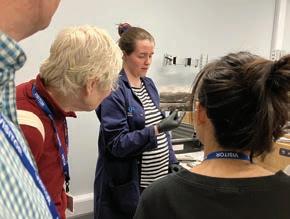
As well as digital events, we hosted our volunteers and those from the National Galleries of Scotland at the National Collection of Aerial Photography, where experts explained how they conserve and digitise images and films. And our team at Huntly Castle welcomed volunteers from the National Trust for Scotland when they hosted a meet-up and tour with our own volunteers.
Conservation Ranger Matt McCabe capped the week off with a guided walk around Holyrood Park, sharing stories about the area’s wildlife, geology and social history.
Thank you to all the people who help us to protect, conserve and connect visitors to our historic environment.
Find out about the latest volunteering opportunities at hes.scot/volunteer
Gillian Bell, Estates Compliance Officer, went behind-the-scenes at Melrose Abbey for some high-level inspection work

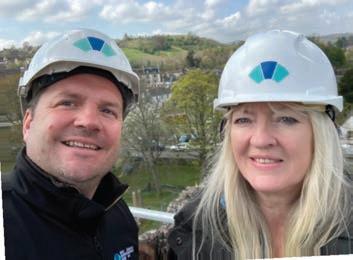
This April, I spent a
his April, I spent a fascinating day shadowing my colleague Joe Pegg, Assistant Works Manager, on his weekly checks at Melrose Abbey.
Joe works as part of a team based in the Scottish Borders, who conduct these weekly inspections of the fabric of our historic sites.
Climate change, in combination with other factors, is accelerating the deterioration of some of our buildings, and our high-level inspections allow us to assess the fabric, including stonework, at these sites within our care.
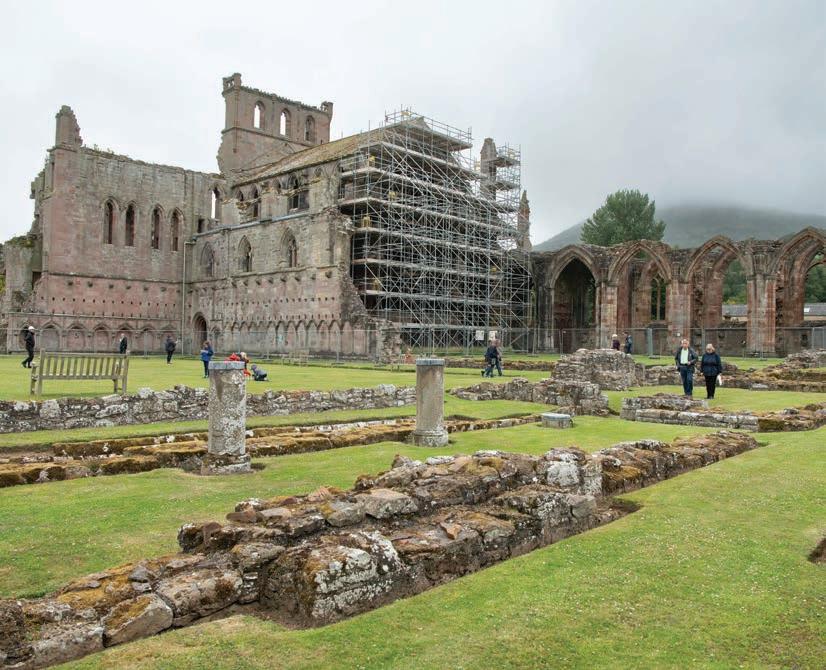
Visiting a site with scaffolding can scupper your hopes of snapping that perfect shot for social media. However, climbing eight floors of scaffolding to perform these important safety checks clearly illustrated the challenges my colleagues face in keeping Scotland’s built heritage safe while conserving it for future generations.
It was also great taking in unique vantage points of the abbey from the scaffolding itself. My job is mainly desk-based, so getting to experience our properties in someone else’s shoes – or in this case, steel toe cap boots – is so important because it helps me make more informed decisions on processes that could affect other employees’ roles.
Read about conservation work happening at our sites hes.scot/conservation-works

These glasses were used to offset the glare of Bonawe Historic Iron Furnace
The tinted lenses of these hornrimmed glasses – a style popular in Victorian times – would have provided workers with protection against the bright flames of Bonawe Historic Iron Furnace.
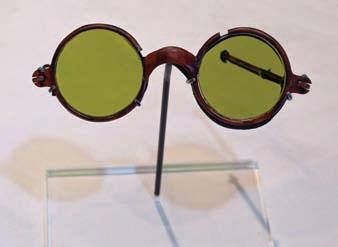
Look back to the past
Bonawe was Scotland’s longestrunning charcoal-fired blast furnace, which was in use for more than 120 years, from 1753 to 1876.
At its peak, the furnace employed more than 600 workers, and it operated around the clock, seven days a week.
It was a harsh working environment, but Bonawe’s community was a focal point for social activity. Objects such as these glasses provide an insight into everyday life here.
Head to trove.scot to find more objects with stories to tell
Discover a tale of two castles and a perfect place for autumn rambles
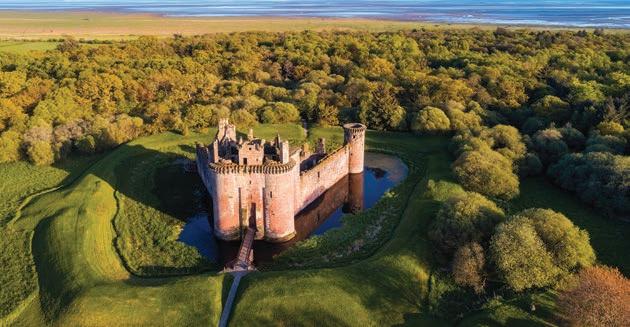
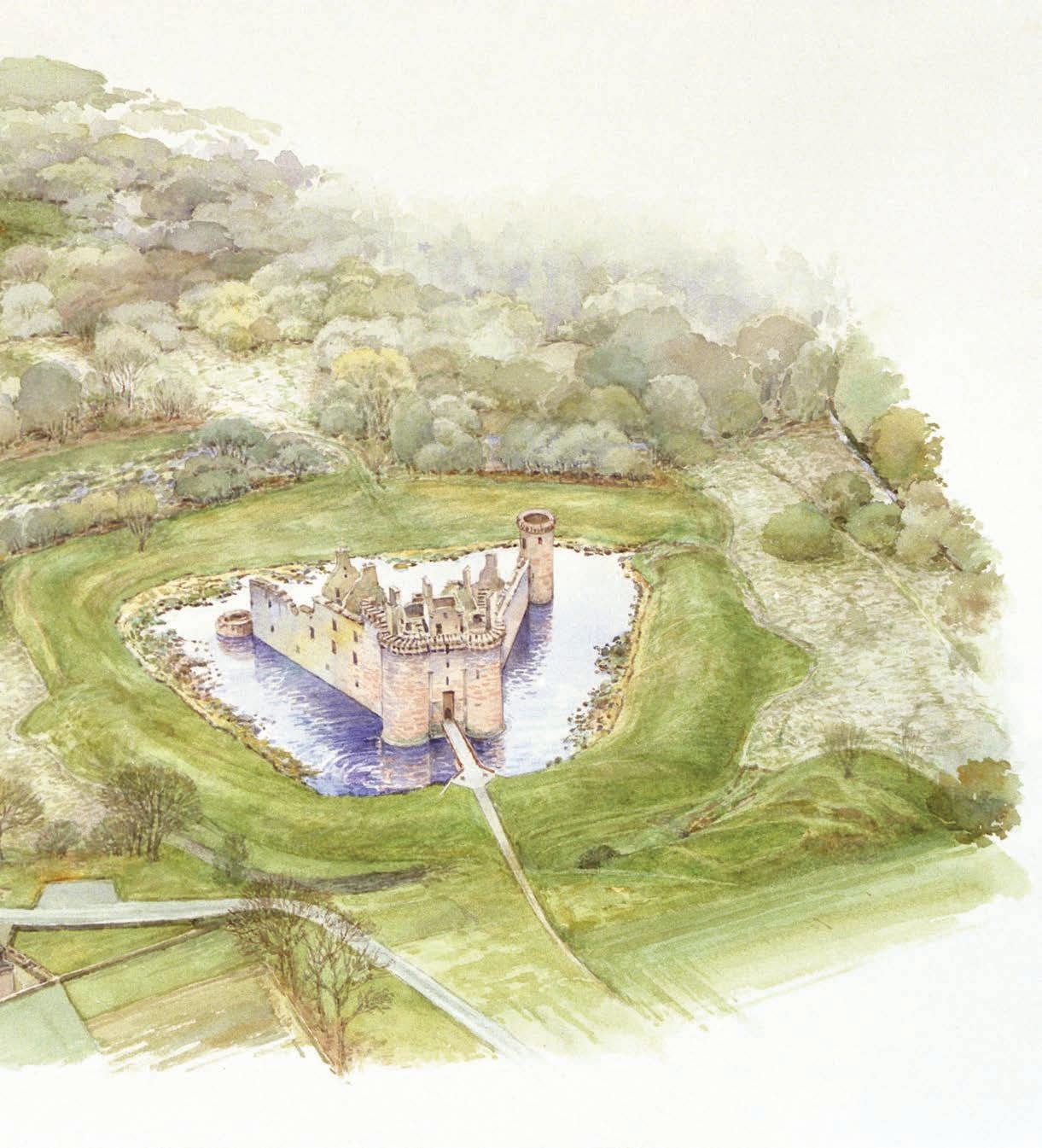
The enchanting medieval castle of Caerlaverock in Dumfries and Galloway, close to the Solway Firth and Scotland’s border with England, was once home to the powerful Maxwell family.
The unique triangular-shaped stronghold and its surrounding moat, built to repel attackers from all sides, played a part during the two Wars of Independence. Yet Caerlaverock’s story begins much earlier.
In the 1990s, archaeologists excavated remains of an older castle, thought to have been built around the 1220s. This earlier stronghold was moated too, and included a timber-built hall and other structures. Changes were wrought over the next 50 years, and a stone curtain wall with square towers at three corners was added along with a great hall. By the 1270s, the building of the ‘new’ castle was under way,

A triangular-shaped stronghold
providing a majestic seat for the Maxwell family, whose aristocratic status was in the ascendancy.
From the new castle, you can follow the road through the ancient woodland to reach the site of the old stronghold. Continue on into Caerlaverock National Nature Reserve and enjoy the view that opens up across the Solway Firth.
As summer ends and nights start to draw in, nature in the unique and picturesque surroundings of Caerlaverock Castle continues to thrive. Traversing boardwalks that take you over “Merse” – salt marsh that teems with life – you can see myriad species, including great flocks of overwintering barnacle geese, rare natterjack toads and an impressive diversity of waders and raptors, such as marsh harriers.
Some access restrictions are currently in place. Visit hes.scot/caerlaverock-castle for the latest information.
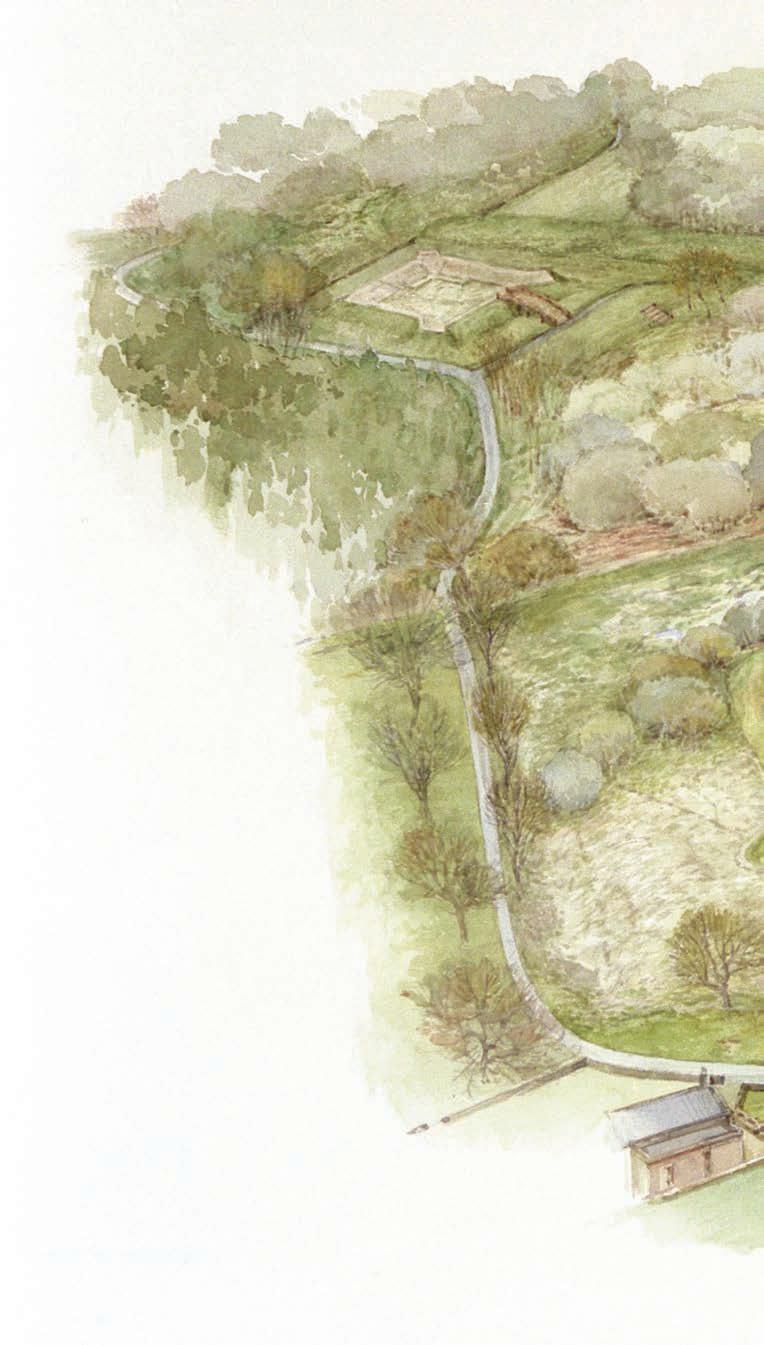


C.1150s
‘Karlaueroc’ estate is held by Radulf, lord of Nithsdale. By the 1170s, the lands may be in royal hands, given the proximity to the new royal burgh of Dumfries.
The original castle is built here, possibly for John de Maxwell and his family, a royal officer who served as chamberlain to Alexander II.
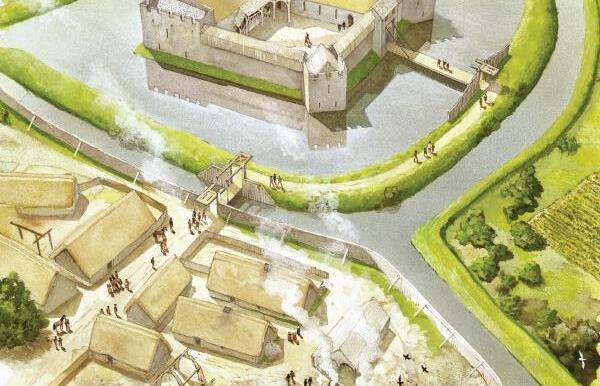
With a changing climate bringing more storms, John de Maxwell’s son Herbert is thought to have made the decision to abandon the old castle and build a new stronghold.
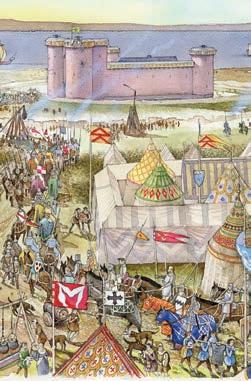
During the Wars of Independence, Edward I of England’s forces deploy siege engines and capture the castle in under two days.

1MOAT AND GATEHOUSE
A wide water-filled moat augments the defences provided by the tall curtain walls and a formidable gatehouse, which is the only structure sitting directly on natural bedrock.

2MURDOCH’S TOWER
The more complete of the two towers at either end of the south range, Murdoch’s Tower may have once held a pit prison. Neither tower had a fireplace, pointing to its use for military purposes.
3THE COURTYARD
The heart of the castle had timber buildings serving various functions that were gradually replaced by stone structures for comfort and a display of wealth.
4THE NITHSDALE LODGING
Completed in 1634 for the first earl and countess of Nithsdale, the lodging featured spacious and well-lit public rooms, fine views and an elaborately carved façade.
1544
English forces take Caerlaverock – the earl of Arran takes it back a year later. The east tower of the gatehouse is possibly rebuilt after this siege.
6 VISITOR CENTRE
Here display panels chart the history of Caerlaverock Castle, making the centre the ideal starting point for a visit.
7CAERLAVEROCK NATIONAL NATURE RESERVE
The castle grounds are adjacent to an area of outstanding biodiversity, recognised as a National Nature Reserve.
5ANCIENT WOODLAND
Today, a path wends through semi-natural ancient woodland, which contributes to the 15 habitats in the castle grounds that support many rare plants and animals.
1593
Robert, eighth Lord Maxwell, adds “great fortifications” to enhance defences. The date ‘1595’ is later carved into the gatehouse.
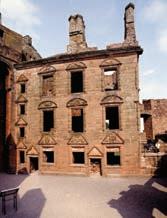
1634
Robert Maxwell, elevated to first Earl of Nithsdale, and Countess Elizabeth Beaumont oversee the building of the Renaissance-style Nithsdale Lodging.
8THE OLD CASTLE
The original timberbuilt castle was replaced by a stone-built structure, which included a Great Hall and two-storey towers for accommodation and defence.
1640
The first earl resists a Covenanting army for 13 weeks before surrendering. The Covenanters’ cannons destroy the castle’s defences, leaving it in ruins.
As The Traitors returns to our screens, casting Scotland as the dark heart of betrayal and deceit, Rosemary Goring shares eight gripping stories of treachery and also heroism – when even your own kin could not be assumed to be Faithfuls.
WORDS: ROSEMARY GORING
IN THIS FEATURE
Dunstaffnage
Castle
Doune
Castle
Stirling
Castle
Earl’s Bu at Orphir

Dirleton
Castle
Holyrood
Park
Edinburgh
Castle

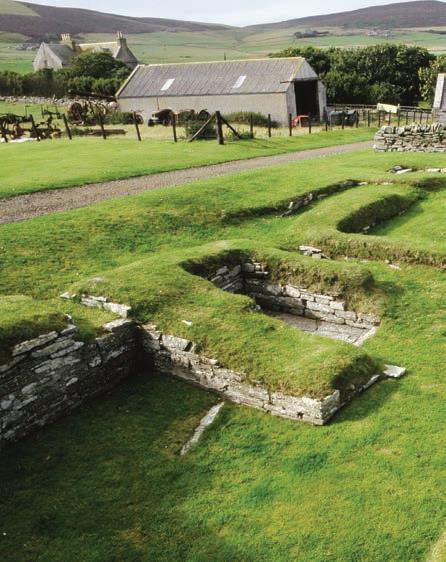
The remnants of Earl’s Bu, where
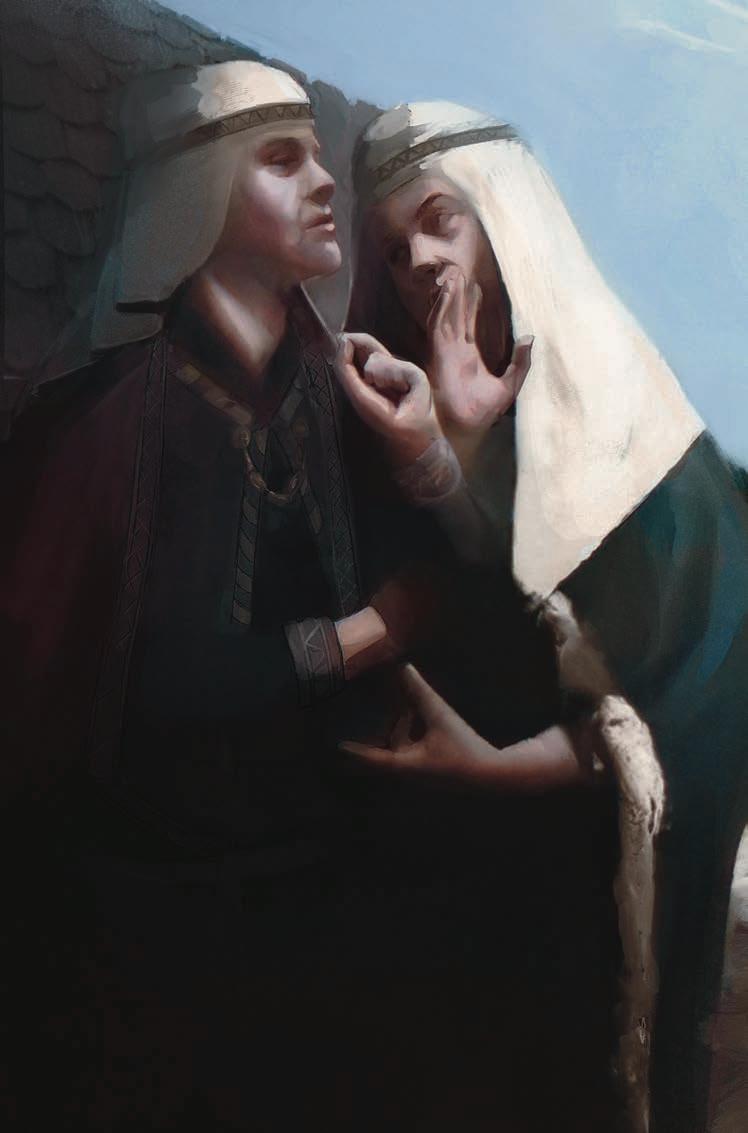
1The murder of Harald Haakonsson, Earl of Orkney, by his mother Helga and her sister Frakkok, is all the more shocking for being accidental. Harald ruled the Orkney Islands jointly with his brother Paul and, c.1128, they planned a lavish Christmas celebration at the Earl’s Bu (residence) at Orphir, where there was a great drinking hall.
The Orkneyinga saga vividly relates that Harald found his mother and aunt stitching a beautiful white linen
garment decorated with gold thread. When told it was for his brother he was enraged and, despite the women’s entreaties, put it on: “but as soon as it touched his sides a shiver went through his body, which was soon followed by great pain, so that he had to take to his bed; and he was not long in bed until he died.”
Paul, whom the saga describes as “taciturn” but also as gentle and generous, realised he had been the intended victim. Showing remarkable forbearance, he banished Helga and Frakkok from the islands.
Dunstaffnage Castle
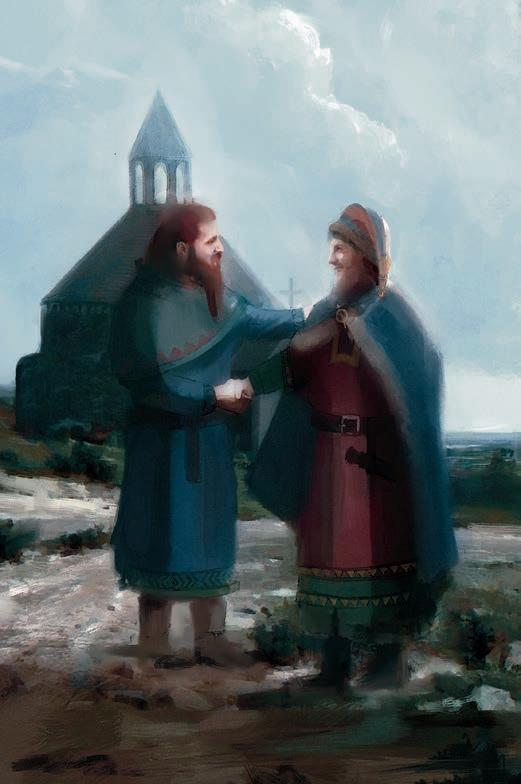
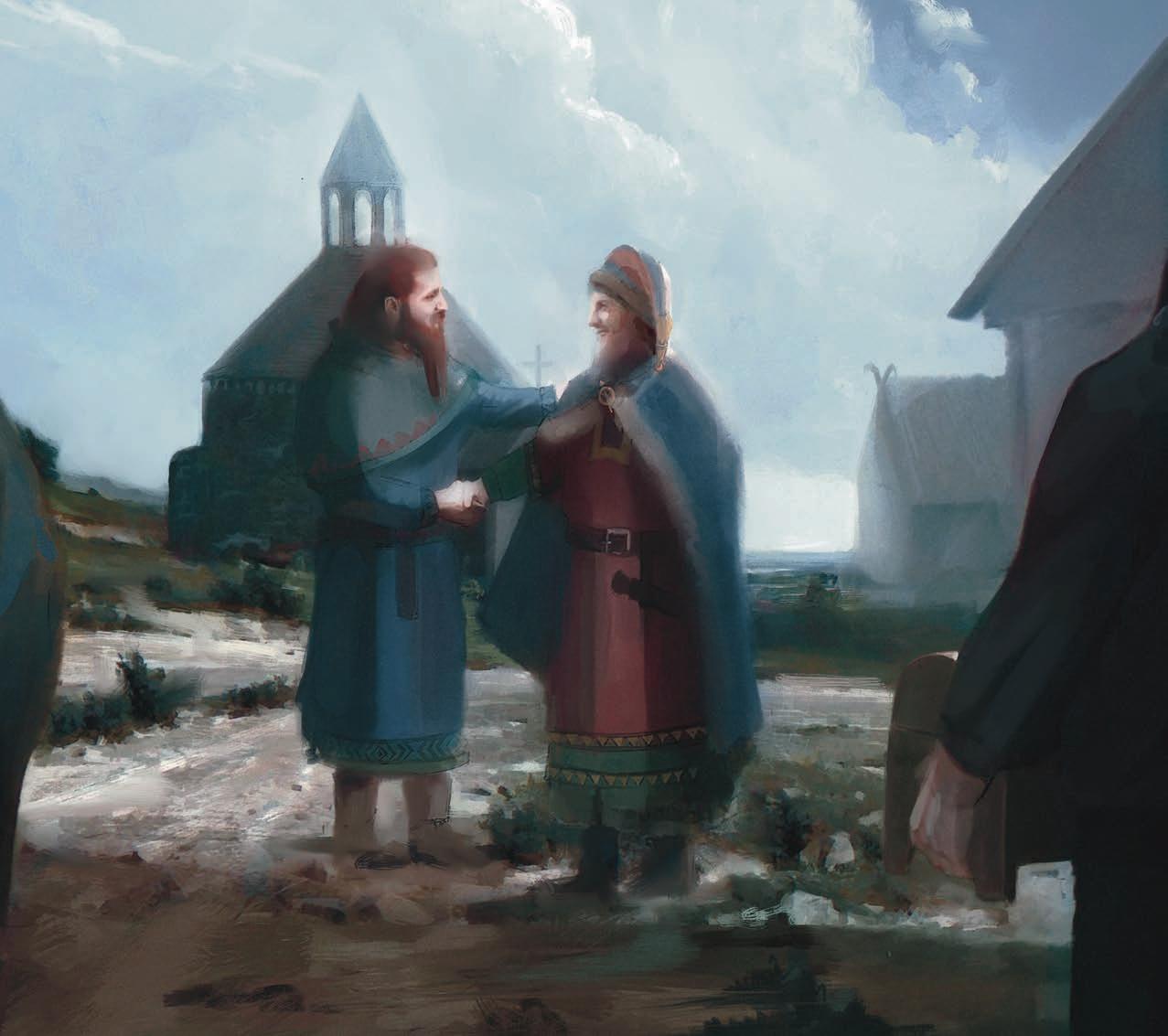
In 1463, on the wedding day of old John Stewart of Lorn, known as ‘Leper John’, pipes were skirling and banners flying as his bride-to-be approached Dunstaffnage Castle. Yet this was not a romantic occasion. John Stewart was marrying a daughter of the MacLaren lord of Ardveich, the mother of his adult son Dougall, in order to legitimise him as his heir.
For many years, power in this strategically important part of the country had been ferociously contested. As Stewart made his way from the castle to the chapel, one of his rivals, Alan MacDougall (or MacCoul), fatally stabbed him.
According to the family history, The Stewarts of Appin, despite being close to death the old lord “ground through the marriage ceremony in order to secure the lordship for his son”.
MacDougall then seized the castle but was forced out by James III, who gave the lordship to Colin Campbell, Earl of Argyll. Although Dougall Stewart retreated to Appin, he avenged his father’s murder at the Battle of Stalc in 1468, where MacDougall was killed.
For current access restrictions, please check historyawaits.scot

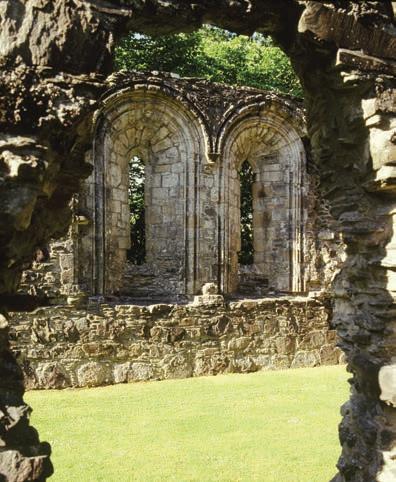
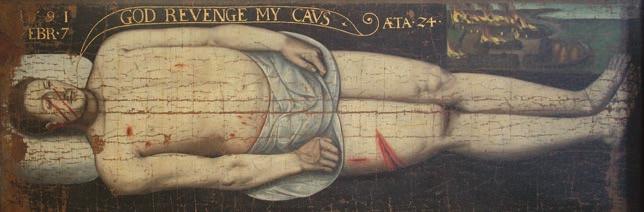
3A remarkable ‘vendetta portrait’ from February 1592 of young James Stewart, Lord Doune and Earl of Moray, shows his mutilated corpse after being slain by George Gordon, 6th Earl of Huntly, and his men. A blood feud between the earldoms of Huntly and Moray had grown increasingly embittered during the reign of James VI, who greatly favoured Huntly. Angered by the strapping young man’s challenge to his authority, Huntly engineered a situation in which he lured Moray south to his mother’s house at Donibristle, near North Queensferry.
While Moray was there, possibly with not just his mother but also his sister and her family, an army of Huntly’s men descended. As battle ensued, Huntly’s men set fire to the house, forcing
everybody to flee. While one of Moray’s supporters acted as decoy, Moray made it unnoticed to the safety of the rocks by the shore. But, as one account has it, the burning plume of his helmet led his attackers to him in the dark.
As Moray lay dying, Huntly either slashed his face or dealt him the final blow. At this, writes Sir Walter Scott in Tales of a Grandfather, Moray “thinking of his superior beauty even in that moment of parting life stammered out the dying words, ‘You have spoiled a better face than your own.’”
Desperate for justice, Huntly’s mother, Lady Margaret Campbell, commissioned the death portrait of her handsome son. Huntly got off with only a week’s house arrest, but a mournful ballad, ‘The Bonnie Earl o’ Moray’, has ensured the young earl’s immortality to this day.
Dirleton Castle
Dorothea Stewart, Countess of Gowrie, was left heavily in debt when, in 1584, her husband William Ruthven, Earl of Gowrie, was executed for his part in kidnapping young James VI.
That plot became known as the Ruthven Raid, when the king was held
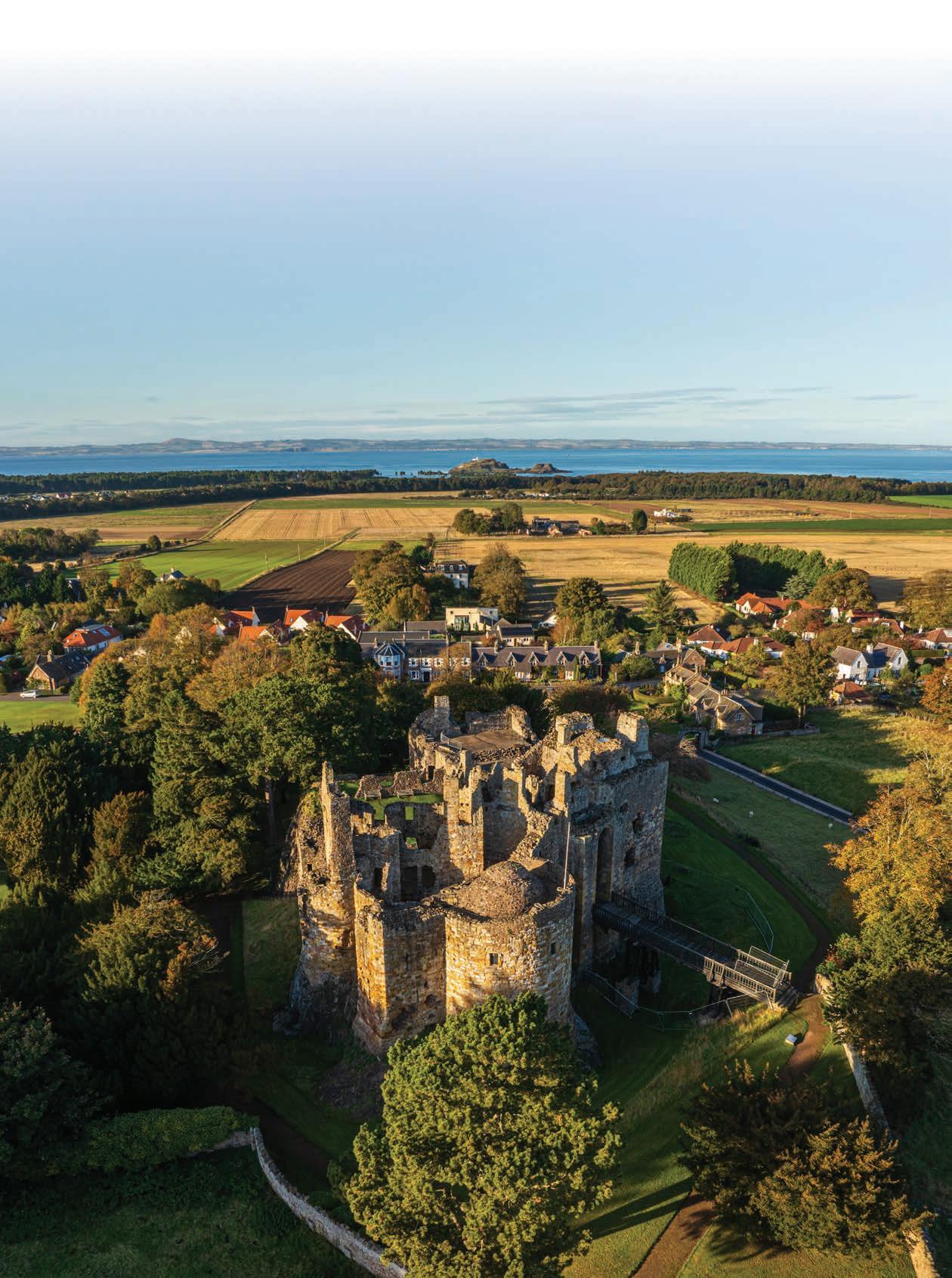
The Countess of Gowrie lost possession of Dirleton Castle due to her husband’s role in the kidnapping of James VI
for 10 months at Huntingtower Castle before managing to escape.
Dorothea had to surrender her main residence, Dirleton Castle, and several other properties. With 14 children and no means to support them, she was distraught. David Calderwood relates in Historie of the Kirk of Scotland (1625) that she attended the opening of Parliament in Edinburgh in August 1584 to petition the king for help.
As James and his lords walked down the High Street towards the Tolbooth,
“the Ladie Gowrie satt doun on her knees, crying to the king for grace to her and her poore barnes, who never had offended his Grace.” However, the Earl of Arran shoved her roughly aside, “and hurt her backe and her hand”.
Dorothea fainted and lay in the street until the procession reached the Tolbooth, at which point somebody took her into a house to recover.
Dorothea’s property was later restored to her and she remarried, living in Dirleton Castle until at least 1600.
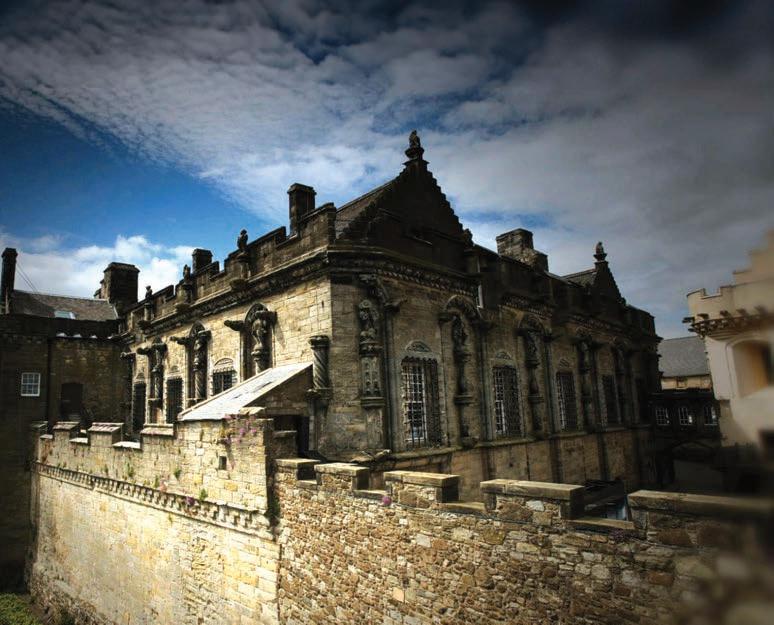
Stirling Castle
A rebel weapon on display in Stirling Castle, from the Radical Rising of 1820, suggests it was a much more vicious affair than it actually was. The greatest acts of violence were by the government, whose secret agents had infiltrated the radicals and incited them to armed rebellion.
The organisers of the last serious insurrection in the country had several clear aims, including universal suffrage for all working men and the repeal of the 1707 Act of Union.
Following a mass strike in the nation’s industrial heartlands, a small group of armed men, led by the weavers Andrew Hardie and John Baird, was on its way to attack the Carron Ironworks in Falkirk when government troops confronted them at Bonnymuir. A skirmish followed but the rebels were easily defeated and taken by cart to Stirling Castle.
After trials in Stirling and Ayr, 22 of those found guilty of high treason and condemned to be hanged, beheaded and quartered were instead transported for life. But three, including an elderly weaver called James Wilson, and Hardie and Baird, paid the full price for their actions.
On the day of execution, insisting they were martyrs for truth, justice and liberty, Hardie and Baird calmly addressed a crowd of around 2,000 gathered by the scaffold outside
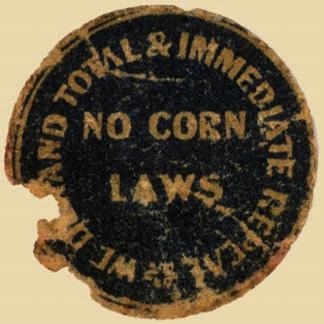
A rebel weapon brandished during the protests is on display at Stirling Castle; inset, Corn Laws contributed to unrest at the time
Stirling Jail. Hardie’s words were cautionary: “Please, after this is over, go quietly to your homes and read your Bibles, remembering the fate of Baird and Hardie.”
Afterwards, attempts were made on the lives of some of the witnesses against Baird and Hardy and unrest broke out again in industrial areas.
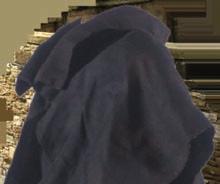
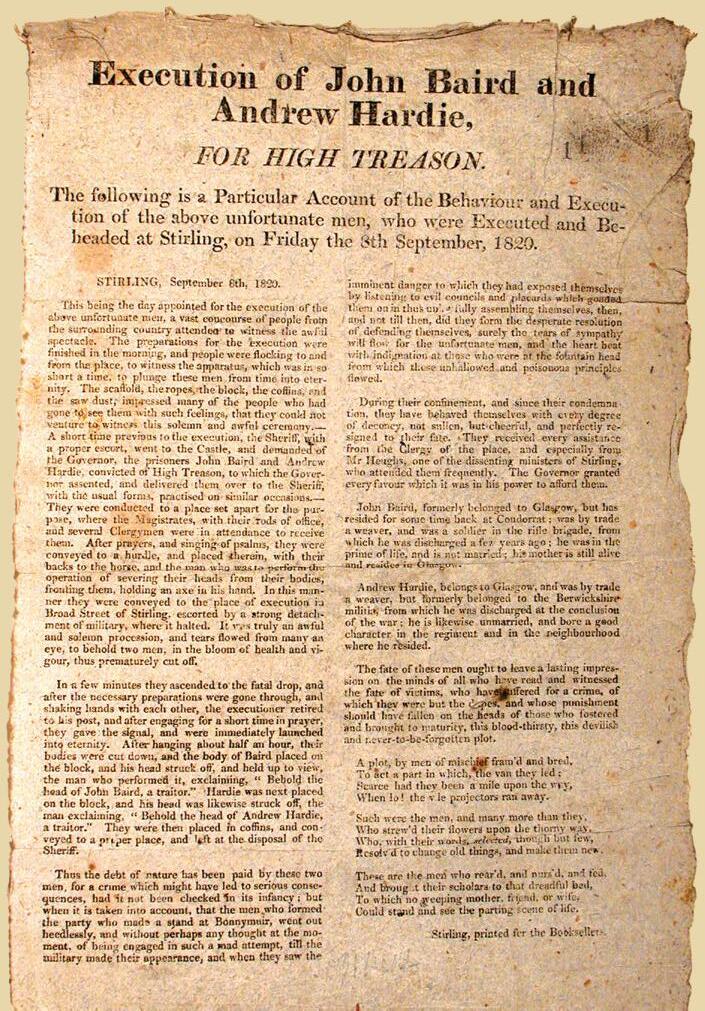

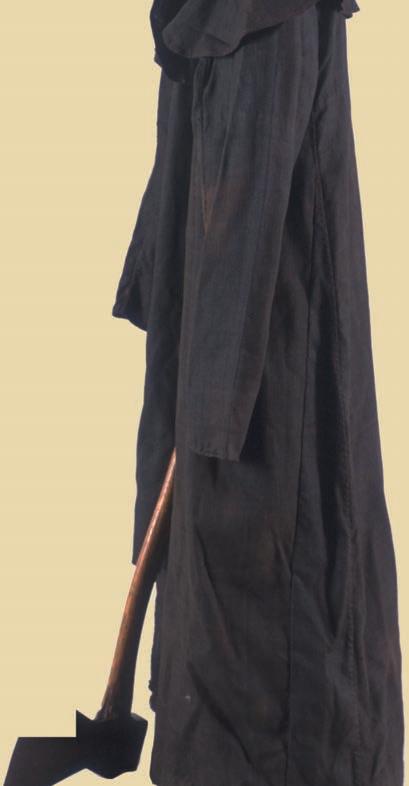

A handbill describing the execution of John Baird and Andrew Hardie, along with the cape and axe used by the executioner

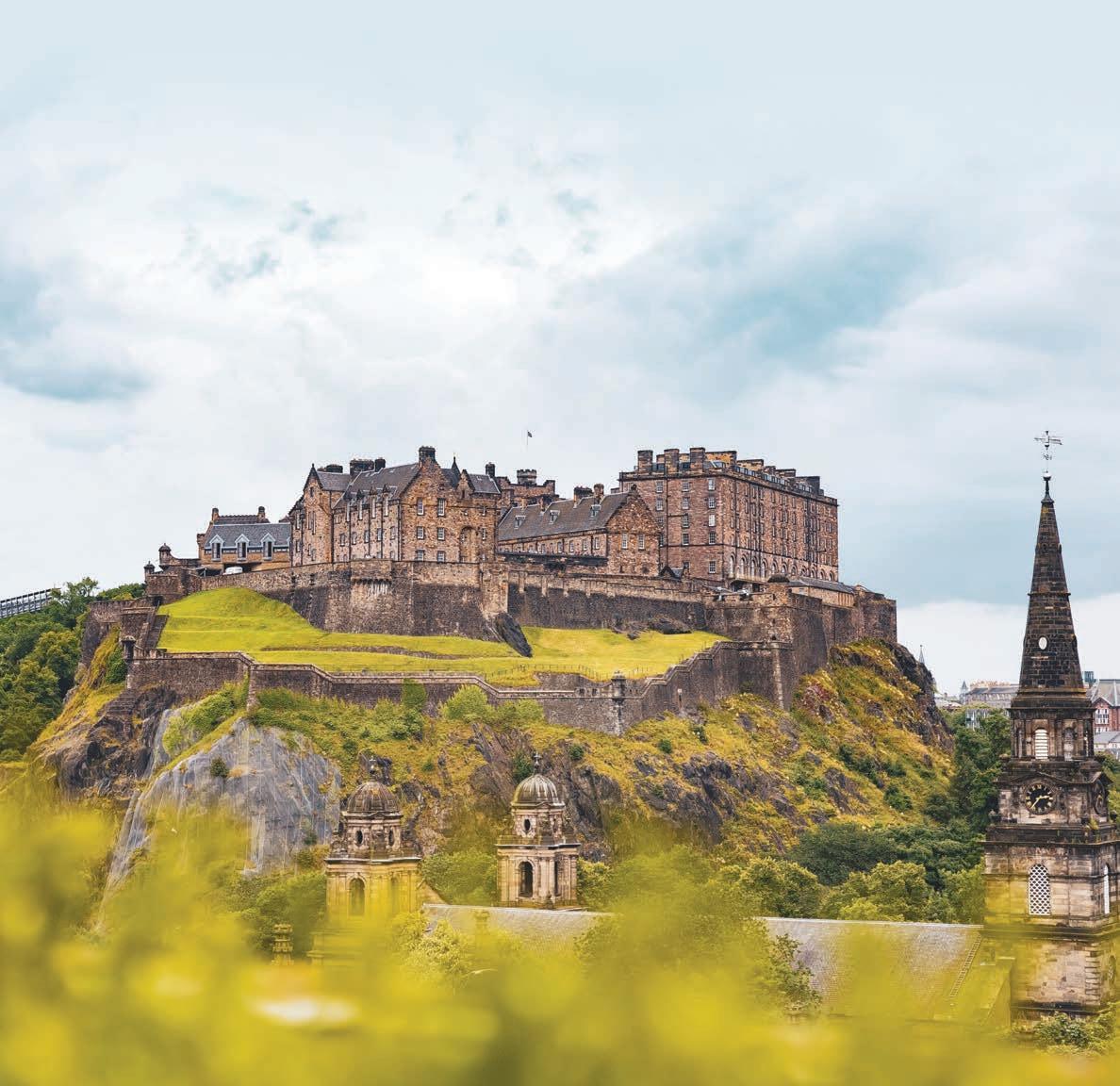
6Few tales down the ages involving Edinburgh Castle match the Black Dinner of 24 November 1440 for treachery. On that day, William, sixth Earl of Douglas, who was aged between 16 and 18, and his younger brother David were invited to dinner with 10-yearold James II. Also present were William Crichton, the chancellor, and Sir Alexander Livingston.
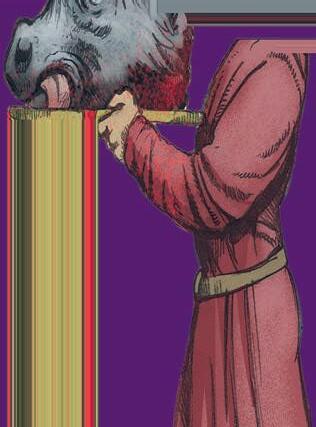
Later histories relate that the boys were served a black bull’s head, a sign that they had been condemned to death. It is said they were dragged from the hall to Castle Hill and summarily beheaded on the charge of treason.
Evidence points to the boys’ great-uncle, James the Gross, Earl of Avondale, being involved.
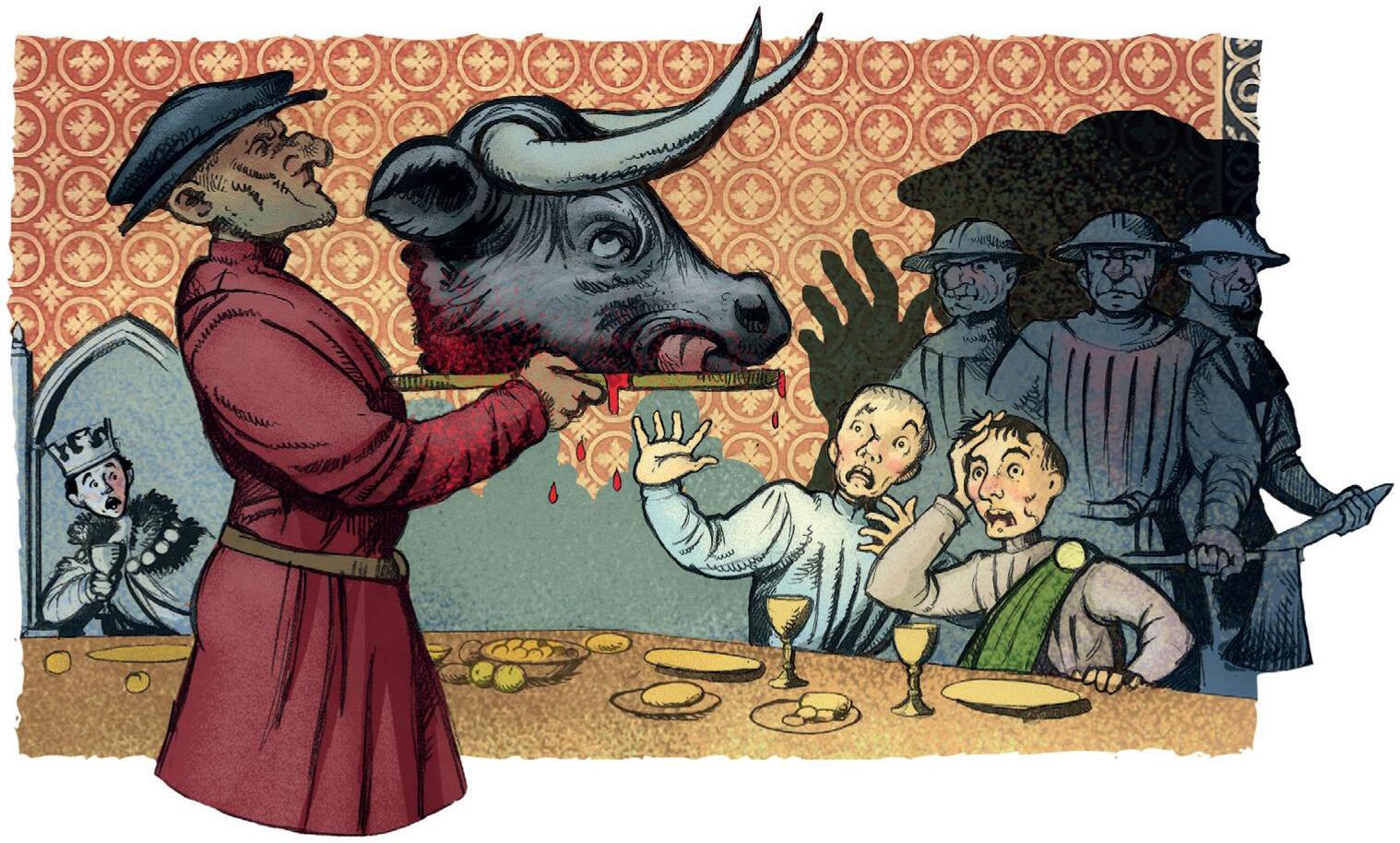
The story of the Black Dinner may have been exaggerated a little in the telling
The recent death of Earl William’s father Archibald, lieutenant general of Scotland, had destabilised the minority government around James II.
With the plans of Joan Beaufort, the queen mother, threatening those who sought to control government after James I’s assassination, and the youthful Earl William showing
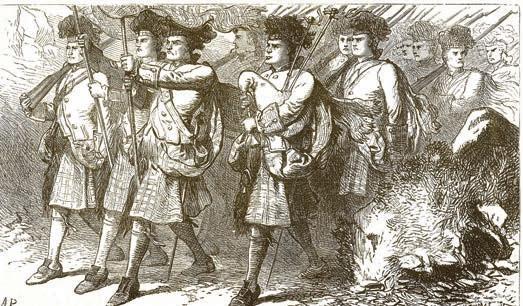
In late September 1778, Holyrood Park became the setting for a mass military mutiny. Around 600 soldiers from Lord Seaforth’s 78th Highlanders revolted when, prior to embarkation at the Port of Leith, nobody would tell them where they were heading.
The soldiers were already resentful that they had not received their enlistment pay, so when rumours spread that they were being sold to the East India Company, even though
alarming signs of independence, James the Gross is strongly implicated in his nephews’ murder, since he stood to benefit richly from it. As historian Christine McGladdery writes, on inheriting the title of Earl of Douglas, the boys’ great-uncle showed “no inclination for revenge” and instead “consolidated his newly elevated position”.
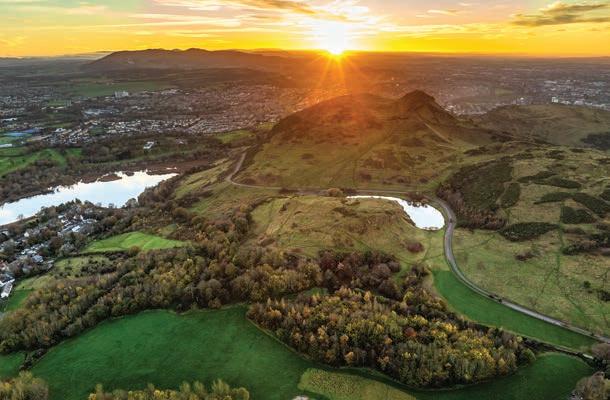
they had been recruited for home defence, they marched to Holyrood Park and camped out for three days and nights on Arthur’s Seat.
Sympathetic locals brought them bread and cheese, and as a letter from Edinburgh, published in Aris’s Birmingham Gazette, recorded, having drums and bagpipes helped the troops “keep up spirits with Music and Dancing, and animating exercises”. However, scuffles broke out between the mutineers and soldiers
sent to bring them to heel, with “a good many Wounds on both sides”.
Known as “the Affair of the Wild Macraes” because many of the soldiers were of that name, it was resolved when the soldiers returned to Leith on the assurance that they would be paid their arrears and guaranteed not to be taken to India.
Three years later, the regiment was indeed sent to India. For many, it was a one-way journey.
‘Themost dangerous maninBritain’
8In 1916 Edinburgh Castle was used to imprison five Red Clydesiders who were deemed a threat to social order and the First World War effort. Among them was Glasgow schoolteacher John Maclean.
Considered a hero by many ordinary Scots, he was named “the most dangerous man in Britain” by British military intelligence. Maclean had for many years taught Marxist economics to the working classes. He was also a vocal opponent of the war, believing it made no sense for the workers of Europe to be killing each other.
Parliament extended the Defence of the Realm Act to include such anti-war rhetoric, and Maclean was arrested at a Glasgow meeting in February 1916. Sent to Edinburgh Castle as a prisoner of war to await trial, he wrote to his wife Agnes:
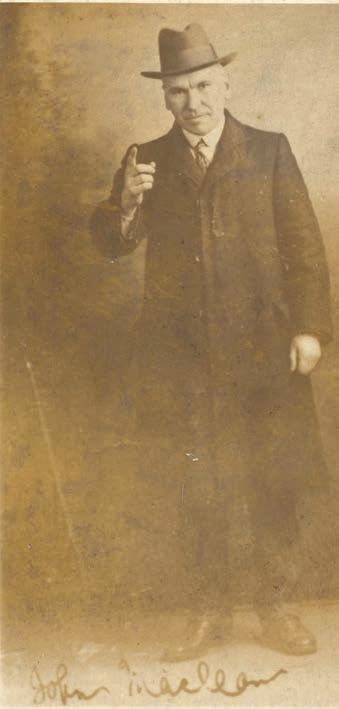
John Maclean was one of the main figures in the Red Clydeside movement
“I have been well treated so far, so need not feel anxious.”
Maclean, whose younger daughter Nan Milton later wrote his biography, was sentenced to three years’ hard labour at Peterhead Prison. When his health deteriorated, he was moved to the hospital at Perth Prison. Public outcry secured his early release in June 1917, but he was back in prison the following year for sedition.
Nan described her mother’s regret that he lost his job after his first prison term – he served five in all –and how she eventually left him.
“He exerted every ounce of himself to bring this socialist revolution about. He missed us all and he loved us. It was very heartbreaking for him, but he had to keep on.”
In 1923, a few months after reuniting with Agnes, John Maclean died suddenly, aged 44.
TRAITOROUS PAST
Plan your visits to our sites with dark tales to tell at historyawaits.scot





















































































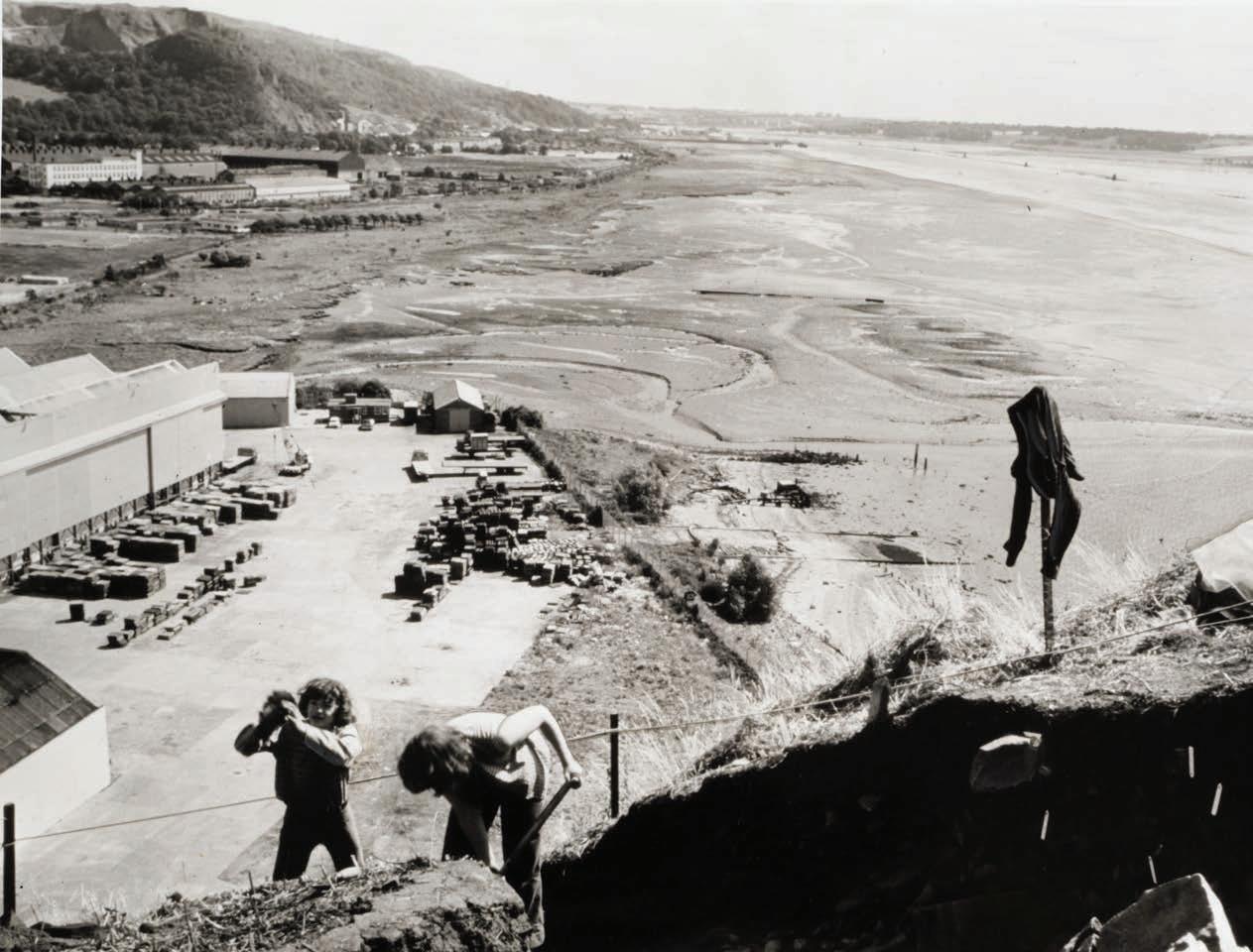
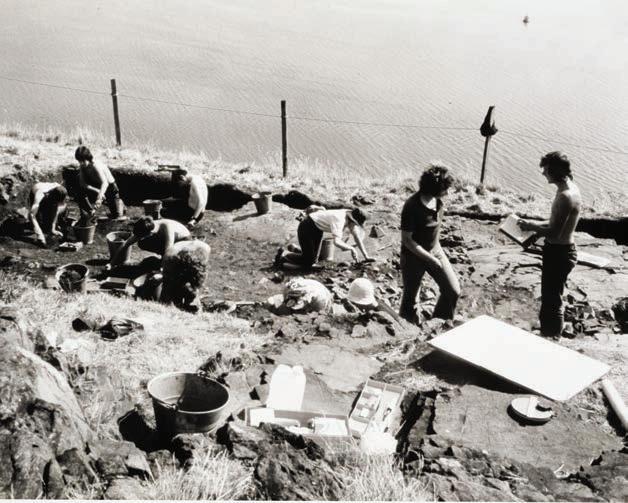
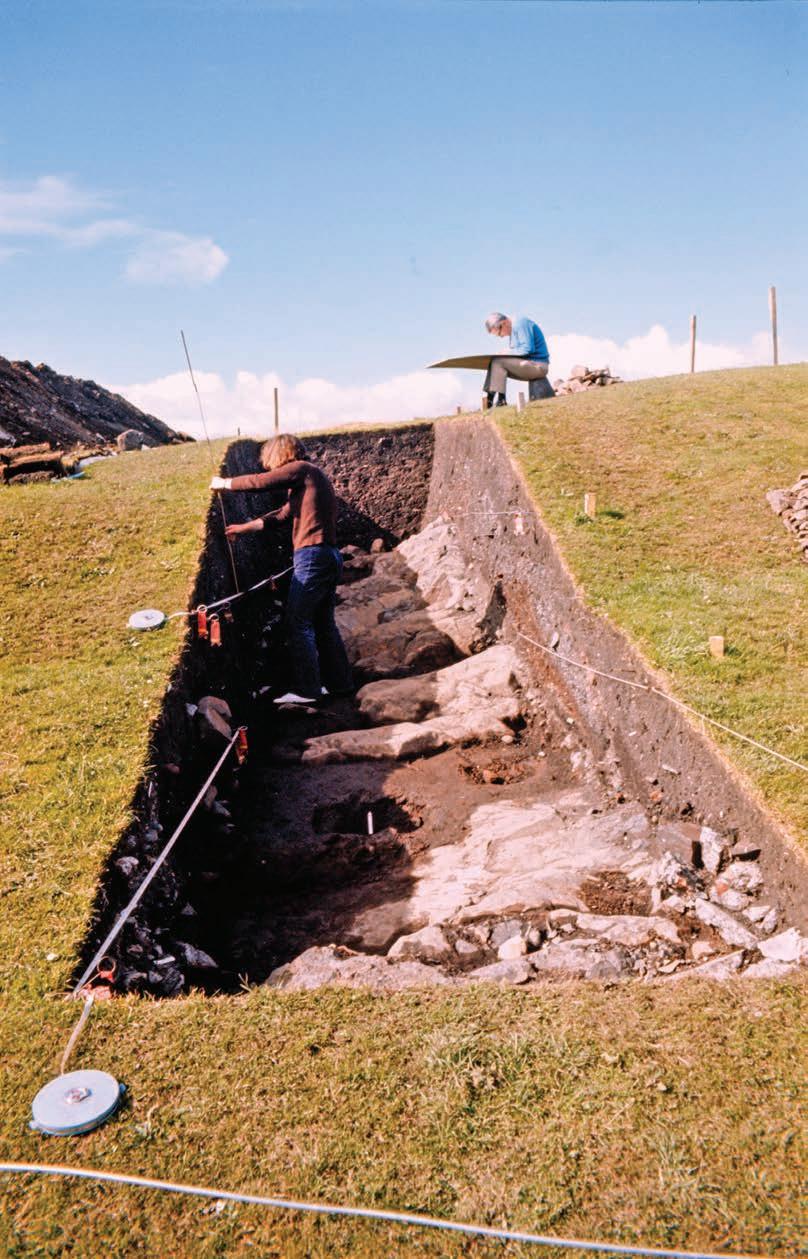
The daring story of a precarious 1970s archaeological dig in search of an ancient fortress, which yielded objects now on display at Dumbarton Castle for the first time
WORDS: ALASDAIR CAMPBELL, INTERPRETATION LEAD, ROCK OF AGES EXHIBITION
In 1973 archaeologists Leslie and Elizabeth Alcock planned an audacious archaeological dig at Dumbarton Castle. The couple had already been on many adventures together after first meeting on a climbing holiday on the Isle of Skye, and they were about to add another to the list.
When the Alcocks moved to Glasgow and Leslie took on the job as chair of the new archaeology department at the University of
Glasgow, they were keen to investigate a number of fortifications in Scotland mentioned in historical documents. These included the castles of Fast, Dunollie, Urquhart and Dundurn. They considered Dumbarton Castle to be the easiest to start with.
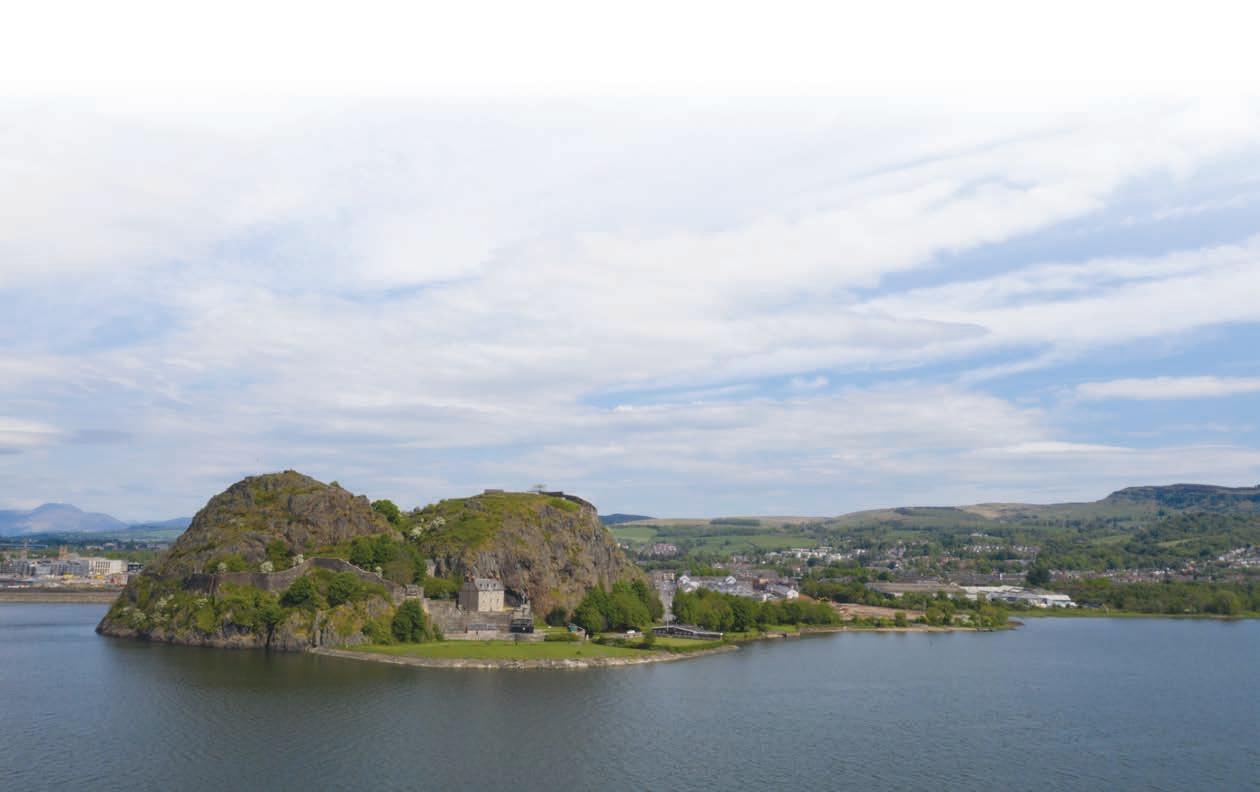
The rock on which the castle is built was once a volcano that erupted 350 million years ago. Its human history spans more than 2,000 years, including a prehistoric fort, an early medieval settlement, a royal castle dating from
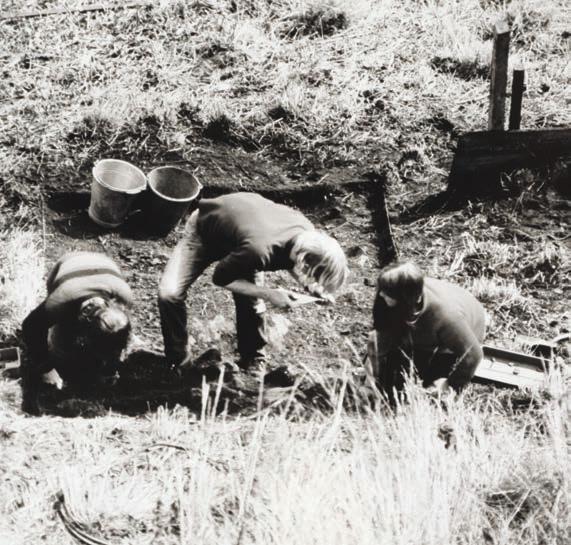
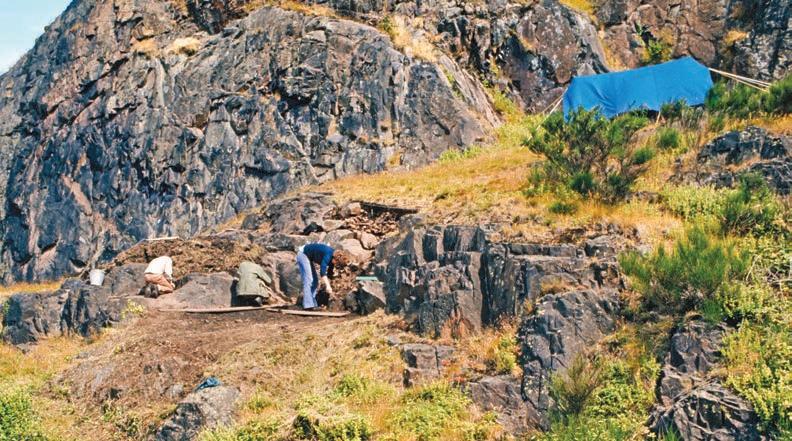
On these pages you can see images of the Alcock team’s dig at Dumbarton Castle in the summer of 1974, in some cases close to the edge of the Rock
with its links to Camelot and the legend of King Arthur. Elizabeth was originally from Dunbartonshire, while the dig cemented a lifelong connection to the west of Scotland for Leslie too, who hailed from Manchester.
At Dumbarton Castle, they were searching for the legendary fortress of the kings of Strathclyde, referred to as early as the mid-400s AD when St Patrick wrote a letter to King Ceretic of Strathclyde. The fortress is again recorded in the early 700s AD by the chronicler Bede, who called it Alcluith – ‘Rock of the Clyde’ – and described it as “a strongly defended centre of the Britons”. The planned excavations sought evidence to support these historical claims.
the 1200s, an 18th-century garrisoned fortification and, in more recent times, a Second World War anti-aircraft battery.
This summer a new, permanent exhibition, ‘Rock of Ages’, opened at the castle, charting this history and featuring some of the 300 or so objects recovered during the Alcocks’ dig.
Leslie and Elizabeth specialised in the early medieval era. Leslie had already captured the public’s imagination with his 1960s’ excavations of a hillfort at Cadbury in Somerset,
Steve Driscoll, an American who moved to Scotland in 1982 to study under Leslie, recalls fondly the ‘family’ style of digs run by the Alcocks. He says: “The teams were small, just one minibus of students with the occasional post grad student or other experienced grown up acting as supervisors, as there were few professional archaeologists in Scotland at the time.
“We stayed in self-catering accommodation and were looked after by Elizabeth. There was always a cooked breakfast. We stayed off the beaten path, so trips to the pub involved a minibus and I was one of the designated drivers.”
As Leslie and Elizabeth noted afterwards: “When [we] first visited the site with critical eyes it was immediately obvious”. They meant that they believed the traces of the early medieval fortress could be seen on the Beak, the lower of the two summits on Dumbarton Rock.
So, in the summer of 1974, Leslie, Elizabeth and the students began their excavations on the Rock. They had marked out three trenches to begin digging. Here, they encountered medieval and later remains along with various artefacts, but no ancient fortress.
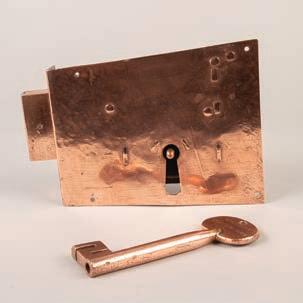
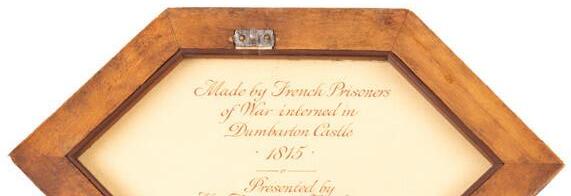
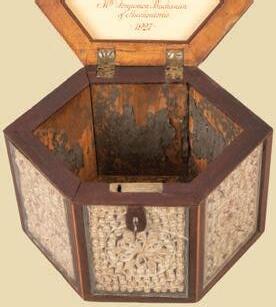
A layer of mason’s chips clearly came from the construction of the Georgian-era gunpowder magazine on top of the Beak. Gunpowder was needed to supply cannons installed on the Rock during the Napoleonic Wars, anticipating a French attack down the Clyde that never came. The magazine survives and its key and lock box can be seen in the new exhibition, along with a wooden jewellery box probably made by French prisoners of war.
A number of metal objects recovered turned out to be coins, with one being a billon hardhead from the reign of James VI. Other coins included copper ‘Stirling’ turners (two-penny pieces) of Charles I, issued between 1632 and 1639.
The Alcocks recorded in their excavation report that a sharp slope on the west side of the Beak may have been part of the early medieval
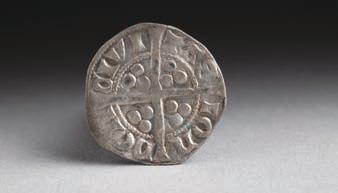
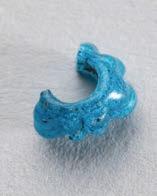
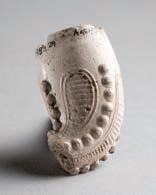
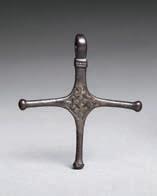
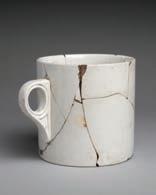
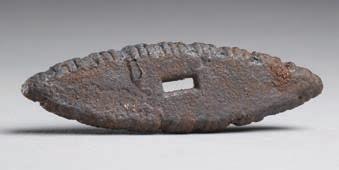
1. Silver penny, c1300
2. Glass bead, AD 500-700
3. Decorative pipe bowl, c.1800
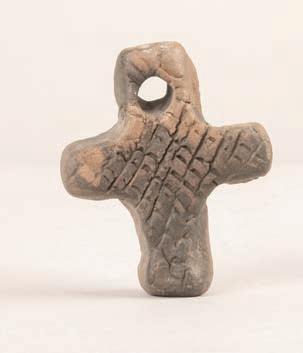
4. Cross pendant, c.1200
5. Ministry of Defence mug, 1940
6. Viking sword pommel, AD 800-900
settlement. However, some rubble unearthed at the bottom of the slope contained green glazed pottery, likely from a 1500s French wine jug. Records show there was a thriving wine trade during the medieval era with the ports of La Rochelle and Bordeaux, and ships registered at the castle.
It became clear to the Alcocks that any remains of the early fortress were likely obliterated by the construction and subsequent demolition of the medieval castle and Georgian defences.
The gun turret installed during the Second World War to defend the Clyde’s shipyards, as well as the four bombs dropped on the Rock by German aircraft in 1941, made things even more difficult.
The archaeologists needed to find an area of the Rock that was suitable for occupation but lay outside this busy area of the medieval castle walls and the Georgian cannon batteries. It was going to be very challenging as the surviving walls are mostly built around the steepest and craggiest edges of the Rock, and it is likely that the ancient fortress would have followed a similar footprint.
Since the 1960s, the Rock, known to climbers as ‘Dumby’, has been at the forefront of Scottish rock climbing. The Rock’s intimidating cliffs tower above the dark waters of the Clyde and offer challenging routes, while huge lumps of basalt at the base of the Rock are renowned for bouldering.
Since the 1960s the Rock – known to climbers as ‘Dumby’ –has been at the forefront of Scottish rock climbing

You

Leslie Alcock explained that the “somewhat adventurous reconnaissance of the eastern spur of the Beak did reveal two ledges, or at least easements, in the otherwise steep slope, which might have been suitable for human occupation.”
As Steve recalls: “Hillforts probably attracted Leslie because he had a strong interest in mountaineering, fostered perhaps when he did his national service in Pakistan during the Second World War. In any case, he was certainly not fearful of heights. I don’t know how they dug the trench on the east side of Dumbarton Rock but I hope they were roped in!”
Crucible clue
So, it was in two highly precipitous trenches almost hanging over the industrial yards of Dumbarton’s waterfront that the Alcock team had success. They found fragments of thinwalled crucibles, providing evidence for metalworking dating to AD 600-800. Skilled artisans of Alt Clut, the settlement’s name in Old Welsh (its early medieval inhabitants spoke Brythonic), would have melted down precious metals in these crucible pots, ready to pour into jewellery moulds.
The fragments, which can be seen in the exhibition, still bear traces of gold and silver. At that time, gold was only
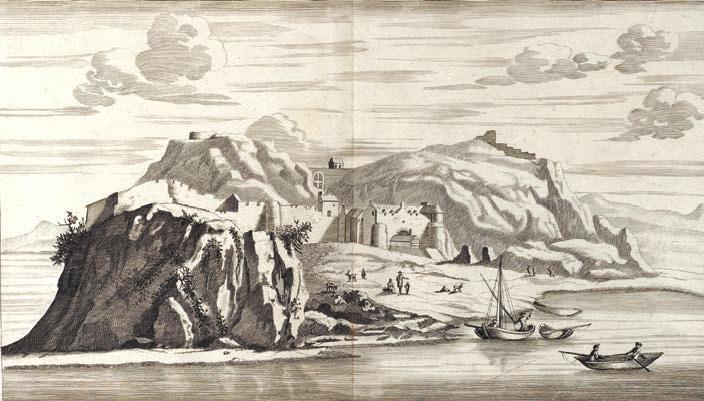
Above: c.1718 engraving of Dumbarton Rock
Left: Lock and key for the gunpowder magazine
permitted to be used at royal sites, so this provided strong evidence for the kings of Strathclyde’s fortress. The Alcocks theorised that the ledges were an industrial metalworking area separate from the high-status settlement that was likely located on the Beak’s summit.
Traces were also found of a timberand-rubble rampart, the first solid evidence of a structure from the ancient fortress, which may have defended Alt Clut from potential ingress from the landward side. Remains showed evidence of being burned, suggesting the rampart could have been destroyed during a four-month siege of Alt Clut in AD 870, led by Olaf ‘the White’ and Ivar ‘the Boneless’, the joint Viking rulers of Dublin.
When the fortress finally fell, it was said that 200 longships carried captives and plunderback to Ireland. The archaeologists also found part of a Vikingstyle sword handle, either from the siege
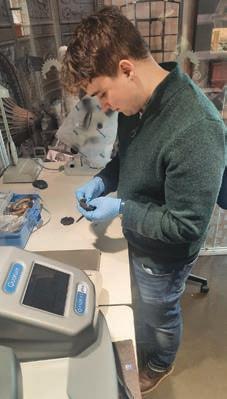
Preparing for SEM analysis of the cross
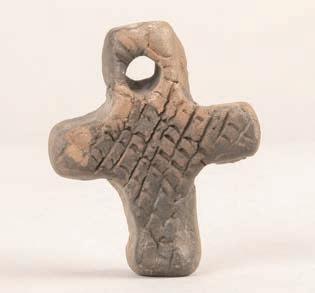
A tiny cross now on display in the new Rock of Ages exhibition has recently been analysed by our Heritage Science Team.
The 5.5cm by 4cm object was found during routine works at Dumbarton Castle in 1995, and at first was assumed to be early medieval in origin.
The team’s initial microscopic analysis showed the cross had a black surface – possibly a glaze –and some white crystals on the back. X-ray Fluorescence (pXRF) then confirmed it was made from ceramic material.
The team then used a Scanning Electron Microscope (SEM), which provides very high magnification. This revealed a lot of surface carbon, supporting a theory that the cross had been given a light firing. The white crystals on the back turned out to be mainly titanium dioxide – a pigment used in white paint and first patented in the early 1800s. Did this rule out an early medieval date? Not necessarily. The cross might have been found, painted and reburied, or the white compound may in fact come from soil pollution, such as smokescreens used during the Second World War.
Our team’s work has deepened our understanding, but we don’t yet know who made the cross or why. Its story is far from told.
or forged by a local blacksmith inspired by Viking designs. Glass decoration from a bangle worn by a resident of Alt Clut – later inset into a lead weight, a common Viking practice – was also discovered.
One of the most significant finds made during the 1970s dig is the collection of pottery, considered the northernmost example in Britain –and perhaps Europe – of imported sixth-century Mediterranean amphorae. Pottery fragments on display come from vessels for wine and perhaps olive oil, showcasing how well-connected Alt Clut was to Europe. Fragments of wine glasses certainly suggest the elite of Alt Clut dined well. Glass beads worn as jewellery by both the men and women of Alt Clut, along with counters from ancient board games, give further insight into life on the Rock. These

objects can all be found in the new displays at Dumbarton Castle.
The Alcocks’ excavations on the Rock not only confirmed the existence of the ancient fortress but also provided insight into the experiences of the many different peoples and cultures who lived, fought and died there.
The cliffside trenches contained material, for example, that the Alcocks believed had been swept off the summit, such as iron arrowheads and silver English coins dating from the First War of Independence (1296-1328).
In 1297 the castle was briefly controlled by an English garrison, which fled after the victory of William Wallace at Stirling Bridge.
Get closer to Dumbarton Castle’s past in a new exhibition featuring artefacts from different eras. Some of these objects were found during the 1970s dig and are on loan from The Hunterian, University of Glasgow.
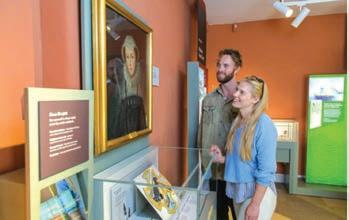
You’ll see other objects loanedbyEnglishHeritage and the Argyll Sutherland Highlanders Museum at Stirling Castle. And there are items from our own collections too, including a replica of a toucan embroidery by Mary Queen of Scots, created while she was imprisoned in England, and a jewellery box, which may have been made by 19th-century French PoWs.
Threecarvedstones,one ofwhichmaydatebackto the10thcentury,areon displayafteranintricate
Left:The‘family’atworkon theRock Inset:LeslieAlcockstudies thefinds
These objects represent parts of the site’s history that are no longer visible, and they are now on display to the public for the first time just over 50 years after they were discovered.
As Steve reflects: “The Alcocks’ dig at Dumbarton and other Scottish sites revitalised historical archaeology in Scotland and inspired a new generation of archaeologists. Digging with Leslie and Elizabeth gave me the opportunity and confidence to find work as an archaeologist.”
Steve moved to Scotland permanently and remained in the University of Glasgow’s archaeology department, where he is professor of historical archaeology. And he is still hot on the heels of those kings of Strathclyde. For the last three decades he has led his own digs just a few miles along the Clyde at the Govan Stones –a regular feature of Leslie’s lectures –where the kings of Strathclyde shifted their base after the siege of AD 870.
l Read about the analysis of e Dumbarton Cross at hes.scot/dumbarton-cross
craneoperationtoinstall them.Visitorscanalso enjoyavirtualtourofthe castle,whichvisitskey locations,includingthe topofDumbartonRock–providingalternative accesstotheRock’s spectacularviews.
Left,the19th-century jewelleryboxdecorated withpaperscrolls; below, oneofthe highlydetailedcarved stonesnowondisplay
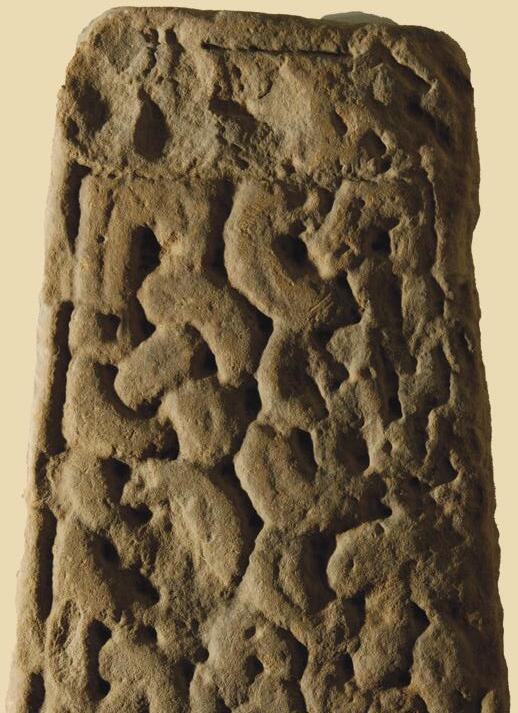
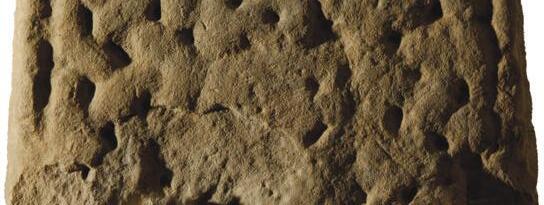






























































Travel back in time to meet Ishbel, one of the many children employed at Stanley Mills during the 19th century
WORDS: HANNAH BROWN

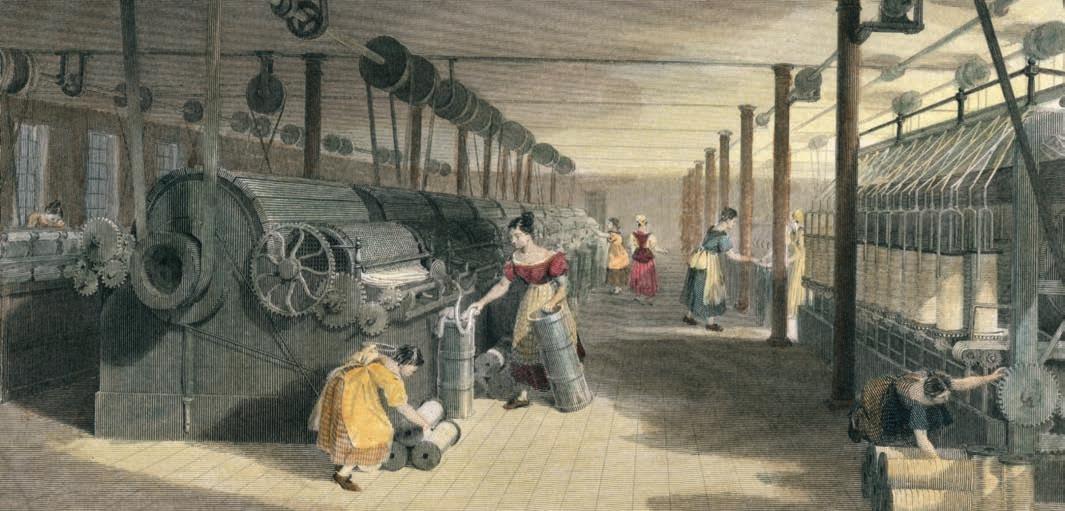
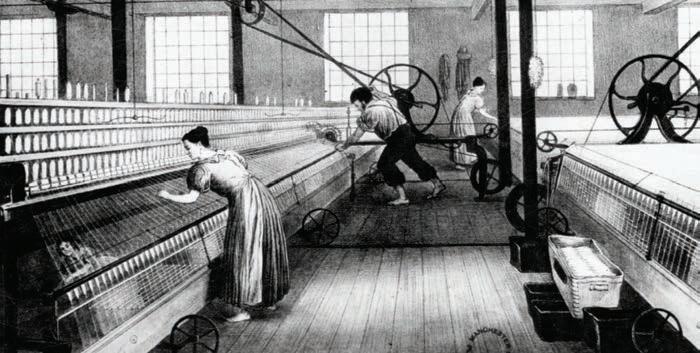
In the Victorian mills, women and children fed raw cotton into the big, heavy carding machines that would untangle the fibres and clean them, ready to be spun
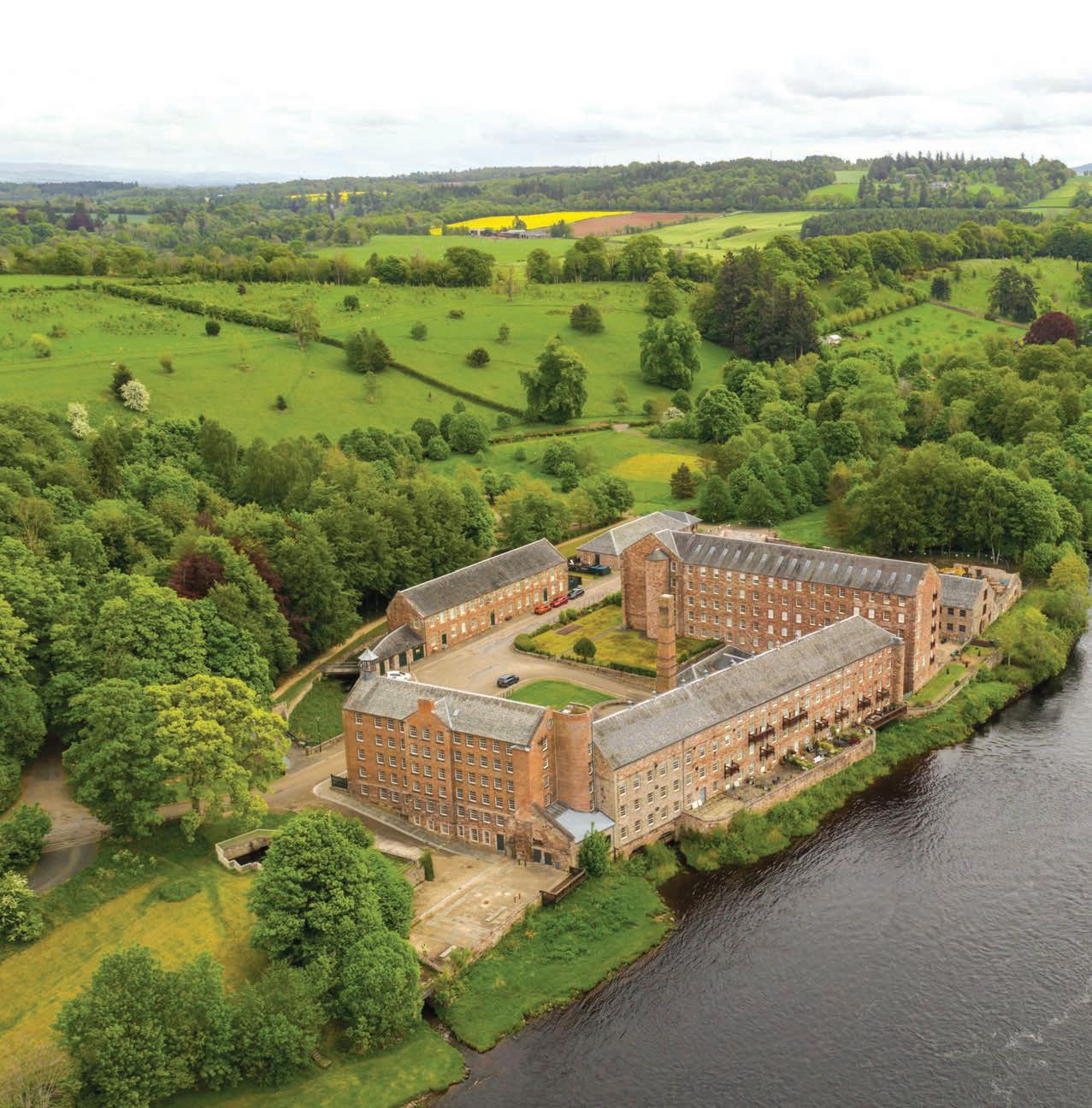
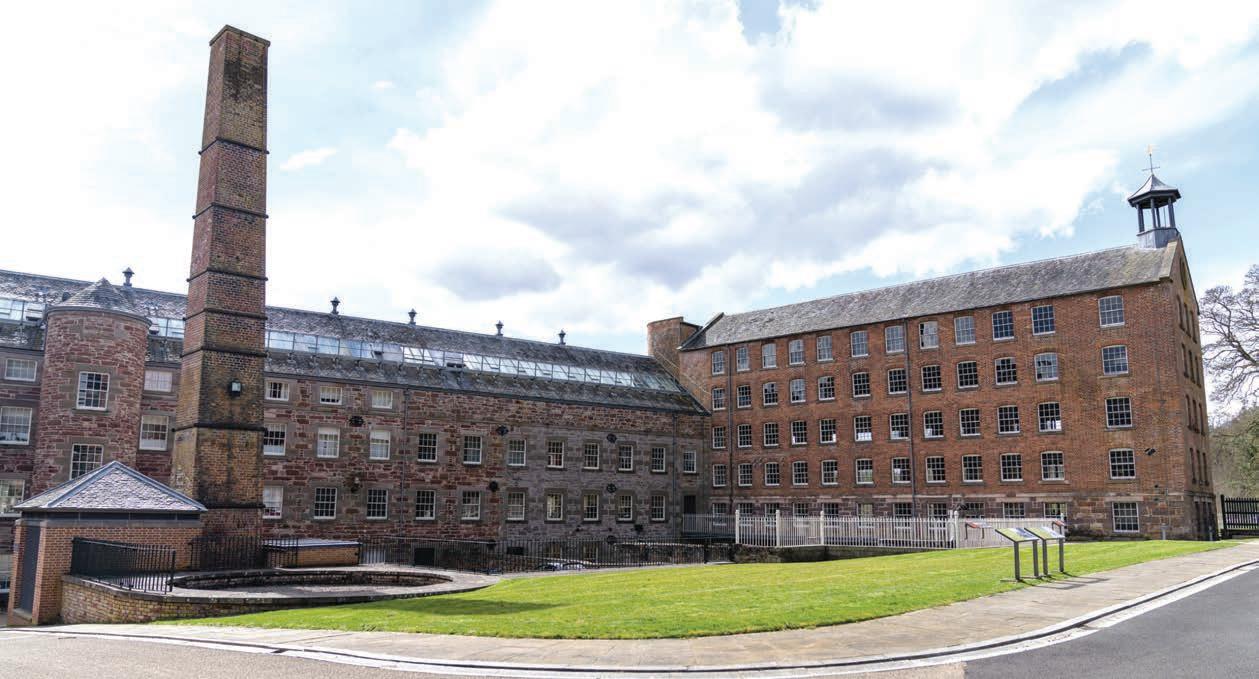
What was life really like for people in the past? This is a question that we, the Interpretation Team, are always thinking about for our visitors. Join me as we go back in time to 1850s Perthshire to explore the massive factory complex, Stanley Mills. You’ll be led by Ishbel, one of the nearly 500 children who work here.
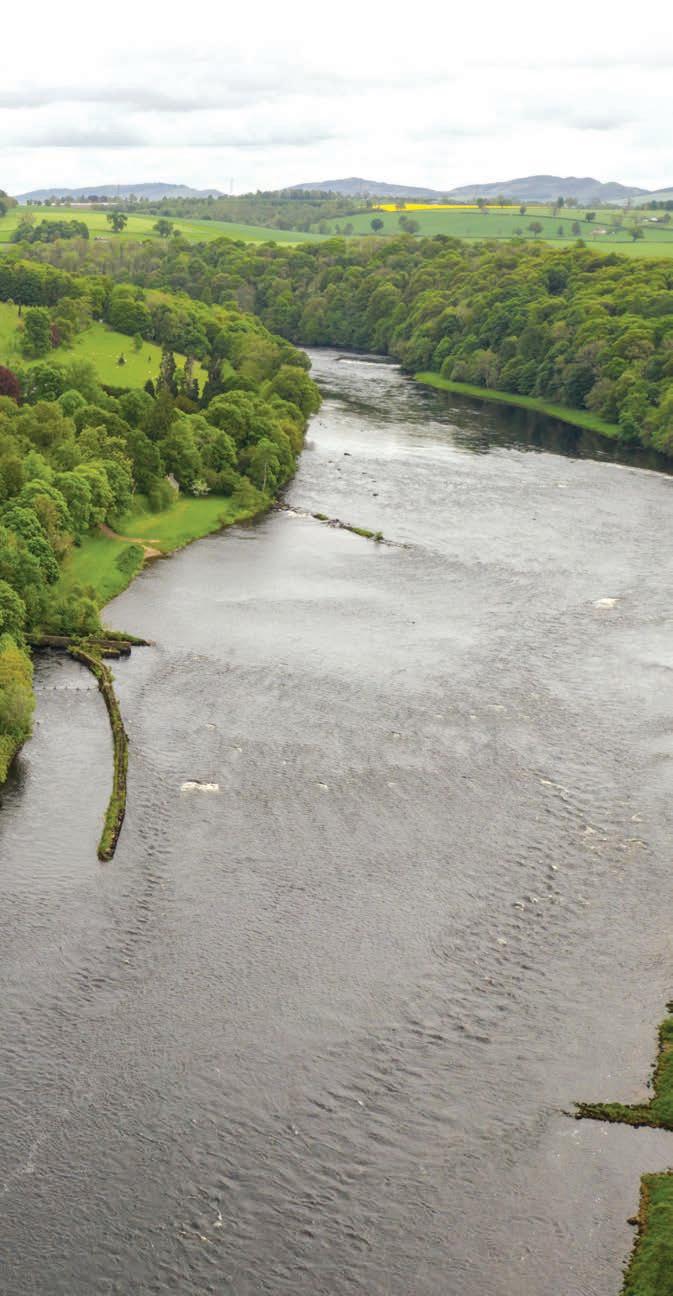
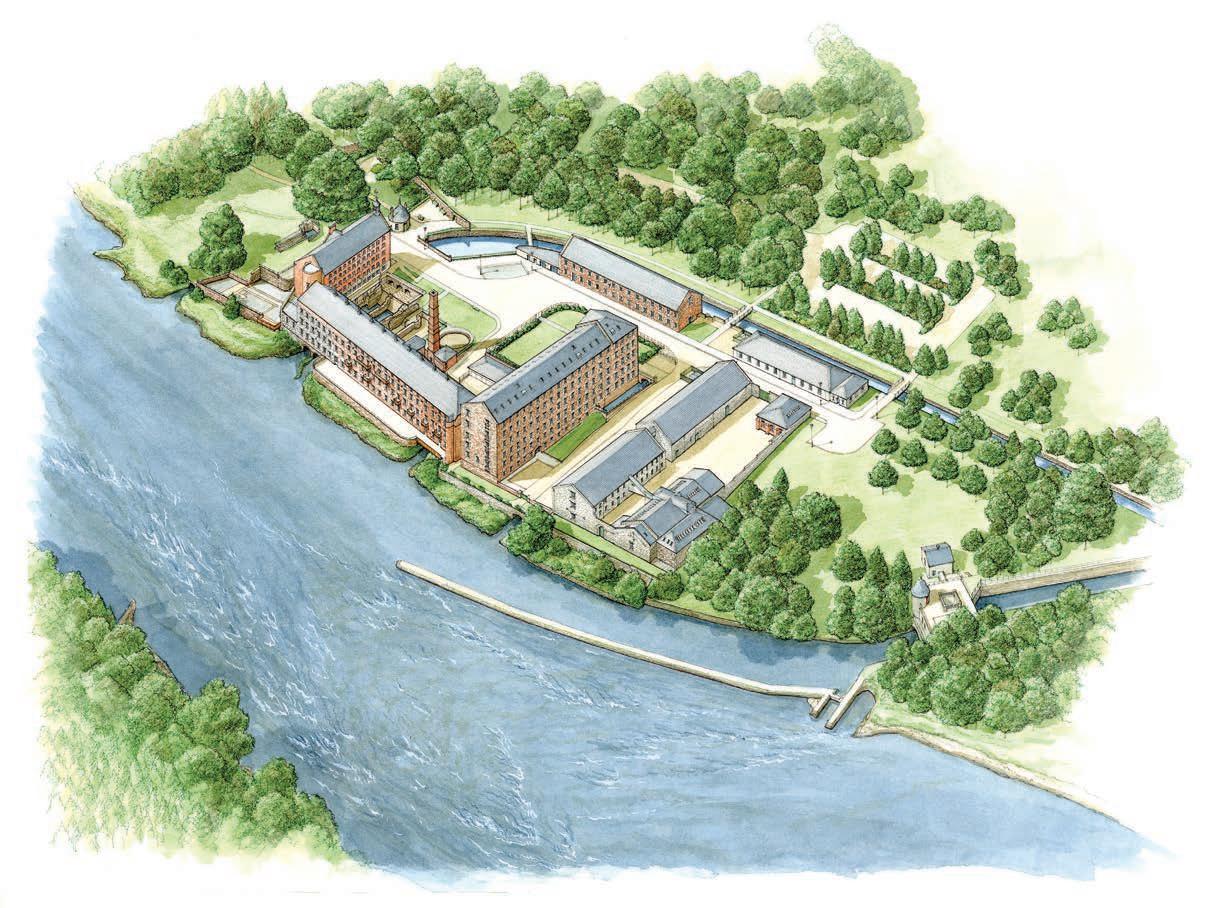
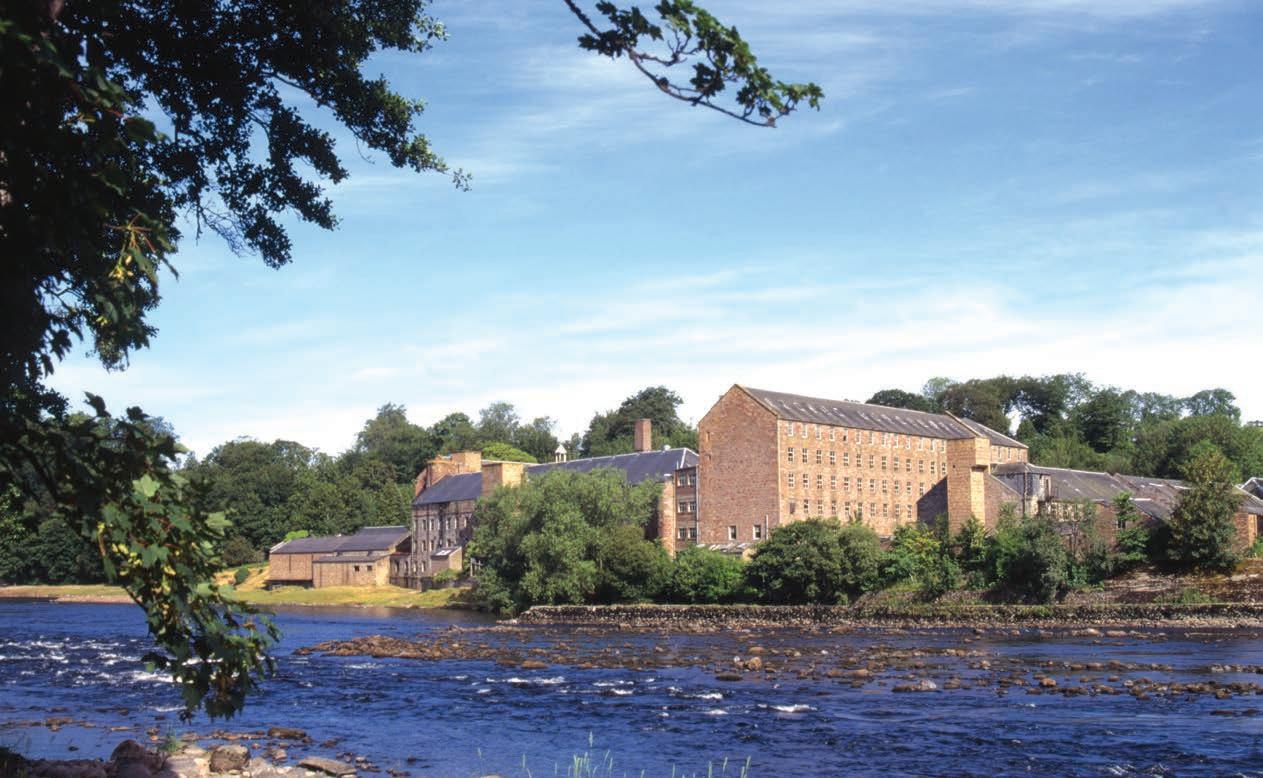
Stanley Mills is now a tranquil site, sitting on a bend in the River Tay. You can hear birds singing in the woodland and, if you’re lucky, spot some Atlantic salmon in the river. But back then, an autumn day in 1850 during the factory’s industrial heyday, it was a thriving hub of manufacturing. The air would have been filled with the sounds of the machinery used to process cotton.
Stanley Mills was founded in 1787. The landowner, the 4th Duke of Atholl, initiated the development, supported by the Perthshire merchants and the local MP. Richard Arkwright, considered the father of the British cotton industry, provided engineering, design knowledge and finance. This mill would manufacture textiles almost continuously until it eventually closed in 1989.
The immense power of the River Tay was key to the location of the factory, as was locally found cheap labour, such as Ishbel. Let’s join her to experience a typical day for Stanley’s millworkers.
The sound of a bell breaks through my sleep and I force open my drowsy eyes. It’s 5am and, as it does every day, the Bell Mill is calling us all to work. My blankets barely keep me warm in the cooler autumn mornings but I still push them off reluctantly. I get dressed in my frock with a pinafore over the top and my wool shawl to keep off the morning chill and slip my feet into my clogs. My frock is made of rough cloth, but it’s been worn every day into soft comfort.
My sister helps me pin my hair up as it’s best to keep it out of the way. It’s still completely dark outside but work in the mill starts at 5.30am so I head out with my brother, sisters and
mother. Our breath rises up as we walk down the sweeping road towards the mill in a crowd of women and children, all preparing to work nine hours in hot, noisy spaces. The youngest are only nine years old, the same age as I was when I started working. I’ve been working here three years now and consider myself a seasoned worker.
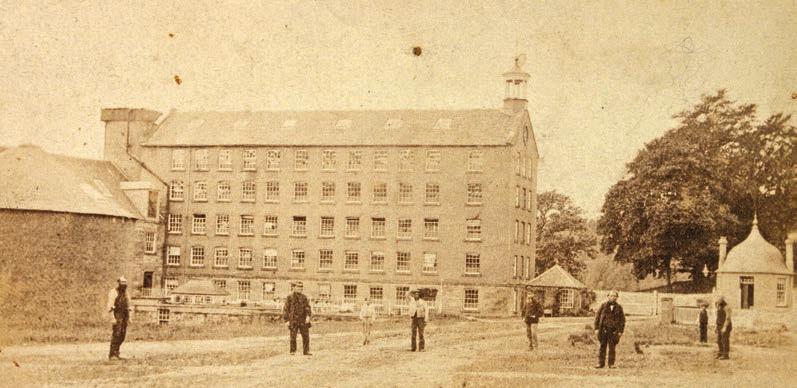
As we approach, the Bell Mill towers above us. It’s a big building by anyone’s standards but at six storeys it’s massive. I’ve never seen anything like it but some of the older people from other mills have been to England and tell tales of hundreds of buildings just as tall in vast cities, such as Manchester.
I work in the Bell Mill, which someone told me is the oldest building here, with the machines that spin cotton. When cotton is picked, it’s not strong enough to be woven into cloth. So first it needs to be spun.
Spinning is when the cotton fibres are twisted together into a strong, single strand, called yarn. My grandmother says that people once did this at home using a spinning wheel but it was very slow work. There are still folk doing a bit of spinning at home in our village, but I see huge amounts of cotton being made in the mill. How could little spinning wheels do that?
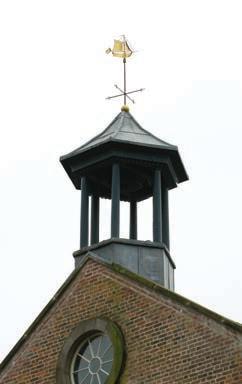
The belfry seen today on the Bell Mill is an original

In school we’ve learnt about Mr Arkwright, who invented the water frame and the factory system, so lots more cotton can be produced in a much faster time. Now someone, like my mother and older sister, can feed the cotton into the machine’s moving rollers and the fibres are drawn onto rotating spindles to be twisted into yarn. I’ll do this when I get older. My sister says it’s terribly boring and you
just do the same thing over and over again, but you still have to pay attention.
I do one of the most dangerous jobs in the mill; cleaning the machines. I have to get underneath them, even when they’re moving. If you don’t clean quickly enough it’s easy to get injured. I’m really fast so I’ve never been hurt but I have friends who have had their hands and arms crushed when they didn’t manage to get out the way.
The fibres are drawn onto rotating spindles to be twisted into yarn
The River Tay connected this small valley in Perthshire with the global cotton industry. This industry, which brought vast wealth to a powerful few, exploited millions of people through transatlantic slavery and colonialism. Many of the mill’s original founders and subsequent owners had connections to slavery-based economies, such as the East India Company and plantations in the Caribbean.
The cotton spun at the mill was brought to Stanley, via Port Glasgow, from plantations in the Caribbean and Southern US and was picked by enslaved people. New interpretation at Stanley Mills now places the cotton industry in its global context and tells this story in more depth.
Established in the late 1780s, Stanley Village provided housing for workers at the mill,
We’ve been working for a few hours and it’s so hot in the mill. Cotton has to be spun at high temperatures to stop the fibres breaking. You can hear the clank of the flues that carry the hot air around. The mill has big windows so it’s very light, but we’re not allowed to open them to cool down.
The bell rings again and it’s time for our 9am break when I get to eat, rest and see my friends. As I climb out from under the machines, I stretch my arms and legs to try to stop any cramp. Our food is always the same, some porridge with oatcakes and tea. It gets a bit boring but my sisters and I still push and shove to get our portion first.
We can’t talk when we’re working at the machines because it’s so incredibly loud but now we get to gossip and share stories. I love listening to all the different accents of the other workers, some of them from as far away as Lancaster. I like hearing people speak Gaelic too.
My sister works in the East Mill, spinning cotton. I’m a bit scared to go in there because there was a fire a few years ago. It wasn’t that bad but cotton fibres catch quickly and everyone is afraid of the whole mill burning down.
The men don’t even smoke near the buildings and if the foreman caught anyone with an open flame, they’d be sacked straight away.
After the fire, the master made some improvements, including iron beams that are supposed to stop the fires spreading too fast.
My sister told me there are 27,288 mule spindles across the East, Mid and Bell mills. Can you even imagine the noise of all that machinery working at the same time? It’s such a loud racket that we can’t talk to each other, so we mainly communicate through lip reading or sign language.
My mother works in the Mid Mill on the big heavy carding machines. She feeds the fluffy raw cotton into the machine which untangles it and cleans it off. Then it’s ready to be spun. As with spinning, I see some folk doing this at home, but there’s no way they could make enough for the mill.
Everyone says that the machines are so heavy that they had to reinforce the floors. My mother gets this bad cough when she’s in the carding room from all the fine cotton dust that’s floating around. It looks beautiful, like it’s snowing in there, but she says it gets in her lungs.
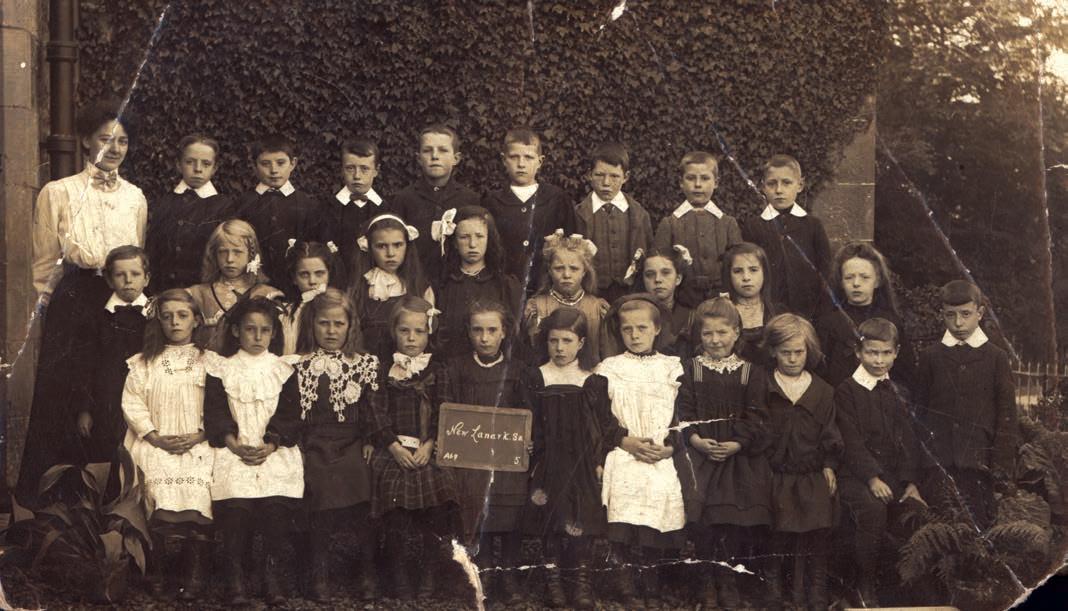
While children working in mills didn’t have a lot of power, some advocated for themselves
At 3.30pm I get to stop crawling desperately under the machines. I’m so tired but it’s time to go to school. When I turn 14, I’ll have to work until 7pm and won’t go to school anymore. I join all the other children for the trek up the hill to the village. My brother runs off to play with his friends. They won’t get told off, our parents know they need to let off some steam.
The classroom is cold and I wrap my shawl tightly around myself as we repeat after the schoolmaster, trying to learn by rote. I can smell chalk from the board and the books smell of damp. My fingers are freezing and it’s difficult to write, but my dad says we’re lucky to learn reading, writing and some arithmetic, so I keep going.
My home is in Stanley Village, like most of the other people who work in the mill. There are a lot of us in the little house. I have to share a bed with my sister but, even when it’s really crowded and noisy, I’m glad my family is around and I’m not one of the orphans from Perth who work in the
mill. That must be lonely. We have a late dinner, the usual broth and potatoes with kale. Then it’s time for bed. We have to be up early again, at the bell, ready for another long day in the mill.
While children working in mills didn’t have a lot of power, some of them advocated for themselves, forming societies and requesting time to play and study from the mill’s owners. The Factory Act of 1878 stopped children under the age of 10 working in mills and restricted the number of hours for older children. In 1901 the school leaving age in Scotland was raised to 14.
It’s many years since children such as Ishbel worked long hours in Scotland’s hot and dangerous cotton mills like Stanley Mills. Yet children still work in the textile industry all over the world in very similar conditions.
Stanley Mills features in episode 7 of the Historic Scotland Podcast. Listen at hes.scot/members-podcast
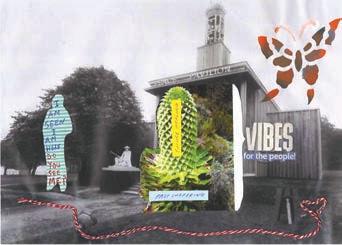
Traces of Empire is a new exhibition coming to our sites. The displays cover different themes, including cotton, belonging, language, reclaiming past and future narratives, and healing. The exhibition seeks to understand the legacies of empire still experienced today and explores how we might move forward together.
You can see Traces of Empire at Glasgow Cathedral from 16 to 27 October and Blackness Castle from 31 October to 9 March 2026. It will then tour other sites, including Stanley Mills, in 2026.
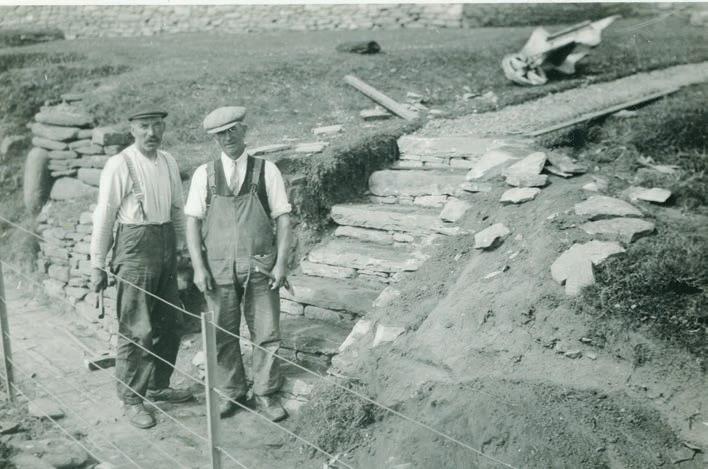
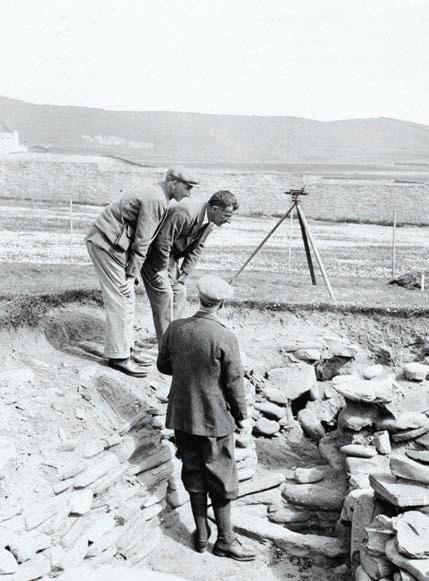
In the 1930s, Alexander Ormiston Curle led the excavation of
on the Shetland Islands
The
spectacular settlement of Jarlshof and its sister sites provide a vivid portrait of island life across 4,000 years
WORDS: NICOLA MORE
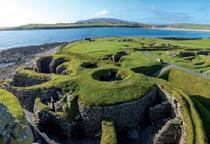
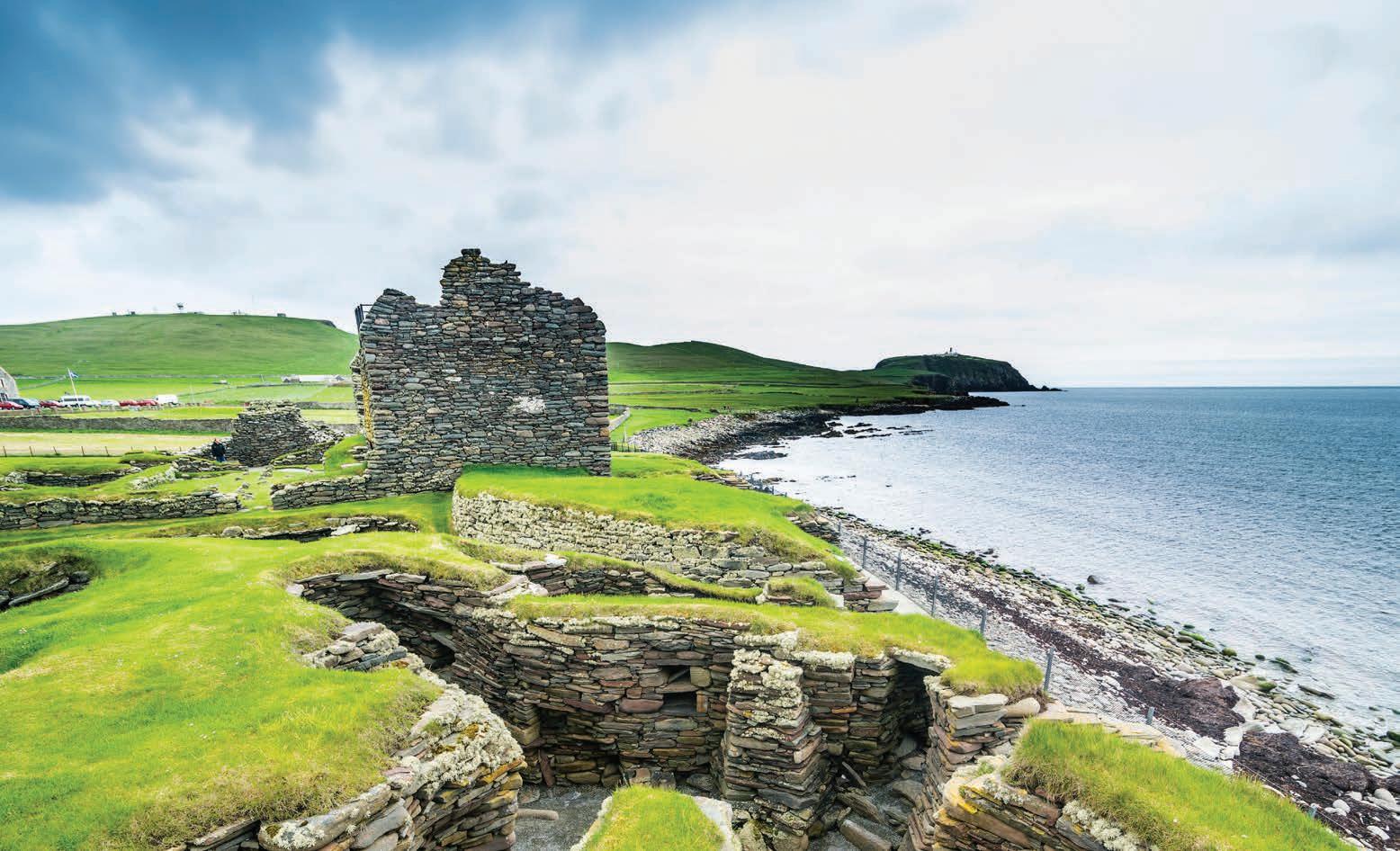
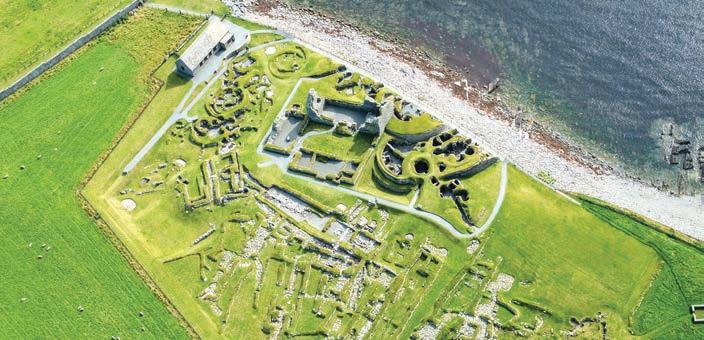
The fate of Shetland has long been intertwined with the sea, and its bestknown archaeological site offers a tantalising glimpse into more than 4,000 years of life on the island. As a time capsule of human history, Jarlshof Prehistoric and Norse Settlement is unparalleled in the British Isles.
Perched on the exposed headland overlooking the West Voe of Sumburgh, Jarlshof would have offered a safe
haven for explorers arriving by sea. Early settlers are thought to have first landed there around 6,000 years ago, and fragments from the dwellings of their descendants date from around 3,000BC. Over the following millennia, the settlement went through periods of abandonment and rediscovery.
“The sea was a crucial resource throughout the evolution of the Jarlshof site,” explains Esther Renwick, District Visitor and Community Manager for Orkney and Shetland.
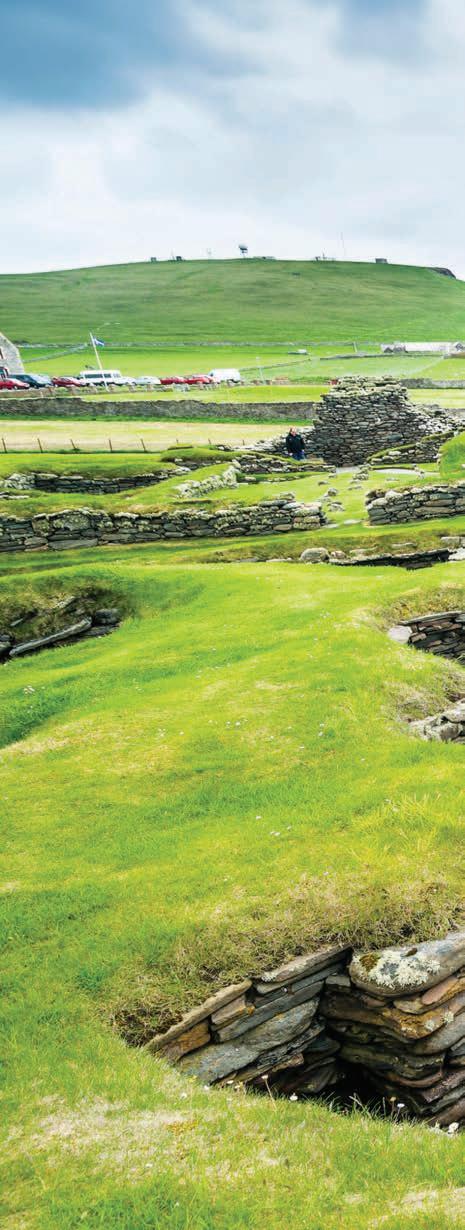
“We have this cycle where settlements were abandoned and covered over with sand, before being revealed again through storms and coastal erosion. The result is a unique site made up of layers of history built one on top of the other, capturing every time period of Shetland life.”
As the sea laid claim to each historical era, a new settlement laid claim to the land, leaving behind vital clues to early Scottish life. In the 1890s, a powerful storm revealed parts of the
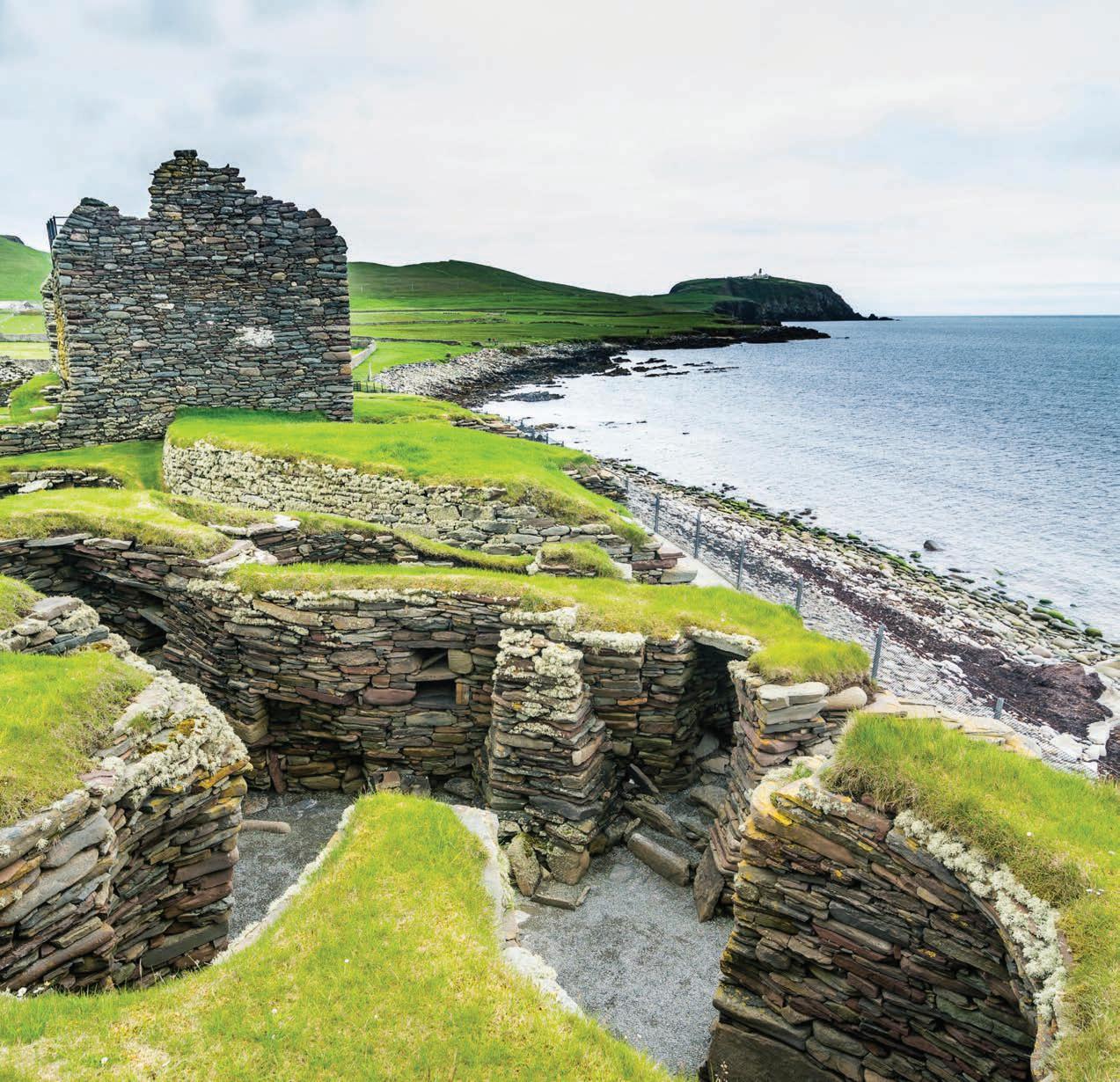
Jarlshof site, later fully uncovered by years of excavations. And today visitors can discover relics from Neolithic times through the Iron Age to the arrival of the Vikings and, latterly, the rule of the Scottish lairds.
A visit to the atmospheric settlement cannot fail to capture the imagination –and Jarlshof left a lasting impression on one high-profile visitor in particular. In the summer of 1814,
novelist Walter Scott joined celebrated lighthouse engineer Robert Stevenson (grandfather of Treasure Island author Robert Louis Stevenson) on a tour around Scotland, including the northern isles.
At the time of Scott’s visit, the only visible part of the Jarlshof site was the Old House of Sumburgh – likely the remains of an early laird’s house –which he dismisses as a “dreary mansion”. Yet the setting itself did not disappoint.
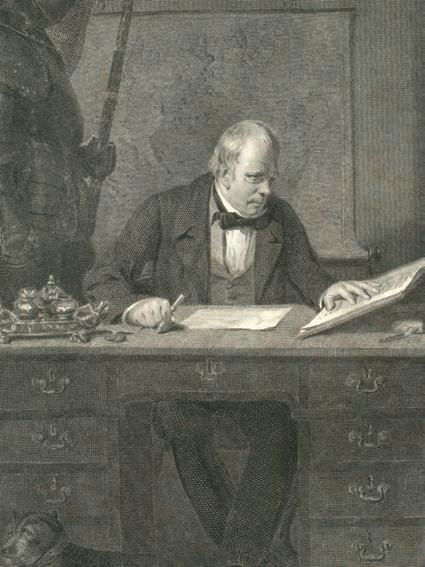
Scott writes, “The sea beneath rages incessantly, among a thousand of the fragments which have fallen from the peaks, and which assume a hundred strange shapes. It would have been a fine situation to compose an ode to the Genius of Sumburgh-head, or an elegy upon a Cormorant – or to have written or spoken madness of any kind in prose or poetry.”
Later, Scott does compose such a tale. His novel The Pirate named the site Jarlshof (earl’s house), giving it the title we know today. Yet Jarlshof was not the only site to inspire the writer
on his voyage. Scott was also captivated by the sight of Shetland’s brochs – giant Iron Age stone towers, which are unique to Scotland.
Initially, brochs were thought to be defensive structures but more recent analysis suggests they were grand residences, perhaps for influential local leaders or landholders. Scott appears to favour the latter interpretation, writing: “From the top of his tower the Pictish Monarch might look out upon a stormy sea…and immediately around was the deep fresh-water loch on which his fortress was constructed.”
Mousa Broch, which overlooks Mousa Sound on the western shore of the island of Mousa, is considered one of the wonders of prehistoric Europe. It is the most intact broch in Scotland and the best-preserved Iron Age structure in the British Isles. Standing 13 metres tall, it has a smaller diameter than most brochs but much thicker walls – a feature that probably helped it survive 5,000 years of coastal weather.
It was the first of Shetland’s sites to be taken into state care, in 1885, followed three years later by Clickimin Broch on mainland Shetland. Clickimin is an equally fascinating but entirely different prospect to its southern sister.
The Clickimin site is unique in that it combines three distinct structures –a surrounding wall, blockhouse and broch tower – suggesting a larger settlement serving a number of different functions. Adding to the mystery is a pair of footsteps carved into stone on the causeway. Are these a record of ancient kings?
The answers to such questions are often revealed piece by piece in a
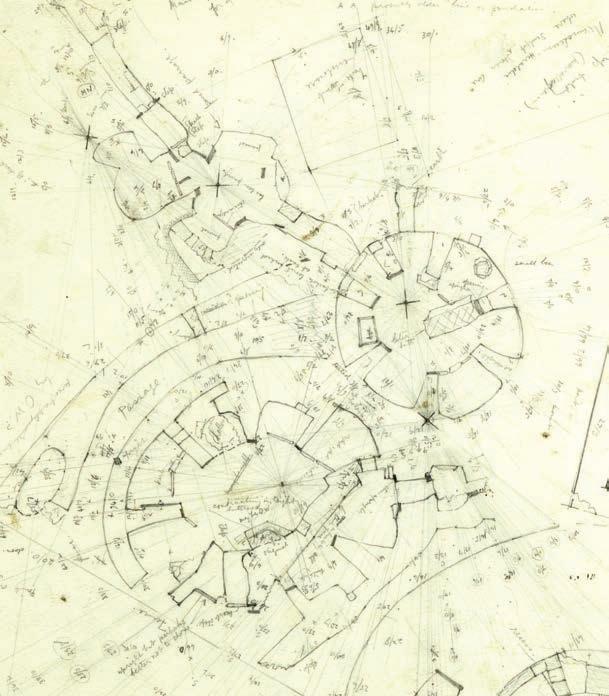
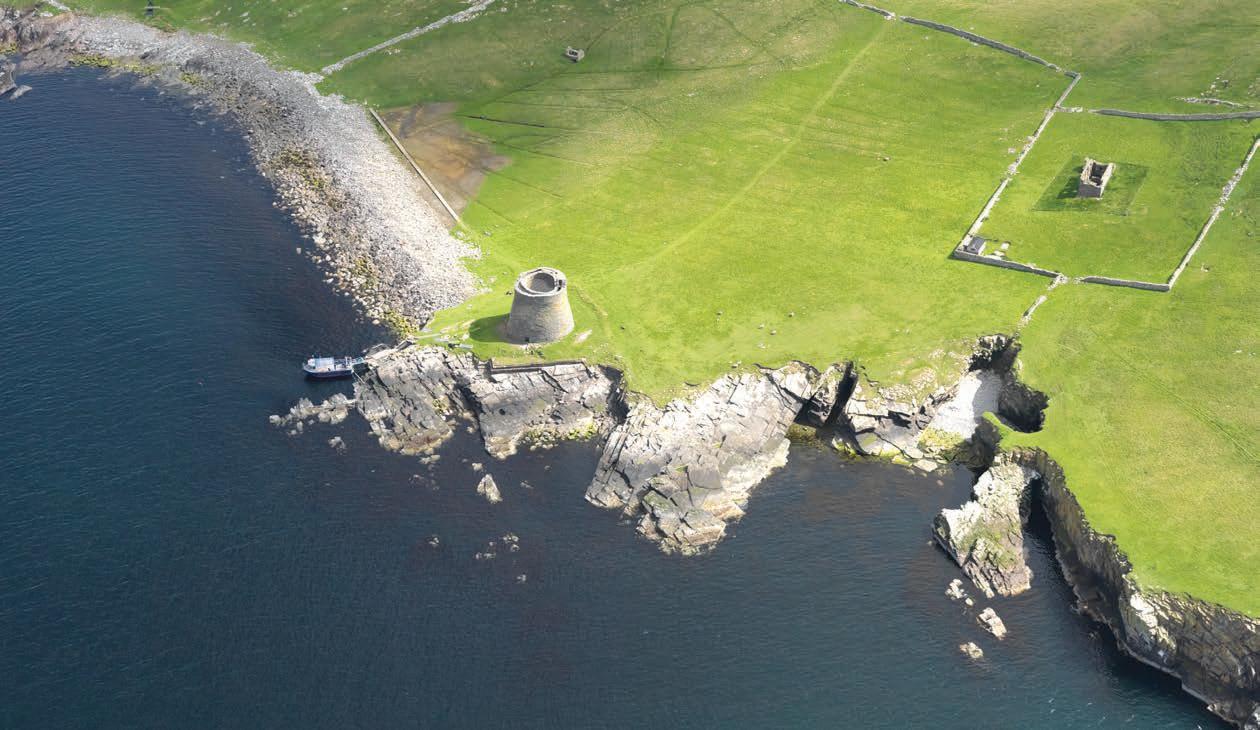
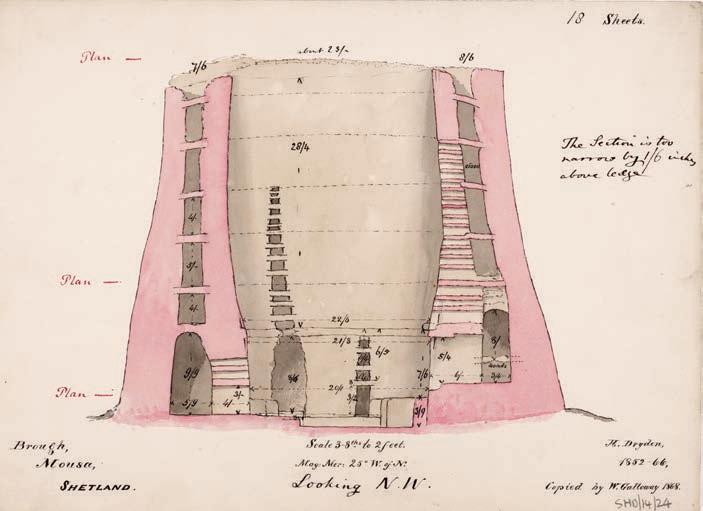
process of careful excavation and meticulous record-keeping. Entrusting the sites to state care allowed for over a century of expert analysis, as we can see from archaeologists’ notebooks stored in our archives.
On 7 July 1930, John Maitland Corrie writes: “Visited Broch of Clickimin with Mr Calder and took a number of photographs and made a preliminary inspection of the structure. A number of enquiries were followed up later in the day and much useful information in regard to the rural areas collected and noted for future guidance.”
Given the painstaking nature of most excavations, one can only imagine the dramatic moment when Jarlshof’s
4,000-year past was laid bare by a storm in 1897. Records show that the landowner John Bruce of Sumburgh visited the site with friends and was shocked to discover large structures eroding on the shoreline. At that point, “their interest and enthusiasm led them to cast off their coats and begin excavating.”
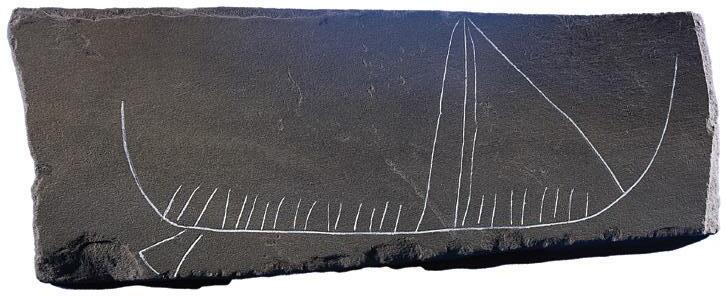
It was a dramatic moment when Jarlshof’s history was laid bare by a storm in 1897
Further excavations continued into the 20th century under the expert guidance of Alexander Ormiston Curle. Curle’s Excavation of a Dwelling of the Viking Period describes an astonishing range of artefacts, including cooking and sharpening stones, iron fishhooks, rivets and knives, steatite bowls and lamps, and various bone carvings, including “two fine combs of bone, with interlaced ribbon”. Among a number of exciting finds, now cared for by National Museums Scotland, was a piece of Viking graffiti in the form of a longship war vessel carved into stone.
The arrival of the Norse people in Shetland ultimately marked an end to the days of Pictish monarchs gazing over the sea from their fortresses. The Vikings ushered in a new era of Norse occupation and one of the bestpreserved elements of the Jarlshof settlement is a traditional Viking longhouse, which grew and shrank during as many as 16 generations.
“The Norse period was relatively steady and settled,” says Esther. “You have a continuation of Scandinavian culture and flourishing trade links. Then, in 1469, Shetland officially passes from Norway to Scotland, and we see the reign of the two Stewart earls.”
Local history here took a darker twist, as Robert Stewart first took control of the island, succeeded by his tyrannical son Earl Patrick.
Earl Patrick ordered the building of the Old House of Sumburgh, which today dominates the site at Jarlshof, and also the construction of Scalloway Castle – which sits within the harbour village of Scalloway – around 1600. His ruthless oppression of the islanders extended to forcing them to labour on his towers without pay, earning him the title Black Patie.
Legend has it that locals were too afraid to speak his name, and that the
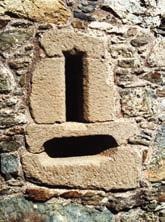
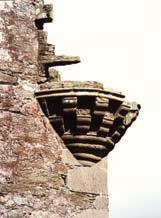
Robert Stewart took control of the island, succeeded by his tyrannical son Earl Patrick
plaster of Scalloway Castle was mixed with Shetlanders’ blood. A Latin inscription above the door, now worn away, featured a Bible quote: ‘That house whose foundation is rock will stand, but will perish if it be shifting sand.’ One tale attributes its creation to a rebellious stonemason.
This prophecy was fulfilled when Black Patie’s crimes caught up with him, and he was beheaded in 1615.
Christian Ployen, a Danish government official from the Faroe Isles who visited the site in 1839, recounts the tale in his memoirs, writing: “As the proprietor of the Castle had with justice been universally detested…
the peasantry… sought every opportunity for laying it waste.”
Despite its gruesome history, Scalloway Castle is an impressive example of a late 16th/early 17th-century tower house. It’s one of only three castles constructed on Shetland, including Castle Holm, of which little survives, and Muness Castle, which belonged to Black Patie’s uncle, Laurence Bruce of Cultmalindie.
The most northerly castle on the British Isles, Muness would have been a spectacular sight in its day, arranged in a grand Z-shape and surrounded by extensive gardens, now sadly lost.
Bruce apparently was no fonder of his nephew than the islanders, yet despite many years of conflict between the two, Muness Castle shares many architectural features with Scalloway. Muness also features narrow windows with lintels bearing arc details, which aren’t seen anywhere else in Scotland and suggest a European mason’s hand.
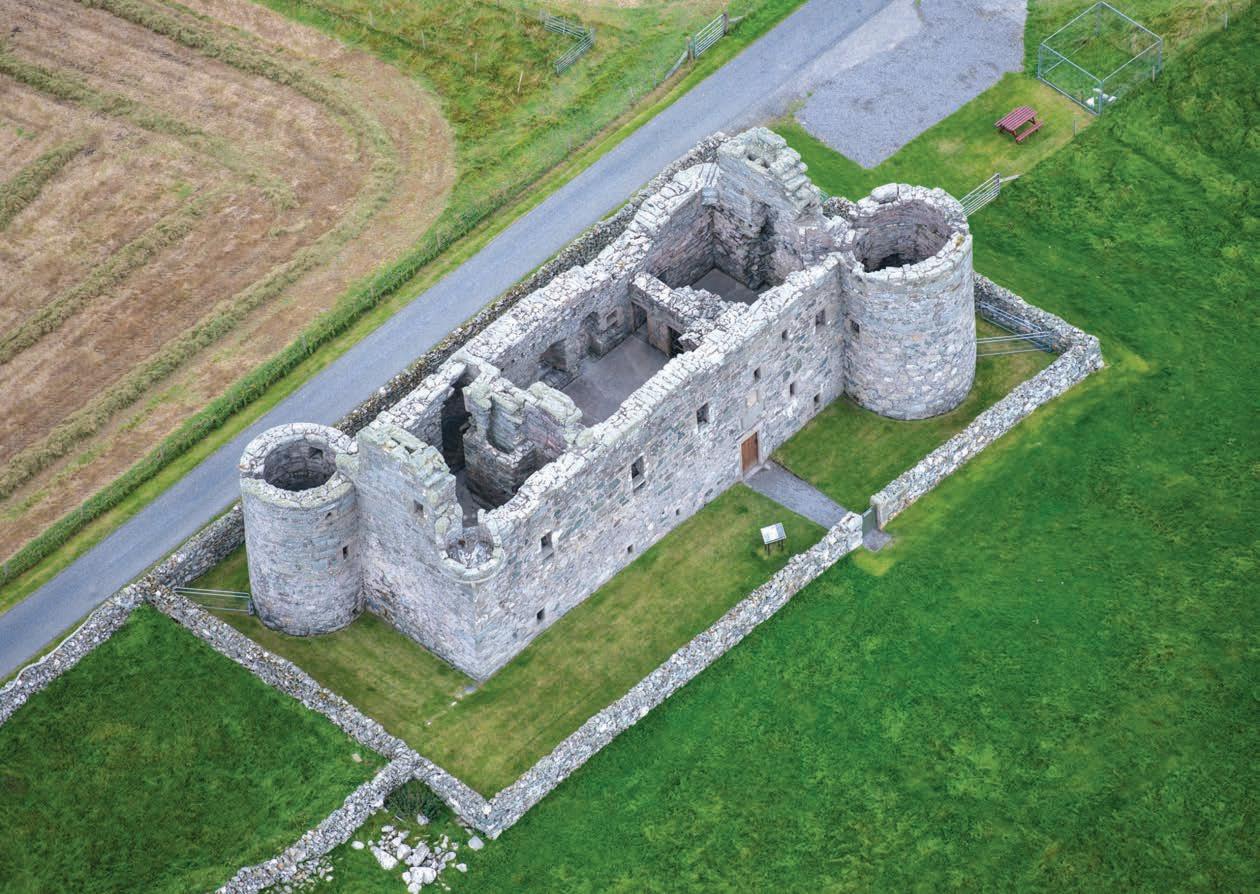
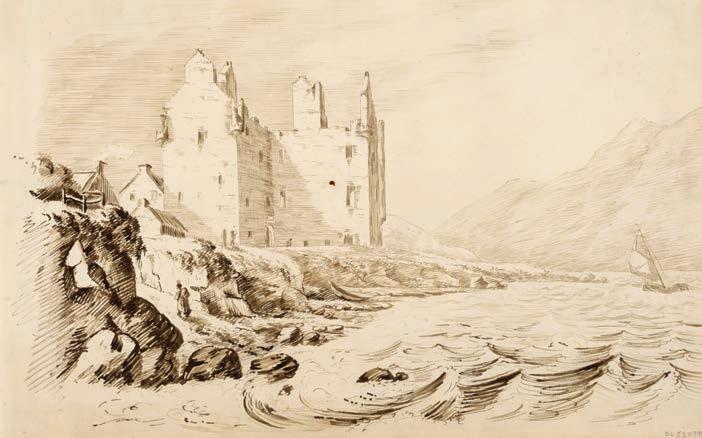
While Muness fell into ruin in the 18th century, Scalloway continued to play a role in Shetland life, serving as a courthouse and jail. It was even the site of witchcraft trials, which sent convicted souls up to ‘Gallows Hill’. It also played a small role in the Second World War operation known as ‘the Shetland Bus’, which ran small boats to support the Norwegian Resistance during German occupation.
As with Jarlshof, many of Shetland’s historical sites changed hands over time, falling successively into ruin and reuse. One of the most striking among them is Fort Charlotte, the astonishingly well-preserved artillery fort designed to defend Scotland in the Second Dutch War. The fort was not completed until the American War of Independence more than a century later, and while it never did see military action, it sits at the heart of Lerwick life.
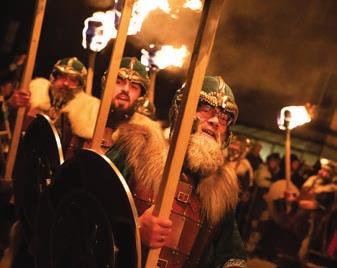
Over the years the fort served as a court, jail, drill hall and war office. In 1881 it found a happier purpose as a central venue for Shetland’s legendary Up Helly Aa midwinter torch procession. It still hosts military regiments today, marking two centuries of unbroken service.
Sharing the landscape with modern developments, Shetland’s sites –perhaps more than any other – are part of the fabric of their communities, woven through generations of island life. While they remain at the mercy of the fierce North Sea, their entry into state care over the past 100 or more years has enabled their protection, exploration and deserved celebration.
The Shetland Times’ 1933 report on Curle’s Jarlshof excavations aptly captured the public mood:
“Before taking leave of Jarlshof, I must ask you to let your minds go back and try to visualise those 100 generations or more who have lived and toiled, waging an unceasing struggle for existence round this historic site. For over 3,000 years at least, here men and women, boys and girls, have had their home. What a pageant for the imagination it all is!”
Around a century on, it remains just so.
Find more archive images of our historic sites at trove.scot
‘WE
I was interested in heritage from a very young age. We grew up in the village across from Mousa Broch. I studied archaeology at the University of Edinburgh and was so fortunate to be able to come home and join our team at Jarlshof.
Living in Shetland, it’s hard not to be connected to our past – it’s literally in the hills around us.
I recently discovered that my great, great uncle, Hugh Mackay, was the first person ever to be prosecuted for removing stones from a site under state care! He sent masons to gather stone from Clickimin to build his house. However, Clickimin had just been taken into state care and he fell on the wrong side of the Ancient Monuments Protection Act. No malice was intended and, fittingly, his son went on to become a steward on the site. He eventually built his house there too!
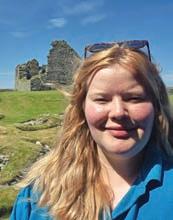
Mousa and Clickimin came into state care very early because the landowners were concerned about potential damage. There is such a rich archaeology here, I think the community is generally glad to see it being looked after.
Lucy Morris, Monument Manager, Shetland
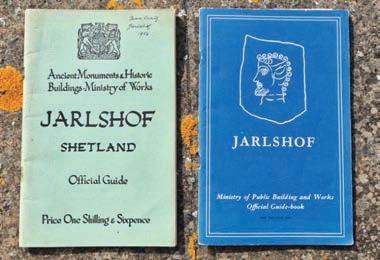
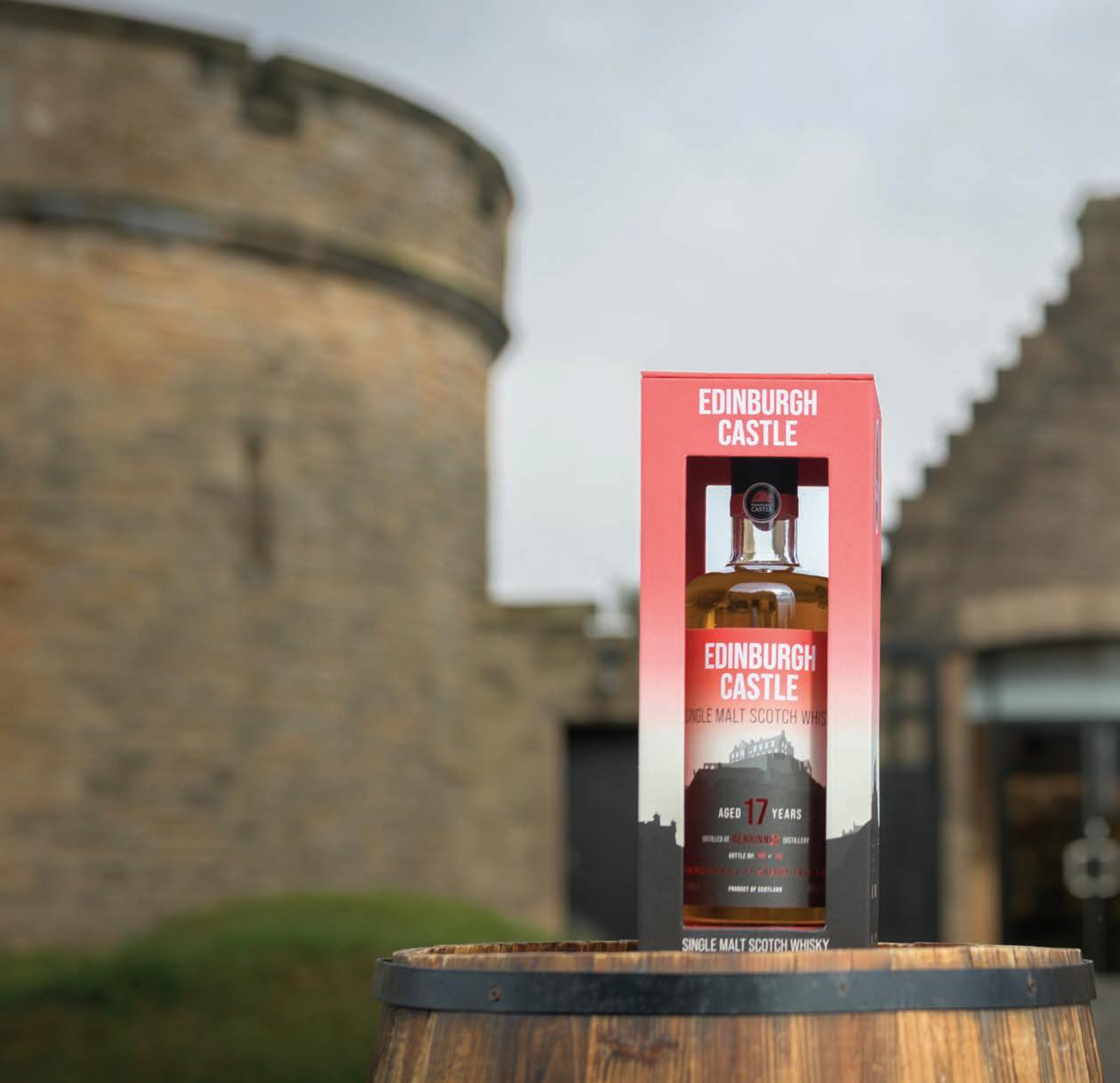
And we certainly get a lot of rain! Introducing a new, limited edition Edinburgh Castle Whisky. This is a 17-year-old single malt distilled at the Benrinnes Distillery in Speyside, a region famous for its distilleries. Working with Murray McDavid Whisky, a leading whisky bottler, and using interesting casks in the art of maturation, this whisky is packed with flavoursome history. Just 315 bottles have been produced priced at £148, and the packaging is 100% sustainable.
After distillation, the Benrinnes spirit was placed in an ex-bourbon cask, where it developed delicate layers of complexity and elegance. Following 14 years of maturation, the spirit was then transferred into an authentic Pedro Ximénez sherry cask from the renowned familyowned Bodega Ximénez-Spínola in Jerez, Spain.
On the nose, this whisky will have a blend of milk chocolate, mocha fudge, chai spices and fig cake.
On the palate, the toasty malt will add a little sweet oak spice with almond, with a hint of ginger and cinnamon on the finish.

Founded in 1826, Benrinnes distillery has been active since it was founded in 1826. This muchloved Speyside producer has suffered a number of unfortunate events. It was flooded in 1829, went bankrupt in 1864 and was severely damaged by fire in 1896! Yet the distillery has endured and, today, its resilient nature is perfectly reflected in its powerful, hearty whisky.
Check out our Edinburgh Castle range of Alcohol Accessories, available at the Edinburgh Castle Whisky shop and online at stor.scot. These include a leather hip flask made by Fife-based company Selbrae House and a 100% cotton bar towel.

1. Bar towel
2.
3. Leather hip flask
If you’re visiting our Orkney sites, be sure to pop into our Skara Brae and Maeshowe shops for some exclusive and bespoke products, along with many local and made-in-Scotland gifts and souvenirs. These are some of our new products, which are available at stor.scot if you can’t make the trip yet!

You can’t go wrong with a beanie hat when exploring the Orkney Islands on windy days! £13
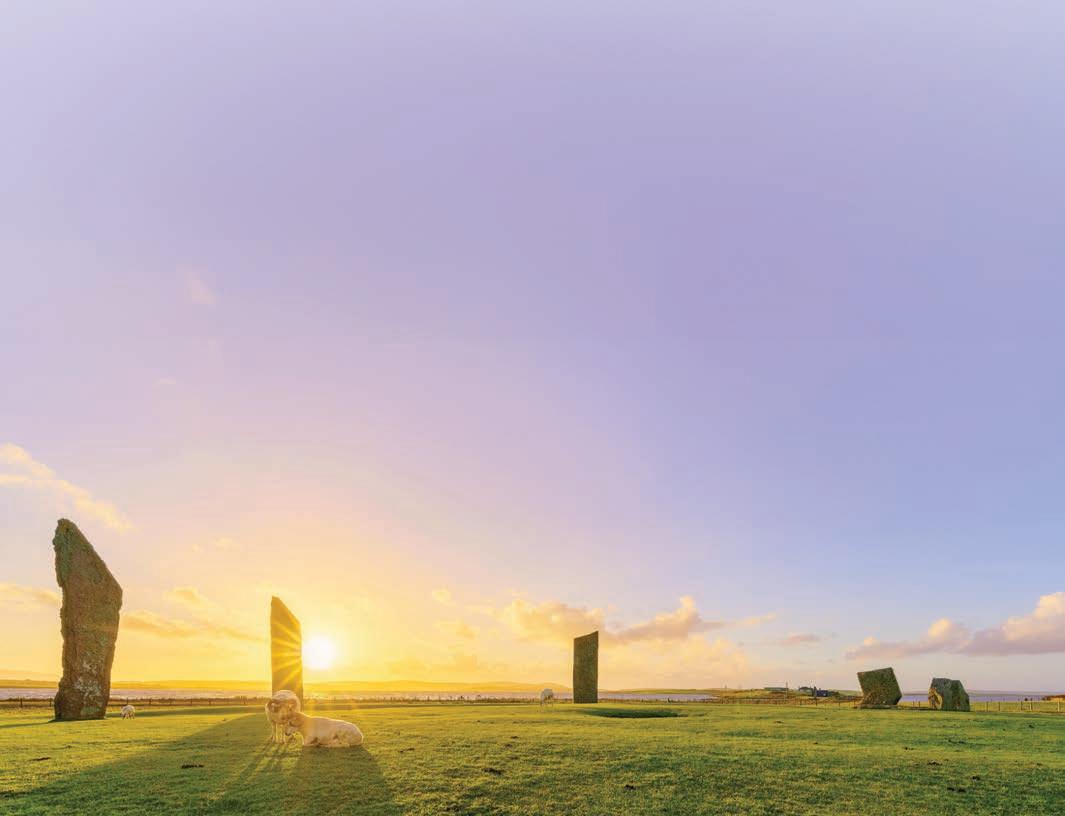
The Maeshowe Dragon decoration is just one of this year’s new designs. Others include a puffin, the Skara Brae Dresser and the Orkney

is a fun and informative souvenir detailing some key moments in history, with
Check out these and a range of other titles at our online shop, stor.scot
CommunicationsOfficerRobinKepple reviewsournewanthologyspotlightingthe diversityofScotland’sLGBTQ+experience, andweintroducetwoothernewbooks
VARIOUS AUTHORS, CURATED BY LEWIS HETHERINGTON AND CJ MAHONY
I moved to Scotland at 17, confused by who I wanted to be and wanted to be with. Edinburgh taught me about queerness through its closes and streets. The stories in Who Will Be Remembered Here focus on the gay clubs, theatres and libraries across Scotland rooted in our queer history, and I loved this collection for reminding me of that time and for being a powerhouse of writing.
I enjoyed the chapters by authors I already loved – Ali Smith, Ever Dundas and Louise Welsh – and was delighted to be introduced to new writers. It surprised me how affecting I found Johnny McKnight’s ‘Little Gless Box’. The experience depicted may be far from my upbringing, but the description of finally coming into your own resonated deeply.
Who Will be Remembered Here examines queer history through political and personal lenses in the physical spaces where queer people find themselves, their homes and love. It’s full of novel explorations of these themes, including Mae Diansangu’s playful yet sincere ‘The Library is a Queer Thing’ and Ink Asher Hemp’s emotionally vulnerable ‘20-something Spittal Street’.
The collection has stories in Gaelic and Scots, confirming that Scotland’s queer history doesn’t just belong to the Central Belt or the wealthy few, but to all queer people who have made their mark on this country.


“Scotland’s queer history doesn’t just belong to the Central Belt or the wealthy few”
Who Will Be Remembered Here elevates the experience of ordinary people like me and made me think about how I, too, form part of Scotland’s queer history by getting married and creating a life with my LGBTQ+ friends and family.
I recommend this book to anyone interested in the social history of Scotland’s buildings and places, or those looking for reflections on the country’s queer spaces from some of our finest national writers.
£16.99
Don’t forget your members’ 20% discount
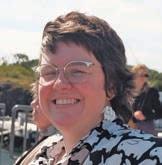
JOHNHUNTER
Thisguidetothe fascinatingand evocativeislands ofCanna,Eigg, MuckandRum isnowavailable inpaperback. Writtenbythe Universityof Birmingham’sEmeritusProfessor ofAncientHistoryandArchaeology, TheSmallIslesfeaturesawealthof photographs,mapsanddrawings thattakereadersonatourthough time,revealinghiddenhistories andancientsecrets.
£18.99
Hex
JENNIFAGAN

Hex is part of the Darkland Tales series, which reimagines Scotland’s history, myths and legends. It focuses on the last night of Geillis Duncan’s life following her conviction as a witch in the North Berwick witch trials. She recounts the circumstances of her arrest, torture and confession, but while imprisoned underneath Edinburgh’s High Street, a mysterious visitor claiming to be from the future offers Geillis the chance to escape.
£7.99






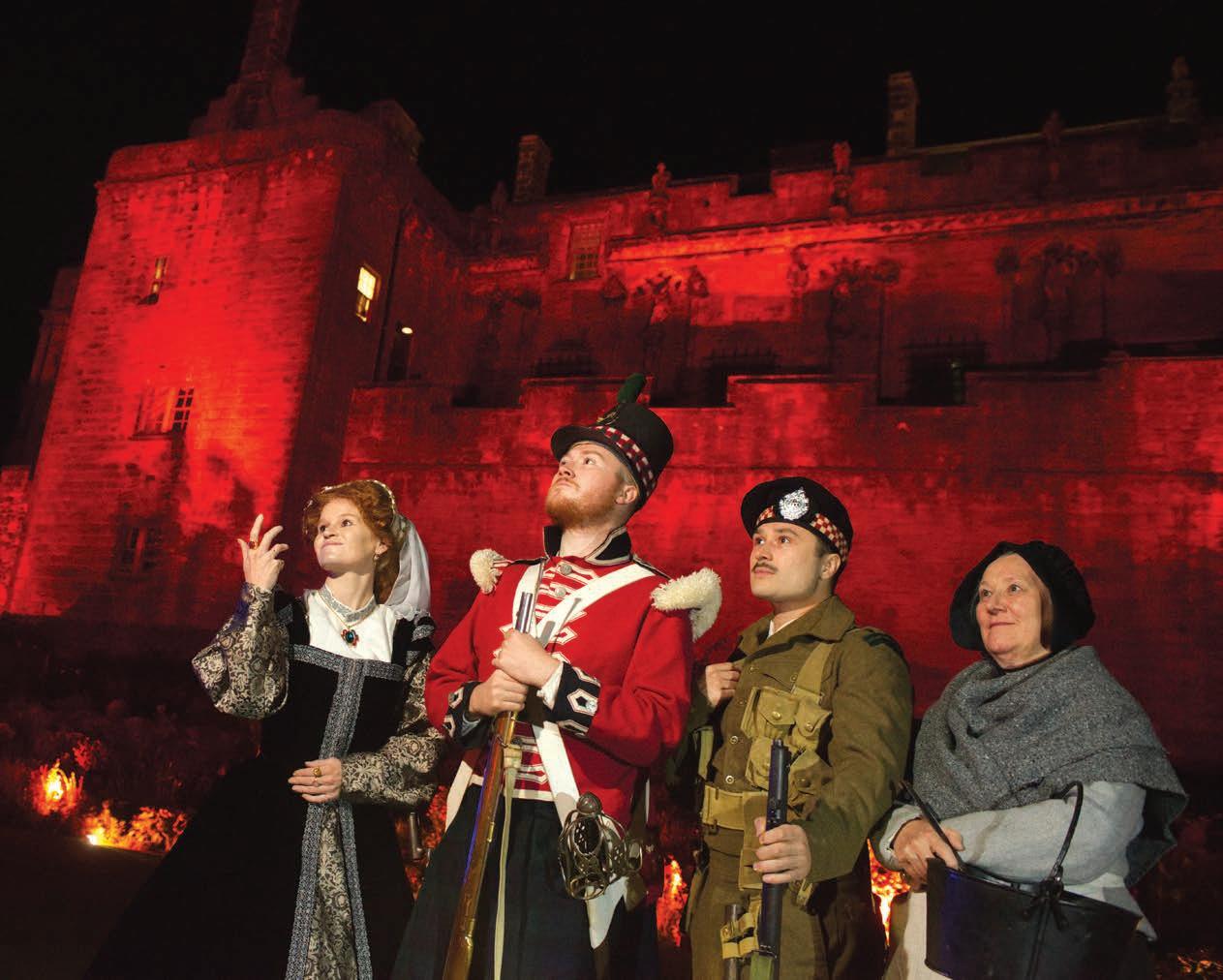
Expect to meet a host of characters at our sites this season
DAYTIME EVENTS ARE FREE FOR MEMBERS
Autumn is the perfect season to enjoy events at our historic sites and castles. There’s a chill in the air and the dark nights are creeping in – just in time for Halloween...
Halloween Tales
TRINITY HOUSE
Hear eerie stories from Trinity House’s resident storyteller. Little Ones Halloween Tales is suitable for ages 5+. Our more grown-up Halloween Tales event is suitable for ages 12+. This includes a twilight tour of Trinity House –which houses a fascinating collections of objects relating to Leith’s maritime past – and the lantern-lit 16th-century vaults.
l Mon 27 & Tues 28 Oct. Little Ones Halloween Tales 4.30pm-6pm.
Halloween Tales 7pm-8.30pm. Booking is essential.
EDINBURGH CASTLE
The city of Edinburgh is a place where strange mysteries and anomalies haunt our streets, and Edinburgh Castle is no exception. Join our guide for a journey through the
grounds of this ancient site to explore the veiled past of Edinburgh Castle, as well as the shadows and whispers of tales that have been left behind… Suitable for 18+ only.
l Various dates between Sat 4 Oct to Sat 1 Nov, 11am and 2pm. Booking is essential.
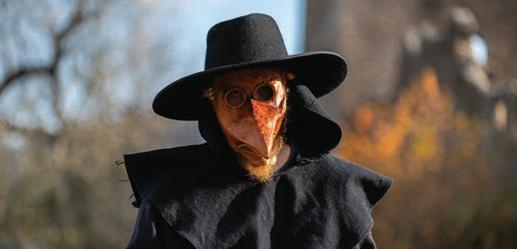
A face from the past
VARIOUS SITES
Our living history characters are back at our heritage sites across the nation. To coincide with the October holidays, some of our properties will be hosting characters from a range of different periods. For example, meet a knight at Urquhart Castle or a medieval musician at Aberdour Castle. Learn about our sites’ captivating history as our living history reenactors share stories about the past and also pose for a few photos!
l Sat 11 to Sun 19 Oct, during site opening hours.
VARIOUS SITES
As you explore our historic places this Halloween, will you bump into a giant or come face-to-face with a faery? This autumn, follow our family trails to discover some of the magical and mystical creatures of Scottish folklore. This self-guided activity will take place at 24 sites across the country.
l Sat 11 Oct to Sun 2 Nov, during site opening hours.
EDINBURGH CASTLE, STIRLING CASTLE, CRAIGMILLAR CASTLE, URQUHART CASTLE
Visit our legendary castles this Halloween – if you dare! At Edinboo Castle, Stirling Caaastle, Craigthriller Castle and Urrrrquhart Castle, all manner of tales and magic will be shared and myths and legends brought to life.
l Sat 25 & Sun 26 Oct, during site opening hours.
STIRLING CASTLE
Walk on Stirling Castle’s dark side and join us for a Halloween themed tour. Your guide will lead you by lantern light through the dark corners of the castle and tell of the mysteries, murders and malice that echo through the castle’s long history. Prepare yourself for a fright in the night as you might bump into ‘somebody’ from the past along the way. This tour is not for the faint of heart and will feature loud noises and frights! You have been warned.
l Sat 25, Sun 26 & Fri 31 Oct, various evening times. Booking is essential.
A feast of great activities and experiences are on the menu this Christmas. Here’s a flavour of what’s in store.
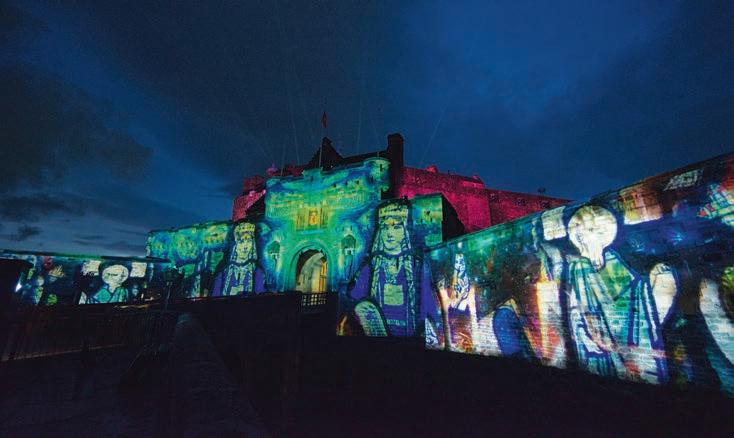
EDINBURGH CASTLE
Castle of Light returns for its sixth year at Edinburgh Castle! Prepare to be mesmerised by the enchanting forces of fire and ice as these two powerful elements intertwine throughout the castle to create unmissable immersive displays, interactive installations, music and wonder. Make Castle of Light part of your festive plans and enjoy one of Scotland’s largest annual projection and lighting shows.
l Various dates from Fri 21 Nov to Sun 4 Jan 2026, 4.30pm-9pm. Quiet Night is on Sun 7 Dec. We recommend booking tickets in advance. Exclusive 25% members’ discount for 2025. Book at: castleoflight.scot
EDINBURGH CASTLE, STIRLING CASTLE
Make Christmas 2025 special with afternoon tea in The Tearooms at Edinburgh Castle or the Great Hall at Stirling Castle and enjoy a dining experience fit for royalty. This package
One of Scotland’s largest projection and lighting shows returns to Edinburgh Castle
will include an afternoon tea for one person and castle entrance.
l Edinburgh Afternoon Teas: Mon 1 Dec to Sun 4 Jan 2026, sittings every 30 minutes from 11am-2.30pm.
l Stirling Afternoon Teas: Sat 6 Dec, Sun 7 Dec, Fri 12 Dec, Sat 13 Dec, Sun 14 Dec, 1pm.
STIRLING CASTLE
The ever-popular Christmas Shopping Fayre returns. Stock up for the festive season in the splendour of the Great Hall, with stalls showcasing the very best of local Scottish brands, crafts and fine food and drink.
l Tue 2 Dec, 6pm-9pm.
STIRLING CASTLE
Operation Moonlight brings Charles Dicken’s timeless tale of hope and redemption to Stirling Castle this festive season, following the miserly Ebenezer Scrooge as he discovers the true meaning of Christmas.
l Fri 19-Mon 22 Dec, 7pm start.
Members’ Exclusive Events have limited capacity and must be booked online in advance. Head to hes.scot/ member-events to book.
ELGIN CATHEDRAL
Uncover stories etched in stone at our exclusive tour of the Elgin Cathedral graveyard. Our expert guide will delve deeper into the history, art and meaning of the gravestones around the ‘Lantern of the North’. We will have a closer look at the symbolism adorning tombs, the mechanics of a wall tomb
and look at the graves of some local celebrities. Beyond the symbolism of wealth, our exploration will unveil the influence of geology on the headstones themselves, and how these weathered stones provide a unique habitat for a surprising array of flora and fauna.
l Sat 4 & Sat 11 Oct, 11am-12.30pm.
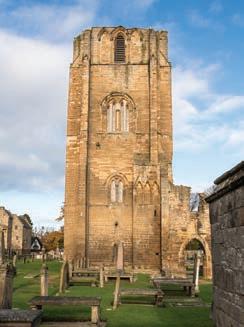
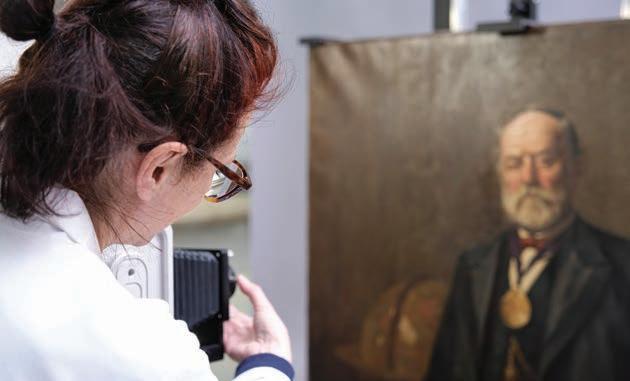
CONSERVATION CENTRE
Step into the world of conservation at the South Gyle Conservation Centre, where you are invited to gain an exclusive insight into the meticulous work of our conservation team. This unique guided tour provides a closer look at the extraordinary efforts that go into safeguarding Scotland’s treasured heritage. You’ll meet the
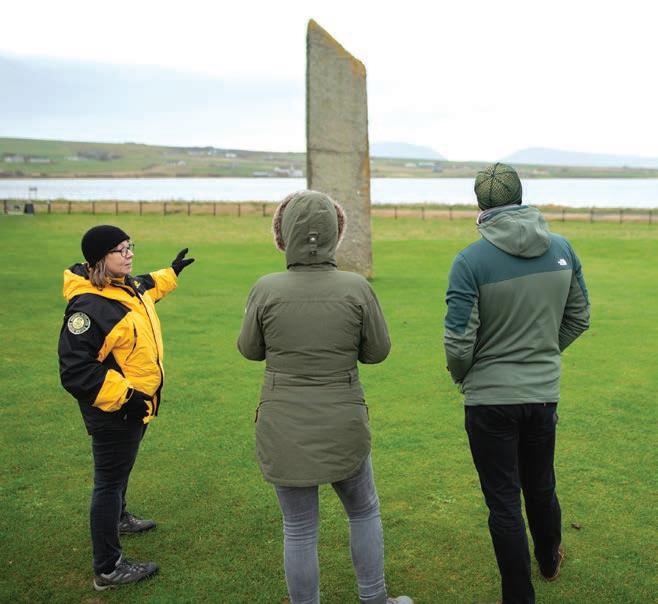
experienced professionals who specialise in restoring historic artefacts, ensuring that pieces of the past are preserved for future generations to enjoy. From intricate stonework repairs to the delicate restoration of paintings and the precise techniques used in metalwork, you’ll gain first-hand knowledge of the artistry and expertise involved in conservation. l Thur 16 Oct, 10.30am12pm, 2pm-3.30pm.
Join our Rangers in the great outdoors for walks and activities for all ages and abilities this autumn. Discover the geology of Arthur’s Seat and seven millennia of prehistory and history in Holyrood Park.
l Pre-booking for some activities is advised.
Explore the Orkney landscape and discover five millennia of history and prehistory with the Orkney Rangers Service. They’ll be your guide on their free walks this autumn at the Ring of Brodgar, the Stones of Stenness and Barnhouse Village.
l No booking required for Orkney Rangers Service walks.
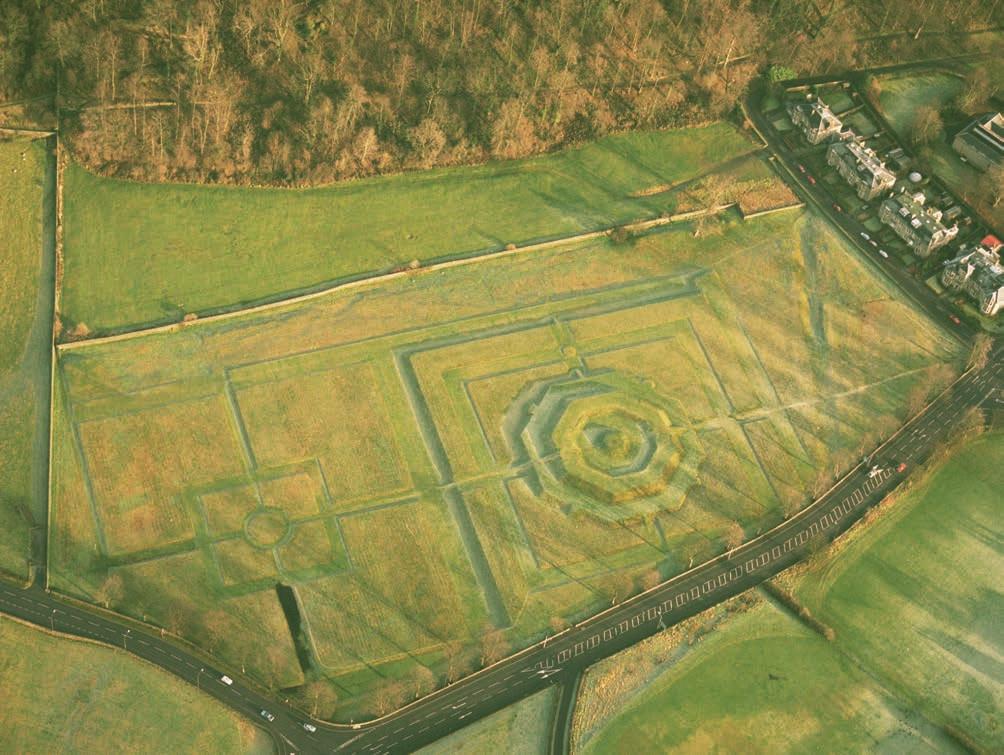
Co-curated by four community groups, Traces of Empire looks at how we can explore imperial histories, represent different voices and offer collective healing. Touching upon a breadth of themes including cotton, belonging, language and reclaiming past and future narratives, the exhibition looks to understand some of the legacies of empire still experienced today and explores how we might move forward together.
l GLASGOW CATHEDRAL Thu 16-Mon 27 Oct, during site opening hours.
l BLACKNESS CASTLE Fri 31 Oct-Mon 9 Mar 2026.
ABERDOUR CASTLE
For many of us, gardens and green spaces are an important part of our lives, providing us with places to relax, disconnect or grow food in, but they can also tell us something about the past. This exhibition, using material from our archives, explores
what we can learn about Scotland from our gardens, such as the grand design of the aristocracy, the role of empire in revolutionising plant diversity at home, and the blooming of city allotments.
l Fri 24 Oct-Sun 4 Jan 2026, during site opening hours.
STIRLING CASTLE
On the 100th anniversary of the National Library of Scotland Act, we explore the history of libraries
in Scotland and how they’ve developed from private book collections to vital spaces at the heart of our communities. Inspiring the Nation checks out the growth of libraries from the 17th century on, and the way that their continuing evolution in response to the changing needs of society has made them the varied public services they are today.
l Fri 7 Nov-Mon 2 Mar 2026, during site opening hours.

Discover the history and symbolism of this painting by English artist Stanley Spencer, the latest Work in Focus at Duff House, in coordination with National Galleries Scotland. ‘Christ Delivered to the People’ was painted in 1950, a year which saw Spencer seek reconciliation with his first wife, Hilda, and take out divorce proceedings against his second wife, Patricia Preece.
l Until Tues 25 Aug 2026, during site opening hours.
Find images of trams and much more at trove.scot
A tram at a stop in Inverleith, Edinburgh, in around 1900. Every available surface is put to good use for advertising.
An Edinburgh tram conductress, probably during the First World War
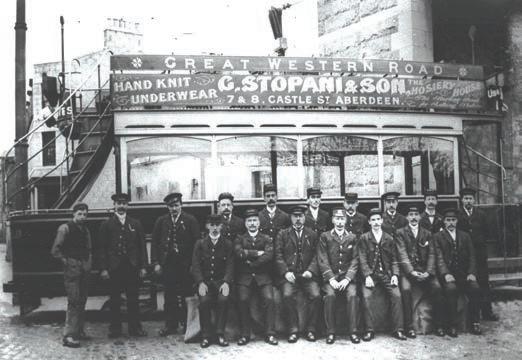
Hopping aboard an Edinburgh tram today is like catching an echo of history. Scotland’s trams were once an essential part of daily life in the capital as well as in Glasgow, Aberdeen and Dundee, where they ferried passengers and provided jobs. And Scottish engineering played its part in keeping them on track.
The first trams, introduced in the 1870s, were horse-drawn but as technology progressed they were soon powered by electricity. Leith resisted the change when the city
of Edinburgh made the switch but eventually ‘succumbed’ in 1905, much to the consternation of horse-drawn tram enthusiasts.
The tram networks carried goods, too. Glasgow’s tram system, for example, had a unique track gauge that meant railway wagons could be used to deliver materials such as steel to the shipyards. Those keen to market their products soon saw the potential provided by moving billboards, and trams sported adverts for everything from cigarettes and gin to undergarments.
During the First World War, with many men away fighting, women backfilled jobs on the trams. This was part of a wider societal shift that saw middle- and upper-class women accepted in working roles. However, they were not paid equal wages and had to leave the job if they married.
The original tram networks reached the end of the line in the late 1950s and early 1960s, but they endure in family stories and the legendary cry of the clippies (women conductors) to hesitant passengers: “Come on, get aff!”