End notes, 1
BEST PRACTICE VERSION
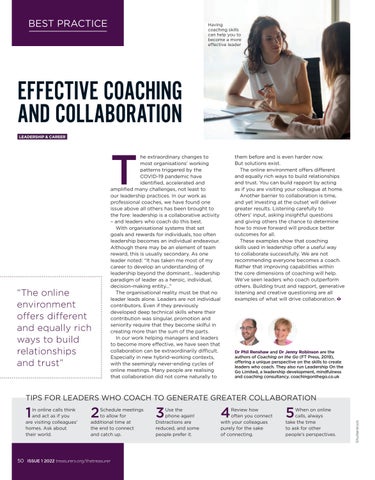
Having coaching skills can help you to become a more effective leader
REPRO OP SUBS
EFFECTIVE COACHING AND COLLABORATION LEADERSHIP & CAREER
ART
T
PRODUCTION CLIENT
“The online environment offers different and equally rich ways to build relationships and trust”
them before and is even harder now. But solutions exist. The online environment offers different and equally rich ways to build relationships and trust. You can build rapport by acting as if you are visiting your colleague at home. Another barrier to collaboration is time, and yet investing at the outset will deliver greater results. Listening carefully to others’ input, asking insightful questions and giving others the chance to determine how to move forward will produce better outcomes for all. These examples show that coaching skills used in leadership offer a useful way to collaborate successfully. We are not recommending everyone becomes a coach. Rather that improving capabilities within the core dimensions of coaching will help. We’ve seen leaders who coach outperform others. Building trust and rapport, generative listening and creative questioning are all examples of what will drive collaboration.
he extraordinary changes to most organisations’ working patterns triggered by the COVID-19 pandemic have identified, accelerated and amplified many challenges, not least to our leadership practices. In our work as professional coaches, we have found one issue above all others has been brought to the fore: leadership is a collaborative activity – and leaders who coach do this best. With organisational systems that set goals and rewards for individuals, too often leadership becomes an individual endeavour. Although there may be an element of team reward, this is usually secondary. As one leader noted: “It has taken me most of my career to develop an understanding of leadership beyond the dominant… leadership paradigm of leader as a heroic, individual, decision-making entity…” The organisational reality must be that no leader leads alone. Leaders are not individual contributors. Even if they previously developed deep technical skills where their contribution was singular, promotion and seniority require that they become skilful in creating more than the sum of the parts. In our work helping managers and leaders to become more effective, we have seen that collaboration can be extraordinarily difficult. Especially in new hybrid-working contexts, with the seemingly never-ending cycles of online meetings. Many people are realising that collaboration did not come naturally to
Dr Phil Renshaw and Dr Jenny Robinson are the authors of Coaching on the Go (FT Press, 2019), offering a unique perspective on the skills to create leaders who coach. They also run Leadership On the Go Limited, a leadership development, mindfulness and coaching consultancy. coachingonthego.co.uk
1
In online calls think and act as if you are visiting colleagues’ homes. Ask about their world.
2
Schedule meetings to allow for additional time at the end to connect and catch up.
3
Use the phone again! Distractions are reduced, and some people prefer it.
4
Review how often you connect with your colleagues purely for the sake of connecting.
5
When on online calls, always take the time to ask for other people’s perspectives.
Shutterstock
TIPS FOR LEADERS WHO COACH TO GENERATE GREATER COLLABORATION
50 ISSUE 1 2022 treasurers.org/thetreasurer
BLACK YELLOW MAGENTA CYAN
91ACTAUG22136.pgs 24.02.2022 10:23